

Inbound Prospecting: The Operational Playbook Most Teams Are Missing
A RevOps lead on r/sales described her inbound process last quarter: 15-30 sign-up leads per day, delivered to SDRs a full 24 hours after the prospect signed up. Most reps dropped them into a sequence and moved on. At $150-$650+ per inbound lead - factoring in content, ads, and tooling - that's not a pipeline. It's a bonfire.
The fix wasn't more content or a bigger ad budget. It was operations. Inbound prospecting lives or dies on the systems behind the content.
Three Fixes That Actually Move the Needle
This isn't a content strategy. It's an operational system. Here are the three highest-ROI changes you can make this quarter:
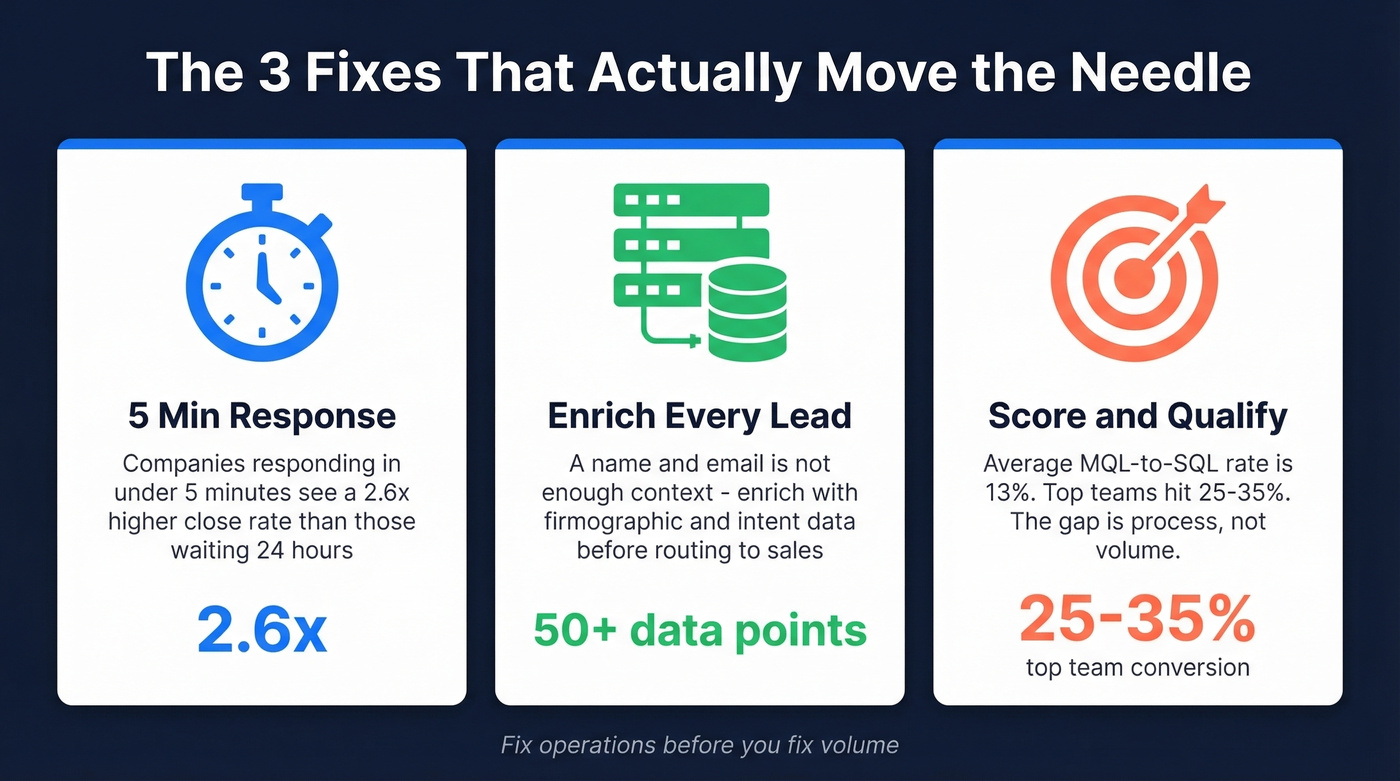
- Respond to inbound leads within 5 minutes. Companies that do this see a 2.6x higher close rate than those responding after 24 hours.
- Enrich every lead with firmographic and intent data before routing to sales. A name and email address isn't enough context for a rep to have a real conversation.
- Score and qualify leads so reps stop complaining about "bad leads." The average MQL-to-SQL conversion rate is 13%. Top teams hit 25-35%. The gap is usually process, not volume.
What Inbound Prospecting Actually Means
Most teams conflate inbound prospecting with inbound marketing. They're not the same thing, and the confusion costs pipeline.
Inbound marketing drives traffic and awareness - blog posts, SEO, webinars, social content. Its KPIs are pageviews, downloads, and email subscribers. The prospecting layer is what happens after that traffic converts: the system that scores, enriches, routes, and responds to leads with the goal of producing qualified sales opportunities.
Here's the thing. Inbound marketing celebrates "+25% resource center consumption." The prospecting motion celebrates "+11% inbound SQLs next quarter." One measures attention. The other measures revenue readiness. If your team only tracks the first metric, you don't have an operational pipeline - you have a content operation hoping for the best.
Why the Numbers Favor Inbound
Inbound and outbound aren't interchangeable. They solve different problems at different economics.
| Metric | Inbound | Outbound |
|---|---|---|
| Lead intent | High - buyer-initiated | Low - seller-initiated |
| Dial-to-meeting | N/A | 2.3-2.5% |
| Email reply rate | N/A | 5-10% |
| Visitor-to-demo request (at 25K+ monthly visitors) | <1% | N/A |
| MQL-to-SQL conversion | 13% avg, 25-35% top | N/A |
The outbound numbers aren't bad - they're just expensive. A 2.3-2.5% dial-to-meeting rate means roughly 1 meeting per 40-45 dials. Outbound email reply rates sit at 5-10% for solid teams, with 20-30% of those replies converting to booked meetings.
Inbound's advantage isn't volume - it's intent. A study of 100 B2B software websites found that even at scale, with 25,000+ monthly visitors, the visitor-to-demo-request rate drops below 1%. But the leads that do convert arrive with buying intent baked in. One B2B SaaS founder shared that after grinding outbound for a year, inbound leads were closing much faster and the motion was more scalable.
Let's make the funnel math concrete: 25,000 monthly visitors produce roughly 50 demo bookings, which yield 10 closed deals at a 20% close rate and $15,000 average deal size - that's $150,000 in new ARR per month. That math only works if the operational layer is tight. Which brings us to the most underrated lever in all of B2B sales.
Speed-to-Lead: The Lever Nobody Prioritizes
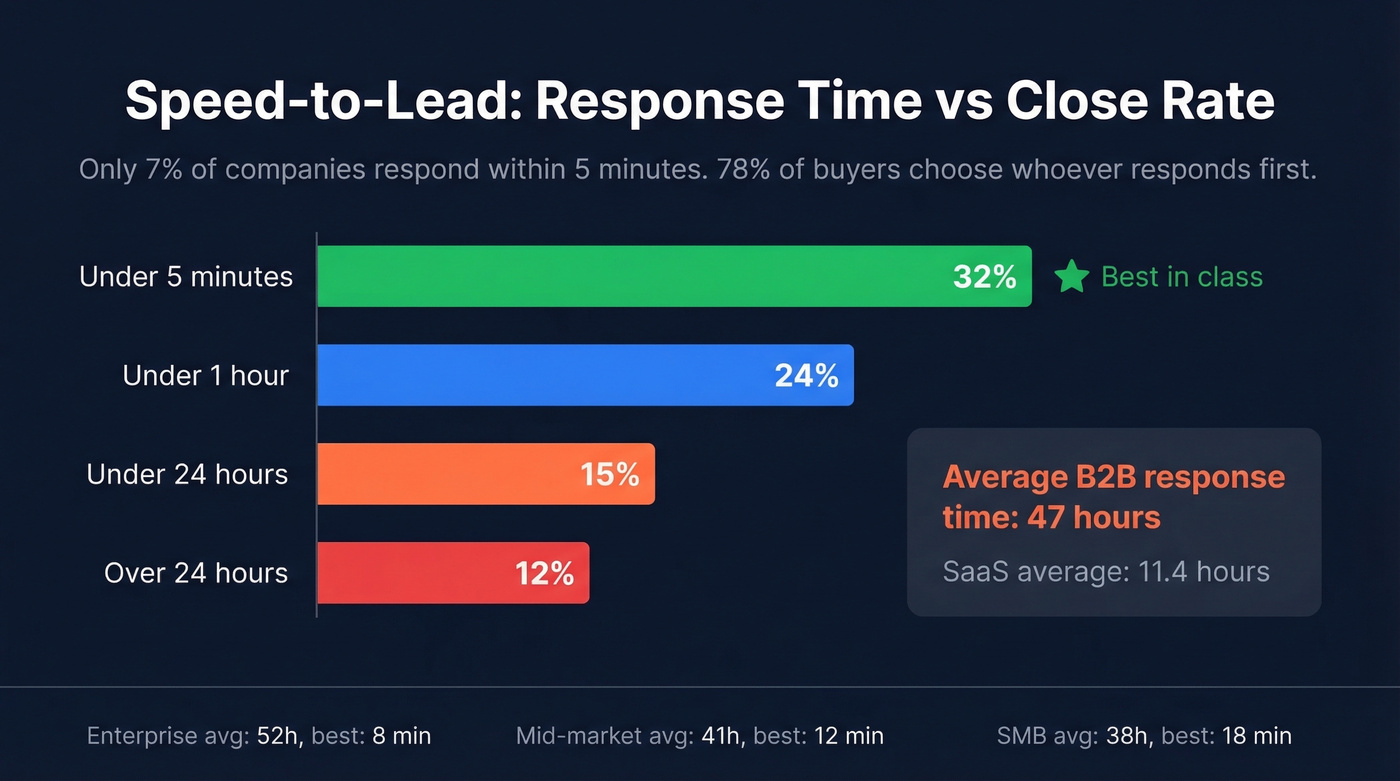
The average B2B company takes 47 hours to respond to an inbound lead. Forty-seven hours. That's an invitation for your competitor to close the deal first.
| Response Time | Close Rate |
|---|---|
| <5 minutes | 32% |
| <1 hour | 24% |
| <24 hours | 15% |
| >24 hours | 12% |
Responding in under 5 minutes produces a 32% close rate - nearly 3x the rate of responding after a day. And 78% of customers buy from the company that responds first. Only 7% of companies hit the 5-minute window.
Benchmarks by company size tell the same story:
| Company Size | Avg Response | Best-in-Class |
|---|---|---|
| Enterprise | 52h | 8 min |
| Mid-market | 41h | 12 min |
| SMB | 38h | 18 min |
If your response time is measured in hours, you're losing deals to competitors who've automated this step entirely. SaaS companies average 11.4 hours, which is better than most industries but still terrible.
We've seen teams spend $50K on a new ABM platform before they'll spend $500/month on a routing tool that cuts response time from 12 hours to 3 minutes. Get your response time under 5 minutes before you optimize anything else. Everything else is rearranging deck chairs.
Inbound vs. Outbound: When to Use Each
Most teams need both motions. The question is which one gets primary resourcing.
Go inbound-primary when your average deal sizes are in the four-figure range, you're selling at high volume, your ICP spans multiple industries and company sizes, and you have even a small content/SEO team.
Go outbound-primary when you're selling six-figure contracts, your ICP is narrow and well-defined, and you need to control timing and targeting precisely. Outbound also gives you more control over finding potential customers in specific verticals where inbound traffic is thin.
Run both when you're past $5M ARR and need diversified pipeline sources. Inbound feeds volume, outbound targets strategic accounts.
Pick a primary motion and resource it properly. The worst outcome is splitting budget 50/50 and doing both poorly.

You're spending $150-$650 per inbound lead on content and ads. Don't waste them with missing context. Prospeo enriches every lead with 50+ data points - title, seniority, revenue, headcount, and intent signals - at a 92% match rate so your scoring model fires on real data and reps walk into calls ready to close.
Stop routing bare leads. Enrich them for $0.01 each.
The Inbound Prospecting Playbook
Six steps, in order. Skip one and the whole system leaks.
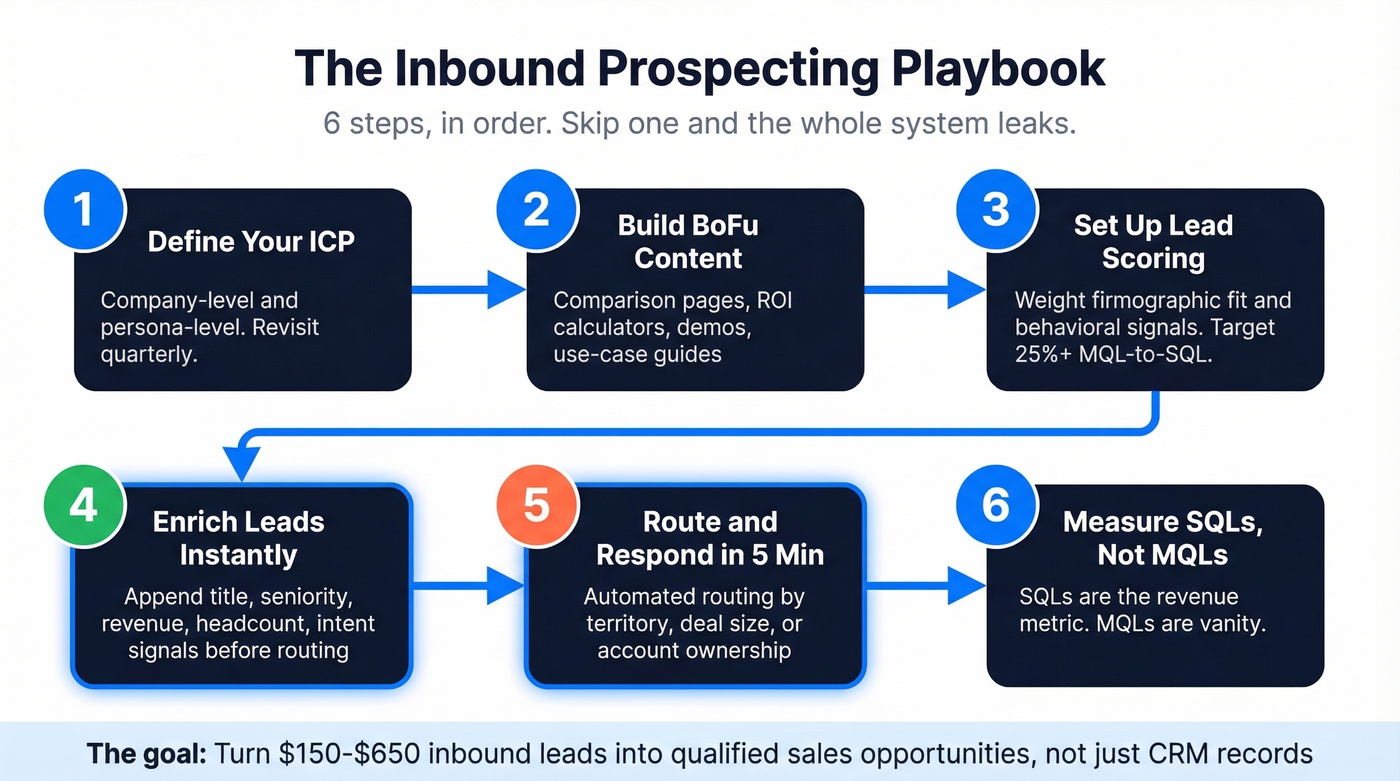
Step 1: Define Your ICP
Everything downstream - content, scoring, routing - depends on knowing exactly who you're trying to attract. Define ICP at the company level and buyer personas at the individual level. Revisit it quarterly. If it's older than six months, it's already wrong.
Step 2: Build Bottom-of-Funnel Content
Content is the magnet, not the machine. Prioritize assets that signal buying intent: comparison pages, ROI calculators, product demos, and use-case guides. A blog post about industry trends generates traffic. A page comparing your product to alternatives generates pipeline. The goal is finding prospects who are already evaluating solutions - not just browsing.
Step 3: Set Up Lead Scoring
Build a scoring model that weights firmographic fit and behavioral signals. Route hot leads to reps instantly and nurture the rest automatically. Target a 25%+ MQL-to-SQL conversion rate - anything below 13% means your scoring needs work. We've included a copyable model further down.
Step 4: Enrich Leads Immediately
Inbound leads arrive with a name and an email. Maybe a company name if you're lucky. That's not enough context for a rep to have an intelligent conversation, and it's not enough to score accurately.
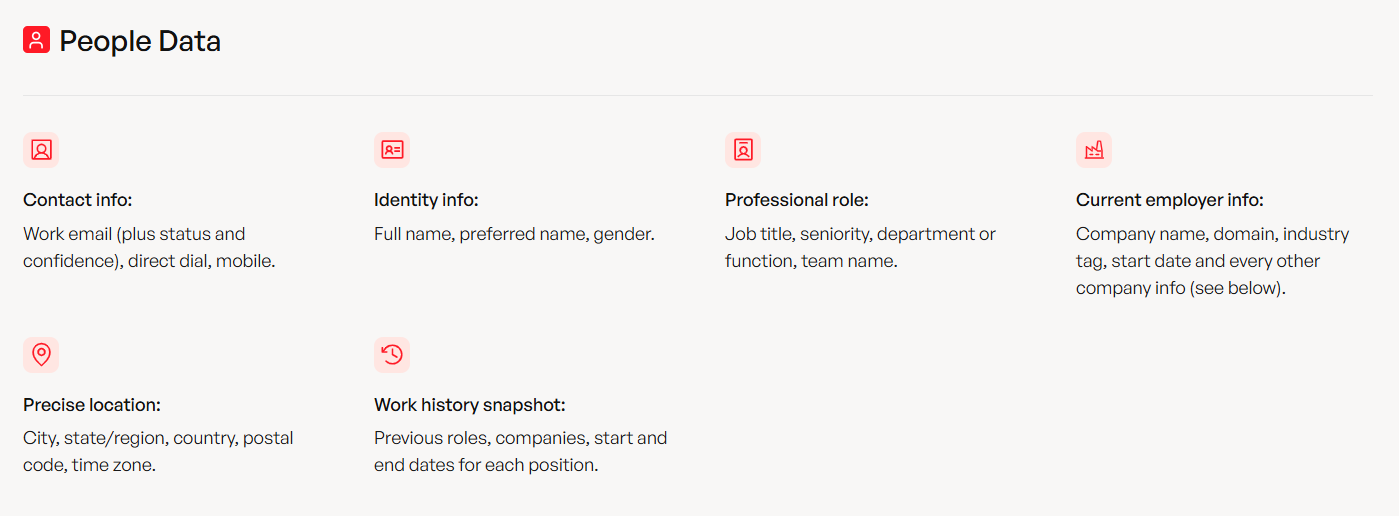
Use an enrichment tool to append firmographics, title, seniority, company revenue, headcount, and intent signals before routing. Your scoring model fires on real data, not guesses, and reps walk into calls with full context. In our experience, the difference between an enriched lead and a bare one is the difference between a 3-minute qualifying call and a 15-minute fishing expedition.
With Prospeo, you can enrich leads with 50+ data points per contact, run real-time email and mobile verification, and layer intent data across 15,000 topics. The platform covers 300M+ professional profiles with a 7-day data refresh cycle - compared to the 6-week industry average.
Step 5: Route and Respond in 5 Minutes
Enriched, scored leads need to hit the right rep's queue immediately. Set up automated routing based on territory, deal size, or account ownership. Use tools like Chili Piper or even a Zapier workflow to eliminate manual handoffs. The 5-minute window isn't aspirational - it's the difference between a 32% and a 12% close rate.
Step 6: Measure SQLs, Not MQLs
MQLs are a marketing vanity metric. SQLs are a revenue metric. If you need 20 SQLs per month and your MQL-to-SQL rate is 25%, you need 80 MQLs. If your rate is 13%, you need 154. The math makes the problem obvious - and it's almost always a conversion problem, not a volume problem.
A Lead Scoring Model You Can Copy
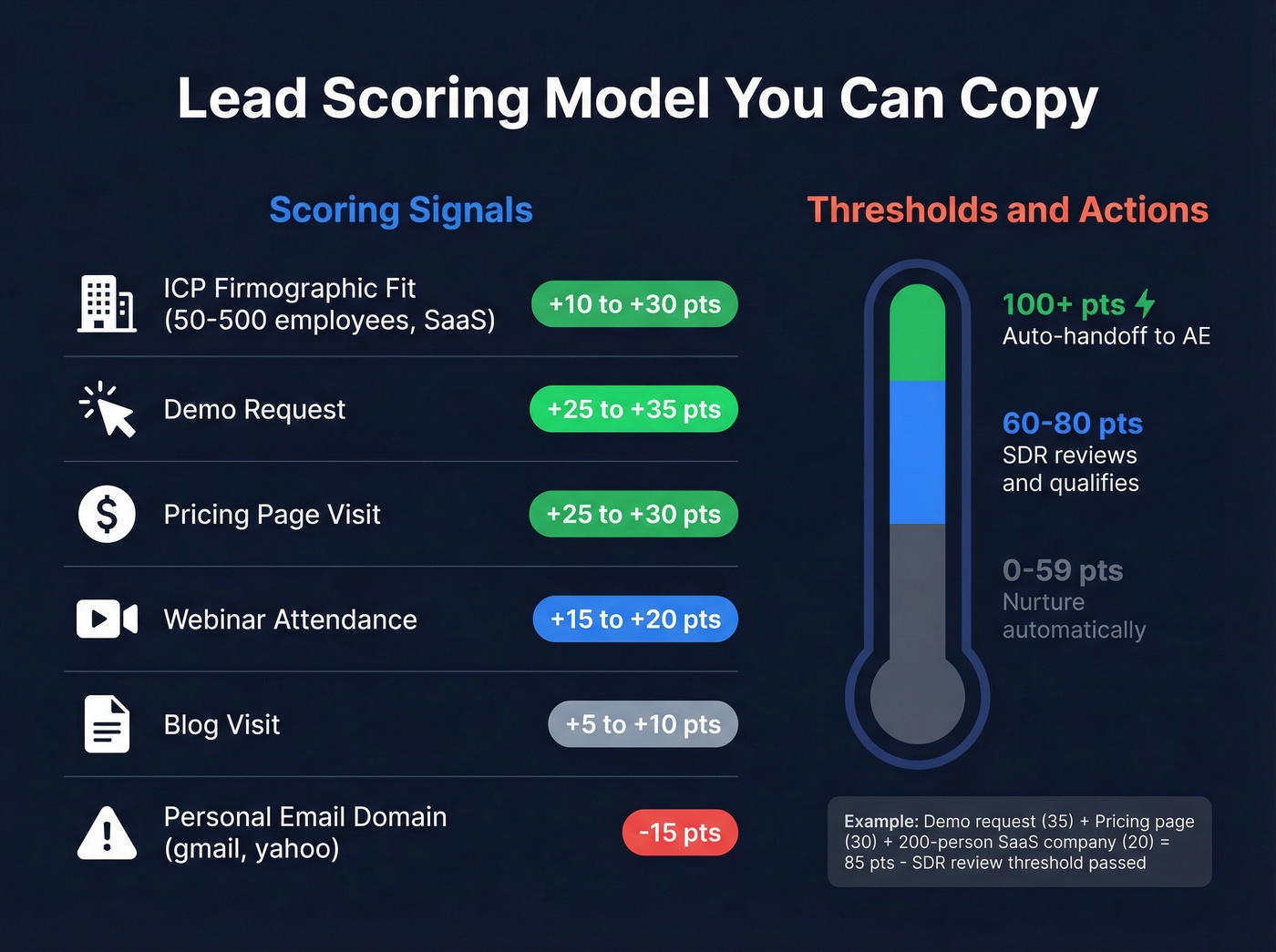
Adjust the point values to your business, but this structure works across most B2B motions.
| Signal Type | Example | Points |
|---|---|---|
| ICP firmographic fit | Company 50-500 employees, SaaS | 10-30 |
| High-intent behavior | Demo request | 25-35 |
| High-intent behavior | Pricing page visit | 25-30 |
| Medium-intent behavior | Webinar attendance | 15-20 |
| Low-intent behavior | Blog visit | 5-10 |
| Negative signal | Personal email domain | -15 |
| Threshold | Action |
|---|---|
| 60-80 | SDR reviews and qualifies |
| 100+ | Auto-handoff to AE |
Worked example: a prospect requests a demo (35 points), visits the pricing page (30 points), and works at a 200-person SaaS company (20 points for ICP fit). That's 85 - past the SDR review threshold and approaching auto-handoff territory. One more high-intent action and they're in an AE's calendar automatically.
Weight by recency and frequency. A pricing page visit yesterday is worth more than one three weeks ago. Adobe reported a 30% improvement in sales acceptance rates after implementing progressive scoring with shared lead definitions.
MQL-to-SQL Handoff
The average MQL-to-SQL conversion rate is 13%. Top-performing teams hit 25-35%. That gap isn't about lead quality - it's about handoff process.
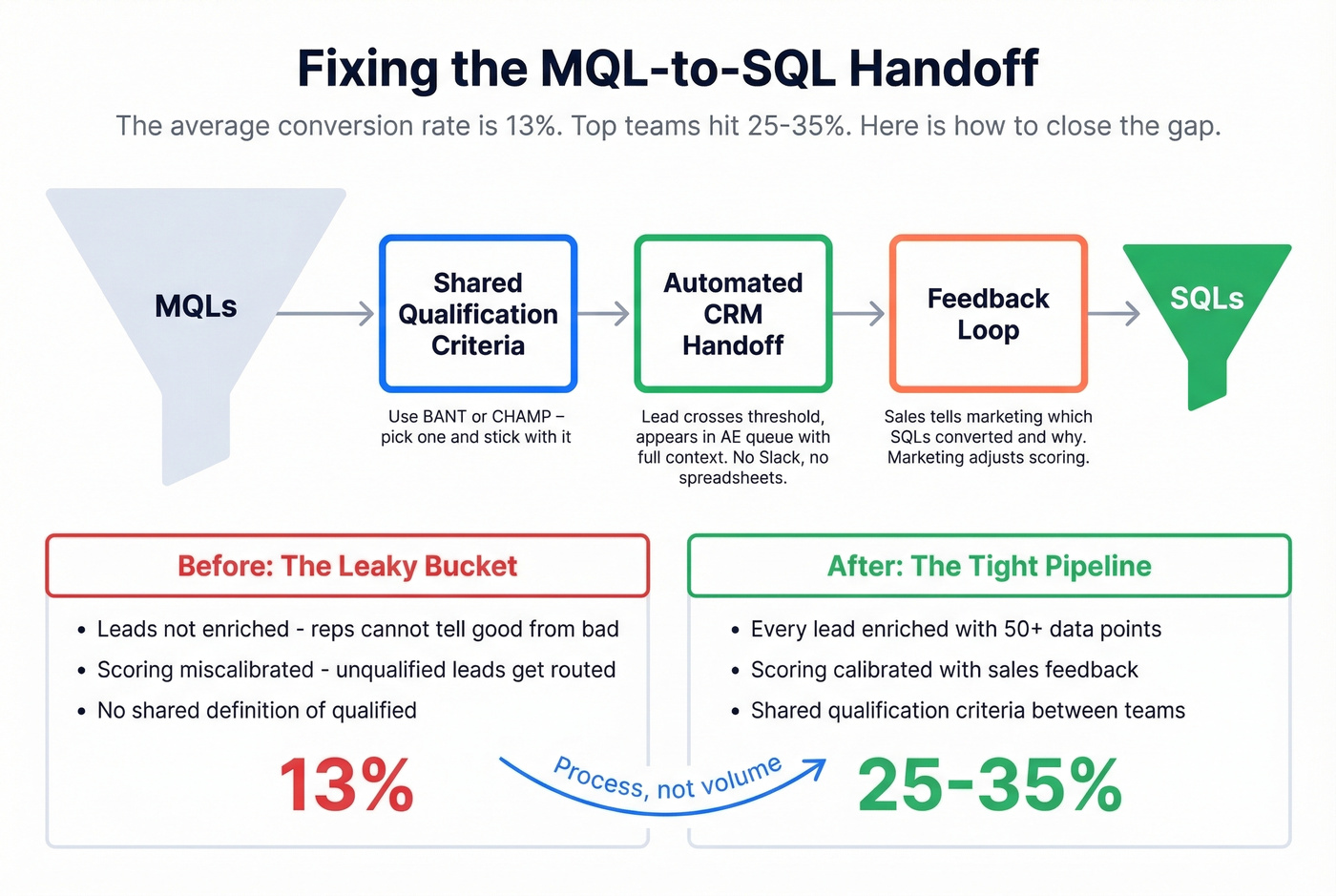
When sales complains about "bad leads," the instinct is to generate more volume. That's almost always the wrong move. The real problem is usually one of three things: leads aren't enriched so reps can't tell good from bad, scoring is miscalibrated so unqualified leads get routed, or there's no shared definition of what "qualified" means. We've watched teams double their MQL volume only to see SQL numbers stay flat - because they were pouring water into a leaky bucket.
Fix the handoff:
- Agree on qualification criteria. Use BANT or CHAMP - pick one and stick with it.
- Automate CRM handoffs. When a lead crosses the SQL threshold, it should appear in the AE's queue with full context. No Slack messages, no spreadsheets.
- Build a feedback loop. Sales tells marketing which SQLs converted and why. Marketing adjusts scoring. This loop is where the 13% becomes 25%.
Tools Worth Paying For
You don't need 12 tools. You need the right ones in each category.
Lead Enrichment: Prospeo - 300M+ profiles, 98% email accuracy, intent data across 15,000 topics. Free tier available, paid plans run ~$0.01 per email. Compare that to ZoomInfo at $15-40K/year or Clearbit at ~$1,000+/month.
CRM: HubSpot offers a free tier that handles most early-stage inbound workflows. Salesforce runs ~$25-300/user/month depending on edition.
Lead Routing: Chili Piper runs ~$30+/user/month for scheduling and routing. Worth every penny if speed-to-lead is your bottleneck.
Sequencing: Outreach or SalesLoft run ~$75-$150/user/month for follow-up sequences. Skip these if your volume is under 50 leads/month - manual follow-up works fine at that scale.
Intent Data: Bombora runs ~$25-50K/year for enterprise teams needing standalone intent signals.
SEO: Ahrefs runs ~$99+/month for keyword research and content planning that feeds the top of your inbound funnel.
Five Mistakes That Kill Pipeline
Responding after 24+ hours. The average is 47 hours. Best-in-class is under 5 minutes. Every hour you wait, close rates drop.
"Sequence and pray" without research. Dropping a lead into a generic 8-touch sequence without checking their title or intent signals is lazy, and prospects can tell. We've seen reply rates double when reps spend 90 seconds reviewing enrichment data before hitting send.
Measuring traffic instead of SQLs. Track conversion rates by source, response times, and average deal size - not just pageviews.
Not enriching leads before routing. There's no excuse for routing bare leads to your sales team in 2026. Enrich every contact before it hits a rep's queue.
Complaining about "bad leads" instead of fixing qualification. Nine times out of ten, that's a process problem. Tighten scoring, enrich before routing, and align on what "qualified" means.
The gap between 13% and 35% MQL-to-SQL conversion isn't volume - it's data quality. Prospeo layers firmographics, technographics, and Bombora intent data across 15,000 topics onto every inbound lead, refreshed every 7 days. Your lead scoring finally works because it's built on accurate, current signals - not stale guesses.
Turn your inbound scoring model from guesswork into a pipeline machine.
FAQ
What's the difference between inbound prospecting and inbound marketing?
Inbound marketing drives traffic through content and SEO. Inbound prospecting converts that traffic into qualified sales opportunities by scoring, enriching, and routing leads. The KPI shift is from pageviews to SQLs - one measures attention, the other measures revenue readiness.
What's a good speed-to-lead benchmark?
Under 5 minutes is best-in-class and produces a 32% close rate - nearly 3x the rate of responding after 24 hours. Under 18 minutes is strong for SMBs. If you're above one hour, you're leaving revenue on the table.
What's a good MQL-to-SQL conversion rate?
The average is 13%. Top teams hit 25-35% by tightening lead scoring, enriching contacts before routing, and aligning sales and marketing on shared qualification criteria. Fix scoring before increasing volume.
What's the minimum tool stack for inbound sales prospecting?
A CRM (HubSpot free tier works), an enrichment tool like Prospeo (free tier: 75 emails/month), and a routing workflow via Zapier or Chili Piper. Three tools, under $100/month total, and enough infrastructure to capture, enrich, and route leads in under 5 minutes.
How does inbound prospecting help find potential customers?
It attracts buyers who are already researching solutions, meaning you engage people at the moment of highest purchase intent. Instead of cold-calling a list, you're responding to hand-raisers - and that intent advantage is why inbound leads close faster and at higher rates than outbound.