

How to Increase Sales Revenue: A Framework-Driven Guide for 2026
It's Q2 planning season. The board wants 30% growth. Marketing says pipeline is up. But your CFO just flagged that revenue per rep is flat - and three of your best closers missed quota last quarter.
If you're trying to increase sales revenue, you're not alone, but most teams are pulling the wrong levers. 84% of sales reps missed quota in recent years, yet 59.9% of sales teams say they're on track to hit revenue targets. Someone's math doesn't add up. The gap between "on track" and "actually closing" is where most revenue growth plans go to die.
You don't need more leads. You need a different operating model.
The Short Version
Most teams try to grow revenue by adding pipeline. The data says otherwise - fix your win rate, raise your prices, and expand existing accounts. These three levers alone can add 15-25% to revenue without a single new lead. The rest of this guide uses the sales velocity framework as a diagnostic tool that tells you which lever to pull first, then walks through seven strategies mapped to that framework.
Why 4 Out of 5 Growth Plans Miss
Only about 20% of mid-to-large SaaS and tech companies actually hit their accelerated growth plans. The other 80% don't fail because they picked the wrong strategy. They fail because they confuse activity with progress.
Here's what that looks like in practice:
Activity theater. Pipeline volume becomes the KPI. Reps stuff the funnel with unqualified deals so dashboards look green. Leadership celebrates "record pipeline" while win rates crater.
Unrealistic targets. The board sets a 40% growth target. Headcount stays flat. Ramp time to full productivity averages 3.2 months. Nobody does the math on whether the existing team can physically close that much.
Post-sale neglect. 100% of leadership attention goes to new logos. Customer success has no revenue target. Churn quietly eats the growth that new deals create.
Linear forecasting. Leaders project revenue as if deals close on a predictable timeline, ignoring the 6-10 stakeholders now involved in the average B2B buying decision.
You don't need a longer to-do list. You need a diagnostic.
The Sales Velocity Framework
Sales velocity is the single formula that ties every revenue lever together:
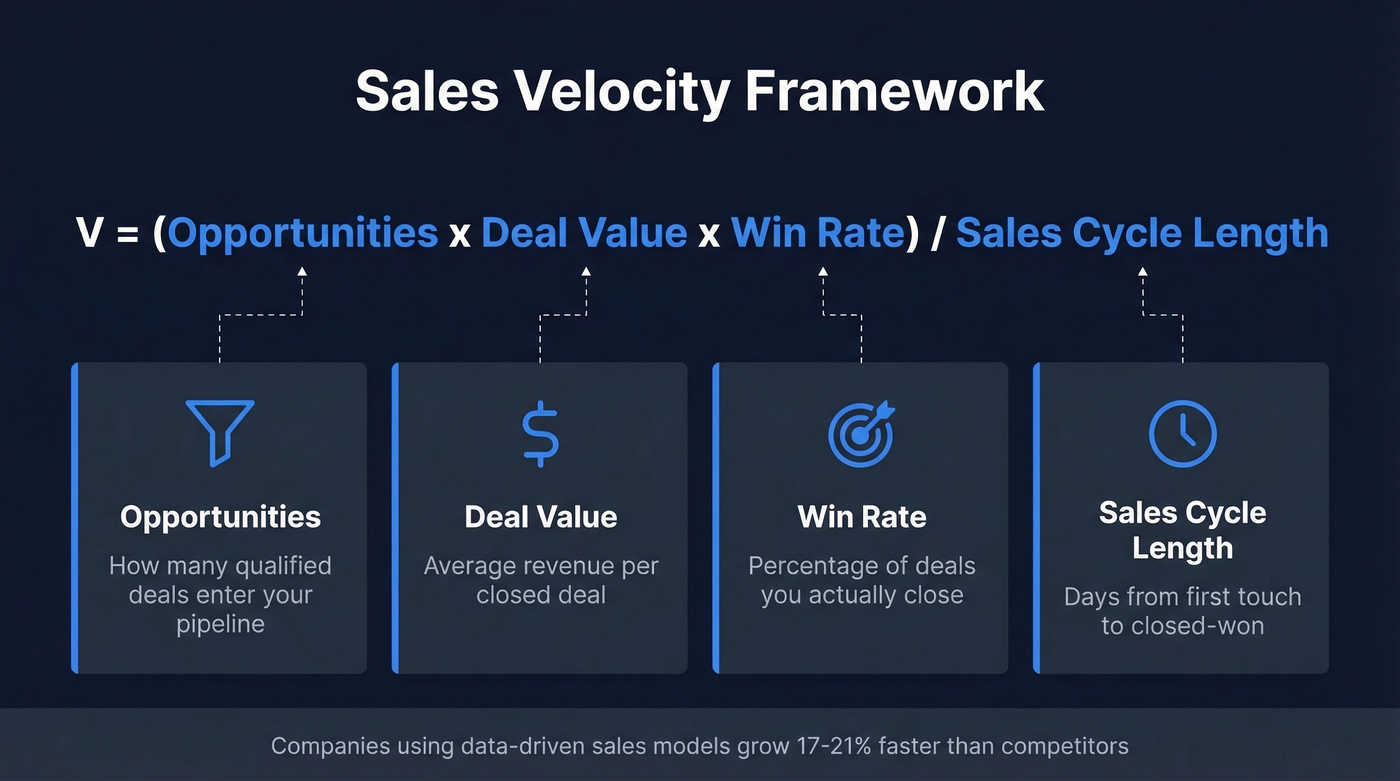
V = (Opportunities x Deal Value x Win Rate) / Sales Cycle Length
Four variables. Every strategy for growing revenue maps to one or more of them. The power of this framework isn't the math - it's the diagnostic clarity. Instead of asking "how do we grow?" you ask "which variable is the bottleneck?"
Companies with modern, data-driven sales models grow 17-21% faster than competitors relying on traditional approaches. The difference isn't magic. It's knowing which lever to pull and when.
The real value comes from running velocity at the rep level. Try "what-if" scenarios with your managers: what happens if Rep A improves win rate from 18% to 25%? What if Rep B increases average deal size by $5K? This turns a formula into a coaching conversation - and coaching conversations are where revenue actually gets made.
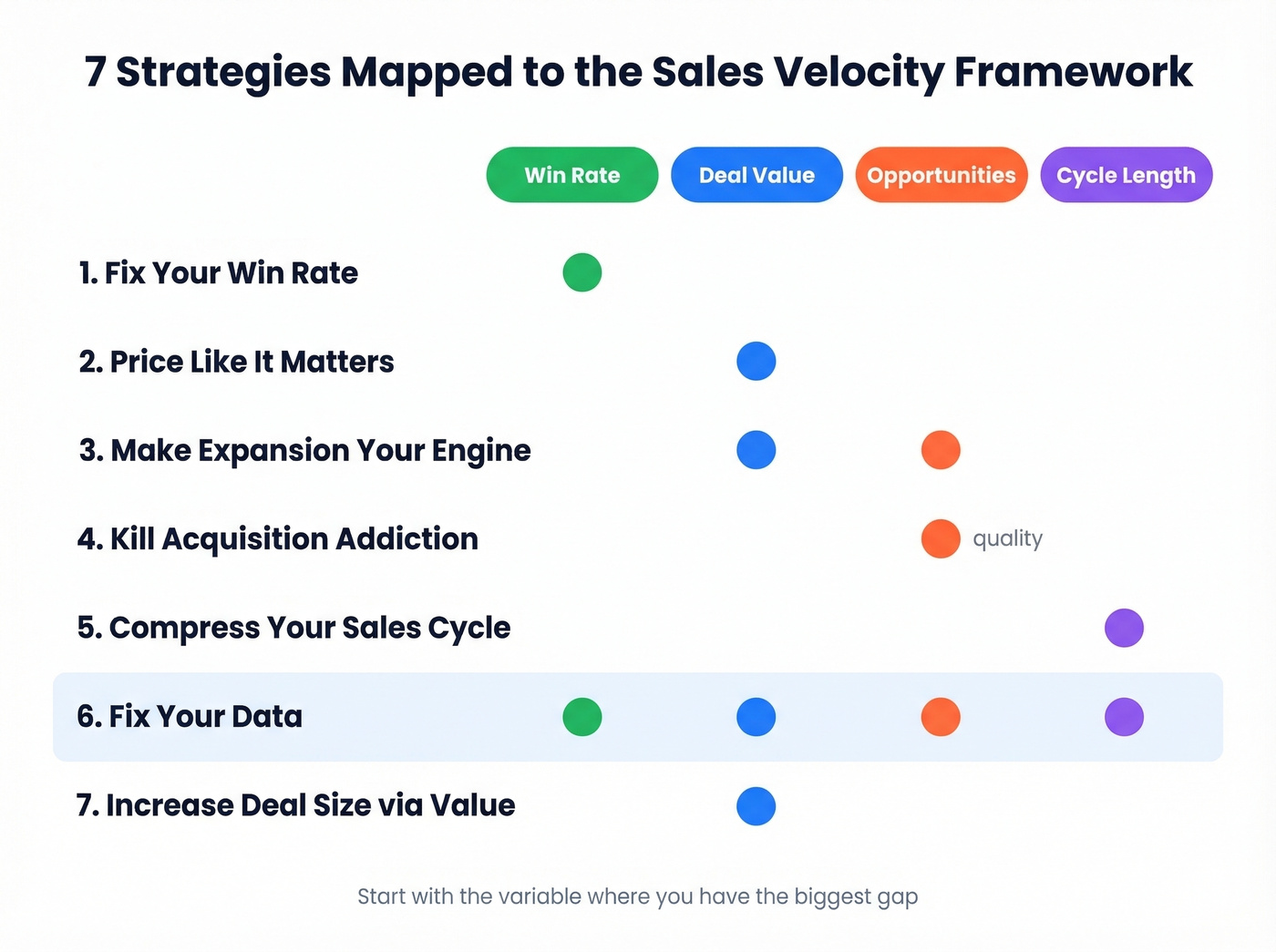
Here's how the seven strategies map to the framework:
| Strategy | Velocity Variable(s) |
|---|---|
| Fix your win rate | Win Rate |
| Price like it matters | Deal Value |
| Make expansion your engine | Deal Value + Opportunities |
| Kill acquisition addiction | Opportunities (quality) |
| Compress your sales cycle | Cycle Length |
| Fix your data | All four |
| Increase deal size via value | Deal Value |

Your win rate is only as good as your data. If reps waste hours chasing bounced emails and wrong numbers, no framework will save your revenue targets. Prospeo delivers 98% verified emails and 125M+ mobile numbers with a 30% pickup rate - so every opportunity in your pipeline connects to a real buyer.
Fix the data variable first. Every other lever depends on it.
Seven Strategies to Boost Revenue
1. Fix Your Win Rate Before Adding Pipeline
Pipeline volume is the most overrated metric in sales. We've seen it over and over: teams celebrate "record pipeline" while revenue stays flat because win rates sit at 21% on average.
The best case study on this comes from SaaStr founder Jason Lemkin. His VP of Sales doubled net new revenue in 90 days - and nothing else changed: no new prospects, same product, same pricing, same target customer. What changed was revenue per lead. The VP immediately hired three proven closers who converted leads at up to 3x the rate of existing reps, re-routed leads away from underperformers, promoted a high-talent junior rep, and killed "pipeline" as a KPI entirely. The focus shifted to closing.
The lesson is brutally simple. Before you spend another dollar on lead gen, audit your win rate by rep, by segment, and by lead source. If you're below the 21% average, that's your bottleneck - and fixing it is faster and cheaper than generating more pipeline.
2. Price Like It Matters
Pricing is the most neglected revenue lever in B2B. A 1% increase in price results in an average 11.1% increase in operating profit. No other lever comes close.
McKinsey found that digital pricing transformations drive 2-7 margin points in 3-6 months. A KPMG survey of 425 companies showed pricing-mature organizations carry 3-8 percentage points higher EBITDA margins than peers. Blue Ridge Partners documented that simply fixing mispriced deals generates 1-2% revenue increase within a single quarter - money that goes straight to the bottom line.
What to do this quarter: audit discount authority, implement price floors on your most common deal sizes, and test a 10-15% increase on new customers. Most teams are shocked at how little pushback they get. The top deal-killers in B2B are no product fit (37%) and poor value for money (35%) - not "too expensive." If your product fits, you can charge more.
3. Make Expansion Your Growth Engine
Expansion ARR now represents 40% of total new ARR across B2B SaaS, up five percentage points year-over-year. For companies above $50M ARR, expansion accounts for more than half of all new revenue. This isn't a trend. It's a permanent shift in how growth works.
Yet most companies treat expansion as an afterthought. Median NRR sits at 101%, which is close to flat. Gross retention is trending from 90% down to 88%. If your CS team doesn't have a revenue target, you're leaving your biggest growth lever unmanaged.
Let's be honest: the tactical playbook here isn't complicated. Structured QBRs with expansion-specific agendas. Usage-based triggers that flag accounts ready for upsell. A dedicated expansion AE or at least a clear handoff process from CS to sales. And don't forget lost customers - win-back campaigns convert at 2-3x the rate of cold outreach, and most teams never run them. The companies growing fastest in 2026 aren't the ones with the biggest top-of-funnel. They're the ones extracting more value from customers who already trust them.
4. Kill the Acquisition Addiction
Customer acquisition cost has increased 220% in the last eight years. In 2024, Meta ad prices rose 14% year-over-year. Google Ads CPC climbed in 86% of industries. Brands now lose $29 per new customer acquired on average, up from $9 in 2013.
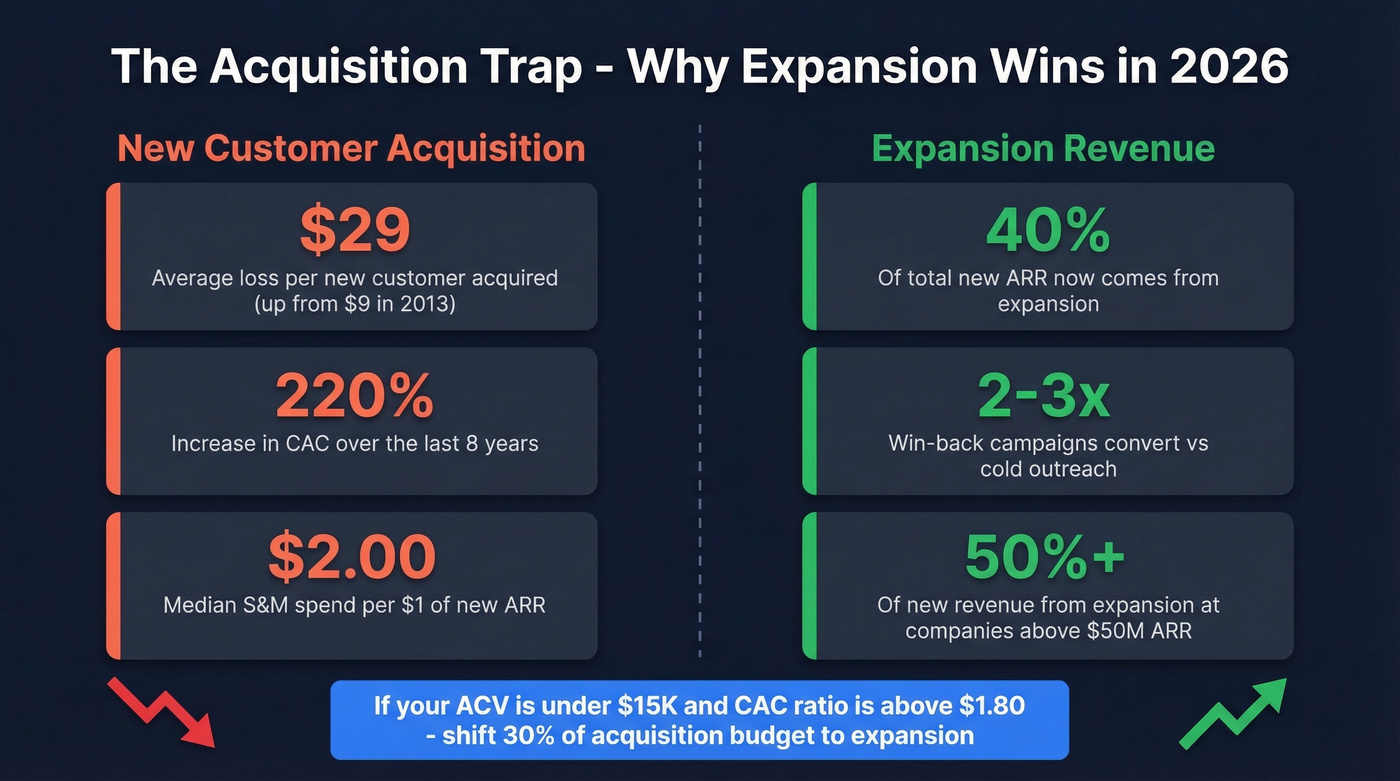
The median new CAC ratio in B2B SaaS is $2.00 in S&M spend per $1.00 of new customer ARR. Fourth-quartile companies spend $2.82 per dollar. That's not a growth strategy - it's a cash incinerator.
None of this means you should stop acquiring customers. But pricing and expansion deserve a bigger share of your leadership attention and budget than they're currently getting. The economics have shifted, and the teams that recognize this are reallocating accordingly.
If your average contract value is under $15K and your CAC ratio is above $1.80, you probably can't afford to grow through new logos alone. Shift 30% of your acquisition budget to expansion and retention. The math will thank you within two quarters.
5. Compress Your Sales Cycle
Responding to a lead within five minutes increases the likelihood of engagement by 9x. More than 99% of companies don't respond within five minutes. That gap alone represents weeks of unnecessary cycle time.
With 6-10 stakeholders now involved in the average B2B buying decision, deals stall for structural reasons, not just sales reasons. Three moves that compress cycles without cutting corners:
- Set a speed-to-lead SLA - five minutes for inbound, same business day for outbound.
- Multi-thread early by engaging three or more stakeholders in the first two weeks.
- Build mutual action plans that create shared accountability for timeline.
AI-assisted tools are accelerating this in 2026. Teams using AI for forecasting, email personalization, and call coaching see 10-20% productivity gains - time that goes directly back into selling. And kill stalled deals faster. A deal stuck for 60 days at the same stage isn't a deal; it's a distraction.
6. Fix Your Data Before Fixing Your Process
Reps spend only 30% of their time actually selling. A huge chunk of the other 70% gets burned on bad data - wrong emails, disconnected numbers, outdated titles. The consensus across sales communities on Reddit is consistent: fixing data quality delivers faster ROI than adding headcount.
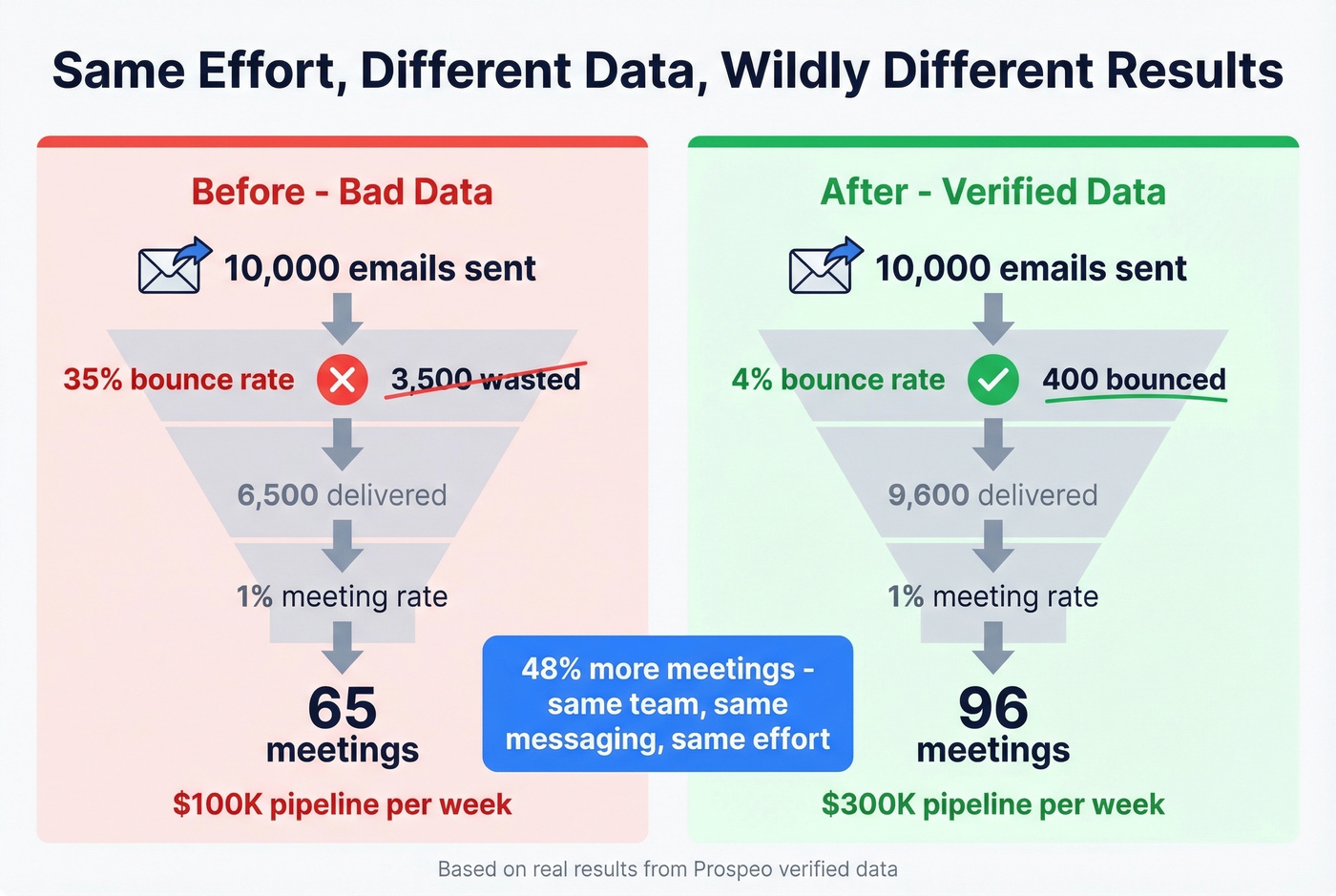
Here's the thing. An SDR sends 10,000 emails this month. If 35% bounce - a number we've seen more often than you'd think - that's 3,500 wasted touches. At a 1% meeting rate on the remaining 6,500, you get 65 meetings. Now run the same math with a 4% bounce rate: 9,600 delivered, 96 meetings. That's 48% more pipeline from the same effort, and you haven't changed a single thing about your messaging, targeting, or team size.
This isn't hypothetical. Meritt, a sales agency, saw pipeline triple from $100K to $300K per week after switching to Prospeo's verified data. Their bounce rate dropped from 35% to under 4%. While you're auditing data quality, look at your entire sales tech stack for integration gaps - disconnected tools create the same kind of waste as bad contact records.

7. Increase Deal Size Through Value Selling
The top deal-killers in B2B aren't price objections - they're no product fit (37%) and poor value for money (35%). That "poor value" number is telling. Buyers aren't saying your product costs too much. They're saying you haven't proven it's worth what you're charging.
Ninety-three percent of sales teams say average deal sizes are holding steady or growing - but "holding steady" isn't growth. The teams pushing deal sizes up are doing it through value articulation, not feature stacking.
Use MEDDICC or a similar qualification methodology to identify larger opportunities early. Bundle adjacent products instead of selling point solutions. Build ROI models into every proposal so the buyer's CFO sees the math before the renewal conversation. Sell outcomes - "we'll reduce your bounce rate from 35% to 4% and add 48% more pipeline" - not feature lists.
Revenue Killers - What to Stop Doing
Knowing what to do matters less if you don't stop doing the things that actively hurt revenue. Three anti-patterns we see constantly:
Manipulation tactics that kill trust. Fake scarcity, exaggerated social proof, aggressive urgency - these push deals into "no decision" faster than anything else. The Head of Sales at LinkBuilder.io replaced urgency-based CTAs with data-backed proposals and tailored value maps. The result: win rate increased 20% over two quarters. Evidence beats pressure every time.
Pipeline theater. When pipeline volume is the primary KPI, reps stuff the funnel with deals that'll never close. Leadership sees green dashboards while actual revenue flatlines. Measure pipeline quality - weighted by win probability and deal stage velocity - not raw volume.
Ignoring churn while chasing new logos. If GRR is trending from 90% to 88% and you're spending $2.00 to acquire every $1.00 of new ARR, you're filling a leaking bucket with increasingly expensive water. Fix the bucket first.
2026 Benchmarks - What Good Looks Like
If you're below median on any variable, that's your velocity bottleneck. Copy this table into a spreadsheet and fill in your numbers.
| Metric | Median |
|---|---|
| Quota attainment | 43% |
| Win rate | 21% |
| Net revenue retention | 101% |
| Expansion % of new ARR | 40% |
| CAC ratio (S&M per $1 ARR) | $2.00 |
| Rep selling time | 30% |
| Rep ramp time | 3.2 months |
| % of teams "on track" | 59.9% |
If even 20% of your "opportunities" are built on bounced emails and wrong numbers, your real win rate is even lower than you think. Clean data is the prerequisite for trusting any of these benchmarks - and for every strategy that can increase sales revenue in a measurable way. If you want a tighter diagnostic, start with sales operations metrics and work backward to the root cause.
Expansion and upsell campaigns die when your CRM is full of stale contacts. Prospeo refreshes every record on a 7-day cycle - 6x faster than the industry average - and enriches contacts with 50+ data points including buyer intent signals across 15,000 topics. That means your reps reach the right stakeholder at the right moment.
Stop leaving revenue on the table because your data expired last month.
FAQ
What's the fastest way to increase sales revenue?
Fix your win rate and raise prices. A 1% price increase drives an average 11.1% profit increase, and re-routing leads to your best closers can double revenue per lead in 90 days - no new pipeline required.
How do you calculate sales velocity?
Sales velocity = (Opportunities x Deal Value x Win Rate) / Sales Cycle Length. Track it monthly per rep. The formula pinpoints which of the four variables is your biggest bottleneck so you stop guessing.
Why is my revenue flat even though pipeline is growing?
Growing pipeline with a low win rate or shrinking deal sizes creates the illusion of progress. Run the velocity formula - if win rate or average deal value is declining, more pipeline just masks the real problem.
How much does bad contact data cost a sales team?
If 35% of your emails bounce, you're wasting a third of your outreach and damaging domain reputation. Verified data drops bounce rates to under 4%, adding up to 48% more pipeline from the same effort.
What's a good net revenue retention rate?
Median NRR across B2B SaaS is 101%. Top performers exceed 120%, meaning their existing customer base grows 20% annually before a single new deal closes - making expansion the most capital-efficient growth lever available.