

Upsell vs Cross-Sell in SaaS: What Actually Works (2026)
Every guide on this topic gives you the same Zoom example and the same unsourced "14x more likely to sell to existing customers" stat. None of them tell you what to actually do on Monday morning.
Here's the short version: upselling moves customers up your pricing tiers (vertical growth); cross-selling moves them into adjacent products (horizontal growth). Which one to prioritize depends on whether you sell one product with multiple tiers or a product suite. Expansion now accounts for 40% of new ARR, so getting this right isn't optional. And here's the opinion most consultants won't give you: stop treating these as sales tactics. They're product decisions. If your packaging doesn't create natural upgrade paths, no amount of CSM outreach will fix it.
Expansion Revenue Is Half the Engine
Acquiring a new customer has gotten brutally expensive. The new-logo CAC ratio hit $2.00 by 2024, up from $1.76 the prior year. Meanwhile, the blended CAC ratio that includes expansion dropped to $1.40. The math is clear.
B2B SaaS companies now generate 40% of total new ARR from existing customers, up from a 25% median in 2022. That's a structural shift, not a trend. Yet most teams still treat upselling and cross-selling as interchangeable - lumping both motions into a single playbook when each requires distinct triggers, messaging, and ownership. Using the wrong motion on the wrong account wastes pipeline and erodes trust.
The Actual Difference
Think of it as vertical vs horizontal growth. Upselling moves a customer up - more of what they already use, at a higher tier. Cross-selling moves them across - into a product or module they haven't touched yet.
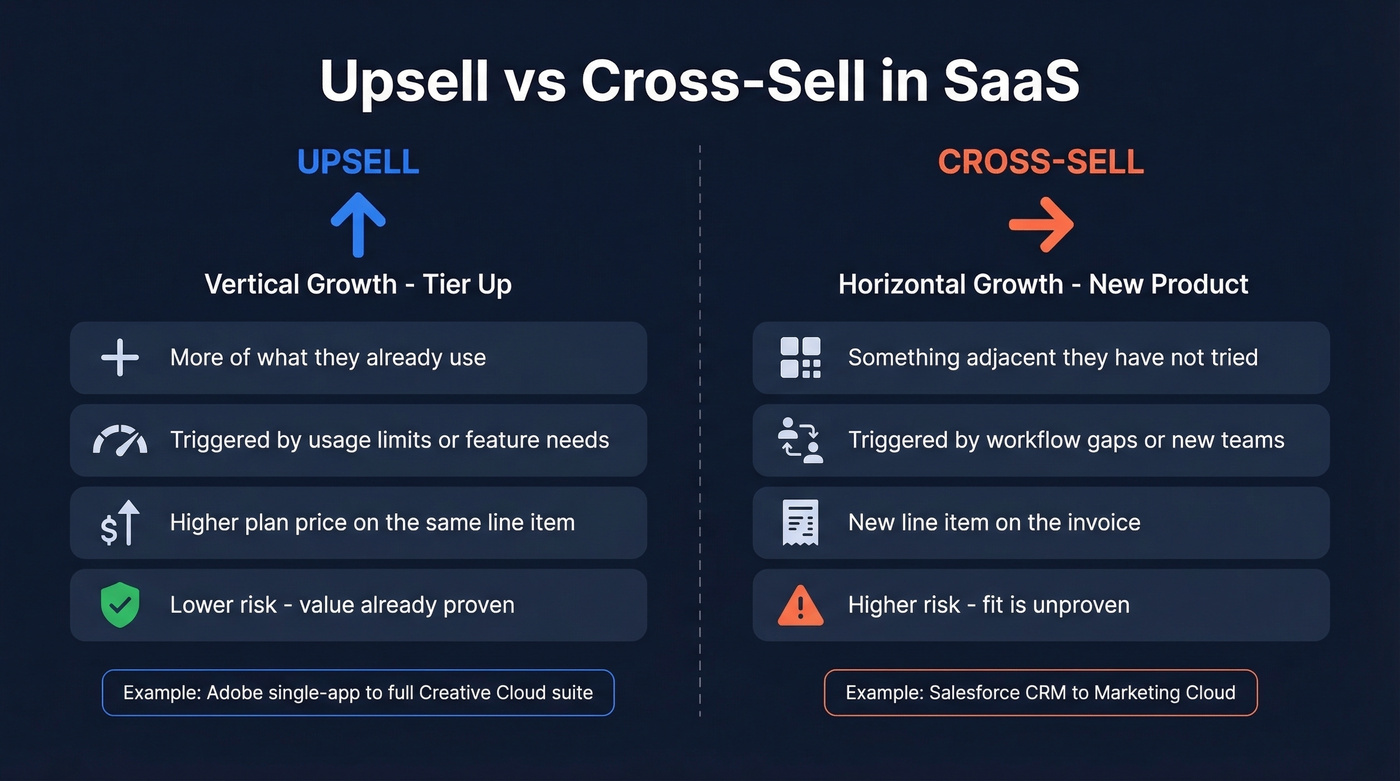
| Dimension | Upsell | Cross-Sell |
|---|---|---|
| What you're selling | More of the same | Something adjacent |
| Growth direction | Vertical - tier up | Horizontal - new product |
| Typical trigger | Usage limits, feature need | Workflow gap, new team |
| Billing impact | Higher plan price | New line item |
| Risk level | Lower - proven value | Higher - unproven fit |
Adobe Creative Cloud is the textbook upsell: a designer on a single-app plan hits the ceiling and upgrades to the full suite. Salesforce CRM to Marketing Cloud is the textbook cross-sell - a different product solving a different problem for a different team. Asana gates features like Portfolio behind higher tiers, which is upsell architecture. Atlassian sells Jira users into Confluence, which is cross-sell because it's a complementary product entirely.
When to Upsell vs Cross-Sell
One product with tiers? Upselling is your primary lever. Product suite? Cross-selling customers into adjacent modules is where the money is.
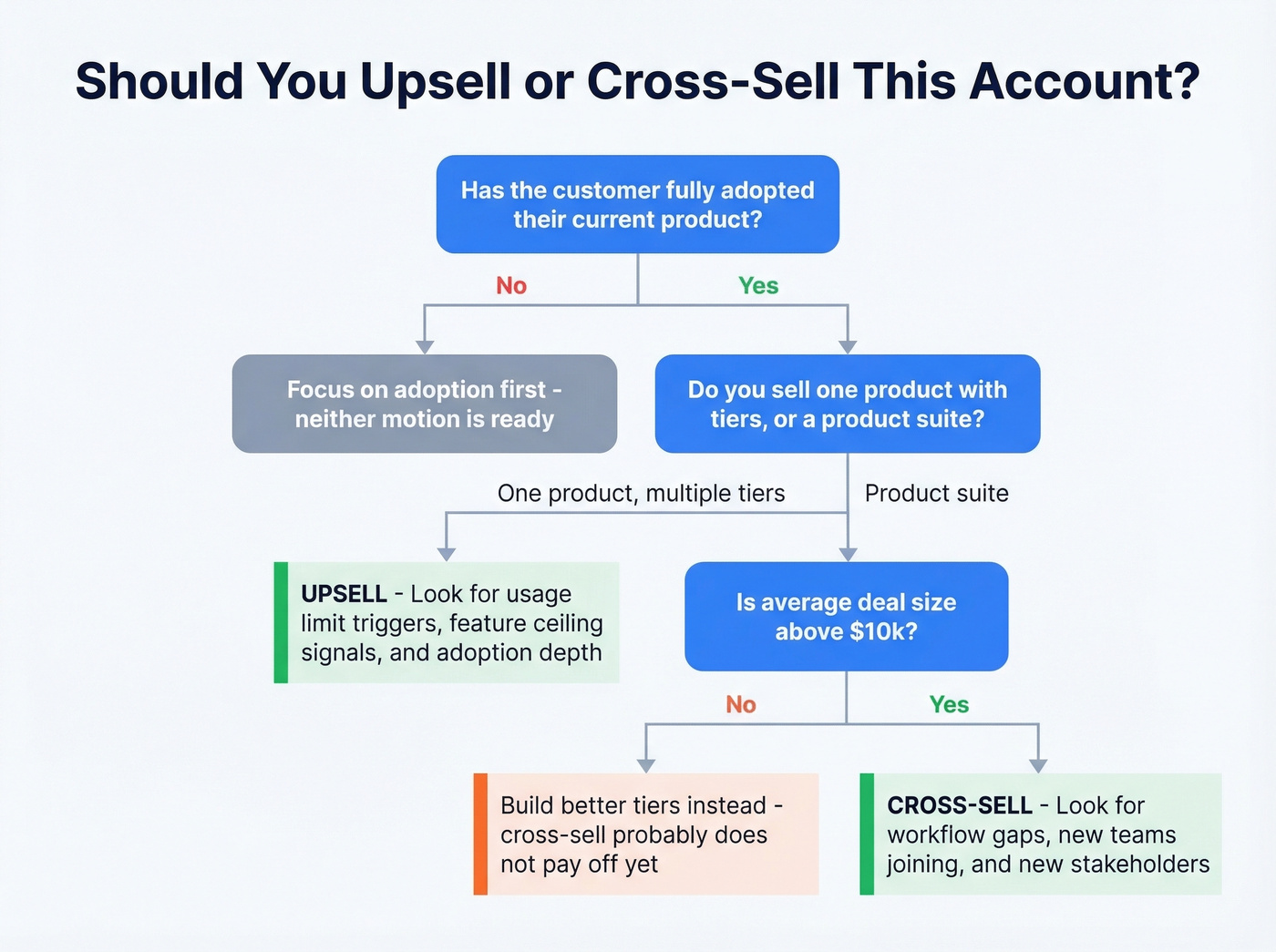
Product portfolio breadth is the structural constraint that shapes everything. The secondary factor that matters most is customer maturity. Accounts that haven't fully adopted their current product aren't ready for either motion. Usage depth signals upsell readiness; workflow gaps signal cross-sell readiness.
Let's be honest: if your average deal size is under $10k, you probably don't need a cross-sell motion at all. Build better tiers instead. Cross-selling only pays off when you have genuinely distinct products with separate value propositions - not feature bundles dressed up as a "platform."
The Expansion Playbook
Triggers That Convert
Don't guess when to expand. Usage-limit triggers convert because they're tied to a real constraint the customer is actively feeling. Feature adoption plateaus and onboarding completion milestones are strong secondary signals, while QBR and renewal windows create natural commercial conversations. New stakeholders joining an account signal team growth and budget potential - and that's one of the strongest cross-sell indicators we've seen.
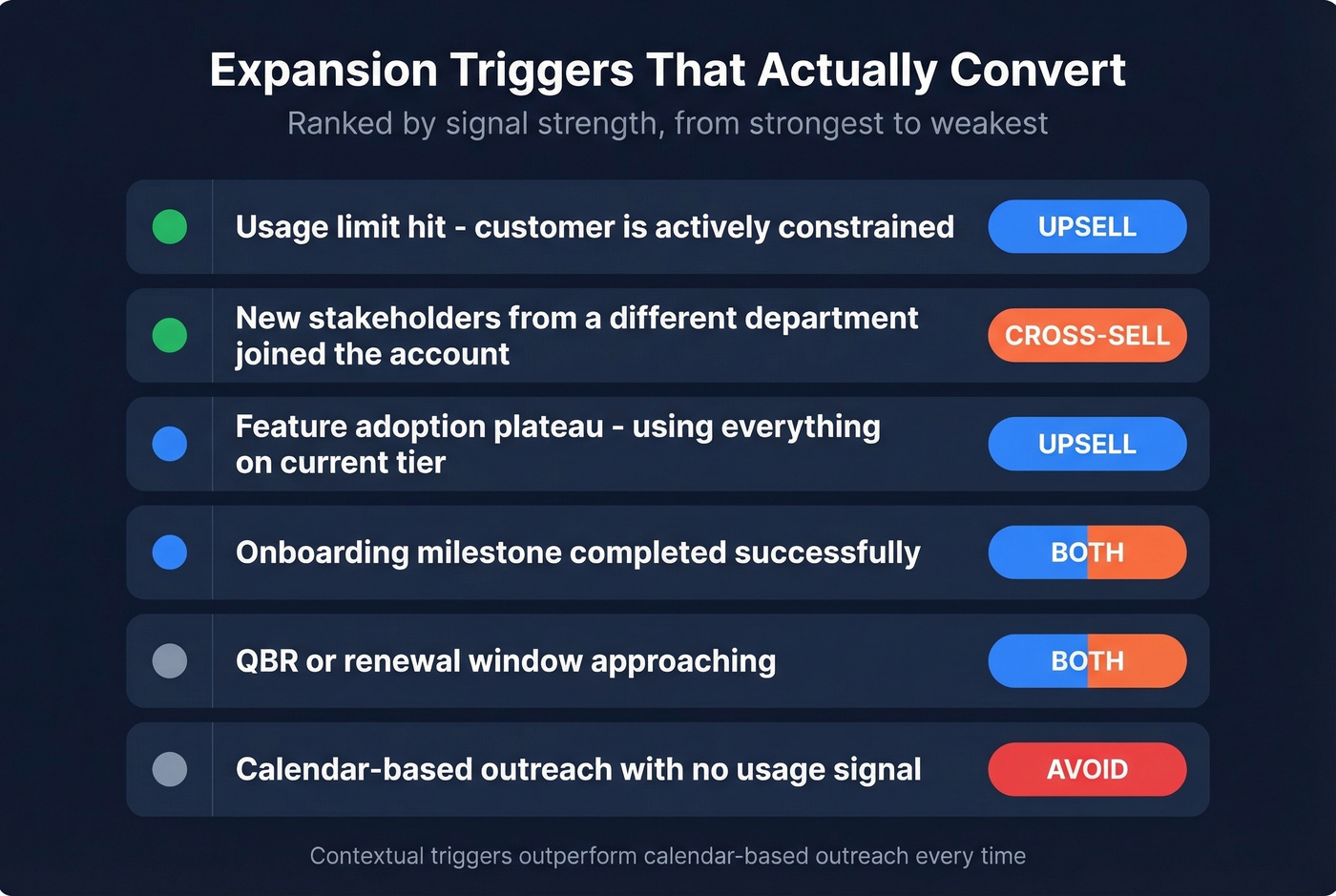
Spotify's skip-limit prompt is the textbook PLG upsell: hit the limit, see the upgrade framed as "unlimited discovery." Squarespace gates key integrations behind higher tiers - integration gating as an upsell lever. Both work because the trigger is contextual, not arbitrary.
Messaging That Lands
Lead with "why now" and value, not features. The Custify approach nails the template: "You've used X of your Y allocation this month - let's make sure your team isn't hitting walls." That works because it mirrors the customer's reality. Value framing beats feature listing every time.
Here's a scenario we run into constantly: a CSM notices an account has three new users in the last 30 days, all from a department that wasn't part of the original deal. That's not just a usage signal - it's a cross-sell signal. The new team has a different workflow, different pain points, and potentially different budget. The message to them shouldn't be "upgrade your plan." It should be "your marketing team is using this differently than your sales team - here's how other marketing teams get more out of it."
Who Owns the Conversation
The #1 operational failure in expansion isn't bad timing - it's unclear ownership. A Reddit thread in r/CustomerSuccess captured this perfectly: a company shifting upsells from CSMs to AEs with "few solid processes and little/no comms" between the teams. The consensus in that thread was damning - most respondents said the handoff destroyed both the customer relationship and the pipeline.
CSMs identify expansion signals. AEs close them. Define the handoff explicitly or both teams fumble.

New stakeholders joining an account is one of the strongest cross-sell signals - but only if you actually find them. Prospeo tracks job changes and surfaces verified emails for new decision-makers across 300M+ profiles, so your CSMs spot expansion opportunities the moment they appear.
Stop guessing who joined the account. Know in real time.
What Good NRR Looks Like
Median NRR for bootstrapped SaaS at $3M-$20M ARR sits at 104%, with the 90th percentile hitting 118% across 1,000+ companies. Below 100% means churn is outpacing expansion and needs immediate attention.
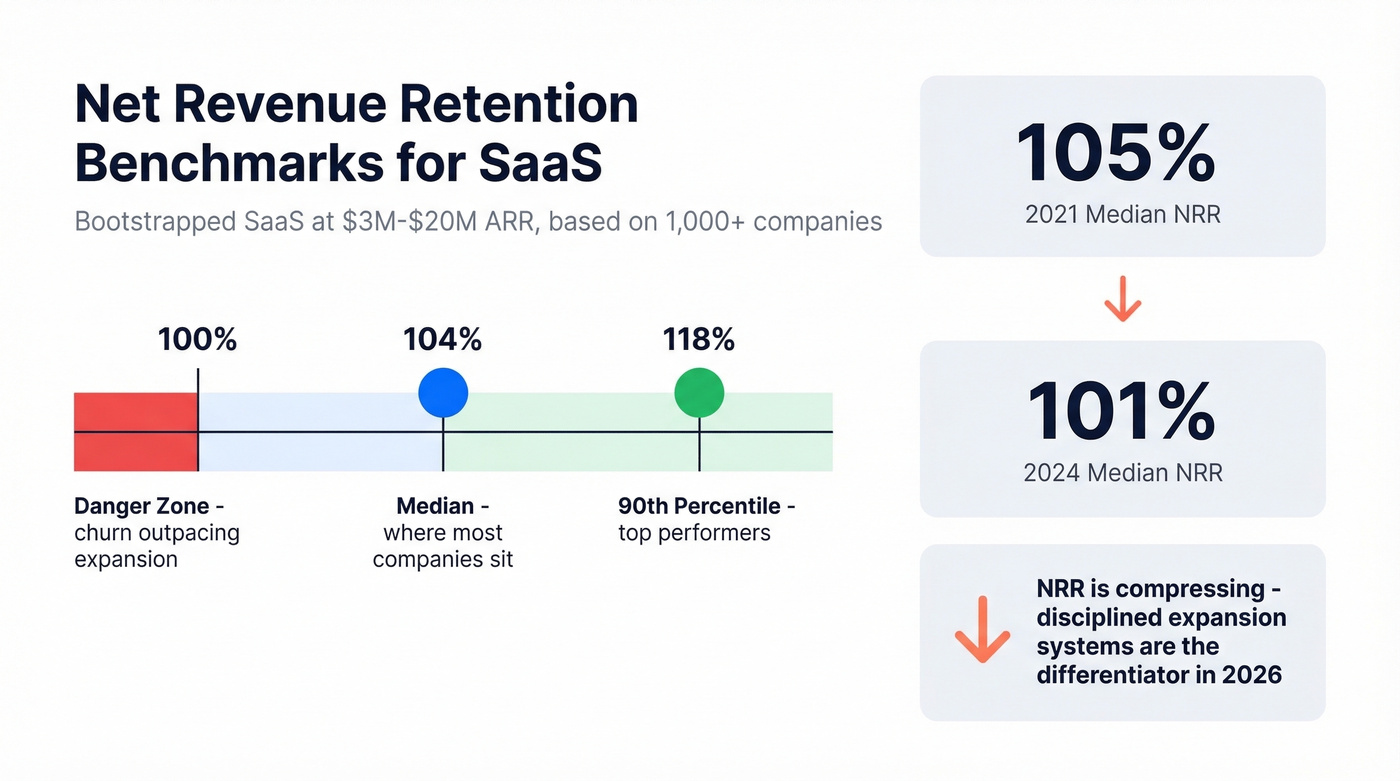
Beyond roughly $20M in ARR, expansion becomes the dominant growth engine. But here's the uncomfortable trend: by 2024, median NRR had declined to 101% from 105% in 2021, and the pressure hasn't eased heading into 2026. The teams that instrument triggers, nail handoffs, and maintain clean data will separate from the pack.
Mistakes That Kill Expansion
Pushing upgrades before value is proven. If the customer hasn't hit their "aha moment," an upsell pitch feels like a cash grab. Wait for adoption signals. I've watched teams blow six-figure expansion opportunities by pitching an upgrade during the onboarding phase - before the customer even understood what they'd already bought.
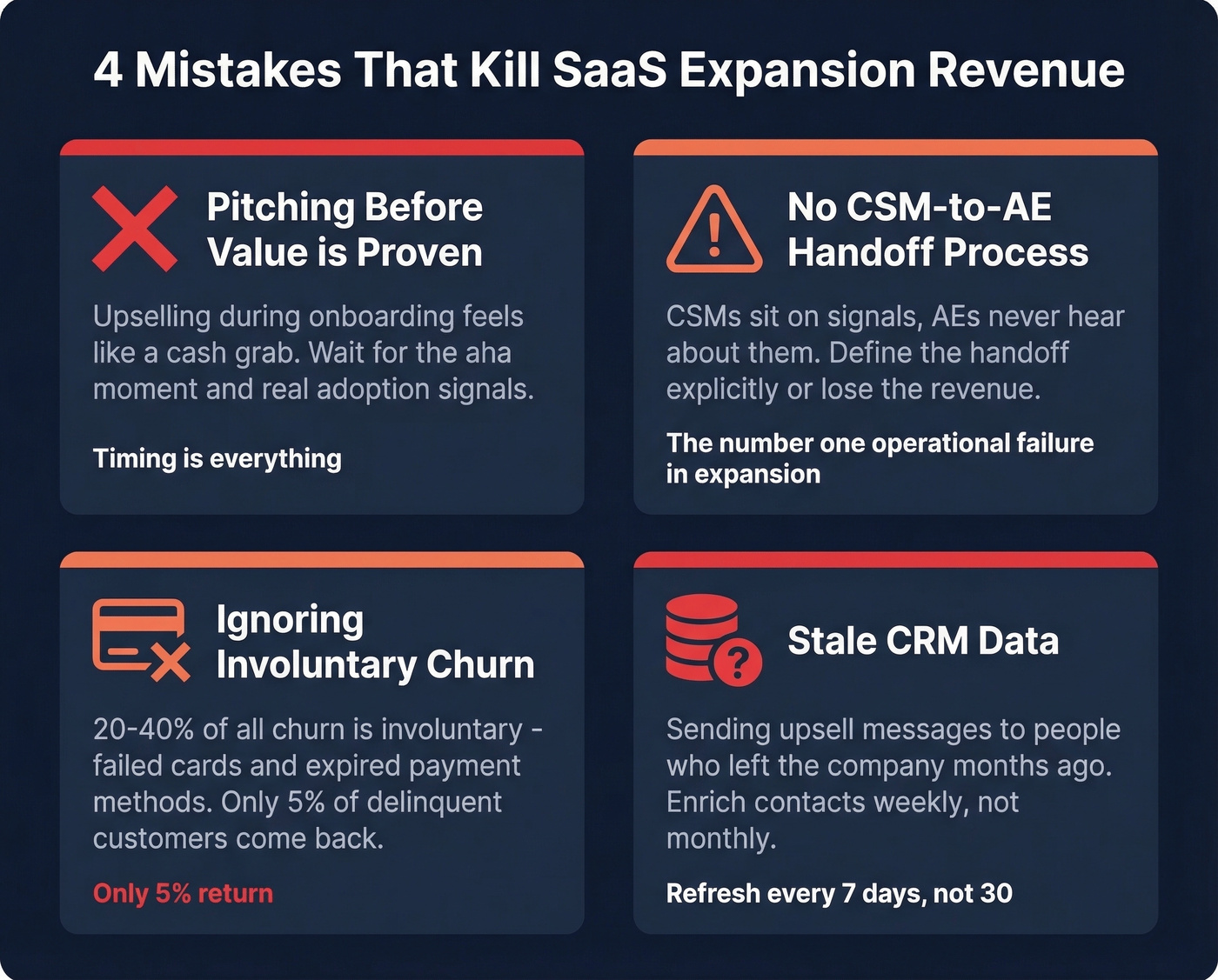
No CSM-to-AE handoff process. We've seen this pattern repeatedly: CSMs sit on expansion signals because they don't want to "ruin the relationship," and AEs never hear about the opportunity. Define the handoff or lose the revenue. (If you need a starting point, use a handoff email template and standardize it.)
Ignoring delinquent churn. 20-40% of overall churn is involuntary - failed credit cards, expired payment methods. Only about 5% of delinquent customers come back. In-app pre-dunning notifications help; email-based pre-dunning can actually backfire and cause more churn. You can't expand accounts you've accidentally lost. (If you're diagnosing this, start with a proper churn analysis.)
Stale CRM data torpedoing outreach. This is the expansion killer nobody talks about at conferences. Your playbook is only as good as your contact records. If your CRM is full of outdated emails, you're sending upsell messages to people who left the company months ago. Prospeo refreshes contact data every 7 days and verifies emails at 98% accuracy, so when your CSM flags an expansion-ready account, the AE actually reaches the right stakeholder instead of bouncing into the void. If you're evaluating vendors, compare data enrichment services and lead enrichment workflows before you buy.

Clean data separates the teams hitting 118% NRR from those bleeding churn. Prospeo enriches your CRM with 50+ data points per contact - department, seniority, tech stack - so you trigger the right expansion motion on the right account. 92% match rate. 7-day refresh cycle.
Enrich your accounts and never miss an upsell signal again.
Beyond SaaS
The upsell vs cross-sell framework isn't unique to software. In manufacturing, the same dynamics play out with longer sales cycles, custom quoting, and multi-stakeholder procurement - but the core logic holds: expand vertically before expanding horizontally. Financial services expansion relies on relationship depth and trust signals rather than product-led triggers, yet the sequencing principles are identical.
The difference is that SaaS companies have a data advantage: usage telemetry tells you exactly when an account is ready. Skip this section if you're purely SaaS - but for teams selling into traditional industries, know that the framework translates. You just won't have the same real-time signals, so you'll lean harder on QBR conversations and relationship mapping.
Building a Durable Expansion System
Tactics decay. A durable upselling strategy starts with packaging - your tiers need to create natural friction points that customers want to resolve. Then layer in automated triggers tied to real usage data, clear CSM-to-AE handoffs, and enriched contact records so outreach actually lands. Companies that treat expansion as a system rather than a quarterly push consistently outperform on NRR, and the gap between disciplined teams and everyone else is widening every quarter. If you want to operationalize this, build a lightweight process for how to track sales triggers and keep your pipeline health visible weekly.
FAQ
What's a good NRR target for SaaS?
Median NRR for bootstrapped SaaS at $3M-$20M ARR is 104%. Top-decile companies hit 118%. Below 100% means churn is outpacing expansion - fix your upsell and cross-sell motion before investing in anything else.
Should CSMs or AEs own upsells?
Split it. CSMs identify expansion signals because they have relationship context and see usage data daily. AEs close because they have commercial skills. Define the handoff explicitly - without a documented process, both teams fumble.
How do you prevent stale data from killing expansion campaigns?
Enrich your CRM on a weekly cycle. Tools like Prospeo return 50+ data points per contact with a 92% match rate, so outreach reaches the right person - not a dead inbox. Most providers refresh every 4-6 weeks, which is too slow for active expansion plays.
Does the approach differ from other industries?
The core principles are consistent - expand proven value before introducing new products. What makes SaaS unique is real-time usage telemetry: you can see exactly when a customer hits a tier ceiling or when a new team starts exploring your platform, giving you far more precise timing than industries relying on quarterly reviews alone.