

How to Find Industry Contacts That Actually Work
You export 1,000 contacts from your database. By the time your team works through the list, 113 are already dead - bounced emails, disconnected phones, people who changed jobs while you were building your sequence. B2B contact data decays at 2.1% per month, which means roughly a quarter of your database is stale by year-end. That's a pipeline problem, not a rounding error.
The fix isn't finding more industry contacts. It's finding the right ones, verifying them before they touch your CRM, and refreshing them before they rot.
What You Need (Quick Version)
- Use 2-3 contact sources, not one. A waterfall approach hits 85-95% find rates vs. 50-60% from one provider alone.
- Re-verify quarterly. Email addresses decay 23-30% per year. Phone numbers change 18% annually. Skip this and you're burning your domain reputation on every send.
Why Industry Contacts Decay So Fast
Contact data isn't static. People change jobs, companies rebrand, phone numbers get reassigned, and email servers get decommissioned.

B2B contact data decays at 2.1% per month - [roughly 22.5% annually](https://demandscience.com/resources/blog/b2b-data-deprecation-marketers-guide/). Email addresses are the worst offenders at 23-30% per year, followed by phone numbers at about 18%. The average data provider delivers roughly 50% accuracy. That's a coin flip.
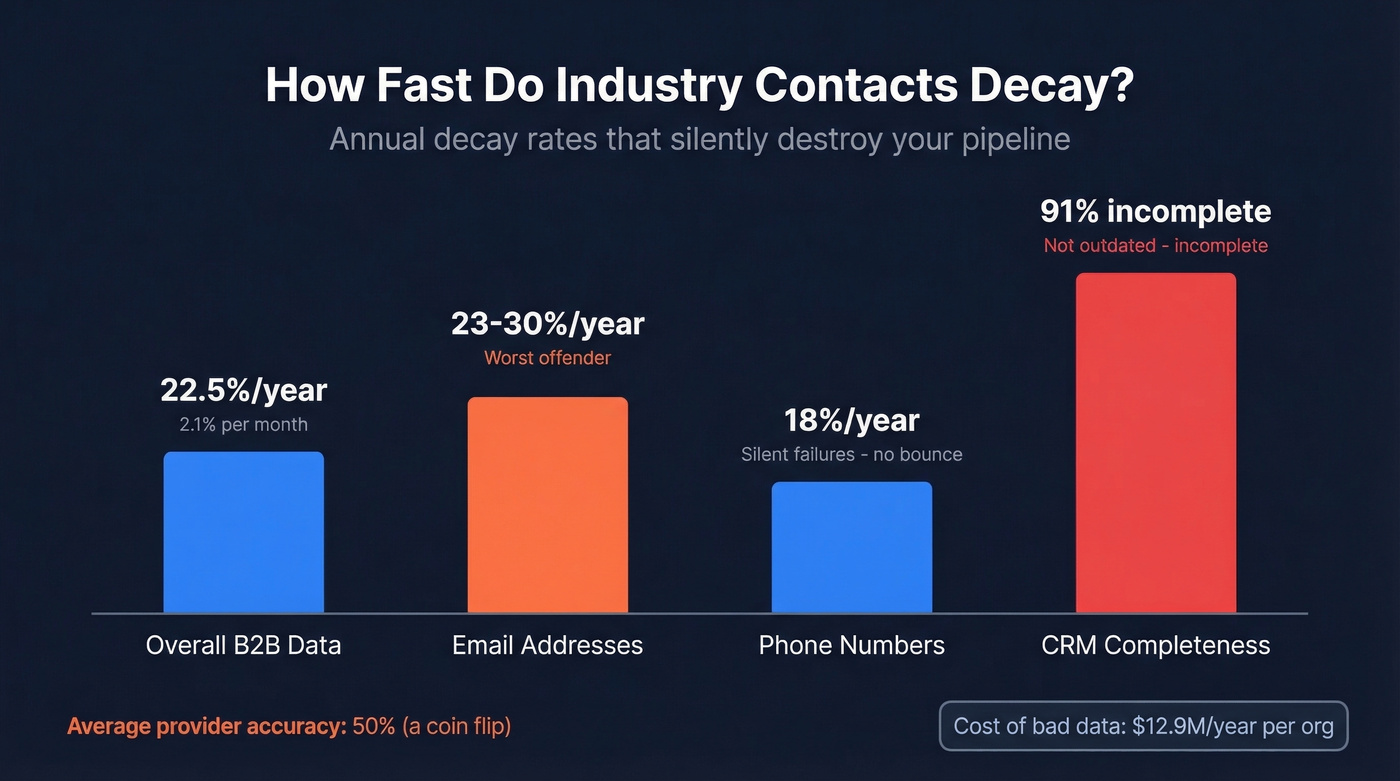
The downstream costs hit hard: reps lose an estimated 500 hours per year validating and correcting contact info, and across an organization, poor data quality costs $12.9M per year. Meanwhile, 91% of CRM data is incomplete - not "slightly outdated," but incomplete. If you're treating your CRM as a source of truth without a verification layer, you're building outreach on a foundation that's already crumbling.
Here's the thing: the sales intelligence market has ballooned to $4.85B and is projected to hit $10.25B by 2032. That growth exists because the old way - buy a list, blast it, hope - stopped working years ago. The teams winning in 2026 treat contact data as a living asset, not a static spreadsheet.
Seven Ways to Find Industry Contacts
The best prospectors use at least three of these in combination.
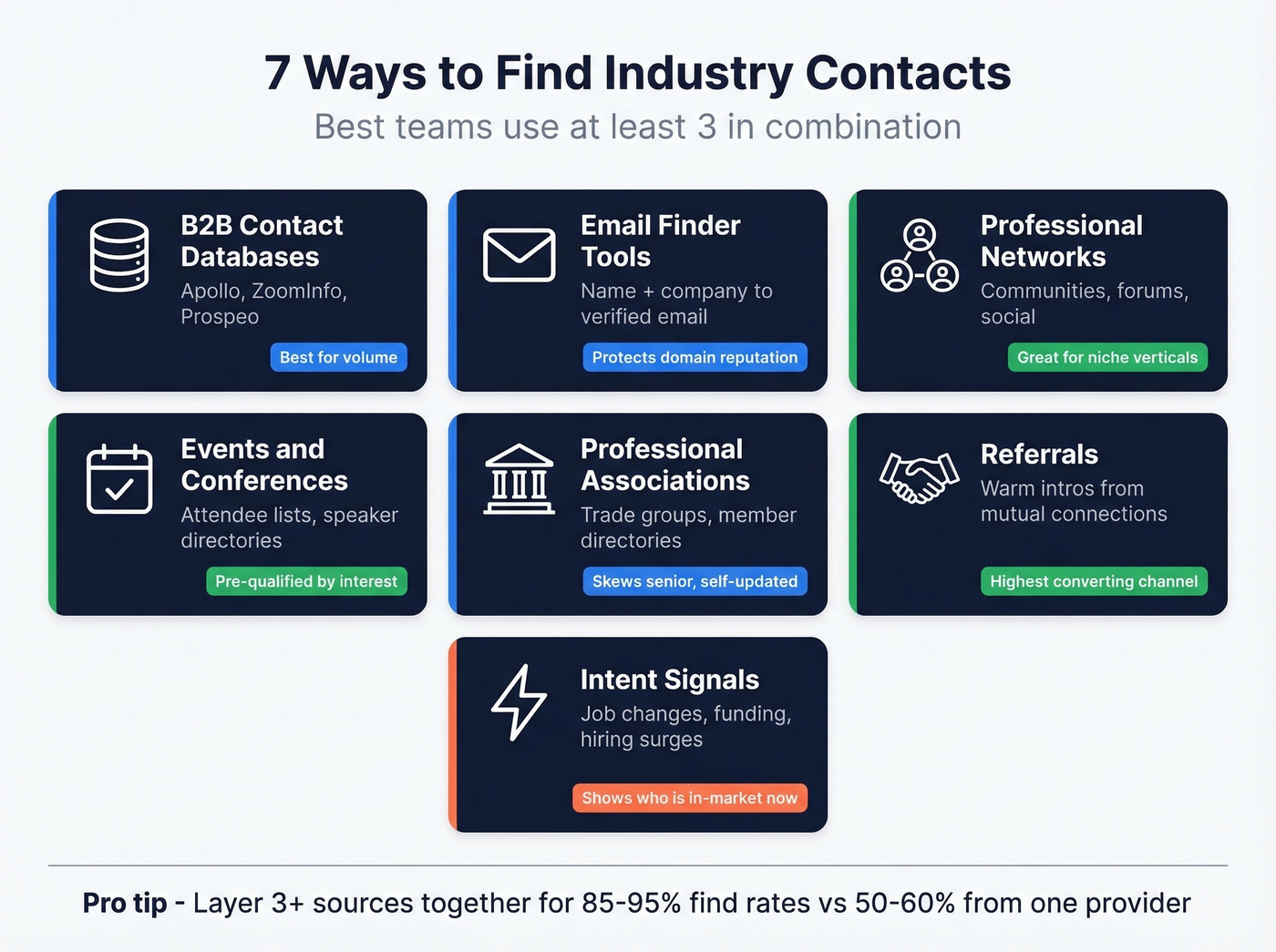
B2B contact databases. Tools like Apollo, ZoomInfo, and Prospeo let you search by job title, industry, company size, and technographics. Start here for volume - then verify everything before outreach.
Email finder tools. When you have a name and company but no email, dedicated finders pull verified addresses in seconds. These matter most when your email deliverability is on the line.
Professional networks. Industry-specific communities, forums, and professional social platforms surface contacts that databases miss entirely. Especially valuable for niche verticals where database coverage is thin.
Industry events and conferences. Attendee lists, speaker directories, and sponsor pages are goldmines. The contacts are pre-qualified by interest - they showed up to an event in your space.
Professional associations. Trade groups and industry bodies often publish member directories. These skew senior and are frequently updated by the members themselves.
Referrals. The oldest channel and still the highest-converting. A warm intro from a mutual connection beats any cold email. Build referral asks into your post-deal workflow.
Intent signals. Job changes, funding rounds, hiring surges, and content engagement all signal buying windows. Tools with intent data integrations let you filter contacts by who's actually in-market, turning a static list into a prioritized pipeline.

You just read that B2B contacts decay at 2.1% per month and the average provider delivers 50% accuracy. Prospeo's 7-day refresh cycle and 98% verified email accuracy mean your industry contacts are current this week - not from last quarter. 300M+ profiles, 125M+ verified mobiles, 30+ filters including intent data and technographics, starting at $0.01 per email.
Stop building outreach on data that's already decaying.
Top Tools for Building an Industry Contact List
| Tool | Free Tier | Starting Price | Enterprise | Best For |
|---|---|---|---|---|
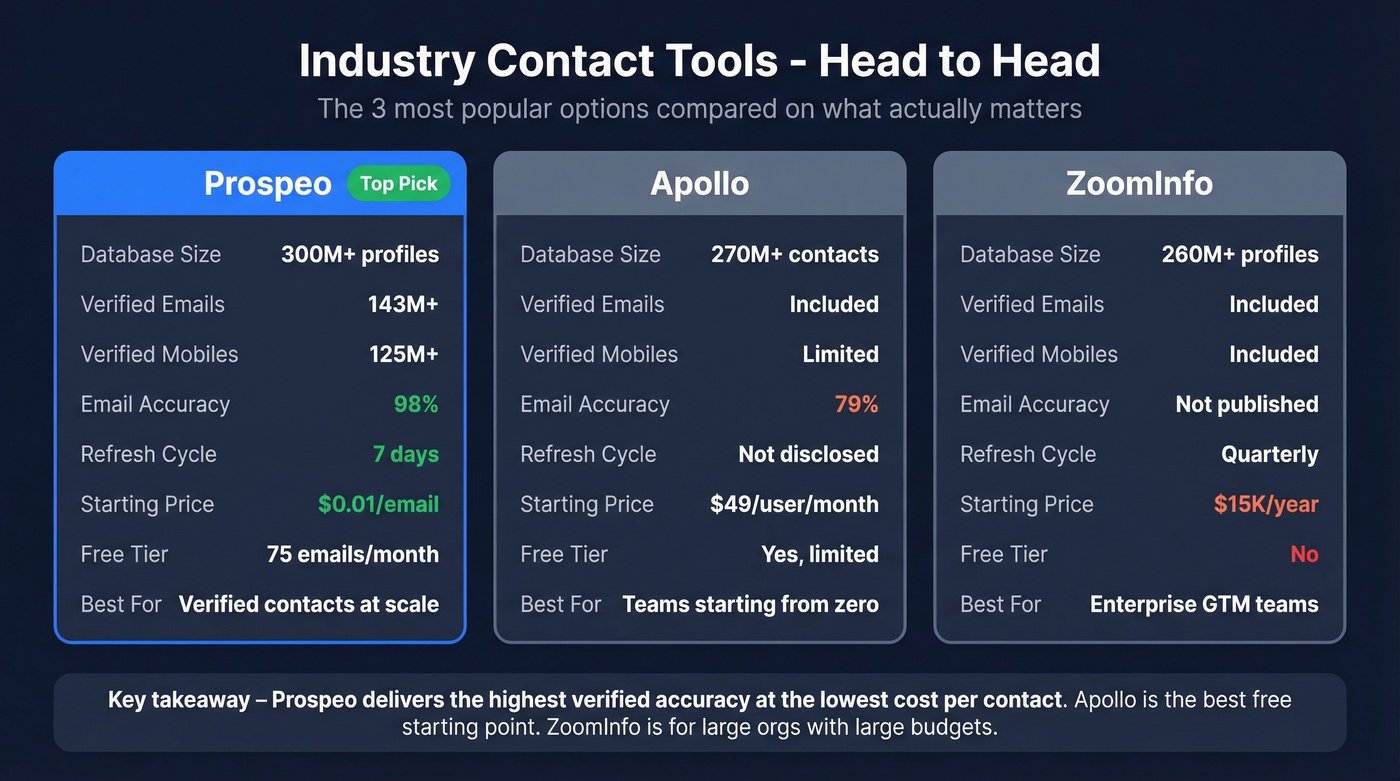
| Prospeo | 75 emails/mo | ~$0.01/email | Self-serve | Top pick - verified emails + mobiles |
| Apollo | Yes | $49/user/mo | $119/user/mo | Broad coverage + free start |
| ZoomInfo | No | ~$15K/year | ~$45K+/year | Enterprise teams with big budgets |
| Lusha | Yes | $22.45/user/mo | Custom | Quick Chrome lookups |
| Hunter.io | 25 searches/mo | $34/mo | Custom | Email finding + verification |
| Crunchbase | Limited | $49/mo | Custom | Company discovery |
| SignalHire | 5-10 credits/mo | $39/mo | Custom | Budget prospecting |
| Salesgenie | No | $99/mo | Custom | Local/traditional B2B |
Prospeo
Prospeo's database covers 300M+ professional profiles with 143M+ verified emails and 125M+ verified mobile numbers that deliver a 30% pickup rate. The 98% email accuracy comes from a proprietary email-finding infrastructure that doesn't rely on third-party providers - a meaningful distinction when most competitors are reselling the same underlying data. The 7-day refresh cycle means you're working with contacts verified this week, not six weeks ago.

The Chrome extension, used by over 40,000 people, pulls verified contact data from any website or CRM in one click. Pricing is transparent and credit-based at roughly $0.01 per email, with a free tier giving you 75 verified emails and 100 Chrome extension credits per month. No contracts, no sales calls. One customer, Meritt, tripled pipeline from $100K to $300K per week while dropping bounce rates from 35% to under 4%.
Skip this if you need a full-suite GTM platform with built-in sequencing and a dialer - pair it with Instantly or Lemlist for that.
Apollo
Apollo's 270M+ contact database is genuinely impressive for a tool with a free tier. You get basic search, limited exports, and enough credits to test whether the data quality works for your ICP. Paid plans run $49-$119/user/month billed annually.
The tradeoff is accuracy. We've seen Apollo's email accuracy hover around 79% in testing - workable for high-volume outreach, but you'll want a verification layer on top. Where Apollo shines is breadth: if you need contacts across industries, geographies, and company sizes, the coverage-to-price ratio is hard to beat.
Apollo is the best "first tool" for teams starting from zero. But once your outreach volume grows past a few hundred contacts per month, the 79% accuracy becomes a liability. At that point, you need a verification-first tool as your primary source.
ZoomInfo
ZoomInfo is the 800-pound gorilla, and the pricing reflects it. Professional plans start around $15K-$18K/year, Advanced runs $25K-$28K, and Elite hits $40K-$45K+. Additional seats cost $1,500+/year, and renewals typically increase 10-20% annually.
The database runs 260M+ professional profiles and 100M+ company profiles. The feature set is enormous: intent data, website visitor tracking, conversation intelligence, workflow automation. It's a GTM operating system, not just a database. The #1 complaint on Reddit? Price - and specifically, paying for modules you never activate.
ZoomInfo is still the best all-in-one GTM platform for large orgs. But most teams don't need all-in-one. If your average deal size is under $25K or your team is under 10 reps, you're paying for a Ferrari to drive to the grocery store. A focused tool at 90% less cost will outperform it for pure prospecting.
Lusha
Dead-simple Chrome extension for quick lookups. Free tier to test. Pro plan at $22.45/user/month is accessible for small teams. The downside: database depth doesn't match Apollo or ZoomInfo for bulk prospecting, and Premium jumps to $52.45/user/month. Better as a supplement than a primary database.
Hunter.io
Hunter's domain search feature is genuinely useful - enter a company domain and get every email pattern and verified address associated with it. Starts at $34/month billed annually, with 25 free searches per month. It's an email-finder specialist, not a full contact database - no phone numbers, no intent data, no company enrichment. Pair it with a database tool for a complete workflow.
Crunchbase
The best tool for company discovery - funding rounds, leadership changes, growth signals, and industry classification. Starts at $49/month billed annually. Use it as step one in a two-step workflow: Crunchbase for account identification, then a contact database for the VP of Sales' direct dial.
SignalHire
Covers 850M profiles with a free tier offering 5-10 credits per month. Paid plans start at $39/month. Worth testing if you're on a tight budget, though we haven't tested it deeply enough to recommend it over the Tier 1 options above.
Salesgenie (Data Axle)
A legacy B2B/B2C database starting at $99/month. Better suited for local business contacts and traditional industries than tech or SaaS prospecting. If you're selling to dentists or HVAC companies, it's worth a look.
Meritt tripled pipeline from $100K to $300K/week and cut bounce rates from 35% to under 4% - because their industry contacts were verified, not guessed. Prospeo's proprietary email infrastructure doesn't resell third-party data. You get 143M+ verified emails and 125M+ verified mobiles with a 30% pickup rate, refreshed every 7 days.
Find industry contacts that connect - 75 free verified emails to prove it.
Why Verification Is Non-Negotiable
The average B2B data provider delivers roughly 50% accuracy. Half the contacts you're paying for don't work.
A phone data benchmark testing 9 providers found accuracy ranging from 63% to 91% and coverage ranging from 26% to 92%. Unlike email, phone numbers don't bounce - you only discover they're wrong after wasting dials. That's invisible waste eating your team's productivity.
Some competitors tout "human-verified" databases with hundreds of full-time researchers. Sounds impressive until you consider the math: a human team can't re-verify millions of records on a weekly cycle. Automated verification at scale - with catch-all handling, spam-trap removal, and honeypot filtering - delivers both freshness and coverage that manual processes can't match.
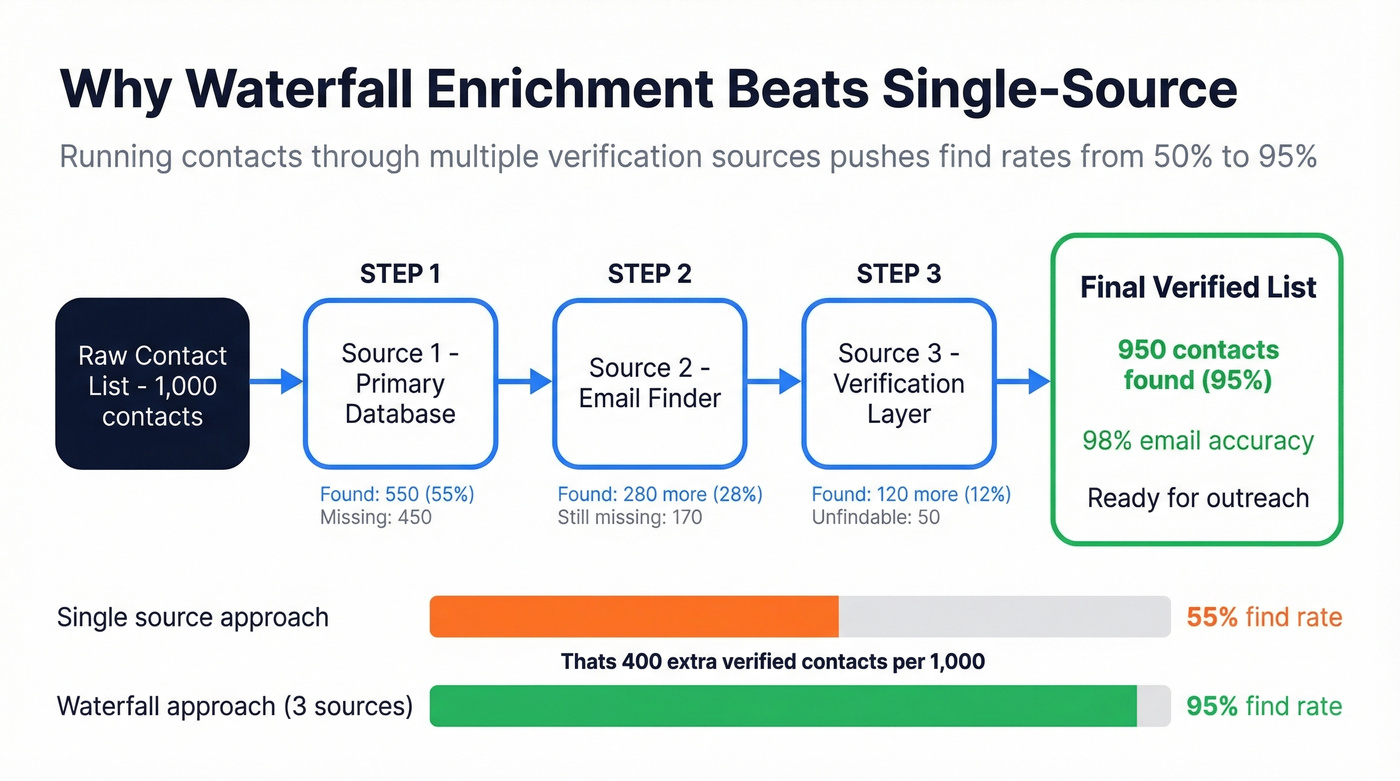
This is why waterfall enrichment matters. In our testing, running contacts through multiple sources consistently pushed find rates to 85-95% vs. 50-60% from a single provider. That's the difference between a sequence that builds pipeline and one that gets your domain blacklisted.
Let's be honest: 75% of B2B marketers rely on email as their primary lead gen channel. If you're not verifying contacts before they hit your sequences, you're gambling with your most important outreach channel on every campaign.
Intent Signals Over Static Lists
The "buy a list and blast" era is over. Practitioners on r/b2bmarketing report cold email reply rates around 2%. That's a symptom of bad data and overused prospects who've been hammered by every competitor running the same export.
The shift is toward intent-based prospecting. Instead of blasting 5,000 contacts and hoping, you track signals that indicate buying windows: job changes, hiring surges, funding rounds, leadership turnover, and engagement with competitor content. One GTM engineer on Reddit reported that Clay's native contact-finding missed contacts at roughly 2/3 of their target companies - a perfect illustration of why single-source approaches fail and why layering intent data on top of verified contacts produces dramatically better results.
We've watched teams transform their outreach by combining intent signals with verified industry contacts. The ones filtering by who's actually researching solutions in their category - rather than blasting everyone with the right job title - consistently see 3-5x higher reply rates. That gap only widens as inboxes get more crowded.
Five Mistakes That Ruin Your Contact Strategy
Only reaching out when you need something. Inc. research on networking highlights this as the top relationship killer. If every touchpoint is a pitch, you're not building a network - you're burning one.
Relying on a single database. No provider covers every industry, geography, or role. We've run bake-offs where the "best database" missed entire segments that a secondary source caught easily. Two or three sources minimum.
Skipping verification before outreach. A 5-7% bounce rate from unverified data doesn't sound catastrophic until your domain lands on a blacklist. I've seen teams destroy months of domain warming in a single unverified campaign. Verify everything before it enters a sequence.
Ignoring compliance. GDPR, CAN-SPAM, and CASL aren't optional. Fines aside, non-compliant outreach tanks deliverability. Make sure your data provider enforces opt-outs and offers DPAs.
Letting data age without re-verification. You verified your list six months ago? Roughly 11% of it has decayed since then. Quarterly re-verification isn't paranoia - it's maintenance.
FAQ
How often should I update my industry contacts?
Re-verify quarterly at minimum. B2B contact data decays at 2.1% per month - roughly 22.5% annually - so a list verified in January is 6% stale by April. If you run monthly campaigns, re-verify before every send. Email addresses decay fastest at 23-30% per year.
What's the best free tool for finding industry contacts?
Apollo offers the most generous free tier for broad contact searches. For verified emails specifically, Prospeo's free plan gives you 75 verified emails and 100 Chrome extension credits per month - enough to test accuracy before committing. Hunter.io adds 25 free domain searches.
How accurate are B2B contact databases?
The average provider delivers roughly 50% accuracy. Top-tier tools with real-time verification hit 97-98%. Always test a sample before buying credits in bulk - run 50 contacts through your tool and measure bounce rate against the provider's accuracy claims.
Should I buy a contact list or build my own?
Build your own. Purchased lists contain overused contacts that every competitor is already emailing. Use a database tool to pull contacts matching your ICP, verify them, and enrich with intent signals. You'll get better reply rates and protect your domain reputation.
What's the difference between a contact database and an email finder?
A contact database lets you search for people by filters like job title, industry, company size, and technographics - you're discovering who to reach. An email finder takes a specific person's name and company and returns their verified email address. Most prospecting workflows need both: a database for discovery and a finder for filling gaps on known targets.