

Infofree vs ZoomInfo: Which Is Worth Your Money in 2026?
You saw Infofree's $150/month price tag next to ZoomInfo's $15,000+/year quote and thought: there has to be a middle ground. You're right. But the middle ground isn't either of these tools.
Infofree vs ZoomInfo is a comparison between a legacy list-pull service and an enterprise GTM platform. They don't compete. And for most teams reading this, neither is the right answer.
30-Second Verdict
- Pick ZoomInfo if you're an enterprise team with $30K+ in annual budget and you need intent data, technographics, and workflow automation across a large sales org.
- Pick Infofree if you only need basic business lists for direct mail or local prospecting and can tolerate accuracy gaps.
Pricing Breakdown
| Infofree | ZoomInfo | Prospeo | |
|---|---|---|---|
| Starting annual cost | $1,500/yr (Starter annual prepay) | ~$15,000/yr | Free tier; paid from ~$39/mo |
| Per-contact cost | ~$0.21-$0.75/export (plan-dependent) | ~$3.00/credit | ~$0.01/email |
| Export limits | 200-1,000/mo (plus annual export packages) | Credit-gated | Credit-based, scalable |
| Contract length | Monthly or annual | Annual (2-3 yr push) | None - cancel anytime |
| Cancellation | Call or mail a letter | 60-90 day notice window | Self-serve, instant |
| Hidden fees | $99 setup fee on monthly plans | Add-ons push to $50K+ | None |
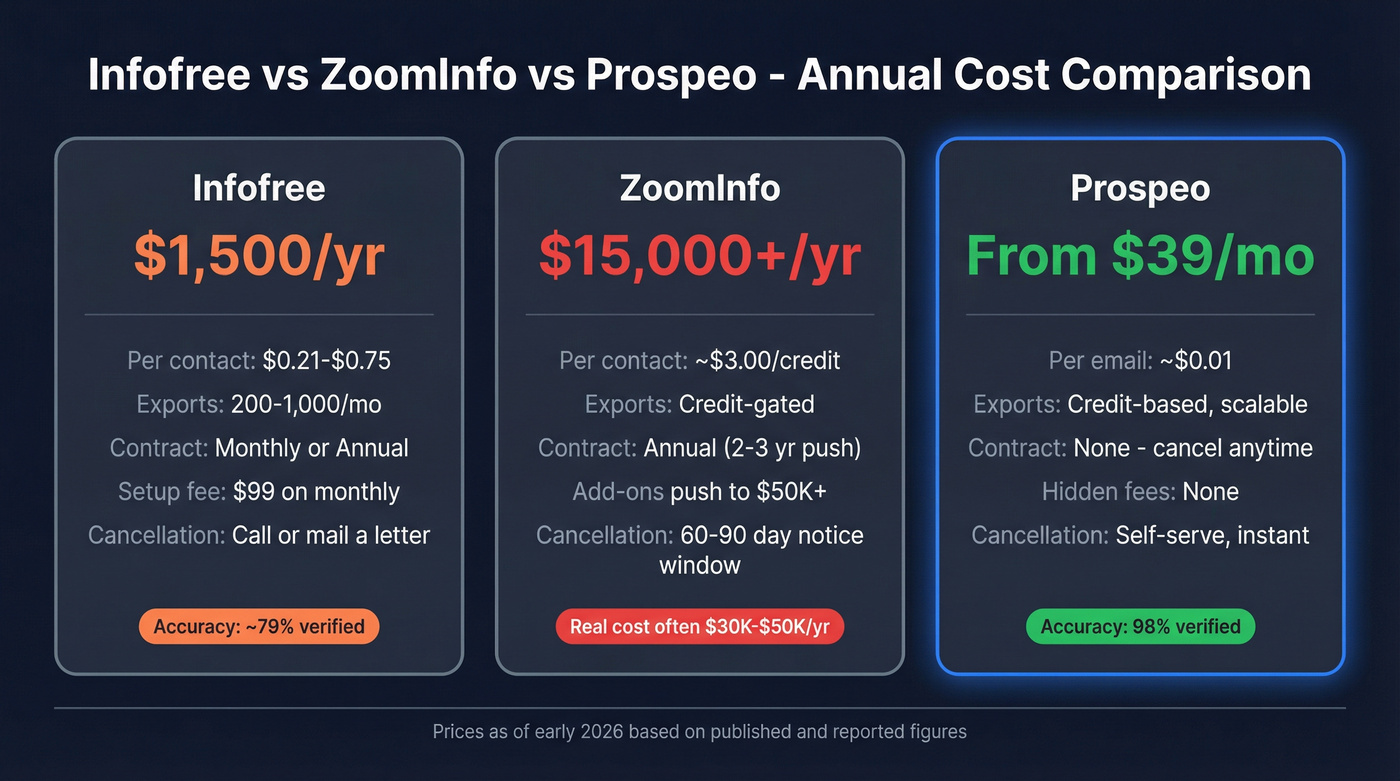
Infofree's Starter plan runs $150/month with a $99 setup fee on the monthly option and caps you at 200 exports/month. The Team plan jumps to $275/month for 1,000 exports/month. Annual prepay drops those to $1,500/year and $2,500/year respectively, and bigger annual packages exist - $3,000/year for 10,000 exports and $4,500/year for 20,000 exports.
ZoomInfo operates in a different universe entirely. Professional starts around $15,000-$18,000/year for 1-3 seats with roughly 5,000 credits. Advanced runs $22,000-$28,000. Elite hits $35,000-$45,000+. Then the add-ons stack: extra credits at ~$3,000 per 5,000, NeverBounce verification at ~$3,000, Global Data at ~$9,995. Teams routinely land at $50,000/year. Renewal uplifts of 10-20% mean year two costs more than year one - and ZoomInfo renewal sticker shock is a recurring theme on r/sales and in RevOps communities.
Worth noting: Salesgenie, a Data Axle product, starts at $99/month on a 12-month term, which makes Infofree's higher tiers hard to justify for a lot of SMB use cases.
Data Quality & Accuracy
Here's where things get uncomfortable for Infofree. They claim 95% accuracy on business data, 90% on consumer data, and 80% on weekly hot leads. The database covers 15M businesses, 70M executives, and 240M consumers compiled from 5,000+ business and 10,000+ consumer sources - classic data compilation from public and proprietary records, not real-time verification.
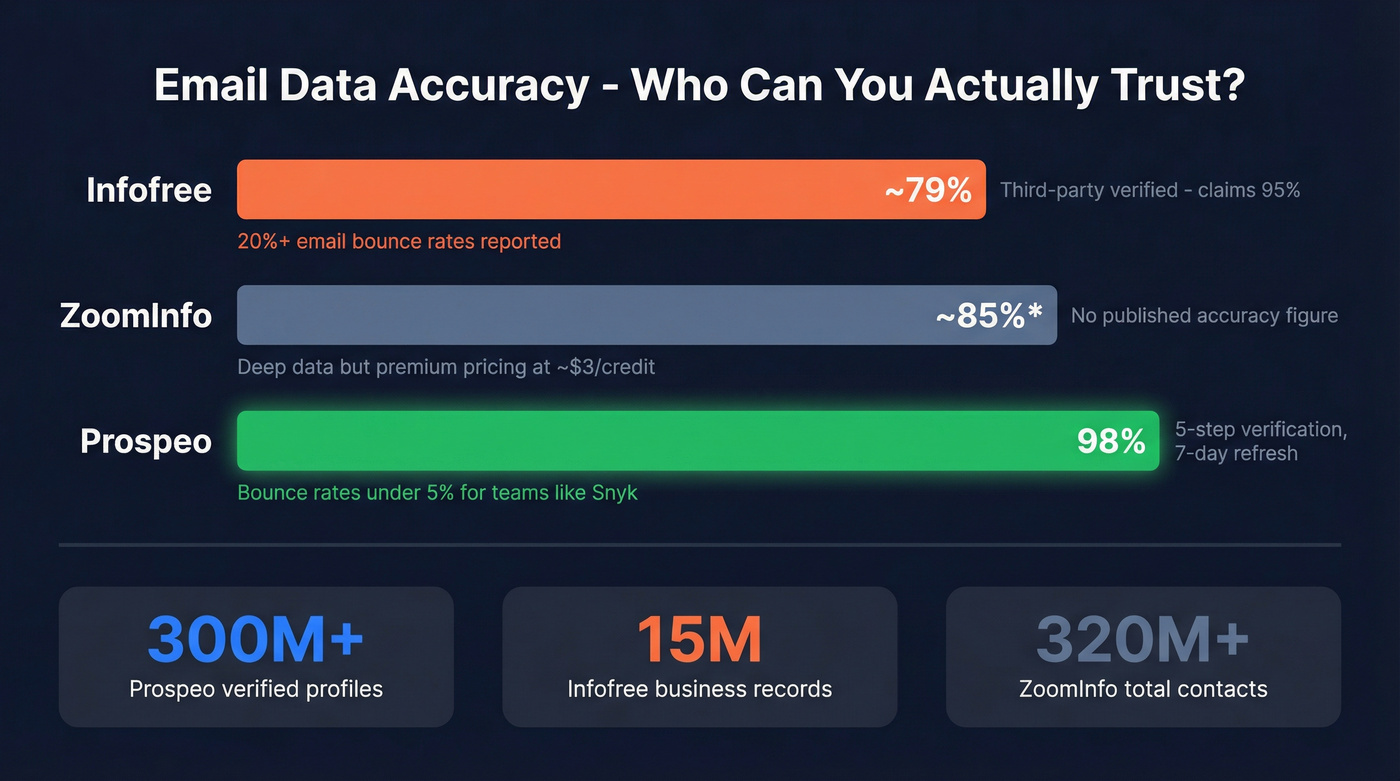
A third-party analysis pegged Infofree's contact name accuracy at 79%, with other fields ranging 80-100%. That's well below the vendor's 95% claim. On G2, Infofree sits at 2.9 out of 5 stars across 20 reviews, with data accuracy as the recurring complaint. We've seen teams burn through Infofree's 200 monthly exports in a single afternoon and still end up with a list that bounces 20%+ of emails.
ZoomInfo's database is massive - 320M+ contacts. They don't publish a single overall accuracy percentage, and the data is deeper and more current than Infofree's for B2B contacts. But you're paying a steep premium for that depth.
For context, Prospeo's 300M+ profiles run through a 5-step verification process on a 7-day refresh cycle, delivering 98% email accuracy. That's a meaningful gap when your sender reputation is on the line.

Infofree bounces 20%+ of emails. ZoomInfo charges $3/credit. Prospeo delivers 98% email accuracy at ~$0.01 per email with a 7-day data refresh cycle - no annual contracts, no mailing cancellation letters to Omaha.
Stop choosing between bad data and budget-breaking contracts.
Contracts & Cancellation
Mailing a physical letter to cancel a SaaS subscription in 2026 tells you everything you need to know about Infofree's approach to customer retention. Your options are calling customer service between 8am-5pm CST or sending a cancellation letter to a PO Box in Omaha, NE. Cancel and you lose access - saved searches gone, remaining credits forfeited. The 24-hour free trial requires no credit card but doesn't let you download anything, so you can't actually evaluate the data before committing.
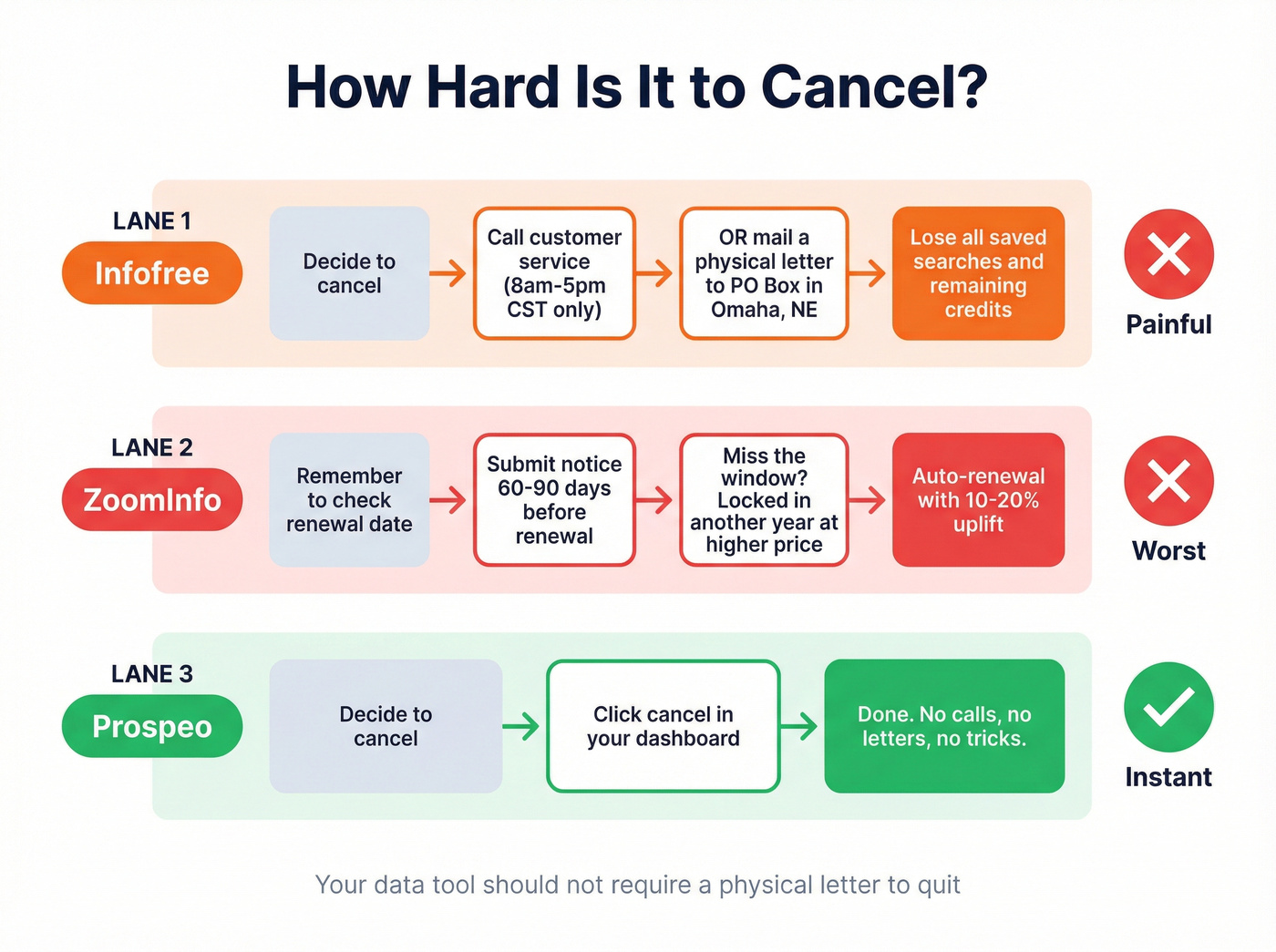
ZoomInfo isn't much better. They push 2-3 year contracts and bury auto-renewal notice windows at 60-90 days before your renewal date. Miss that window and you're locked in for another year at a higher price. In our experience, most teams don't realize they've missed the cancellation window until the invoice hits.
Let's be honest: both of these cancellation processes feel designed to trap you, not serve you.
Compliance & Legal Risk
ZoomInfo's aggressive data collection practices have had real consequences. The company settled a $29.55M privacy class action (Ramos v. ZoomInfo, Case No. 1:21-cv-02032) with final approval in November 2024, covering alleged privacy violations across California, Illinois, Indiana, and Nevada.
Infofree's consumer database is CASS Certified and run through NCOA monthly. Less powerful, but less legally exposed.
Who Should Pick Which
You need ZoomInfo if you're running a 50+ person sales org with $30K+ in data budget, you need intent signals and technographics layered into ABM workflows, and you have the ops team to implement it. Negotiate hard - first-year discounts exist.
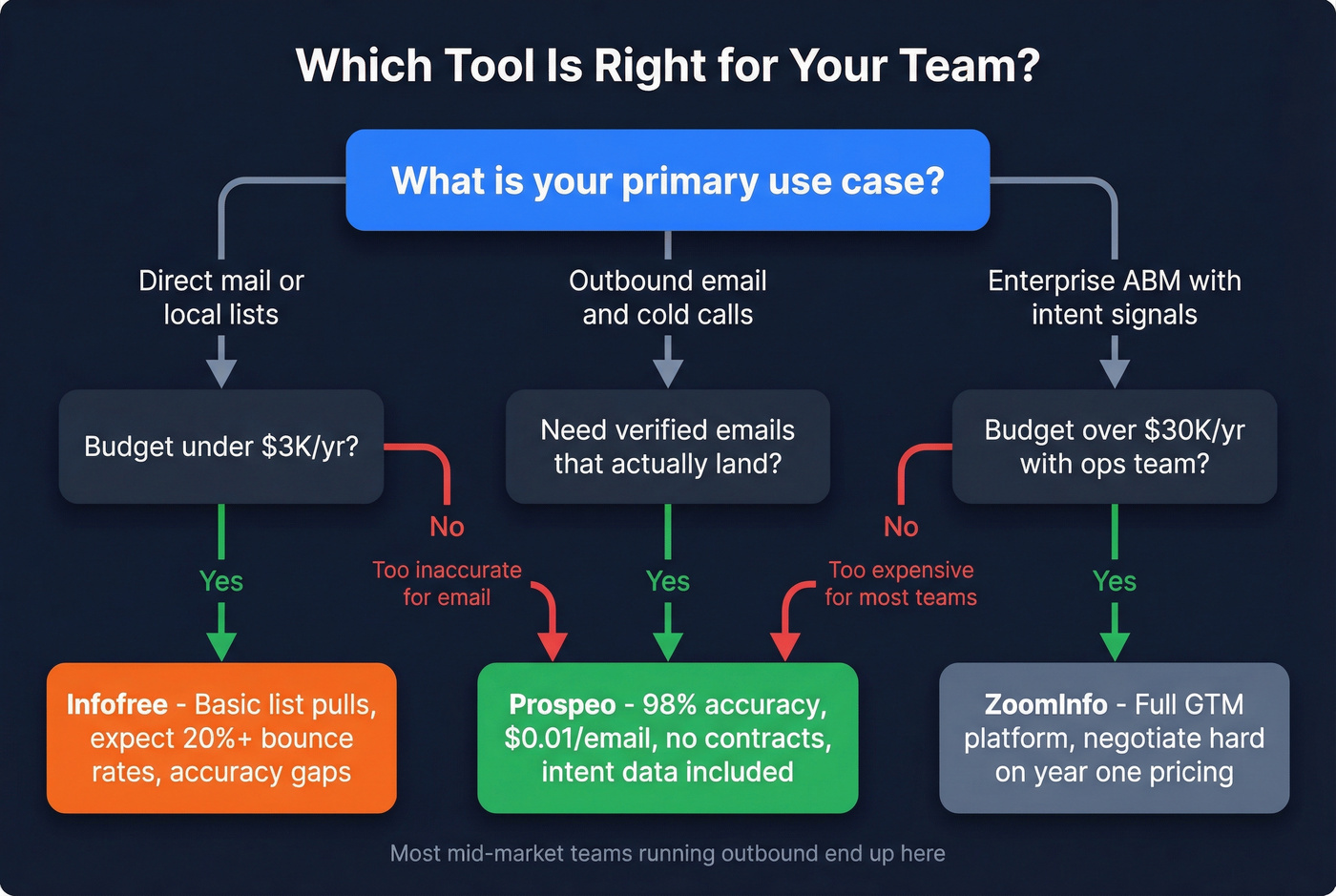
You need Infofree if your use case is basic list pulls for direct mail, local business prospecting, or consumer outreach. Expect accuracy gaps and plan around them. Skip this if you're running outbound email campaigns - Infofree's bounce rates will wreck your domain reputation before you book a single meeting.
You need neither if your goal is booking meetings through outbound email and cold calls. One's too expensive, the other's too inaccurate. Here's the thing: if your average deal size is under $25K, you almost certainly don't need ZoomInfo-level infrastructure, and Infofree's data quality won't survive a real outbound campaign.
The Third Option Most Teams Actually Need

Teams that want intent signals get Bombora-powered tracking across 15,000 topics - without ZoomInfo's price tag. Native integrations with Salesforce, HubSpot, Smartlead, Instantly, and Clay mean you can plug it into existing workflows in minutes, not weeks.
Real results back it up. Snyk's 50-person AE team dropped bounce rates from 35-40% to under 5% and grew AE-sourced pipeline 180%. Stack Optimize built to $1M ARR while keeping client deliverability above 94% and bounces under 3%.
Snyk's 50 AEs dropped bounce rates from 35-40% to under 5% and grew pipeline 180% - with data refreshed every 7 days, not compiled from static public records. 300M+ profiles, 98% accuracy, intent data across 15,000 topics. Starting at $0.
Get ZoomInfo-grade data without the ZoomInfo invoice.
FAQ
Is Infofree Owned by Data Axle?
Data Axle USA is the rebranded InfoUSA (the company rebranded in 2020). Salesgenie is a Data Axle product starting at $99/month on a 12-month term - cheaper than Infofree's current $150/month Starter plan. For teams comparing list-pull tools in the Data Axle ecosystem, Salesgenie often offers better value.
Can You Get ZoomInfo Under $15K?
Rarely. ZoomInfo sells annual contracts with no published monthly plans. Some startups negotiate lower first-year deals, but renewal uplifts of 10-20% quickly erase any discount. Add-ons for credits, NeverBounce, and Global Data push real costs toward $30,000-$50,000/year.
What's a Good Alternative to Both?
For outbound teams running email and cold call campaigns, Prospeo delivers 98% email accuracy at ~$0.01/lead with a free tier of 75 emails/month. It fills the gap between Infofree's low cost and ZoomInfo's data depth - without annual contracts or cancellation hoops.
Is This Even the Right Comparison for B2B Teams?
Honestly, not for most. Infofree is a list-pull tool built for direct mail and local prospecting. ZoomInfo is an enterprise GTM platform. If you're running outbound email and cold calls, you need verified contact data at a price that scales - which is the problem neither solves well for mid-market teams.