

Inside Sales: The Complete Guide for 2026
84% of sales reps missed quota last year. Not because they lacked effort - many were making 60-70 calls a day and grinding through sequences. The problem is structural: bad data, activity theater, and a buying process that's fundamentally changed while most sales orgs haven't caught up.
We've spent the last year watching teams adapt (or fail to adapt) to this shift, and the gap between top performers and everyone else is widening fast. This guide covers what actually works right now - the strategy, the numbers, the tools, and the mistakes that are quietly killing pipeline.
What You Need (Quick Version)
Inside sales is remote, consultative B2B selling - phone, email, video, chat, and social. It's now the dominant model. 80% of B2B sales interactions happen through digital channels, and 90% of companies plan to stick with hybrid models because single-channel approaches can't keep up.
If you're building or joining a team in 2026, you need to understand team structure, the right KPIs (hint: it's not calls made), realistic compensation benchmarks, a lean tech stack, and how AI is creating a two-tier system between reps who use it and reps who don't.
What Does Inside Sales Actually Mean?
The definition is straightforward: selling remotely - from an office, a home office, or anywhere with a laptop and decent internet. Reps use phone, email, video calls, chat, and social channels to prospect, qualify, demo, negotiate, and close deals without ever meeting a buyer in person.
The critical distinction from telemarketing deserves its own callout:
Inside sales ≠ telemarketing. Salesforce's guide draws a clear line. Telemarketing is scripted, random dialing with limited product knowledge and a single goal - usually booking a meeting or reading a pitch. Inside sales is consultative, full-cycle selling. Reps have deep product expertise, manage complex deal cycles, and build real relationships across buying committees. They share a phone. That's about it.
The channels have expanded dramatically. Buyers use an average of 10 interaction channels, up from 5 in 2016. The best reps meet buyers wherever they are, which increasingly means digital-first touchpoints long before a live conversation happens.
Sales cycles tend to be shorter than field sales because the products sold remotely are typically less complex. But "shorter" doesn't mean "simple." A mid-market SaaS deal still involves multiple stakeholders, procurement reviews, and security questionnaires - all handled without a single plane ticket. The skill ceiling is just as high as field sales; the travel budget is just lower.
Inside Sales vs. Outside Sales
The debate is effectively settled by the data.
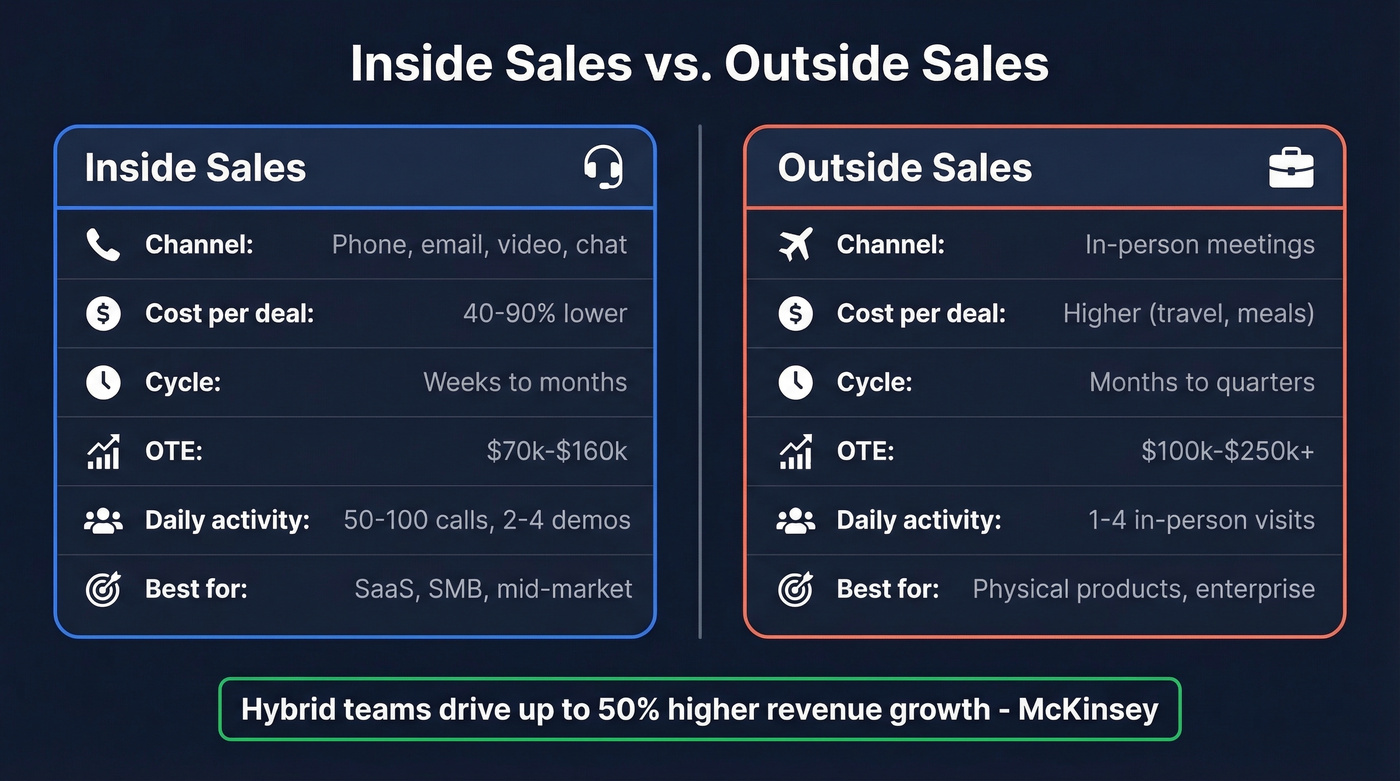
| Dimension | Inside Sales | Outside Sales |
|---|---|---|
| Primary channel | Phone, email, video | In-person meetings |
| Travel required | None or minimal | 50%+ of work time |
| Cost per acquisition | 40-90% lower | Higher (travel, meals) |
| Sales cycle length | Shorter (weeks to months) | Longer (months to quarters) |
| Avg deal size | Mostly SMB, growing mid-market | Mid-market and enterprise |
| Typical OTE | $70k-$160k | $100k-$250k+ |
| Scalability | High - add reps fast | Limited by geography |
| Calls/meetings per day | 50-100 calls, 2-4 demos | 1-4 in-person visits |
| Buyer preference trend | Growing - 75% prefer remote | Declining for most B2B |
| Best for | SaaS, services, SMB/MM | Physical products, enterprise |
Outside sales pros earn roughly 14% more than their inside counterparts, but that premium is shrinking as deal sizes for remote-sold products climb. The real story is the cost structure: remote selling can reduce customer acquisition cost by 40-90% compared to field models. For a Series A company watching burn rate, that math is decisive.
Pure inside or pure outside is increasingly rare. McKinsey found that hybrid teams drive up to 50% higher revenue growth than single-channel organizations. The question isn't "inside or outside?" It's "how much field presence does your specific product require?" For most SaaS and B2B services, the answer is almost none.
The State of Remote Selling in 2026
The buying environment has shifted underneath sellers in ways that make this model both more important and harder to execute well.
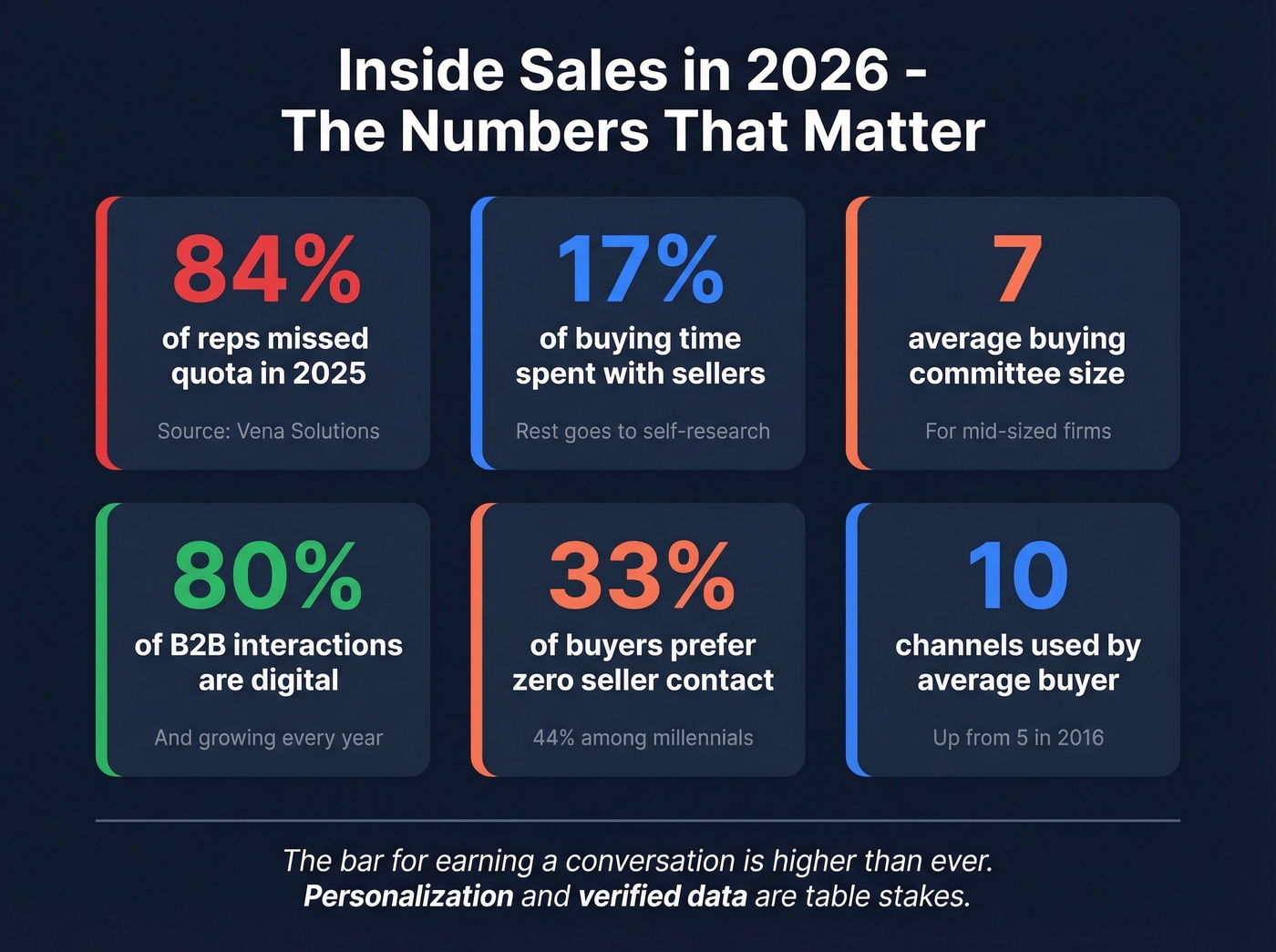
Buyers are self-educating at scale. They spend only 17% of their buying time meeting with suppliers - the rest goes to independent research, internal discussions, and consensus-building. By the time a prospect books a demo, they've likely consumed your case studies, compared your pricing page to three competitors, and formed an opinion.
The numbers paint a challenging picture. In 2025, 84% of reps missed quota, and 67% didn't expect to hit it. Average buying committees have grown to 7 people for mid-sized firms. 57% of sales professionals say the sales cycle is getting longer, not shorter.
Here's the thing: 33% of all buyers now prefer a completely seller-free experience, and that number jumps to 44% among millennials. This doesn't mean the model is dying. It means the bar for earning a conversation is higher than ever. 73% of B2B buyers actively avoid sellers who send messages that don't connect to their specific situation.
Reps who combine verified data, personalized outreach, and AI-assisted workflows are outperforming their peers by wide margins. We're seeing a clear split between teams that have adapted and teams still running 2019 playbooks with 2019 data.
How the Sales Process Works
The process follows a consistent flow, even if the specifics vary by company size and deal complexity. Keep in mind that 71% of consumers prefer to gather information themselves before speaking with a human - your process needs to account for buyers who already know a lot before you ever reach them.
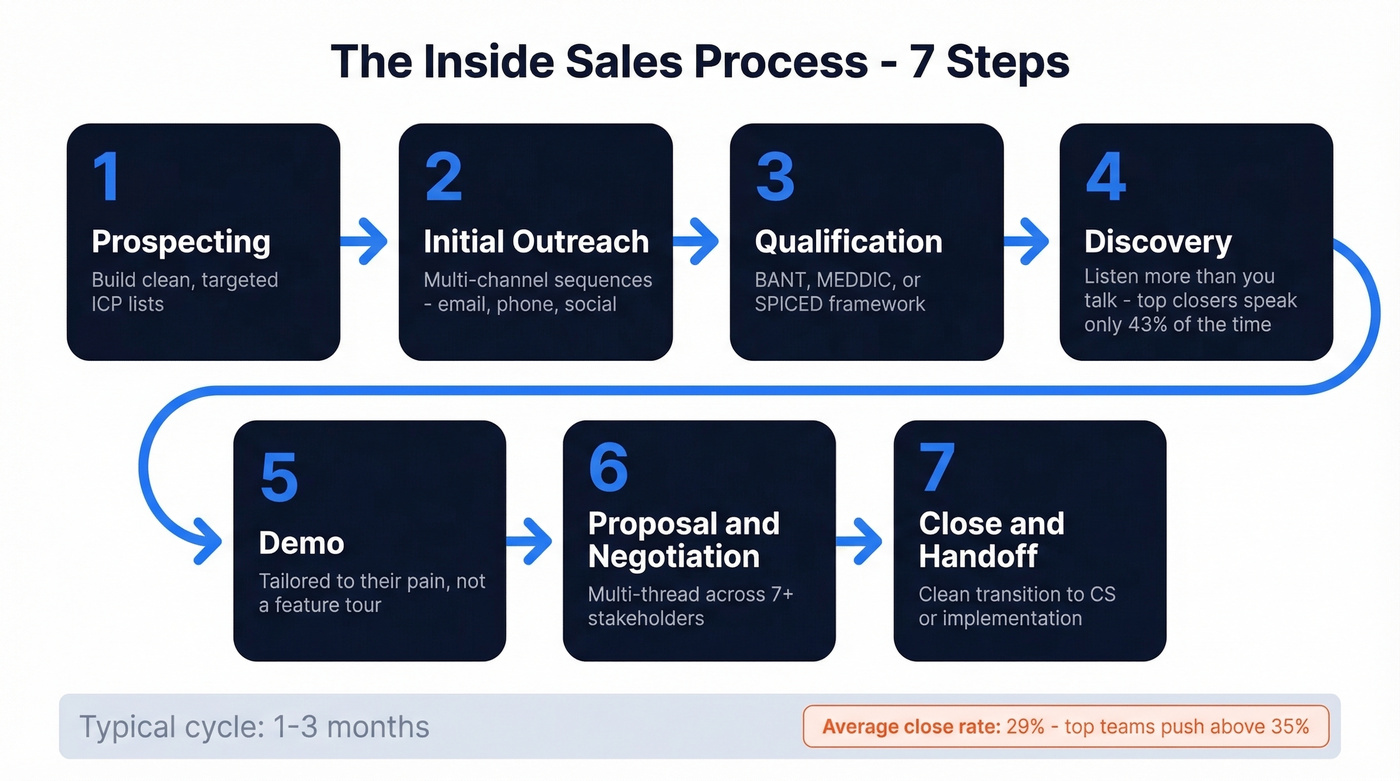
1. Prospecting. Identify target accounts and contacts that match your ideal customer profile. Build a clean, targeted list using verified data - not a massive one full of dead ends. Quality over quantity wins here every time.
2. Initial outreach. Multi-channel sequences combining email, phone, and social touches. The first follow-up email boosts reply rates by 49%. The second adds just 3%. By the third, your chance of a reply actually decreases by 30%. Front-load your best messaging.
3. Qualification. Use a framework like BANT, MEDDIC, or SPICED to determine fit. Does the prospect have budget, authority, need, and timeline? If not, disqualify fast. The best SDRs protect their AEs' calendars ruthlessly.
4. Discovery. This is where deals are won or lost. Ask questions, listen more than you talk, and map the prospect's pain to your solution. Top closers speak 43% of the time on discovery calls. Average performers talk 65%. That gap is enormous.
5. Demo/presentation. Tailor the demo to what you learned in discovery. Generic product tours kill deals. Show the prospect their world with your product in it, not every feature you've ever built.
6. Proposal and negotiation. Present pricing, handle objections, navigate procurement. Deals stall here when you've only talked to one stakeholder. With 7 people involved in a typical mid-market decision, multi-threading isn't optional.
7. Close and handoff. Get the signature, then execute a clean handoff to customer success or implementation. A botched handoff undoes months of selling work.
The entire cycle typically runs 1-3 months for mid-market deals, with about 8% of high-value deals stretching past 5 months. The average B2B close rate sits around 29%, and top-performing teams push above 35%.
Team Structure & Roles
SDRs & BDRs
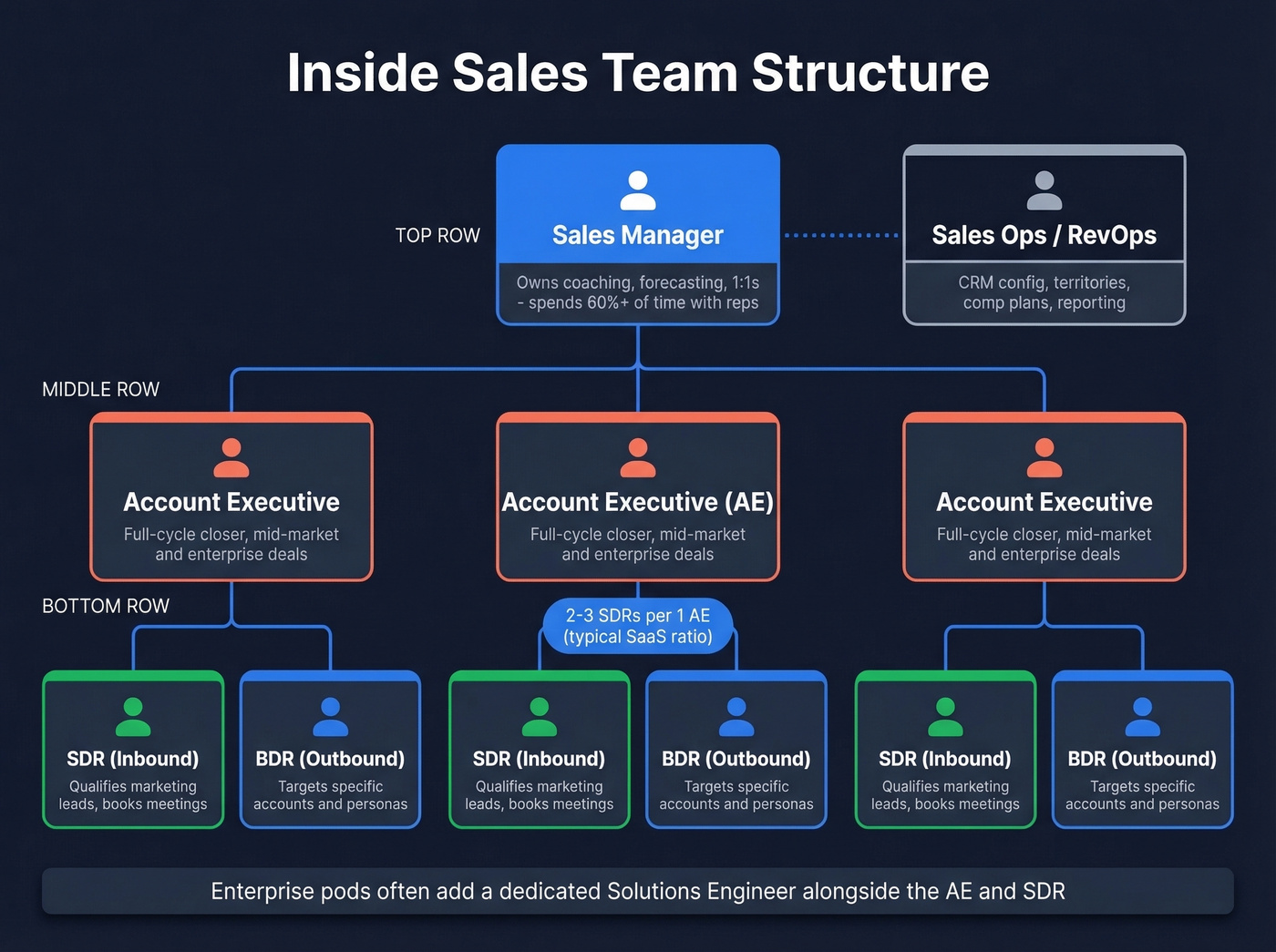
Sales Development Reps handle inbound leads - qualifying marketing-generated interest and booking meetings for AEs. Business Development Reps focus on outbound prospecting, targeting specific accounts and personas. In larger orgs, these are distinct roles with different comp plans and activity expectations. Smaller companies often combine them into one role covering both inbound and outbound, which works until volume makes it unsustainable.
Activity expectations for SDRs often run 50-100 calls per day and 10+ demos per week. Reddit job-seeker threads on r/sales cite 60-70 calls/day for entry-level roles.
Inside Sales Reps & AEs
Inside sales reps run the full cycle - from qualified opportunity through close. In some orgs, ISRs handle smaller deals while Account Executives take mid-market and enterprise opportunities. The distinction usually comes down to deal size and complexity.
A common team ratio in SaaS: 2-3 SDRs feeding one AE. As deal sizes grow, that ratio tightens - enterprise AEs often have a dedicated SDR or even a two-person pod with a solutions engineer.
Managers & Sales Ops
Sales Managers own team performance, coaching, and forecasting. The best ones spend 60%+ of their time in 1:1s and call reviews, not building reports. Sales Ops handles the infrastructure - CRM configuration, territory design, comp plan modeling, and reporting. In teams under 20 reps, one person often covers both RevOps and enablement. Above that, you need dedicated headcount for each.

You can't run a consultative inside sales process on garbage data. Prospeo gives your reps 300M+ verified profiles with 98% email accuracy and 125M+ mobile numbers - refreshed every 7 days, not every 6 weeks. Teams using Prospeo book 26% more meetings than ZoomInfo users.
Stop grinding through dead contacts. Start conversations with real buyers.
KPIs That Actually Matter
Let's be honest about something that'll save you months of misalignment: Demos Held should always be the top metric for SDR/BDR compensation. Not calls made. Not emails sent. Not "activities logged." Demos Held is the closest leading indicator to pipeline that an SDR directly controls.
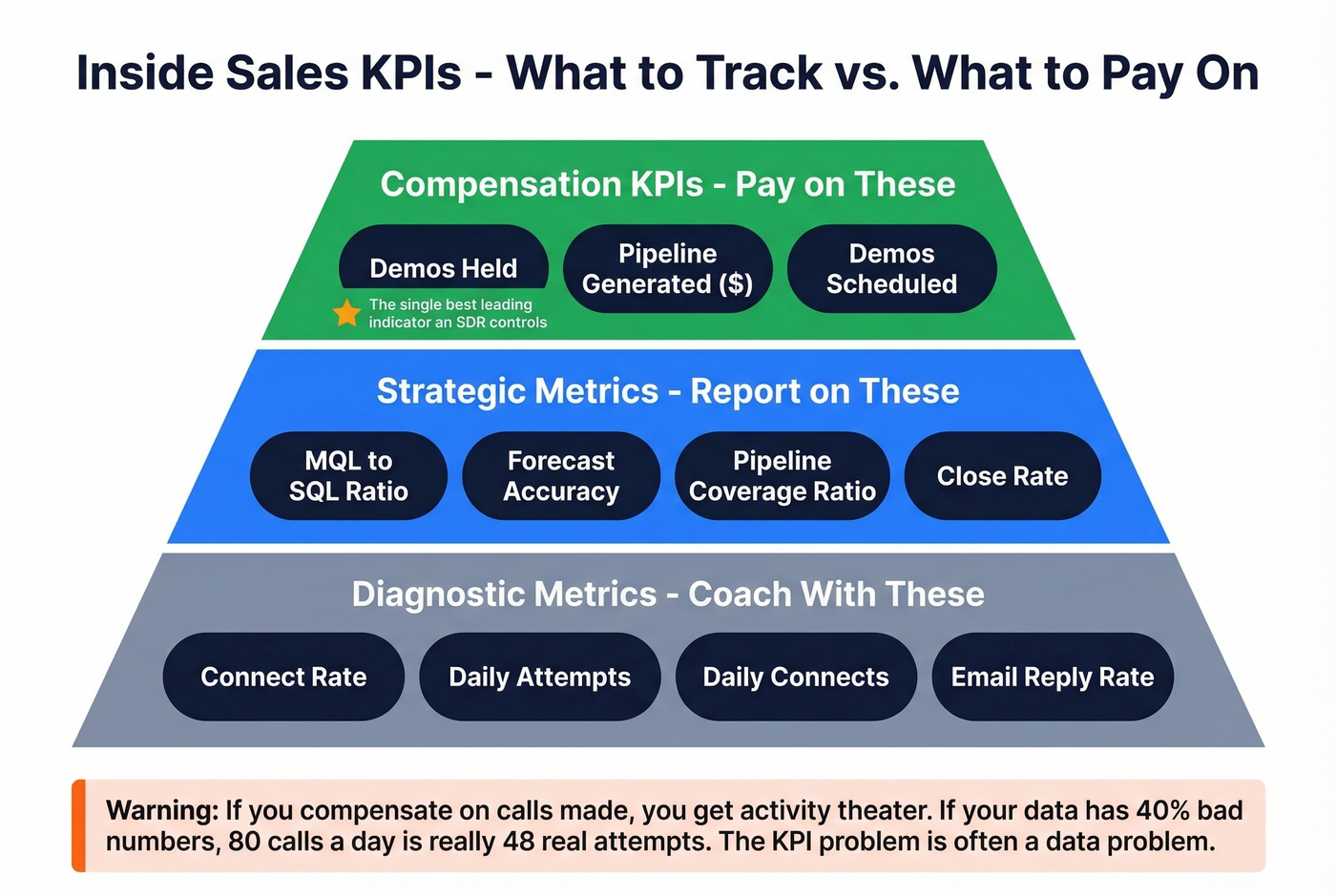
| Type | Metrics | Purpose |
|---|---|---|
| Diagnostic | Connect rate, attempts, daily connects | Coaching signals |
| Compensation KPIs | Demos scheduled, demos held, pipeline generated | Pay triggers |
Track everything. Pay on what matters. If you compensate reps on calls made, you'll get 80 calls a day - many to bad numbers, with no regard for conversation quality. Compensate on demos held and pipeline generated, and reps self-optimize toward outcomes.
Beyond SDR metrics, map your broader sales strategy to measurable KPIs. CRM hygiene drives follow-up rate and contact frequency. Lead conversion processes map to MQL-to-SQL ratio and time-to-opportunity. AI-powered forecasting should be measured by forecast accuracy and pipeline coverage ratio, not just whether someone filled in the CRM fields.
If your VP wants 80 calls a day but your data provider gave you 40% bad numbers, you're making 48 real attempts and your manager thinks you're underperforming. The KPI problem is often a data problem in disguise.
Salaries & Compensation
Compensation follows a predictable structure, with meaningful jumps at each career stage:
| Role | Base Range | Avg Base | OTE Range | Typical Split |
|---|---|---|---|---|
| SDR/BDR | $38k-$55k | ~$45k | $70k-$90k | 60/40 |
| ISR | $38k-$72k | $52,040 | $90k-$110k | 50/50 |
| ISR (AE) | $42k-$73k | $56,184 | $120k-$160k | 50/50 |
| Enterprise AE | $80k-$130k | ~$100k | $180k-$250k+ | 50/50 |
Base salary data reflects PayScale's most recent benchmarks - expect 3-5% upward drift in 2026 given demand for remote selling talent. The 50/50 base-to-variable split is standard for experienced full-cycle roles. SDRs typically skew 60/40 since their variable is tied to meeting-setting rather than closed revenue.
Most comp plans include a SPIFF budget of 5-10% of variable comp for short-term accelerators - things like booking demos with target accounts, multi-threading into buying committees, or hitting weekly activity streaks.
The career path is well-defined: SDR → ISR/AE → Senior AE → Sales Manager → Director → VP. Threads on r/sales and r/techsales regularly ask whether $150k+ OTE is realistic for remote roles. It is, once you're in a mid-market or enterprise AE seat at a well-funded SaaS company.
The Inside Sales Tech Stack
You need four to five tools that integrate tightly, not ten that don't talk to each other.
CRM: Pick Based on Team Size
If your team is under 50 reps, start with HubSpot. The free tier is genuinely useful, paid plans start at $20/user/month, and the learning curve is shallow enough that reps actually use it. Above 50 reps, Salesforce's customization and ecosystem become harder to replicate - but you'll pay for it at $25-330/user/month depending on the edition. The decision is really about complexity: do you need custom objects, advanced workflow automation, and a massive app marketplace? If yes, Salesforce. If you're not sure, you don't.
Engagement Platforms
Outreach and Salesloft are more similar than different. Both handle multi-step sequences across email, phone, and social - the operational backbone of outbound execution. Outreach runs ~$100-150/user/month and edges ahead for teams running 5+ step sequences at high volume. Salesloft runs ~$100-130/user/month and wins for Salesforce-native teams that want the tightest possible CRM sync. Pick based on your CRM and workflow preferences, then stop second-guessing.
Conversation Intelligence
If you can only afford one tool beyond CRM and engagement, make it Gong (~$100-150/user/month). It records, transcribes, and analyzes sales calls - surfacing talk-to-listen ratios, identifying winning patterns, and enabling coaching on real conversations instead of hypotheticals. The data Gong generates on rep performance is what turns average managers into great ones.
Data & Enrichment
This is where most teams either overspend or get burned by bad data. Prospeo covers 300M+ professional profiles with 98% email accuracy and 125M+ verified mobile numbers that hit a 30% pickup rate. The 7-day data refresh cycle means you're not calling people who changed jobs six weeks ago. Pricing starts free, with paid plans running about $0.01 per email - no contracts, no sales calls required.

For comparison: ZoomInfo runs $15-40k/year on typical mid-market contracts, at roughly $1/lead. Apollo offers a free tier with paid plans from ~$49/month, but email accuracy sits around 79%. We've run bake-offs where the cheapest tool outperformed the most expensive one on connect rates - data quality matters more than database size.
Video & Collaboration
Zoom handles demos and discovery calls. The free tier works for calls under 40 minutes; paid plans start at $13.33/month. Some teams add async video tools like Vidyard for personalized prospecting. Skip this category if your reps are already comfortable on camera - don't over-invest in video software when they should be on calls.
Here's the full stack at a glance:
| Category | Tool | Starting Price | Best For |
|---|---|---|---|
| CRM | HubSpot | Free / $20/user | SMB to mid-market |
| CRM | Salesforce | $25/user/mo | Mid-market to enterprise |
| Engagement | Outreach | ~$100/user/mo | High-volume sequences |
| Engagement | Salesloft | ~$100/user/mo | Salesforce-native teams |
| Intelligence | Gong | ~$100/user/mo | Call coaching, deal intel |
| Data | Prospeo | Free / ~$0.01/email | Verified emails & mobiles |
| Data | Apollo | Free / $49/user/mo | Budget prospecting |
| Data | ZoomInfo | ~$15-40k/yr | Enterprise data + intent |
| Video | Zoom | Free / $13.33/mo | Demos, discovery calls |
Hot take: If your average deal is under $15k, you almost certainly don't need ZoomInfo-level data spend. A self-serve tool with high accuracy and a free tier will outperform a $30k/year platform that your team barely uses. Spend the savings on Gong instead.
Your inside sales team makes 50-100 calls a day. If 35% bounce, that's activity theater - not pipeline. Prospeo's 5-step verification drops bounce rates under 4% and puts direct dials in front of reps at $0.01 per email. No contracts, no sales calls required.
Kill the bounce rate before it kills your domain reputation.
AI & Automation
AI adoption in sales has gone from experiment to expectation. Adoption rose from 24% in 2023 to 43% in 2024, and by 2025, 56% of sales pros were using AI daily. Daily AI users were twice as likely to exceed their targets.
The performance gap is stark. Gartner found that sellers partnering with AI tools are 3.7x more likely to meet quota. Bain & Company reported that early AI deployments in sales boosted win rates by more than 30%. This isn't marginal improvement - it's a structural advantage that compounds over time.
The practical use cases delivering the most value right now:
- Email drafting and personalization - AI writes first drafts of outreach based on prospect data, job changes, and company signals. Reps edit and send in a fraction of the time.
- Call coaching - Real-time and post-call analysis of talk-to-listen ratios, objection handling, and next-step commitments.
- Lead scoring - Predictive models that surface which prospects are most likely to convert, so reps focus on the right accounts.
- CRM data entry - Automatic logging of calls, emails, and meeting notes. This alone recovers hours per week.
- Forecasting - AI-powered pipeline analysis that catches deal slippage before it shows up in the quarterly review.
The automation opportunity is massive. 60% of sales reps' time goes to non-selling tasks - admin, internal meetings, CRM updates, and reporting. AI doesn't replace the rep. It gives them back the 60% of their day that was never selling in the first place.
Skills & Coaching
The single most predictive skill is listening. Gong's data shows that top-closing reps speak 43% of the time on calls, while average performers talk 65%. That 22-point gap represents the difference between asking good questions and waiting for answers versus pitching features and hoping something sticks.
Beyond active listening, the skills that separate top reps in 2026 fall into three buckets.
Objection handling - not overcoming, but handling, which means acknowledging the concern and reframing it. Bulldozing past objections is a 2015 tactic that buyers see through instantly.
Video selling. Camera presence, demo pacing, and screen-share storytelling matter because most discovery calls happen on video now. Reps who look at the camera, pause for reactions, and narrate their screen shares like a story instead of a feature tour close at meaningfully higher rates.
Social selling - building credibility through content and engagement before the first cold touch. When a prospect already recognizes your name from a thoughtful comment on their post, the cold call isn't really cold anymore. The consensus on r/sales is that social selling alone won't fill your pipeline, but it makes every other channel work better.
Coaching delivery is evolving too. Static playbooks - the 40-page PDFs that live in a shared drive and get updated once a year - are being replaced by dynamic playbooks embedded directly in the CRM. The difference is dramatic: a static playbook requires a rep to leave their workflow, search for the right document, and hope it's current. A dynamic playbook delivers contextual guidance based on deal stage, industry, and persona in real time. When a rep opens an opportunity in the discovery stage for a healthcare prospect, they see the relevant talk track, competitive positioning, and case studies right in the record. No searching, no guessing, no stale information.
Common Mistakes
1. Bad data killing pipeline. If 30-40% of your phone numbers are disconnected, you're not running a sales team - you're running a random number generator. Reps spend 60% of their time on non-selling tasks, and a huge chunk of that waste comes from chasing invalid contacts. One team we know of tripled their pipeline from $100k to $300k per week after switching to verified data and watching their bounce rate drop from 35% to under 4%.
2. Activity theater. Measuring calls made instead of demos held creates perverse incentives. Reps dial faster, not smarter. They hit the daily number and log out, regardless of whether any conversations moved pipeline forward. Compensate on outcomes, not motion.
3. Irrelevant outreach. 73% of B2B buyers actively avoid sellers who send generic messages. "I noticed your company is growing" isn't personalization - it's a template with a merge field. Real personalization references a specific trigger: a job change, a funding round, a technology adoption, or a public initiative.
4. Talking too much. Average performers talk 65% of the time on calls. They lead with features, pitch before understanding pain, and fill silence with product details instead of questions. The fix is simple but hard: shut up and listen. Record your calls, measure your talk ratio, and coach toward 43%.
5. No follow-up discipline. The first follow-up boosts reply rates 49%. But by the third, your chance of a reply drops 30%. Most reps either give up too early or keep hammering past the point of diminishing returns. Build a cadence with 2-3 well-timed follow-ups, then move on.
FAQ
Is inside sales a good career?
Yes - it's one of the most accessible paths to six-figure earnings in B2B. SDR OTE starts at $70-90k, mid-market AEs earn $120-160k, and enterprise AEs hit $180-250k+. The role is remote-friendly, in high demand across SaaS and tech, and offers a clear progression from SDR to AE to management.
How is it different from telemarketing?
Telemarketing is scripted, random dialing with limited product knowledge and a single transactional goal. Inside sales is consultative, full-cycle selling using phone, email, video, chat, and social - with deep product expertise and relationship-building across buying committees. They share a phone. That's about it.
How many calls should a rep make per day?
SDRs typically target 50-100 dials per day, but calls made is a diagnostic metric, not a compensation trigger. An SDR booking 3 qualified demos from 50 calls outperforms one who dials 100 times and books zero. Demos held and pipeline generated are what matter.
What tools does a team need?
Four essentials: a CRM (HubSpot or Salesforce), an engagement platform (Outreach or Salesloft), conversation intelligence (Gong), and a data provider with verified contacts. Five well-integrated tools beat ten disconnected ones every time.
What's a good close rate?
The average B2B close rate is roughly 29%. Top-performing teams exceed 35%. Win rate - deals won as a share of total opportunities - averages about 21%. Consistently above 30% means your team is performing well. Below 20%, examine lead quality and qualification criteria before blaming reps.