

Best Intent Data Providers in 2026 - What Nobody Tells You
A RevOps lead we know spent $60,000 on an intent data provider last year. Six months in, the team had 4,000 "surging" accounts in a dashboard and exactly zero new meetings to show for it. The data wasn't wrong - it was just useless without a way to act on it.
The Real Cost Nobody Talks About
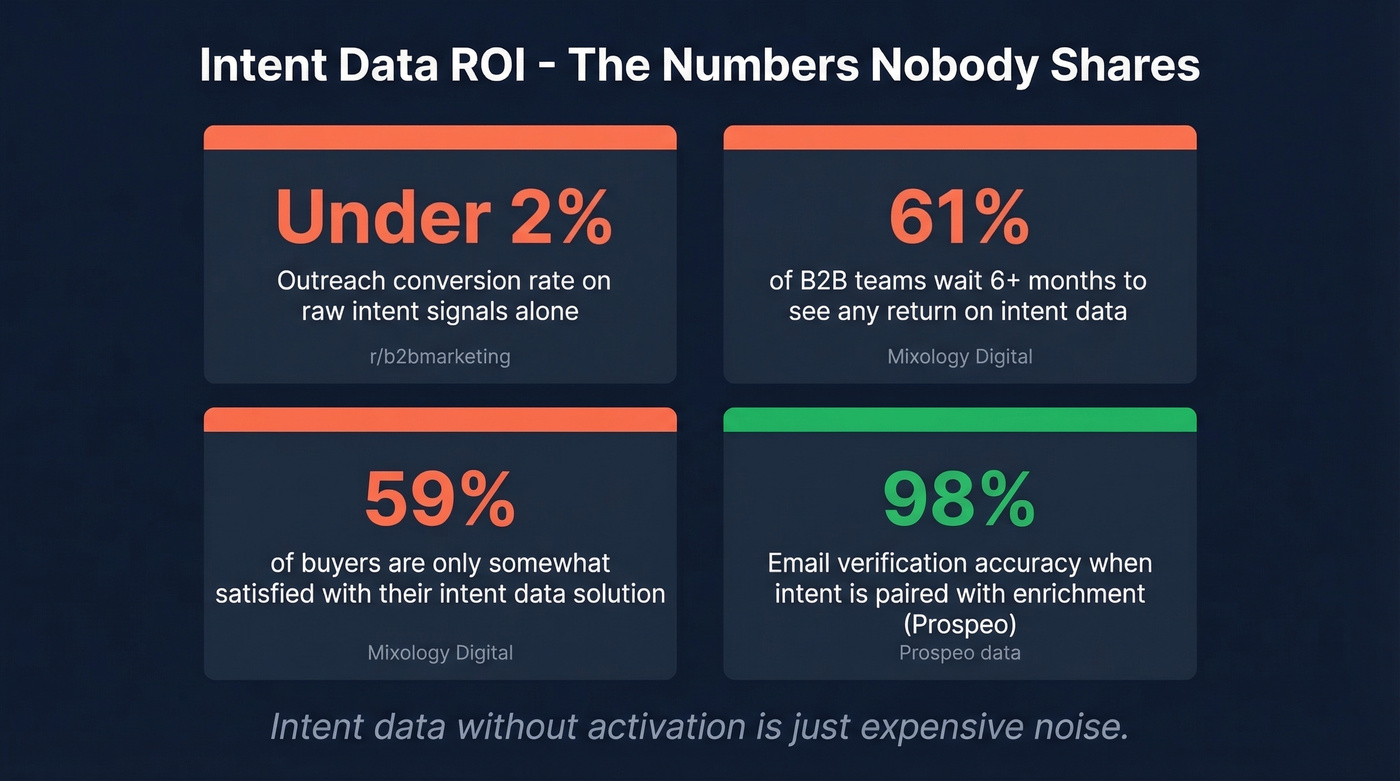
Here's the thing about intent data: the tool isn't the hard part. Activation is. 59% of B2B teams say they're only "somewhat satisfied" with their current intent data solution, and 61% report it takes six months or longer to see any return. Those aren't edge cases - that's the majority of buyers.
The Reddit threads tell the same story. One practitioner on r/b2bmarketing described intent tools as promising "the world but delivering mostly generic signals" - a single pricing-page visit flagged as a hot lead, with outreach conversion on raw intent signals under 2%. Another veteran on r/LeadGeneration with 15+ years in the space called most buyer intent solutions "trash" after spending heavily on 6sense, ZoomInfo, and Bombora through 2021-2022.
The pattern is consistent: teams buy intent data expecting a list of ready-to-close accounts. What they get is a firehose of signals that need layering, filtering, and - critically - a way to reach actual decision-makers at those accounts. Most providers solve the signal problem. Almost none solve the activation problem. That gap is where budgets go to die.
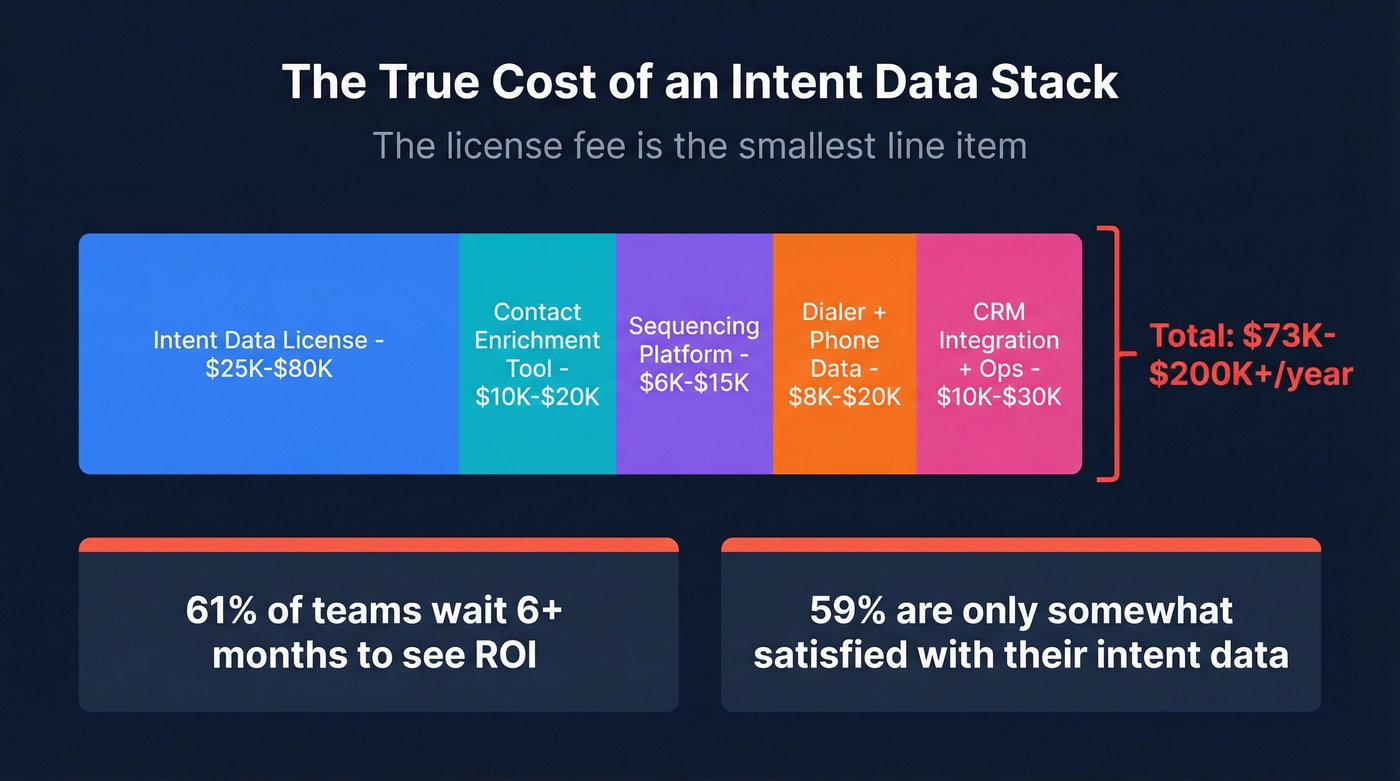
The license fee is the smallest line item. The real cost is the stack you need around it. Bombora contracts typically land in the $25K-$80K/year range. Add data enrichment, sequencing, a dialer, and CRM integration, and a Bombora-based stack can balloon to $73,600-$200,000+/year.
Our Picks (TL;DR)
Best for intent + verified contacts in one platform: Prospeo. Bombora-powered intent across 15,000 topics, layered with 300M+ profiles and 98% email accuracy. Go from surging account to verified decision-maker email without a second tool. Starts free, paid plans from ~$39/mo.
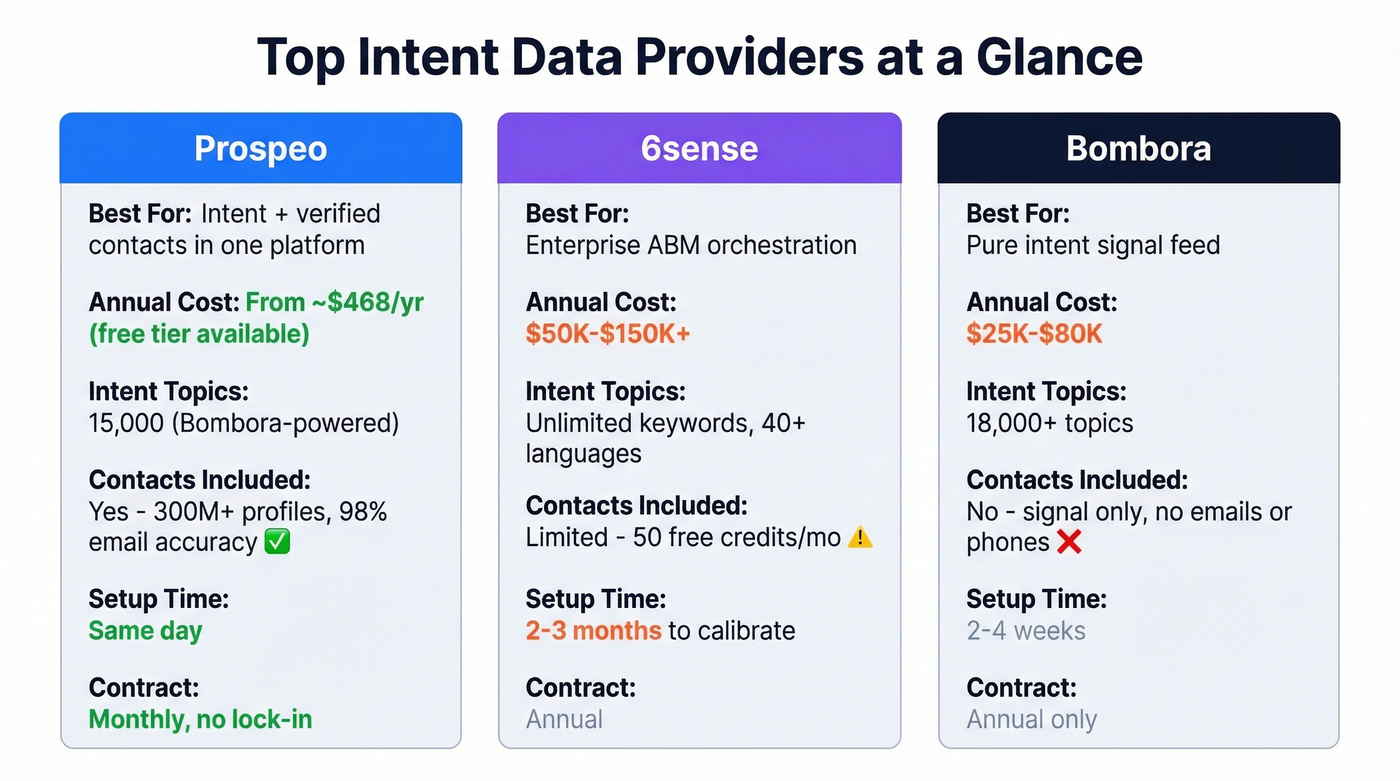
Best enterprise ABM platform with native intent: 6sense. Predictive buying stages, unlimited keywords, 40+ languages. The full orchestration machine - if you've got the budget ($50K-$150K+/year) and a dedicated ops person to run it.
Best standalone intent signal feed: Bombora. The co-op model that powers intent signals across a huge partner ecosystem. Pure signal, no activation layer. Median contract ~$24,750/year, with larger deployments reaching ~$80K+.
What B2B Intent Data Actually Costs
Nobody publishes a clean pricing table for intent data. Here's what we've pieced together from anonymized contract data, vendor pages, and community discussions.
| Provider | Typical Annual Cost | Intent Included? | Best For |
|---|---|---|---|
| Bombora | $25K-$80K | Yes (core product) | Pure signal feed |
| 6sense | $50K-$150K+ | Yes (paid tiers) | Enterprise ABM |
| Demandbase | $45K-$150K+ | Yes (all tiers) | ABM + display ads |
| ZoomInfo | $15K-$45K+ | Advanced+ only | Existing ZoomInfo customers |
| G2 Intent | $10K-$87K+ | Yes (core product) | SaaS comparison-stage |
| Cognism | ~$12K-$36K | Elevate tier only | EMEA-focused teams |
The Bombora, 6sense, and Demandbase figures come from Vendr's anonymized contract data - the closest thing to real pricing transparency in this market. Bombora's median sits at $24,750/year, 6sense at $58,617, and Demandbase at $65,981.
Budget 15-25% above the quoted license for implementation, CRM integration, and topic configuration. We've seen a $60K 6sense contract become $75K in year one once onboarding and professional services hit the invoice. ZoomInfo renewals often increase 10-20%, so that $28K Advanced plan becomes $33K by year two.
Top Intent Data Providers for 2026
Prospeo
Use this if: You want to go from "surging account" to "verified decision-maker email" in a single workflow - without stitching together three tools.
Skip this if: You need a full ABM orchestration platform with display ad targeting, web personalization, and predictive account scoring across thousands of seats.
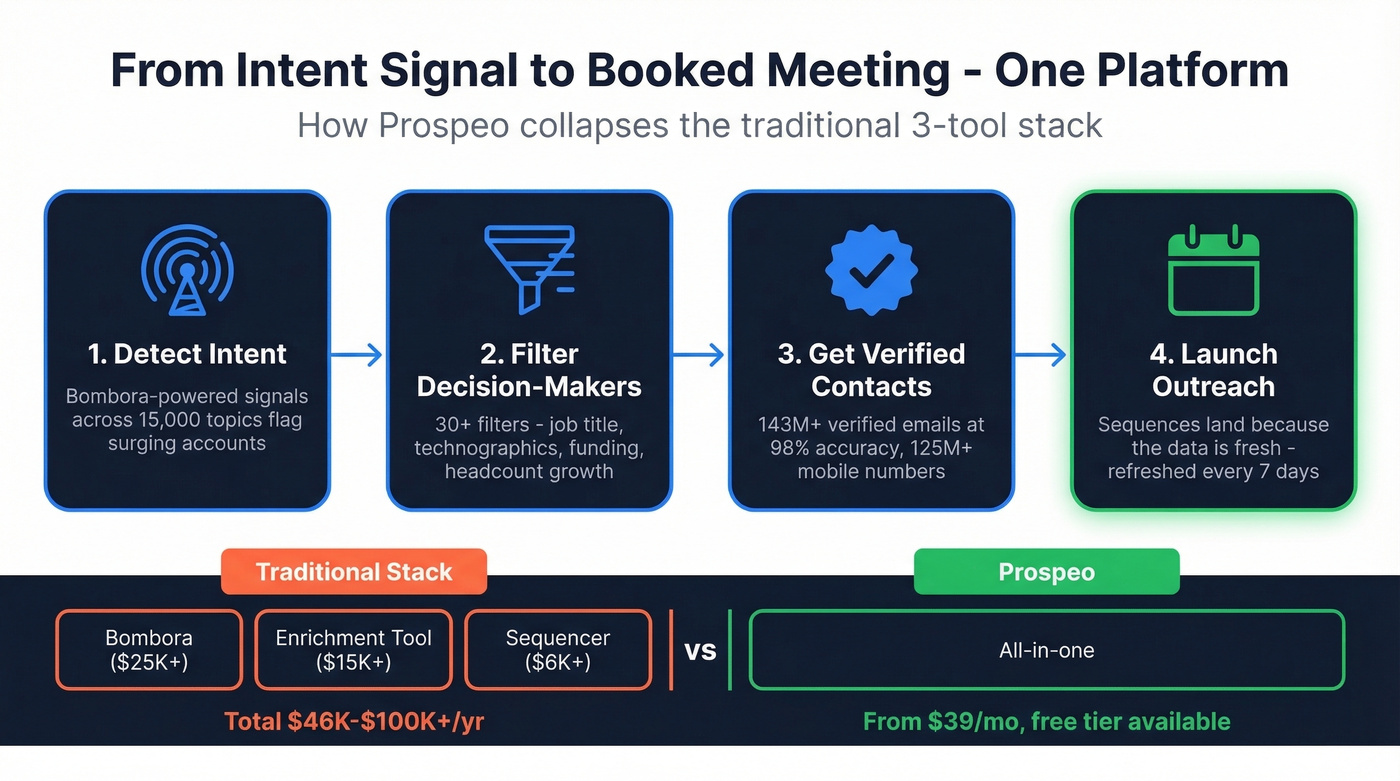
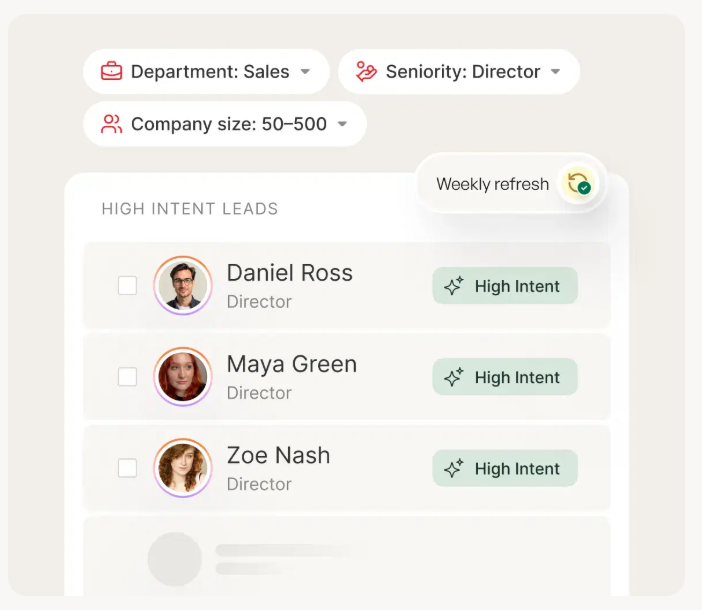
Prospeo layers 15,000 Bombora-powered intent topics on top of a proprietary contact database: 300M+ professional profiles, 143M+ verified emails, and 125M+ verified mobile numbers. The intent data tells you which accounts are researching your category. Then 30+ search filters - including technographics, job changes, funding signals, and headcount growth - let you drill into the right people at those accounts. The 98% email accuracy and 30% mobile pickup rate mean your sequences actually land.

Pricing is transparent and self-serve: roughly $0.01 per email, 10 credits per mobile, with a free tier of 75 emails plus 100 Chrome extension credits per month. No annual contracts. Data refreshes every 7 days - compared to the 4-6 week industry average - so you're acting on current signals, not stale ones. For a team spending $50K+ on Bombora or 6sense and then another $15K on an enrichment tool to actually reach contacts, Prospeo collapses that stack into one platform at a fraction of the cost.
Bombora
Use this if: You already have an activation stack - CRM, sequencer, enrichment tool - and want a pure intent signal feed.
Skip this if: You don't have a separate way to get verified contacts at surging accounts. Bombora tells you which accounts are researching. It doesn't give you emails or phone numbers.
Bombora analyzes billions of consumption events every month across a data co-op of thousands of B2B sources to detect research spikes. Its Company Surge scoring flags when an account's consumption exceeds its baseline, and Bombora offers 18,000+ intent topics. As a standalone source, it remains the most widely integrated signal feed in the market.

The tradeoff is scope. Bombora covers English-only topics, updates weekly, and doesn't include historical trend data in the standard workflow. And it's a signal source, not an activation platform - you'll need enrichment and sequencing tools on top. The median contract lands at $24,750/year, with enterprise deployments running $100K-$300K+. Annual contracts only, no monthly option. When you add enrichment, sequencing, and dialer tools on top, the total stack cost can run $73K-$200K+/year.
6sense
6sense is the most ambitious platform in this space - and the most demanding. It ingests intent signals alongside technographic, firmographic, and engagement data, then runs predictive models to assign accounts to buying stages. Unlimited keyword tracking, 40+ languages, and deep integrations with Salesforce, HubSpot, and major ad platforms.

In our testing, the predictive buying stages are genuinely useful once calibrated - but calibration takes 2-3 months and a dedicated RevOps person. The median annual contract is $58,617, but enterprise implementations with expanded TAM modules and professional services regularly hit $150K-$300K+. There's a free tier with 50 credits/month, but intent features require paid plans. 6sense wins over ZoomInfo on predictive buying stages and multi-language coverage. ZoomInfo still wins on simpler setup and a more accessible database for teams without dedicated ops.
Demandbase
Demandbase takes a fundamentally different approach to signal collection. Instead of a publisher co-op, it pulls from bidstream data across roughly 3 million sites, plus partner intent and first-party signals. The result: 575,000+ topics, 133 languages, and one year of historical data - significantly broader coverage than co-op-only models.
The advertising integration is the real differentiator. If your ABM strategy includes display ads targeted at surging accounts, Demandbase is the only platform that natively orchestrates intent signals into ad campaigns. The median contract runs $65,981/year, with Basic tiers starting around $18K-$24K and enterprise deals reaching $300K+. Onboarding alone costs ~$29K. The catch: Demandbase is primarily account-level intent. If you need person-level signals - who specifically at the account is researching - you'll need to layer in a contact enrichment tool.
ZoomInfo
ZoomInfo's intent data is fine. It's just overpriced for what you get.
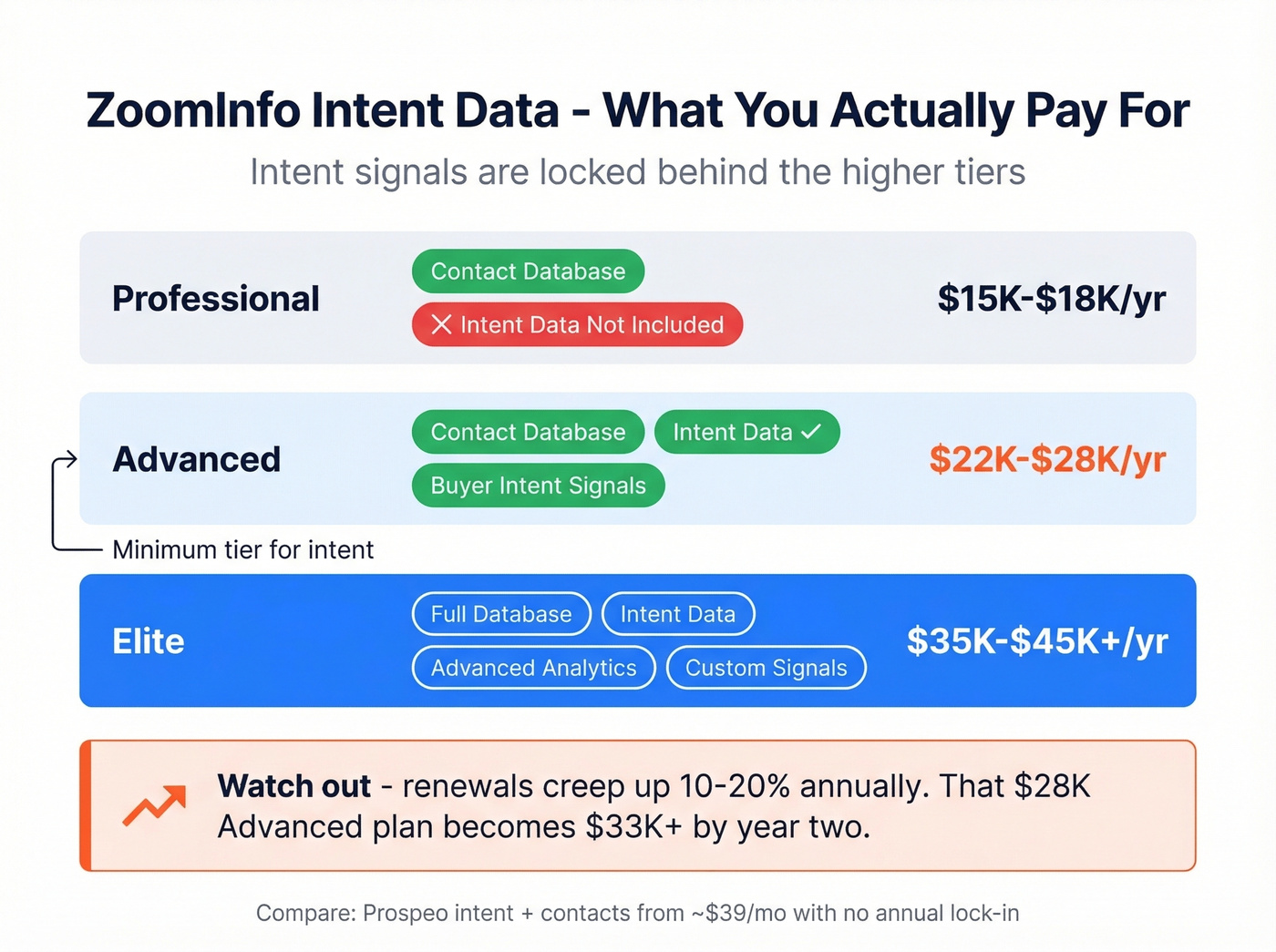
Intent signals aren't included in the Professional tier at $15K-$18K/year. You need Advanced at $22K-$28K, and the full suite typically requires Elite at $35K-$45K+. That's a lot of money for intent that's essentially a bolt-on to a contact database. Where ZoomInfo makes sense is if you're already a customer - adding intent to an existing contract is simpler than onboarding a new platform. Where it doesn't: paying $35K+ for Elite just to unlock intent signals you could get elsewhere for a fraction of the cost. Renewals also creep up 10-20% annually, so that $28K Advanced plan becomes $33K+ by year two. The #1 complaint about ZoomInfo on Reddit? Price - and specifically, paying for modules you don't use.
Cognism
European-strong database with intent data on the Elevate tier. If you're selling into EMEA and need GDPR-compliant intent signals paired with verified mobiles, Cognism is the obvious pick over ZoomInfo in that geography. Intent is Bombora-powered. Expect ~$1,000-$3,000/month for small teams, with intent requiring higher-tier plans. US database depth doesn't match ZoomInfo or Apollo.
G2 Buyer Intent
Second-party intent from actual review-site behavior - you can see which companies are comparing you against specific competitors right now. That's a fundamentally different signal than topic-level research intent. G2's data shows measurable lift in B2B buyer journeys. Pricing ranges from $10K-$87K+/year. Best for SaaS companies with active G2 profiles who want to catch buyers in the comparison phase.
TechTarget Priority Engine
Content-based intent from TechTarget's network of IT-focused media properties. If you're selling infrastructure, security, networking, or enterprise software to IT buyers, this is the most targeted intent source available. Think of it as a niche sniper rifle, not a broad intent platform. Pricing typically runs $30K-$75K/year depending on topic coverage and seat count.
Lead Forensics
Website visitor identification through IP-based deanonymization. Two plans - Essential and Automate - focused on turning anonymous website traffic into named accounts with contact details. First-party intent in its purest form. Expect ~$500-$1,500/month for mid-market.
Dealfront (formerly Leadfeeder)
Website visitor ID for European markets with a free tier. SMB-friendly alternative to Lead Forensics, now part of the broader Dealfront platform. Paid plans up to ~$99/month.
Apollo.io
Free tier through $149/user/month. Apollo added intent filters on Basic+ plans, but they're limited to 6 topics - a fraction of what dedicated providers offer. Better as a sequencer and contact database than an intent source.

Most intent data providers solve the signal problem but leave you stranded on activation. Prospeo layers 15,000 Bombora intent topics directly on top of 300M+ profiles with 98% email accuracy - so you go from surging account to verified decision-maker contact in one workflow, not three tools and $100K+ in stack costs.
Collapse your intent-to-outreach stack into one platform for $0.01 per email.
Which Provider Fits Your Team?
Skip the feature matrices. Answer three questions.
Team under 10 reps, budget under $20K/year? You need intent and contacts in one tool without a six-month implementation. Prospeo or Apollo with G2 intent layered on top.
Enterprise team, $50K+ budget, dedicated RevOps? 6sense if you want predictive buying stages. Demandbase if display ads are central to your ABM motion.
Already have an enrichment and sequencing stack? Bombora for a pure signal feed. G2 if you're SaaS and want comparison-stage signals. TechTarget if you sell to IT buyers.
For teams selling primarily into EMEA, Cognism with its Bombora-powered intent tier is the strongest option - ZoomInfo's European coverage doesn't compare. And if you've got high website traffic and want to convert anonymous visitors, Lead Forensics handles mid-market well while Dealfront covers European SMBs.
How Intent Signals Are Collected
Not all intent signals are created equal. The methodology determines what you're actually measuring, and understanding data sources is critical before you commit budget.
| Method | How It Works | Providers | Strength | Limitation |
|---|---|---|---|---|
| Co-op | Publisher content consumption pooled | Bombora | High signal quality | Weekly cadence; topic constraints |
| Bidstream | Ad-exchange bid data | Demandbase | Massive scale, 133 langs | Noisier signals |
| Review-site | Behavior on review platforms | G2, TrustRadius | High-intent actions | Narrow funnel stage |
| Predictive/web | Web + engagement + ML models | 6sense | Buying stage prediction | Complex setup |
| Visitor ID | IP deanonymization | Lead Forensics, Dealfront | First-party, high intent | Requires site traffic |
The co-op model produces high-quality third-party signals because it measures actual content consumption, not inferred behavior. Bidstream data offers massive scale but more noise. Review-site intent is the narrowest but highest-fidelity - someone comparing your product to a competitor is further down the funnel than someone reading a blog post about your category. The best implementations layer multiple sources to capture the full buying journey.
10 Intent Data Mistakes That Kill ROI
Forrester's research identified the most common mistakes. Here are the ones we see destroy pipeline:
- Treating all intent sources the same. Co-op signals, bidstream data, and review-site behavior measure different things. Weight them accordingly.
- Ignoring data decay. Intent is time-sensitive. A signal from three weeks ago isn't a signal - it's noise.
- Using intent in a vacuum. Pair it with technographics, engagement data, and firmographics. A surging account that doesn't match your ICP is still a bad lead.
- Settling for one source. Multiple varied sources are more predictive than a single feed, as long as they aren't duplicative.
- Treating signals as qualifiers. Intent indicates research activity, not purchase readiness. It should prioritize outreach, not replace qualification.
- Undervaluing first-party intent. Your own website visitors, content downloads, and product usage signals are often stronger than third-party data.
- Relying on vendors for compliance. You still need lawful basis for outreach. GDPR and privacy obligations don't transfer to your vendor.
- Failing to map signals to buying stages. A topic surge in "cloud security" means something different at the awareness stage than at the evaluation stage. Without mapping, you send the wrong message at the wrong time.
- Misaligning sales and marketing on signal definitions. If marketing considers a 70+ surge score "hot" but sales expects a demo request, both teams waste time arguing over lead quality instead of closing deals.
- Over-indexing on proprietary scoring. Every provider scores differently. If you build your entire workflow around one vendor's black-box algorithm, you're locked in - and blind to what the score actually measures.
How to Make Intent Data Work
The teams that get real ROI from buyer intent follow a consistent pattern.
Layer intent with first-party and CRM data. Raw third-party signals convert poorly on their own. Combine them with website visits, content engagement, and CRM activity to separate genuine buying behavior from casual research. Intent-driven leads that are layered properly convert 2-3x faster than cold outbound.
Pair signals with verified contact data. This is where most implementations fail. You've got 200 surging accounts in a dashboard - now what? Without verified emails and direct dials for the right decision-makers, those signals sit in a spreadsheet. We've watched teams spend months building dashboards only to stall because nobody could reach the actual buyers.
Set SLAs for follow-up speed. Intent signals decay fast. If your BDR team takes a week to act on a surge, you've already lost the window. Best-in-class teams respond within 24-48 hours.
Use multiple signal sources. Combine co-op intent from Bombora, review-site signals from G2, and your own first-party data. No single source captures the full picture.
Calculate your total stack cost before signing. In our experience, the biggest budget surprise isn't the license - it's everything else. A $25K Bombora contract needs enrichment ($10K-$15K), a sequencer ($5K-$12K), a dialer, and CRM integration. That $25K becomes $73K-$200K+ before you've sent a single email. Map the full stack cost before committing.
That 61% of teams waiting 6+ months for intent ROI? They're stuck because signals without verified contacts are just expensive dashboards. Prospeo refreshes data every 7 days and delivers 30% mobile pickup rates - meaning your reps reach real buyers at surging accounts this week, not next quarter.
Turn intent signals into booked meetings without a second enrichment tool.
Intent Data Provider FAQ
What is an intent data provider?
A company that tracks online research behavior - content consumption, search activity, review-site visits - to identify which businesses are actively exploring a solution category. The output is a scored list of accounts showing elevated interest. B2B-focused providers help sales and marketing teams prioritize accounts most likely to convert based on buying-signal intensity.
First-party vs. third-party intent: what's the difference?
First-party comes from your own properties: website visits, app usage, content downloads. Third-party comes from external networks like content co-ops, bidstream, or review sites. Best results come from layering both - first-party signals are higher quality, third-party gives broader market coverage.
How much does intent data cost?
Standalone feeds like Bombora typically run $25K-$80K/year. Full ABM platforms with intent like 6sense and Demandbase cost $50K-$150K+/year. Budget-conscious teams can get Bombora-powered intent with verified contacts starting free through Prospeo, which bundles both capabilities at roughly $0.01 per email.
How long until I see ROI?
Most teams report 3-6 months. 61% of B2B teams say it takes six months or longer. Speed depends on activation workflows - how fast you turn a surging account into a booked meeting - not just the data itself.
Can I get intent data and verified contacts in one tool?
Yes. Prospeo combines 15,000 Bombora-powered intent topics with 300M+ verified profiles, so you can identify surging accounts and reach decision-makers without a separate enrichment tool. Most other providers require a second platform for contact data, adding $10K-$15K/year to your stack.