

How to Build an Internal Sales Process That Actually Works
Ask five reps to describe your sales process and you'll get six answers. In recent data, 75% of sales reps missed quota, and reps spend roughly 30% of their time actually selling. The other 70% vanishes into admin, internal meetings, and chasing bad data.
A documented internal sales process won't fix everything, but it fixes the thing that makes everything else possible: consistency.
Here's the thing - most companies don't need a better CRM. They need an actual sales playbook with stages tied to exit criteria, enforced handoffs, and clean data underneath. That alone puts you ahead of most B2B teams we've talked to.
What Is an Internal Sales Process?
An internal sales process isn't the same as "inside sales." Inside sales is a selling model - remote reps instead of field reps. An internal sales process is the documented workflow your team follows to move a deal from first touch to close, regardless of where reps sit.
Most companies think they have one because there's a CRM dropdown with stages like "Qualified" and "Negotiation." That's not a process. A real process has exit criteria tied to buyer actions, required fields at each stage, and handoff SOPs between roles. Modern B2B buying involves 6-10 stakeholders per decision, and some sources cite up to 13. Buyers are roughly 70% through their journey before they ever talk to sales. Without a structured process, your reps are navigating that complexity on instinct alone - and instinct doesn't scale.
7 Stages With Exit Criteria
Seven stages, each gated by something the buyer does - not something the rep believes.
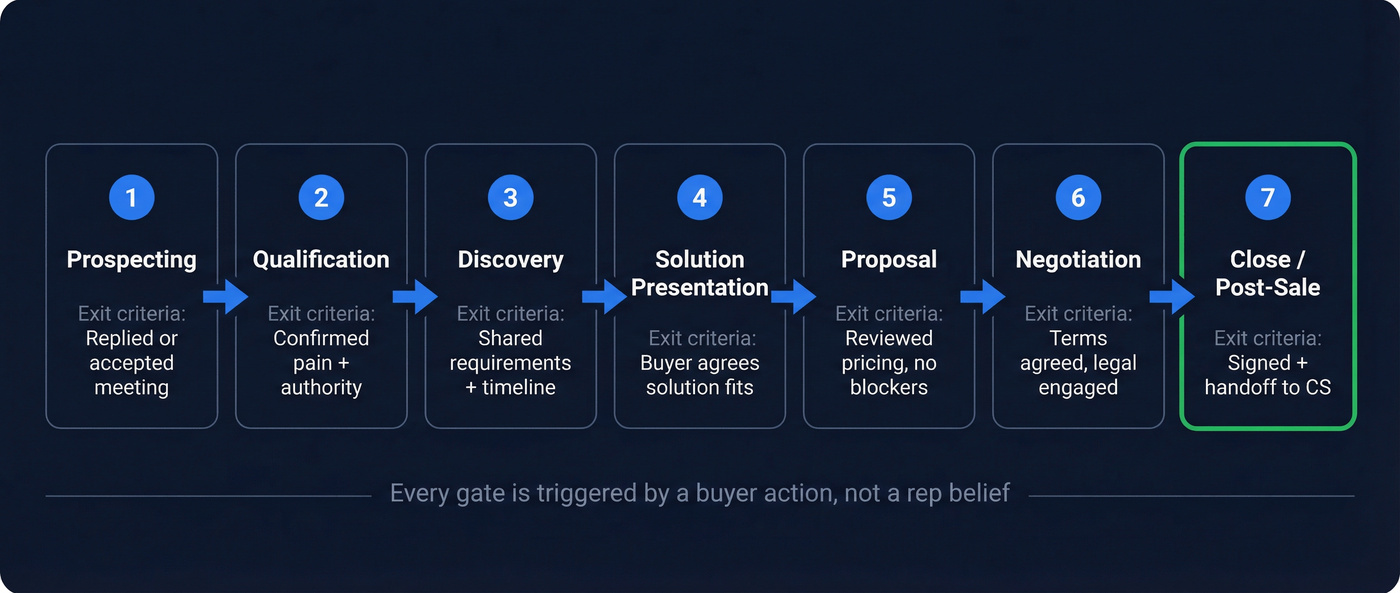
| Stage | Exit Criteria (Buyer Action) | Key CRM Fields |
|---|---|---|
| Prospecting | Replied or accepted meeting | Lead source, ICP fit |
| Qualification | Confirmed pain + authority | Framework score, budget |
| Discovery | Shared requirements + timeline | Use case, decision date |
| Solution Presentation | Agreed solution fits need | Demo completed, champion |
| Proposal | Reviewed pricing, no blockers | Proposal sent date, amount |
| Negotiation | Terms agreed, legal engaged | Redline status, approvers |
| Close / Post-Sale | Signed + handoff to CS | Close date, contract value |
For qualification frameworks: BANT works for SMB deals where budget and authority are binary. MEDDICC is the move for enterprise, where you need to map metrics, economic buyers, and paper processes. Pick one and enforce it. The worst outcome is reps using different frameworks on the same team.
Prospecting and Qualification
Your process starts with reachable contacts. Cold email reply rates average mid-single digits. Cold call conversions run 2-3%. Those numbers only work at scale if the data underneath is clean - Prospeo delivers 98% verified emails on a 7-day refresh cycle, so reps spend time selling instead of debugging bounced addresses.
The qualification gate is where most pipelines get polluted. Win rates increase 3.1x when deals align with your ideal customer profile, which means qualification isn't just filtering - it's the single highest-leverage stage in your pipeline. A deal shouldn't advance unless the prospect has confirmed a real business problem and the rep has identified someone with authority.
If your CRM shows 80% of deals "qualified" but only 30% closing, your exit criteria are too loose. Full stop.
Discovery Through Close
Discovery is where reps earn the right to present. The buyer should share specific requirements, a timeline, and who else is involved. Solution presentation isn't a generic demo - it's a tailored walkthrough mapping your product to problems uncovered in discovery. The exit criterion is the buyer agreeing the solution fits, not the rep marking "demo completed."
Proposal stage means the buyer has seen pricing without deal-killing objections. Negotiation means legal is engaged. Close means ink on paper and a clean handoff to customer success.
Each stage should have a maximum age. Deals that stretch 30 days past your average cycle see close rates drop 60%. If a deal is aging out, either re-qualify it or kill it. Dead weight in your pipeline warps every forecast you build.
Conversion Benchmarks by Industry
What "good" looks like by industry, based on FirstPageSage's funnel benchmarks:
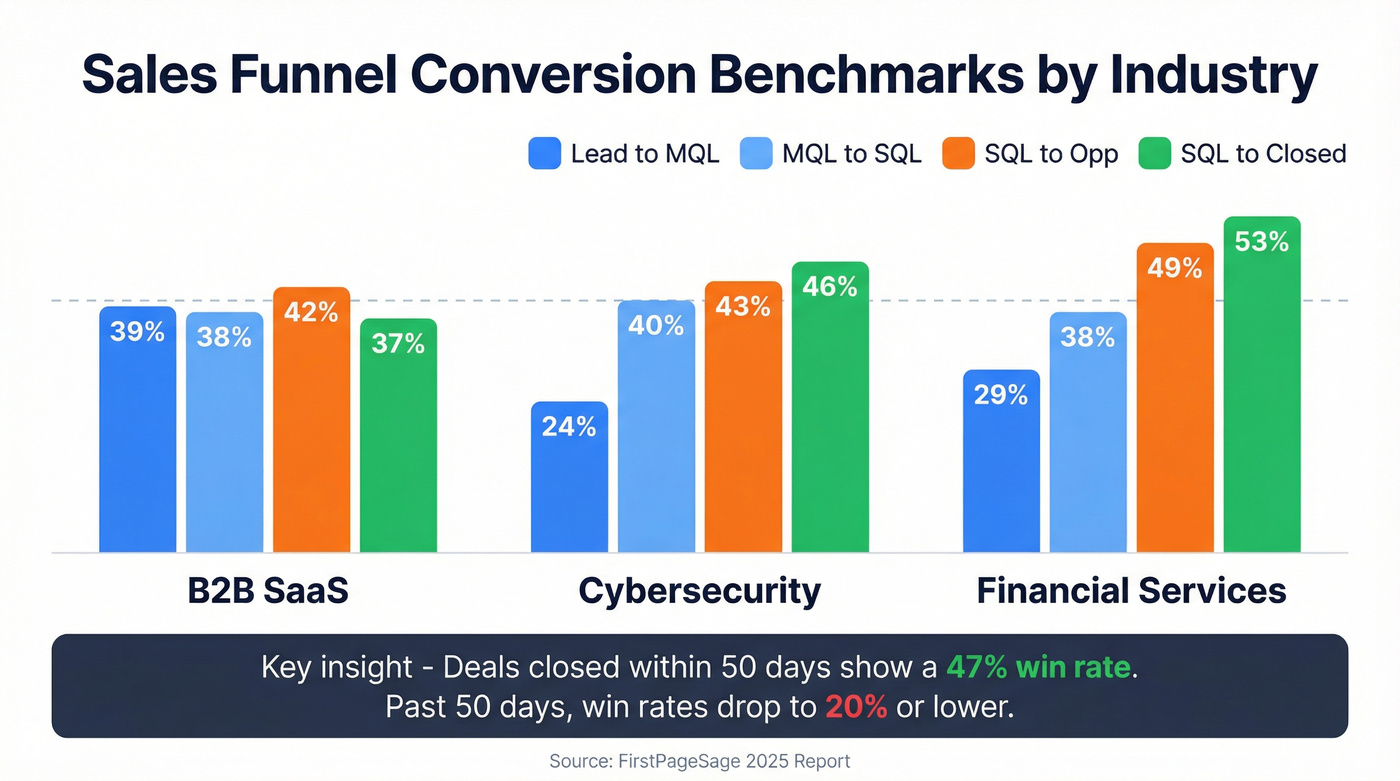
| Industry | Lead to MQL | MQL to SQL | SQL to Opp | SQL to Closed |
|---|---|---|---|---|
| B2B SaaS | 39% | 38% | 42% | 37% |
| Cybersecurity | 24% | 40% | 43% | 46% |
| Financial Services | 29% | 38% | 49% | 53% |
The benchmark that matters most: deals closed within 50 days show a 47% win rate. Past 50 days, win rates crater to 20% or lower. If your average B2B cycle runs 60-120 days, deal velocity through early stages is everything.
The stages where you can compress time the most are prospecting - better data means faster connects - and qualification, where tighter criteria mean fewer wasted cycles. Only 43.5% of sales professionals hit quota recently. Speed and focus are the levers that separate them from the rest.
Sales Process vs. Marketing Process
One of the most common alignment failures we see is treating sales and marketing as a single funnel. The distinction matters: marketing generates demand and nurtures leads to MQL status, while your internal sales process picks up from there to qualify, present, negotiate, and close.
When both teams share a single pipeline view without clear ownership boundaries, leads stall in no-man's-land between MQL and SQL. Define the exact handoff point - typically when a lead meets your ICP criteria and has taken a high-intent action - and hold both sides accountable with SLAs. Marketing owns the lead until it hits the criteria. Sales owns it from there. No gray area.

Your prospecting stage is gated by one thing: reachable contacts. Prospeo's 98% verified emails on a 7-day refresh cycle mean reps hit real inboxes instead of debugging bounces. At $0.01 per email, clean data stops being a budget conversation and starts being a pipeline multiplier.
Stop losing deals at Stage 1 because your contact data is stale.
The SDR-to-AE Handoff
This is where deals go to die. Let's be honest - we've watched teams lose winnable deals because the handoff was a Slack message that said "they seemed interested."
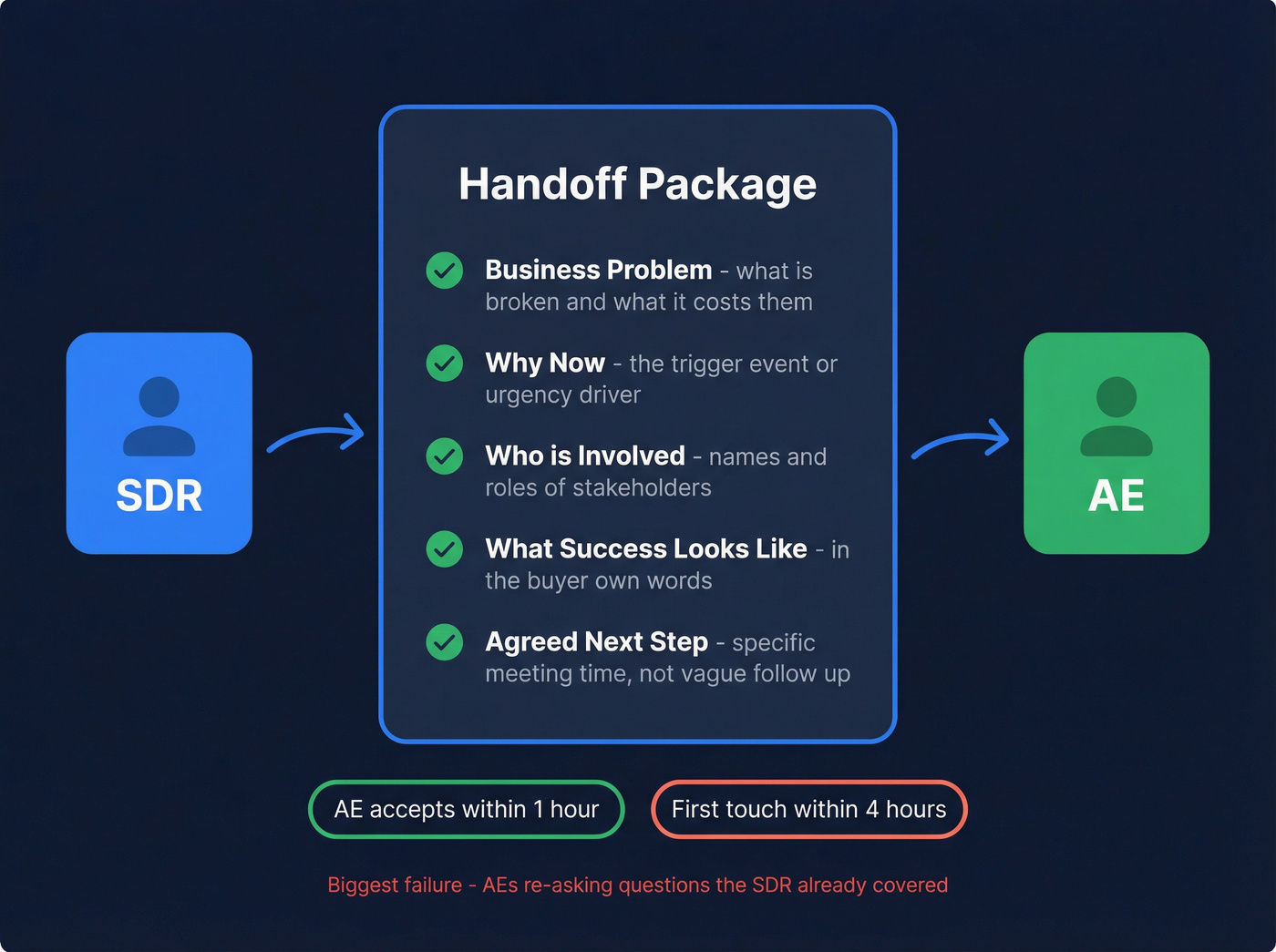
The handoff package should include five fields, non-negotiable:
- Business problem - what's broken and what it's costing them
- Why now - the trigger event or urgency driver
- Who's involved - names and roles of stakeholders identified
- What success looks like - the buyer's own words
- Agreed next step - specific meeting time, not "they said to follow up"
The most common failure: AEs re-asking qualification questions the SDR already covered. That kills credibility instantly. Every piece of discovery - call notes, email threads, qualification scores - should transfer with the deal record, not live in the SDR's head. Set an SLA: AE accepts the handoff within 1 hour, first touch within 4 hours. As one rep on r/sales put it, it's "easy to go in 10 different directions every day" when there's no clean handoff structure.
Internal Selling - Your Own Company
The negotiation that kills deals often happens inside your company, not with the buyer. Sales vs. finance on discount approval. Sales vs. legal on contract redlines. Every hour your deal sits in internal limbo is an hour the buyer is talking to a competitor.
Build guardrails before reps need them:
- Discount thresholds - what's auto-approved, what needs manager sign-off, what goes to deal desk
- Clause library - pre-approved fallback language so legal isn't a bottleneck
- Escalation paths - who approves what, with response-time SLAs
Skip this if you're a five-person startup where the founder approves everything in real time. But the moment you have two AEs and a deal desk, write it down.
Tools That Make It Work
You need three layers. Everything else is optional until you're past $5M ARR.
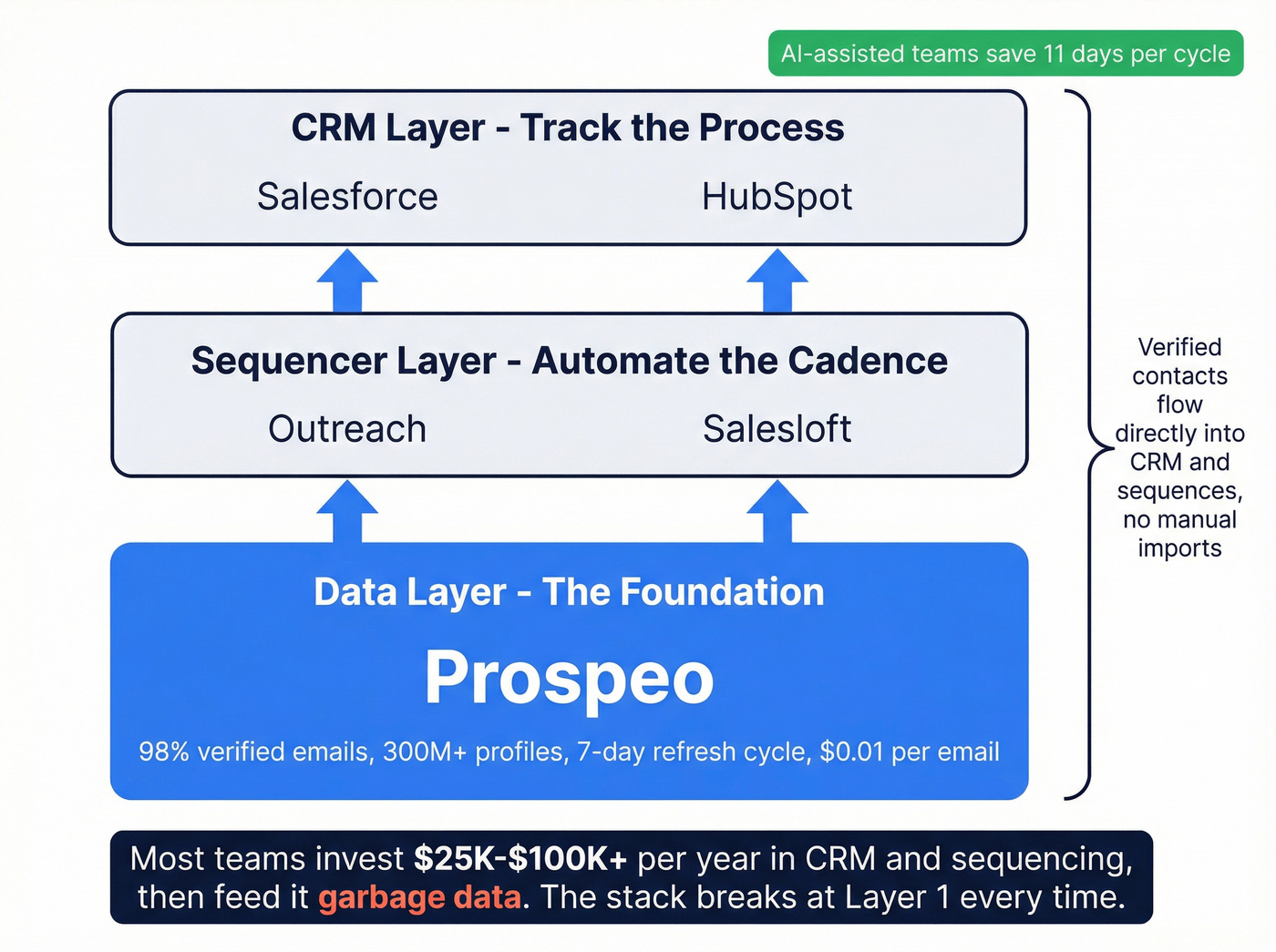
Your CRM tracks the process - Salesforce or HubSpot (see examples of a CRM if you’re standardizing). Your sequencer automates the cadence - Outreach or Salesloft. Your data layer feeds both of those tools with something real to work with.
This is where most stacks break down. Teams invest $25K-$100K+/year in CRM and sequencing infrastructure, then feed it garbage data from a free scraping tool. The process collapses at Stage 1 every time. In our experience, the data layer is the most underinvested part of the stack and the one with the highest ROI when you get it right. Prospeo plugs into this stack natively - Salesforce, HubSpot, Smartlead, Instantly, Lemlist, and Clay integrations mean verified contacts flow directly into your CRM and sequences without manual imports.
Teams using AI-assisted coaching are shaving roughly 11 days off their sales cycles, and automation can free about 20% of seller capacity. That capacity only matters if reps are reaching real people at real numbers, which circles back to data quality as the foundation of everything above it (more on data enrichment services).

Using Customer Feedback to Improve
A strong internal sales process isn't static. It evolves based on what buyers actually experience. Run a quarterly review: pull closed-lost reasons from your CRM, survey recent buyers on their purchase experience, and compare win/loss patterns against your stage exit criteria.
I've seen teams discover that their "Negotiation" stage was actually where deals died because legal turnaround took 12 days - not because pricing was wrong. That's the kind of insight you only get by systematically reviewing the data. The teams that act on this feedback shorten cycles and improve conversion rates faster than those relying on rep intuition alone.
If you want a more formal approach, borrow a few pipeline health checks and review them alongside stage aging.
Every stage in your internal sales process depends on talking to the right person. Prospeo gives you 300M+ profiles with 30+ filters - buyer intent, job changes, headcount growth - so reps qualify faster and waste fewer cycles on bad-fit leads.
Tighter qualification starts with better data. Teams book 26% more meetings with Prospeo.
FAQ
What's the difference between an internal sales process and inside sales?
Inside sales is a selling model - remote reps closing deals by phone, email, and video. An internal sales process is the documented workflow for moving deals from first touch to close, regardless of where reps sit. You can run an internal sales process with field reps, inside reps, or a hybrid team.
How many stages should a sales process have?
Seven is the sweet spot for most B2B teams. Fewer and you lose pipeline visibility; more and reps stop updating the CRM. Buyer-action exit criteria matter more than the stage count itself.
How do I know if my sales process is broken?
Three red flags: reps describe different steps for the same deal type, forecasted deals slip more than 30% of the time, or your SDR-to-AE handoff requires re-asking qualification questions. Fix the data layer first with verified contacts, then document stages with exit criteria.
What's the best free tool for sales process data quality?
Prospeo offers 75 free email credits plus 100 Chrome extension credits per month - enough for a solo founder or small team to validate their prospecting stage. For teams running real outbound, that free tier covers more ground than most alternatives.