

Is Cold Emailing Illegal? What the Law Says in 2026
Cold emailing isn't banned in any major market. But "legal" and "unregulated" are very different words, and the gap between them is where companies get fined, domains get blacklisted, and sales teams lose months of pipeline. Each separate email that violates CAN-SPAM can cost up to $53,088 in penalties - per message, not per campaign.
Here's what actually kills most outbound programs, though: it's not a regulator knocking on the door. It's sending to bad data, triggering spam complaints, and watching inbox providers torch your domain reputation in a week.
The Short Answer: Regulated, Not Banned
Cold email is legal in the US, UK, EU, Canada, and Australia. Three things actually bite.
Jurisdiction-specific rules like CAN-SPAM, GDPR, CASL, and PECR each carry different consent models and penalty structures. State-level liability that most guides ignore entirely - Washington's CEMA carries $500 per email plus treble damages. And deliverability death from bad data, which hits faster and harder than any regulator ever will.
Cold Email vs. Spam
The distinction matters more than most people think.
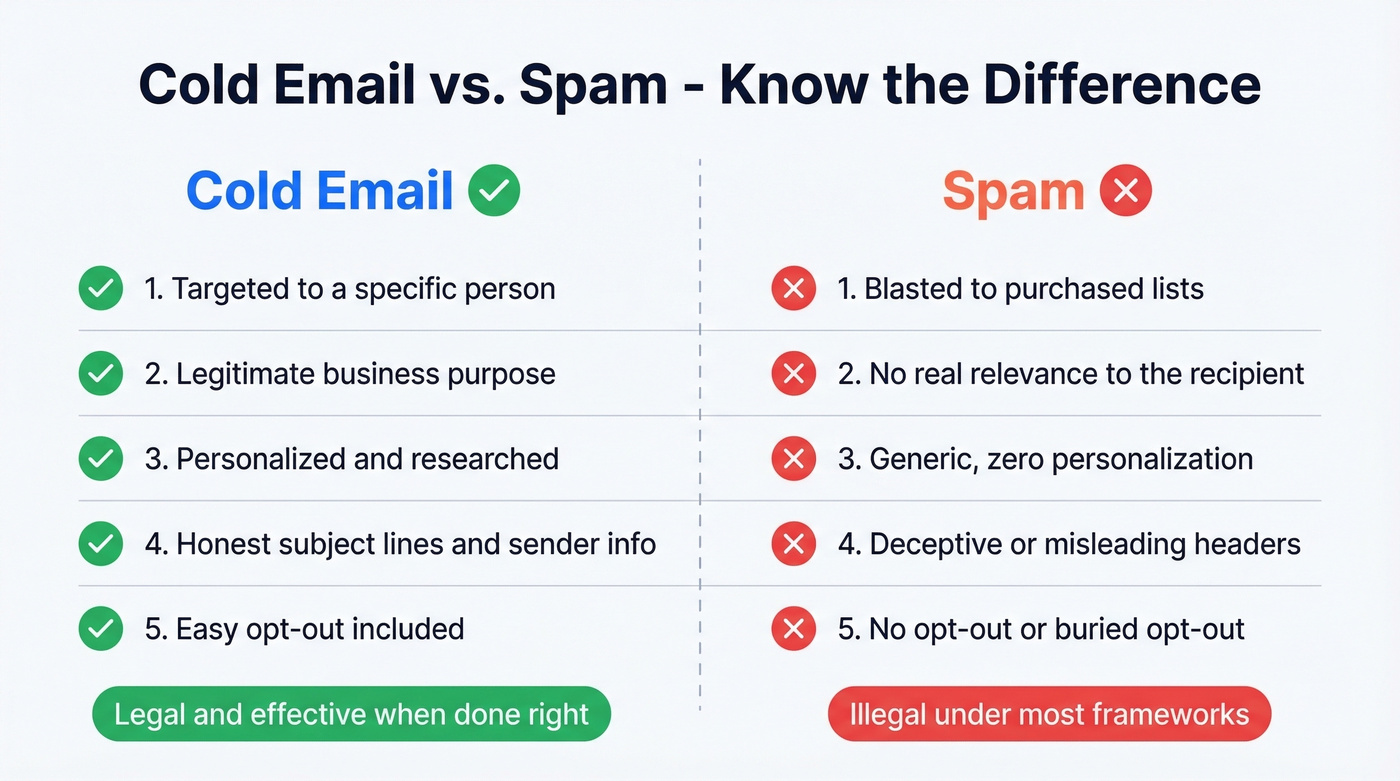
Cold email is targeted outreach to a specific person for a legitimate business purpose. Spam is the kind of outreach that gets people and inbox providers angry fast: irrelevant, deceptive, and sent at scale with zero respect for opt-outs. A GMass analysis puts it plainly: cold email is buyer-centric, honest about its purpose, and sent to researched contacts. Spam is none of those things.
If you're personalizing outreach to qualified prospects using legitimately sourced data, you're on the right side of the line. If you're blasting 50,000 addresses you bought from a list broker, you're not.
Cold Email Laws by Jurisdiction
US - CAN-SPAM Act
CAN-SPAM is an opt-out framework, not opt-in. You don't need permission to send the first email. Here are the seven specific requirements:
- No false or misleading header information - your "From," "To," and "Reply-To" fields must accurately identify you.
- No deceptive subject lines - the subject must reflect the email's content.
- Identify the message as an ad - flexibility in how, but it must be clear.
- Include a valid physical postal address - street address, registered P.O. box, or private mailbox.
- Provide a clear opt-out mechanism - easy to find, easy to use.
- Honor opt-out requests within 10 business days - no fees, no extra info required.
- Your opt-out mechanism must work for at least 30 days after sending.
One thing most guides get wrong: there's no B2B exception. The FTC is explicit - "The law makes no exception for business-to-business email." B2B cold email legal requirements are identical to B2C requirements under CAN-SPAM.
And the penalty figure? Most articles still cite $50,120. The current adjusted figure is $53,088 per violating email. If a vendor or agency sends on your behalf, both parties can be held liable under the "primary purpose" framework in 16 CFR Part 316.
State Laws Most Guides Skip
CAN-SPAM doesn't preempt all state laws. Washington's Commercial Electronic Mail Act (CEMA) is the one to watch.
In Brown v. Old Navy (Apr 17, 2025), the Washington Supreme Court held that advertisers can't send commercial emails with any false or misleading factual information in the subject line. Damages? $500 per violation, plus potential treble damages under Washington's Consumer Protection Act. Then on Jan. 14, 2026, Ma v. Nike confirmed that CAN-SPAM doesn't preempt CEMA's deceptive-subject-line provisions.
The practical takeaway: "Best deal of the year" is puffery - fine. "50% off ends tonight" when the sale runs through Friday is a factual misrepresentation - actionable at $500 per email sent to a Washington resident. We've seen teams get burned by this exact scenario, and the math gets ugly fast when you're sending thousands of emails.
EU - GDPR + ePrivacy
If your VP of Legal says cold email "doesn't follow GDPR," they're half-right but mostly wrong. This is the single most common misconception on r/coldemail, and it kills outbound programs before they start.
B2B cold outreach across the EU is commonly done under GDPR's "legitimate interest" lawful basis, but ePrivacy rules - implemented differently by each member state - can still change what's allowed and when opt-in is required. Whether cold outreach is lawful in Europe doesn't have a single answer; it depends on the country.
If you're using legitimate interest, you need to document a Legitimate Interest Assessment covering three tests: there's a real commercial reason, the data processing is necessary to achieve it, and the recipient's privacy rights don't override your interest. That documentation is what separates compliant outreach from a GDPR violation. Skip it, and you're gambling with fines up to EUR20M or 4% of global revenue.
UK - PECR
The UK is more permissive for B2B than most people realize. PECR Regulation 22(3) creates a corporate subscriber consent carve-out, which is why B2B cold email to corporate subscribers is widely used without prior opt-in consent.
There's a myth floating around Reddit's digital marketing communities that you can only email generic inboxes like info@ or sales@. That's not what the corporate subscriber concept means. You can email named individuals at corporate addresses - you still need to identify yourself, provide an opt-out, and handle the personal data under UK GDPR.
Canada - CASL
Canada is one of the strictest major markets. Period.
CASL requires either express or implied consent before sending commercial electronic messages. Implied consent can cover existing business relationships, but the bar is much higher than CAN-SPAM's opt-out model. Sending without some form of consent is a violation, and enforcement is real: Gap Inc. settled for $200,000, OneClass paid $100,000, and the government's CASL enforcement hub logged over 208,083 spam complaints in the Oct 2024-March 2025 reporting period alone. Maximum penalties run up to $10M CAD for businesses.
Australia
Australia requires a 5-working-day unsubscribe processing window and keeps opt-out mechanisms functional for 30 days. Enforcement is active - Australia's ACMA collected more than AU$14 million in spam-related penalties between 2023 and 2025. Don't treat this market as an afterthought.

Bad data is the fastest way to torch your domain reputation - and regulators aren't far behind. Prospeo's 5-step verification, spam-trap removal, and honeypot filtering deliver 98% email accuracy, so every cold email lands in a real inbox. No bounces tanking your sender score. No complaints from dead addresses.
Stay compliant and connected - start with 75 free verified emails.
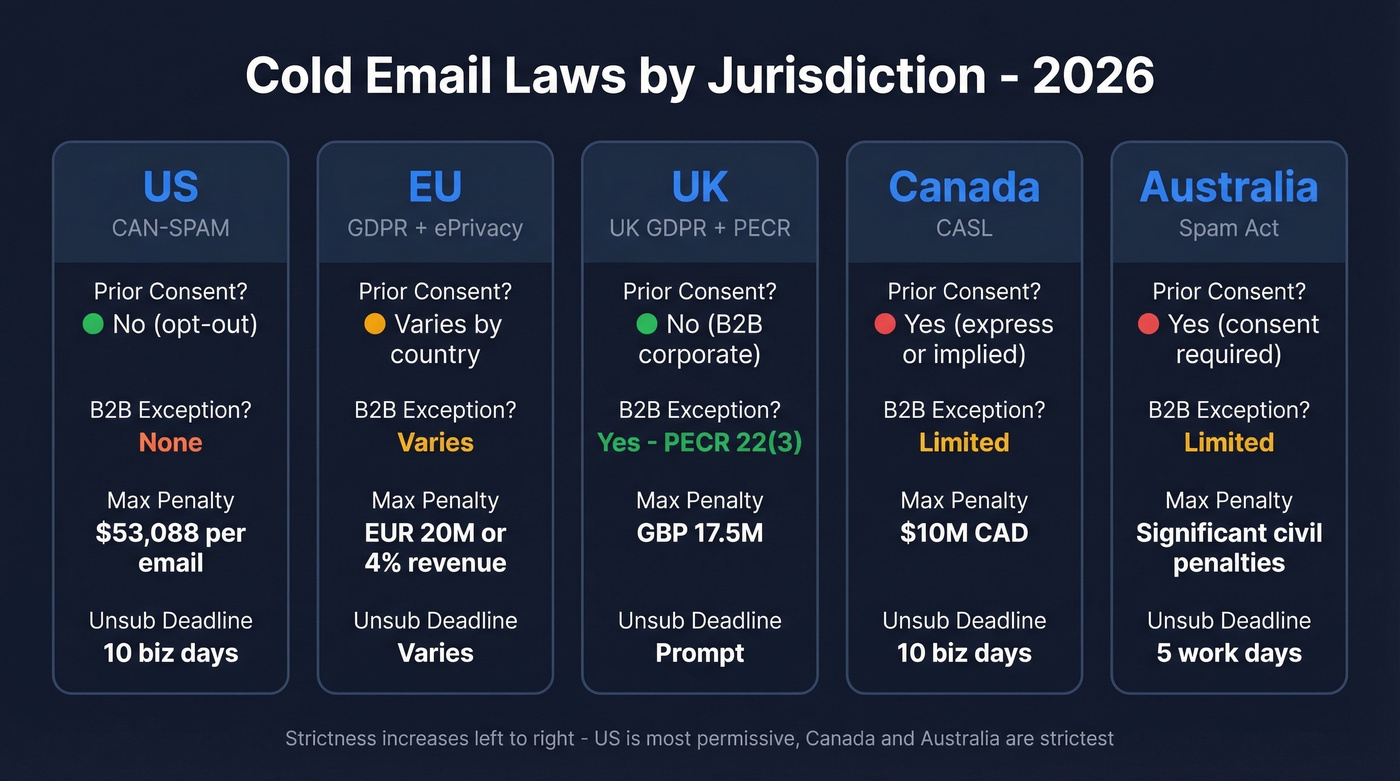
Jurisdiction Comparison Table
| Region | Key Law | Prior Consent? | B2B Exception? | Max Penalty | Unsub Deadline | Enforcer |
|---|---|---|---|---|---|---|
| US | CAN-SPAM | No (opt-out) | None | $53,088/email | 10 biz days | FTC |
| EU | GDPR + ePrivacy | Varies by country | Varies | EUR20M or 4% rev | Varies | DPAs |
| UK | UK GDPR + PECR | No (B2B corporate subscribers) | Yes (PECR 22(3)) | GBP17.5M | Prompt | ICO |
| Canada | CASL | Yes (express/implied) | Limited | $10M CAD | 10 biz days | CRTC |
| Australia | Spam Act | Yes (consent required) | Limited | Significant civil penalties | 5 work days | ACMA |
Deliverability Is the Real Enforcement
Let's be honest: inbox providers can tank your deliverability in days. Regulators take months. For most outbound teams, deliverability is the enforcement mechanism that actually bites.
At a minimum, authenticate your domain with SPF, DKIM, and DMARC, keep complaint rates low, and include a clear unsubscribe in every message. If you trigger enough complaints, your emails stop reaching inboxes. The consensus on r/coldemail is that consumer recipients spam-report far more aggressively than B2B contacts, which is why B2C cold email is technically legal but practically treacherous.
If you're selling deals under $10k and running B2C cold email, you're lighting money on fire. The spam complaint rate alone will torch your domain before you close enough deals to justify the risk.
Your list quality is your first line of defense. Bouncing off invalid addresses is the fastest way to tank sender reputation - we've watched teams go from 95% deliverability to under 60% in a single week because they skipped verification. Prospeo's 5-step verification catches invalid addresses, spam traps, and catch-all domains before they destroy your deliverability, delivering 98% email accuracy with data refreshed every 7 days.

How to Send Cold Emails Legally
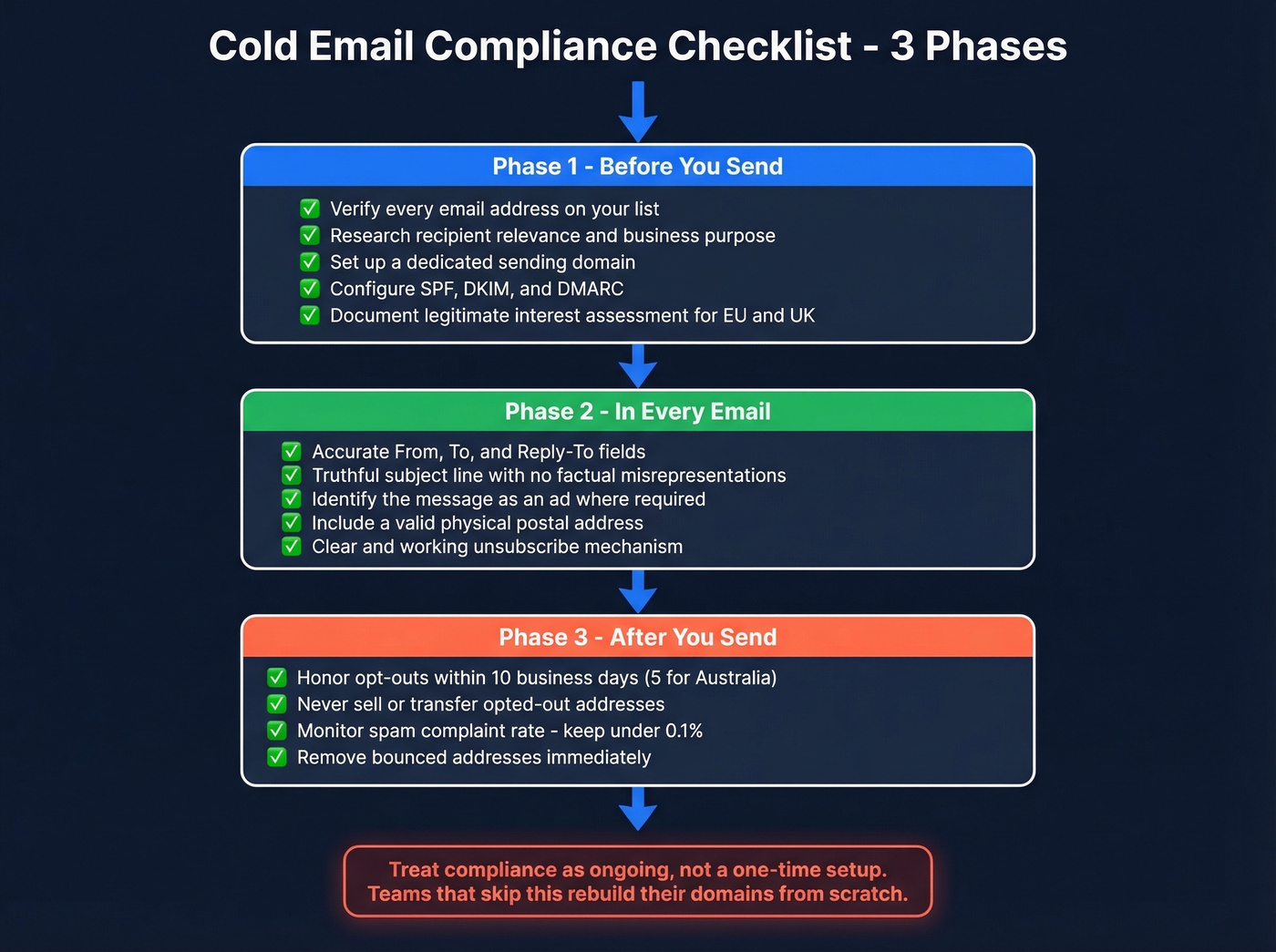
Before You Send
- Verify every email address on your list - bouncing off invalid addresses is the fastest way to kill your domain (see email bounce rate)
- Research recipient relevance - can you articulate a legitimate business purpose for this specific email?
- Set up a dedicated sending domain, not your primary corporate domain
- Configure SPF, DKIM, and DMARC authentication
- If targeting EU/UK prospects, document your legitimate interest assessment
In Every Email
- Accurate sender information in From, To, and Reply-To fields
- Truthful subject line - no factual misrepresentations (remember Washington CEMA) (use these cold email subject line examples)
- Identify the message as an ad where required
- Include a valid physical postal address
- Clear, working unsubscribe mechanism
After You Send
- Honor opt-out requests within 10 business days (5 working days for Australia)
- Never sell or transfer opted-out email addresses
- Monitor spam complaint rate - keep it under 0.1% (track with email reputation tools)
- Remove bounced addresses immediately and don't retry them
Skip the checklist at your own risk. In our experience, teams that treat compliance as a one-time setup instead of an ongoing process are the ones who end up rebuilding their domain reputation from scratch six months later (here’s how to improve sender reputation).
GDPR, CAN-SPAM, and CASL all demand you know who you're emailing. Prospeo's 300M+ profiles are refreshed every 7 days - not the 6-week industry average - so you're never sending to outdated contacts that trigger complaints and put your domain at risk. Every record passes catch-all verification and spam-trap removal before you ever see it.
Clean data is your first line of compliance defense. Try Prospeo free.
FAQ
Is B2C cold email illegal?
No. CAN-SPAM covers all commercial email - B2B and B2C alike - with no distinction. The practical risk with B2C is much higher spam complaint rates, which destroy sender reputation faster than any regulator acts. Legal doesn't mean safe for your domain.
Do I need consent to send B2B cold email in the US?
No. CAN-SPAM is opt-out, not opt-in. You can send the first email without prior permission as long as you include accurate sender info, a truthful subject line, a physical address, and a working unsubscribe. Honor opt-outs within 10 business days.
Can I cold email prospects in Europe?
Yes, B2B cold outreach is common across Europe under GDPR's "legitimate interest" basis, but rules vary by country because ePrivacy directives are implemented differently. In the UK, PECR's corporate subscriber carve-out makes B2B outreach more straightforward. Document your lawful basis and honor opt-outs promptly.
How do I avoid deliverability problems when sending cold email?
Verify every address before sending - bounces above 3-4% trigger inbox-provider penalties fast. Authenticate with SPF, DKIM, and DMARC, keep complaint rates under 0.1%, and remove bounced addresses immediately. The single biggest factor is list quality: bad data ruins everything else you do right.