

Is Email Verification Necessary? The Data-Backed Answer
Every vendor article asking this question gives the same answer: yes, absolutely - now buy our tool. That's lazy. The real answer depends on what you're doing with those addresses, and the stakes vary wildly between a cold outbound campaign and a SaaS signup form.
Let's be honest: we sell verified email data, so we've got skin in this game. But we've also watched enough teams torch their domain reputation from a single unverified blast to know the answer isn't always a blanket "yes."
The Quick Answer
Almost always yes - but the type of verification and when you enforce it depends on your use case.
- Sending cold outbound or marketing emails? Non-negotiable. Verify every address before you hit send.
- Building a SaaS signup flow? Verify before critical actions, not before first use.
- Low-stakes app where email is just a username? You can delay or skip it entirely.
Validation vs. Verification vs. Authentication
Validation checks whether an email could exist - correct format, real domain. It catches typos like
gmial.combut can't confirm the mailbox is actually there.Verification checks whether the mailbox exists and can receive mail via MX lookups, SMTP checks, and catch-all detection. This prevents hard bounces.
Authentication is sender-side setup - SPF, DKIM, DMARC records that prove you are who you say you are.
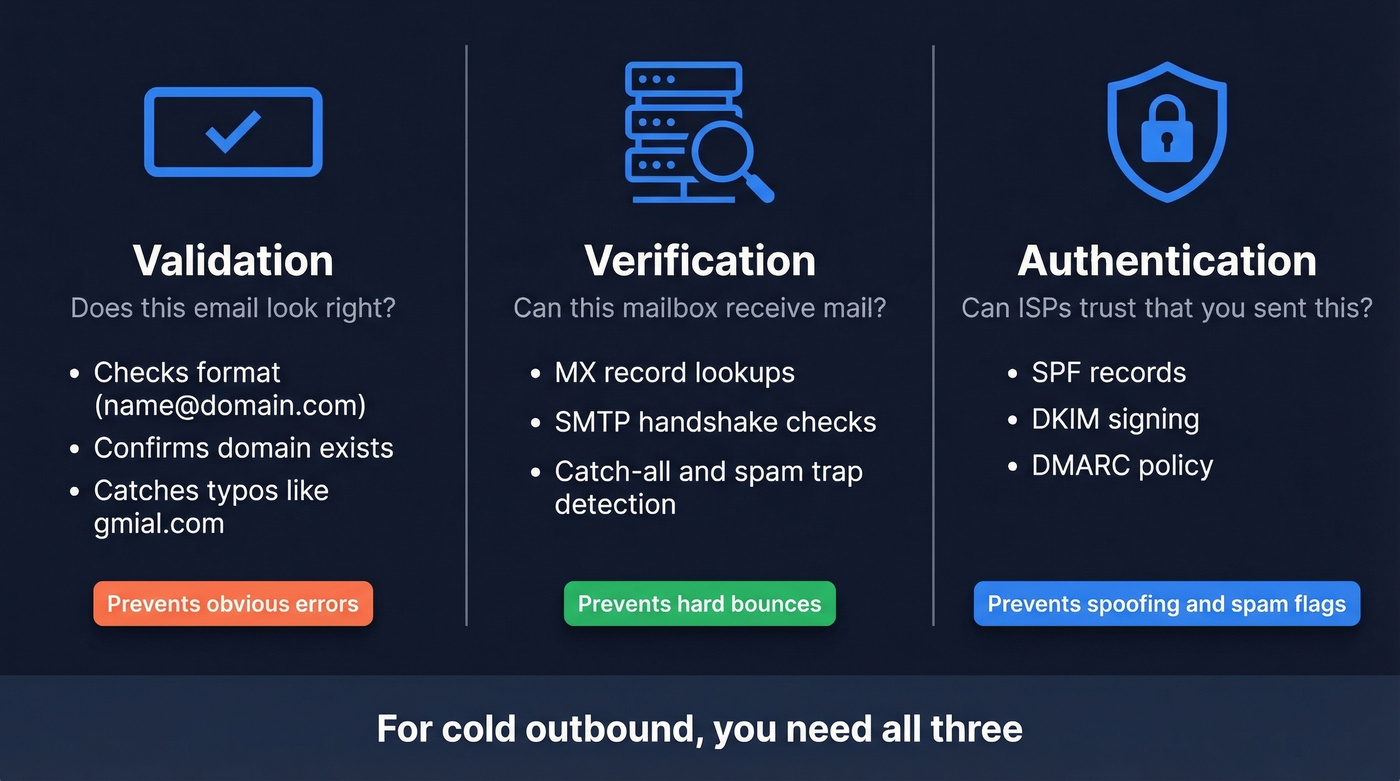
When people ask whether email verification is necessary, they mean the middle one. For outbound, you need all three - plus a solid email deliverability foundation.
Why Verification Is Non-Negotiable for Outbound
Email lists rot faster than most teams realize. At least 23% of an email list degrades yearly, and only 62% of emails submitted to ZeroBounce in 2024 were actually valid. In B2B, decay hit 3.6% in a single month during late 2024 - nearly double the traditional 1.5-2% baseline. On top of that, 9%+ of emails checked were catch-all addresses: domains that accept everything, making it impossible to know if the specific mailbox is real without deeper verification.

That decay compounds. If you haven't touched a list in six months, around 10-12% of it can be dead - and that's before you factor in job changes, role changes, and catch-all domains.
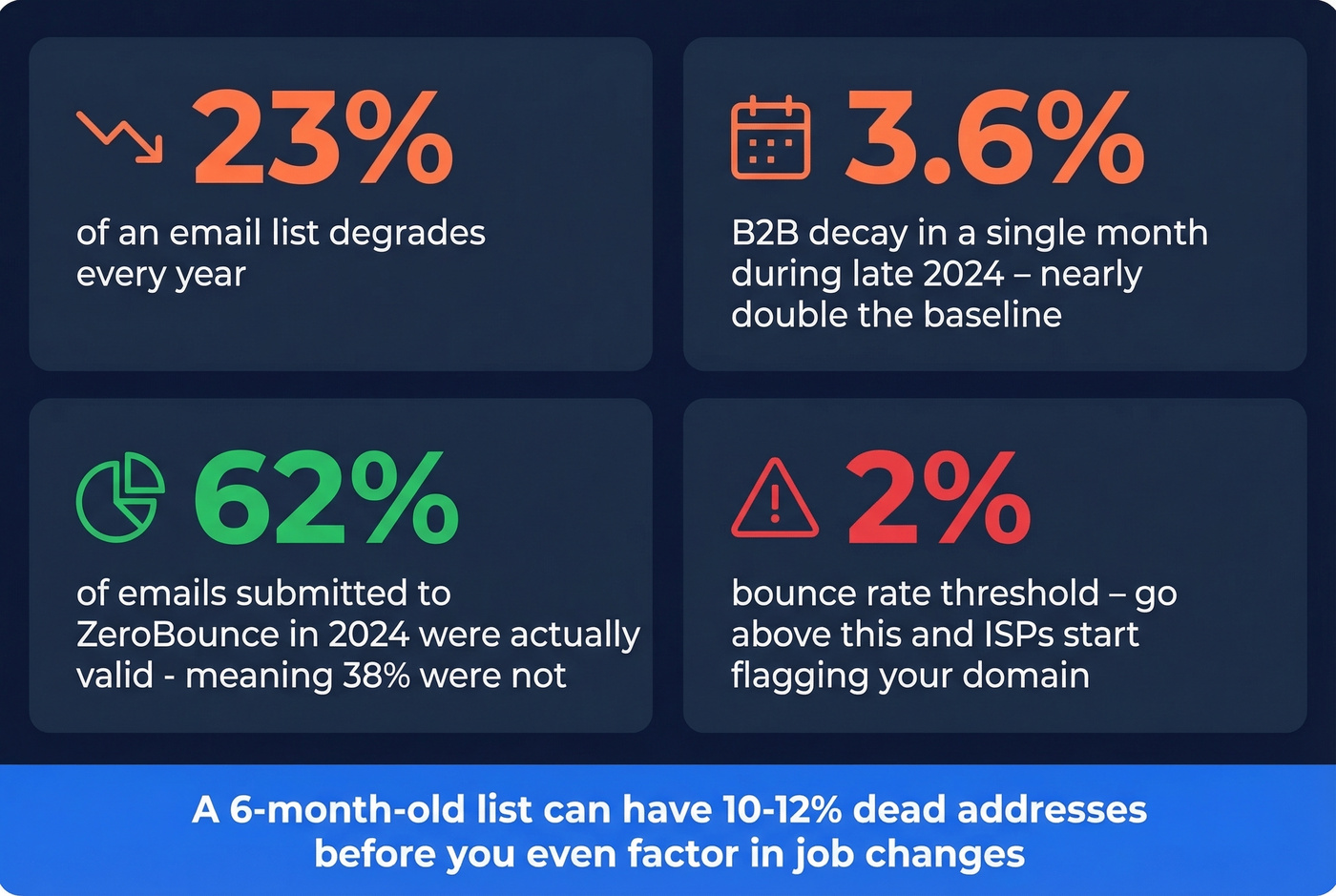
Complaint rates matter too. Gmail complaint rates above 0.3% quickly reduce inbox placement. And bounce rate discipline is just as critical: a bounce rate over 2% is widely treated as the line you don't want to cross, because consistently high bounces cause providers like Gmail or Outlook to classify your domain as risky and hurt deliverability across every future send (see email bounce rate benchmarks and fixes).
We've seen teams lose months of domain warmup from a single unverified blast. Cold outbound, email marketing, account recovery, security alerts - if the email doesn't work, the downstream consequences range from wasted sends to permanently locked-out users. There's also the third-party problem: someone mistypes their address at signup, and the real owner of that inbox starts getting your account emails, billing notifications, or worse. Verification catches this before it becomes a support ticket - or a legal one.
Here's the thing: if your deal sizes are above $5k and you're sending cold outbound without verifying, you're not saving money. You're burning your most valuable asset. A domain takes weeks to warm up and one bad campaign to destroy.

You just read why unverified lists destroy domains. Prospeo's 5-step verification pipeline - catch-all handling, spam-trap removal, honeypot filtering - runs before emails ever reach your list. 98% accuracy across 143M+ verified addresses, refreshed every 7 days.
Start with clean data instead of cleaning up bounces afterward.
When You Can Delay or Skip It
For SaaS signups, mandatory verification before first use is often overkill. A team on Stack Exchange ran this exact experiment: they removed the verification gate and sent a background password-set email instead. Zero support emails in three weeks. About 50% never completed confirmation, but raw signup volume held steady.
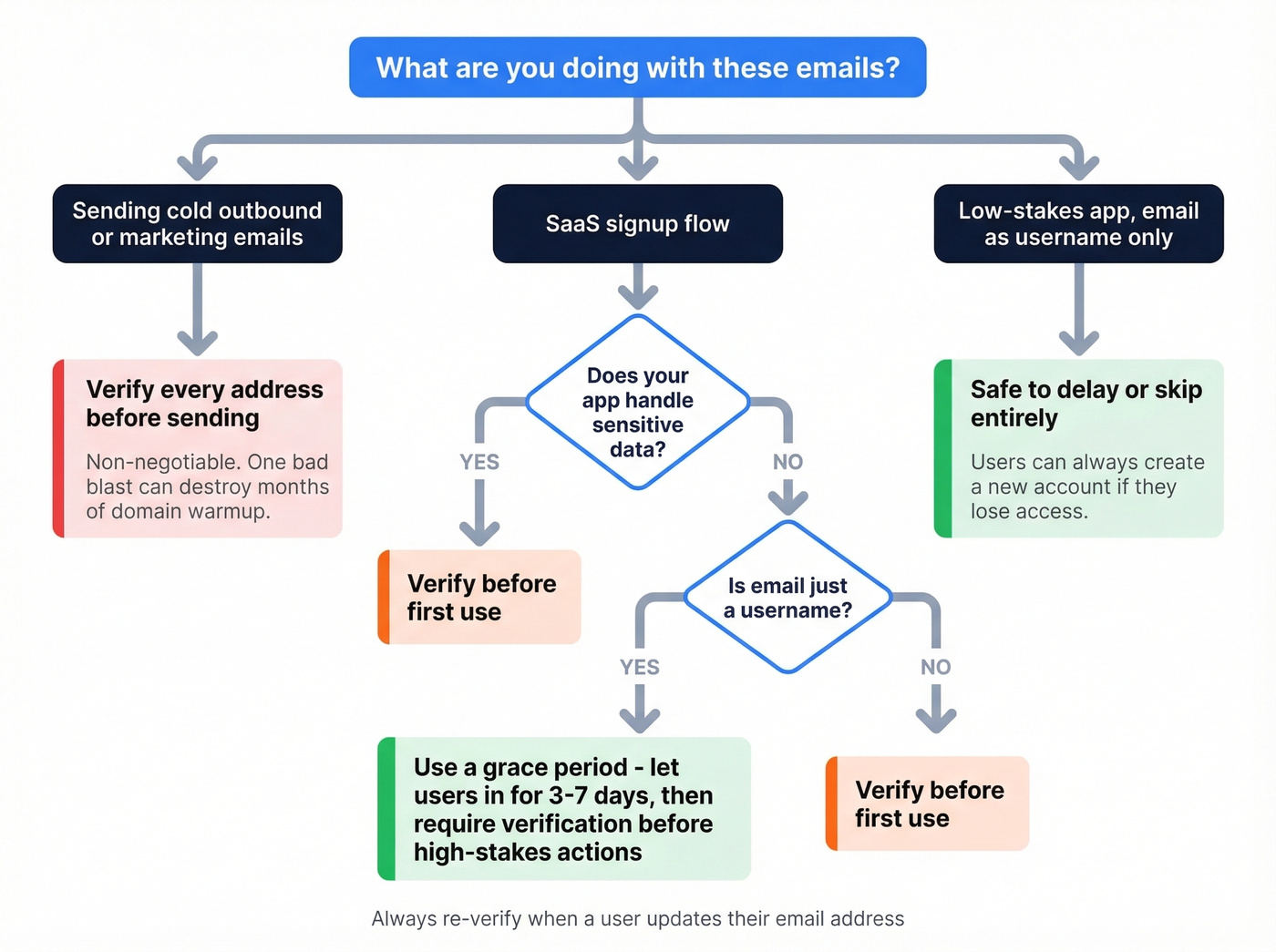
Three criteria tell you if you can delay:
- Your app doesn't handle sensitive data.
- Email is basically just a username.
- Users can create a new account if they lose access.
Hit all three? Skip the gate.
In our experience, the grace-period approach works best for B2B SaaS: let users in for 3-7 days with a persistent banner, then require verification before high-stakes actions like inviting team members or connecting integrations. A password-set email doubles as implicit verification without the friction of a separate "click to confirm" step. For older or less tech-savvy audiences, typos and silently discarded confirmation emails create real abandonment - the kind that never shows up in your analytics because the user just leaves.
One edge case people forget: if a user updates their email address, re-verify before trusting it for recovery or notifications. Skipping this is how accounts get hijacked.
What Happens Without Verification
Picture this: you collect 5,000 leads at a conference, import them into your sequencer without verification, and 8% bounce. Your domain gets flagged. Now your regular emails - proposals, follow-ups, invoices - land in spam.
39% of businesses only verify email data after a bounce has already occurred. That's reactive damage control, not strategy. Understanding why verifying addresses matters before you press send - not after your domain reputation tanks - is the difference between proactive pipeline management and firefighting.
Even verified emails don't guarantee inbox placement. Here's where the major ISPs stand:
| ISP | Inbox Rate | Spam Rate | Missing |
|---|---|---|---|
| Gmail | 87.2% | 6.8% | 6.0% |
| Outlook | 75.6% | 14.6% | 9.8% |
| Yahoo/AOL | 86.0% | 4.8% | 9.2% |
| Apple Mail | 76.3% | 14.3% | 9.4% |
Validity/Litmus 2025 benchmarks.
Outlook is brutal - nearly 1 in 4 emails don't reach the inbox. That's the baseline for senders with clean reputations. Add a 5-8% bounce rate from unverified lists and those numbers crater.
The Outbound Verification Stack
Verification doesn't exist in isolation. For cold outbound, it's one piece of a deliverability infrastructure that includes secondary domains, 14-21 days of warmup, SPF/DKIM/DMARC authentication, and volume discipline. The consensus on r/coldemail is pretty clear: verification is table stakes, but it won't save you if your warmup, authentication, or sending volume are sloppy (more on safe sending limits in email velocity).
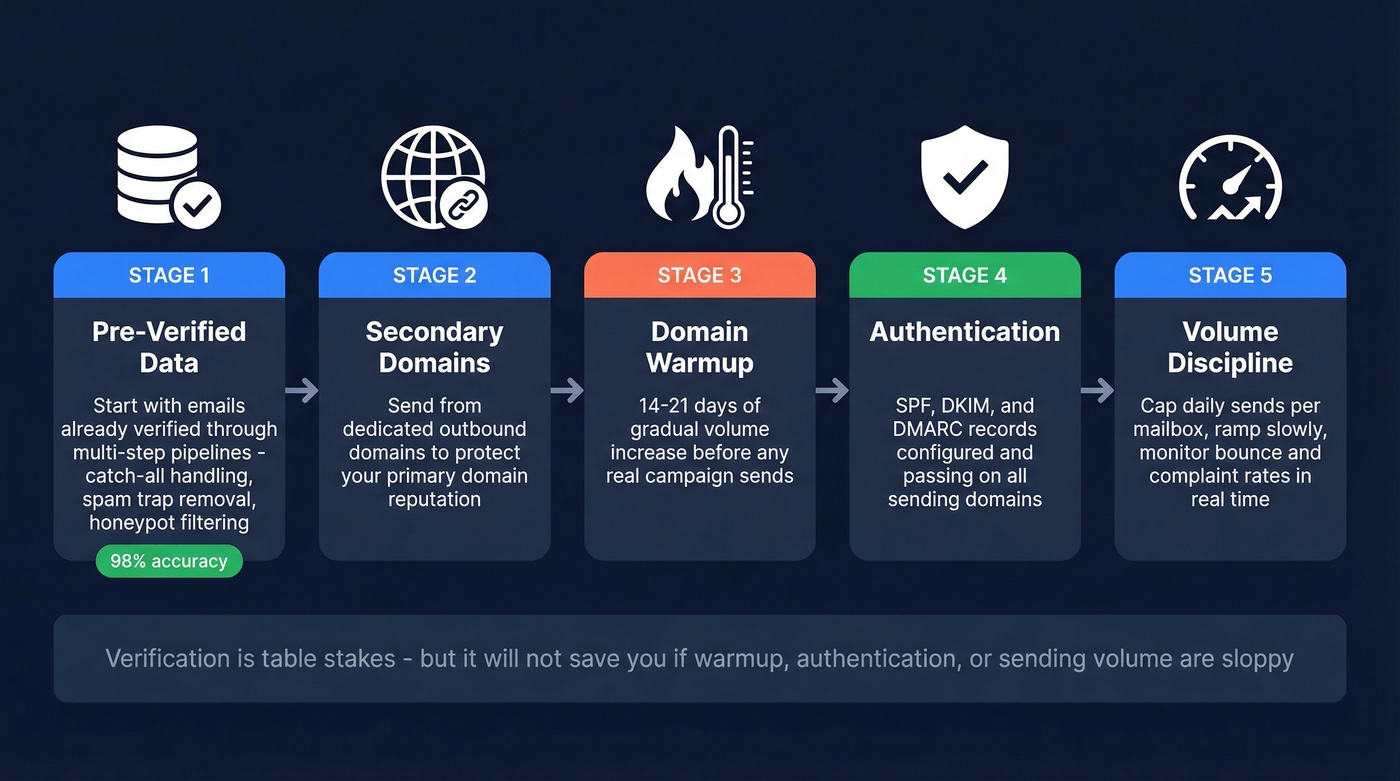
But why clean up bad data after the fact when you can start with verified emails? Prospeo runs every email through a 5-step verification pipeline - catch-all handling, spam-trap removal, honeypot filtering - before it ever reaches your list. The result is 98% email accuracy across 143M+ verified addresses, refreshed on a 7-day cycle. Stack Optimize built their agency to $1M ARR on Prospeo data, maintaining 94%+ deliverability, bounce rates under 3%, and zero domain flags across all clients. The free tier gives you 75 verified emails per month, with paid plans at roughly $0.01 per email.
Starting with pre-verified data eliminates the entire "verify before sending" step from your workflow - especially if you're sourcing from email list providers or doing lead enrichment at scale.
Stack Optimize built a $1M agency on Prospeo data: 94%+ deliverability, sub-3% bounce rates, zero domain flags. That's what happens when every email passes 5-step verification and data refreshes weekly - not every 6 weeks like competitors.
Protect your domain reputation starting at $0.01 per verified email.
FAQ
Is email verification legally required?
No law mandates verification specifically. GDPR and CAN-SPAM require valid consent mechanisms and working unsubscribe links - both of which depend on reaching real inboxes. Verification is a compliance best practice, not a legal obligation.
How often should I re-verify my list?
Verify before every major campaign. For active outbound lists, monthly is the right cadence - email data decays roughly 2% per month, with spikes up to 3.6% during high job turnover. Any list older than 3-6 months should be re-verified entirely.
What's a safe bounce rate for outbound?
Stay below 2% total. Under 1% hard bounces is best practice for cold outbound. Above 2%, you'll see throttling, spam folder placement, or outright blocks from major ISPs like Gmail and Outlook.
Can I get pre-verified emails instead of cleaning lists myself?
Yes. Platforms that verify addresses through multi-step pipelines before delivery let you skip the separate verification step entirely. A 98% accuracy rate with a weekly refresh cycle means the data stays clean between campaigns - useful for teams sending weekly sequences.