


Jiminny Pricing, Reviews, Pros & Cons (2026)
Review aggregators can't agree on what Jiminny costs. You'll see $42, $85, $100 - all on the same search results page. The confusion comes from Jiminny's seat-type model: that $42/month figure plastered across comparison sites is the Insights Seat, which lets you access recordings and dashboards but doesn't actually record calls. If you want call recording, you're looking at $83/month minimum for a Recording Seat. We dug into 900+ G2 reviews and real-world spend data to sort this out.
30-Second Verdict
Jiminny is a strong mid-market conversation intelligence platform that often lands at about a third of Gong's Year 1 cost in a typical 10-user setup. It's best for teams of 25-200 reps who need coaching, call recording, and CRM sync without enterprise-tier budgets. The G2 rating of 4.6/5 is earned - 77% of reviews are five-star, with 0% one-star and 0% two-star ratings. Customer support and ease of use consistently top the praise list.
But if you're under 10 reps, Fathom or Claap will get you 80% of the value at a fraction of the cost.
The conversation intelligence market is projected to more than double from $25.3B in 2025 to $55.7B by 2035. Jiminny is betting it can own the mid-market slice of that growth - and so far, the bet's paying off.
Jiminny Pricing Breakdown
Jiminny structures pricing around three seat types, which is where the aggregator confusion originates.
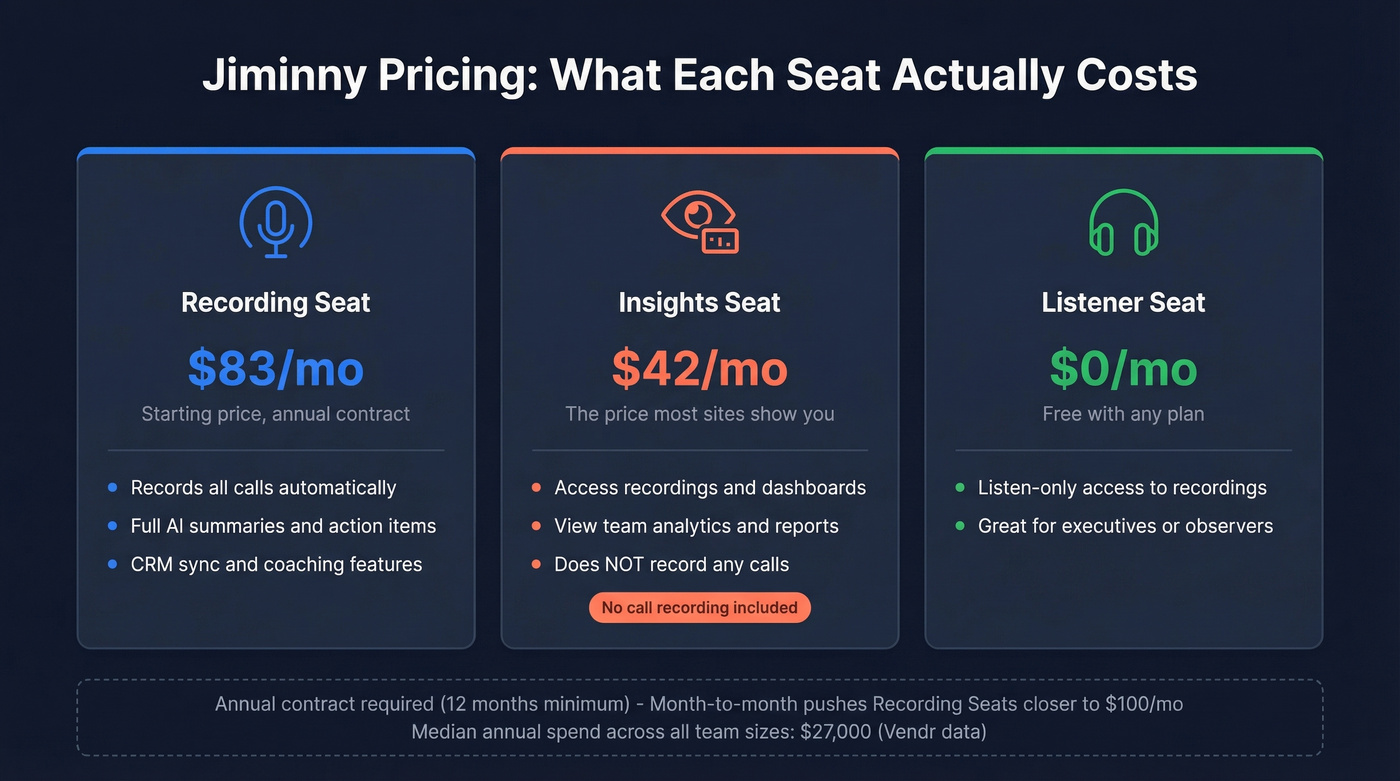
| Seat Type | Starting Price | What It Does |
|---|---|---|
| Recording | $83/mo | Records calls + full AI features |
| Insights | $42/mo | Access to recordings/insights (doesn't record calls) |
| Listener | $0/mo | Listen-only access |
The $42 figure that sites like SelectHub display lines up with the Insights Seat - useful for managers reviewing calls, but it doesn't record anything. The $85 on TrustRadius is close to the $83 Recording Seat starting price; the small difference likely reflects rounding or quote variation. Month-to-month billing pushes closer to $100/user/month.
Contract terms matter here. Jiminny requires a 12-month minimum commitment and charges a one-time setup fee with no recurring platform fee - a real difference from Gong's model. Quick math: 5 Recording Seats run about $425/month, 20 seats about $1,700/month.
What do companies actually pay? Vendr's benchmark data puts the median annual spend at $27,000, with a range of $11,160 to $52,728 depending on team size and seat mix. That wide spread tells you negotiation matters (and it helps to understand an anchor in negotiation before you get on the call).
The 14-day free trial requires no credit card, which is refreshing.
How Jiminny Compares on Price
Here's what a 10-user team looks like in Year 1 across the main players.
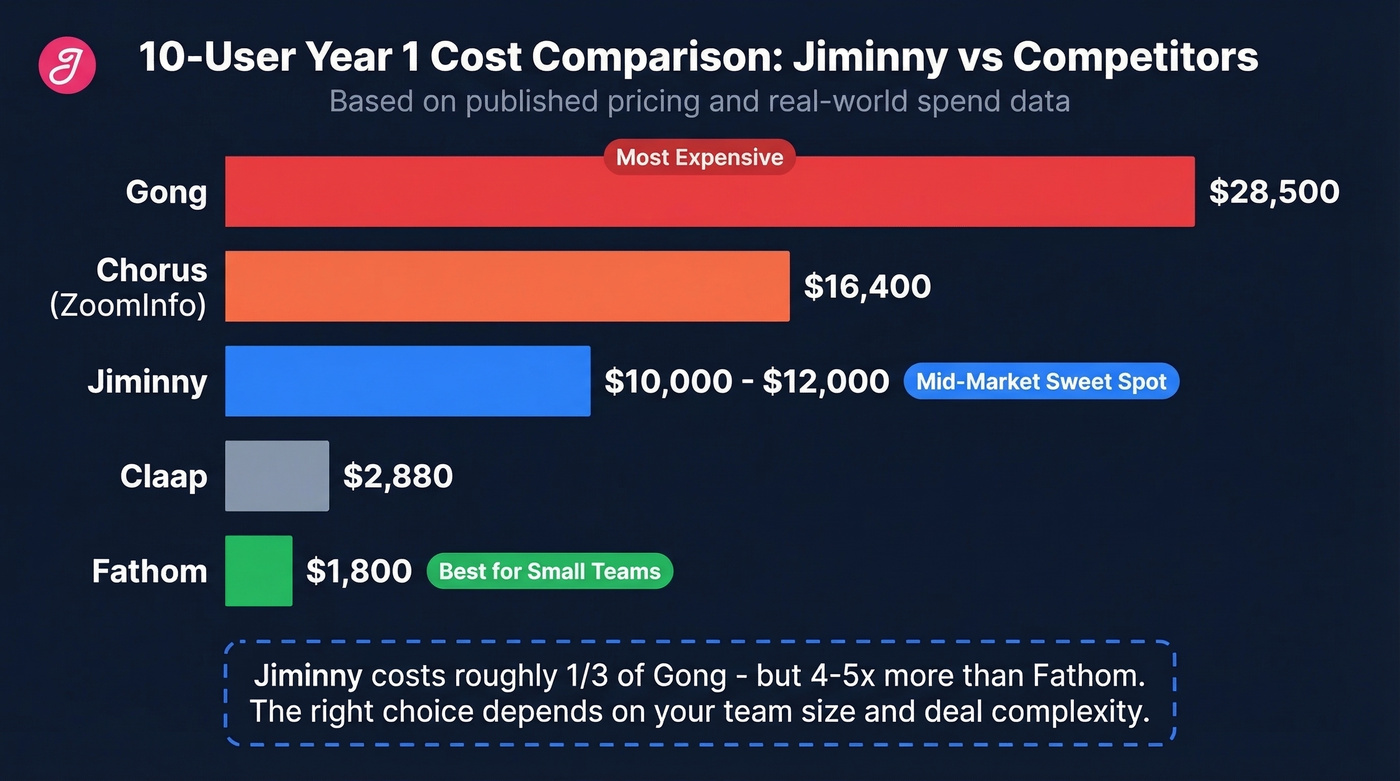
| Tool | Starting Price | 10-User Year 1 |
|---|---|---|
| Jiminny | $83/user/mo | ~$10,000-$12,000 |
| Gong | $1,400+/user/yr + platform fee | ~$28,500 |
| Chorus (ZoomInfo) | $8,000/yr for 3 seats | ~$16,400 |
| Fathom | $15/user/mo | ~$1,800 |
| Claap | $24/user/mo (free tier) | ~$2,880 |
Jiminny sits in a clear middle lane - roughly a third of Gong's Year 1 cost and cheaper than Chorus, but 4-5x more expensive than Fathom or Claap. The real question isn't whether Jiminny beats Gong on price. It obviously does. The question is whether the gap between Jiminny and Fathom justifies the price difference for your team size.
Here's the thing: if your average deal size stays below $15K, you probably don't need Jiminny-level coaching infrastructure. Fathom plus a solid contact data provider will outperform a CI tool that's recording calls to prospects who never pick up. (If you're rebuilding your outbound motion, start with these sales prospecting techniques.)

Jiminny records calls - but only if prospects pick up. With 125M+ verified mobile numbers and a 30% pickup rate, Prospeo ensures your reps actually connect with decision-makers before any CI tool can add value.
Stop recording voicemails. Start reaching real buyers at $0.01 per email.
What Users Love About Jiminny
The most-praised feature across 900+ G2 reviews isn't the AI. It's the support team.
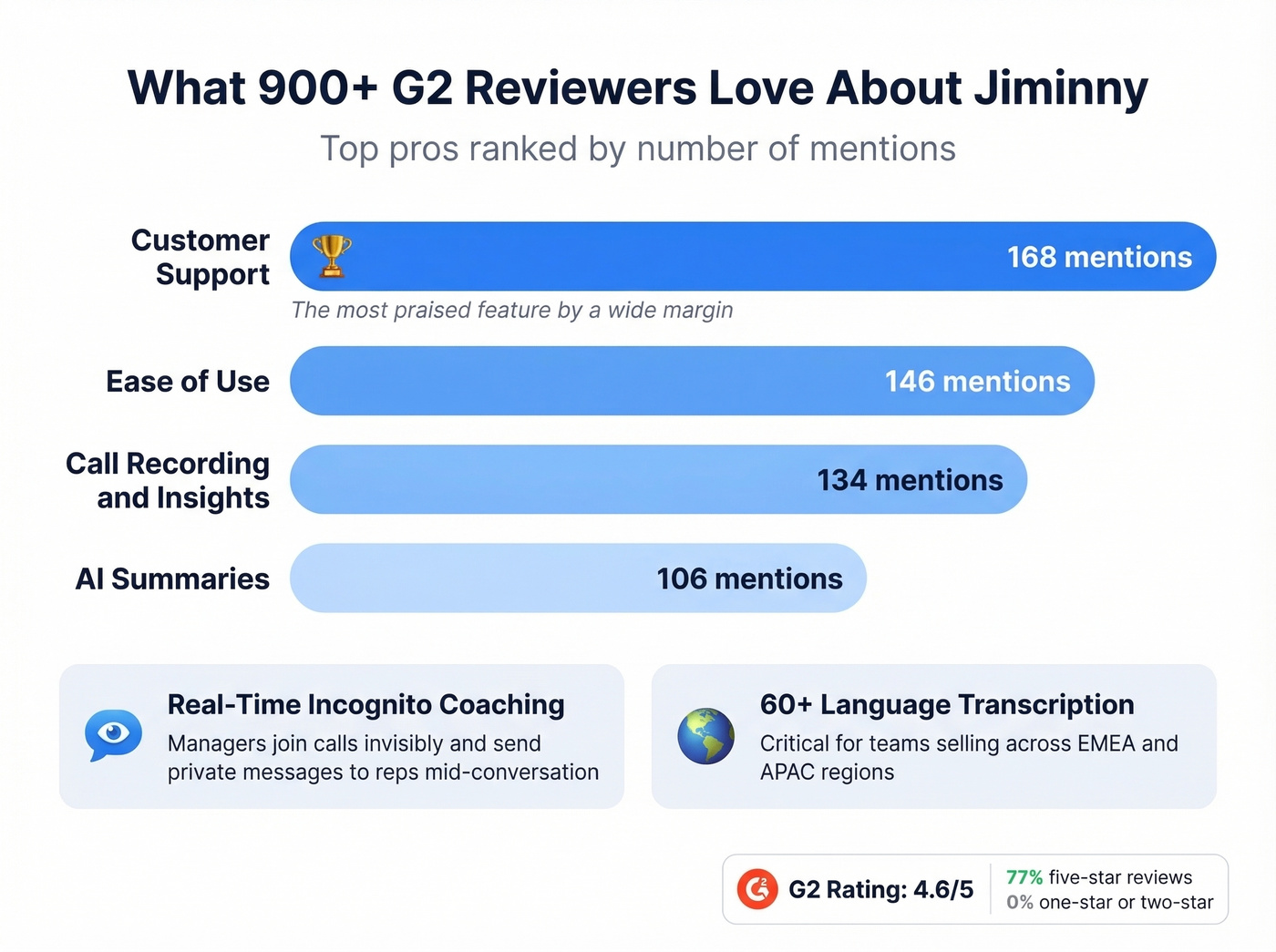
Customer support tops the list with 168 mentions - by a wide margin. Users consistently call out fast, responsive help. For a tool that touches your CRM, dialer, and video stack, this matters more than most features on a spec sheet.
Ease of use comes second at 146 mentions. G2 lists time to implement as 1 month, which is fast for a CI tool that needs CRM connections, call routing, and team permissions configured. Call recording and insights at 134 mentions confirm the core product works. Calls get captured, tagged, and surfaced reliably. AI summaries at 106 mentions help cut down post-call admin with automatic call summaries and action items.
Two standout features deserve a callout. Real-time incognito coaching lets managers join calls invisibly and send private messages to reps mid-conversation - genuinely useful for onboarding new hires (pair it with a solid 30-60-90 day plan). Transcription covers 60+ languages, which matters if your team sells across EMEA or APAC. On the integrations side, G2 lists 46 integrations for Jiminny.
Cons That Frustrate Users
Let's be honest about the complaints, because they cluster around four themes that are worth understanding before you commit.
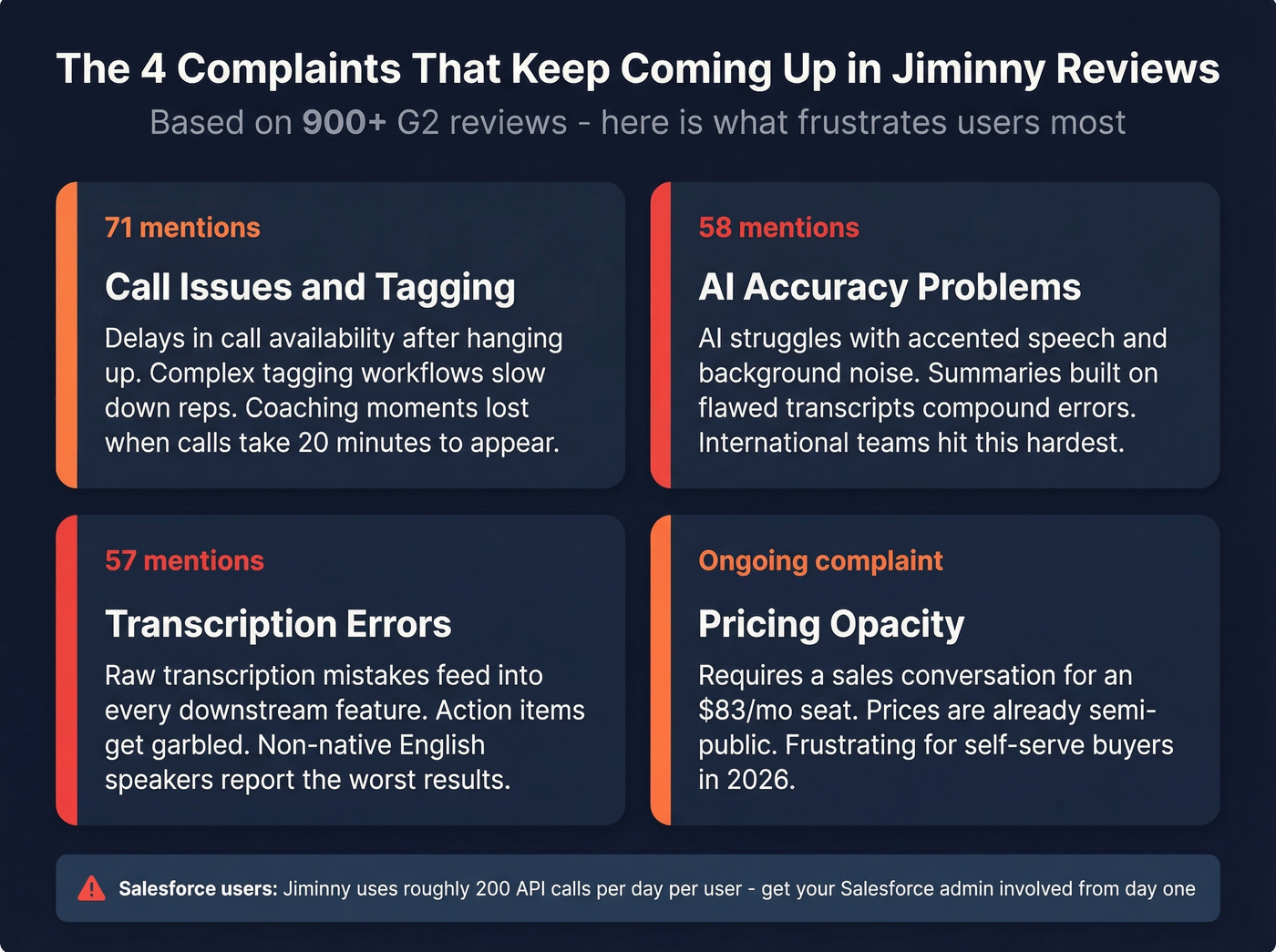
Call issues and tagging complexity lead the gripes at 71 mentions. Delays in call availability and overly complex tagging workflows frustrate reps. When someone finishes a call and can't review it for 20 minutes, the coaching moment is gone. The "bare bones version of Gong" framing that shows up in TrustRadius comparisons is a fair critique if you're coming from an enterprise tool and expecting feature parity.
AI and transcription accuracy are related but distinct problems, with 58 and 57 mentions respectively. The AI struggles with accented speech and background noise, and raw transcription errors compound when the system tries to summarize or extract action items from flawed text. If your team sells internationally or works from noisy environments, expect imperfect transcripts.
Pricing opacity is absurd in 2026. Requiring a custom quote for an $83/month seat - where the seat prices are already semi-public - feels like it's trying to have it both ways. Just publish the pricing page.
Salesforce integration friction rounds out the list. Jiminny uses roughly 200 API calls per day per user, and common sync errors include REQUEST_LIMIT_EXCEEDED, validation rule conflicts, and picklist mismatches. Your Salesforce admin needs to be involved from day one (and it helps to know the real Salesforce pricing before you scale seats).
Who Jiminny Is (and Isn't) For
Use Jiminny if you're a mid-market team of 25-200 reps that needs coaching at scale, runs Salesforce or HubSpot and wants auto-CRM sync, and wants Gong-level insights at roughly a third of the price. You should be willing to trade some transcription polish for significant cost savings.
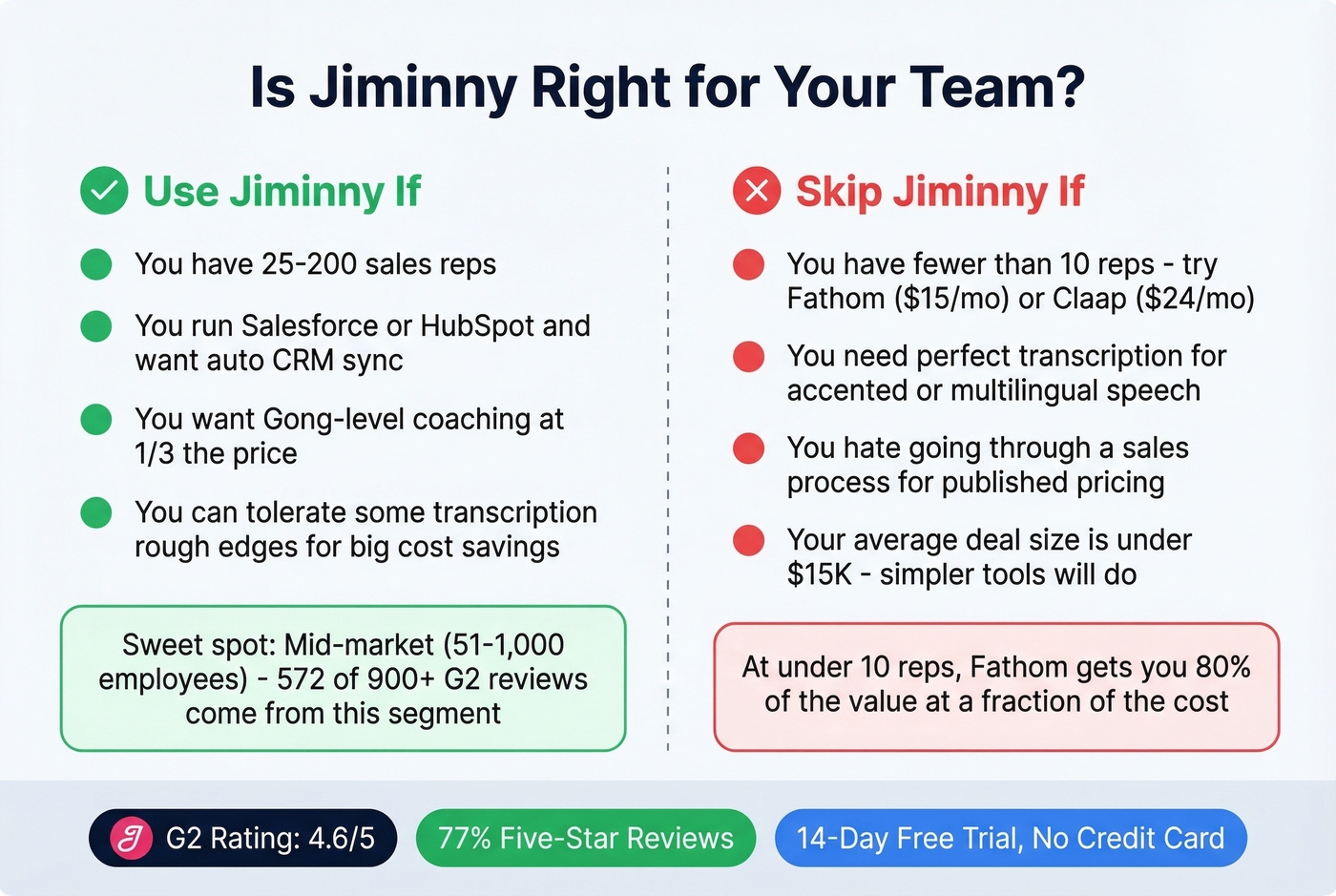
Skip Jiminny if you're under 10 reps - Fathom at $15/user/month or Claap at $24/user/month will cover you. Same goes if you depend on perfect transcription for accented or multilingual speech, or if you're unwilling to go through a sales conversation for pricing you can already estimate from this article.
The G2 segment data confirms the sweet spot: 572 of 900+ reviews come from mid-market companies (51-1,000 employees), versus 286 from small business and just 56 from enterprise. Mid-market is where Jiminny lives.
Of course, conversation intelligence only works if reps are talking to the right people. We've seen teams invest $83/month per seat to record calls, only to realize half those dials are hitting dead numbers. Prospeo's 125M+ verified mobile numbers deliver a 30% pickup rate across all regions - and the free plan lets you test before spending a dime on CI tooling (especially if you're evaluating free lead generation tools to fill the top of funnel).
A $10K/year CI investment is wasted when your reps chase bad contact data. Prospeo's 98% email accuracy and 7-day data refresh mean fewer bounces, more live conversations, and coaching insights that actually matter.
Fix the data before you fix the pitch. 75 free emails to start.
FAQ
How much does Jiminny actually cost per user?
Recording Seats start at $83/month on an annual contract. Insights Seats - which don't record calls - start at $42/month. Listener Seats are free. Month-to-month billing pushes Recording Seats closer to $100/month. Vendr data shows median annual spend around $27,000 across all team sizes.
Is Jiminny better than Gong?
Jiminny costs roughly a third of Gong's Year 1 price for a 10-user team (~$10K-$12K vs ~$28,500). It covers core coaching, recording, and CRM sync well. Gong offers deeper analytics and a more polished transcription engine, so teams above 200 reps with enterprise budgets still tend to prefer it.
What are the biggest downsides of Jiminny?
Transcription accuracy with accented speech and noisy environments is the top complaint at 115+ mentions on G2. Salesforce sync requires admin attention due to high API call volume. Pricing still requires a sales conversation despite seat costs being semi-public - frustrating for self-serve buyers.
How do I get better results from any conversation intelligence tool?
Start with verified contact data so reps aren't recording voicemails to dead numbers. Clean data upstream paired with coaching tools downstream is the combination that actually moves pipeline metrics.
Final Verdict
Jiminny is the obvious shortlist candidate for mid-market teams who want Gong-level insights without Gong-level pricing. At $83/month for Recording Seats - not the misleading $42 - it delivers strong coaching tools, solid CRM integration, and genuinely excellent support backed by 77% five-star reviews. Go in knowing the transcription has rough edges, the Salesforce sync needs admin attention, and the quote-based pricing process will test your patience. The 14-day free trial requires no credit card. Start there.