Kaspr vs QuickEnrich: Which B2B Data Tool Should You Pick?
You just watched 37 phone credits expire in your Kaspr dashboard - unused, gone, reset to zero. Meanwhile, your ops lead found an API-first enrichment tool on Clay's marketplace at a third of the price. Sound familiar?
When you compare Kaspr vs QuickEnrich, you quickly realize they aren't really competitors. One's a Chrome extension for browser-based prospecting. The other's an API-first email finder for programmatic workflows. Picking between them depends entirely on how your team actually finds and enriches contacts. And relying on a single enrichment source typically leaves 40-60% of qualified prospects unreachable, so the tool you pick matters more than most teams realize.
30-Second Verdict
Pick Kaspr if you're a solo SDR prospecting European contacts from a browser and you value a polished Chrome extension.
Pick QuickEnrich if you run API-first or Clay-based enrichment workflows and want double-verified emails at low per-unit cost.
Side-by-Side Feature Comparison
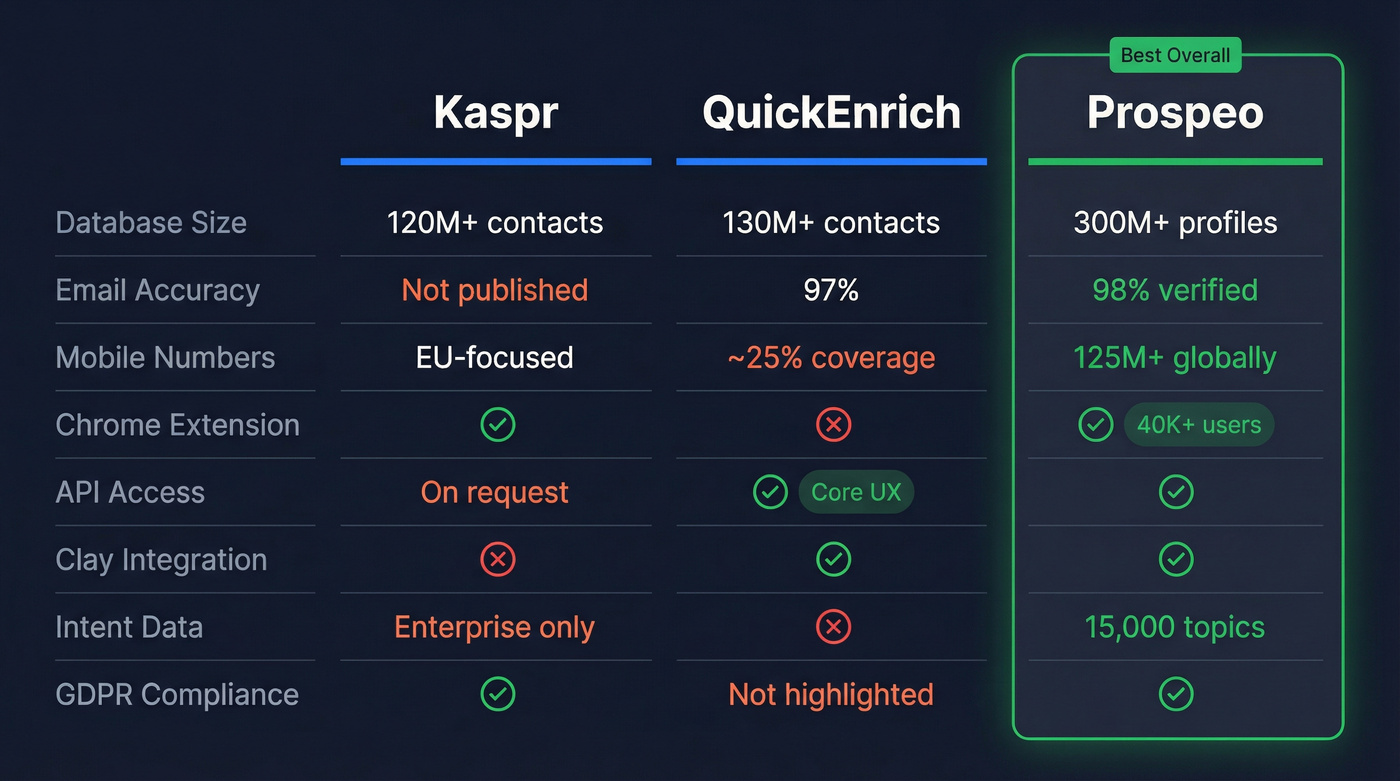
| Database size | 120M+ contacts (EU-focused) | 130M+ contacts | 300M+ profiles |
| Email accuracy | Not published | 97% (self-reported) | 98% verified |
| Mobile numbers | Yes (EU-focused coverage) | ~25% of contacts | 125M+ globally |
| Chrome extension | Yes (core UX) | API-first (no extension) | Yes (40K+ users) |
| API access | On request | Yes (core UX) | Yes |
| Clay integration | Not a core focus | Yes | Yes |
| CRM integrations | HubSpot, Salesforce, Pipedrive | Via API | Salesforce, HubSpot |
| G2 rating | 4.4/5 (833 reviews) | Not listed | - |
| GDPR compliance | Yes | Not highlighted | Yes |
| Intent data | Enterprise plan only | No | 15,000 topics |

Tired of Kaspr's expiring credits and QuickEnrich's missing extension? Prospeo gives you 300M+ profiles, 98% email accuracy, and 125M+ verified mobiles - with both a Chrome extension (40K+ users) and full API access. No per-seat pricing, no annual contracts.
Stop choosing between browser and API - get both for $0.01/email.
Key Differences That Matter
Data Quality & Verification
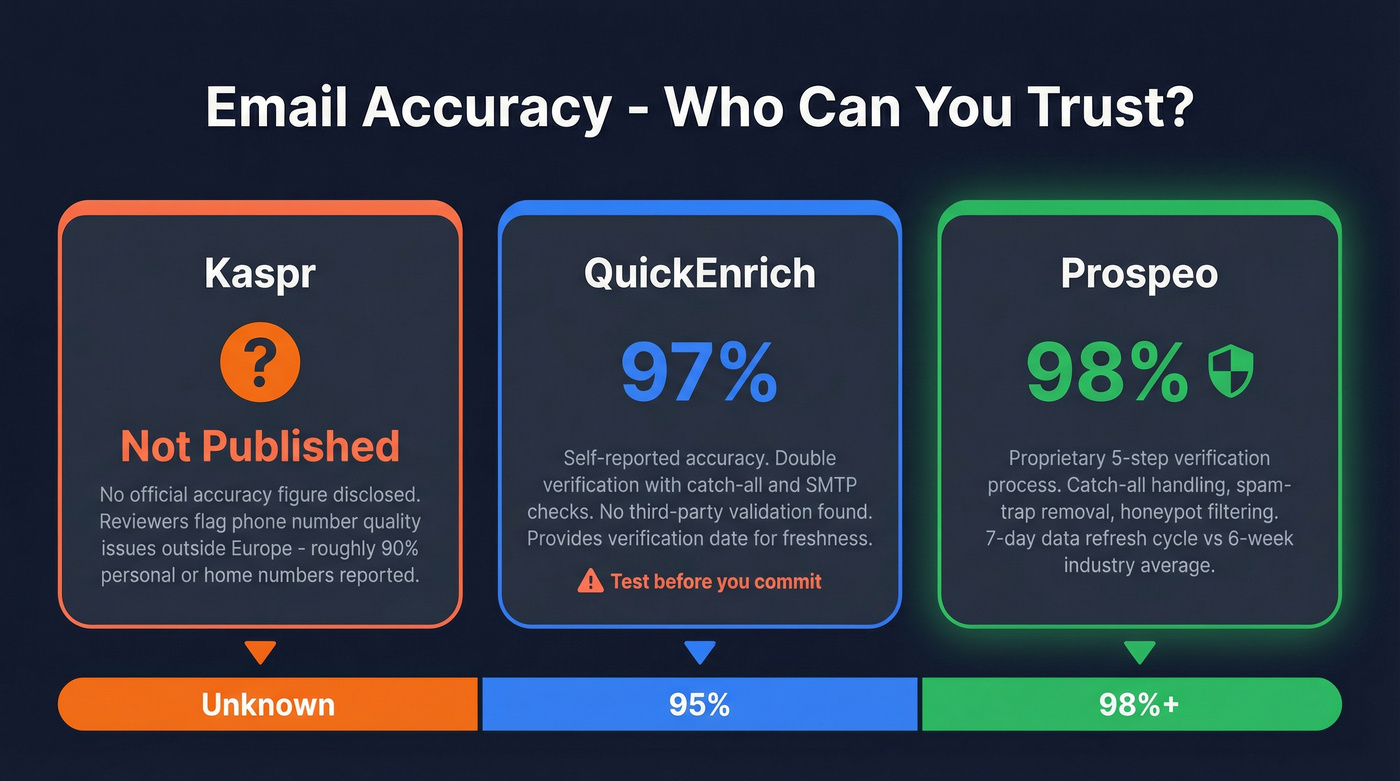
Kaspr pulls contact data from multiple sources and reveals emails and phone numbers in the moment via its extension - solid for email, though reviewers consistently flag phone number quality outside Europe. One G2 reviewer noted that roughly 90% of Kaspr's phone numbers were personal or home numbers, with fewer than 10% being actual business lines. That distinction matters if your compliance team has opinions about cold-calling personal mobiles.
QuickEnrich takes a different approach. It runs double verification using catch-all and SMTP checks, never returns risky emails, and provides a verification date so you know how fresh the result is. The 97% accuracy claim is self-reported, though, with no third-party validation we could find. We've seen plenty of tools claim 95%+ and then bounce at 15% in production - so test before you commit. (If you’re comparing verifiers, see our roundup of email verification options.)
Pricing & Credit Economics
Kaspr's per-seat model runs EUR 45-79/user/mo on annual plans, with phone credits allocated monthly. That credit mechanic is the #1 complaint in reviews - "limited credits" and "expensive" surface over and over. In our experience, per-seat pricing with monthly credit limits punishes small teams the hardest, because unused credits just vanish. If you’re evaluating vendors broadly, it helps to benchmark against other data enrichment services.
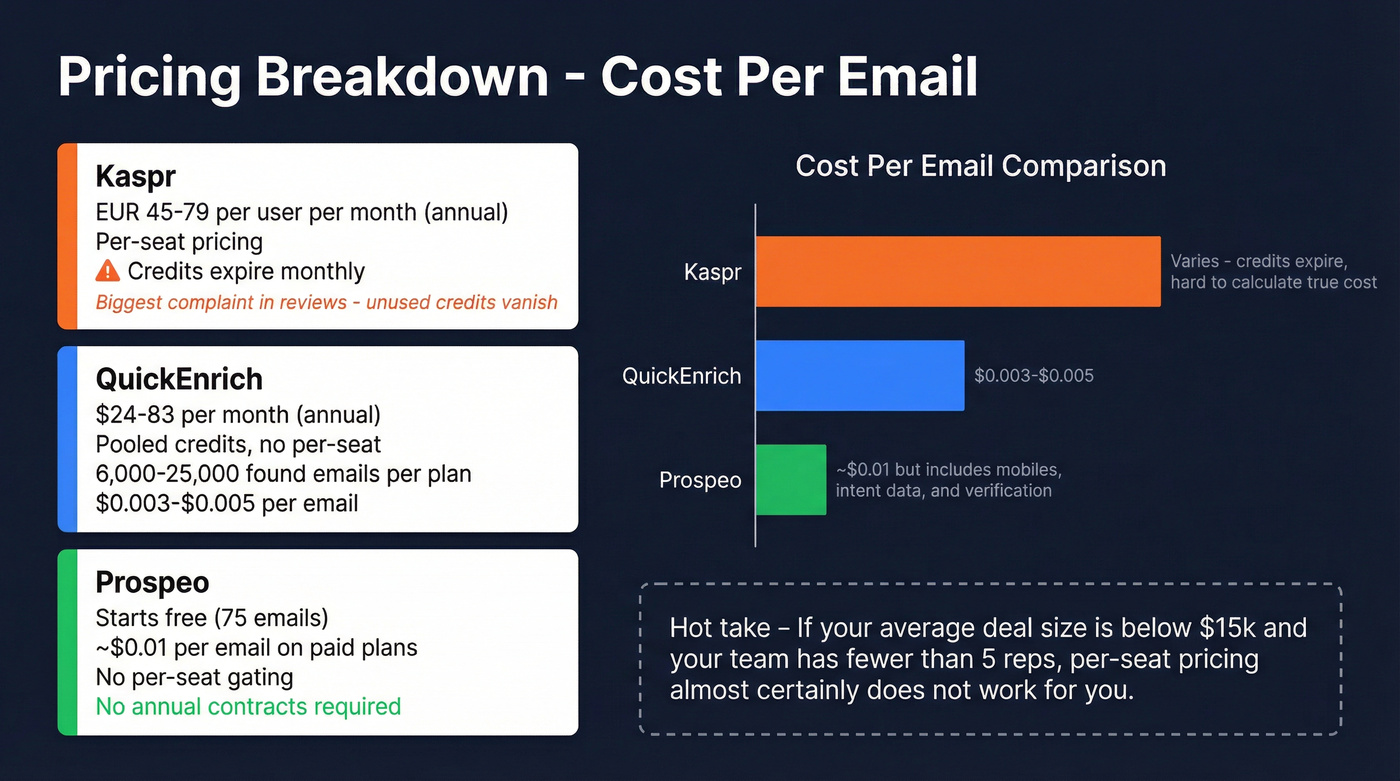
QuickEnrich uses pooled credits starting at $29/mo (or $24/mo annually) and scaling to $99/mo (or $83/mo annually). It isn't priced per seat. The Starter plan includes 6,000 found emails or phone numbers, and Growth jumps to 25,000. Unit pricing lands around $0.003-$0.005 per found email/phone depending on plan.
Here's our hot take: if your average deal size sits below $15k and your team has fewer than five reps, you almost certainly don't need Kaspr's per-seat model. The math just doesn't work.
Workflow: Extension vs API
Let's be honest - these tools solve fundamentally different problems. Kaspr is built for reps who live in a browser, clicking through profiles and pulling contact info one-by-one or in small batches. QuickEnrich is built for ops teams running Clay workflows or programmatic enrichment via API, and it finds true employee email domains (not just the company's website domain) - useful when employees use subsidiary or division-specific addresses. If you’re building lists inside Clay, this Clay list building guide will help you cost it out.
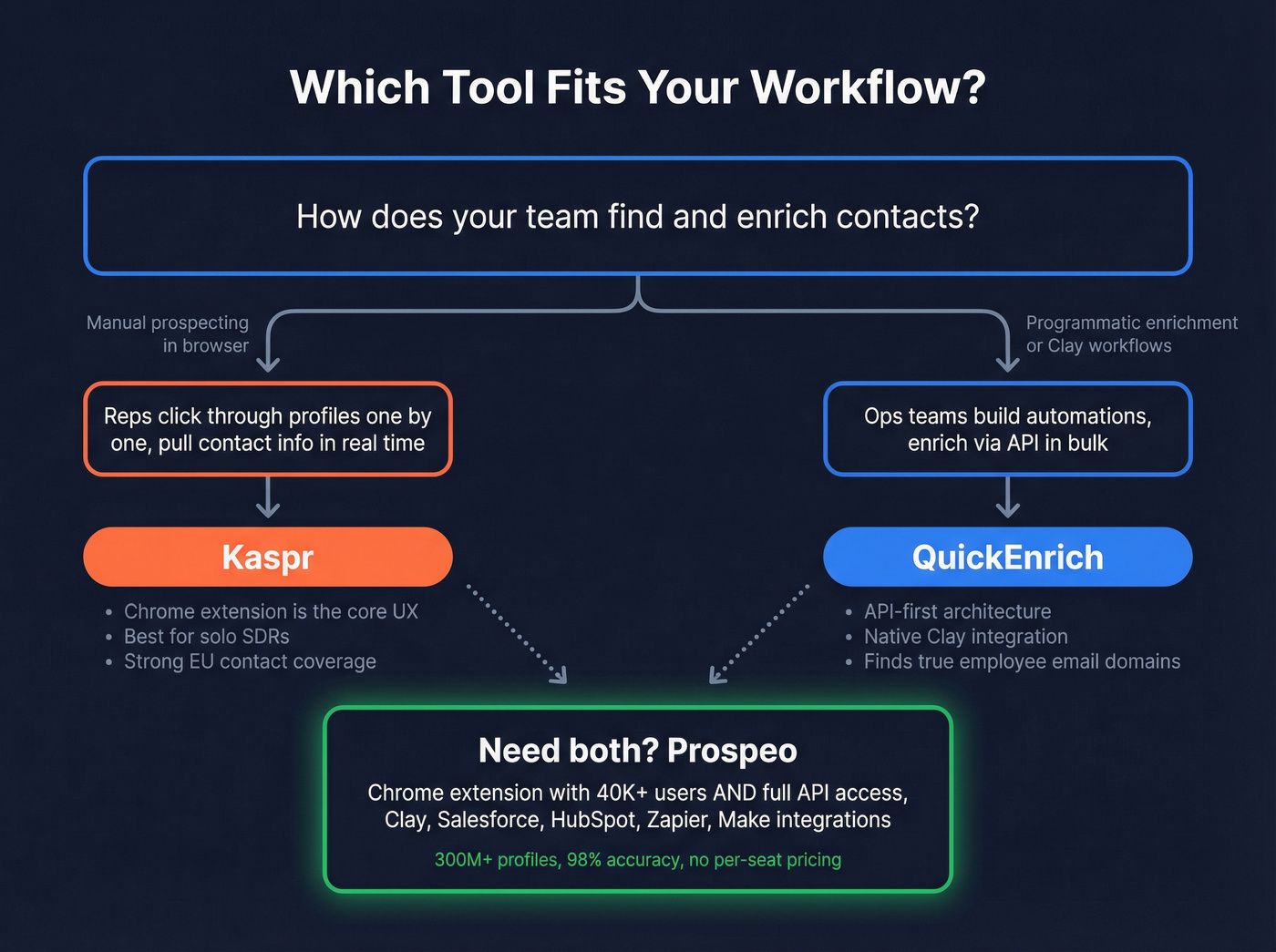
If your team prospects manually, Kaspr's UX wins. If your team builds enrichment automations, QuickEnrich fits the architecture. Simple as that. For more tactics on how reps actually source accounts, see these sales prospecting techniques.

When Neither Tool Fully Fits
We've tested both tools against our own workflows, and the honest answer is that most growing teams outgrow single-source enrichment fast. Prospeo covers what both leave on the table: 300M+ profiles including 143M+ verified emails at 98% accuracy through a proprietary 5-step process - not third-party providers. You also get 125M+ verified mobile numbers, intent data tracking 15,000 topics via Bombora, and a 7-day data refresh cycle versus the six-week industry average.
Native integrations with Salesforce, HubSpot, Clay, Zapier, and Make mean it fits both browser-based and API-driven workflows. Pricing starts free with 75 emails/month, and paid plans run about $0.01/email with no per-seat gating or annual contracts. If you’re standardizing your stack, it’s worth mapping this into your lead generation workflow so enrichment doesn’t become a bottleneck.

Single-source enrichment leaves up to 60% of prospects unreachable. Prospeo's proprietary 5-step verification, 7-day data refresh, and native Clay, Salesforce, and HubSpot integrations fill the gaps Kaspr and QuickEnrich leave behind.
Find the contacts both tools miss - 75 free emails, no credit card.
Final Verdict
Comparing Kaspr vs QuickEnrich head-to-head is like comparing a sports car to a pickup truck - the right choice depends on what you're hauling. If you’re still shopping, start with a broader shortlist of SDR tools and narrow based on workflow.
FAQ
Is QuickEnrich a Direct Kaspr Alternative?
Not really. Kaspr is a Chrome extension for browser-based prospecting - you click profiles and pull contact data in real time. QuickEnrich is an API-first email finder built for programmatic enrichment and Clay workflows. They overlap on email enrichment but serve fundamentally different use cases.
Does QuickEnrich Have a Chrome Extension?
QuickEnrich is built around its API and Clay integration, and a dedicated Chrome extension isn't highlighted on its site. If you need a Chrome extension for prospecting from professional profiles or company websites, Kaspr is the better fit between the two.
Which Tool Has the Most Accurate Email Data?
Prospeo leads at 98% accuracy, verified through a proprietary 5-step process with catch-all handling, spam-trap removal, and honeypot filtering on a 7-day refresh cycle. QuickEnrich lists 97% through double verification but lacks third-party validation. Kaspr doesn't publish an accuracy figure at all.