

The Key Account Management Process That Actually Works
Seventy-nine percent of sales organizations have rebuilt their key account programs at least once in the past seven years. The reason is almost always the same: vague plans, no operational artifacts, and a process that goes stale within a quarter.
We've watched this cycle play out across dozens of teams we work with. Someone builds a beautiful strategy deck, presents it at a kickoff, and three months later nobody can find the file. Here's the version built around frameworks and cadences that survive contact with reality.
Why 79% of KAM Programs Get Rebuilt
Delivering higher returns from key accounts is a priority for 70% of CSOs, per Gartner. Yet most programs underperform because they're treated as a sales initiative rather than a business model. The gap isn't strategic ambition - it's operational rigor.
A survey of 1,034 practitioners across 62 countries found that organizations with structured account planning see 75% better win rates, 58% shorter sales cycles, and 55% stronger customer loyalty. Those aren't marginal improvements. They're the difference between a KAM program that justifies its headcount and one that gets "rebuilt" next fiscal year.
What You Need First
Before you build a 12-tab spreadsheet, start with three things. Cranfield's research on KAM failures calls out "boiling the ocean" as a top mistake - trying to copy everything at once instead of prioritizing 3-4 must-dos.
- A tiered account list - segmented by revenue share, LTV, strategic value, and growth potential
- A one-page account plan - covering seven elements (Step 3 below)
- A RACI chart - so nobody argues about who owns the renewal conversation
Get those three right and you've got a foundation. Everything else is optimization.

Your stakeholder map is only as good as your contact data. Decision-makers change roles constantly - and stale emails mean bounced QBR invites and broken multi-threading. Prospeo refreshes 300M+ profiles every 7 days with 98% email accuracy, so your key account org charts never go dark.
Stop losing six-figure renewals to outdated contact data.
7-Step Account Management Framework
Step 1 - Segment and Tier Your Accounts
Not every large account is a key account. Segment using five criteria: revenue share, lifetime value, strategic value, growth potential, and product fit. Roughly 33% of a SaaS vendor's revenue comes from a handful of key accounts - the Pareto principle holds.
Tier them into three buckets. Tier 1 gets deep, cross-functional attention. Tier 2 gets structured but lighter engagement. Tier 3 gets monitored with a scaled cadence. If every account is "key," none of them are.
Step 2 - Map Stakeholders
Use a power-interest matrix (originally developed by Aubrey Mendelow) to categorize every stakeholder into four quadrants: manage closely for high-power, high-interest contacts; keep satisfied for high-power, low-interest; keep informed for low-power, high-interest; and monitor for the rest. This tells you exactly where to spend your relationship capital.
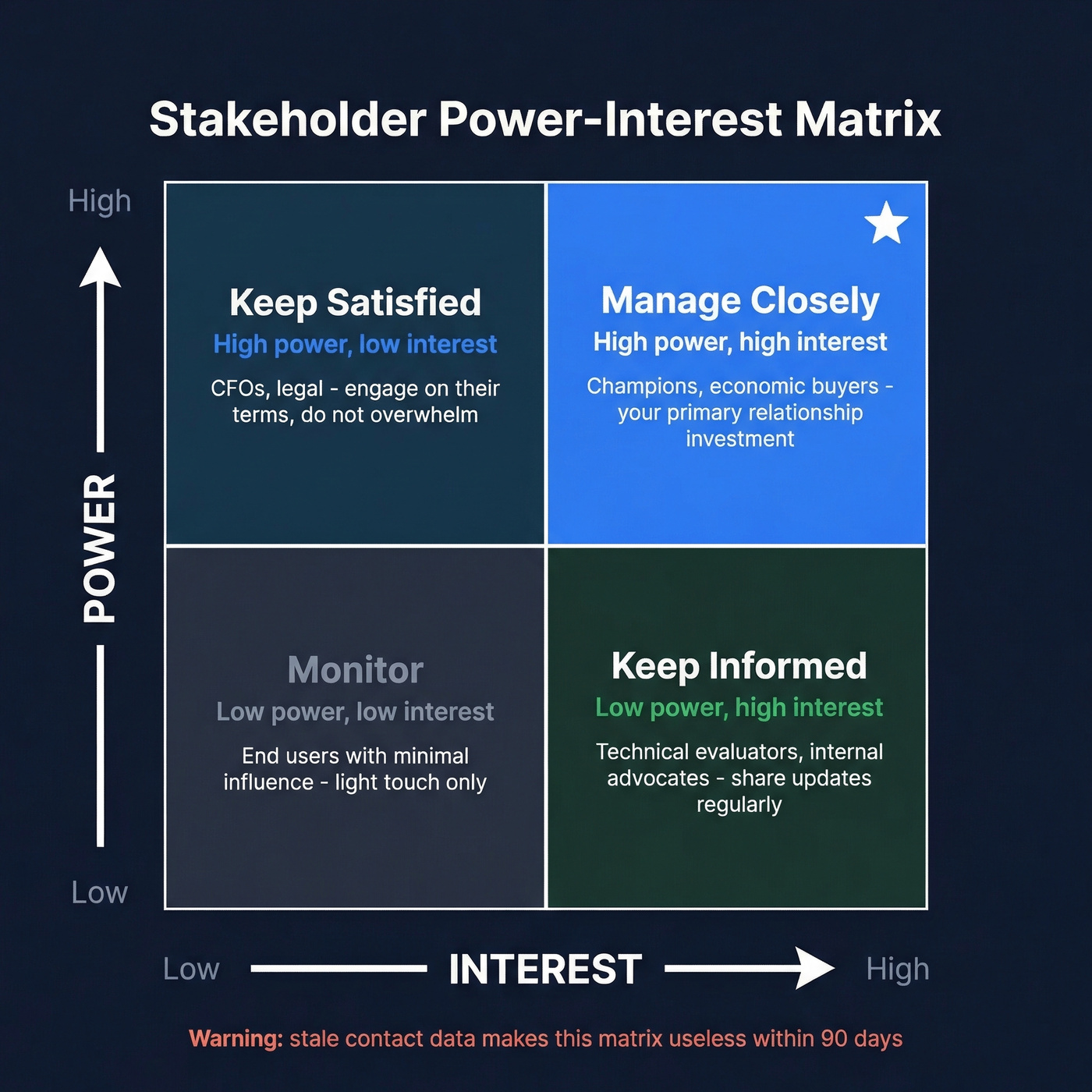
Here's the thing: if your stakeholder map has stale emails, your QBR invites bounce and your multi-threading falls apart. Decision-makers change roles constantly, and org charts decay even faster. We've seen teams lose six-figure renewals because the champion left and nobody noticed for two quarters. Keep contact data fresh with a tool like Prospeo, which refreshes records every 7 days at 98% email accuracy - compared to the 6-week refresh cycle most data vendors offer.
Step 3 - Build the Account Plan
A one-page account plan beats a 40-slide deck that nobody opens after the kickoff meeting. Per Smartsheet's research, effective plans cover seven elements: client profile, situation analysis (SWOT and competitive landscape), goals and objectives, strategies and tactics, action plan with owners and deadlines, resource allocation, and performance monitoring. Smartsheet offers free, downloadable templates for each - including a one-page account plan and org-chart stakeholder map.
Frequently updated plans make organizations 3x more likely to build customer decision confidence. A living document in your CRM beats a polished PowerPoint that's six months out of date.
Include a white space analysis - a visual map of which products or services each business unit has adopted and where expansion opportunities remain. This is the artifact that turns your account plan from a status report into a growth playbook.
Step 4 - Define Roles With a RACI Chart
RACI stands for Responsible (the doers), Accountable (the single owner), Consulted (two-way input), and Informed (one-way updates). The critical rule: one "A" per task. If two people think they own the renewal conversation, nobody does.
Map every major KAM activity - QBR prep, executive sponsorship, escalation handling, expansion proposals - against your internal team. This prevents the "Captain Super-KAM" problem where one person tries to do everything without support from finance, ops, and product.
Step 5 - Execute With Tier-Based Cadences
Not every account gets the same touch frequency. Match cadence to tier:
| Tier | External QBRs | Internal Reviews |
|---|---|---|
| Tier 1 | Quarterly | Monthly |
| Tier 2 | Semiannual | Quarterly |
| Tier 3 | Annual | As needed |
Tier 1 accounts justify the investment because they represent outsized revenue concentration. Tier 3 accounts still matter - they just don't need monthly internal reviews burning your team's calendar.
Step 6 - Track KPIs With Real Formulas
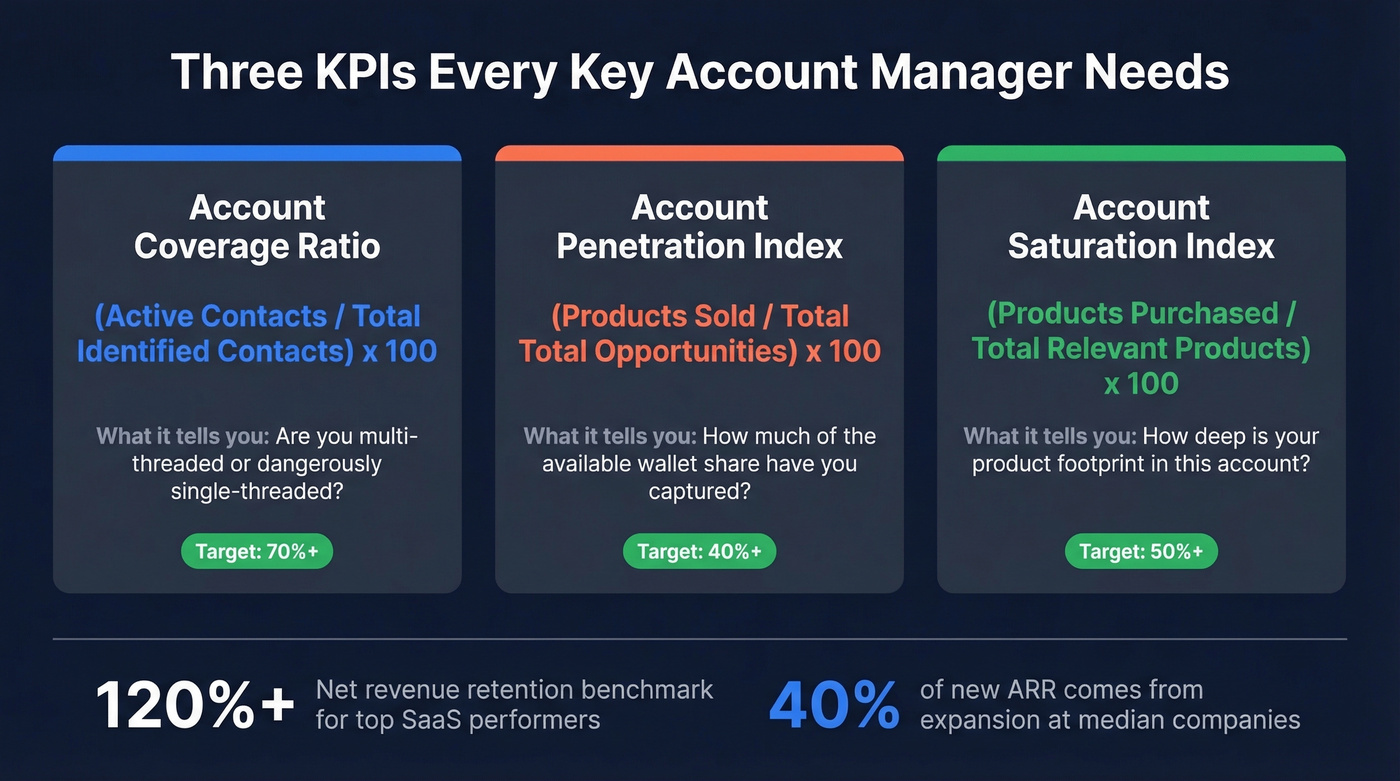
Generic "track your KPIs" advice helps nobody. Three KPI formulas from KPI Depot's KAM library that actually tell you something:
| KPI | Formula | What It Tells You |
|---|---|---|
| Account Coverage Ratio | (Active contacts / total identified contacts) x 100 | Multi-threaded or single-threaded? |
| Account Penetration Index | (Products sold / total opportunities) x 100 | How much wallet share captured? |
| Account Saturation Index | (Products purchased / total relevant products) x 100 | How deep is your footprint? |
For SaaS companies, benchmark against industry standards: top performers hit 120%+ net revenue retention, and expansion accounts for about 40% of new ARR at the median company. If your key accounts aren't expanding, your KAM program is a retention program - not a growth engine.
Step 7 - Review, Recalibrate, Report
Customers with high decision confidence are 10x more likely to make a high-quality, low-regret purchase. Your job in every review cycle is to build that confidence by showing impact - not just activity. In one documented case, a B2B service provider saw a 30% revenue boost after implementing structured account intelligence across its top 10 accounts.
As Kapta's framework puts it, not reporting value back is a deadly sin. When you stop showing ROI, renewals become price conversations. Every quarterly review should also evaluate whether the account still qualifies as "key" - strategic fit changes, and your tier list should reflect that.
Why KAM Programs Fail
Distilled from Cranfield's 12 mistakes and Kapta's 7 deadly sins, here are the five failure modes we see most often:
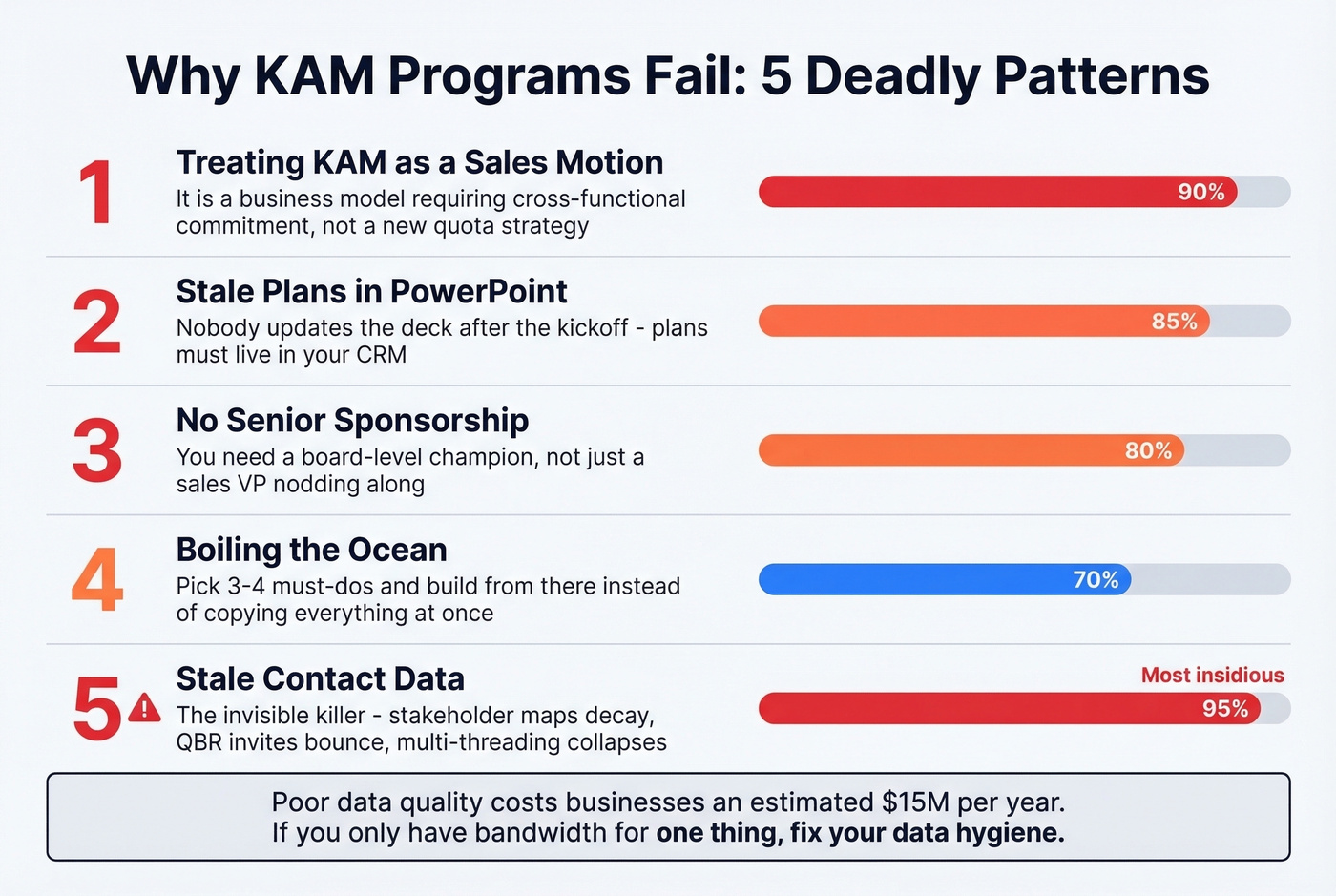
- Treating KAM as a new sales motion instead of a different business model requiring cross-functional commitment
- Stale plans in PowerPoint that nobody updates after the initial strategy session
- No senior sponsorship - effective KAM needs a board-level champion, not just a sales VP
- Trying to boil the ocean instead of picking 3-4 must-dos and building from there
- Stale contact data - the invisible failure mode where stakeholder maps decay, QBR invites bounce, and multi-threading collapses silently
That fifth one is the most insidious because it doesn't show up in any dashboard. Your account plan looks complete, but half the contacts have changed roles. Poor data quality costs businesses an estimated $15M per year.
Let's be honest: most KAM programs don't fail because of bad strategy. They fail because nobody owns the boring operational work - updating the stakeholder map, auditing the tier list, running the RACI review. If you only have bandwidth for one thing, skip the strategy offsite and fix your data hygiene instead.
Best Practices for Your Tech Stack
A solid KAM tech stack has three layers: data quality as the foundation everything else depends on, CRM for workflow, and a dedicated KAM platform for account-specific tooling.
| Layer | Tool | Starting Price | Best For |
|---|---|---|---|
| Data Quality | Prospeo | Free tier; ~$0.01/email | Stakeholder freshness |
| CRM | Salesforce | From $25/user/mo | Enterprise KAM |
| CRM | HubSpot Sales Hub | From $15/mo | Mid-market teams |
| KAM Platform | DemandFarm | ~$15K-$50K/yr | 20+ key accounts |
| KAM Platform | Kapta | ~$500-$2,000/mo | Smaller programs |
Salesforce is the default CRM foundation for enterprise KAM; Sales Cloud starts at $25/user/month, and higher tiers typically run $100-$200/user/month depending on edition and add-ons. HubSpot works well for mid-market teams wanting simpler setup, with Sales Hub starting around $15-$20/month. DemandFarm is purpose-built for key account management with org charts, whitespace analysis, and account health scoring. Kapta is a lighter alternative with relationship mapping, better suited for smaller programs.
Skip DemandFarm if you're managing fewer than 15 key accounts - the overhead won't justify the cost, and you can get 80% of the value from a well-structured CRM with custom objects.
For the data quality layer, Prospeo's CRM enrichment returns 50+ data points per contact at a 92% match rate, which is useful for keeping stakeholder maps current without manual research. It integrates natively with Salesforce and HubSpot, so enrichment runs inside your existing workflow rather than creating another tab to manage.
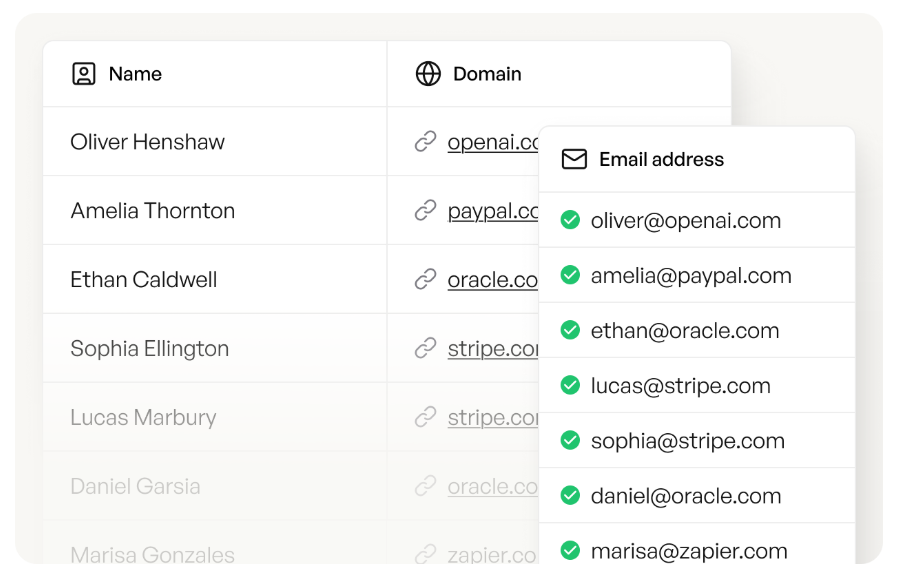
A high Account Coverage Ratio requires verified emails and direct dials for every stakeholder on your power-interest matrix. Prospeo gives you 143M+ verified emails and 125M+ mobile numbers - enriching your CRM with 50+ data points per contact at $0.01 per email. No contracts, no stale records.
Multi-thread every key account with data that's never more than 7 days old.
FAQ
What separates KAM from regular sales?
KAM optimizes for depth, retention, and expansion within accounts that disproportionately drive revenue - typically the top 10-20% generating about 33% of total revenue. Regular sales optimizes for acquisition volume. KAM is a cross-functional business model, not a pipeline motion.
How many accounts should one KAM handle?
Most key account managers handle 3-5 Tier 1 and 8-12 Tier 2 accounts effectively. Beyond that, execution quality drops fast. If a KAM owns 20+ accounts, they're really just an account manager with a fancier title.
How do you keep stakeholder data accurate?
Decision-makers rotate roles frequently, and org charts decay between QBRs. Use a data quality tool with automated refresh cycles, or schedule manual audits quarterly at minimum. The consensus on r/sales is that stale data is the silent killer of multi-threading strategies - and most teams don't realize how bad the problem is until a renewal slips.
What are the most important KAM KPIs?
Track Account Coverage Ratio (active contacts divided by total identified contacts, times 100), Account Penetration Index, and net revenue retention. Top-performing SaaS companies hit 120%+ NRR, with expansion driving about 40% of new ARR. If those numbers are flat, your program is retaining - not growing.