

Lead Enrichment for CRM: What to Enrich, When to Refresh, and What It Costs
A RevOps lead on r/SalesOperations put it bluntly: their enriched CRM data was "60% garbage after 3 months." Contacts from major providers started bouncing within weeks - wrong titles, job changes, dead emails. SDRs burned four hours a day manually checking profiles before they'd even start outreach.
B2B contact data degrades about 30% per year. If you're treating lead enrichment for CRM as a one-time data append, you're building pipeline on a foundation that's actively crumbling.
Here's the thing: most teams don't need a $30K/year platform. They need one accurate data source, a re-enrichment cadence, and their CRM's native automation for field mapping.
What CRM Lead Enrichment Actually Means
Lead enrichment isn't a one-time CSV upload. It's an ongoing system that fills, corrects, and refreshes CRM records so reps work with data that reflects reality - not a snapshot from six months ago.
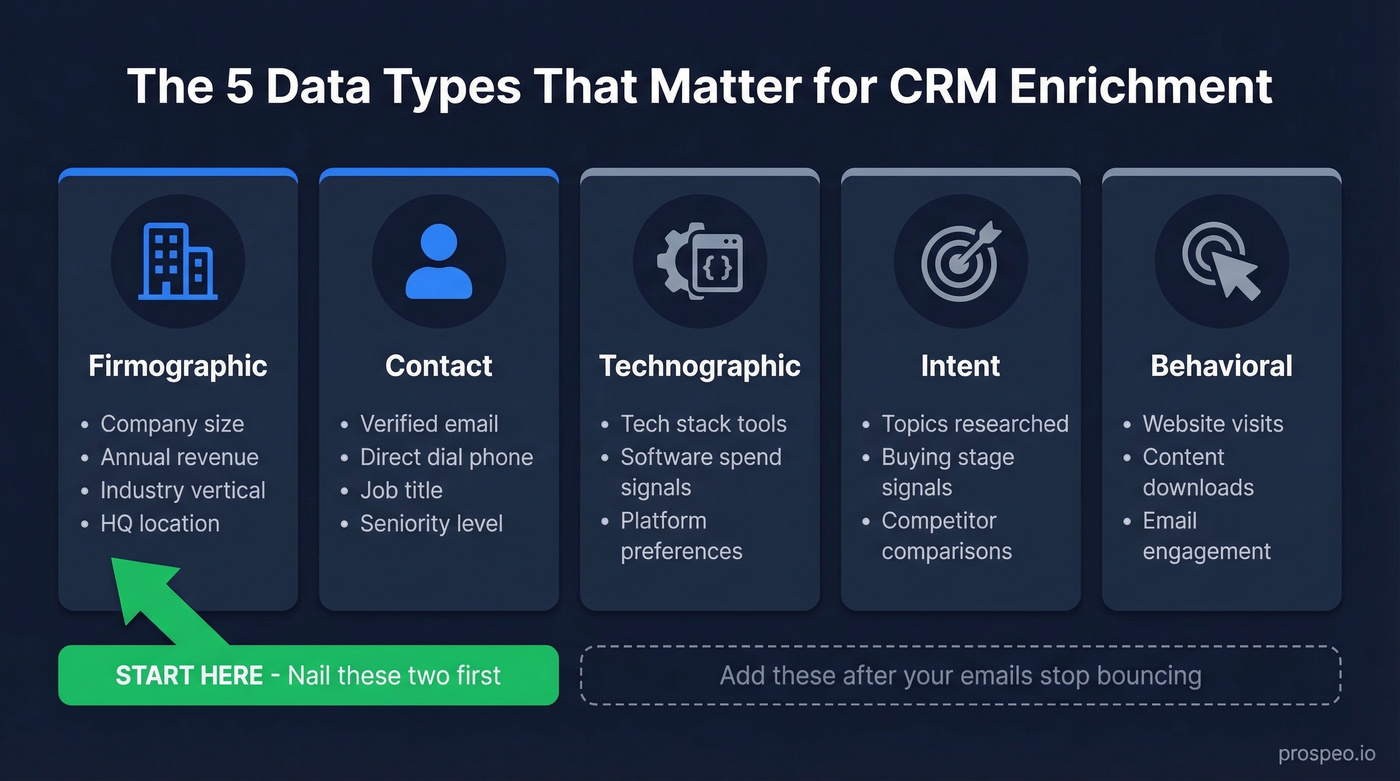
The data types that matter break into five categories: firmographic (company size, revenue, industry), contact (verified email, direct dial, job title), technographic (tech stack signals), intent (topics a company is actively researching), and behavioral (website visits, content engagement). Nail the first two before worrying about the rest. Getting fancy with intent data doesn't help if half your emails bounce.
One emerging angle worth watching: AI agents that extract structured fields from internal CRM artifacts like call notes and transcripts. Early data from Cotera shows 3.4x conversion lifts when a stated timeline is captured and 2.8x for budget signals. No competitor covers internal enrichment well yet, but it's where the category is heading.
How Enrichment Workflows Run
Single-source enrichment is the simplest approach: plug one provider into your CRM and let it fill in the blanks. The problem is coverage. A single provider typically matches 40-50% of your records with usable contact data, which means half your database stays incomplete.
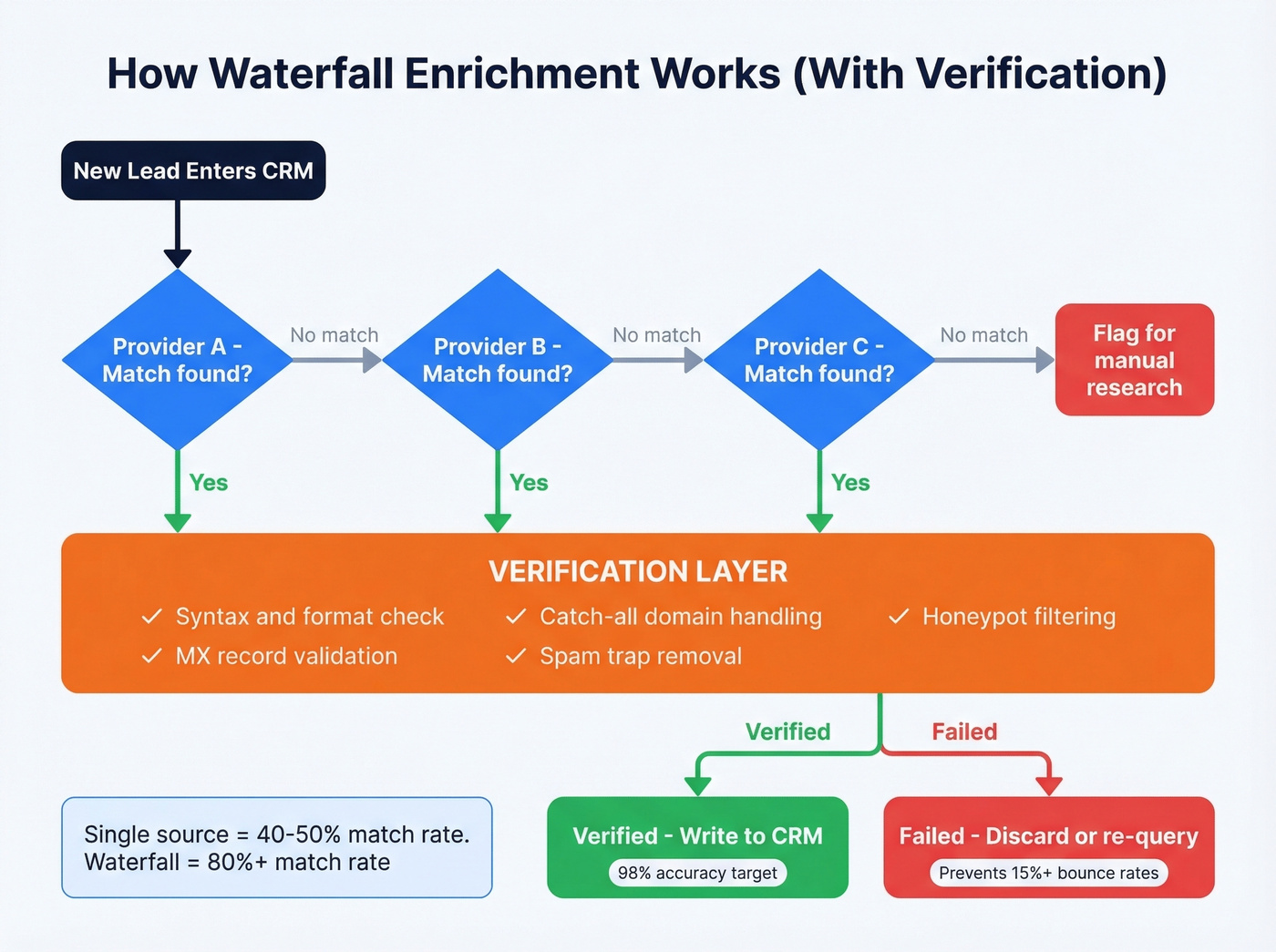
Waterfall enrichment queries multiple providers sequentially - if Provider A doesn't have a verified email, the system tries Provider B, then C. This pushes email match rates above 80%. The tradeoff is cost and complexity. Tools like Clay are built for this, but simpler setups work too.
The verification layer is where most teams cut corners and pay for it later. Enrichment without verification is expensive data pollution. A provider can return an email that looks right but bounces on first send. Catch-all domain handling, spam-trap removal, and honeypot filtering aren't optional - they're the difference between a healthy sender reputation and a blacklisted domain. Skip verification and you're looking at 15%+ bounce rates, which tanks deliverability across your entire domain.

You just read that enrichment without verification is expensive data pollution. Prospeo's 5-step verification - catch-all handling, spam-trap removal, honeypot filtering - delivers 98% email accuracy on 300M+ profiles. 83% of leads come back enriched with 50+ data points. At $0.01/email, no contract required.
Stop enriching your CRM with data that bounces in three months.
Best CRM Enrichment Tools in 2026
Prospeo
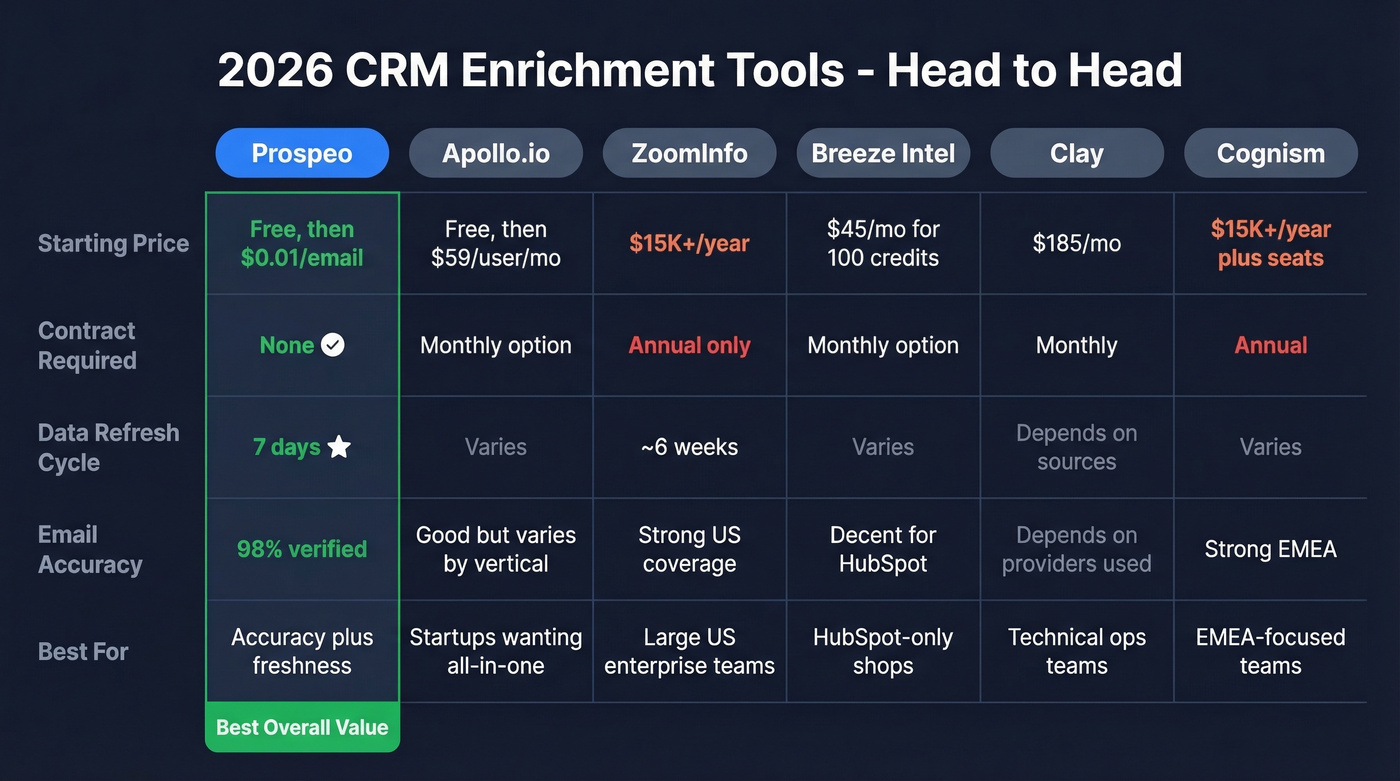
Use this if you want the highest email accuracy available without signing an annual contract. Prospeo draws from 300M+ professional profiles and returns contact data on 83% of leads, with 50+ data points per record and 98% verified email accuracy. The 7-day data refresh cycle is the standout - the industry average is six weeks.
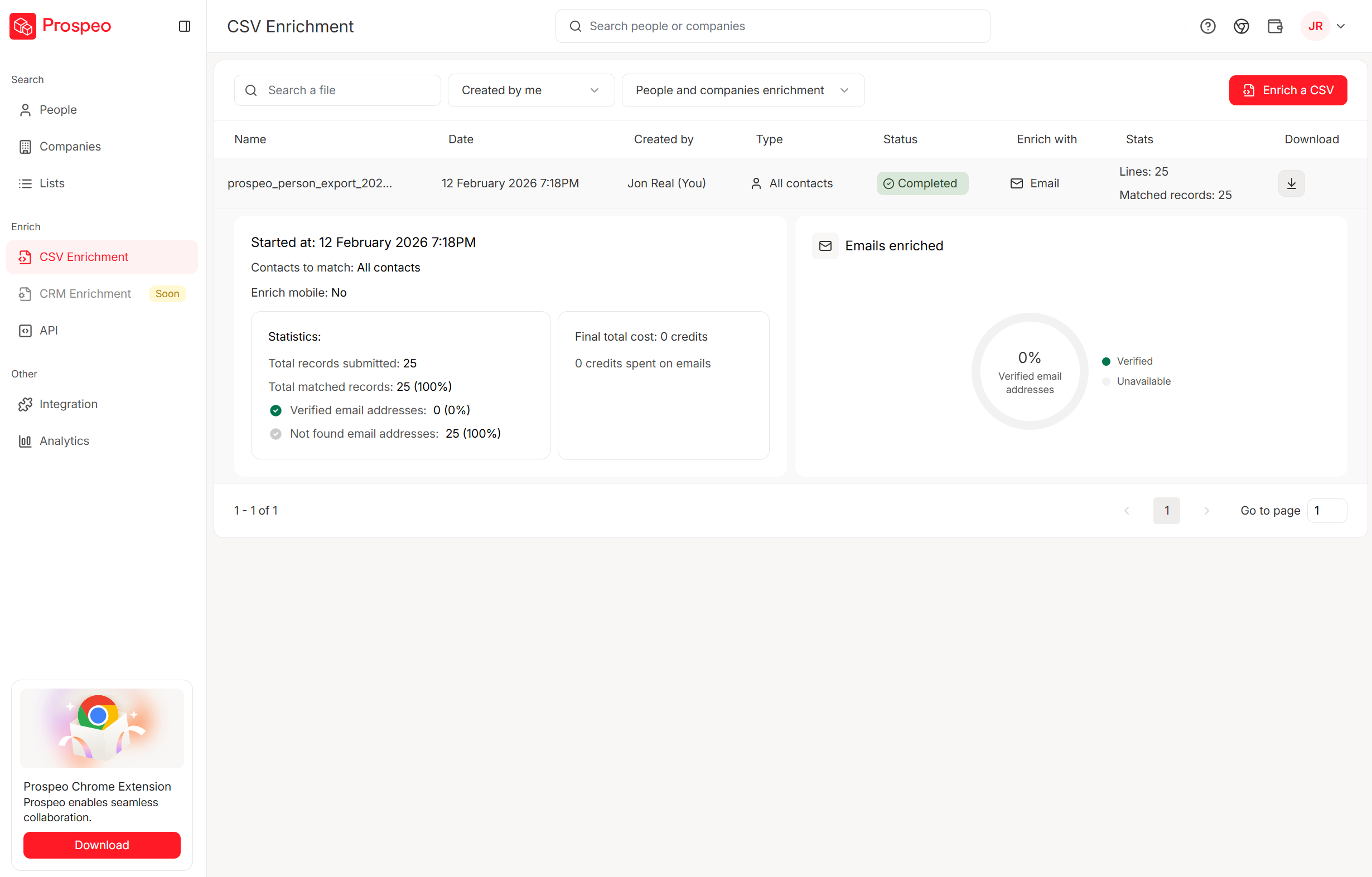
Native Salesforce and HubSpot integrations make setup fast, and Bombora-powered intent data across 15,000 topics layers buying signals without bolting on another vendor. Real results: Snyk's 50-person AE team dropped their bounce rate from 35-40% to under 5%, and AE-sourced pipeline jumped 180%.
Pair it with your existing sequencer or dialer - Prospeo handles the data layer so your outreach tools work with verified contacts.
Pricing: ~$0.01/email with a free tier (75 emails/month). No contracts.
Apollo.io
Apollo is the default for teams that want enrichment and outbound sequencing in one platform. The database covers 210M+ contacts, the free tier is genuinely usable, and paid plans run $59-$149/user/month. The built-in sequencer means you can find, enrich, and email from one tool. We've found match quality varies significantly by industry vertical, and credit limits on lower tiers can bite you mid-quarter during high-volume campaigns.
ZoomInfo
Deep US and Canadian coverage. But a typical contract runs $15K-$45K+/year with annual commitments only, and renewal uplifts of 10-20% are standard. A common complaint on r/sales_intelligence is paying for features you never touch - intent modules, org charts, and workflow tools that sit unused while you really just need verified emails and phone numbers. One poster called the renewal quote "eye-watering." For 80% of teams, ZoomInfo is overkill.
Clearbit / Breeze Intelligence
HubSpot's native enrichment. Credit packs start at $45/month for 100 credits, and packs range from $30 to $700/month depending on volume. Credits reset every 30 days - use them or lose them. Clean integration for HubSpot shops, but per-record cost adds up fast.
Clay
Powerful waterfall orchestration querying multiple providers in sequence. Plans start at $185/month after Clay's March 2026 pricing change. CRM integrations require the Growth tier at $495/month. Expect a 4-6 week learning curve - this is a workflow builder, not plug-and-play.
Cognism
Strong European coverage with Bombora intent data baked in. Platform fees start around $15K/year plus $1,500-$2,500/user/year. Best fit for teams selling into EMEA who need GDPR-compliant mobile numbers. Skip it for US-only prospecting.
Comparison Table
| Tool | Starting Price | Contract | Best For | Our Verdict |
|---|---|---|---|---|
| Prospeo | Free; ~$0.01/email | None | Accuracy + freshness | Best overall value |
| Apollo.io | Free; $59/user/mo | Monthly/annual | Outbound + enrichment | Best free tier for startups |
| ZoomInfo | ~$15K/year | Annual only | Large US teams | Best if you'll use the full suite |
| Breeze Intel | $45/mo (100 credits) | Monthly/annual | HubSpot shops | Skip unless you're all-in on HubSpot |
| Clay | $185/mo | Monthly | Waterfall orchestration | Best for technical ops teams |
| Cognism | ~$15K/year + seats | Annual | EMEA coverage | Overkill for US-only teams |
How Often to Re-Enrich CRM Data
"Enrich once" is a recipe for bounced emails and wasted pipeline. The RevOps lead from r/SalesOperations mentioned earlier saw reply rates climb roughly 15% just by keeping contacts current. In our experience, quarterly refreshes catch 80%+ of decay before it impacts campaigns.
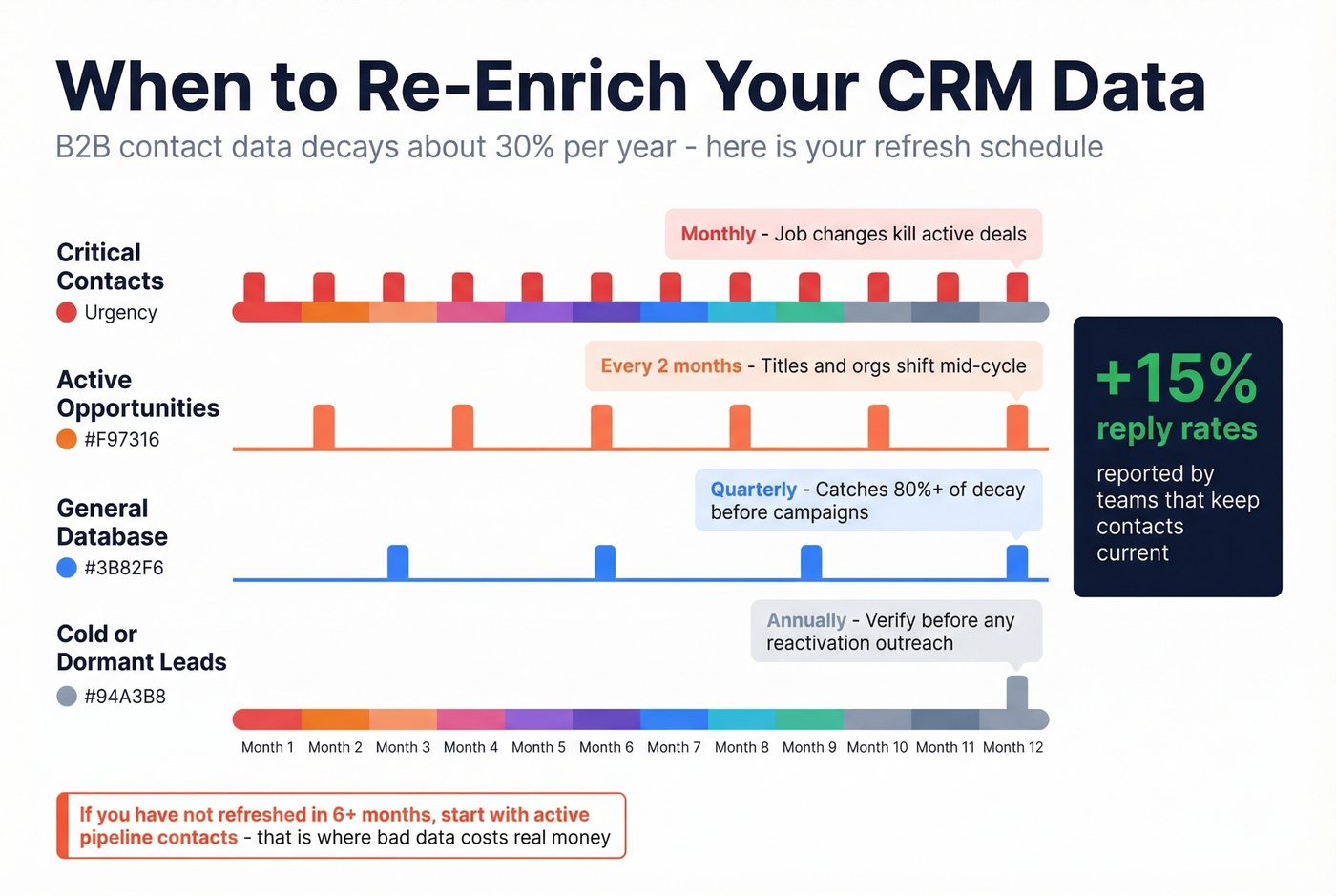
| Lead Segment | Cadence | Why |
|---|---|---|
| Critical contacts | Monthly | Job changes kill deals |
| Active opportunities | Every 2 months | Titles and orgs shift |
| General database | Quarterly | Catch decay before it compounds |
| Cold/dormant leads | Annually | Verify before reactivation |
Let's be honest - most teams we talk to haven't re-enriched their database in over a year. They're shocked when we show them how many records have gone stale. If you haven't refreshed in six months, start with your active pipeline contacts. That's where bad data costs you real money.
Implementation Checklist
Look - the tooling matters less than the process. Here's what to get right before you scale:
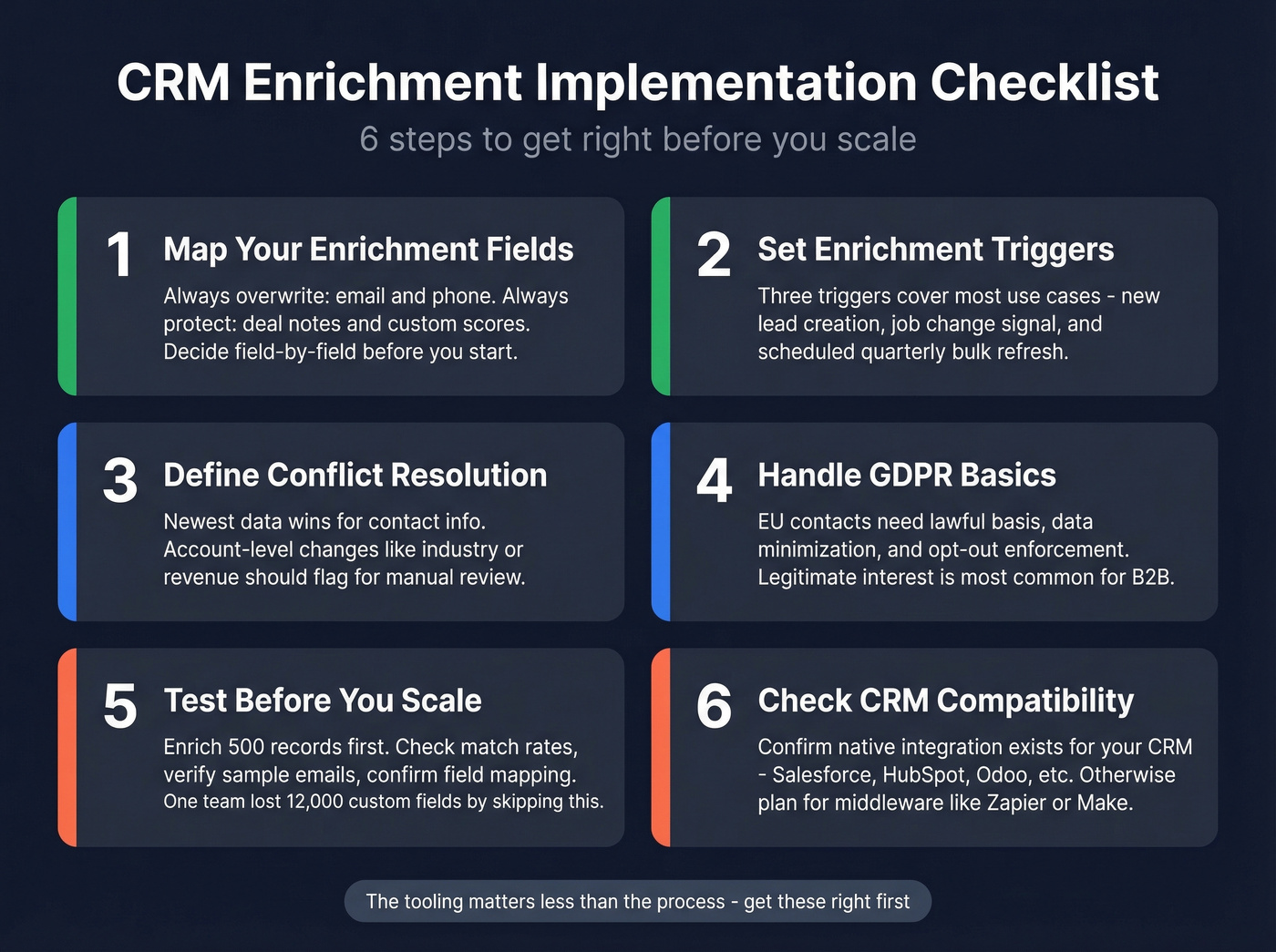
Map your enrichment fields. Decide which CRM fields get overwritten and which are source-of-truth. Always overwrite email and phone; protect manually entered deal notes and custom scoring fields.
Set enrichment triggers. Three triggers cover most use cases: new lead creation, job change signal detection, and a scheduled quarterly bulk refresh. Most CRMs support these natively or through tools like Zapier and Make.
Define conflict resolution rules. Newest data wins for contact info. Account-level changes like industry or revenue band should flag for manual review - automated overwrites here break segmentation.
Handle GDPR basics. If you're enriching EU contacts, you need a lawful basis (legitimate interest is most common for B2B), data minimization practices, and opt-out enforcement. This isn't optional.
Test before you scale. Enrich 500 records first. Check match rates, verify a sample of emails, and confirm your field mapping works before running 50,000 records through the pipe. We learned this the hard way after a client's bulk enrichment overwrote 12,000 custom fields because nobody tested the mapping first.
Consider your CRM platform. What Odoo users need differs from what Salesforce or HubSpot teams require - check whether your chosen tool has a native integration or if you'll need middleware.
Quarterly re-enrichment catches 80% of data decay - but only if your provider actually refreshes its records. Prospeo runs a 7-day data refresh cycle while the industry average sits at six weeks. Native Salesforce and HubSpot integrations mean enriched records flow straight into your CRM without manual mapping.
Keep your CRM current with data that's never more than a week old.
FAQ
What data types should I enrich first?
Verified email and job title - these decay fastest and directly impact deliverability. Add firmographic data (company size, revenue, industry) next for lead scoring. Intent data and technographics come last, once your scoring model can actually act on them.
How much does CRM enrichment cost for a small team?
Most teams under 10 reps spend $50-$200/month. Prospeo starts free at ~$0.01/email with no contract, while Apollo's free tier works for low-volume prospecting. Enterprise platforms like ZoomInfo start at $15K/year - unnecessary unless you're running coordinated ABM with 20+ reps.
Can I enrich CRM records automatically?
Yes. Most tools support triggers - enrich on new lead creation, on a scheduled cadence, or when a job change signal fires. Prospeo, Apollo, and Breeze Intelligence all support automated enrichment through native Salesforce/HubSpot integrations or workflow tools like Zapier and Make.
How do I prevent enrichment from overwriting good data?
Set field-level conflict resolution rules in your CRM. Always let enrichment overwrite email and phone since these decay fastest, but protect manually entered fields like deal notes, custom scores, and relationship context. Flag account-level changes - industry, revenue band - for manual review instead of auto-overwriting.