

Lead Gen Specialists: What They Do, What They Earn, and How to Build the System Around Them
Your VP just asked you to "figure out lead gen" - and your budget is one headcount. Maybe you're that headcount. Either way, you're staring at the same problem every B2B company hits: 79% of marketing leads never convert into sales, and someone needs to fix the plumbing between "interested" and "closed-won." That someone is usually one of the company's lead gen specialists - or the person about to become one.
Here's the thing: you don't need a lead generation specialist. You need a lead generation system. The specialist is the person who runs it, and the system is only as good as the data, tools, and process you build around them.
What You Need (Quick Version)
Three paths, three budgets:
If you're hiring in-house: Expect $65k-$83k base, $110k-$150k fully loaded with benefits, tooling, management overhead, and ramp time. Budget 3-6 months before they produce consistently.
If you're outsourcing: Expect $3k-$12k/mo depending on scope. You'll see results in 2-6 weeks, but you're trading control for speed.
If you ARE the specialist: Learn BANT, CHAMP, or MEDDIC depending on your deal complexity. Build your starter stack with a solid enrichment tool and HubSpot CRM - that's under $100/mo total. Track CPL and lead-to-customer rate, not vanity metrics like raw lead volume.
What Lead Gen Specialists Actually Do
Every guide says "they generate leads." That's like saying a chef "makes food." Let's be specific.
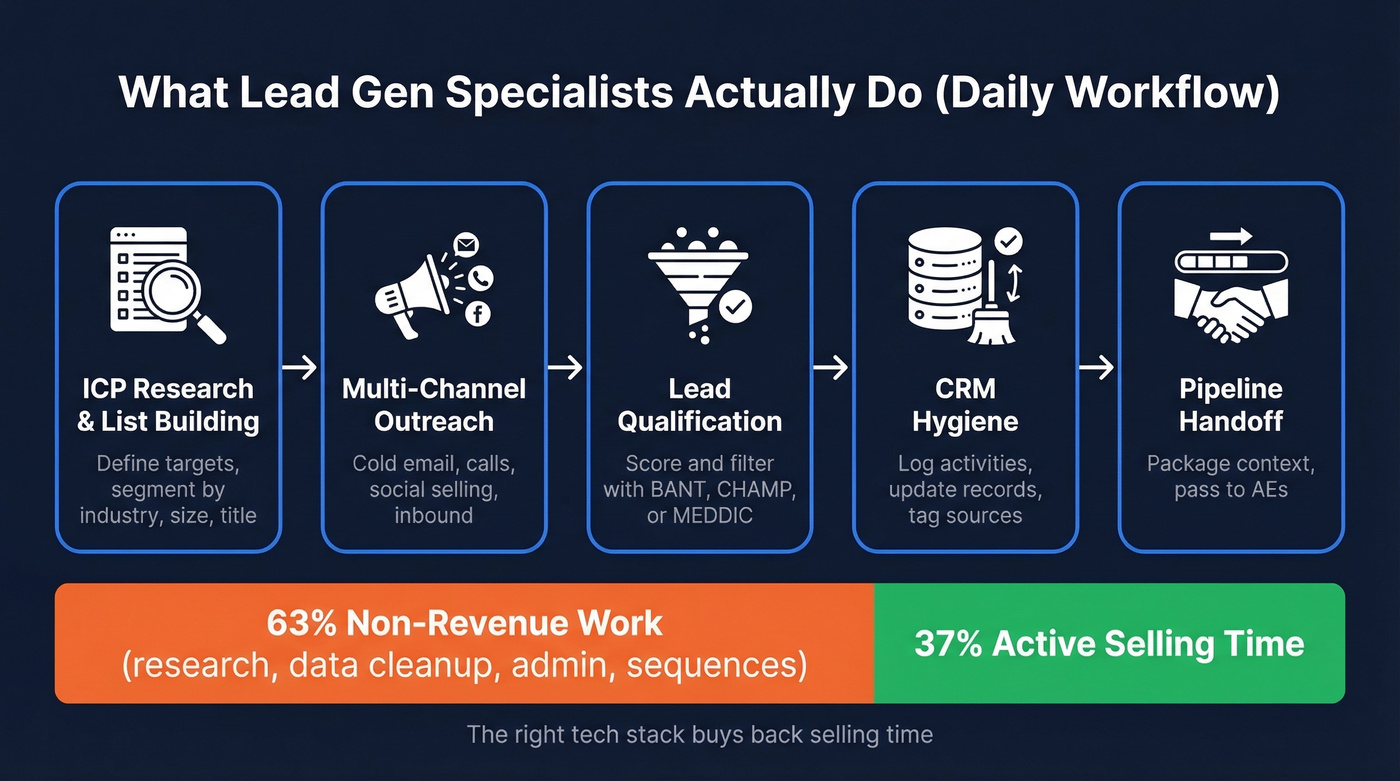
Lead generation specialists own the top of the funnel. Their job is to identify the right people at the right companies, get their attention, qualify whether they're worth pursuing, and hand them off to closers with enough context to run a real conversation. The day-to-day breaks into five responsibilities:
- ICP research and list building - defining who to target, building segmented lists by industry, company size, title, and buying signals
- Multi-channel outreach - cold email sequences, cold calls, social selling, and sometimes content-driven inbound campaigns
- Lead qualification - scoring and filtering leads using frameworks like BANT or MEDDIC so sales doesn't waste time on tire-kickers
- CRM hygiene - logging activities, updating contact records, tagging lead sources, keeping nothing from falling through the cracks
- Pipeline handoff - packaging qualified leads with context and passing them to AEs
The operational reality is less glamorous than the job description. A good specialist spends around 63% of their time on non-revenue work - research, data cleanup, admin, sequence management. That ratio is why the tech stack matters so much: the right data and tooling buys back selling time. Some teams address this by pairing a specialist with a lead generation assistant who handles the list-building grunt work, freeing the senior person to focus on outreach and qualification.
Skills That Separate Top Performers
Hard skills determine whether someone can operate the system. Soft skills determine whether they can read a conversation and adapt.
CRM proficiency isn't optional - if they can't navigate HubSpot or Salesforce fluently, every task takes twice as long. Data analysis matters because a specialist who reads conversion rates and adjusts targeting saves months of wasted effort. Copywriting is underrated. Small changes in a cold email can swing reply rates by double digits, and we've seen reps go from 2% to 8% reply rates just by rewriting their opening line with a specific observation about the prospect's company.
On the soft skills side, persistence matters because outbound is a volume game with a low hit rate - you need someone who doesn't take rejection personally. Pattern recognition is the sleeper skill: noticing that a certain persona converts better, or that a specific objection keeps surfacing, and adjusting the playbook accordingly.
How They Qualify Leads
Qualification is where lead gen specialists earn their salary. Without it, you're generating noise.
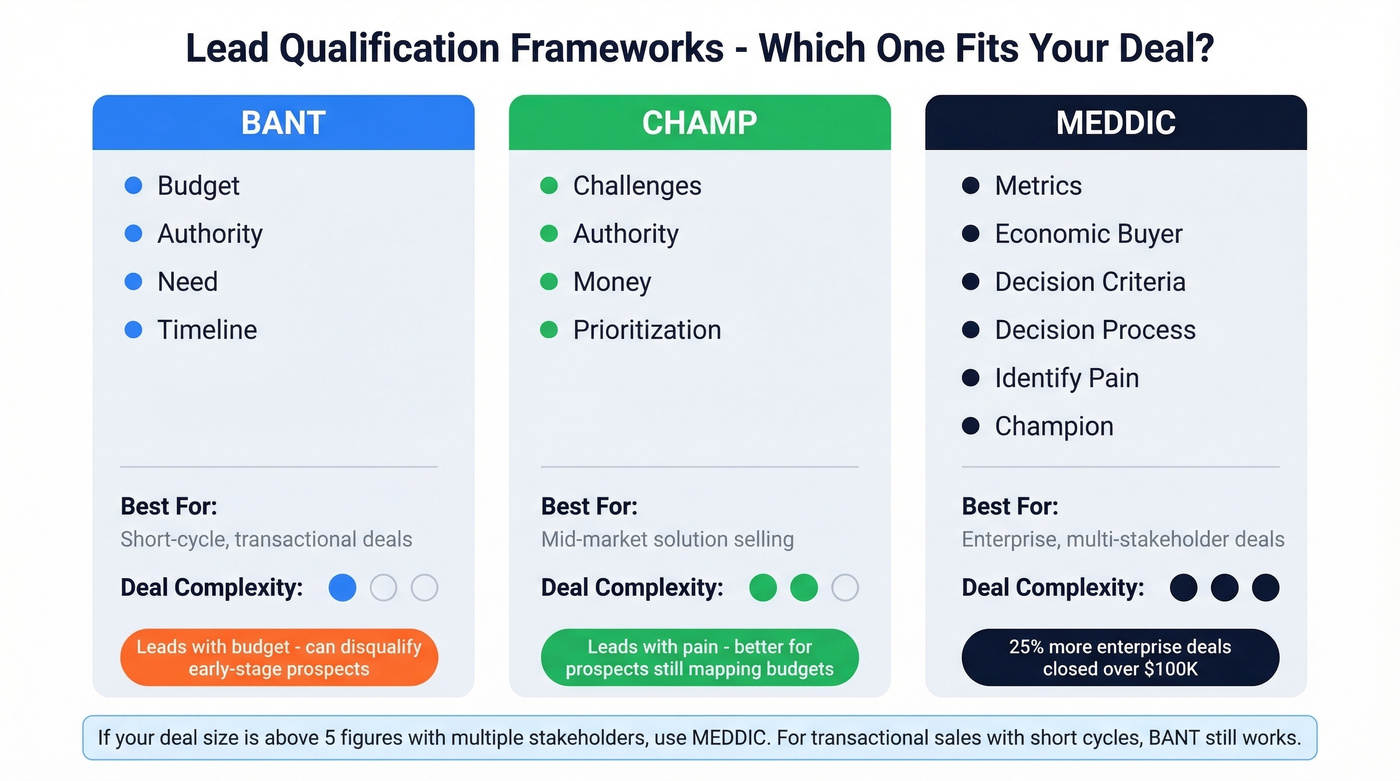
| Framework | Criteria | Best For | Deal Complexity |
|---|---|---|---|
| BANT | Budget, Authority, Need, Timeline | Short-cycle, transactional | Low-Medium |
| CHAMP | Challenges, Authority, Money, Prioritization | Mid-market solution selling | Medium |
| MEDDIC | Metrics, Economic Buyer, Decision Criteria, Decision Process, Identify Pain, Champion | Enterprise, multi-stakeholder | High |
BANT was created by IBM and works when deals close in days or weeks. Does the prospect have budget, authority, a real need, and a timeline? If yes, pass them to sales. The limitation: BANT leads with budget, which can disqualify prospects who have a real problem but haven't allocated spend yet.
CHAMP flips the script by leading with challenges. It fits mid-market deals where the prospect knows they have a problem but hasn't mapped it to a budget line.
MEDDIC is the enterprise standard. Teams using MEDDIC close 25% more enterprise deals over $100K. It's heavier - you're mapping the entire buying committee, identifying a champion inside the account, and understanding the decision process before you pitch. That's necessary when buyers spend only 17% of their buying process in meetings with vendors.
Look, BANT is outdated for complex B2B sales. If your deal size is above five figures and involves multiple stakeholders, MEDDIC is the right framework. BANT still works fine for transactional sales with shorter cycles - just don't pretend it'll handle a six-month enterprise deal.
Salary Benchmarks in 2026
The salary data for this role is a mess. Indeed says $35,673, Comparably says $71,463, and PayScale shows $31k-$62k for the more junior "Lead Generator" title. The real answer depends on title, seniority, and geography.
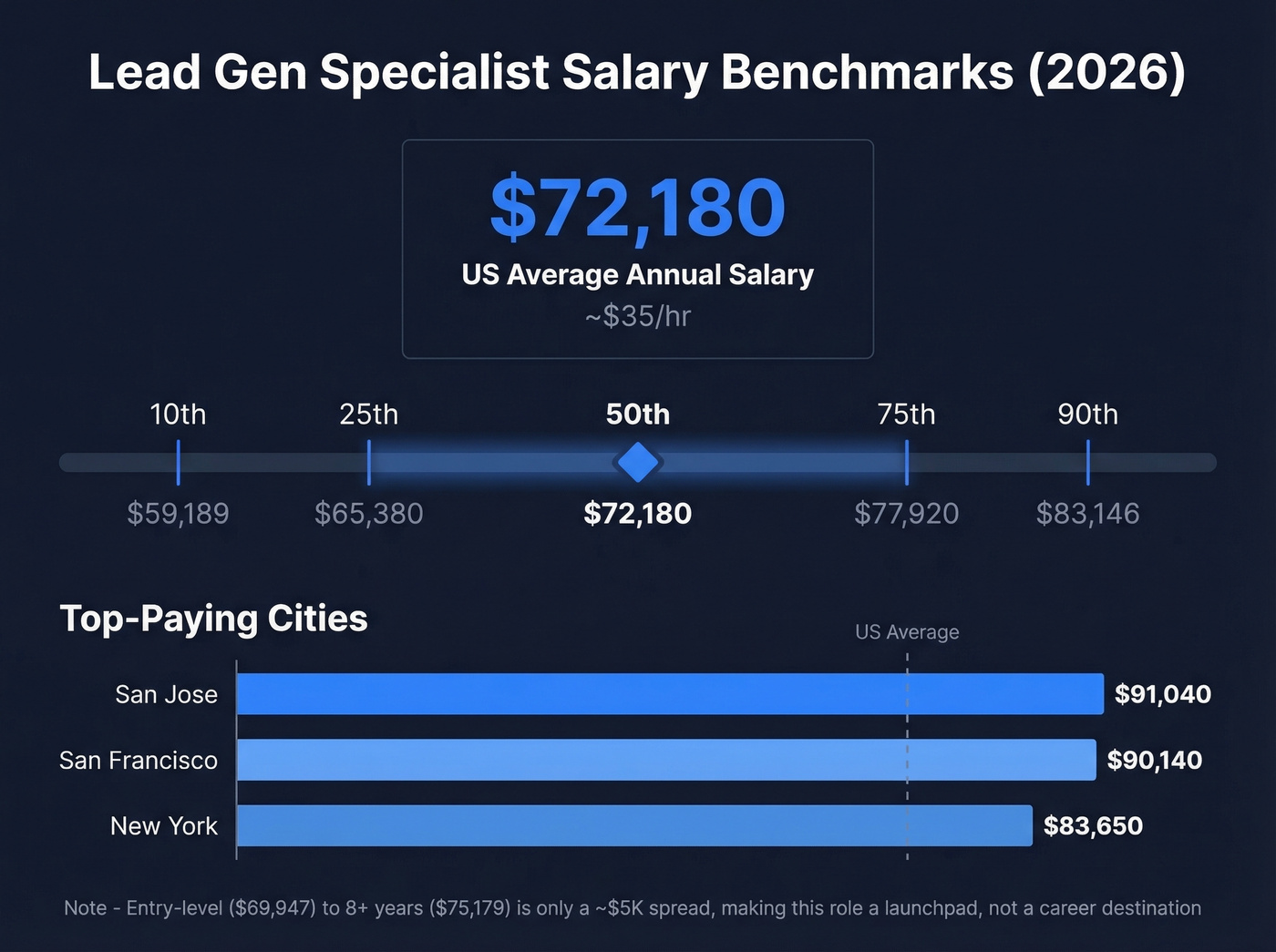
The cleanest benchmark comes from Salary.com: as of early 2026, the average lead generation specialist salary in the US is $72,180/year (~$35/hr).
| Percentile | Salary |
|---|---|
| 10th | $59,189 |
| 25th | $65,380 |
| 50th (median) | $72,180 |
| 75th | $77,920 |
| 90th | $83,146 |
Geography swings the number significantly:
| City | Average Salary |
|---|---|
| San Jose | $91,040 |
| San Francisco | $90,140 |
| New York | $83,650 |
Why do some sources show $31k-$62k? Title variance. PayScale's "Lead Generator" data - based on 26 salary profiles - reports a median hourly rate of $19.46/hr with total pay ranging $31k-$62k. That title skews junior and inside-sales-adjacent. "Lead Generation Specialist" commands a premium because it implies strategic ownership, not dial-and-smile activity.
One thing that surprised us: experience-level progression is unusually flat. Entry-level averages $69,947, while 8+ years averages $75,179. That's a ~$5k spread across an entire career in the role - which tells you this isn't a position people stay in long-term. It's a launchpad.

Your lead gen specialist's biggest bottleneck is data quality - not effort. Prospeo delivers 98% email accuracy, 125M+ verified mobiles, and 30+ filters for ICP targeting, all refreshed every 7 days. That means less time on list cleanup, more time on outreach and qualification.
Give your specialist the data stack that actually converts.
The Tech Stack (With Pricing)
A specialist's stack breaks into four categories: CRM, enrichment/data, outreach, and marketing automation.
| Category | Tool | Starting Price |
|---|---|---|
| CRM | HubSpot | Free (Starter $15/user/mo) |
| CRM | Salesforce | Starter $25/user/mo |
| Enrichment | Prospeo | Free; ~$0.01/email |
| Enrichment | ZoomInfo | ~$15,000-$40,000/year |
| Enrichment | Apollo | Free; paid from $49/mo |
| Enrichment | Cognism | ~$1,000-$3,000/mo |
| Outreach | Outreach | $100-$150/user/mo |
| Outreach | Salesloft | ~$100-$150/user/mo |
| Automation | ActiveCampaign | $49-$399/mo |
| Automation | Marketo | $1,500-$5,000/mo |
CRM is the operating system. HubSpot's free tier is genuinely usable for small teams - you don't need to pay until you outgrow it. Salesforce starts at $25/user/mo on its Starter tier but realistically costs more once you add the modules you actually need. CRM implementation drives a 29% increase in sales productivity, so this isn't optional.
Enrichment and data is where the real value lives. Enrichment tools reduce manual research time by 70% - that's hours per day a specialist gets back for actual outreach.

Prospeo covers 300M+ professional profiles with 98% email accuracy, refreshed every 7 days - not the 6-week industry average. The free tier gives you 75 emails plus 100 Chrome extension credits per month, with paid plans at roughly $0.01/email and no contracts. The Chrome extension (40,000+ users) lets you pull verified contacts from any website, professional profiles, and CRMs in one click. Compare that to ZoomInfo at $15k-$40k/year, and the accessibility gap is obvious.
Apollo's free tier is solid for getting started, but its email accuracy runs lower. Cognism ($1k-$3k/mo) is a common choice for teams running GDPR-conscious workflows and selling into EMEA.
Outreach tools handle the sequencing. Outreach and Salesloft handle multichannel well. Instantly and Smartlead are strong for cold email at scale at lower price points.
Marketing automation matters if your specialist handles inbound too. ActiveCampaign ($49-$399/mo) is the mid-market sweet spot. Marketo ($1,500-$5,000/mo) is enterprise-grade.
In-House vs. Outsourced: The Real Cost
Most companies underestimate the true cost when they compare hiring to outsourcing.
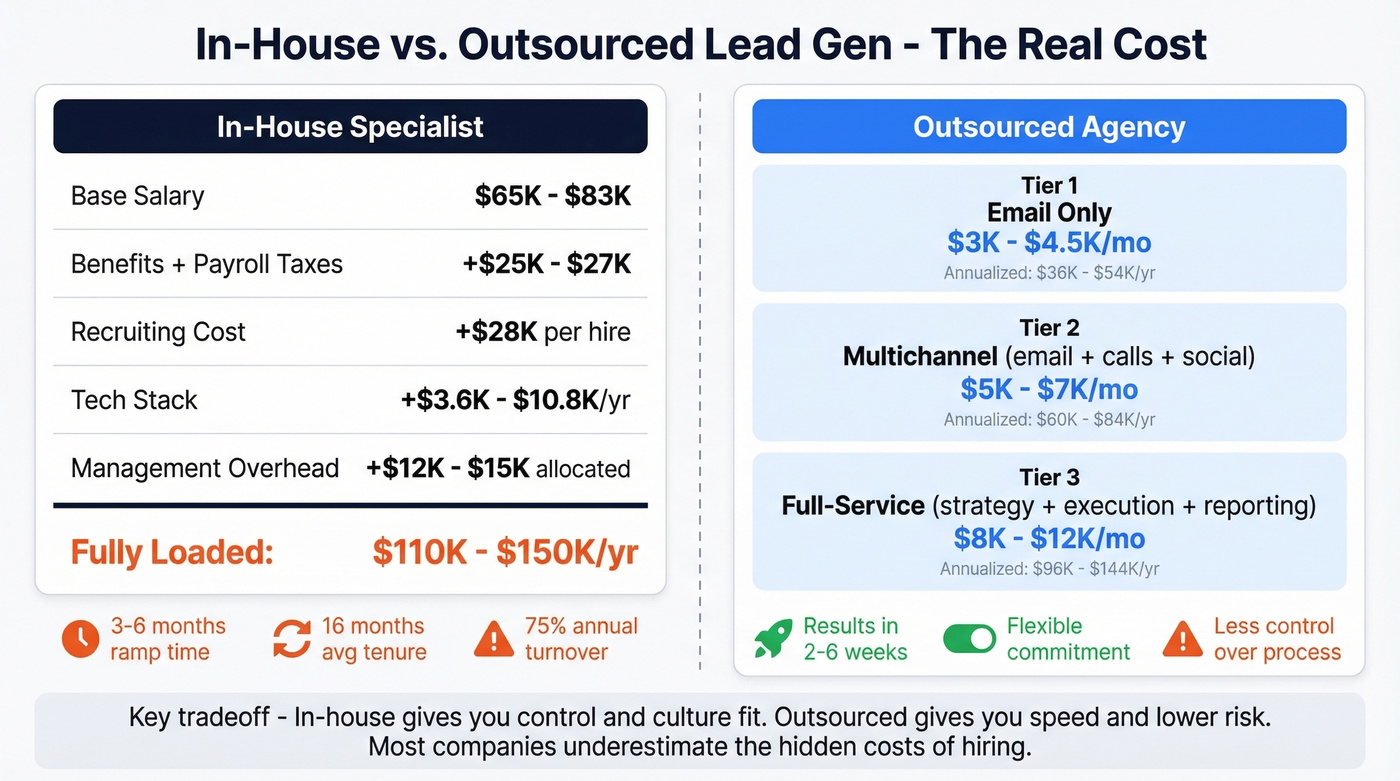
The fully loaded in-house cost: $110k-$150k/year. Base salary runs $65k-$83k. Add variable comp, benefits, and payroll taxes - you're at $90k-$110k. Then layer on recruiting (often $28k+ per hire for senior roles), a full outbound stack at $300-$900/mo per rep, management overhead (one SDR manager at $120k-$150k covers 8-10 reps), and 3-6 months of ramp time at full salary for partial productivity. Average ramp to full productivity is 3.2 months.
The kicker? Average SDR tenure is 16 months, and companies replace roughly 75% of their SDR team annually. You're not just paying to hire - you're paying to re-hire.
Outsourced pricing bands:
- Email-only: $3k-$4.5k/mo
- Multichannel (email + calls + social): $5k-$7k/mo
- Full-service (strategy + execution + reporting): $8k-$12k/mo
Clutch lists 3,070+ lead gen companies as of early 2026. Martal Group, one of the top-rated providers (4.8 stars, 106 reviews), offers packages starting at $4,500/mo. Many of these firms operate as dedicated lead generation agents, embedding into your workflow and acting as an extension of your sales team rather than a disconnected vendor.
| Factor | In-House | Outsourced |
|---|---|---|
| Annual cost | $110k-$150k loaded | $36k-$144k |
| Time to first meeting | 3-6 months | 2-6 weeks |
| Average tenure | 16 months | Contract-based |
| Messaging control | Full | Moderate |
If your average deal size is under $15k, you probably don't need an in-house hire at all. Outsource the prospecting, keep the qualification in-house, and spend the salary savings on better data and tooling. The math just works better until you've validated the playbook enough to justify a full-time headcount.
One UK-focused analysis modeled the total opportunity cost of an in-house SDR at £274,679/year when factoring in ramp, attrition, rehiring, and unmanaged sales function gaps. That number is aggressive, but it illustrates why the "just hire someone" approach is more expensive than it looks.
Benefits of Hiring In-House
Despite the cost, there are clear benefits of hiring a lead generation specialist in-house when the conditions are right.
The biggest advantage is full control over messaging, ICP targeting, and qualification standards - outsourced teams can approximate your voice, but an internal specialist lives and breathes your product daily. You also get tighter feedback loops between sales and marketing, deeper institutional knowledge that compounds over time, and the ability to iterate on outreach strategy in real time without waiting on an external team's sprint cycle.
Skip the in-house route if you haven't validated a repeatable outbound playbook yet. But if your average contract value exceeds $20k, your sales cycle involves multiple stakeholders, and you know what messaging works, the in-house hire pays for itself through higher conversion rates and better pipeline quality.
KPIs and Benchmarks
If your specialist reports on "leads generated" without context, you're measuring the wrong thing. A thousand leads that don't convert cost more than fifty that do.
Focus on three non-vanity KPIs: cost per lead, customer acquisition cost, and lead-to-customer conversion rate.
Funnel-stage scorecard:
| Stage | Great | Average | Needs Work |
|---|---|---|---|
| Visitor to Lead | >5% | 2-5% | <2% |
| MQL to SQL | >60% | 40-60% | <40% |
| Lead to Customer | >20% | 10-20% | <10% |
Channel benchmarks (2026 data):
| Channel | Conversion Rate | CPL |
|---|---|---|
| Email marketing | 6.5% | $30-$45 |
| Webinars | 11.2% | $60-$80 |
| Content/SEO | 1.8% | $30-$60 |
| Google Search Ads | 4.5% | $90-$150 |
| LinkedIn Ads | 3.2% | $120-$200 |
Webinars have the highest conversion rate at 11.2%, but they're labor-intensive to produce. Email marketing offers the best CPL-to-conversion ratio for most B2B teams. LinkedIn Ads convert decently but the CPL is brutal - $120-$200 per lead means you need high deal values to justify the spend.
One advanced metric worth tracking: Lead Velocity Rate. For healthy B2B SaaS, 15%+ month-over-month growth in qualified leads signals strong momentum. If LVR is flat while you're spending more, something in the funnel is broken.
Career Path
The specialist role is a launchpad, not a destination.
The flat salary progression ($69,947 entry-level to $75,179 at 8+ years) confirms what everyone in the role already knows: the real money is in the next job. The consensus on r/sales is that 12-18 months is the sweet spot before pushing for promotion - stay longer than two years and you risk being typecast.
SDR to Account Executive (12-18 months) is the most common path. Hit 90%+ quota for two straight quarters and you'll have a strong case. OTE jumps to $120k-$180k.
SDR to Revenue Operations (18-24 months) is the analytical path. If you're the person who builds the dashboards and optimizes the sequences, RevOps is your lane. Total comp: $90k-$130k.
SDR to Customer Success (15-20 months) fits if you prefer relationship management over hunting. Total comp: $80k-$110k.
SDR to Marketing / Demand Gen is less common but increasingly viable, especially for specialists who've run inbound campaigns alongside their outbound work.
The promotion criteria are consistent across all these paths: sustained quota attainment, demonstrated ability to run a process independently, and showing you can think strategically about pipeline - not just execute tasks.
Mistakes That Kill Performance
Five mistakes we see repeatedly in our work with outbound teams. The most common complaint in SDR orgs is being handed a purchased list and told to "just call through it." That's mistake number one.
Relying on purchased lists. Static lists decay fast. By the time you're emailing them, a meaningful chunk of the contacts have changed jobs. Use real-time verification and refresh your data continuously so you're not burning domains on bad addresses.
Skipping qualification. Every unqualified lead that reaches an AE wastes closing time and kills trust between teams. Implement BANT for transactional deals, CHAMP for mid-market, MEDDIC for enterprise. No exceptions.
No follow-up system. We've seen teams where reps manually track follow-ups in spreadsheets. That's how leads die. Automate sequences - even a basic 5-touch cadence beats ad hoc follow-up every time.
Generic outreach. "Hi {First Name}, I noticed your company is growing" isn't personalization. Use enrichment data - technographics, funding signals, job changes - to write emails that reference something specific to the prospect's situation. One of our team members tested two versions of the same campaign last quarter: the generic version pulled a 1.9% reply rate, while the version referencing a specific tech stack change hit 7.3%. Same list, same offer, wildly different results.
Tracking vanity metrics. "We generated 500 leads this month" means nothing without CPL, conversion rate, and pipeline contribution. If your specialist can't tell you the cost per qualified meeting, the measurement framework needs work.
Hiring a lead gen specialist costs $110K-$150K fully loaded. Don't let bad data eat their productivity. At $0.01 per verified email, Prospeo pays for itself the first week - and teams using it book 35% more meetings than Apollo users.
Stop paying specialist salaries to clean up bad contact data.
FAQ
What's the difference between an SDR and a lead gen specialist?
About 90% overlap. SDR is the SaaS-specific title; lead generation specialist spans industries. Both own top-of-funnel prospecting and qualification. Specialists more often handle inbound and outbound, while SDRs skew outbound-only.
Can one person handle inbound and outbound?
Yes, for small teams - but performance drops above ~200 leads/month. At that volume, split the roles or bring on a lead generation assistant to handle list building and data enrichment so the specialist can focus on conversations.
How long before a new hire produces results?
In-house lead gen specialists take 3-6 months to ramp fully. Outsourced agencies deliver first meetings in 2-6 weeks. The gap is process maturity and existing playbook documentation, not raw talent.
What tools should a specialist learn first?
Start with a CRM (HubSpot or Salesforce), a data platform for contact sourcing and verification, and one sequencing tool like Instantly, Lemlist, or Outreach. That covers 80% of the daily workflow for under $100/mo.
Is this a good career path?
Yes - it's one of the fastest on-ramps into high-earning B2B sales. Average salary is $72k with clear progression to Account Executive ($120k-$180k OTE) or Revenue Operations ($90k-$130k) within 12-24 months.