

Lead Generation Advertising: Platforms, Benchmarks, and the Workflow That Actually Converts
Your team just spent $5,000 on LinkedIn Lead Gen Forms last month. You got 40 leads. Your SDRs called every one - 12 had wrong phone numbers, 6 bounced on the first email, and 3 were interns who clicked by accident. That's not a lead gen problem. That's a post-capture problem, and it's where most lead generation advertising budgets quietly die.
Lead generation advertising is the practice of running paid ads designed to collect contact information - name, email, phone, company - through a form. Unlike conversion ads that push toward an immediate purchase, lead gen ads are built for first contact. They're the top of your paid funnel, and they work across Google, Meta, and LinkedIn in different ways.
Google captures people actively searching for what you sell. Meta and LinkedIn interrupt people who fit your buyer profile but aren't actively looking. The mechanic is the same - serve an ad, collect a form fill, route to your CRM - but the intent level and cost structure vary wildly by platform.
TL;DR
If your monthly ad budget is under $3,000, start with Google Ads. You're capturing intent, and CPLs are manageable. Between $3,000 and $8,000, choose based on your sales cycle - shorter cycles favor Meta's volume, longer B2B cycles favor LinkedIn's targeting. Above $8,000, run both and let the data tell you where to shift spend.
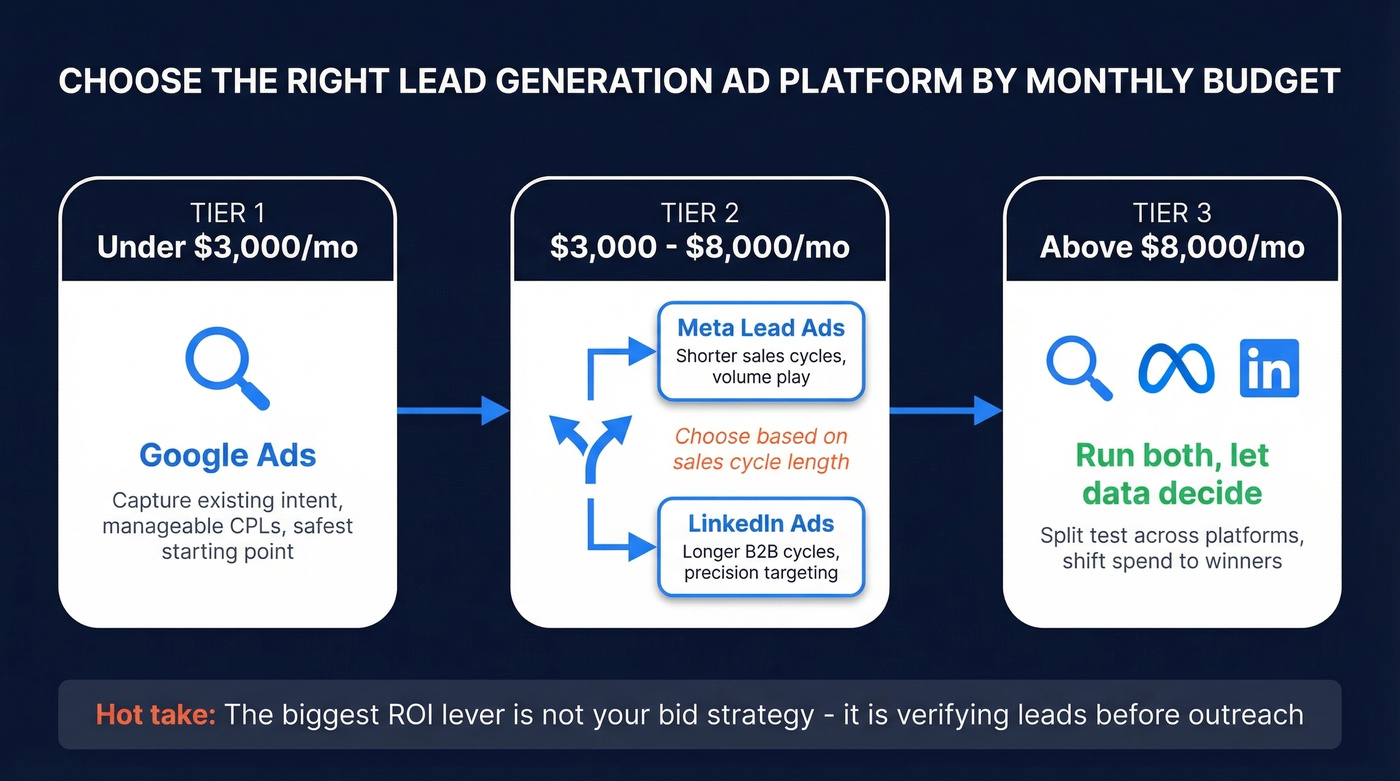
Here's the hot take most agencies won't give you: stop optimizing your ads and optimize what happens after the click. The biggest ROI lever in paid lead generation isn't your bid strategy or your creative - it's verifying your leads before outreach. Bad data kills campaigns faster than bad targeting ever will.
Three Platforms That Matter
For most B2B teams, the platforms worth your attention are Google, Meta, and LinkedIn. Here's what each one actually delivers.
Google Ads
Google Ads is demand capture. Someone types "CRM for construction companies" into search, and your ad meets them at the moment of intent. That's why it converts.
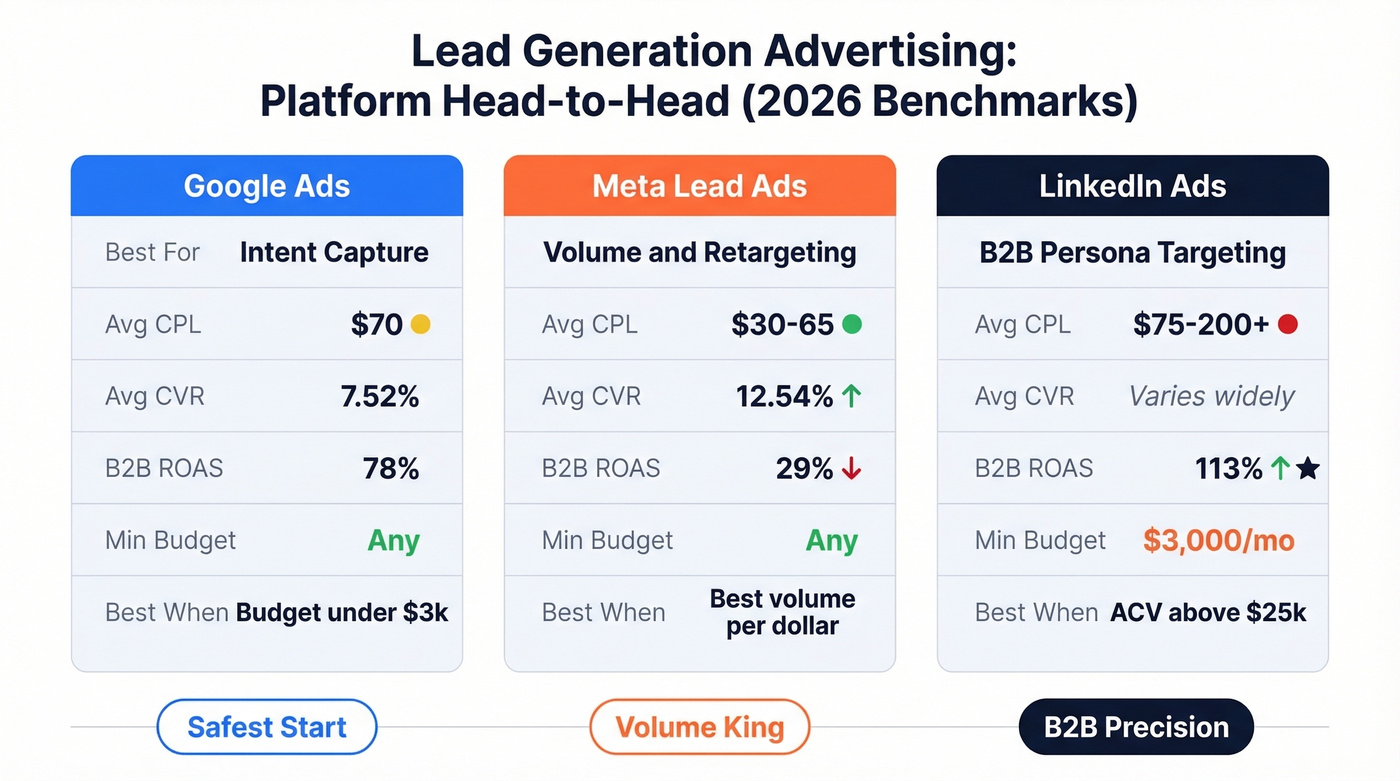
WordStream's 2025 benchmarks (based on 16,000+ campaigns) put the average Google Ads CTR at 6.66%. Swydo's cross-platform comparison cites an average conversion rate of 7.52% and an average CPL of $70.11 - up from $66.69 the prior year. CPC increased for 87% of industries, which means the floor keeps climbing. If you're in B2B tech, expect to pay more than that $70 average.
The strength is intent quality. Someone searching for your category is further down the funnel than someone scrolling Instagram. The weakness is ceiling - you can only capture demand that already exists. For teams with tight budgets, Google Search is the safest starting point because every dollar chases someone who's already looking.
Meta Lead Ads
Meta's lead forms are the volume play. B2B and SaaS advertisers typically see CPLs between $30 and $65 on lead forms - roughly 30-50% cheaper per lead than sending traffic to a landing page. Native lead forms convert at 12.54% versus 10.47% for landing pages, according to a LeadSync analysis of 3,000+ campaigns and $9.5M in ad spend.
The catch is lead quality. Pre-filled forms make it too easy to submit garbage. A 10-year practitioner on r/FacebookAds confirmed this: lead forms keep outperforming landing pages for cold traffic, but only when you add qualifying questions and pair them with a strong offer. We've seen this pattern repeatedly - teams celebrate a $35 CPL, then realize half the leads are uncontactable.
LinkedIn Ads
LinkedIn is the precision instrument for B2B audiences. CPC runs $5.58-$10, CPM sits at $33.80-$55, and Swydo's 2026 B2B ROAS benchmark puts LinkedIn at 113% (higher than Google Search at 78% and Meta at 29%). The targeting is unmatched - job title, seniority, company size, industry - and that's why B2B teams keep coming back despite the cost.
But LinkedIn eats small budgets alive. One Reddit user testing at $100/day reported burning through $75 in roughly five minutes with only four website visits to show for it. That's not a bug. It's what happens when you bring a $1,500/month budget to a platform that needs $3,000+ to generate meaningful data. Below that threshold, you're paying for LinkedIn's learning phase and getting almost nothing back. Budget at least $3k/month or skip it entirely.
Platform Comparison
| Metric | Google Ads | Meta Lead Ads | LinkedIn Ads |
|---|---|---|---|
| Best for | Intent capture | Volume / retargeting | B2B persona targeting |
| Avg CPL | $70 | $30-65 (lead forms) | $75-200+ |
| Avg CVR | 7.52% | 12.54% (lead forms) | Varies widely |
| CPC range | Auction-based | Auction-based | $5.58-$10 |
| B2B ROAS benchmark | 78% | 29% | 113% |
| Min budget rec. | Any | Any | $3,000/mo |
| Winner | Best ROI under $3k | Best volume per dollar | Best if ACV > $25k |
Lead Forms vs. Landing Pages
The data here is surprisingly clear. Native lead forms convert at 12.54% versus 10.47% for landing pages and cost 30-50% less per lead. But landing pages produce 5.7% higher quality leads and 1.4% more demo requests.
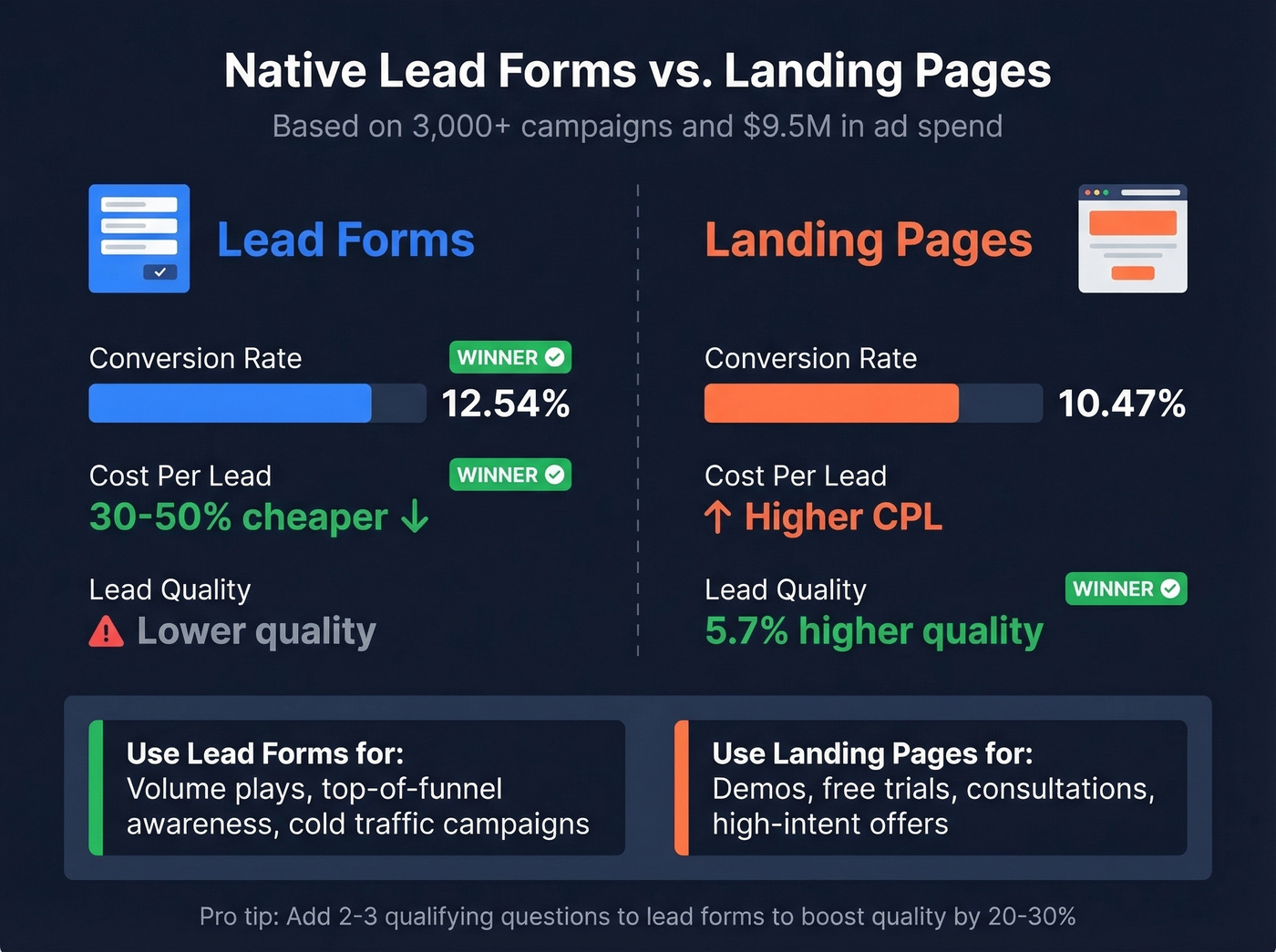
Use lead forms for volume plays and top-of-funnel awareness campaigns. Use landing pages for high-intent offers - demos, free trials, consultations - where lead quality directly impacts pipeline.
If you're running Meta lead forms, add 2-3 qualifying questions like company size, budget range, and timeline. It'll cut your volume by 20-30% but the leads that come through will actually pick up the phone. In our experience, teams that skip qualifying questions regret it within a week.

You just read it: 12 wrong numbers, 6 bounced emails, 3 interns. That's what happens when you skip post-capture verification. Prospeo enriches and verifies every lead from your ad forms - 98% email accuracy, 125M+ verified mobiles, at $0.01 per email. Your ad budget deserves better than dead data.
Fix the post-capture problem that quietly kills your CPL math.
How Much Does It Cost?
The cross-industry average CPL is $198. That number shocks people, but it includes everything from finance at $285 to higher education at $55. B2B tech sits at $208. Your mileage depends entirely on your industry, targeting, and keyword competition.
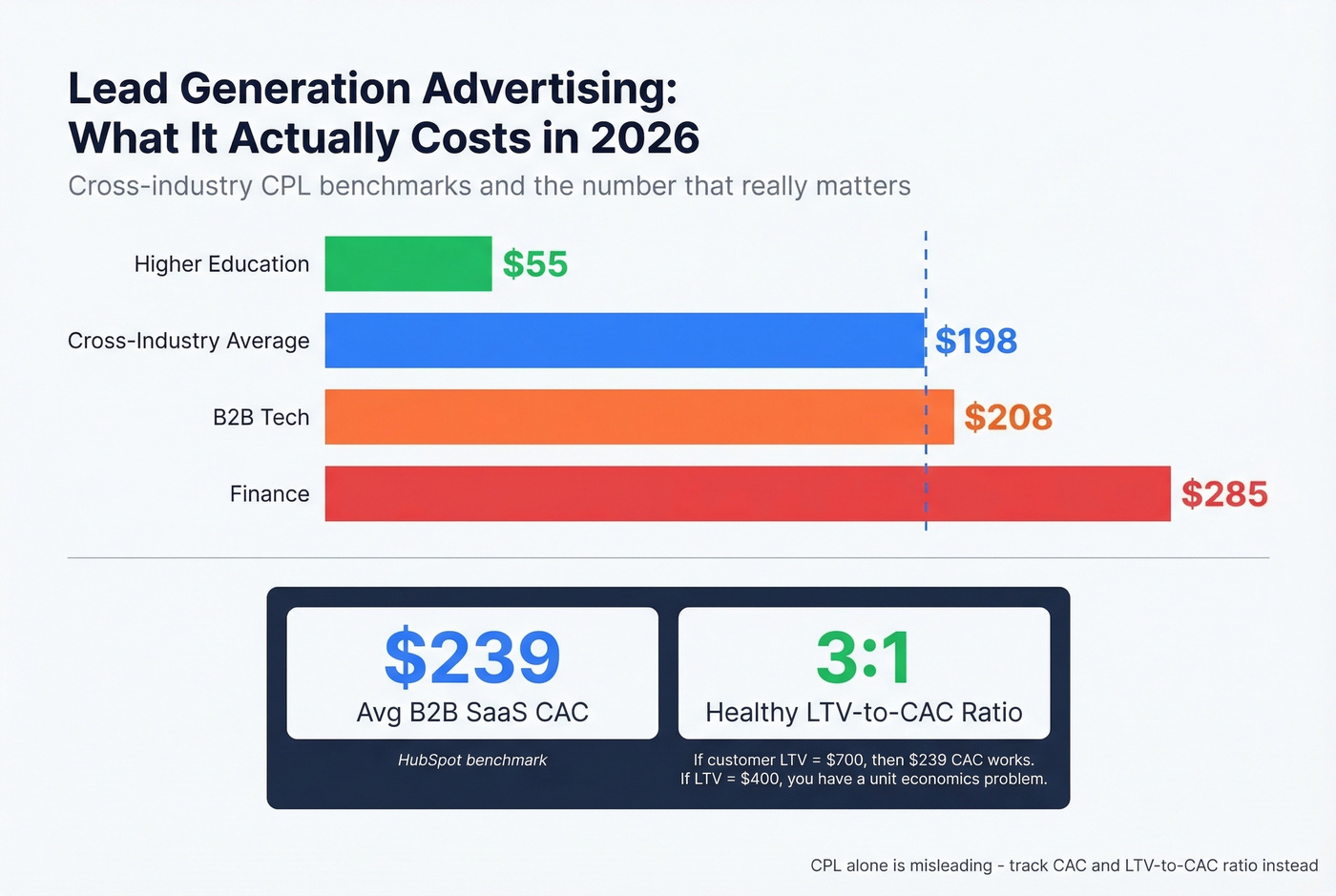
| Industry | Avg CPL |
|---|---|
| B2B Tech | $208 |
| Finance | $285 |
| Higher Education | $55 |
| Cross-industry avg | $198 |
CPL alone is misleading, though. The number that matters is customer acquisition cost. HubSpot's benchmark roundup puts B2B SaaS combined average CAC at $239. The healthy benchmark is a 3:1 LTV-to-CAC ratio - if your average customer is worth $700 over their lifetime, a $239 CAC is fine. If they're worth $400, you've got a unit economics problem that no amount of ad optimization will fix.
Building a Campaign That Converts
Here's the setup that separates campaigns generating pipeline from campaigns generating spreadsheets of dead leads.
Targeting comes first. On Google, build around intent-based keywords - what your buyers actually search when they have a problem. On LinkedIn, build around persona - job title, seniority, company size. These are fundamentally different approaches, and mixing them up is how teams waste budget.
Form design is your quality filter. Every qualifying question you add reduces volume but increases lead quality. At minimum, include company size and a "what are you looking for" dropdown. The average landing page converts at 2.35%, but top performers hit 11%+. The gap almost always comes down to form design, offer clarity, and page load speed.
CRM integration isn't optional. Connect your lead forms to your CRM via API or Zapier so leads route instantly. Layer in enrichment to add verified phone numbers and company data to every lead automatically - this turns a name and email into a complete contact record before your SDR even opens the CRM.
A/B test relentlessly. Test your creative, your form length, your offer, and your targeting. Run each variant long enough to clear the learning phase and collect meaningful volume before making decisions. The teams that treat lead gen ads as "set and forget" are the ones complaining about ROI on Reddit.
The Step Most Teams Skip
You ran the campaign. Two hundred leads came in. Your SDRs start dialing. Thirty percent have wrong phone numbers. Fifteen percent of emails bounce on the first sequence. A quarter have no company data attached - just a first name and a Gmail address from a pre-filled form.
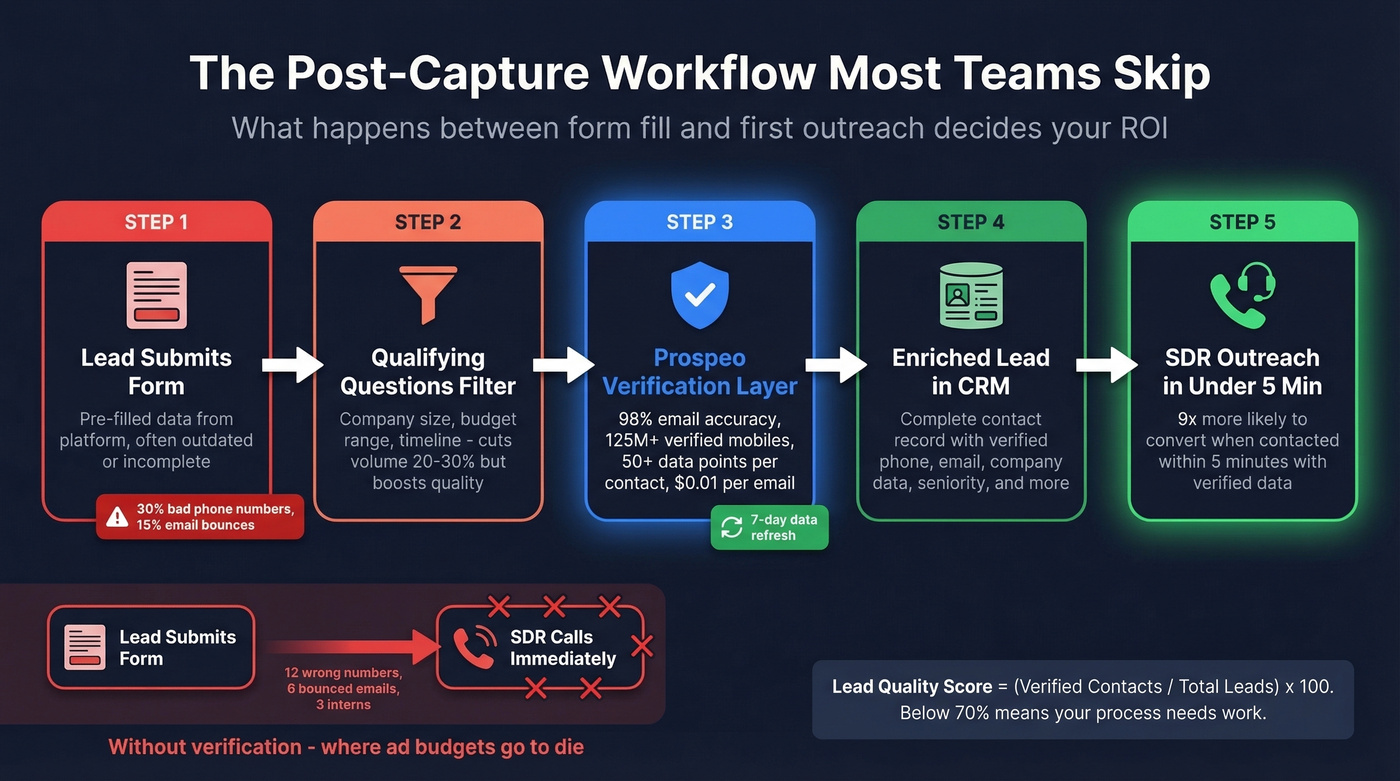
This is the garbage-in, garbage-out problem that plagues paid lead generation, and almost nobody talks about it. Native lead forms auto-populate fields from whatever the platform has on file, which is often outdated or incomplete. The lead looks real in your CRM. It's not real when your rep tries to reach them.
The fix is a verification layer between form submission and first outreach. Leads contacted within 5 minutes are 9x more likely to convert - but only if you're reaching the right person at a working number. Before your SDR touches a single lead, run the list through Prospeo. At $0.01 per email, the cost is negligible compared to the ad spend that generated those leads. Upload a CSV and get verified emails with 98% accuracy, direct mobile numbers from 125M+ verified globally with a 30% pickup rate, and 50+ data points per contact. The free tier handles 75 email verifications and 100 Chrome extension lookups per month - enough to test the workflow on your next campaign. With a 7-day data refresh cycle versus the 6-week industry average, you're not calling numbers that went stale last quarter.
Track your results with this formula: (Verified contacts / Total leads) x 100 = Lead Quality Score. Anything below 70% means your form design or verification process needs work. We've tracked campaigns where the $70 Google lead outperformed the $15 Facebook lead 4:1 on pipeline - because the Google leads were contactable and the Facebook leads weren't.
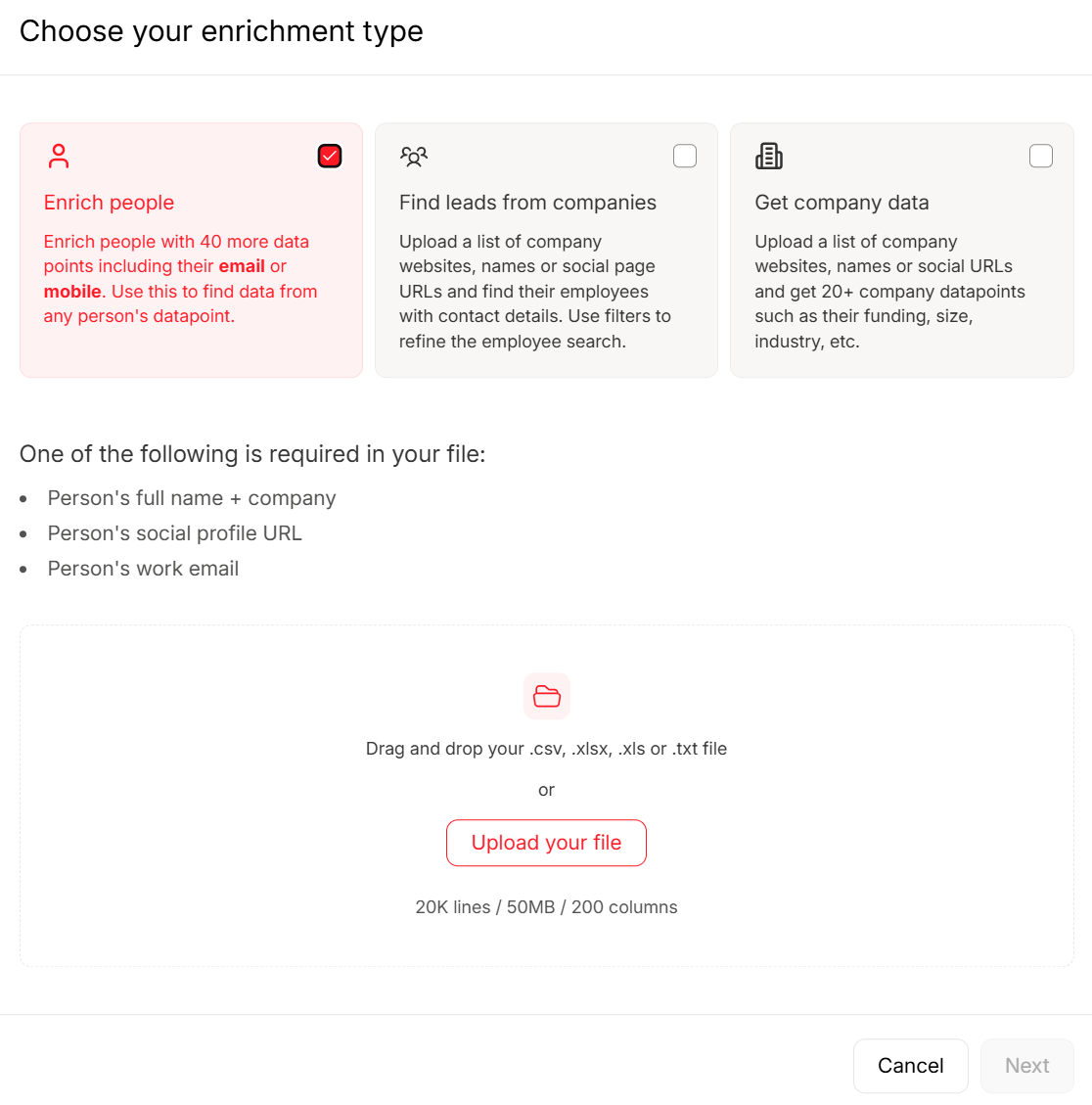
Qualifying questions on your lead forms help, but they don't catch fake emails or outdated phone numbers. Prospeo's 5-step verification and 7-day data refresh cycle do. Route every form fill through enrichment and get 50+ verified data points back - before your SDRs waste a single dial.
Stop calling dead leads. Verify every form fill before outreach.
Measuring What Matters
Your finance team asks why you're paying $70 per lead on Google when your competitor claims $15 on Facebook. Here's how to answer that without getting fired.
First, distinguish ROAS from ROI. ROAS = (Revenue / Ad Spend) x 100%. It only measures media dollars. ROI = [(Revenue - Total Costs) / Total Costs] x 100%. Total costs include agency fees, creative production, landing pages, and software - not just what you paid Google. Most teams report ROAS when they should be reporting ROI, which makes every channel look better than it is.
Second, assign a dollar value to each lead. The formula: close rate x average deal size. If 1 in 5 leads becomes a $5,000 deal, each lead is worth $1,000. Now that $70 Google CPL looks like a bargain, and that $15 Facebook lead that never converts looks like waste.
For attribution, start with last-touch - it's simple and defensible. Other models like linear and time-decay have their place, but multi-touch attribution is the gold standard for B2B sales cycles where a buyer hits multiple touchpoints before converting. It requires clean data and RevOps alignment, so don't jump there on day one.
Let's be honest: connect your PPC data to your CRM. Platform attribution windows are too short for B2B sales cycles with longer time-to-close. If you're measuring lead gen ads purely inside the ad platform, you're missing the full picture. A solid demand generation strategy ties ad performance to pipeline revenue, not just form fills.
FAQ
What's a good cost per lead in 2026?
The cross-industry average is $198. B2B tech averages $208, finance $285, higher education $55. Track CPL against your close rate and deal size - a $200 lead that closes at 20% on $10k deals beats a $30 lead that never converts.
Are Facebook Lead Ads better than landing pages?
Lead Ads convert at 12.54% vs. 10.47% and cost 30-50% less per lead. But landing pages produce higher quality leads and more demo requests. Use lead forms for volume, landing pages for high-intent offers like demos or consultations.
How much should I spend on LinkedIn Ads?
Budget at least $3,000/month. LinkedIn CPC runs $5.58-$10, so smaller budgets evaporate before generating enough data for optimization. Start with Google if your budget is tighter, then add LinkedIn once spend supports it.
How do I verify leads from ad campaigns?
Upload your lead list to a verification tool like Prospeo before outreach. At $0.01 per email with 98% accuracy, you can validate every contact, add missing phone numbers, and enrich with 50+ data points - catching bad data before your SDRs waste time on dead leads.
What's the best attribution model for lead gen ads?
Start with last-touch for simplicity and defensibility. As your CRM data matures across multiple platforms, graduate to multi-touch - the most accurate model for B2B cycles where buyers interact with 5-8 touchpoints before converting.