

How to Build a Lead Generation Marketing Strategy That Actually Produces Pipeline
Your CPL looks fine. Marketing's dashboard is green. And sales just told the CRO that every lead from last quarter was junk.
This disconnect isn't a communication problem - it's a strategy problem. The average qualified-lead conversion rate across 100M+ datapoints is 2.9%, which means 97 out of 100 visitors don't become qualified leads, and the ones who do often aren't ready to buy.
Meanwhile, buyers complete up to 80% of their decision-making before talking to sales. They're researching, comparing, and shortlisting before they ever fill out a form. If your lead generation marketing strategy is still built around gating whitepapers and dumping form fills into a sales queue, you're optimizing for a buyer that doesn't exist anymore.
The fix isn't more leads. It's better architecture - from targeting to qualification to the operating cadence that keeps quality from drifting. Let's build that.
The 30-Day Starting Point
If you've only got a month and limited bandwidth, focus on three things:
A benchmark dashboard. Track visitor-to-lead, MQL-to-SQL, and lead-to-customer conversion rates. Compare them against the thresholds in the benchmarks section below. You can't fix what you can't measure, and most teams are measuring the wrong things.
One primary acquisition channel plus one retargeting channel. Fund both at minimum viable spend. Spreading budget across five channels at sub-threshold investment levels produces noise, not signal.
A qualification gate using the AQO framework. A meeting only counts if it holds, passes a quality check, and has a next step scheduled within a week. This single rule will change how your team thinks about lead quality overnight.
Everything else in this article builds on these three foundations.
Lead Gen vs. Demand Gen
68% of companies haven't identified their funnel. That's not about laziness - it's about confusion. The line between lead generation and demand generation has gotten blurry, and teams waste real money when they conflate the two.
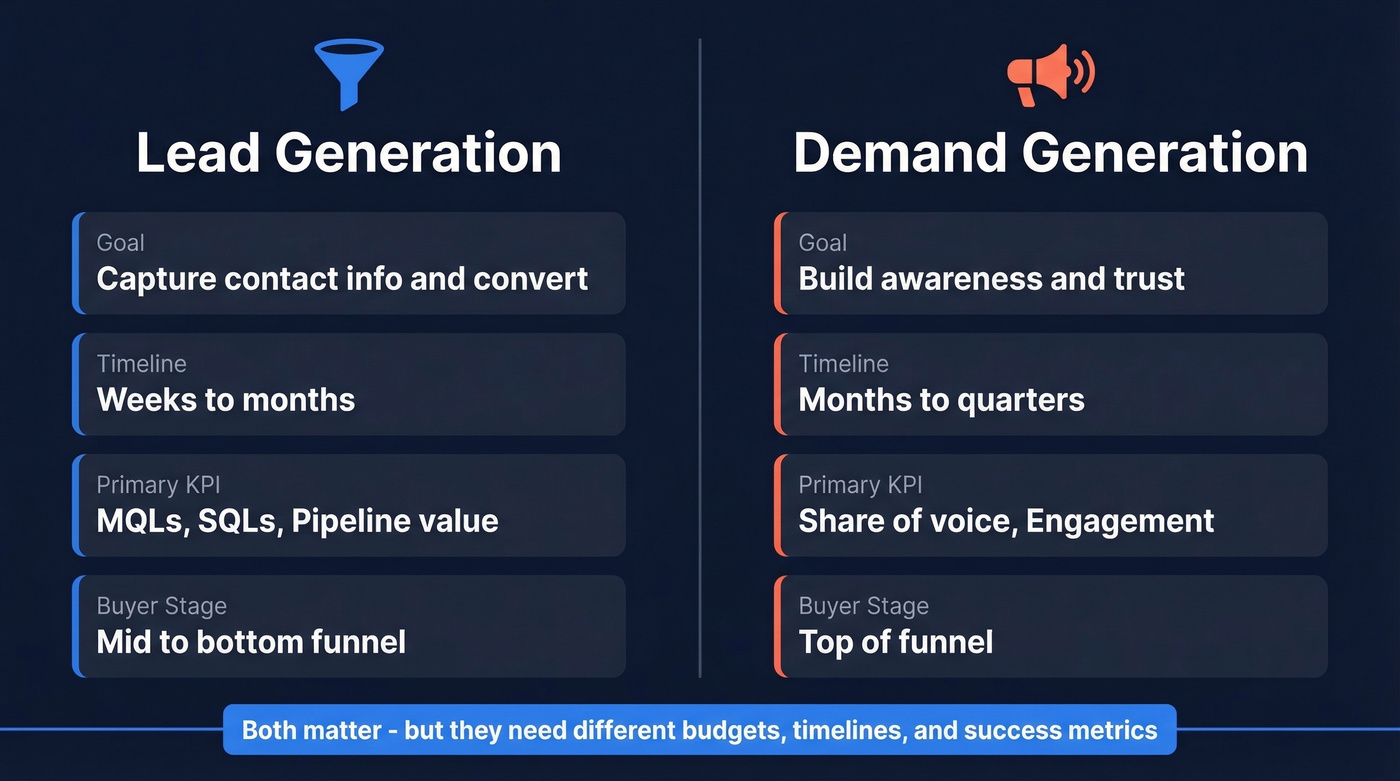
Lead generation captures existing demand. Someone's already aware of the problem and looking for solutions, and you're trying to get their contact information and move them into a sales conversation. Demand generation creates awareness and interest before someone's ready to buy - content, events, brand, community. Brand awareness work is what fills the top of the funnel that lead gen later harvests.
Both matter. But they require different budgets, different timelines, and different success metrics.
| Lead Generation | Demand Generation | |
|---|---|---|
| Goal | Capture contact info | Build awareness + trust |
| Timeline | Weeks to months | Months to quarters |
| Primary KPI | MQLs, SQLs, pipeline | Share of voice, engagement |
| Buyer stage | Mid-to-bottom funnel | Top funnel |
You also need shared vocabulary across sales and marketing. An MQL meets engagement and fit thresholds set by marketing. An SQL has been vetted in a real conversation where budget, authority, need, and timing are confirmed. A PQL has used your product and hit activation milestones.
50% of qualified leads aren't ready to purchase at first contact. That's normal. The strategy needs to account for nurture, not just capture.
2026 Benchmarks That Matter
Benchmarks without context are useless. "Our conversion rate is 3%" means nothing unless you know whether that's good, average, or a sign you should fire your agency.
Channel Performance
These channel conversion and CPL baselines come from compiled B2B benchmark research - directional, but useful for planning.
| Channel | Avg. Conversion | Avg. CPL | Notes |
|---|---|---|---|
| 6.5% | $30-$45 | Highest ROI at scale | |
| Webinars | 11.2% | $60-$80 | Best conversion rate |
| Google Search Ads | 4.5% | $90-$150 | Immediate pipeline |
| Content/SEO | 1.8% | $30-$60 | Slow build, compounds |
| LinkedIn Ads | 3.2% | $120-$200 | Precise targeting, steep CPL |
The all-industry average CPL is $198, but B2B specifically averages $84 - a gap that reflects B2B's more targeted approach. Google Ads averages $70.11. LinkedIn runs $110+, roughly 57% higher than Google Search. These gaps matter when you're allocating a finite budget.
Funnel-Stage Thresholds
This is the table that should live on your wall. If your numbers fall in the "needs improvement" column, that stage is where your strategy is leaking.
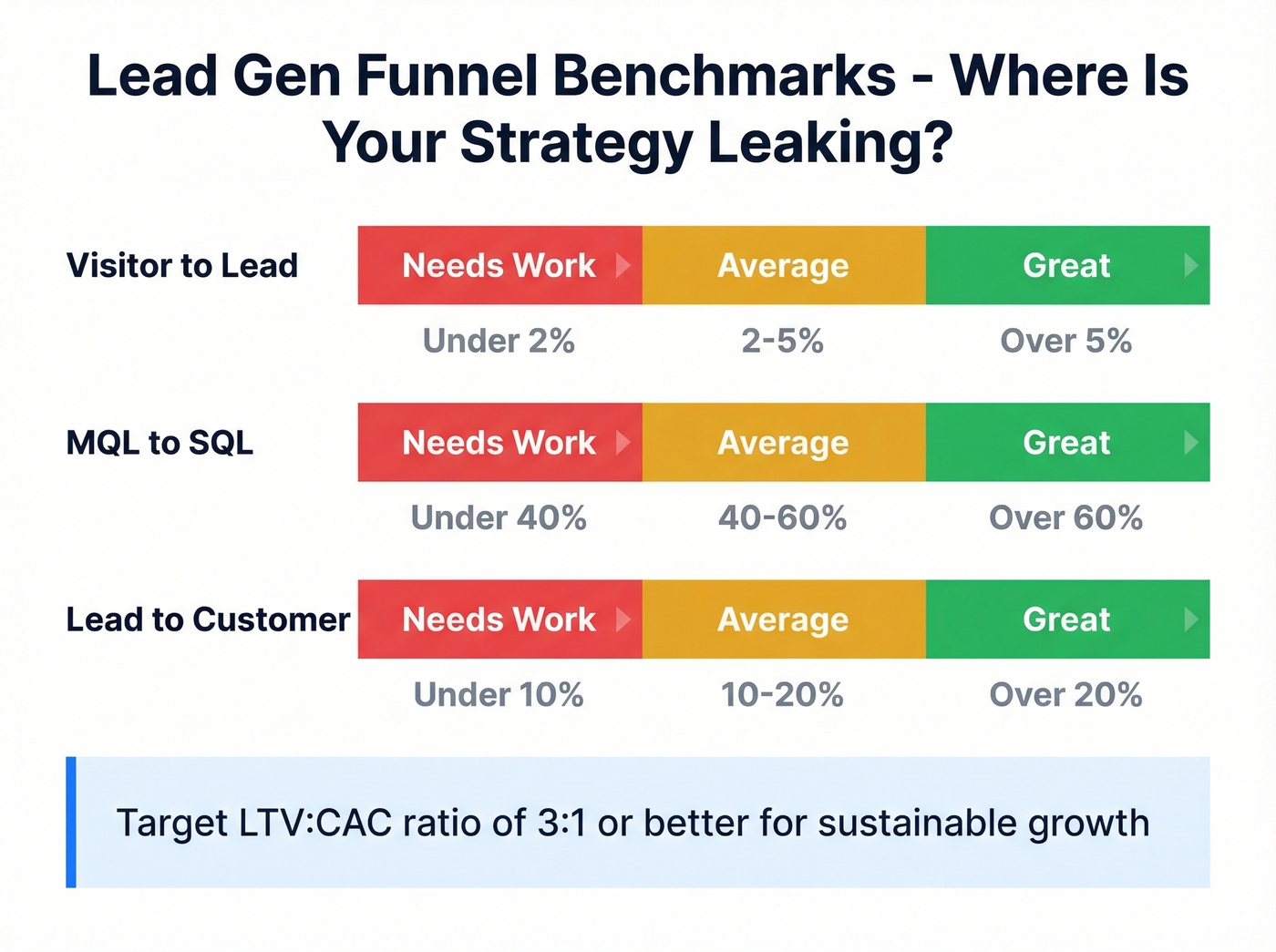
| Funnel Stage | Great | Average | Needs Work |
|---|---|---|---|
| Visitor -> Lead | >5% | 2-5% | <2% |
| MQL -> SQL | >60% | 40-60% | <40% |
| Lead -> Customer | >20% | 10-20% | <10% |
The LTV:CAC ratio that signals sustainable growth is 3:1 or better. Below that, you're either acquiring the wrong leads, paying too much per lead, or both. We've seen teams obsess over CPL while ignoring that their lead-to-customer rate is 6%. A $30 CPL means nothing if those leads never close.
For industry-specific context: SaaS averages a 5.1% conversion rate with $85 CPL and 17% lead-to-customer. Professional services hits 6.0% conversion, $60 CPL, and 20% lead-to-customer. Healthcare tech runs 3.8% conversion, $100 CPL, and 12% lead-to-customer. Financial services lands at 4.5% conversion, $110 CPL, and 15% lead-to-customer. Manufacturing lags at 2.7% conversion and 8% lead-to-customer. Know your vertical's baseline before you set targets.
Build Your Strategy End-to-End
Define Your ICP and Offer
Targeting the wrong audience is the number one lead generation mistake, and it's the most expensive one. Every dollar spent reaching the wrong people compounds downstream - bad leads waste SDR time, inflate CRM clutter, and erode sales trust in marketing.
Your ICP needs to be specific enough to act on. Company size, industry, tech stack, pain points, buying triggers - these aren't optional dimensions. They're the filter criteria that separate a prospect list from a wish list. The practical test: can you translate your ICP into search filters and get a list of real companies and contacts? If you can't, it's too vague. Prospeo's database gives you 30+ filters across buyer intent, technographics, job changes, headcount growth, funding rounds, and revenue brackets - turning an abstract ICP definition into a live prospect list you can export and work today.

The offer matters just as much, and it needs to match the buyer's stage. Top-funnel buyers respond to benchmarks and industry reports. Mid-funnel buyers want comparison guides and ROI calculators. Bottom-funnel buyers are ready for demos, free trials, and assessments. A "request a demo" CTA works for that last group. For everyone else, you need value-first offers that earn the right to a conversation.
Pick Your Channel Mix
Most teams spread budget too thin. Each channel has a minimum viable investment level, and spending below it produces nothing useful. Based on mid-market B2B data:
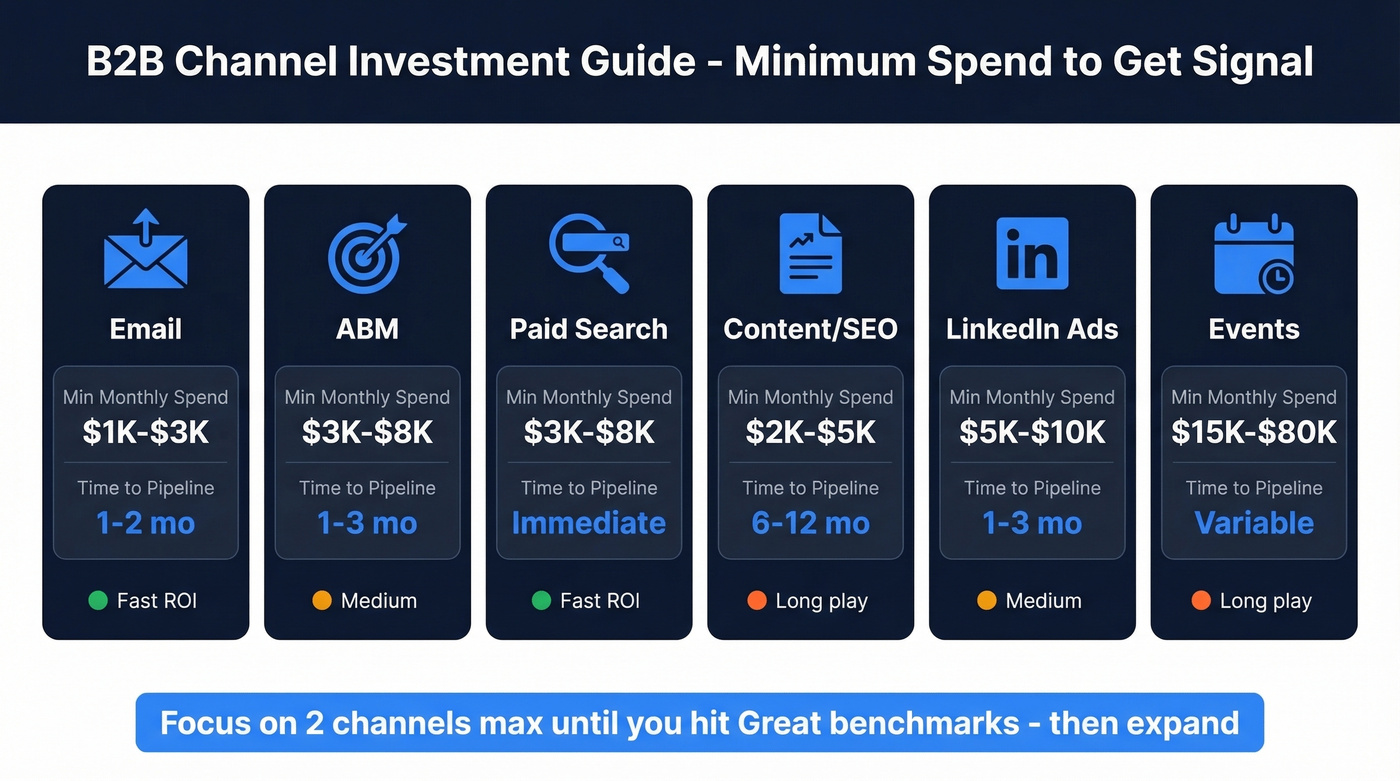
| Channel | Min. Monthly Spend | Time to Pipeline |
|---|---|---|
| Email & automation | $1K-$3K | 1-2 months |
| ABM | $3K-$8K | 1-3 months |
| Paid search (PPC) | $3K-$8K | Immediate |
| Content/SEO | $2K-$5K | 6-12 months |
| LinkedIn Ads | $5K-$10K | 1-3 months |
| Events | $15K-$80K/event | Variable |
LinkedIn's CPM runs $60-$200. Meta's CPM is $8-$30. That's a 3-7x difference in reach cost. Ask any B2B marketer in an outbound community about LinkedIn Ads and you'll hear the same thing: the targeting is unmatched, but the CPMs will bleed you dry if your deal sizes are modest. The math only works if your ACV justifies the CPL.
Here's the thing: cut to two acquisition channels and one nurture engine until you hit "great" thresholds on the funnel table above. Adding a third channel before your first two are performing just dilutes spend and makes attribution impossible. We've watched teams run five channels at $2K each and wonder why nothing's working. $10K concentrated on two channels produces signal. $10K spread across five produces noise.
Capture and Convert
Your conversion infrastructure matters more than your traffic volume. The average form conversion rate is 1.7%, and the average inbound call rate is 1.2%. Most teams are leaving pipeline on the table with over-engineered forms and friction-heavy landing pages.
Three-field forms convert 27% better than five-field forms. Every additional field you add is a tax on conversion. Ask for name, email, and company. Enrich the rest after submission - that's what data enrichment tools are for.
67% of buyers prefer self-service. Build paths that let them explore, compare, and qualify themselves before they ever talk to a rep. Interactive tools, pricing calculators, and ungated content aren't "giving away the farm" - they're matching how buyers actually want to buy.
Score, Qualify, and Hand Off
Dumping context-free MQLs on sales is how marketing loses credibility. The handoff needs structure.
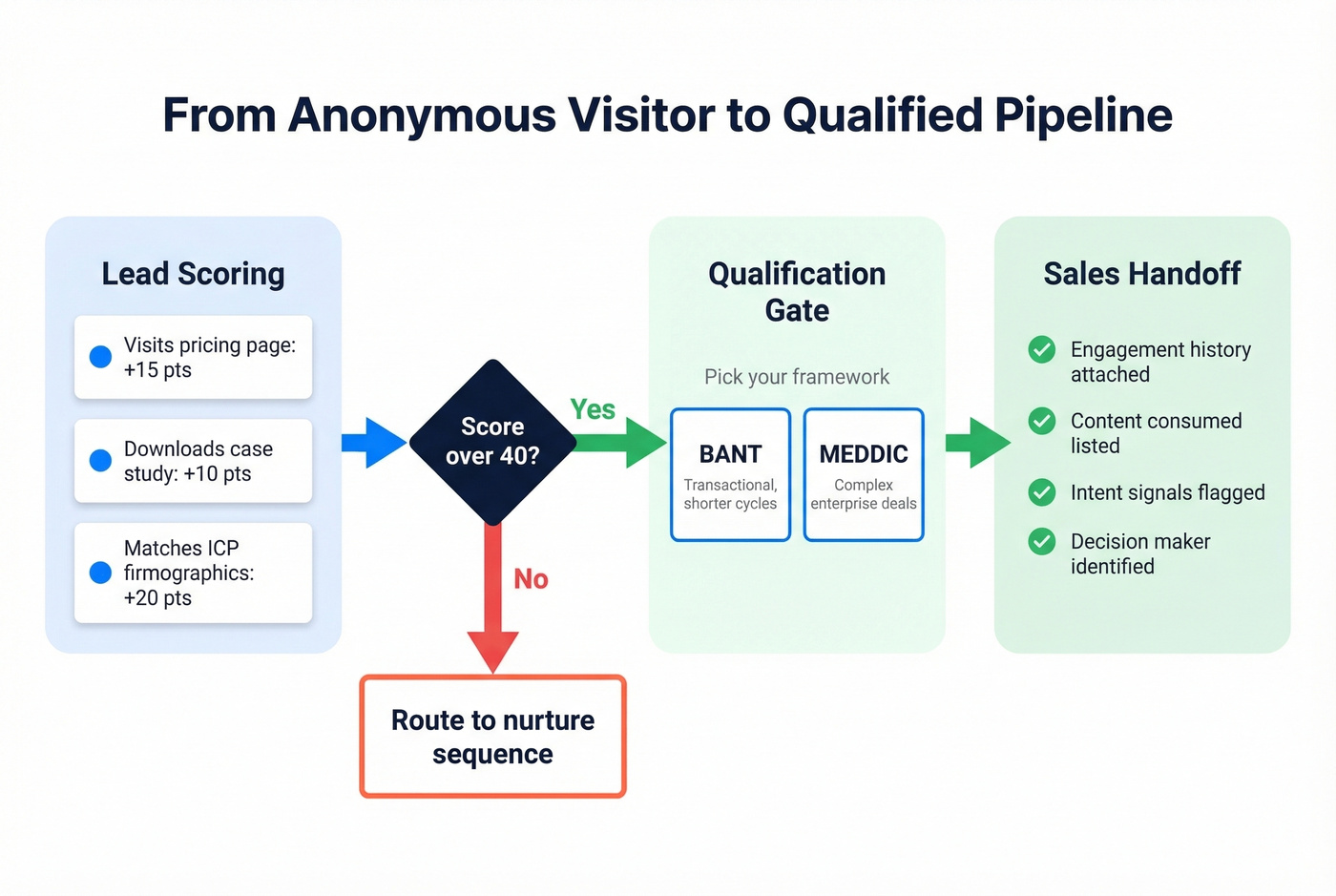
BANT works for transactional sales with shorter cycles - Budget, Authority, Need, Timeline. Simple, fast, easy to train on. MEDDIC works for complex enterprise deals where multiple stakeholders and long procurement processes are the norm, covering Metrics, Economic buyer, Decision criteria, Decision process, Identify pain, and Champion. MEDDPICC adds Paper process and Competition for even more rigor.
The framework matters less than consistency. Pick one, document it, and make sure both marketing and sales agree on what qualifies a lead to move stages. Deals without a decision-maker identified are 80% less likely to close. If your MQL definition doesn't include "right person," you're generating volume, not pipeline.
A concrete example: a lead who visits your pricing page (+15 points), downloads a case study (+10), and matches your ICP firmographics (+20) crosses the 40-point MQL threshold. That lead gets routed to sales with engagement history, content consumed, intent signals, and any qualification data captured. A lead that downloaded three case studies about your enterprise tier and visited your pricing page twice tells a very different story than one who filled out a webinar form and never came back.
Nurture Without Nagging
44% of reps give up after one follow-up. 80% of deals require five or more touches. Over 30% of B2B sales take one to three months to close, and 48% of companies report that leads require a long sales cycle before purchasing. The math is clear: your nurture engine isn't optional.
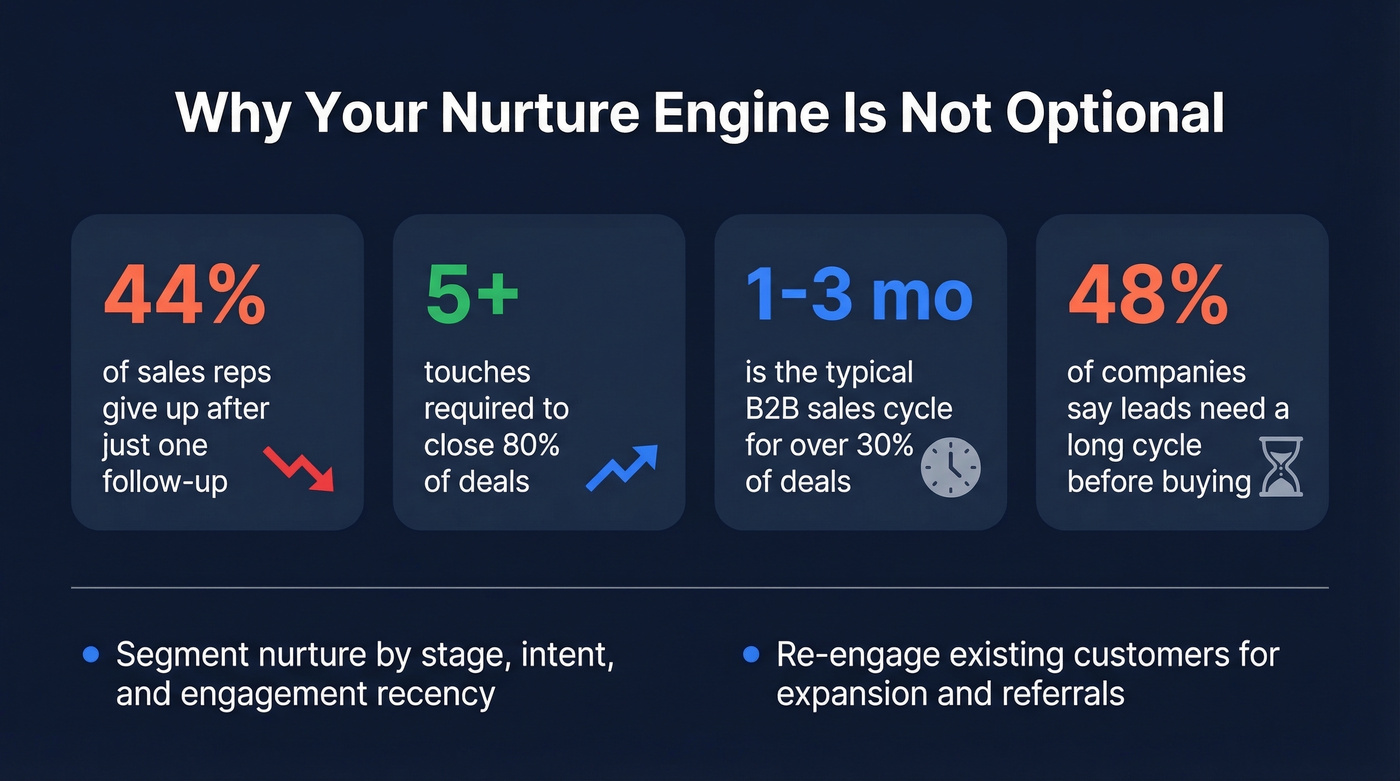
Journey-based nurturing beats generic drip campaigns. Segment by stage, intent level, and engagement recency. A lead who attended your webinar last week needs different content than one who downloaded an ebook six months ago. The goal isn't to stay in their inbox - it's to be useful at the moment they're ready to move forward. Re-engaging existing customers with expansion offers and referral programs also turns your install base into a pipeline source, and it's one of the most underused plays in B2B.

Your lead gen strategy is only as good as the data behind it. Prospeo turns your ICP definition into a live prospect list with 30+ filters - buyer intent, technographics, headcount growth, funding, and more - across 300M+ profiles with 98% email accuracy. At $0.01 per email, bad data stops being the reason your funnel leaks.
Translate your ICP into a qualified pipeline you can work today.
Fix Your Data Before You Scale
Most lead gen programs quietly fall apart at the data layer. You can nail your ICP, pick the right channels, build great landing pages - and still watch pipeline evaporate because your contact data is garbage.
B2B lead costs balloon from $40 to $300+ when you're chasing low-intent audiences with bad data. Bounced emails damage your sender domain. Dead phone numbers waste SDR hours. Duplicate records pollute your CRM. The most common complaint on r/sales and outbound communities isn't about messaging - it's about bounced emails destroying sender reputation. Bad data isn't an inconvenience. It's a hidden tax on every channel you run.
The fix has two layers: intent and verification.
Intent-first targeting means layering buyer signals on top of firmographic filters. Tools like 6sense, Bombora, and RollWorks track which accounts are actively researching topics related to your solution. This shifts your outreach from "spray and pray" to "reach out when they're already looking." Prospeo layers intent data across 15,000 topics via Bombora, so you can combine "who matches my ICP" with "who's actively in-market."
Verification means every email and phone number gets checked before it enters a sequence. A 5-step verification process with catch-all handling, spam-trap removal, and honeypot filtering delivers 98% email accuracy. A database refreshing every 7 days - compared to the 6-week industry average - means you're not calling numbers that went stale last month.
The proof is in production results. Snyk's team of 50 AEs cut their bounce rate from 35-40% to under 5% after switching their data provider, and AE-sourced pipeline jumped 180%. That's not a marginal improvement - that's the difference between a data problem and a pipeline engine.
Verify and enrich before you hit send. Everything downstream depends on it.
Your Operating System
A strategy without an operating cadence is just a document. The teams that consistently produce pipeline run a weekly rhythm built around the AQO framework: Activity, Quality, Outcomes.
Activity tracks leading indicators - how many outbound touches went out, how many inbound leads came in, how many meetings were booked. These numbers tell you whether the engine is running.
Quality is where most teams stop measuring and start hoping. A meeting is not a win. It counts only if it holds (the prospect actually shows up), passes a quality check (right company, right people, right timing), and ends with a next step scheduled within a week. Without this gate, your pipeline is full of phantom opportunities.
Outcomes connect activity to revenue. Meetings held, opportunities created, pipeline generated, deals closed. If activity is high but outcomes are flat, you have a quality problem. If quality is high but outcomes are low, you have a volume problem.
The capacity guardrail matters too. Six to eight held meetings per rep per week is a reasonable target. Push past that and quality drops because reps start rushing discovery calls and skipping follow-up.
Build a "Good Meeting Checklist" and review it weekly. Right company: matches ICP. Right people: user plus budget owner or technical contact. Right timing: recent change, active pain, or time-bound goal. If a meeting doesn't check all three boxes, it shouldn't count toward your quality metric.
The teams that adopt this framework hate it for the first two weeks because their "meeting booked" numbers drop. Then they love it because their pipeline-to-close rate jumps.
AI Agents in Lead Gen
Daily AI tool usage is up 233% in six months, and daily AI users report being 64% more productive and 81% more satisfied with their work. This isn't hype anymore - it's operational reality.
The shift that matters for lead generation isn't ChatGPT writing your emails. It's AI agents handling the operational work that used to eat 40% of a rep's week: account research, lead scoring, sequence personalization, campaign routing, and QA.
Juniper Research forecasts automated customer interactions growing from 3.3 billion in 2025 to 34 billion+ by 2027. The Model Context Protocol is gaining adoption across major platforms, giving AI agents standardized access to your tools and data. Agents can now pull CRM data, check intent signals, draft personalized multi-channel sequences, and route leads without a human toggling between eight tabs.
Practical use cases that are working right now:
- Account research agents that compile firmographic data, recent news, tech stack changes, and intent signals into a pre-call brief
- Lead scoring models that combine fit data with behavioral signals to prioritize outreach
- Sequence personalization that generates email, call scripts, and social touches tailored to each prospect's context
- Campaign QA agents that flag underperforming sequences and suggest adjustments before you've burned through your list
Skip the copywriting-only use case. The real gains come from the operational layer - the research, routing, and quality control that compounds across thousands of touches.
The Minimum Viable Tech Stack
You don't need 12 tools. You need the right four or five, connected properly. Here's the buy order for most B2B teams building from scratch.
| Category | Tool Examples | Starting Price |
|---|---|---|
| CRM + automation | HubSpot, Salesforce | Free-$1,000+/seat/mo |
| Data + verification | Prospeo | Free (75 emails/mo) |
| Intent data | Bombora, 6sense, RollWorks | ~$1K-$3K/mo |
| Automation/routing | Zapier | $19.99/mo (annual) |
| Landing pages | Optimizely, Typeform | ~$30-$500+/mo |
| Conversational | Drift, Intercom | ~$50-$1,500+/mo |
| SEO | Ahrefs, Semrush | ~$99-$500+/mo |
Buy order: CRM first - you need a system of record before anything else. Data and verification second, because every channel you run depends on reaching real people at real email addresses. One channel-specific tool third, whichever matches your primary acquisition channel.
Don't overbuild. A HubSpot CRM free tier plus a solid data layer plus one outbound tool gets you further than a $50K/year enterprise stack you'll spend six months implementing. Native integrations with Salesforce, HubSpot, Smartlead, Instantly, Lemlist, Clay, Zapier, and Make mean the data layer plugs into whatever stack you're already running.
If your average deal size is under $15K, you almost certainly don't need a $50K/year data platform. A self-serve tool with verified data and a free tier will outperform an enterprise suite your team barely uses. The best tech stack is the one your reps actually open every morning.
Mistakes That Kill Pipeline
Prioritizing volume over intent. Lead costs balloon from $40 to $300+ when you're chasing low-intent audiences. Layer intent signals on every list before you launch a campaign. Volume without intent is just expensive noise.
Over-relying on one channel. LinkedIn Ads working great? Wonderful. Now imagine LinkedIn raises CPMs 30% next quarter - and they've done it before. Diversify to at least two acquisition channels so a single platform change doesn't crater your pipeline.
No qualification definitions. If marketing and sales can't agree on what an MQL and SQL mean - in writing, with specific criteria - every lead handoff is a coin flip. Document it. Review it quarterly.
Ignoring data quality. Bounced emails damage your sender domain. Dead phone numbers waste SDR time. Stale records pollute your CRM. Bad data is a hidden tax on every channel, and it compounds the longer you ignore it.
Vanity metrics obsession. CTR and raw lead volume don't pay salaries. Pipeline does. If your weekly report doesn't connect marketing activity to revenue outcomes, you're measuring the wrong things. Track funnel-stage thresholds, not impressions.
97 out of 100 visitors don't convert - so the leads that do need to be real. Teams using Prospeo book 26% more meetings than ZoomInfo users because every contact is verified on a 7-day refresh cycle, not stale data from six weeks ago. That's how you fix the MQL-to-SQL gap this article warns about.
Fresh data closes the gap between marketing dashboards and actual pipeline.
FAQ
What's the average cost per lead in B2B?
The average B2B cost per lead is $84 across all channels, per the Flyweel 2026 benchmark index. Email runs $30-$45, content/SEO $30-$60, Google Ads averages $70.11, and LinkedIn Ads hit $120-$200. Your actual CPL depends on industry, targeting precision, and offer quality.
How long does it take to produce results?
Paid search delivers pipeline immediately. Email campaigns typically produce results within one to two months. Content and SEO take six to twelve months to compound. The critical variable isn't the channel - it's whether you're investing at minimum viable spend. Below-threshold budgets produce noise regardless of timeline.
What's the difference between MQL and SQL?
An MQL is marketing-qualified based on engagement scoring and firmographic fit - they've hit enough triggers to warrant sales attention. An SQL is sales-qualified after a direct conversation confirms budget, authority, need, and timing. The handoff needs documented SLAs that both teams agree on, reviewed quarterly.
How do I improve lead quality without reducing volume?
Layer intent data on top of ICP filters so you're reaching accounts actively researching your category. Verify contact data before outreach to keep bounce rates under 5%. Enforce a meeting quality gate so only qualified conversations count toward pipeline. In our experience, teams that add both intent filtering and verification see lead-to-customer rates jump 30-50% without touching their top-of-funnel volume.
Should I use AI for lead generation?
Yes, but for operations - not just copywriting. AI agents handle account research, lead scoring, sequence personalization, and campaign routing at scale. Daily AI users report 64% higher productivity. The biggest wins come from automating research and QA work that eats rep time.