

Lead Generation Outsourcing: Real Costs, When It Works, and When It Doesn't
A Reddit post sums up the nightmare scenario: an agency "spammed millions" over roughly 3-6 months, cost more than $10,000, produced about 3-4 decent leads, delivered zero conversions, and ruined the sender's domain. That's not an outlier - 20-25% of outsourcing relationships fail within two years, and 50% collapse within five years. The agencies don't advertise that stat.
Most lead generation outsourcing advice comes from agencies selling retainers. This is the version written from the buying side.
What You Need (Quick Version)
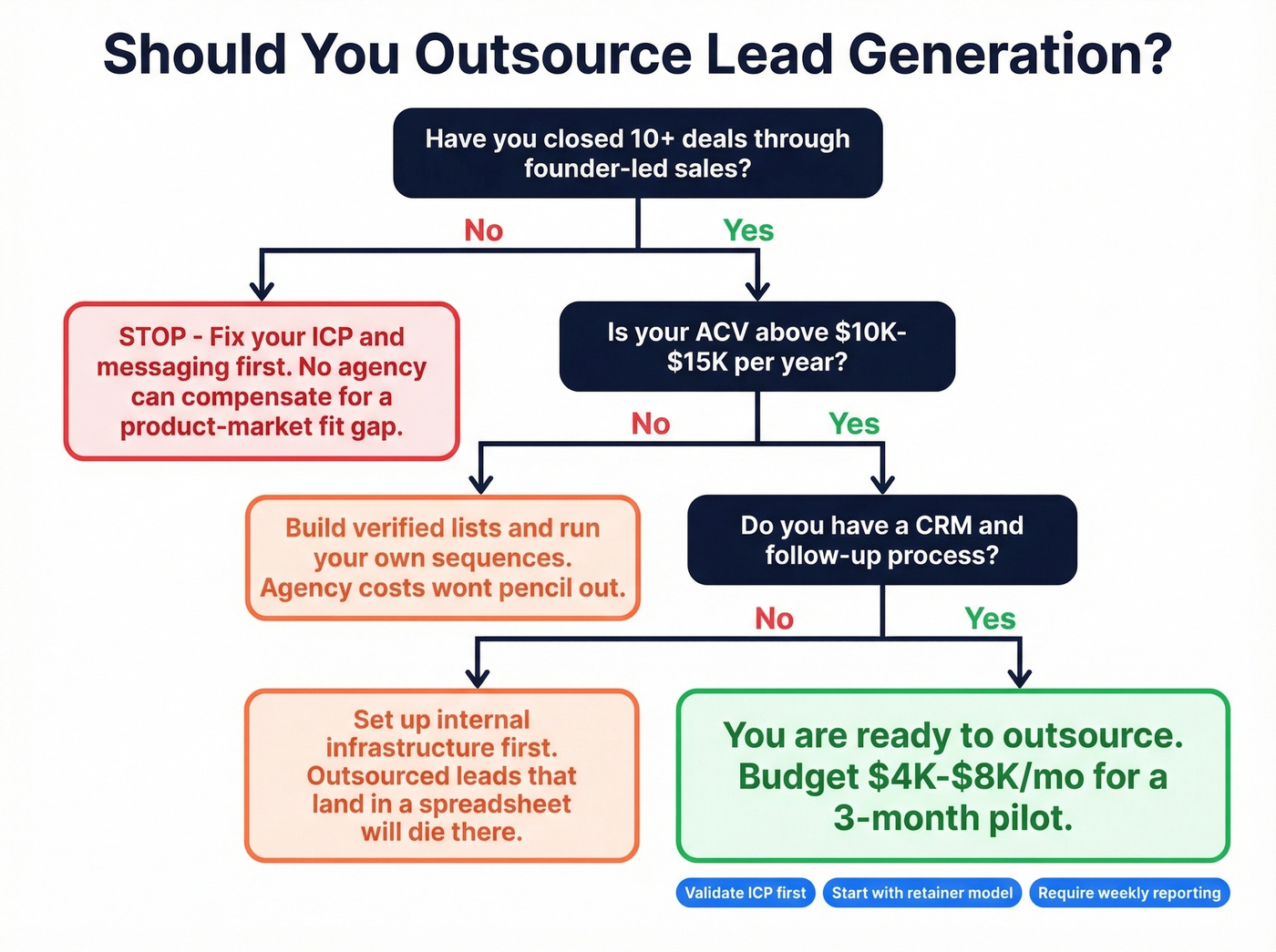
- If you haven't closed 10+ deals yourself, don't outsource yet. Fix your ICP and messaging first - no agency can compensate for a product-market fit gap.
- If you're ready, budget $4,000-$8,000/month for a 3-month pilot. Belkins-style engagements often start around $4,000/month, and Clutch review snapshots show examples around $5,500/month for 10+ meetings.
What Does Outsourced Lead Generation Actually Mean?
Outsourced lead generation means hiring a third-party company - an agency, a fractional SDR team, or a data provider - to find and qualify potential buyers on your behalf. Instead of building an internal team from scratch, you're renting someone else's infrastructure, playbooks, and people.
The global market for these services is projected to exceed $8 billion by 2033, growing at roughly 9.7% CAGR. That growth makes sense: hiring is expensive, ramp time is brutal, and most companies don't have the internal expertise to run multi-channel outbound well. But "outsourcing" covers three very different service categories, and conflating them is where most buyers go wrong.
Three Service Categories
Outbound Sales (Cold Email, Calling, Social)
The most common type. An agency provides SDRs who prospect on your behalf - cold emails, cold calls, social outreach, or some combination. You're buying meetings, not marketing impressions. The agency handles list building, sequencing, and initial conversations. You show up when there's a qualified meeting on the calendar.
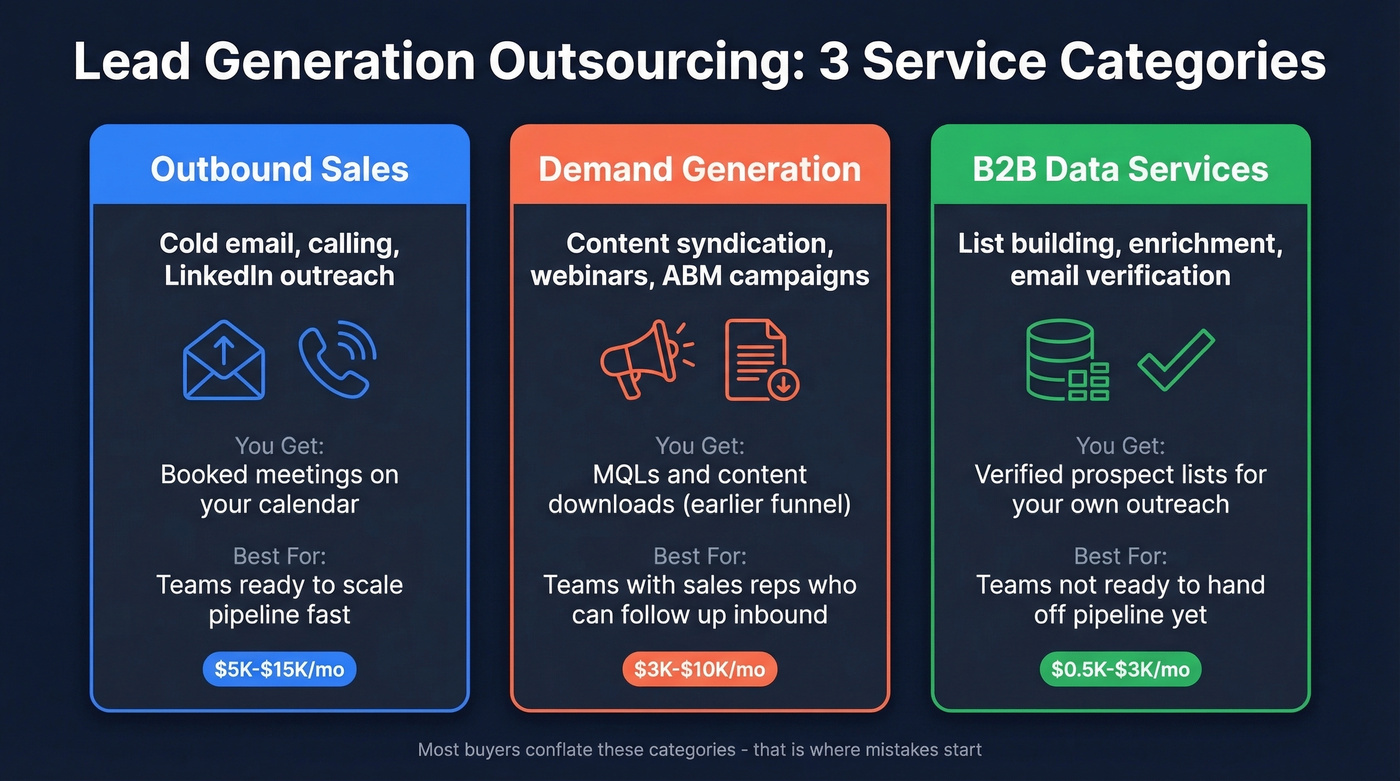
The key risk is incentive alignment. Time-based contracts produce better outcomes than pay-per-lead models, because pay-per-lead rewards volume over quality. More on that in the pricing section.
Demand Generation (Content, Syndication, ABM)
These agencies focus on inbound-adjacent tactics: content syndication, webinar promotion, ABM display campaigns, and lead nurture. You're buying MQLs or content downloads, not booked meetings. The leads are earlier in the funnel and require internal follow-up to convert.
Demand gen outsourcing works best when you already have a sales team that can work inbound leads but need more top-of-funnel volume. Without a follow-up engine, those MQLs die - 72% of B2B leads are never followed up on, usually because they're irrelevant or poorly qualified.
B2B Data Services (Lists, Enrichment, Verification)
The lightest-touch option. You're not outsourcing the selling - you're outsourcing the data. A provider builds targeted prospect lists, enriches your CRM records, or verifies contact information. Your team still runs the outreach.
This is often the smartest starting point for companies that aren't ready to hand off their entire pipeline but need better inputs. And frankly, if your data is bad, nothing else matters - not your sequences, not your SDRs, not your agency's playbook.
When Outsourcing Makes Sense (and When It Doesn't)
Outsource When...
You've validated your ICP through founder-led sales. If you've personally closed 10+ deals and can articulate exactly who buys, why they buy, and what objections come up, an agency can replicate that motion. Without that foundation, you're paying someone to guess.
You need to scale faster than hiring allows. An in-house SDR takes 3-6 months to hire and ramp. An outsourced team can be operational in 2-4 weeks. When the board wants pipeline growth this quarter, not next year, outsourcing buys you time.
Your deals involve complex buying groups. B2B purchases now involve 6-10 stakeholders on average. Multi-threading into those accounts requires dedicated prospecting bandwidth that most lean sales teams simply don't have.
Don't Outsource When...
The founder hasn't sold the product yet. This is the single most common failure mode. If you can't close deals yourself, an agency definitely can't. They'll burn through your budget and your domain while you figure out product-market fit.
Your average deal size doesn't justify the cost. If you're selling a $2,000/year product, paying $300-$900 per meeting doesn't pencil out. Here's the thing: if your ACV sits below $10k-$15k, you probably don't need agency-level outsourcing. Build verified lists, run your own sequences, and save the agency budget for when deal sizes justify it.
You don't have a CRM or follow-up process. Outsourced leads that land in a spreadsheet and die there aren't the agency's fault. You need internal infrastructure to convert what they deliver.
The Real Cost: In-House vs. Outsourced
Every agency page hides pricing behind "Request a Quote." Let's lay out the real numbers.
Side-by-Side Cost Comparison
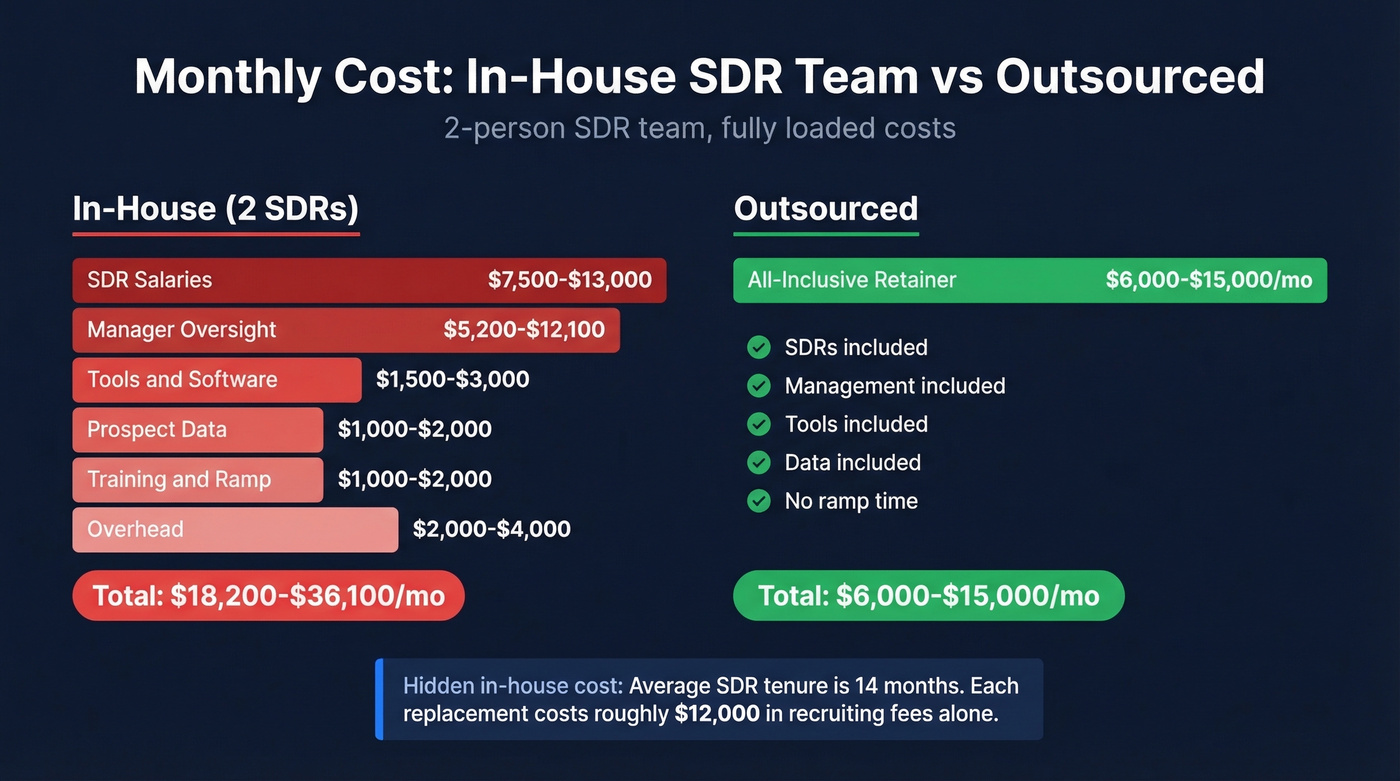
A two-person SDR team - the minimum viable outbound unit - runs $18,200 to $36,100 per month when you account for everything:
| Cost Component | In-House (2 SDRs) | Outsourced Equivalent |
|---|---|---|
| SDR salaries | $7,500-$13,000 | Included in retainer |
| Manager oversight | $5,200-$12,100 | Included in retainer |
| Tools/software | $1,500-$3,000 | Included in retainer |
| Prospect data | $1,000-$2,000 | Included in retainer |
| Training/ramp | $1,000-$2,000 | Included in retainer |
| Overhead | $2,000-$4,000 | Included in retainer |
| Total | $18,200-$36,100/mo | $6,000-$15,000/mo |
And that's before the hidden in-house costs. Average SDR tenure is roughly 14 months. Recruiting fees run 15-20% of first-year salary - about $12,000 per hire. Ramp to full productivity takes 3-4 months, and you're paying full cost for half output during that window. A single fully-loaded SDR costs $9,750-$14,425/month, with $12,010 being the typical midpoint.
Outsourced Pricing by Channel
- Cold email only: $2,000-$8,000/month
- Multi-channel outbound: $5,000-$15,000+/month
- Enterprise outbound: $15,000-$40,000+/month
Cost-Per-Meeting Math
This is where outsourcing's value proposition gets concrete.
| Scenario | Monthly Cost | Meetings/Mo | Cost Per Meeting |
|---|---|---|---|
| In-house (steady state) | $12,010 | 12 held | ~$1,000 |
| In-house (ramp period) | $12,010 | 6-8 held | $1,500-$2,000 |
| Outsourced retainer | $6,000 | 12-16 held | $375-$500 |
| Pay-per-meeting | $2,500-$5,000 | 10-20 held | $175-$350 |
By segment, expect these cost-per-meeting ranges:
| Segment | Cost Per Meeting |
|---|---|
| SMB | $150-$500 |
| Mid-Market | $300-$900 |
| Enterprise | $800-$2,500+ |
The math favors outsourcing on a per-meeting basis, especially during the first year when in-house ramp costs are highest. But cost per meeting doesn't capture everything - in-house teams build institutional knowledge, and that compounds over time.
Pricing Models: Which One Protects You?
Monthly Retainer
The standard model. You pay a fixed monthly fee - $2,500-$19,000+ depending on scope - and the agency delivers a defined set of activities and outcomes. Lower-end retainers ($2,500-$5,000) buy volume-led campaigns with templated outreach. Mid-tier ($6,000-$10,000) gets you dedicated strategists and custom sequences. Premium ($11,000-$19,000+) includes multi-channel execution, ABM, and senior talent. Sopro, as a public reference point, starts around $3,800/month.
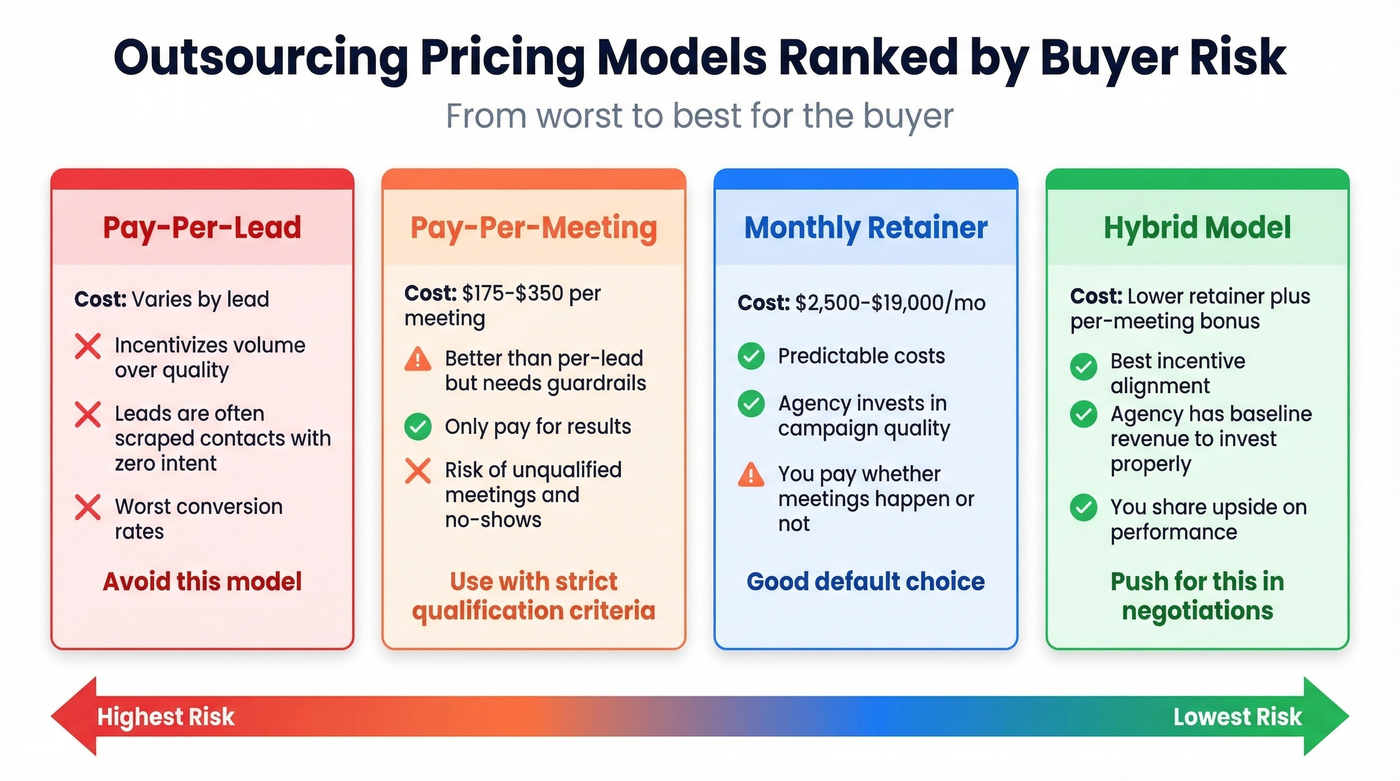
Upside: Predictable costs, aligned incentives around quality. Downside: You're paying whether meetings happen or not.
Pay-Per-Lead (and Why It's Risky)
Pay-per-lead is the worst pricing model for buyers. Full stop. It incentivizes the agency to deliver volume, not quality. You'll get names and email addresses, but the conversion rate to actual pipeline will be abysmal. We've seen teams drown in "leads" that were nothing more than scraped contacts who never expressed any interest.
Pay-Per-Meeting
Better than pay-per-lead, but still requires guardrails. Rates run $175-$350 per qualified meeting. The critical word is "qualified" - without strict definitions of what counts (title, company size, show rate), you'll pay for meetings with unqualified prospects who no-show half the time.
Hybrid Models
Some agencies combine a lower retainer with per-meeting bonuses. This aligns incentives better than pure pay-per-lead while giving the agency enough baseline revenue to invest in your campaign properly. If you're negotiating, push for this structure.

Most outsourcing failures start with bad data - agencies spam unverified lists and torch your domain. Prospeo gives you 300M+ profiles with 98% email accuracy on a 7-day refresh cycle, so you can run outbound in-house at $0.01/email instead of $375+ per meeting.
Skip the $6K/month retainer. Own your pipeline data from day one.
AI SDR Tools: The New Alternative
You can't discuss outsourcing your pipeline in 2026 without addressing AI SDR tools like Artisan's Ava, 11x, and Regie.ai. These platforms automate prospecting sequences - email personalization, follow-ups, even basic objection handling - at a fraction of agency cost ($1,000-$3,000/month for most).
Here's our take after watching dozens of teams try these: AI SDR tools handle high-volume, single-threaded outreach well. For straightforward SMB sales motions with a clear ICP, they're a legitimate alternative to a $5,000/month agency retainer. But they can't replace strategic multi-threading into complex enterprise accounts, and they struggle with nuanced messaging that requires reading between the lines of a prospect's situation. When your sales cycle involves 6-10 stakeholders and custom business cases, you still need humans - whether in-house or outsourced.
The smartest play for many teams: use AI tools for volume-based top-of-funnel, and reserve agency or in-house SDRs for strategic accounts.
Data Quality Determines Everything
Most outsourcing failures aren't strategy failures. They're data failures.
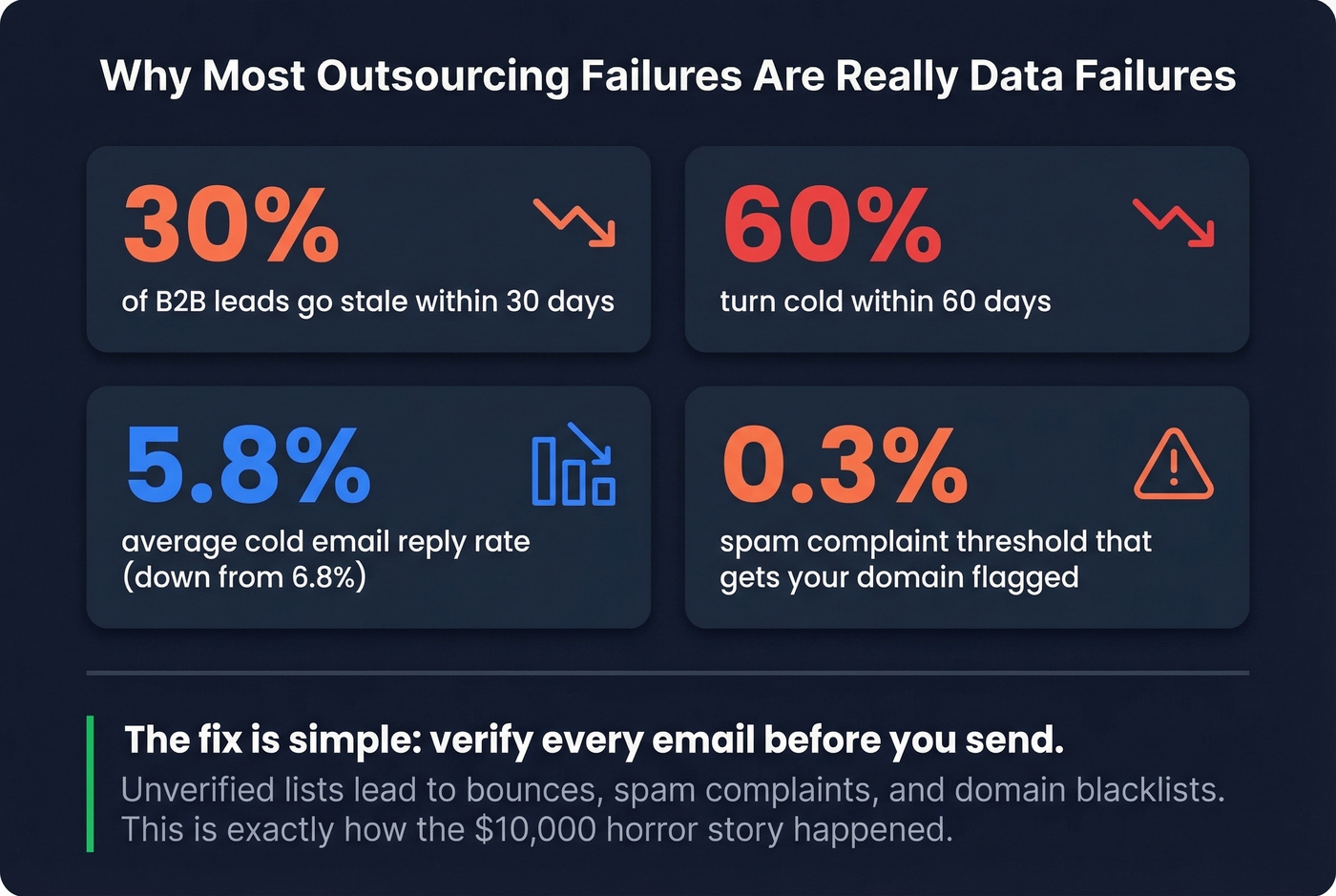
Roughly 30% of B2B leads go stale within 30 days, and 60% turn cold within 60 days. The average cold email reply rate sits at just 5.8%, down from 6.8% the year before - and that's with clean data. With bad data, you're not even reaching inboxes. When an agency builds a list of 10,000 prospects and starts blasting sequences, the quality of that contact data determines whether you get meetings or domain blacklists.
This is where the $10,000 horror story from the intro starts. That agency was working off scraped lists with no verification. Emails bounced, spam complaints spiked past the 0.3% threshold, and the domain got flagged.
The fix is straightforward: verify every contact before it enters a sequence. Prospeo runs a 5-step verification process that catches spam traps, honeypots, and catch-all domains - the stuff that destroys deliverability. With 98% email accuracy and a 7-day data refresh cycle versus the 6-week industry average, it's the verification layer that prevents the horror story. Stack Optimize, an outbound agency, built their entire client operation on this data - 94%+ deliverability, bounce rates under 3%, zero domain flags across all clients.
Whether you're outsourcing or running outbound in-house, the data layer isn't optional. SPF, DKIM, and DMARC authentication are table stakes, but they only matter if the emails you're sending to actually exist.
Choosing the Right Partner
Questions to Ask Before Signing
Don't sign anything until you've gotten clear answers on these:
- Where does your prospect data come from? If they can't name their sources and verification process, walk away - or bring your own verified lists before handing them to any agency.
- What does your sequence cadence look like? You want to see actual email copy, call scripts, and timing. Generic templates are a red flag.
- What's your bounce rate threshold? Any agency worth hiring monitors this obsessively. If they don't have a number, they're not managing deliverability.
- What happens when leads don't convert? Good agencies iterate on messaging and targeting. Bad ones blame your product.
- Can I see campaign dashboards weekly? Monthly reporting isn't enough. You need visibility into open rates, reply rates, and meeting quality in near-real-time.
Red Flags That Should Kill the Deal
Vague sourcing descriptions ("we use proprietary databases") without specifics. Unrealistic volume promises - anyone guaranteeing 50 meetings in month one is lying or spamming. No qualification process for the leads they deliver. And the biggest red flag of all: no references from companies in your segment.
Deliverability Non-Negotiables
Your agency must handle SPF/DKIM/DMARC authentication, domain warm-up for new sending domains, and complaint rate monitoring below the 0.3% threshold. If they don't mention these unprompted during the sales process, they're not sophisticated enough to protect your sender reputation.
Compliance in 2026
Compliance for outbound has gotten meaningfully scarier. TCPA lawsuits surged roughly 95% year-over-year, with class actions spiking 285% in September 2025 alone. TCPA fines run $500 to $1,500 per violation - and "per violation" means per call or text, not per campaign.
Texas SB 140, effective September 2025, expanded the definition of "telephone solicitation" to include texts and images, tying violations to the Texas Deceptive Trade Practices Act with treble damages and attorneys' fees. The FCC's consent-revocation rules - requiring companies to honor "revoke all" requests - were delayed until April 2026 and remain under review.
The Supreme Court's McLaughlin v. McKesson decision added another wrinkle: district courts aren't bound by FCC interpretations in civil TCPA cases, creating jurisdiction-by-jurisdiction variability in how rules get enforced.
What this means practically: GDPR and CCPA compliance has roughly doubled the cost of verified leads. Any agency that isn't proactively discussing consent management, suppression lists, and state-level regulations is a liability, not a partner. Ask specifically how they handle Texas, California, and EU prospects - the answer will tell you everything about their operational maturity.
Top Agencies to Consider
| Agency | Clutch Rating | Est. Monthly Cost | Best For | Key Risk |
|---|---|---|---|---|
| Belkins | 4.9/5 (230 reviews) | ~$4,000-$5,500 | Mid-market first-timers | Annual lock-in pressure |
| Callbox | 4.6/5 (119 reviews) | $15,000-$30,000/pod | Enterprise, multi-region | Overpriced for SMB |
| CIENCE | - | $4,200-$9,000 | Tech, data-heavy campaigns | Slower onboarding |
| Sales Focus Inc. | - | ~$5,000-$10,000/rep | Dedicated outsourced reps | Requires longer commitment |
| Martal Group | - | ~$3,000-$8,000 | SaaS, IT services | Less transparent reporting |
| SalesRoads | - | ~$4,000-$7,000 | Appointment setting | Top-of-funnel only |
Belkins
Belkins is the safest bet for mid-market companies trying outsourced lead gen for the first time. Clutch rating: 4.9/5 across 230 reviews. G2: 4.8/5 with 93 reviews. Starting price sits around $4,000/month, with review-derived pricing suggesting roughly $5,500/month for 10+ meetings.
Services span cold email, cold calling, ABM, and appointment setting. Client feedback consistently highlights effective prospecting, strong project management, and responsive communication. Our take: don't sign annual. Run a 3-month pilot, measure cost per held meeting, and decide from there. Belkins earns the renewal - they don't need to lock you in.
Callbox
Callbox is the enterprise play. Clutch: 4.6/5 with 119 reviews and 20+ years in business. Pricing runs $15,000-$30,000 per Campaign Pod covering one region and language. Multi-region deployments with three pods can hit $45,000-$90,000.
The praise is consistent: strong project management, genuine multi-channel execution, and operational flexibility. The criticism is equally consistent - regional market understanding can be shallow, lead qualification sometimes lacks rigor, and SDRs can be overly script-dependent.
Use this if: You're running enterprise outbound across multiple regions and need a single vendor with global infrastructure.
Skip this if: You're a startup or Series A company. The per-pod pricing doesn't make sense below $50k ACV deals.
CIENCE
CIENCE brings more analytical rigor to outbound than most competitors. Pricing runs $4,200-$9,000/month. They're particularly strong with tech companies that want data-driven campaign optimization rather than spray-and-pray volume. Good middle ground between Belkins' accessibility and Callbox's enterprise scale.
Sales Focus Inc.
Founded in 1998, Sales Focus takes a different approach: they place dedicated outsourced sales reps rather than just booking meetings. Their tiered model offers either a flat monthly fee or a flat fee plus commission structure, with 3-4 month pilot contracts. Expect $5,000-$10,000/month per rep as a starting range. Best for companies that want a full outsourced sales function, not just top-of-funnel appointment setting.
Martal Group and SalesRoads
Martal Group focuses on SaaS and IT services companies, with mid-tier retainers around $3,000-$8,000/month. SalesRoads is a pure appointment-setting specialist - if you only need the top-of-funnel meeting-booking function and have internal AEs to run the calls, they keep it focused at $4,000-$7,000/month.
The article above shows in-house outbound costs $12K+/month per SDR - but $2K of that is prospect data alone. Prospeo replaces that line item with 143M+ verified emails, 125M+ mobile numbers, and 30+ filters including buyer intent and technographics.
Cut your data costs by 90% and keep your domain reputation intact.
Benefits and Risks
Let's be honest about both sides.
Companies outsource for good reasons: faster time to pipeline, lower upfront cost than hiring, access to proven playbooks, and the ability to scale outbound without building internal infrastructure from scratch. For teams with a validated ICP and deal sizes above $10k, the benefits are real and measurable.
Now the failure rates: 20-25% of outsourcing relationships fail within two years, and 50% fail within five. Three failure modes account for the vast majority.
Bad data and domain destruction. This is the $10,000 horror story. An agency works off unverified lists, bounce rates spike, spam complaints cross the threshold, and your sending domain gets blacklisted. Rebuilding takes months. The fix is simple - verify every list before it touches a sequence - but most teams learn this the expensive way.
Misaligned incentives. Pay-per-lead models reward the agency for delivering volume, not pipeline. You end up with thousands of "leads" that your sales team can't convert, and the agency points to their delivery numbers while your pipeline stays flat. We've watched this play out with three different agencies before we stopped recommending that model entirely.
Premature outsourcing. The founder who hasn't validated their ICP hires an agency hoping they'll figure it out. They won't. Agencies amplify what works - they don't discover what works. If you can't articulate your ideal buyer in two sentences, you're not ready.
The cheapest option is almost always the most expensive in the long run. Scraped lists, generic templates, and zero deliverability management will damage your sender reputation in ways that cost far more than the retainer you saved.
FAQ
Is outsourced lead generation worth it?
For companies with a validated ICP and deal sizes above $15k, outsourced lead gen delivers meetings at $375-$500 each versus $1,000+ in-house during ramp. The ROI is clear when the math works - but it requires the right agency, clean data, and a 3-month minimum commitment to see real results.
How long before an agency delivers results?
Most agencies need 4-6 weeks for setup, domain warm-up, and initial sequencing. Meaningful meeting volume typically starts in month two. Any agency promising results in week one is cutting corners on deliverability.
What's a realistic cost per meeting?
SMB targets: $150-$500. Mid-market: $300-$900. Enterprise: $800-$2,500+. Tighter qualification definitions cost more per meeting but convert better downstream - always optimize for pipeline value, not meeting volume.
Should I outsource or hire an SDR?
Outsource if you need pipeline within 60 days and lack SDR management infrastructure. Hire if you're building a long-term outbound motion and can absorb 3-4 months of ramp. Many teams start with an outsourced pilot and bring it in-house once they've proven the playbook.
How do I protect my domain when outsourcing?
Demand SPF/DKIM/DMARC authentication, dedicated sending domains (never your primary), proper warm-up protocols, and bounce rate monitoring below 3%. Verify your lists before any campaign launches - 98% accuracy and 5-step verification catch the spam traps and honeypots that destroy deliverability.