

The Best Lead Generator Tools for 2026 - And the 2-3 You Actually Need
Last quarter, an SDR we know exported 2,000 contacts from a popular database, loaded them into a cold email sequence, and watched 400 bounce within 48 hours. The domain got flagged. Weeks of warm-up work - gone. That's not a tooling problem. It's a data quality problem disguised as a tooling problem, and picking the wrong lead generator is the single most common failure mode in outbound right now.
The lead generation software market hit $7.4B in 2025 and is projected to reach $16.2B by 2034 at a 9.1% CAGR. No shortage of tools. The problem is that 79% of marketing leads never convert to sales, 61% of marketers say lead gen is their greatest challenge, and yet 91% still call it their top priority. More tools haven't closed the conversion gap - better tools, used together, might.
Most roundups list 20+ tools and recommend all of them. This one doesn't. You need 2-3 that actually work together.
Our Picks (TL;DR)
| Pick | Category | Why | Starting Price |
|---|---|---|---|
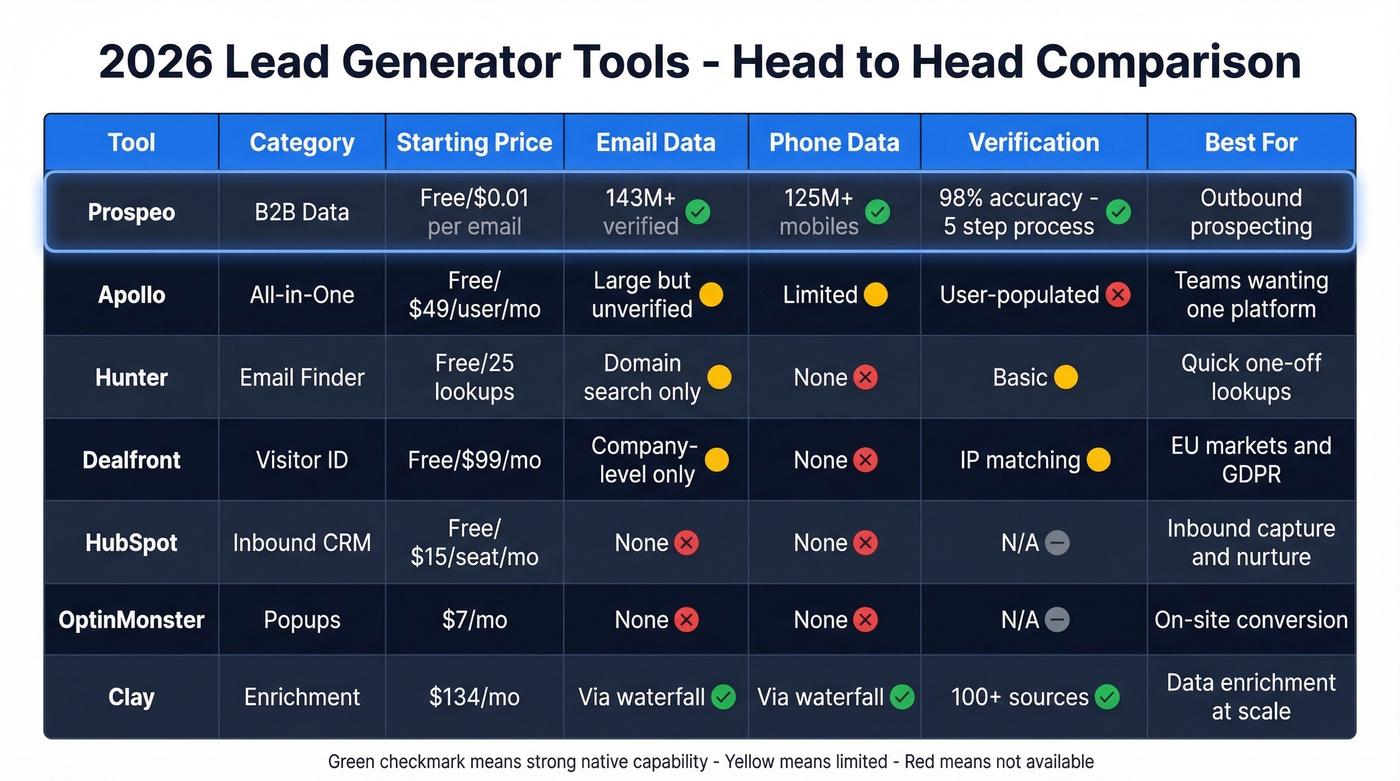
| Prospeo | B2B contact data | 98% accuracy, 125M+ mobiles, 7-day refresh | Free / ~$0.01/email |
| HubSpot | Inbound capture + CRM | Forms, chatbots, email, landing pages | Free / from $15/seat/month |
| Clay | Enrichment & orchestration | Waterfall enrichment, 100+ sources, AI | $134/mo |
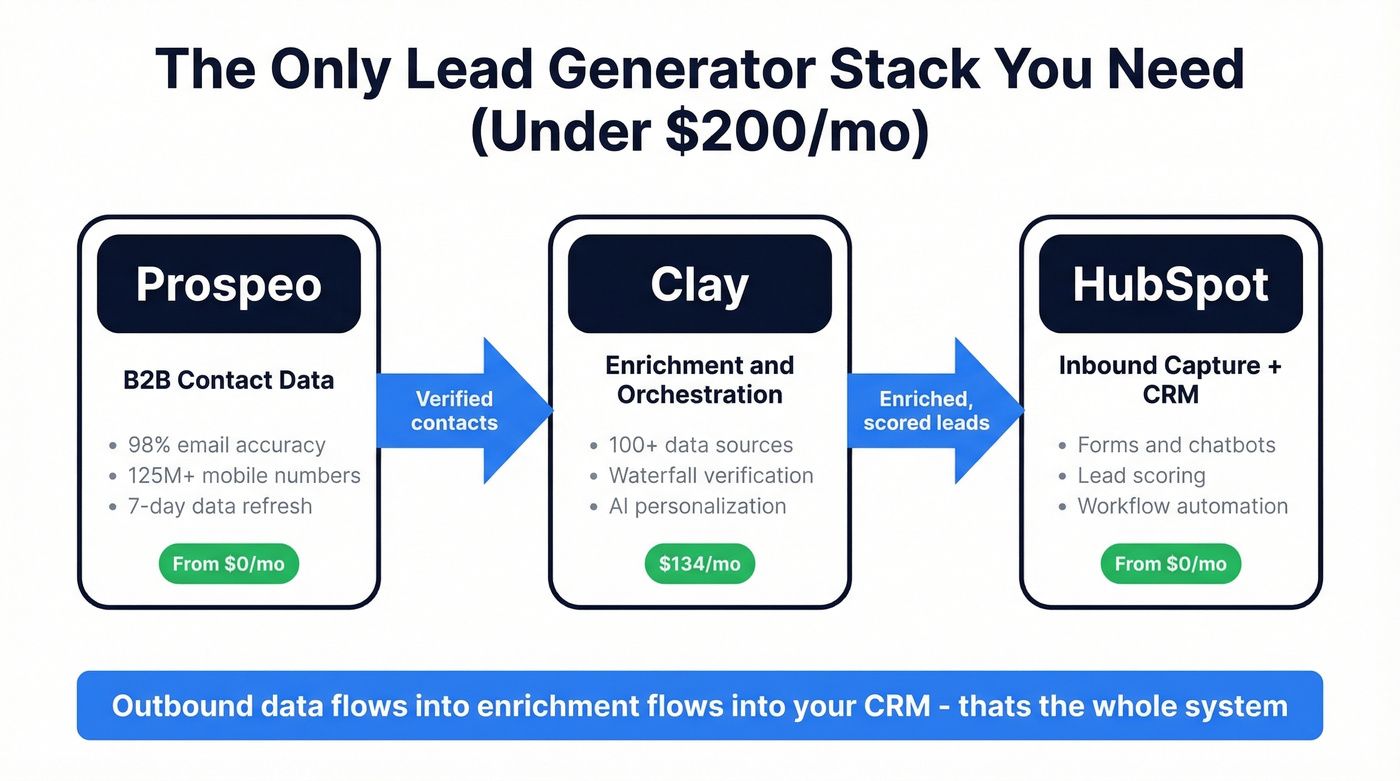
Prospeo gets you the data. HubSpot captures and manages inbound. Clay enriches and orchestrates everything in between. That's a complete lead generation stack for under $200/month.
What Is a Lead Generator?
A lead generator is any tool or system that identifies, captures, or surfaces potential buyers for your business. Simple enough. The useful version requires breaking it into three categories, because the tools that do each job are fundamentally different.
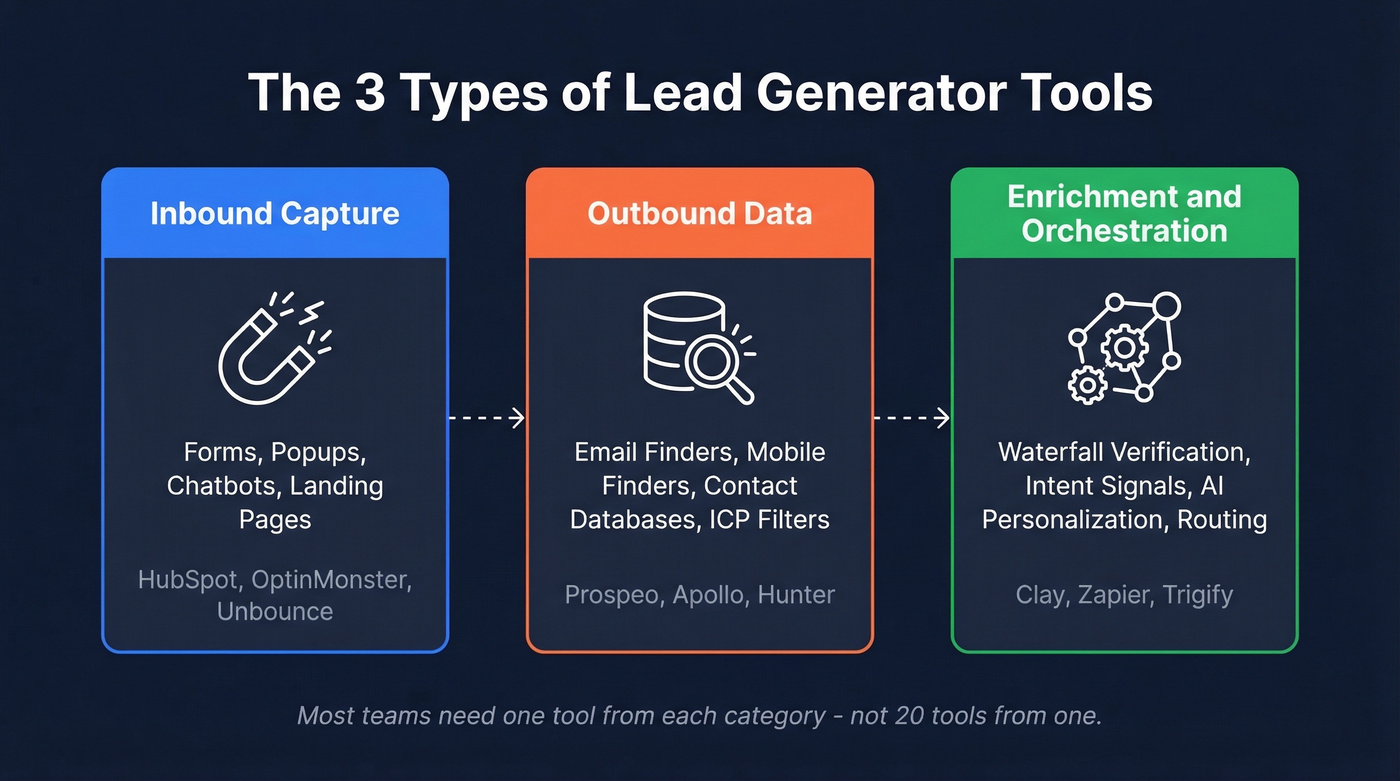
Inbound capture tools - forms, popups, chatbots, landing pages - convert existing website traffic into known contacts. HubSpot and OptinMonster live here. Outbound data tools - databases, email finders, mobile finders - let you proactively build lists of prospects who match your ideal customer profile. Apollo and similar platforms live here. Enrichment and orchestration tools - Clay, Zapier, and similar platforms - take raw leads from any source and layer on verified data, intent signals, and personalization before routing them to your outreach stack.
The biggest shift in 2026 is signal-based prospecting. Instead of blasting a static list, modern lead generation tools track buying signals - site visits, job changes, funding rounds, competitor reviews, technology adoption - and surface prospects at the moment they're most likely to engage. The best tools now layer intent data across thousands of topics directly into search filters, so you're not just finding people who match your ICP. You're finding people who match your ICP and are actively researching solutions like yours.
Three Principles That Still Work
Before you pick any lead generating tool, get these right. The best software in the world won't fix a broken offer or a confusing landing page.
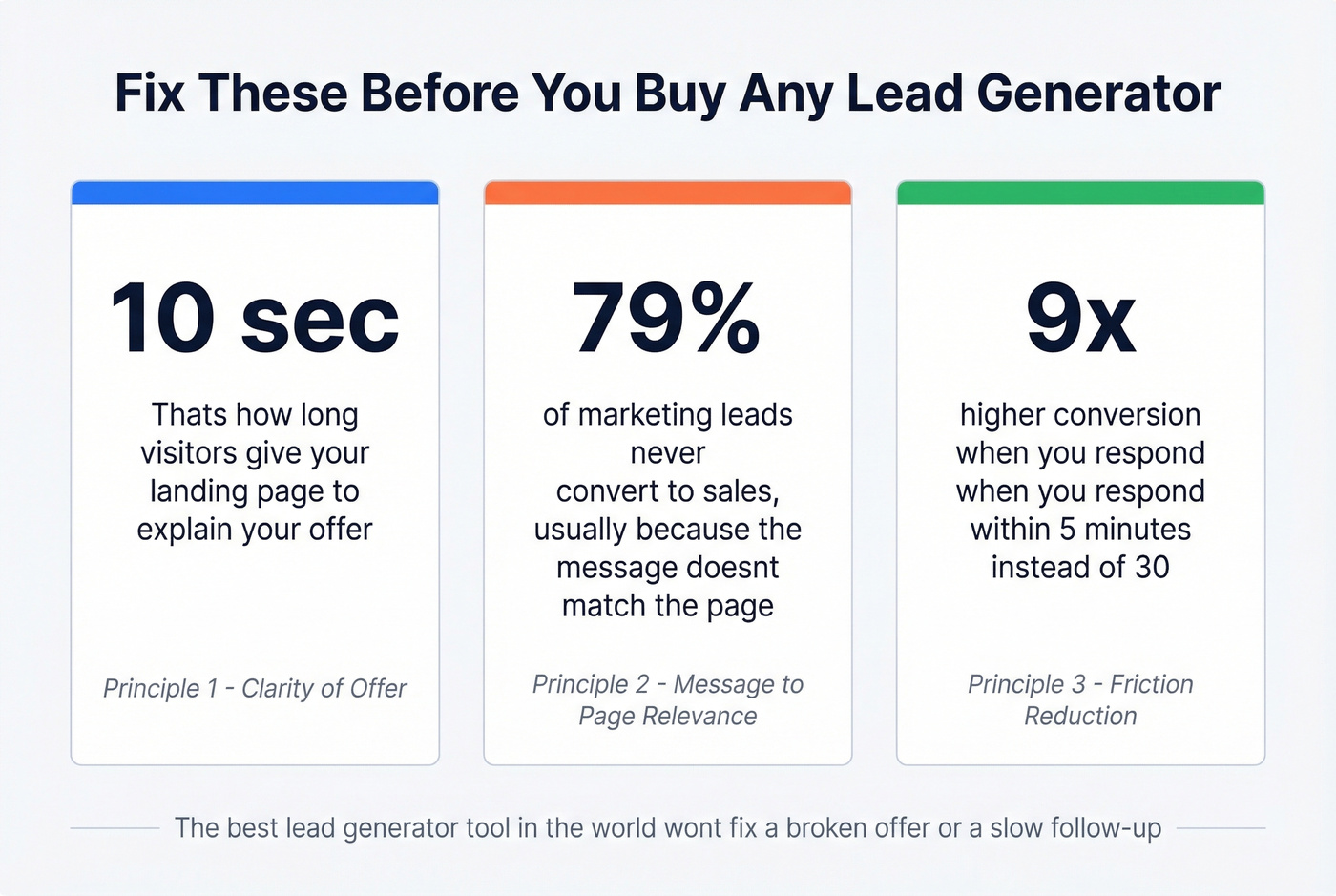
1. Clarity of offer. Your prospect should understand what you're selling, who it's for, and why they should care - in under 10 seconds. If your landing page requires scrolling to find the value proposition, you've already lost most visitors.
2. Message-to-page relevance. The copy on your landing page must match the intent of whatever brought the prospect there. If your ad promises a "free ROI calculator" and the landing page opens with a company history paragraph, you're bleeding conversions. Every click is a promise. Honor it.
3. Friction reduction. Every additional form field, every extra click, every unnecessary decision point costs you leads. Responding within 5 minutes increases conversion chances by up to 9x. Speed is a form of friction reduction too - the faster you follow up, the less friction the prospect feels between interest and action.
Best Lead Generator Tools for 2026
Best for B2B Contact Data
Prospeo
Use this if you need verified B2B contact data that won't torch your domain reputation. Prospeo's database covers 300M+ professional profiles with 143M+ verified emails at 98% accuracy and 125M+ verified mobile numbers that hit a 30% pickup rate. The 7-day data refresh cycle is genuinely unusual - the industry average sits around 6 weeks, which means most databases are serving you stale data by default.

The search filters go deep: 30+ options including Bombora intent data across 15,000 topics, technographics, job changes, headcount growth, funding signals, and department-level headcount. Every record passes a 5-step verification process with catch-all handling, spam-trap removal, and honeypot filtering - all built on proprietary infrastructure, not third-party email providers. The Chrome extension (40K+ users) pulls verified emails and phones from any website or web app in one click, and CRM enrichment returns 50+ data points per contact with a 92% API match rate.
Real results tell the story. Snyk's team of 50 AEs, each prospecting 4-6 hours per week, cut bounce rates from 35-40% to under 5%, grew AE-sourced pipeline by 180%, and generated 200+ new opportunities per month after switching. Meritt tripled their pipeline from $100K to $300K per week while dropping bounce rates from 35% to under 4%. Across the board, teams using Prospeo book 26% more meetings than ZoomInfo users and 35% more than Apollo users.
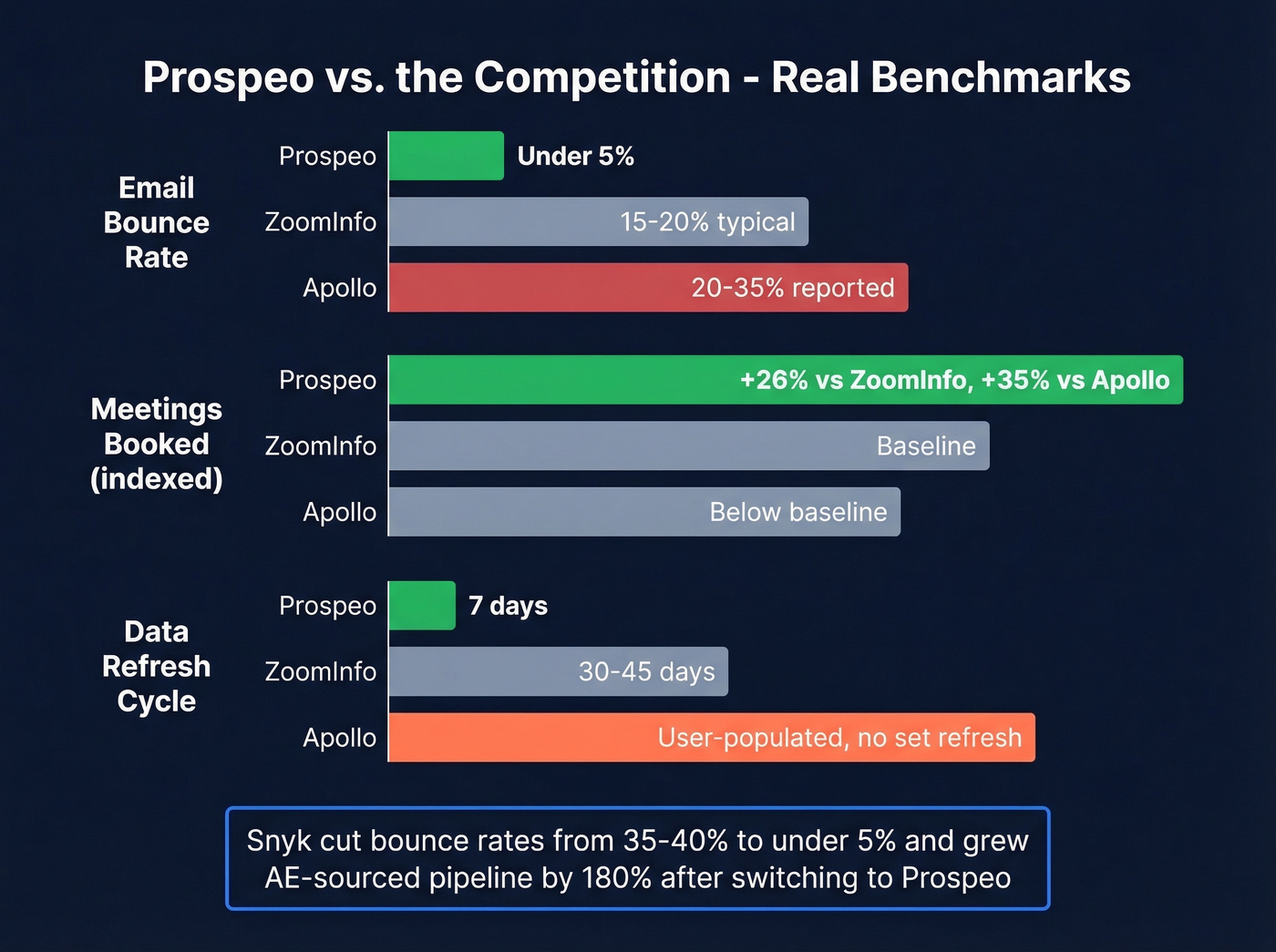
Pricing starts free - 75 emails and 100 Chrome extension credits per month - with paid plans running about $0.01 per email. No contracts, no sales calls required. If you want a free lead generator to test before committing budget, this is one of the strongest starting points available.
Skip this if you need a built-in email sequencer. Pair Prospeo with Smartlead, Instantly, or Lemlist for outreach - native integrations make this plug-and-play.
Apollo.io
Apollo is the obvious starting point for teams that want everything in one place - data, sequencing, dialer, and basic analytics - without paying enterprise prices. The free plan is genuinely useful, and paid plans start at $49/user/month. The database is large, and the sequencing tools are solid for getting reps moving fast. Pros:
- Free tier with real functionality
- All-in-one platform reduces tool sprawl
- Large contact database with decent coverage
- Built-in email sequences and task management
Cons:
- Data is user-populated and not independently verified - practitioners recommend running Apollo exports through at least two separate verification tools
- Twilio VoIP dialer numbers get flagged as spam
- Open/click tracking hurts deliverability - experienced users turn it off
The consensus on r/sales is "jack of all trades, master of none." It works best as a prospecting starting point. Just don't trust the data without verifying it elsewhere, and don't rely on Apollo's own deliverability metrics.
Hunter
Use this if you need quick, one-off email lookups or domain searches without committing to a full platform. Hunter's free plan gives you 25 searches per month, and the domain search feature is clean and fast.
Skip this if you need bulk prospecting or mobile numbers. Hunter's database is smaller than full platforms, and it doesn't offer phone data. It's a scalpel, not a chainsaw - great for targeted lookups, not for building 5,000-contact lists.
Best for Visitor Identification
Dealfront (Leadfeeder)
Dealfront identifies anonymous website visitors and matches them to company profiles, giving your sales team warm leads they didn't have to hunt for. If you sell into European markets, the GDPR-compliant architecture isn't just nice to have - it's table stakes.

One B2B software company reported a 45% increase in qualified leads and 25% increase in sales conversions within six months of deploying Dealfront. The free plan ($0, no time limit) includes unlimited users, shows data from the last 7 days, and caps at 100 identified companies. Paid plans start at $99/month on an annual contract, with a 14-day free trial that doesn't require a credit card.
Here's the catch: visitor identification only works when you have enough B2B traffic to identify. If you're pre-product-market-fit with 200 monthly visitors, spend your money on data tools and outbound first. Come back to Dealfront when your site traffic justifies it.
Best for Inbound Capture
HubSpot
HubSpot is the default inbound marketing platform for teams that attract prospects through content, SEO, and paid campaigns - and for good reason.
Pros:
- Free CRM tier is genuinely generous
- Native lead scoring, lifecycle stages, and workflow automation
- Forms, chatbots, email marketing, and landing pages in one platform
- Takes a stranger from "visited a blog post" to "MQL routed to rep" without leaving the ecosystem
Cons:
- Outbound contact data capabilities are weak compared to dedicated tools
- Marketing Hub pricing escalates quickly once you outgrow the free tier
- The ecosystem lock-in is real - migrating away from HubSpot is painful
Paid plans start at $15/seat/month. For inbound, it's the right choice for most teams. For outbound, pair it with a dedicated data tool and use HubSpot as the system of record.
OptinMonster
Use this if you run a content-heavy site and need to convert traffic into leads with exit-intent popups, slide-ins, and page-level targeting. Starting at $7/month on an annual plan, it's one of the cheapest ways to squeeze more leads out of existing traffic. The A/B testing is solid, and the targeting rules let you show different offers based on which page someone's reading.
Skip this if you need a CRM, outbound data, or anything beyond on-site conversion optimization. OptinMonster does one thing well and doesn't pretend otherwise.
Unbounce
Unbounce builds AI-powered landing pages with a Smart Traffic feature that automatically routes visitors to the highest-converting variant. Starting at $74/month with a 14-day trial, it's best for teams running paid campaigns that need dedicated landing pages separate from their main site.
Best for Enrichment & Orchestration
Clay
Clay is the tool that gets r/sales practitioners genuinely excited. The waterfall enrichment pulls from 100+ data sources, running each contact through multiple providers until it finds verified data. The AI message personalization generates relevant first lines at scale - not the cringe "I noticed you went to Ohio State" openers, but lines that reference real company context.
Starting at $134/month for 2,000 enrichment credits, Clay isn't cheap. It's a scaling tool, not a starting point. Teams that get the most from Clay already have a working outbound motion and want to improve data quality and personalization without hiring more SDRs. Pair it with a signal-monitoring tool like Trigify to feed Clay with real-time job changes and funding events, and you've got an automated prospecting engine that practically runs itself.
Skip this if you're just getting started with outbound. Build your prospecting foundation with a data tool first, then add Clay when you need enrichment orchestration across multiple sources.
ZoomInfo
ZoomInfo is still the most feature-rich all-in-one data platform on the market. Massive database, org charts, intent data, workflow automation - it's all there. But here's the thing: most teams don't need all-in-one. If your average deal size is under $15K, you almost certainly don't need ZoomInfo-level complexity.
Contracts typically run $15K-40K/year depending on seats and modules. That often works out to around $1/lead - with 87% email accuracy. For enterprise teams with 20+ reps running ABM programs, the breadth of features can justify the spend. For everyone else, the math doesn't work.
Best for Outreach Automation
Snov.io
Snov.io is the Swiss Army knife for solopreneurs. Email finding, drip sequences, email warm-up - all in one tool, starting with a free plan (50 credits/month) and paid plans around $30-39/month. No single feature is best-in-class, but the combination at that price point is hard to beat for one-person operations.
Where it falls short: data enrichment is shallow, mobile numbers are absent, and deliverability infrastructure can't match dedicated sending tools. Think of Snov.io as training wheels - effective for learning outbound mechanics, limiting once you're ready to scale.
Best for Workflow Glue
Pipedrive
Pipedrive is a visual pipeline CRM starting at $14/seat/month with a 14-day trial. The LeadBooster add-on adds chatbots and web forms for lead capture. It's the right CRM for small sales teams that want simplicity over Salesforce-level complexity.
Zapier
Zapier connects thousands of apps and starts free, with paid plans from $19.99/month. It's essential glue for teams stitching together tools that don't natively integrate - think "new data export triggers a Slack notification and creates a HubSpot contact" without writing a line of code.

That SDR who lost 400 contacts to bounces? It doesn't have to be you. Prospeo's 5-step verification delivers 98% email accuracy, 125M+ verified mobiles, and a 7-day data refresh - so your lead generator actually generates leads, not domain flags.
Build your first verified list in under 2 minutes - free.
Pricing Comparison
We included actual prices because most "best tools" lists don't. Prices are as of early 2026 - check vendor sites for current plans.
| Tool | Best For | Starting Price | Free Plan? | Trial |
|---|---|---|---|---|
| Prospeo | B2B contact data | ~$0.01/email | Yes | - |
| Apollo.io | All-in-one prospecting | $49/user/mo | Yes | - |
| Hunter | Quick email lookups | Free (25/mo) | Yes | - |
| Dealfront | Visitor identification | $99/mo (annual) | Yes | 14 days |
| HubSpot | Inbound + CRM | from $15/seat/mo | Yes | - |
| OptinMonster | On-site conversion | $7/mo (annual) | No | - |
| Unbounce | Landing pages | $74/mo (annual) | No | 14 days |
| Clay | Enrichment | $134/mo | No | - |
| ZoomInfo | Enterprise data | ~$15K-40K/yr | No | - |
| Snov.io | Cold email + finder | ~$30-39/mo | Yes | - |
| Pipedrive | Visual CRM | $14/seat/mo | No | 14 days |
| Zapier | Workflow automation | $19.99/mo | Yes | - |
How to Build Your Stack
We've seen teams with six subscriptions for four reps, and eventually finance asks the obvious question. The best stacks are lean. Pick a data layer, a CRM/capture layer, and an outreach layer. That's it.
| Stage | Data | CRM / Capture | Outreach | ~Monthly Cost |
|---|---|---|---|---|
| Solo / SMB | Prospeo (free) | HubSpot (free) | Manual / Lemlist | $0-50 |
| Growth (5-20 reps) | Prospeo | Clay + HubSpot | Smartlead or Instantly | $200-400 |
| Enterprise (20+) | ZoomInfo or Prospeo | Salesforce | Outreach or Salesloft | $2K+ |

For solo founders and SMBs, a free data tier plus HubSpot's free CRM gives you a complete lead generation stack at zero cost. You can prospect, verify, capture inbound leads, and manage your pipeline without spending a dollar until you're ready to scale.
Growth teams benefit from adding Clay's enrichment layer between their data platform and outreach tool. The waterfall verification catches contacts that any single provider misses, and the AI personalization lifts reply rates meaningfully. In our experience, this is the stack configuration that delivers the best ROI per dollar spent.
Enterprise teams with 20+ reps may find ZoomInfo's breadth worth the price tag - org charts, advanced intent, and workflow automation. But even at that scale, we've seen teams layer a verification tool on top of ZoomInfo exports, catching the 13% of emails that ZoomInfo gets wrong.
Funnel Benchmarks
Numbers without context are useless. Here's what "good" looks like for a B2B SaaS funnel, based on benchmarks spanning 2017-2026:
| Stage | Benchmark |
|---|---|
| Lead to MQL | 39% |
| MQL to SQL | 38% |
| SQL to Opportunity | 42% |
| SQL to Closed Won | 37% |
If you're converting fewer than 39% of raw leads to MQLs, your lead quality or scoring model needs work. When MQL-to-SQL drops below 38%, sales and marketing aren't aligned on what "qualified" means.
The inbound vs. outbound split matters here too. Inbound leads cost up to 60% less than outbound, but hybrid companies - running both simultaneously - see 2x faster revenue growth than companies relying on either channel alone. B2B customers now engage across 10 channels before making a purchase, up from 5 in 2016, and companies running omnichannel engagement see an 18.96% engagement rate versus 5.4% for single-channel. The takeaway isn't "pick one." It's "do both, make sure your tools talk to each other, and meet buyers wherever they are."
One stat that should haunt every sales leader: 48% of reps stop after one touch, while 80% of sales require five or more follow-ups. Your prospecting tools can surface perfect prospects all day - if your follow-up cadence is broken, none of it matters. Marketing automation is linked to a 451% increase in qualified leads, largely because it solves the follow-up consistency problem that humans are terrible at.
Lead Scoring in Practice
Not every lead deserves a rep's time. A VP of Sales at a 200-person SaaS company who visited your pricing page twice this week scores higher than a marketing intern who downloaded a whitepaper. Lead scoring makes that distinction systematic instead of gut-feel.
| Signal Category | Weight | Examples |
|---|---|---|
| Demographic / Firmographic | 30-40% | Title, company size, industry, revenue |
| Behavioral / Engagement | 40-50% | Page visits, email opens, content downloads, demo requests |
| Buying Signals | 20-30% | Pricing page visits, competitor research, intent data triggers |
The MQL-to-SQL handoff is where most teams fumble. An MQL means marketing thinks the lead is worth pursuing. An SQL means sales has confirmed budget, authority, need, and timeline - the classic BANT framework. If your MQL-to-SQL conversion is below 38%, the gap between those definitions is too wide. Let's be honest: most alignment problems between sales and marketing come down to never having agreed on what "qualified" actually means in the first place. Get both teams in a room, hash it out, and encode the result in your scoring model.
Compliance Essentials
Choosing a non-compliant prospecting tool isn't just a data risk - it's a financial one. GDPR fines can reach EUR 20 million or 4% of global annual turnover, whichever is higher. CCPA gives consumers the right to opt out of data sales, request deletion, and know exactly what's being collected.
Your practical compliance checklist:
- Lawful basis: Document why you're processing each contact's data - consent, legitimate interest, or contractual necessity
- Data minimization: Collect only what you need. If you don't need a prospect's home address, don't store it
- Vendor DPAs: Every data provider you use should have a Data Processing Agreement in place. If they won't sign one, walk away
- Cross-border transfers: If you're moving EU data outside the EU, you need Standard Contractual Clauses or Binding Corporate Rules in place
- Opt-out enforcement: Honor unsubscribe and deletion requests promptly - not just because it's required, but because ignoring them tanks your sender reputation
The compliance landscape is getting stricter, not looser. Picking tools that are GDPR-compliant by design - rather than bolting compliance on after the fact - saves you legal headaches and protects your domain reputation simultaneously.
FAQ
What's the best lead generator for B2B?
For verified contact data, Prospeo delivers 98% email accuracy with 125M+ mobile numbers and a free tier. For inbound capture, HubSpot's free CRM is the default. For enrichment, Clay's waterfall verification across 100+ sources is the practitioner favorite. Most teams need one tool from each category.
How does a lead generator work?
Lead generators work through three mechanisms: database tools let you search professional profiles by title, company size, and intent signals, then export verified contacts. Visitor identification tools match anonymous website traffic to company profiles. Inbound capture tools - forms, chatbots, popups - convert existing traffic into known contacts with qualifying information.
Are lead generation tools worth the cost?
Yes. Marketing automation is linked to a 451% increase in qualified leads, and nurtured leads produce 47% higher order values. A solo founder doesn't need a $40K/year contract - free tiers from HubSpot and Prospeo deliver real results at zero cost. Scale your tooling spend with your team, not ahead of it.
How much do lead generation tools cost?
Free tiers are available from HubSpot, Apollo, Prospeo, and Hunter. Paid plans start at $7/month (OptinMonster) and scale to $40K+/year for enterprise ZoomInfo contracts. The sweet spot for most growth-stage teams is $200-400/month across 2-3 tools - a data platform, an enrichment layer, and an outreach tool.
What's the difference between inbound and outbound lead generation?
Inbound attracts prospects through content, SEO, and ads - they visit your site and self-identify. Outbound means proactively reaching prospects via cold email, calls, or direct messaging. Inbound leads cost up to 60% less, but outbound gives you targeting control. Hybrid companies running both see 2x faster revenue growth than single-channel teams.
The tools keep multiplying. The principle doesn't change: get accurate data, capture inbound interest, and follow up fast. Pick your 2-3 lead generator tools, wire them together, and spend your energy on the conversations - not the stack.