

Lead Nurturing Content Strategy: From Audit to Sequence
A lead downloads your guide on Monday. Sales follows up on Thursday. By then, they've forgotten who you are, and your "nurture" turns into a slow-motion unsubscribe.
That gap isn't a minor inefficiency - it's the whole game. A lead nurturing content strategy bridges it by matching the right proof to the right moment. Leads followed up within five minutes are 21x more likely to qualify, yet most B2B teams treat nurture like a newsletter: batch-and-blast on Tuesday, hope for the best.
Per the [INFUSE Voice of the Buyer report](https://infuse.com/insight/infuse-insights-report-voice-of-the-buyer-2025/), 40.4% of B2B buyers take 6-12 months to decide, and 45.8% consume 7+ content pieces before they buy. Across the industry, marketers complain about the same thing: nurture sequences turn into generic email drips that nobody reads. That's a content problem, not a channel problem. Companies with mature nurture programs generate 50% more sales-ready leads at 33% lower cost, and nurtured leads make 47% larger purchases.
Here's the thing: most content ranking for this topic delivers a content list, not a content strategy. Those aren't the same. Strategy is the logic that makes your content compound - the same thesis, reinforced across formats, delivered at the moments that matter. Let's build the system.
What You Need (Quick Version)
- Audit your content against funnel stages in 30 minutes to spot gaps fast.
- Build a messaging spine (your POV) before you map formats.
- Design behavioral sequences that branch by actions and persona.
- Verify your data before you hit send - bounces will quietly kill the program.
The 6-Step Framework
Audit Your Content (30-Minute Funnel Map)
Open a spreadsheet and do this the Tilipman Digital way: list every asset you've got, then tag it by funnel stage so you can see gaps immediately (their funnel mapping playbook).
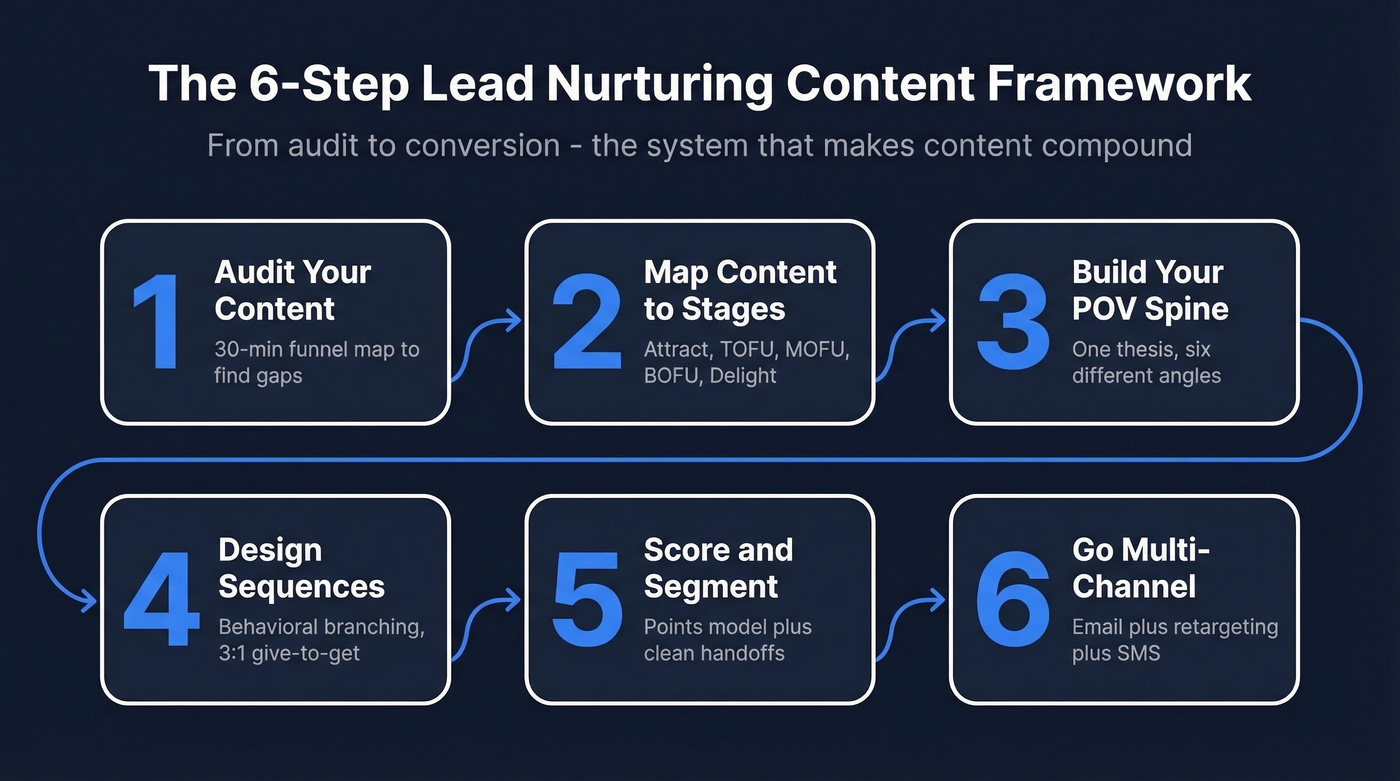
Columns to use:
- Asset name + URL
- Format (blog, webinar, case study, email, deck)
- Primary ICP
- Stage: Awareness / Consideration / Decision
- CTA (subscribe, book demo, pricing, trial)
- "Still accurate?" (yes/no)
Sort by stage and count. Teams are almost always overloaded in Awareness and starved in Decision - the spreadsheet makes that obvious in minutes and tells you exactly where your nurture content has holes. Then write one sentence per stage: "What does a buyer need to believe to move forward?" That sentence becomes your content brief generator for everything downstream.
Map Content to Every Stage
The cleanest stage model we've found for nurture planning is the 5-stage map: Attract, TOFU, MOFU, BOFU, Delight (SmartBug's breakdown). It's old, but it's practical - and it forces you to plan beyond top-of-funnel content.
| Stage | What they need | Content types | Timing notes |
|---|---|---|---|
| Attract | Problem awareness | Blogs, short videos | Fast + frequent |
| TOFU | Category clarity | Ebooks, intro webinars | 2-7 days |
| MOFU | Shortlist confidence | Case studies, demos | 7-21 days |
| BOFU | Risk removal | ROI calc, consult, refs | Trigger-based |
| Delight | Adoption + expansion | Onboarding, upgrades | Ongoing |
Timing matters more than people admit. For short sales cycles, compress TOFU to MOFU into a week. For longer cycles where deal sizes exceed $50K, space it out and let triggers - pricing visits, demo views - accelerate the path instead of a rigid calendar.
Build Your Messaging Spine (POV Framework)
Content mapping tells you what format to ship. It doesn't tell you what to say.
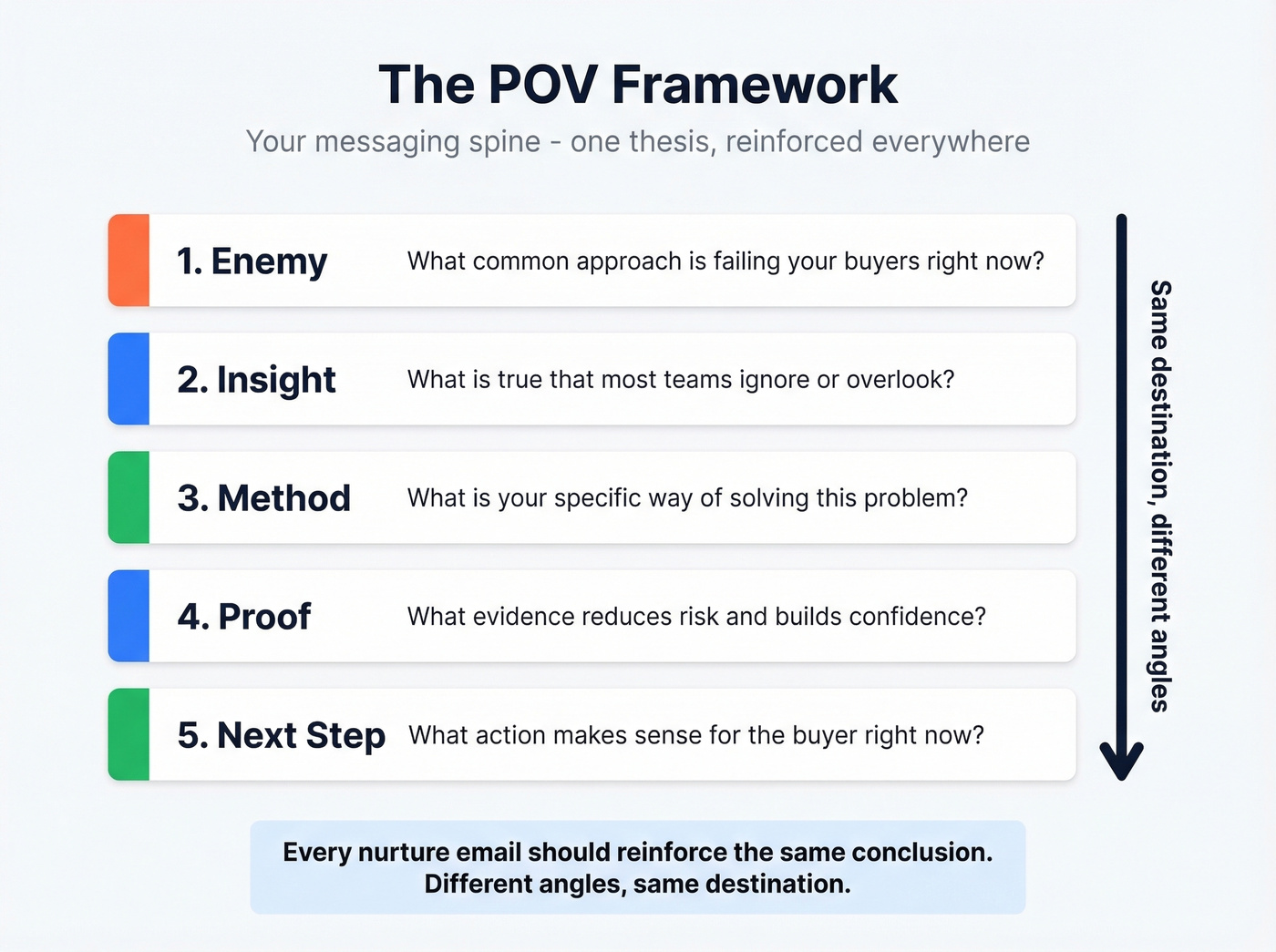
That's the missing layer The B2B Playbook nails: a consistent point of view is what makes content build memory and conviction, so your product becomes the logical conclusion. Without a POV, you're sending content into the void - helpful, maybe, but forgettable.
Look, most nurture programs fail not because the emails are bad, but because they have no thesis. Each email is "helpful" in isolation and meaningless in aggregate. The fix is embarrassingly simple: decide what you believe, then say it six different ways.
A POV framework that works:
- Enemy: what's the common approach that's failing?
- Insight: what's true that most teams ignore?
- Method: what's your way of solving it?
- Proof: what evidence reduces risk?
- Next step: what action makes sense now?
Every email in your nurture should reinforce the same conclusion. Different angles, same destination. We've tested nurture programs where the only change was adding a single thesis, and the downstream demo-to-close rate improved because buyers arrived pre-convinced - not scattered across random insights.
Design Your Nurture Sequences
A nurture sequence isn't a newsletter. It's a behavioral engine that delivers the right proof at the right moment. FluentCRM's research breaks nurture into seven distinct email types - educational, problem/solution, social proof, re-engagement, milestone, promotional, and feedback - and that's the right mental model. Each email has a job.
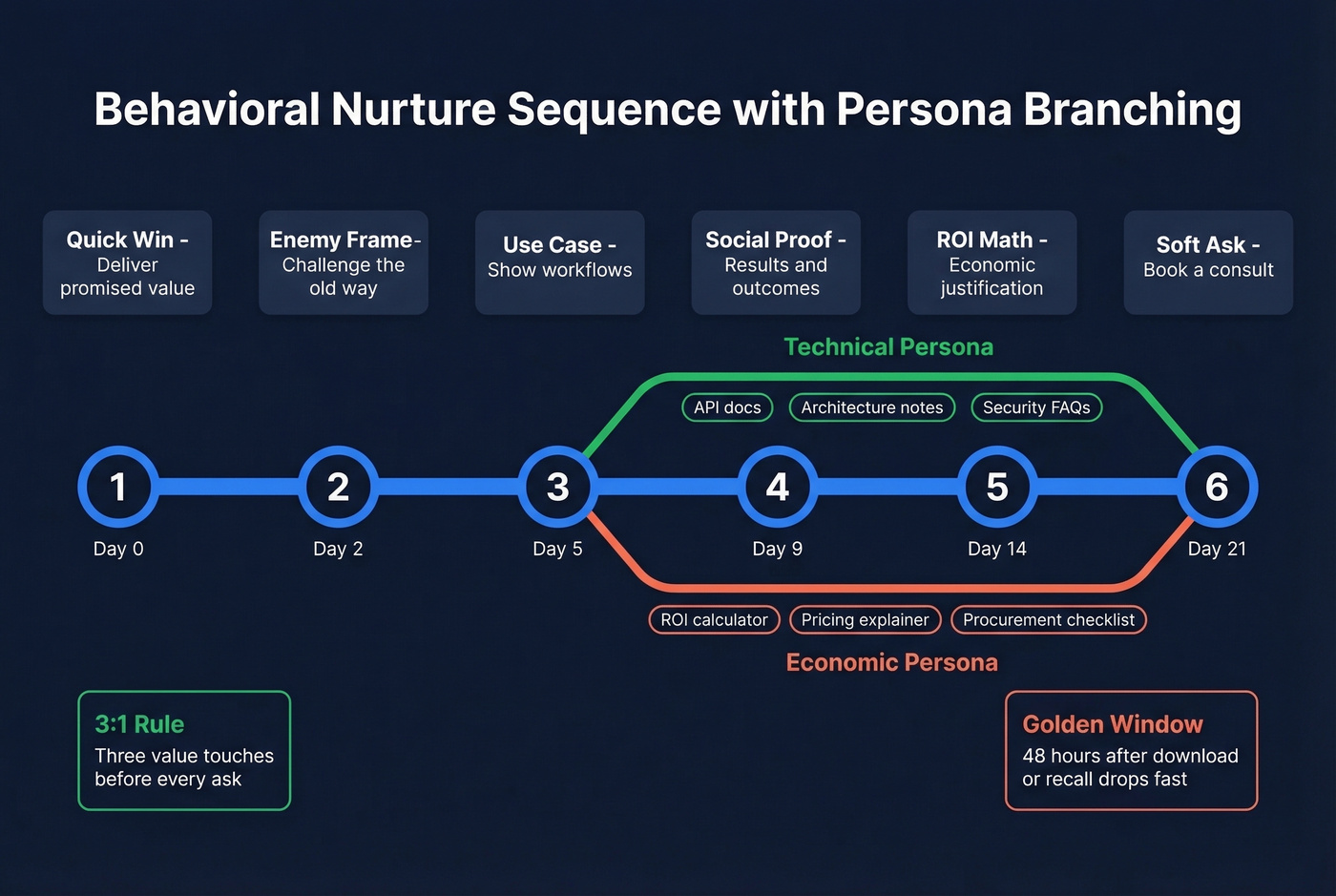
Here's a 6-email sequence you can adapt. Keep a 3:1 give-to-get ratio: three value touches before you ask for a meeting.
| Subject line | When | Purpose | CTA | |
|---|---|---|---|---|
| 1 | "Quick win: fix X in 10 minutes" | Day 0 | Deliver the promised value | Read the checklist |
| 2 | "The mistake that makes X expensive" | Day 2 | POV + enemy framing | Watch 3-min video |
| 3 | "How teams like you do X" | Day 5 | Use-case + workflow | See the playbook |
| 4 | "Proof: results + what changed" | Day 9 | Social proof | Read case study |
| 5 | "ROI math: is X worth it?" | Day 14 | Economic justification | Use ROI calculator |
| 6 | "Want the tailored version?" | Day 21 | Soft conversion ask | Book a consult |
The golden window is 48 hours after a download. After that, recall drops and your brand becomes noise - which is why Email 1 fires on Day 0, not Day 3.
Now add branching. Same skeleton, different payload. A technical persona who clicks implementation content gets API docs, architecture notes, and security FAQs next. An economic persona who clicks ROI content gets the calculator, pricing explainer, and procurement checklist. If you're sending the same six emails to a VP Finance and a Solutions Engineer, you're not nurturing - you're broadcasting.
Score and Segment Leads
Use scoring when you need prioritization and clean handoffs. Skip it when you've got low volume and sales can just work the queue.
A simple point model:
- +5: blog post view
- +10: pricing page view
- +15: case study view
- +20: demo request
- -10: no engagement in 30 days
Set an MQL threshold - say 30 points - and define what happens next: sales task, a BOFU sequence, and a retargeting audience.
Here's the part most teams skip: define the handoff. When a lead hits your MQL threshold, what happens in the next five minutes? If sales and marketing haven't agreed on that, scoring is theater. Segmented campaigns drive 760% more revenue than one-size-fits-all blasts. Layer intent data on top of behavior to spot leads actively researching your category and route them into BOFU content before they hit your pricing page.
Go Multi-Channel
Email-only nurture is the most common mistake because it's the easiest to set up. It's also why programs stall.
Surround sound wins. Email plus retargeting plus SMS plus direct mail for high-value accounts. The goal isn't to spam people across channels - it's to create consistent, spaced repetition so your POV sticks. Automated nurturing emails alone generate 320% more revenue than manual campaigns; add channels and the multiplier compounds.
We've run bake-offs where the "best" email sequence lost to the team that simply added retargeting and one well-timed SMS after a pricing-page visit. Same content. Better orchestration.
Nurture Campaign Benchmarks
If your nurture sequence is hitting 20.8% opens, you're performing at standard email levels - not nurture levels.
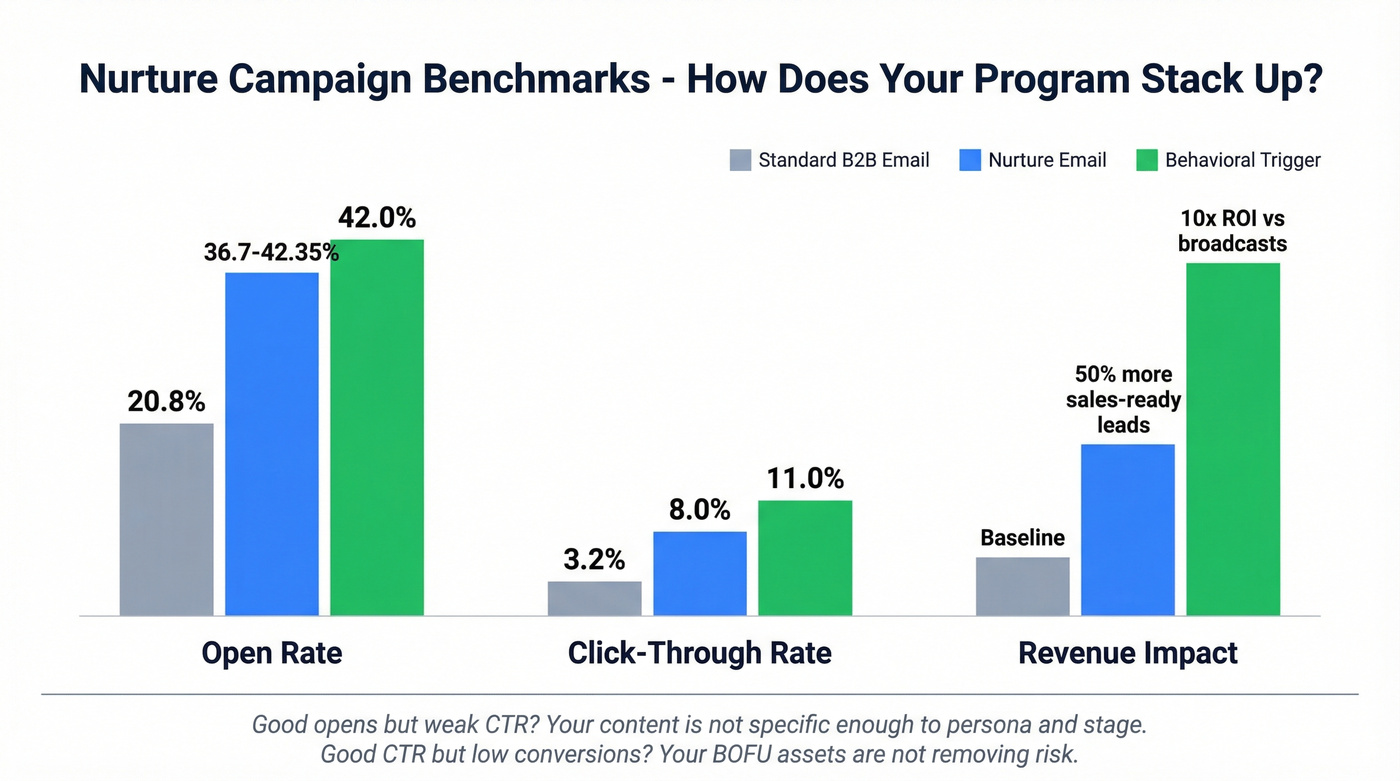
A clean baseline from VIB puts typical B2B email at 20.8% opens and 3.2% CTR. Digital Bloom's 2026 nurture research puts nurture opens at 36.7-42.35% with ~8% CTR, and behavioral triggers around ~42% opens.
| Metric | Standard B2B Email | Nurture Email | Behavioral Trigger |
|---|---|---|---|
| Open rate | 20.8% | 36.7-42.35% | ~42% |
| CTR | 3.2% | ~8% | 10-12% (top performers) |
| Revenue lift | Baseline | 50% more sales-ready leads | 10x ROI vs broadcasts |
Use this table as a diagnostic, not a vanity scoreboard. If opens are fine but CTR is weak, your content isn't specific enough to the persona and stage. If CTR is fine but conversions lag, your BOFU assets aren't removing risk.

You just built a behavioral nurture sequence. Now imagine every email bouncing because your contact data is stale. Prospeo refreshes 300M+ profiles every 7 days and delivers 98% email accuracy - so your carefully crafted Day 0 email actually reaches the inbox, not the void.
Stop nurturing dead addresses. Start with data that connects.
5 Mistakes That Kill Nurture Campaigns
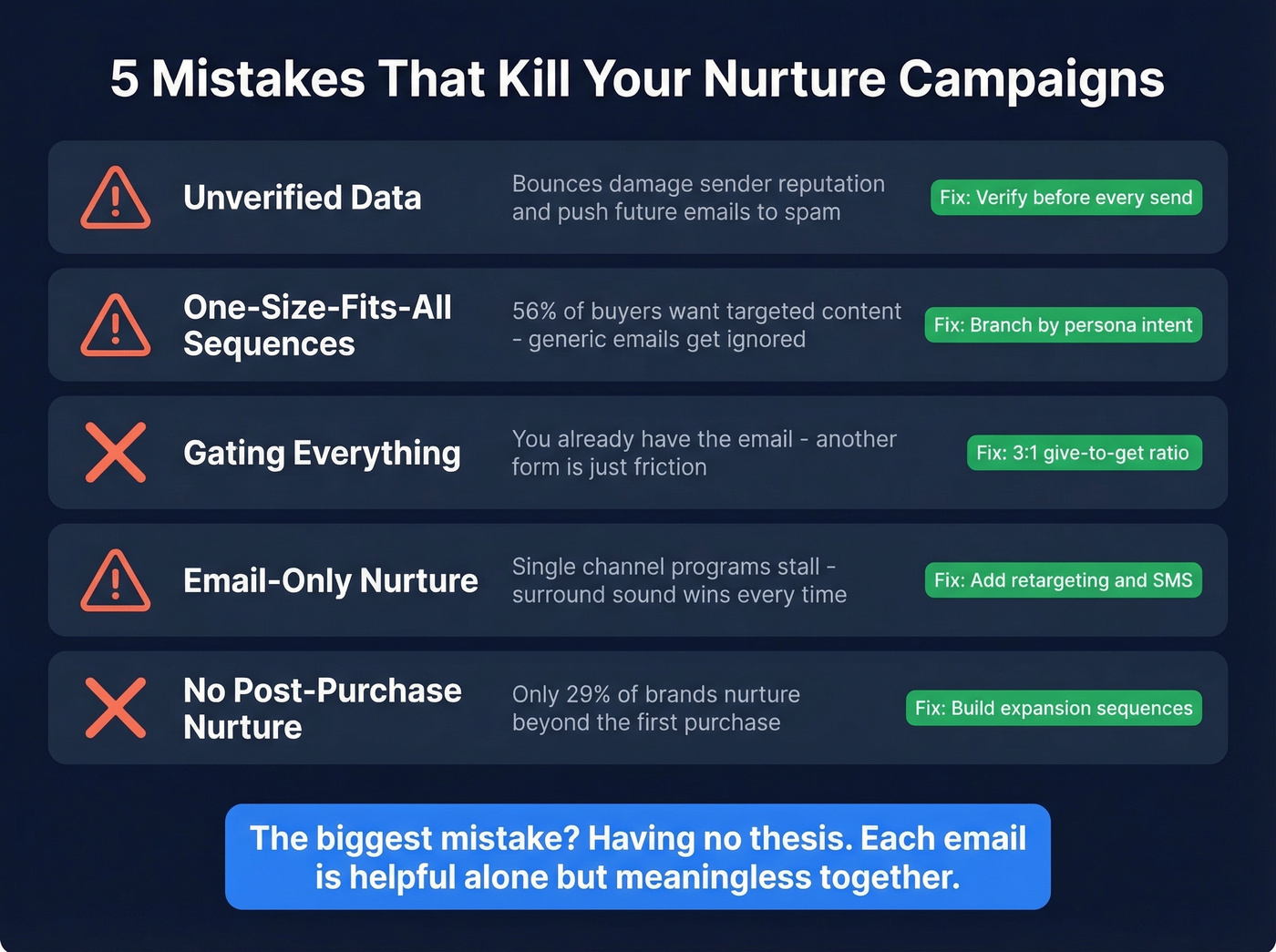
Unverified Data
Bounces don't just waste sends - they damage sender reputation, which pushes future nurture into spam. Prospeo's 5-step verification with catch-all handling and spam-trap removal catches the stuff that quietly ruins deliverability. One customer, Meritt, dropped bounce rate from 35% to under 4% after switching. Whatever tool you choose, verify first or you're building on sand.
One-Size-Fits-All Sequences
Branch when someone shows intent: pricing views, demo video watches, integration page visits. Even two branches - technical vs. economic - lift CTR because the next email feels "made for me," not "made for leads." Fifty-six percent of buyers say targeted content is the most important element of a nurture program. Give them what they're asking for.
Gating Everything
If you already have the email, forcing another form fill is just friction. Keep the 3:1 ratio: three value touches before an ask, and ungate at least one strong MOFU asset so the sequence can move faster. Save gates for truly high-intent assets like ROI calculators or implementation consults.
Email-Only Nurture
Retargeting keeps the narrative alive between emails. SMS works when it's tied to a clear trigger - "saw you checked pricing, want the 2-minute breakdown?" Direct mail is for the top slice of accounts where one deal pays for the whole program.
No Post-Purchase Nurture
Only 29% of brands nurture beyond the initial purchase, per Headley Media. That's wild, because expansion is usually the cheapest revenue you'll ever earn.

Nurturing Leads After the Sale
Most teams stop at "closed-won" and call it done. That's how churn risk hides inside "happy" accounts.
Segment post-purchase by role. Your champion gets internal enablement: slides, ROI recap, "how to sell this internally." Your power user gets workflows: templates, advanced tips, integration guides. Your executive sponsor gets outcomes: quarterly impact summaries, adoption metrics, expansion options.
Since 71% of brands don't nurture beyond the initial purchase, doing this well is an easy differentiator. I've seen teams unlock upgrades simply by sending one monthly "here's what you've achieved" email to sponsors - because it makes value visible when nobody else bothers.
The Tools You Need
Most teams have layer 1 and skip layers 2 and 3 - which is why their campaigns underperform.
Layer 1: CRM and automation. HubSpot ranges from ~$20/mo on entry tiers to ~$890+/mo for Pro, depending on contacts and features. ActiveCampaign starts around ~$29/mo. Marketo runs ~$1,000-3,000+/mo at scale.
Layer 3: Intent data. Layer buyer intent signals on top of your scoring model to prioritize in-market leads and route them into BOFU content without waiting for a demo request. Bombora-powered intent tracking across 15,000 topics is available through several platforms, and it's the fastest way to turn "quiet" leads into "ready" leads.
Branching sequences by persona only works when you have the right contacts in the first place. Prospeo gives you 30+ filters - job title, intent signals, technographics - so your VP Finance gets the ROI calculator and your Solutions Engineer gets the API docs, delivered to verified emails at $0.01 each.
Segment smarter when every contact comes with 50+ data points.
Lead Nurturing Content Strategy FAQ
How many emails should a nurture sequence have?
Most B2B nurture sequences run 5-8 emails over 14-30 days for short sales cycles. For longer cycles spanning 6-12 months, shift to monthly value emails plus trigger-based follow-ups when leads engage with specific content. Match sequence length to your buyer journey duration, not an arbitrary number.
What's a good open rate for nurture emails?
Well-built nurture sequences average 36-42% open rates - roughly double the 20.8% B2B email baseline. If you're below 30%, check your subject lines, send timing, and list hygiene. Behavioral trigger emails perform even higher, around 42% opens, because they're tied to real intent signals.
How do you know when a nurtured lead is ready for sales?
Use a lead scoring model with a defined MQL threshold, assigning points for high-intent actions like pricing page visits (+10), demo requests (+20), and case study downloads (+15). Trigger a sales handoff when the score crosses your threshold. Layer in intent data to flag active research before leads raise their hand.
What free tools help with nurture list verification?
Prospeo offers 75 free email verifications per month with its 5-step process including catch-all handling - enough to clean a pilot nurture list. HubSpot's free CRM handles basic automation. Combine both to launch a verified, automated sequence without upfront cost.