

Best Lead Nurturing Software for 2026
You built a beautiful 6-email nurture sequence. Personalized subject lines, value-driven copy, perfect timing. Then 12% of your list bounced, your domain reputation tanked, and Gmail started routing your follow-ups to spam. The nurture tool wasn't the problem - the data was.
Here's how to pick the right lead nurturing software and, just as critically, how to make sure it actually works.
Why Most Nurture Campaigns Fail
96% of website visitors aren't ready to buy. That's the whole reason nurturing exists - to stay in front of prospects until they are. And the numbers back it up: nurtured leads make 47% larger purchases, have a 23% shorter sales cycle, and companies that excel at nurturing generate 50% more sales-ready leads at 33% lower cost. No wonder 57% of marketers rank lead nurturing as the most valuable feature of their marketing automation software.
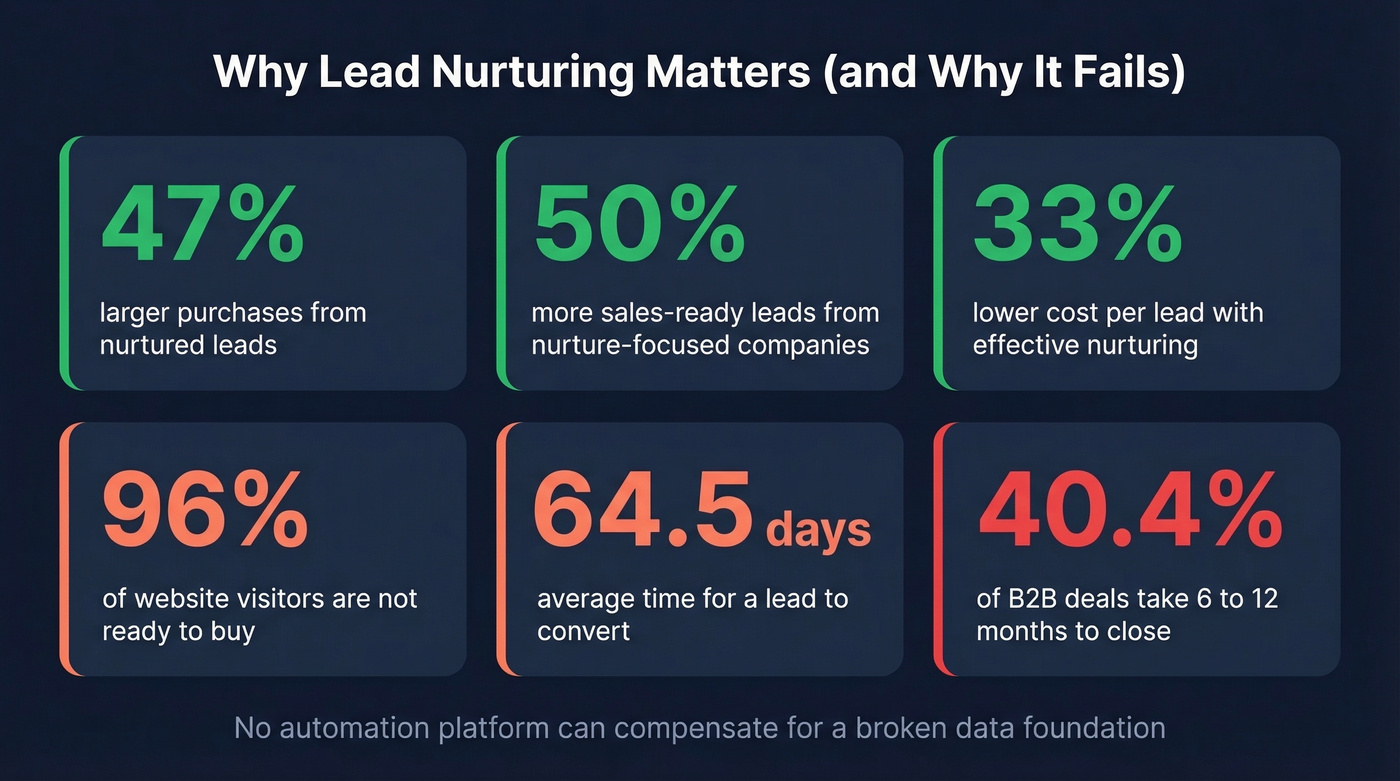
But most nurture campaigns don't work. They fail quietly - open rates decay after email two, bounce rates creep up, reps stop trusting the sequences and go back to manual outreach. The average lead takes 64.5 days to convert, and 40.4% of B2B buying processes stretch 6-12 months. That's a long time to sustain a campaign on bad data and generic messaging. No automation platform can compensate for a broken foundation.
The tools below can all run nurture sequences. The question is which one fits your team, your budget, and your patience for setup.
Our Picks (TL;DR)
| Tool | Best For | Starting Price |
|---|---|---|
| Prospeo | Verified contact data | Free (75 emails/mo) |
| HubSpot | First automated workflows | Free |
| ActiveCampaign | Behavior-triggered nurturing | $59/mo (Plus) |
Your Data Is the Bottleneck
The first follow-up email increases response rates by 220%. But that stat assumes the email actually lands. With an average B2B cold email response rate of just 7%, you can't afford to waste sends on invalid addresses.
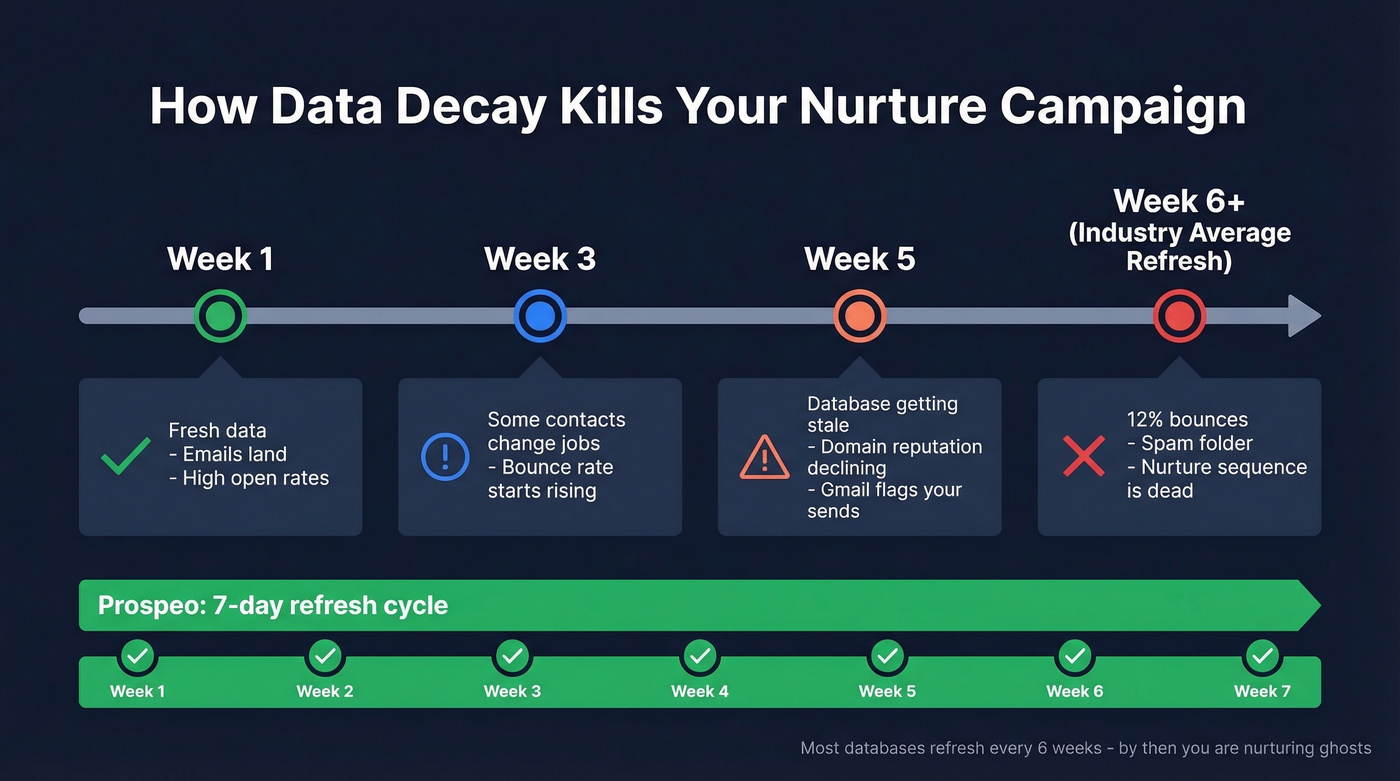
Here's the thing: data decays fast. People change jobs, companies rebrand, inboxes get deactivated. If your database refreshes every 6 weeks (the industry average), you're nurturing ghosts. The consensus on r/sales is that Apollo's credit system is confusing and full of caveats - calls, AI usage, exports, and more all eat credits differently. That frustration isn't unique to Apollo. Most lead gen tools make it hard to know what you're actually paying for.
Clean data isn't a nice-to-have. It's the foundation that makes every other tool on this list perform. Even the best email nurturing platform will underdeliver if half your list is invalid. Verify before you send, every time.

Drip vs. Nurture Campaigns
These terms get used interchangeably, but they're different.
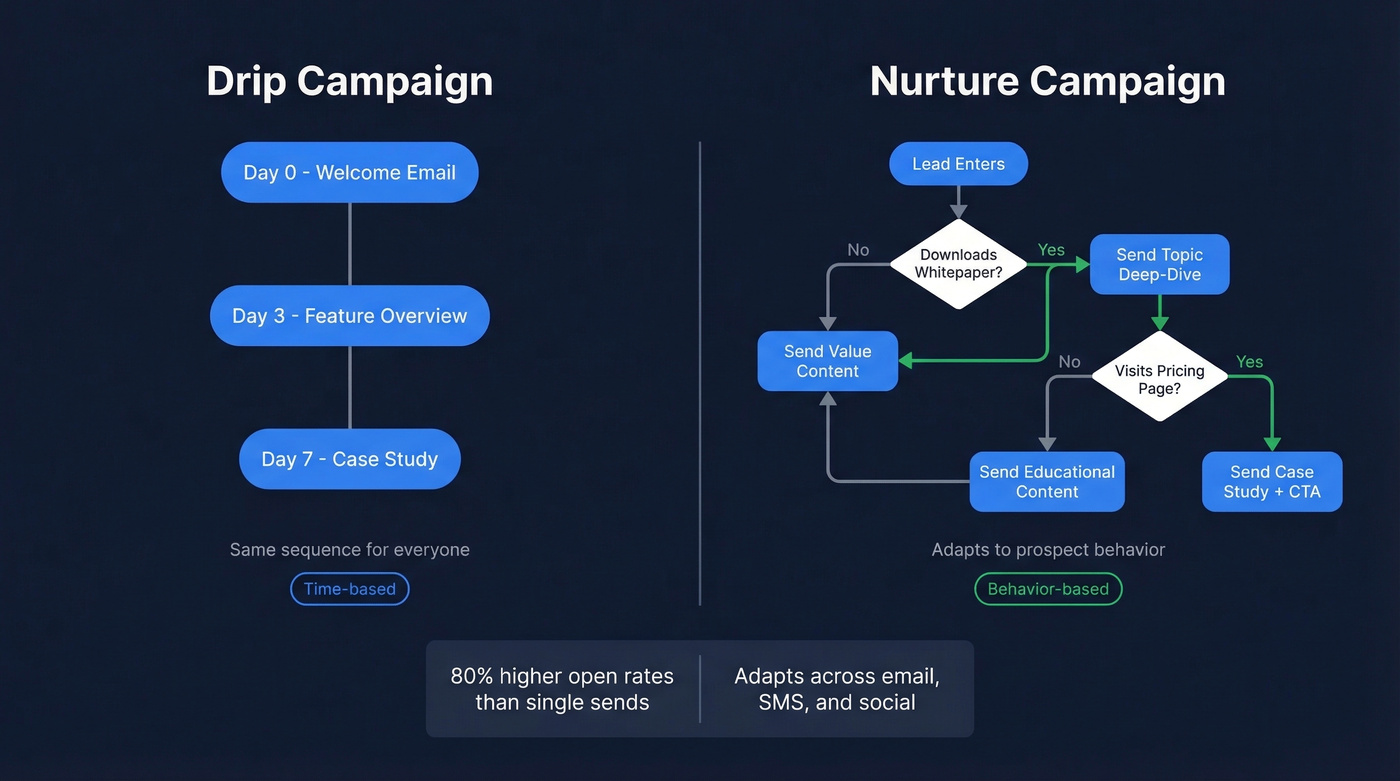
A drip campaign is time-based: Email 1 on Day 0, Email 2 on Day 3, Email 3 on Day 7. Every subscriber gets the same sequence on the same schedule. Think of it as broadcasting.
Nurture campaigns are conversations. Someone downloads a whitepaper, they get a follow-up about that topic. They visit the pricing page, they get a case study. Drip campaigns still outperform single sends - open rates run about 80% higher - but true nurture sequences adapt to what the prospect actually does. The best tools support multi-channel triggers too: email, SMS, and social touchpoints woven into a single workflow. That's where the real conversion lift comes from.

Every nurture email that bounces chips away at your domain reputation - and your pipeline. Prospeo's 7-day data refresh and 98% email accuracy mean your 6-email sequence actually reaches real inboxes, not spam folders. Meritt cut their bounce rate from 35% to under 4% and tripled pipeline to $300K/week.
Fix your data before you fix your nurture sequence.
Top 10 Nurture Tools Compared
| Tool | Best For | Starting Price | Automation Depth |
|---|---|---|---|
| Prospeo | Verified contact data ★ | Free (75 emails/mo) | Data layer (pairs with any tool) |
| HubSpot | Free starting point ★ | Free | Basic to Advanced (expensive to scale) |
| ActiveCampaign | Behavior-triggered nurturing ★ | $59/mo (Plus) | Deep |
| Pipedrive | Sales-focused teams | $14/seat/mo | Moderate (add-ons needed) |
| Keap | All-in-one automation | $249-299/mo | Deep (expensive) |
| EngageBay | Budget all-in-one | Free (250 contacts) | Moderate (gated) |
| Drip | E-commerce | $39/mo | Deep (e-commerce focus) |
| Sender | Solopreneurs | Free (2,500 subs) | Basic |
| monday CRM | Pipeline management | Free (2 seats) | Basic |
| Mailchimp | Simple newsletters | Free (500 contacts) | Basic |
★ = Editor's pick
Prospeo
Prospeo isn't a traditional nurture platform - it's the data layer that makes your automation tools actually deliver results. The platform covers 300M+ professional profiles with 98% email accuracy and a 7-day refresh cycle. That refresh cadence is the key differentiator: while most databases update every 6 weeks, Prospeo catches job changes, bounced addresses, and stale contacts before they damage your sender reputation. Its proprietary 5-step verification process includes catch-all handling, spam-trap removal, and honeypot filtering, so what you export is genuinely clean.
Meritt switched to Prospeo and watched their bounce rate drop from 35% to under 4%, tripling their pipeline from $100K to $300K per week. That's what clean data does for nurture campaigns - every email in your sequence actually reaches a human.
Best for: Teams running nurture sequences through HubSpot, Instantly, Lemlist, or any other platform who need verified contacts before they hit send.
Pair with: Any CRM or email automation tool on this list. Integrates natively with Salesforce, HubSpot, Lemlist, Instantly, and Clay.
Pricing: Free tier gives you 75 verified emails/month. Paid plans run ~$0.01/email with no contracts.

HubSpot
HubSpot is the obvious starting point if you've never run a nurture campaign. The free CRM includes core features, forms, and email - enough to build your first automated sequence without spending a dollar. It carries a 4.4/5 on G2 with over 14,500 reviews, and for good reason: the UI is intuitive, the documentation is excellent, and the ecosystem is massive.
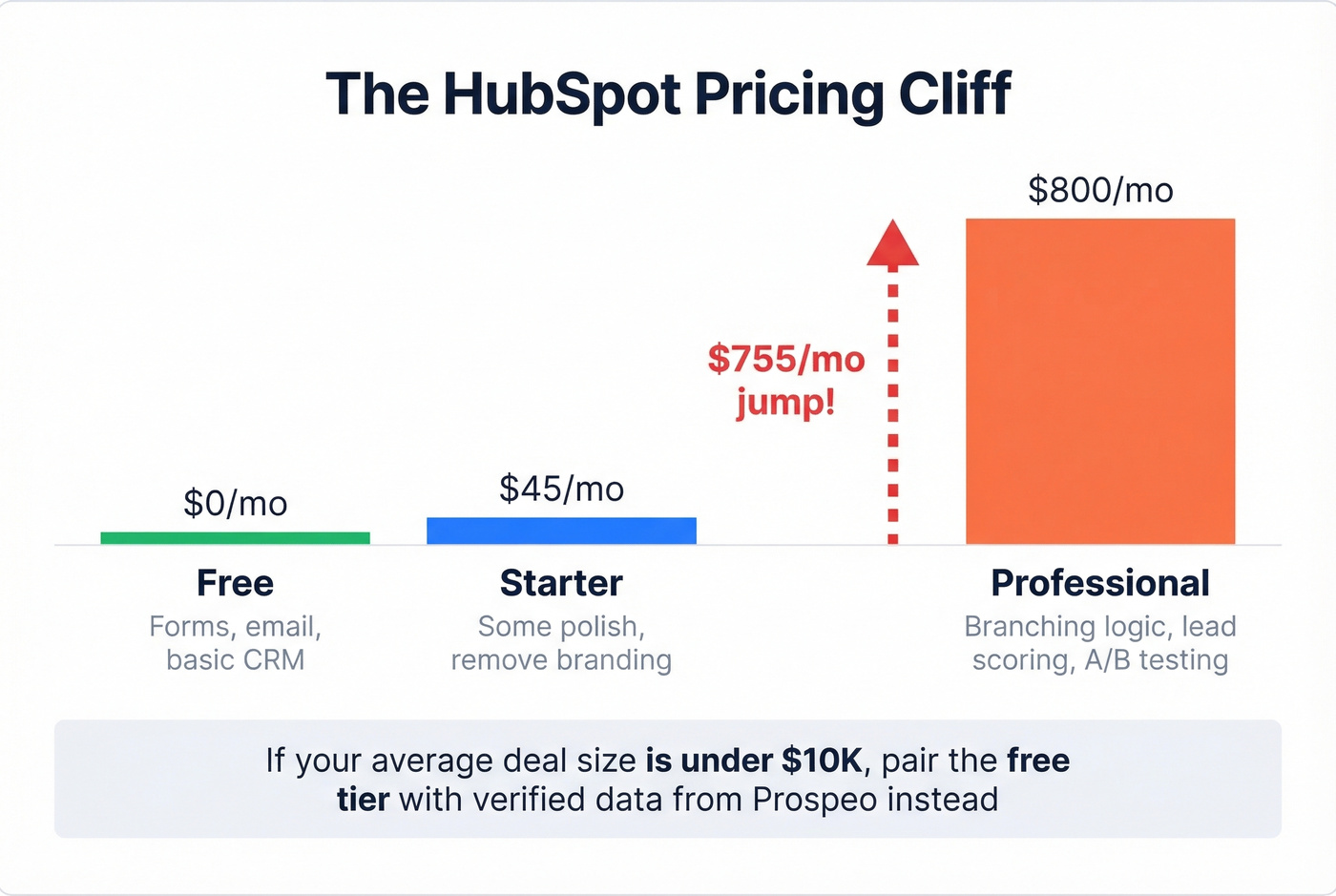
Here's the catch. The free tier gets you started, and the Starter plan at $45/mo adds some polish. But real nurture automation - branching logic, lead scoring, A/B testing - lives in the Professional tier at $800/mo. That's a $755/mo jump. We've seen teams outgrow the free tier in 3 months and then face a painful budget conversation. If your average deal size is under $10k, you probably don't need HubSpot Professional - pair the free tier with verified data and you'll get surprisingly far.
Pros: Unbeatable free tier, massive integration ecosystem, excellent onboarding resources.
Cons: The pricing cliff from Starter to Professional is brutal. You'll hit the ceiling faster than you expect.
ActiveCampaign
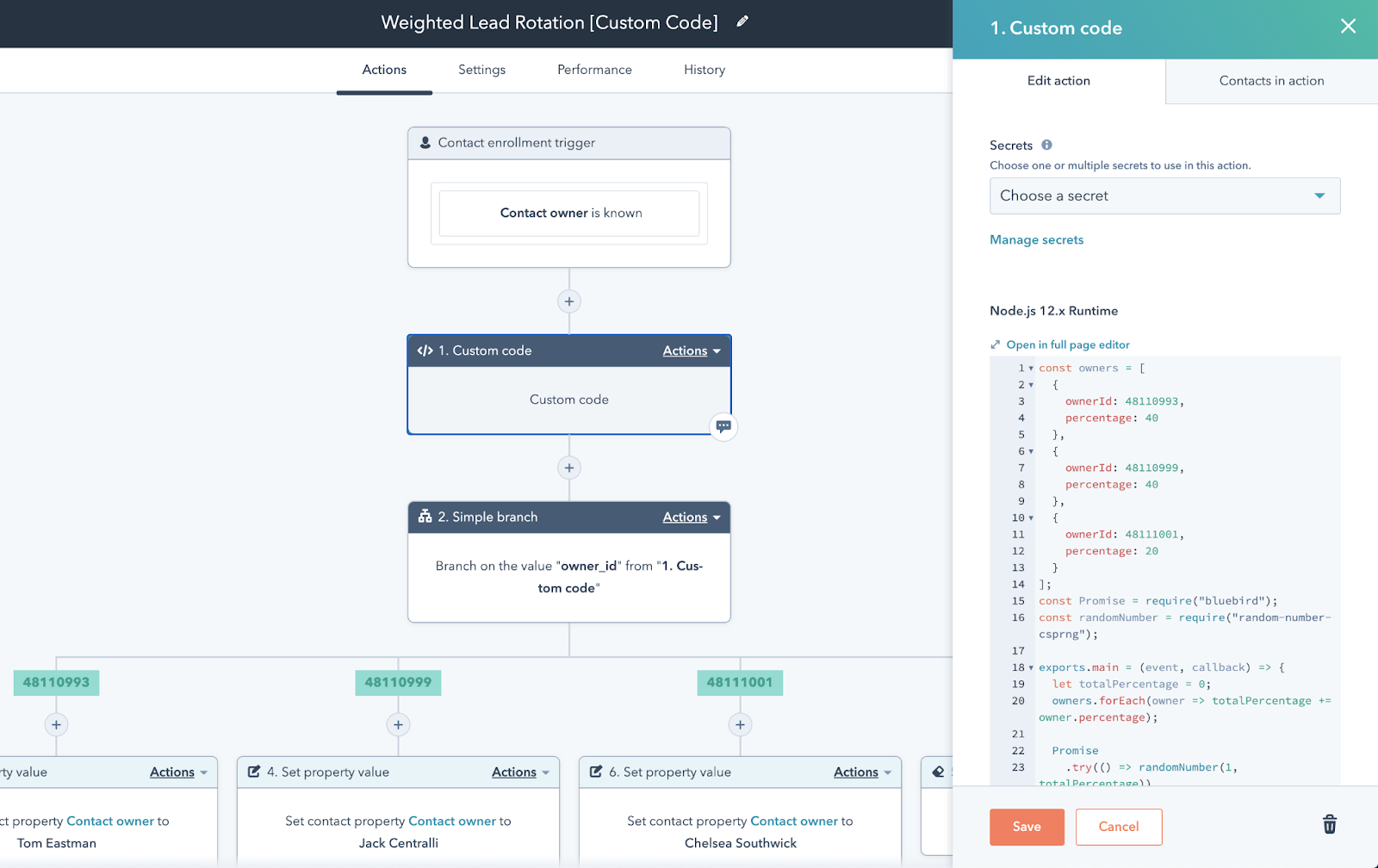
ActiveCampaign is the best pure automation engine on this list for behavior-triggered nurturing. The visual workflow builder handles complex branching, conditional logic, and multi-channel sequences that most competitors can't match at this price point. If you're evaluating email nurturing tools specifically, this is the strongest option under $200/mo.
But the Starter plan is a trap. It caps automations at 5 actions each with no conditional logic - that's an autoresponder, not a nurture engine. You need the Plus plan at minimum, which starts at $59/mo for 1,000 contacts. At 5,000 contacts, Plus runs $179/mo. At 10,000, it jumps to $239/mo.
One more thing to watch: in late 2025, ActiveCampaign started charging new users for all contacts - including unsubscribed, bounced, and unconfirmed. Your contact count and your bill grow even when people opt out. There's no free plan, just a 14-day trial capped at 100 emails.
Best for: Teams ready to invest in serious automation who'll skip straight to Plus.
Skip if: You need a free tier or you're running fewer than 1,000 contacts.
Pipedrive
Pipedrive is built for sales teams who want CRM and basic nurturing in one place. Core plans run $14-$79/seat/mo billed annually, with a LeadBooster add-on at $32.50/mo and a Campaigns add-on at $13.33/mo for email marketing. The pipeline view is excellent for tracking deal progression, and the nurture add-ons are competent if not spectacular.
The trade-off is clear: you get a great CRM with adequate nurturing bolted on, rather than a great nurture engine with a CRM attached. For sales-led teams who live in their pipeline and just need basic drip sequences, that's the right trade-off. For marketing teams running sophisticated behavior-triggered campaigns, look at ActiveCampaign instead.
Keap
Cost warning: Keap's drag-and-drop workflow builder with "when-then" logic is genuinely powerful, and the templates save real setup time. But the price tag demands attention. Keap starts at $249-299/mo, implementation services are required, and there's a $299 early termination fee. The automation is strong - the question is whether your deal sizes justify the investment.
EngageBay
A tiny team's all-in-one: CRM, email, and helpdesk in one dashboard without paying HubSpot prices. The free plan covers 250 contacts, and the Basic tier is just $12.74/user/mo. Real marketing automation is gated behind the Growth tier at $55.24/user/mo, though. At that price, ActiveCampaign Plus offers deeper automation for roughly the same money. EngageBay makes sense if you genuinely need CRM + helpdesk + email in a single tool and you're under 1,000 contacts. Otherwise, you're paying for breadth over depth.
Drip
Perfect match: E-commerce teams running Shopify or WooCommerce. Drip's integrations with those platforms are strong, and every feature is available on every plan - no tiered functionality restrictions. Starts at $39/mo for 2,500 contacts.
Wrong fit: B2B nurturing. Drip's entire architecture is built around purchase behavior, cart abandonment, and product recommendations. Trying to run a 6-month enterprise sales cycle through Drip is like using a sports car to haul lumber - technically possible, deeply unpleasant.
Sender
Generous free tier: 2,500 subscribers and 15,000 emails/month. Paid plans from $15/mo. Simple email and SMS automation that works for solopreneurs and micro-businesses. Don't expect sophisticated branching logic - this is a starter tool, and it knows it.
monday CRM
CRM-first with basic email automation bolted on. Free for 2 seats, paid from $9/seat/mo with a 3-user minimum. Solid for pipeline management, but nurturing is clearly secondary. Use it if your team already lives in monday.com for project management and you want to avoid adding another tool to the stack.
Mailchimp
Everyone knows Mailchimp, and that familiarity is its biggest asset. Free for 500 contacts, Standard plan at $20/mo. Fine for newsletters and simple drip sequences. Underpowered for behavior-triggered nurturing - if you need conditional logic and lead scoring, you'll outgrow it fast.
Mistakes That Kill Campaigns
Pressing for the sale too early. 40.4% of B2B buying processes take 6-12 months. Your third email shouldn't include a demo link.
Generic messaging. Targeting users with content relevant to their position yields 72% higher conversion rates. Segment or don't bother.
Stopping after the sale. Post-purchase nurturing drives upsells, referrals, and retention. The relationship doesn't end at closed-won.
No A/B testing. If you're not testing subject lines, send times, and CTAs, you're guessing. Guessing doesn't compound.
Sending to unverified lists. Run your list through a verification tool before launching any sequence. A 10% bounce rate will do more damage to your domain than a bad subject line ever could. No automation platform can fix deliverability problems caused by dirty data.
The best lead nurturing software in the world can't nurture a ghost. Prospeo verifies every contact through a 5-step process - catch-all handling, spam-trap removal, honeypot filtering - so your drip campaigns land where they should. At $0.01/email with no contracts, clean data costs less than a single bounced send.
Stop nurturing invalid addresses. Start with verified contacts.
A 5-Email Nurture Template
The first follow-up alone lifts response rates by 220%. Here's a cadence we've used and recommended to dozens of teams.
- Email 1 (Day 0): Personalized intro. Reference something specific - their role, a recent company milestone, a shared connection. Include one clear value proposition. No ask.
- Email 2 (Day 3): Social proof. Share a case study or customer result relevant to their industry. Keep it short and link to the full story.
- Email 3 (Day 7): Helpful resource. Send something genuinely useful - a benchmark report, a template, a tactical guide. No pitch.
- Email 4 (Day 14): Product-specific content. Now you've earned the right to talk about your solution. Tie it to the pain point from Email 1.
- Email 5 (Day 21): Breakup email with a soft CTA. "If the timing isn't right, no worries. Here's a link to book time whenever it makes sense." Breakup emails outperform aggressive closes in our experience, and the data backs it up.
How to Choose the Right Stack
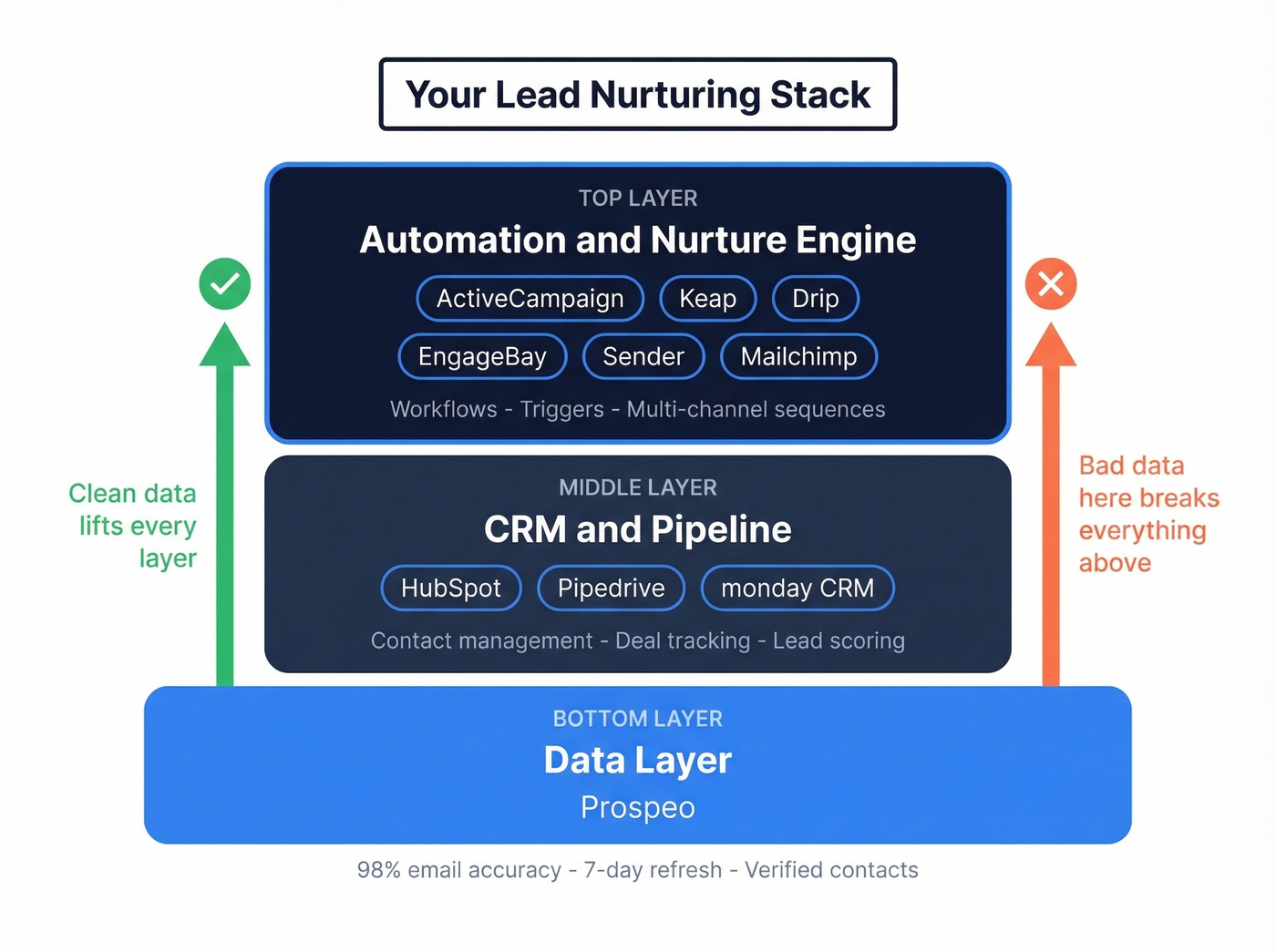
Let's be honest: you don't need a single all-in-one platform. You need a CRM, an email automation tool, and clean data. The stack matters more than any single product. Lead scoring, progressive profiling, multi-channel sequences - these are features to evaluate, not reasons to buy a platform that does everything at 60% quality.
Zero budget: HubSpot Free + Prospeo Free. You get basic workflows and 75 verified emails/month. That's enough to test whether nurturing works for your business before you commit real money.
Small team, real nurturing: ActiveCampaign Plus paired with verified data. Deep automation with clean contacts feeding it.
Sales-first team: Pipedrive + a Campaigns add-on.
E-commerce: Drip. Full stop.
Enterprise: Salesforce Pardot ($1,250+/mo) if you're already in the Salesforce ecosystem. For everyone else at that budget, the modular approach still wins.
If you're building lists to feed these workflows, start with free lead generation tools and then add data enrichment services once you have traction.
FAQ
What's the difference between drip and nurture campaigns?
Drip campaigns send emails on a fixed time schedule - every subscriber gets the same sequence. Nurture campaigns adapt based on prospect behavior like page visits, downloads, or email engagement. Both outperform single sends, but behavior-triggered nurturing drives measurably higher conversion rates because messaging matches buyer intent.
How long does nurturing take to show results?
The average lead takes 64.5 days to convert, and 40.4% of B2B buying processes stretch 6-12 months. Set a 90-day evaluation window minimum before judging whether your program is working. Expect early signals like open-rate trends and reply rates within 3-4 weeks.
What's the best free option for nurturing?
HubSpot's free CRM is the strongest zero-cost automation tool. Pair it with a free verification tier to keep your list clean, and you have a no-cost stack that can run real nurture sequences without deliverability risk.
How many emails should a nurture sequence have?
Four to five emails spread over three weeks is the standard B2B cadence. Start with a personalized intro, build trust with social proof and resources, then introduce your product. End with a low-pressure breakup email. Shorter sequences suit transactional sales; longer ones fit enterprise cycles.
Why are my nurture emails bouncing?
Unverified contact data is the most common cause - addresses decay as people change jobs and inboxes get deactivated. Use a verification tool with a short refresh cycle (7 days, not 6 weeks) to catch stale addresses before they damage your sender reputation. Verify before you send, every time.