

Lead Search: How to Find B2B Leads in 2026
A five-person RevOps team we know ran a bake-off across three lead databases last quarter. The tool with the biggest contact count bounced 31% on the first email sequence. The smallest database? Under 4% bounces and a 22% reply rate. That's the reality of lead search right now: database size is a vanity metric, and data accuracy is the one that pays your bills.
The B2B lead generation market hit $7.4 billion in 2025 and keeps climbing - yet 79% of marketing leads never convert to sales. Most of that waste traces back to targeting the wrong people with bad data.
What You Need (Quick Version)
What Lead Search Actually Means
Finding and filtering specific contacts from a database - by job title, company size, industry, tech stack, or buying signals - is the core of this process. It's one step within lead generation, which covers everything from attracting interest to qualifying and converting pipeline.
The distinction matters because most teams conflate the two. They buy a "lead gen tool" expecting it to generate demand. It doesn't. It gives you a list.
What you do with that list - the sequencing, the messaging, the multi-channel follow-up - is where conversion happens. B2B customers now engage across an average of 10 channels before making a purchase, up from five in 2016. With 91% of B2B marketers calling lead generation their top priority, the competition for attention has never been fiercer. Your prospect research is the starting point, not the finish line.
How to Find Leads Effectively
Define Your ICP First
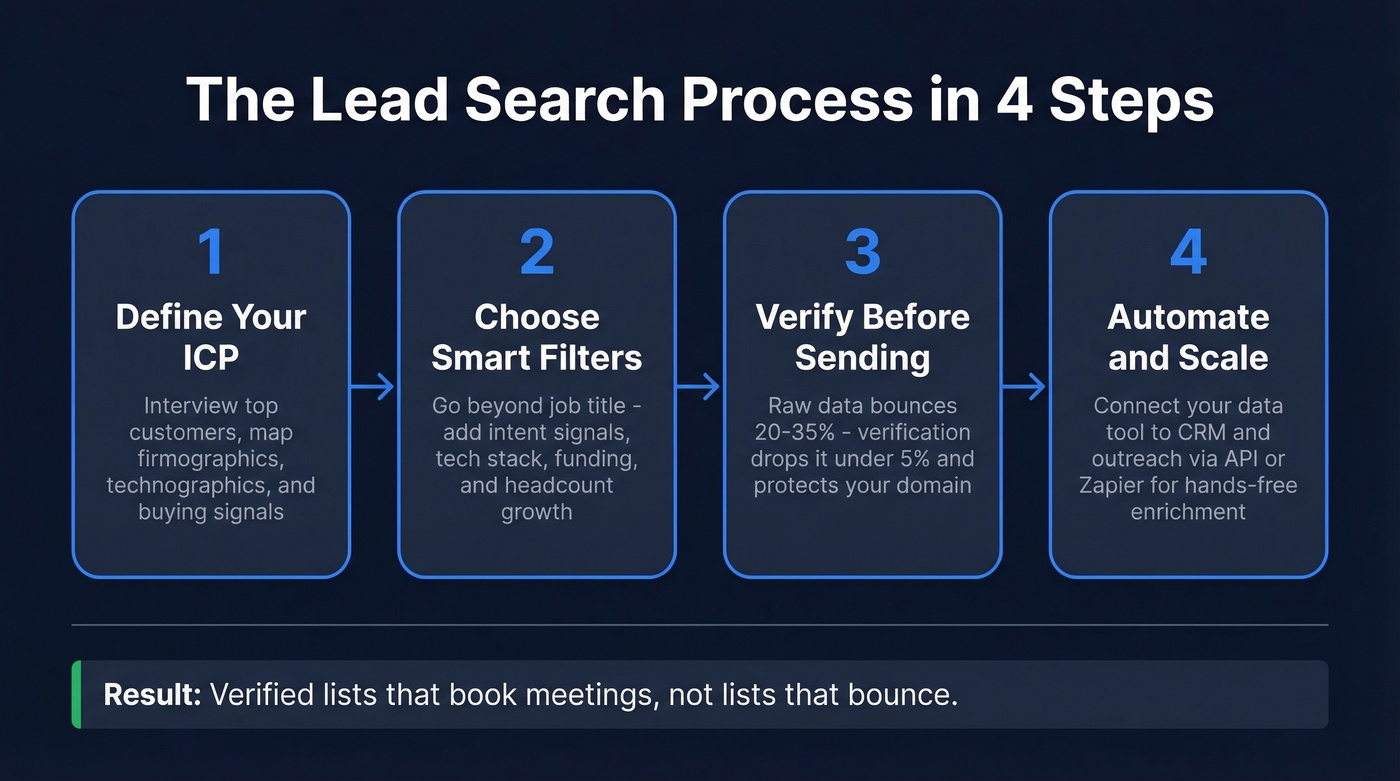
Every wasted hour in prospecting traces back to a vague ICP. "Mid-market SaaS companies" isn't an ICP - it's a category. A real ICP includes firmographics like industry, revenue band, and headcount. It includes technographics - the specific tools a company runs. And it includes buying signals: funding rounds, executive hires, hiring surges, expansion into new markets.
Here's the best method we've found: interview your top 10 customers. Not a survey - actual conversations. Ask what triggered their search, what they were using before, and what almost made them pick a competitor. Patterns emerge fast. Your best customers cluster around specific company sizes, tech stacks, and trigger events. Refresh your ICP quarterly, because the profile that worked six months ago might be pulling in the wrong accounts today.
Choose the Right Filters
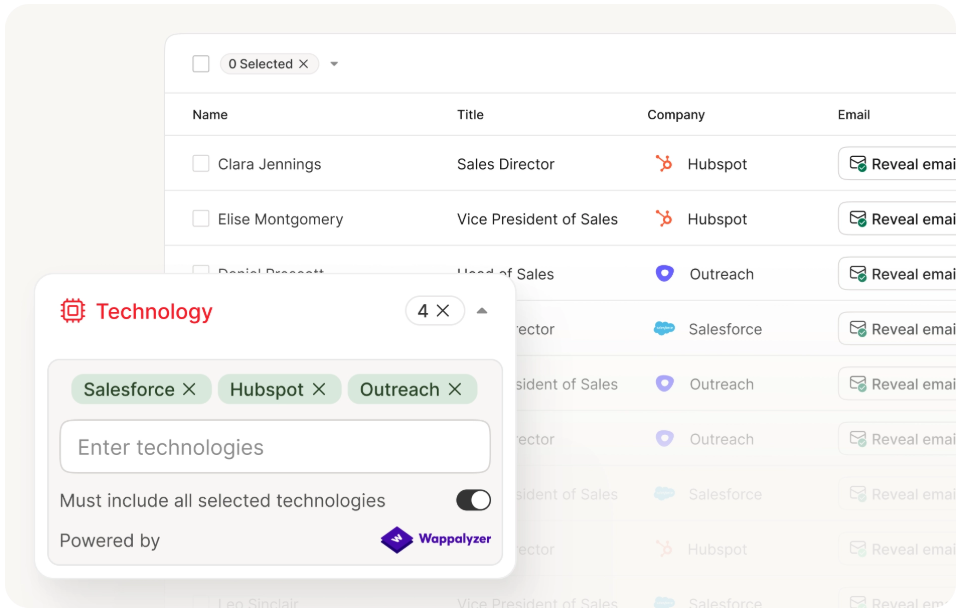
Filters are where your lead search gets surgical. The basics - job title, industry, company size - are table stakes. The filters that separate good lists from great ones are technographics showing what software a company runs, intent signals revealing whether they're actively researching your category, and growth indicators like headcount changes and recent funding.
This matters because 94% of buying groups have already ranked their preferred vendors before they ever talk to sales. If you're not filtering for companies showing active buying signals, you're cold-calling people who aren't in-market.
Verify Before You Send
Raw contact data from any database bounces at 20-35% without verification. Data decays within weeks as people change jobs, companies restructure, and email servers update. Sending unverified lists doesn't just waste sequences - it tanks your domain reputation, which takes months to rebuild.
Snyk's team saw bounce rates drop from 35-40% to under 5% after switching to verified data, which unlocked 200+ new opportunities per month from the same prospecting effort. Verification isn't optional. It's the difference between a campaign that works and one that gets your domain blacklisted.

Automate and Scale
Once your ICP, filters, and verification are dialed in, automation turns manual prospecting into a scalable system. API-based workflows let you query databases programmatically - Coresignal offers a 14-day trial with 400 credits across their 1B+ data fields if you want to experiment with the API-first approach.
The real payoff comes from connecting your data tool to your CRM and outreach stack. Add a Zapier or Make layer and you can trigger enrichment automatically when a new account enters your CRM. No manual list pulls required.

You just read that unverified lists bounce at 20-35% and torch your domain. Prospeo's 5-step verification delivers 98% email accuracy on 300M+ profiles - refreshed every 7 days, not every 6 weeks. At $0.01 per lead, bad data stops being a cost of doing business.
Run your first lead search free - 75 verified emails, no credit card.
Best Lead Search Tools Compared
| Tool | Database Size | Email Accuracy | Starting Price | Best For |
|---|---|---|---|---|
| Prospeo | 300M+ profiles | 98% | Free / from $39/mo | Accuracy-first teams |
| Apollo.io | 275M+ contacts | 65-80% | Free / $49/mo | SMB prospecting |
| ZoomInfo | 100M+ contacts | 75-85% | ~$15K/yr | Enterprise GTM |
| Cognism | 400M+ profiles | ~70-85% | ~$1K-3K/mo | EMEA compliance |
| Hunter.io | 200M+ emails | ~80% | Free / $49/mo | Email-only lookup |
| Lusha | 45M+ contacts | ~75-85% | $29/mo | Quick enrichment |
| Seamless.AI | 1B+ (claimed) | Mixed reports | Free / $147/mo | High-volume lists |
Prospeo
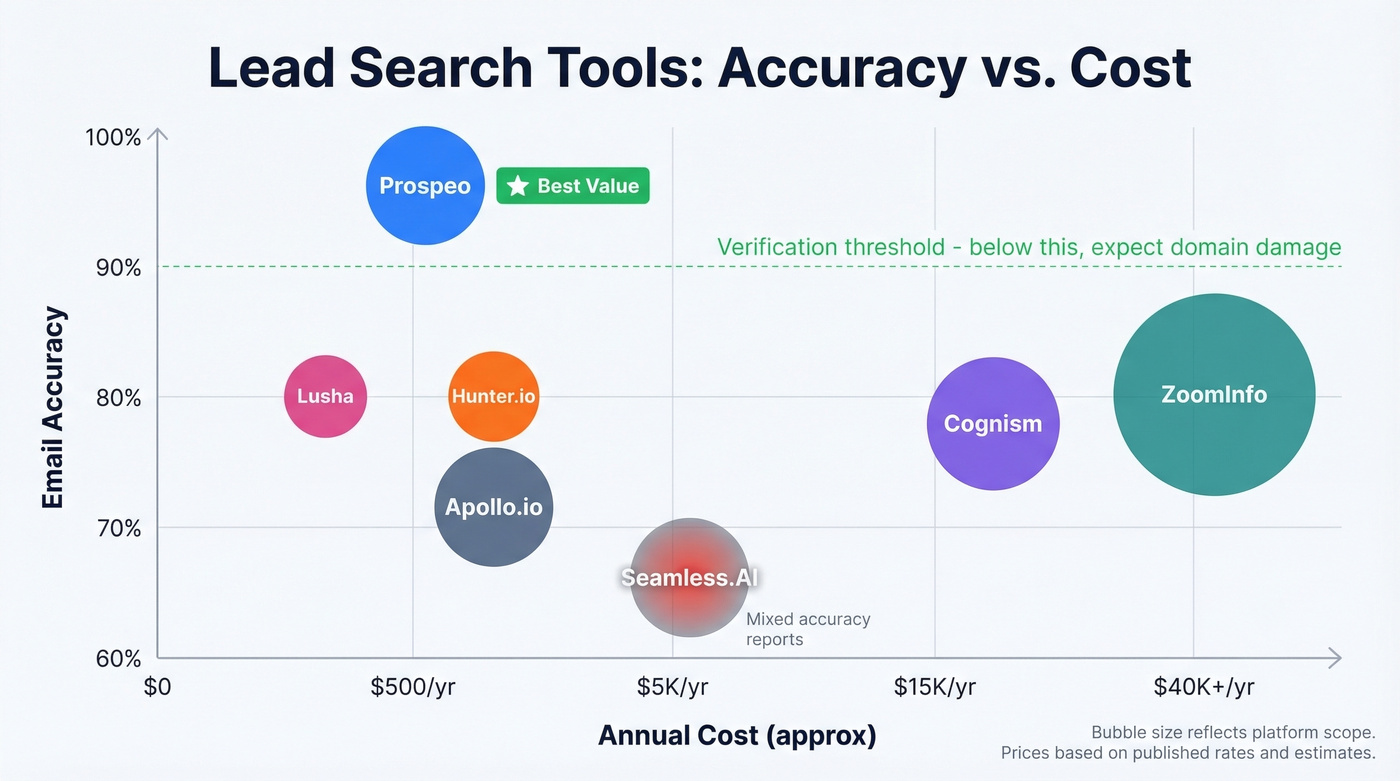
Prospeo is the accuracy play. 300M+ professional profiles, 143M+ verified emails, 125M+ verified mobile numbers - all refreshed on a 7-day cycle while the industry average sits at six weeks. The 98% email accuracy comes from a proprietary 5-step verification infrastructure that doesn't rely on third-party email providers.
The cost structure is what seals it. At roughly $0.01 per lead with a free tier of 75 emails plus 100 Chrome extension credits per month, it's 90% cheaper than ZoomInfo on a per-lead basis. Meritt tripled their pipeline from $100K to $300K per week after switching, with bounce rates dropping from 35% to under 4%. Self-serve onboarding with no contracts and GDPR compliance rounds it out.
Apollo.io
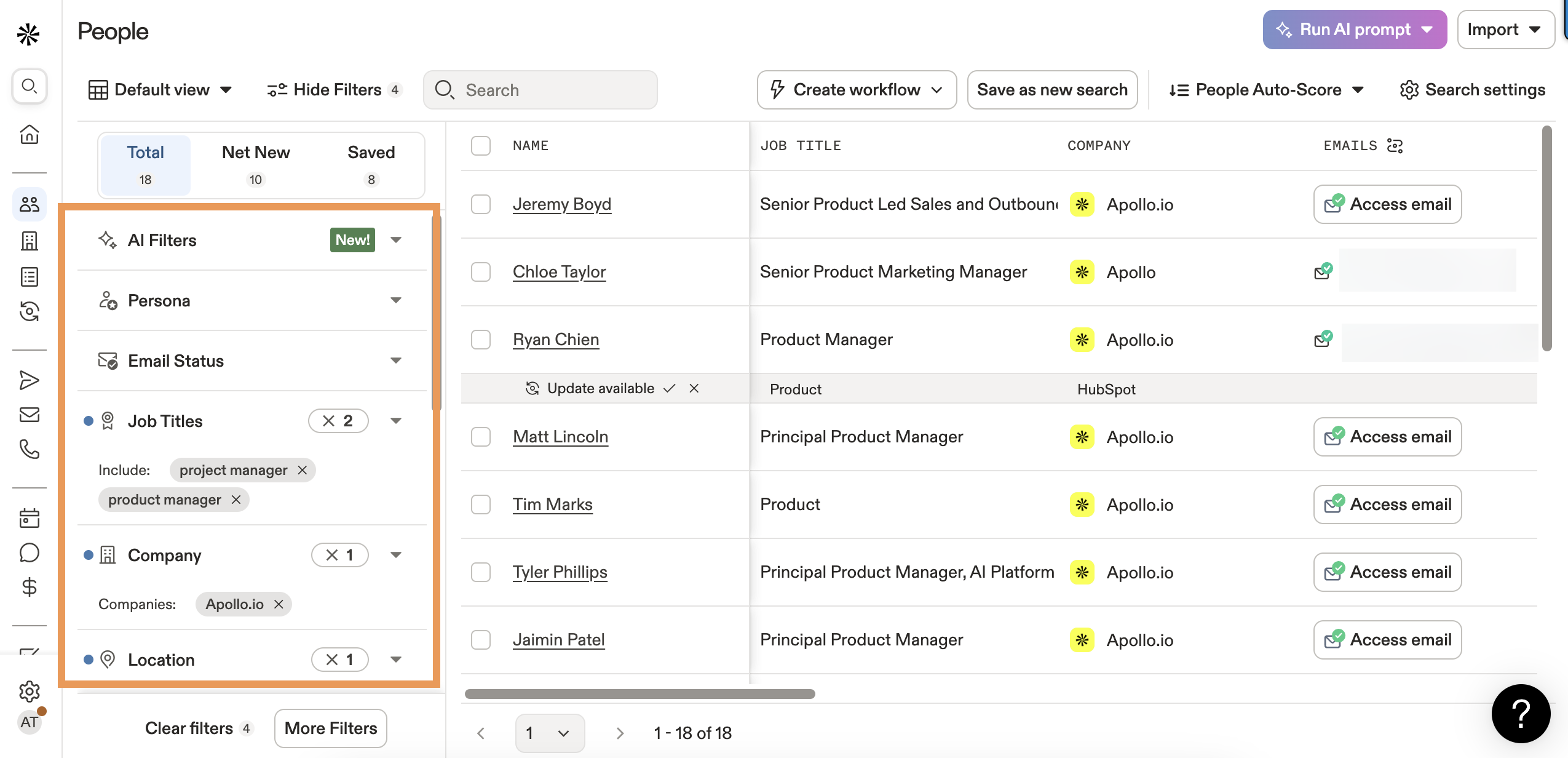
Apollo is the obvious starting point for most SMB teams. The free tier is genuinely useful - 275M+ contacts with basic search filters, and paid plans start at $49/mo per user. Professional runs $99/mo, Organization $149/mo. Month-to-month billing makes it low-risk.
The tradeoff is accuracy. Apollo's email data runs 65-80% depending on the segment. Reddit threads on r/coldemail regularly flag data freshness as a pain point. Where Apollo wins over ZoomInfo: price, speed to value, and a built-in sequencer. Where ZoomInfo wins: data quality and mobile coverage. If you're using Apollo, pair it with a dedicated email verification tool - sending unverified Apollo exports is how you burn domains.
ZoomInfo
Use this if you're a 200+ person sales org running outbound, ABM, and intent from a single platform, and you have the budget and implementation bandwidth.
Skip this if you're under 50 reps, selling deals under $15K, or you don't want to negotiate a 12-month contract with auto-renewal clauses that Reddit users on r/sales describe as "shady" and "horrifying."
ZoomInfo's database covers 100M+ contacts with 75-85% accuracy. The real value is platform breadth: intent data, website visitor tracking, conversation intelligence, and workflow automation under one roof. The real cost is also the platform breadth - a tool advertised at $99/mo can become $3,452 in year one after add-ons and fees. Mid-market contracts typically run $15K-40K+/year depending on seats and modules, and enterprise deals often hit $30K-40K+.
Let's be honest: ZoomInfo is still the best all-in-one platform. But most teams don't need all-in-one. They need accurate data and a good sequencer, which costs 90% less.
Cognism
Cognism's strength is EMEA compliance and mobile-verified data. Their 400M+ profiles focus on European markets where GDPR enforcement is strictest. If you're selling into the UK, Germany, or France, their phone-verified mobiles and compliance infrastructure give it an edge over US-centric tools. Expect $1,000-3,000/month for small teams on annual contracts. Weaker than ZoomInfo on US database depth, stronger on European data quality.
Hunter.io
A focused email-finding tool, not a full prospecting platform. Covers 200M+ emails with a clean interface and a generous free tier. Paid plans start at $49/mo. Great for one-off lookups and domain searches, but you won't find firmographic filtering, intent data, or mobile numbers here. A complement, not a replacement.
Lusha, Seamless.AI
Lusha at $29/mo with no annual commitment works for quick enrichment via browser extension. Limited filtering, 45M+ contacts - best for individuals who need fast lookups, not teams building lists at scale.
Seamless.AI claims the largest database at 1B+ contacts. Real-world accuracy reports are mixed, and the consensus on r/sales leans skeptical. Starts free, paid plans from $147/mo. Test it if volume matters more than precision.
Pricing Breakdown
| Tool | Starting Price | Notes |
|---|---|---|
| Prospeo | Free (75 emails/mo) / from $39/mo | ~$0.01/lead, no contract |
| Apollo.io | Free / $49-$149/mo | Monthly billing |
| ZoomInfo | ~$15K/yr | $30K-$40K+ enterprise, annual |
| Cognism | ~$1K-3K/mo | Annual, custom quotes |
| Hunter.io | Free / $49/mo | Email-only |
| Lusha | $29/mo | Monthly, limited filters |
| Seamless.AI | Free / $147/mo | Monthly |
| Bombora (intent) | ~$12K/yr | Add-on, not standalone |
| 6sense (intent) | ~$30K-300K+/yr | Enterprise ABM |
ICP filters only matter if the data behind them is fresh. Prospeo gives you 30+ filters - buyer intent, technographics, headcount growth, funding - across 300M+ profiles on a 7-day refresh cycle. Meritt used it to triple pipeline from $100K to $300K per week with under 4% bounces.
Stop building lists that bounce. Build lists that book meetings.
Five Mistakes That Burn Budget
1. No clear ICP. Searching without a defined ICP is like fishing without knowing what's in the lake. You'll pull contacts, but they won't convert. That 79% non-conversion rate? Most of it traces back to targeting the wrong people.
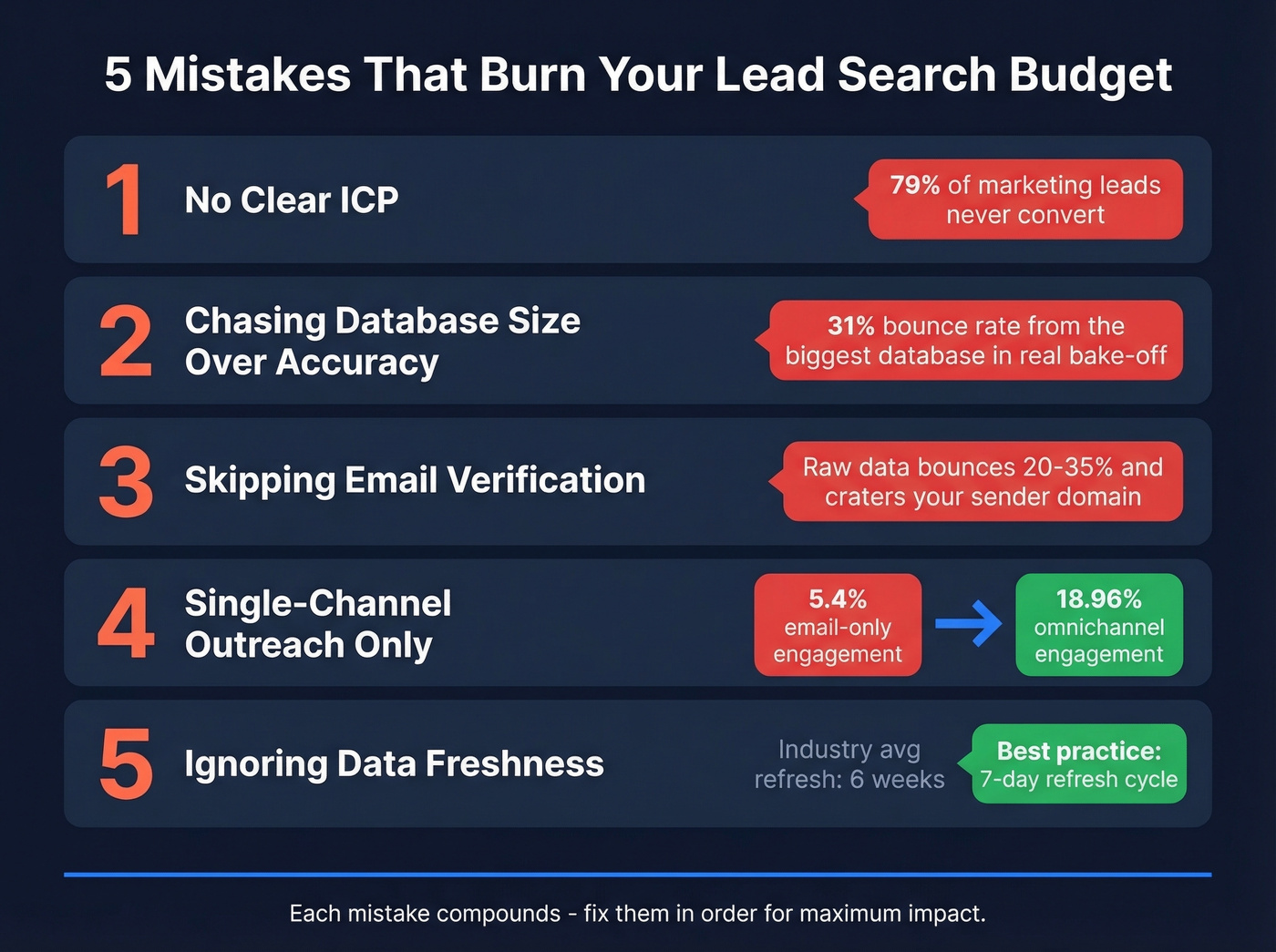
2. Chasing database size over accuracy. "450M contacts" sounds impressive until 30% bounce on your first sequence. A smaller, verified database outperforms a massive unverified one every time. We've seen this in bake-off after bake-off.
3. Skipping verification. One bad campaign can crater your sender reputation for months. This is the single most expensive shortcut in outbound.
4. Single-channel outreach. Teams running email-only see 5.4% engagement rates versus 18.96% for omnichannel sequences. Your contact data should feed email, phone, and social touches.
5. Ignoring data freshness. People change jobs. Companies restructure. A list that was accurate two months ago has already decayed significantly - tools with weekly refresh cycles outperform those refreshing every 4-6 weeks, and the gap compounds with every campaign.
The Stack We'd Build Today
If we were starting an outbound motion from scratch with a $200/month budget, here's exactly what we'd run. Prospeo for contacts and verification - the 98% email accuracy and 7-day refresh cycle mean you're not burning money on bad data. Pair it with Instantly at $37/mo or Lemlist at $69/mo for sequencing and warmup. That's under $150/month total.
Compare that to a mid-market ZoomInfo contract around $30K/year and ask yourself what you're actually getting for the extra $28,000. Stack Optimize, an outbound agency, built from $0 to $1M ARR on a similar setup - client deliverability stayed above 94%, bounce rates under 3%, zero domain flags across all clients.
The expensive tool isn't always the better tool. Your lead search strategy doesn't need a five-figure budget - it needs accurate data, tight targeting, and a verification step that protects your domain.
FAQ
What's the difference between lead search and lead generation?
Lead search is finding and filtering contacts from a database by specific criteria like title, industry, and company size. Lead generation is the broader process - attracting, qualifying, and converting those contacts into pipeline. Think of it as one step within the full funnel, focused purely on building targeted lists.
How much does a B2B lead search tool cost?
Paid plans range from $29/month for Lusha to $40,000+/year for ZoomInfo Enterprise. Most mid-market teams spend $50-$200/month total by pairing a data tool at $39/mo with a sequencer like Instantly at $37/mo - roughly $0.01 per verified contact.
How do I know if my contact data is accurate?
Check your email bounce rate after the first campaign. Under 5% means your data is solid. Over 10% means your provider's verification is weak or the data is stale. Tools with 7-day refresh cycles consistently outperform those refreshing every 4-6 weeks.
Do I need intent data for prospecting?
Not required, but it's a force multiplier. Intent data shows which companies are actively researching your category. Bombora starts at ~$12K/year standalone - overkill for small teams, but some platforms bundle it so you don't need a separate contract.
Can I find leads without paying for a tool?
Yes, but it's slow. You can manually research contacts via company websites and professional profiles. For anything beyond 50 leads per month, a free tier saves hours and delivers better data quality than manual collection.