

Lead Segmentation: Why Your Segments Fail (And How to Fix Them)
A RevOps lead we know exported 8,000 leads last quarter, built what she thought were tight segments, and launched five sequences. The bounce rate came back at 30%. Half the job titles were outdated. She didn't have a lead segmentation problem - she had a data problem disguised as a segmentation problem. That's where most teams go wrong, and it's where we're starting.
What You Need (Quick Version)
Segmenting leads is a data quality problem first, a strategy problem second. If 30%+ of your contact data is stale, your segments are fiction. Three things to get right: segment by what companies do, not just what industry they're in. Automate segment updates - static segments decay fast. And verify your data before you segment it.
What Is Lead Segmentation?
It's the process of dividing your prospect database into smaller groups based on shared characteristics so you can tailor messaging to each group instead of blasting the same email to everyone. It's not about filtering leads out. It's about grouping them in - into buckets where your messaging actually resonates.
The SDR sending the same cold email to a 5-person seed-stage startup and a 2,000-person Series D company? That's what happens without segmentation.
Why Segmentation Actually Matters
The numbers aren't subtle. A Venture Harbour case study showed segmentation driving an 89% sales uplift and a 58% increase in average order value for MusicLawContracts.com. And 77% of marketing ROI comes from segmented, targeted, and triggered campaigns - not batch-and-blast. Eight in ten companies that use market segmentation report increased sales, yet most teams still treat it as a nice-to-have.
Segmentation also determines routing, and routing determines speed-to-lead. A Blazeo 2026 survey of 573 companies found that 81.2% responding in over an hour lose leads to faster competitors. Better segments feed better routing rules, which means faster response times and more pipeline. These benefits compound - the longer your segments stay clean, the more your downstream systems improve.
80% of consumers expect a personalized experience. When your segments are clean and current, personalization just works. When they're stale, every downstream system - sequences, routing, scoring - inherits the rot.
Segmentation vs. Scoring vs. Qualification
These three get conflated constantly. They're related but distinct.
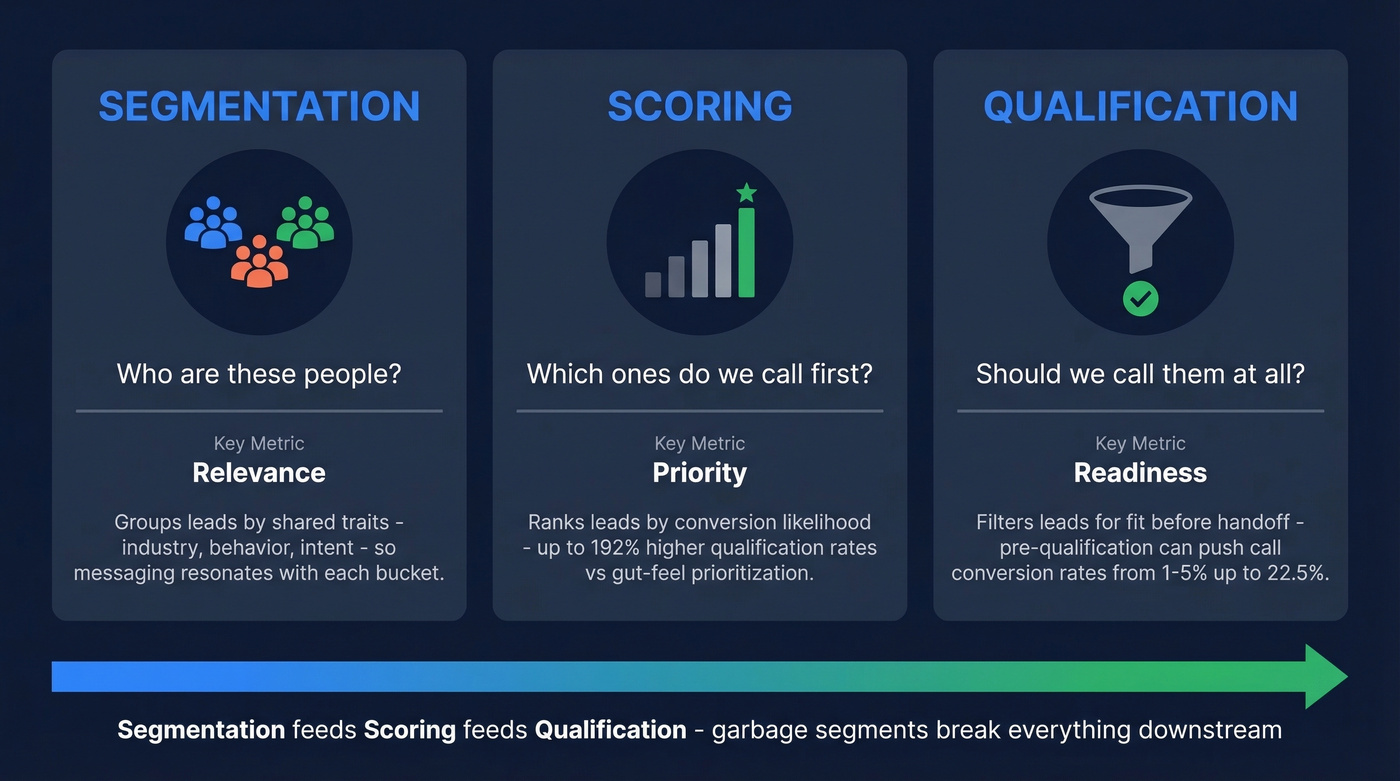
| Concept | What It Does | Key Metric |
|---|---|---|
| Segmentation | Groups leads for tailored messaging | Relevance |
| Scoring | Ranks leads by conversion likelihood | Priority |
| Qualification | Filters leads for fit before handoff | Readiness |
Segmentation asks "who are these people?" Scoring asks "which ones should we call first?" Qualification asks "should we call them at all?"
The interplay matters. Pre-qualification alone can push call conversion rates from the typical 1-5% range up to 22.5%. Lead scoring delivers up to 192% higher qualification rates compared to gut-feel prioritization. But neither works if the underlying segments are garbage. You can't score leads accurately when half your firmographic data is wrong.
Types of Lead Segmentation
Not all segmentation dimensions carry equal weight.
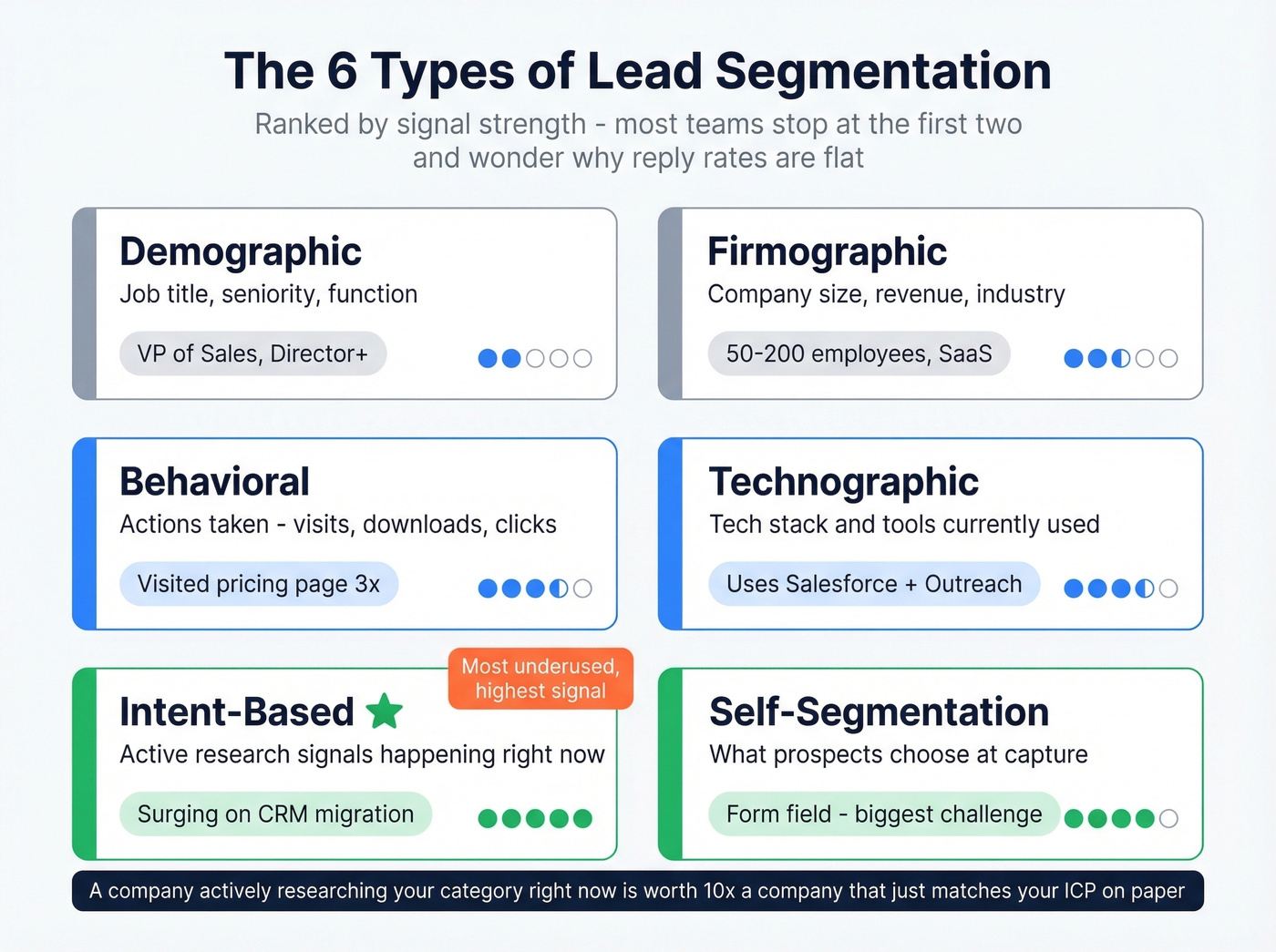
| Type | What It Groups By | Example Signal |
|---|---|---|
| Demographic | Job title, seniority, function | VP of Sales, Director+ |
| Firmographic | Company size, revenue, industry | 50-200 employees, SaaS |
| Behavioral | Actions taken (visits, downloads) | Visited pricing page 3x |
| Technographic | Tech stack and tools used | Uses Salesforce + Outreach |
| Intent-based | Active research signals | Surging on "CRM migration" |
| Self-segmentation | What prospects choose at capture | Form field: "biggest challenge" |
Intent-based segmentation is the most underused and highest-signal type. A company actively researching your category right now is worth ten companies that match your firmographic ideal customer profile but aren't in-market. Most teams stop at demographic + firmographic and wonder why reply rates are flat.
Two angles worth stealing from ABM teams: buying committee segmentation - mapping the 6-10 stakeholders involved in a B2B purchase, not just the single "decision-maker" - and self-segmentation at capture, where conditional-logic forms let prospects tell you their pain point, budget range, or use case before they ever hit your CRM. Both approaches produce segments richer than anything you'll build from third-party data alone.
For SaaS companies with a free tier, product-qualified lead segmentation deserves its own category. Dropbox famously segments by whether a user uploads a file within the first hour; HubSpot tracks whether users activate five features within two months. If you have product usage data, ignoring it is malpractice.
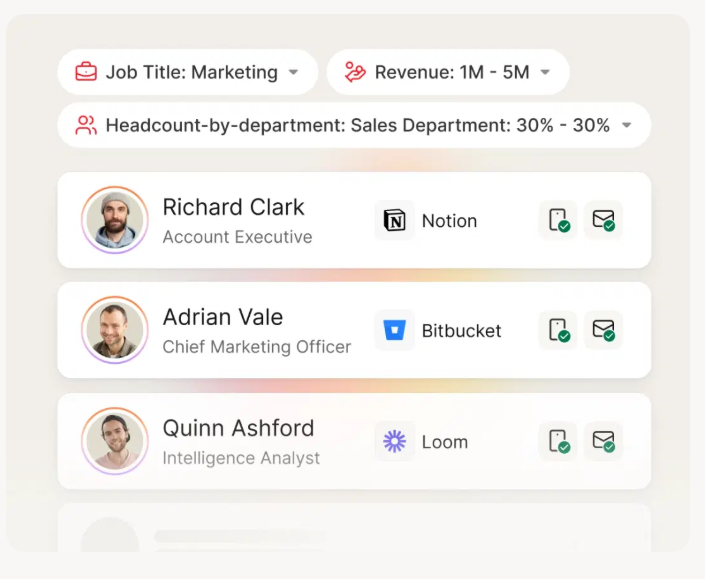

You just read why 49% of a list can be fiction. Prospeo's 7-day data refresh and 98% email accuracy mean your segments are built on verified reality - not stale job titles and dead emails. Layer in intent data across 15,000 topics and 30+ filters to build segments that actually convert.
Stop segmenting garbage. Start with data you can trust.
How Practitioners Actually Segment Leads
The consensus on r/sales is blunt: "industry + company size is not a segment - it's a spreadsheet filter." And they're right. We've seen teams build elaborate ICP documents that boil down to "B2B SaaS, 50-500 employees, North America" and call it segmentation. That's a TAM filter, not a segment.
The practitioners who get results focus on three signals:
- What the company says about itself. The homepage never lies. How a company positions itself tells you more than any industry tag in a database.
- What functional problem they solve. Not their industry - their function. A "fintech" company and a "payments infrastructure" company need completely different messaging even though they'd share a SIC code.
- Where the revenue comes from. A company making 80% of revenue from enterprise contracts behaves differently than one running on self-serve PLG, even if they're the same size.
This works until your list hits about 5,000 companies. That's when manual classification stops scaling and AI becomes the only viable option.
But AI segmentation requires rules, not vibes. Give your model two-sentence segment definitions, explicit tiebreakers (because every company "does three things"), and a clear exclusions list - agencies, consultancies, B2C companies, anything that doesn't fit. With those guardrails, AI classification becomes remarkably consistent.
Data Quality: The Real Prerequisite
Let's run the math. You export 8,000 leads from your database. 2,400 emails bounce. 1,500 have outdated job titles. That's 49% of your list that's fiction - and every segment built on that data inherits the problem. Your "VP of Engineering at Series B SaaS" segment is actually "mix of VPs, former VPs, and people who left that company eight months ago."
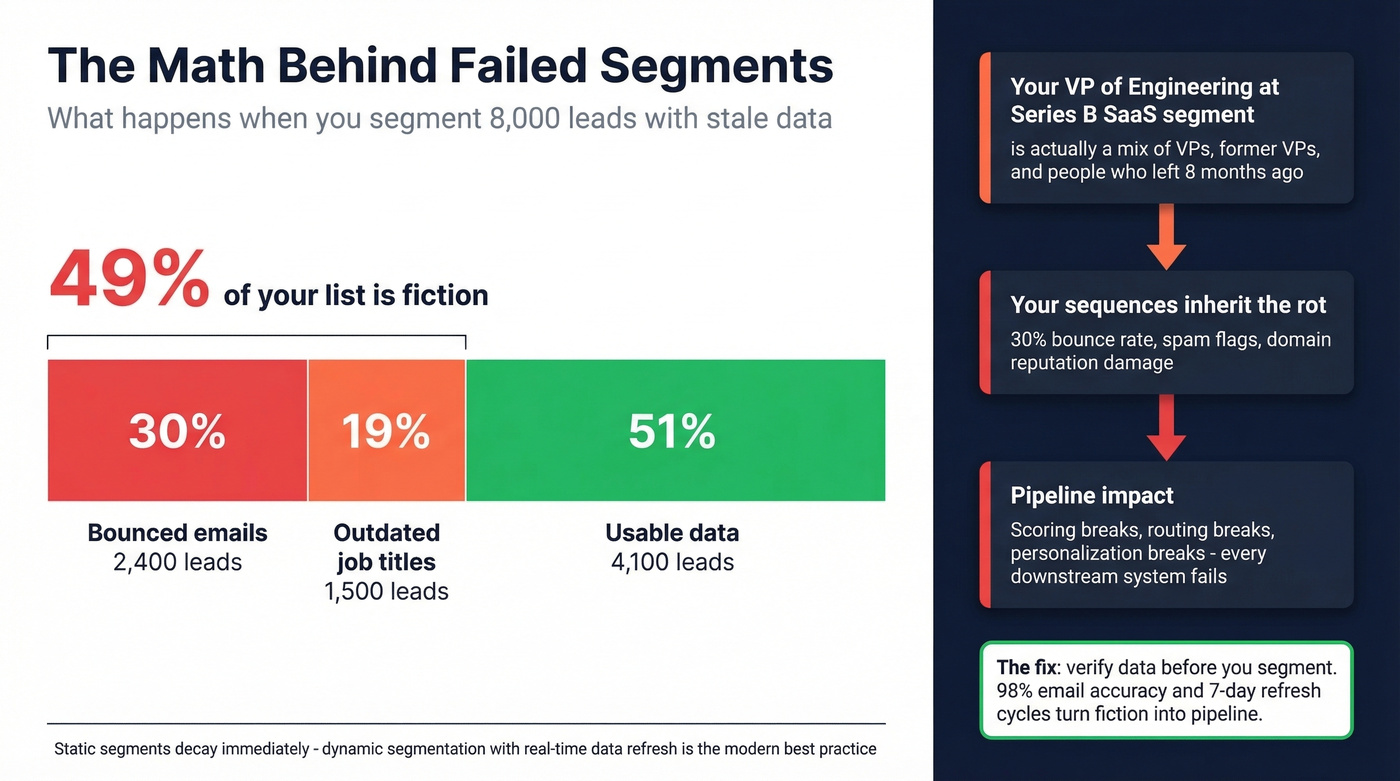
Static segments make this worse. You build them once, they decay immediately. Dynamic segmentation - where records update based on real-time behavioral triggers and refreshed data - is the modern best practice.
Here's the thing: if your average deal size is under $30k and your bounce rate is above 10%, stop tweaking your segments and fix your data. No amount of clever segmentation logic rescues a list where half the emails are dead. This is the layer where Prospeo fits - emails verified in real time at 98% accuracy, records refreshed every 7 days, and 30+ search filters including intent data, technographics, and job changes so your lists arrive pre-segmented with data you can actually trust.

Mistakes That Kill Conversions
Five mistakes we see repeatedly:
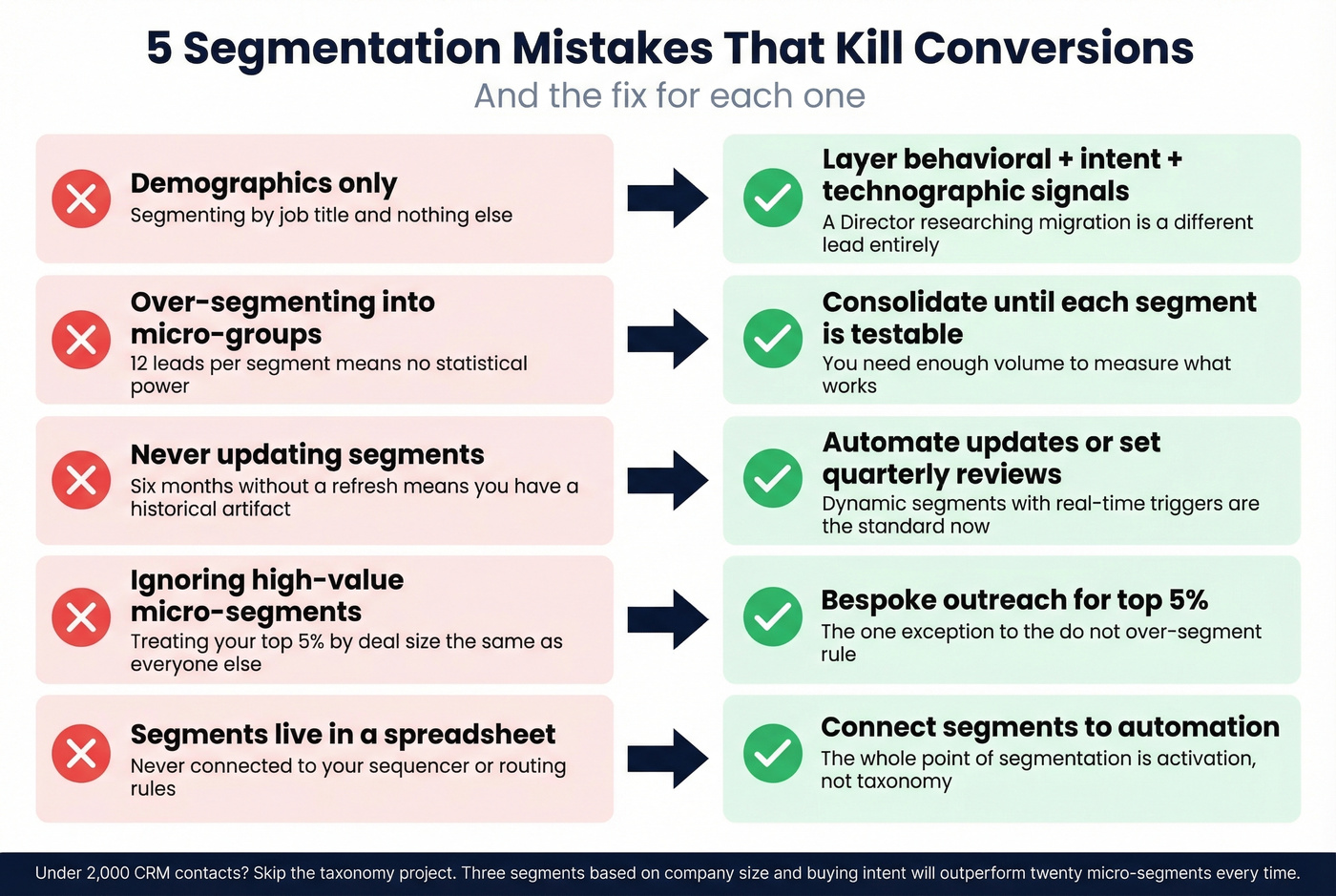
Relying only on demographics. Layer in behavioral signals, technographics, and intent data. A Director of Marketing using HubSpot who's researching "marketing automation migration" is a fundamentally different lead than one with no tech stack signals.
Over-segmenting into micro-groups. If each segment has 12 leads, you can't run statistically meaningful campaigns. Consolidate until each segment is large enough to test against.
Never updating segments. If you haven't refreshed in six months, you don't have segments - you have a historical artifact. Automate updates or set a quarterly review cadence at minimum.
Ignoring high-value micro-segments. Identify your top 5% by deal size or lifetime value and treat them as a distinct segment with bespoke outreach. This is the one exception to the "don't over-segment" rule.
Not connecting segmentation to automation. Segments that live in a spreadsheet and never feed your sequencer or routing rules are academic exercises. The whole point is activation.
Skip the first three months of "building the perfect segment taxonomy" if your CRM has fewer than 2,000 contacts. At that scale, three segments based on company size and buying intent will outperform twenty micro-segments every time.
Best Tools for Lead Segmentation
You don't need ten tools. You need a CRM, an automation platform, and a data source you trust.
| Tool | Best For | Starting Price | Key Feature |
|---|---|---|---|
| Prospeo | Pre-segmented verified lists | Free (75 emails/mo); ~$0.01/email | 30+ filters, 98% accuracy, 7-day refresh |
| HubSpot | All-in-one CRM + segmentation | Free CRM; paid from ~$20/mo | Dynamic lists + lead scoring |
| ActiveCampaign | SMB marketing automation | From ~$29/mo | Behavioral triggers |
| UpLead | B2B prospect filtering | From $99/mo | Intent data + filtering |
| Klaviyo | eCommerce segmentation | From $20/mo | Real-time AI segments |
| Amplitude | Product analytics cohorts | From $49/mo (annual) | Behavioral cohort analysis |
Prospeo is the data layer underneath this stack. With 300M+ professional profiles, 143M+ verified emails, and intent data tracking 15,000 topics, the 30+ search filters - buyer intent, technographics, job changes, headcount growth, funding signals - let you build lists that are already segmented by the criteria that matter before anything hits your CRM. Segmentation built on bounced emails isn't segmentation. It's waste.

Intent-based segmentation is the highest-signal type - but only if you have the data. Prospeo tracks 15,000 intent topics via Bombora and pairs them with firmographic, technographic, and job-change signals across 300M+ profiles. That's segments built on what companies do right now, not what they did last quarter.
Segment by real buying signals for $0.01 per verified email.
GDPR, CCPA, and Compliance
Segmentation requires personal data, which means compliance isn't optional. GDPR fines run up to EUR 20M or 4% of global turnover - whichever is higher. CCPA penalties hit $7,500 per intentional violation. And 81% of consumers believe how a company treats personal data reflects how it respects customers.
Your compliance checklist: collect data with proper consent or legitimate interest basis. Enforce opt-outs immediately. Practice data minimization - don't collect fields you won't use for segmentation. Audit your segments quarterly for stale records and compliance gaps.
FAQ
What's the difference between lead segmentation and customer segmentation?
Lead segmentation groups prospects before they buy so you can tailor outreach and move them through the funnel. Customer segmentation groups existing buyers for retention, upsell, and support. The criteria overlap - firmographics, behavior, value - but the goals are fundamentally different.
How often should I update my segments?
Dynamic segmentation that updates in real time based on behavioral triggers is the 2026 standard. At minimum, refresh quarterly. Static segments decay fast as people change jobs, companies grow, and buying intent shifts.
What tools do I need to start segmenting leads?
A CRM like HubSpot or Salesforce, a marketing automation platform like ActiveCampaign, and a verified data source for clean, pre-filtered contact data. Three tools, not ten - and the data layer matters most because bad inputs poison every segment downstream.
Can small teams benefit from lead segmentation?
Yes - even a two-person sales team sees results. Start with three segments based on company size and buying intent rather than building twenty micro-segments. You don't need enterprise budgets to pull pre-segmented, verified lists and start testing messaging against each group.