

Lead Sourcing vs Lead Generation in 2026: Definitions, Benchmarks, and When to Use Each
Your SDR manager just told the team to source 50 leads by Friday. Half the reps opened a browser and started guessing at email addresses. The other half asked marketing where the inbound leads are. Both groups are frustrated, and neither is wrong - they're talking about two different motions.
Here's the thing: most definitions of lead sourcing vs lead generation stop at the dictionary level. We're going further - with the math, the benchmarks, and a framework for deciding which approach actually deserves your budget.
The Quick Version
Lead sourcing means you go find them. You're diving into the water and grabbing the fish. Lead generation means they come to you. You're fishing with bait and waiting for a bite.
New market or zero traction? Source aggressively. Established brand with a content engine? Lean into generation. Mature GTM team? Run both.
In our experience, teams that source first and build inbound in parallel hit quota two to three months faster than those who wait for content to compound.
What Each Term Actually Means
Lead sourcing is the act of actively identifying prospects who fit your ICP and collecting their contact data. You're building a list - pulling names from databases, scraping event attendee lists, researching companies manually. It's sales-led, proactive, and measured in leads per day.
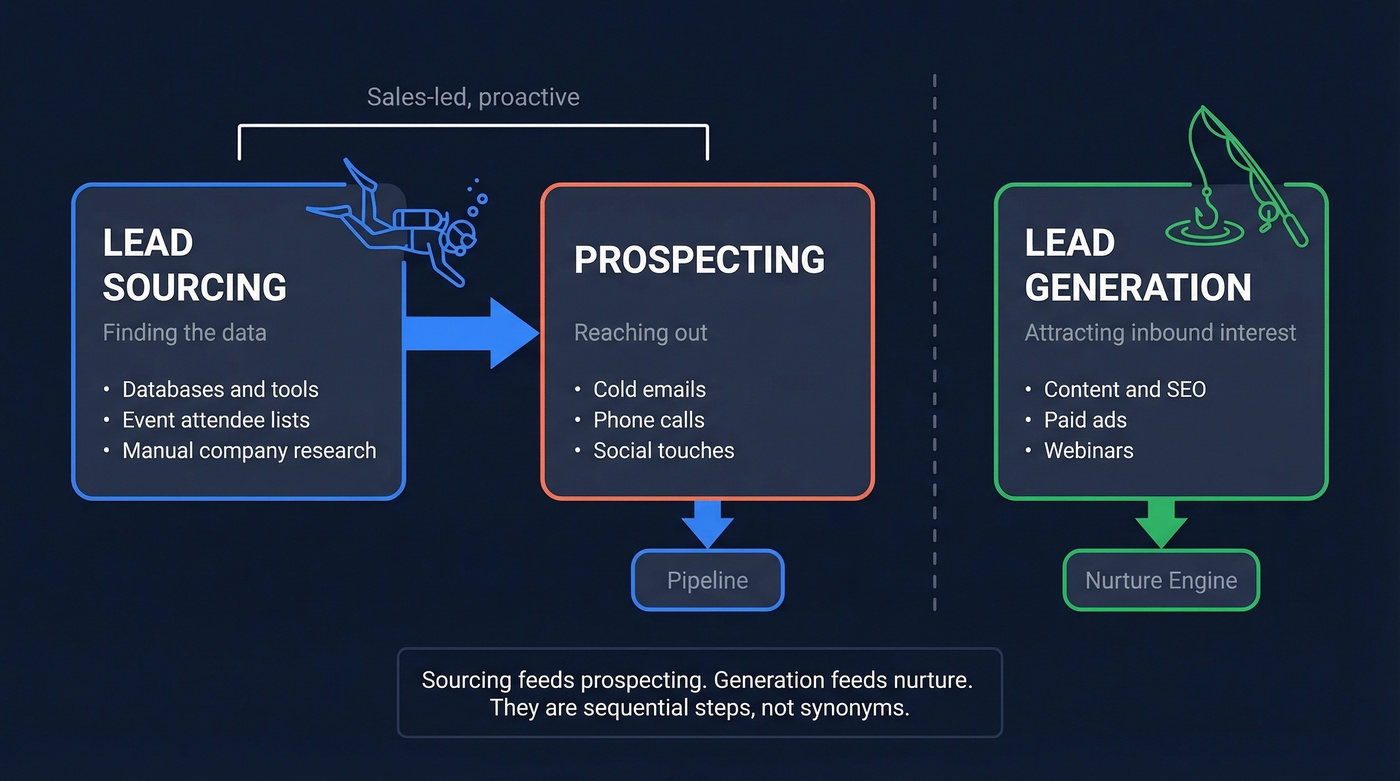
Lead generation is the broader motion of attracting potential buyers to you. Content marketing, SEO, paid ads, webinars - anything that gets a prospect to raise their hand and submit their info. It's typically marketing-led, one-to-many, and measured in MQLs and conversion rates.
There's a third term that trips people up: prospecting. Here's the clean separation. Sourcing is finding the data. Prospecting is reaching out - the cold emails, the calls, the social touches. Generation is attracting inbound interest. Sourcing feeds prospecting; generation feeds your nurture engine. They're sequential steps, not synonyms.
The best analogy I've heard: lead generation is fishing with bait, lead sourcing is diving into the water and grabbing the fish yourself. One requires patience and a good spot. The other requires a wetsuit and a target.
One more distinction worth knowing: "traffic source" (the channel that drove the visit) isn't the same as "lead source" (where you actually captured the contact info). Conflating these creates attribution chaos, and it happens constantly.
Key Differences at a Glance
| Dimension | Lead Sourcing | Lead Generation |
|---|---|---|
| Ownership | Sales / SDR | Marketing |
| Primary tactics | Databases, events, manual research | Content, SEO, ads, webinars |
| Funnel stage | Top-of-funnel targeting | Top-of-funnel attraction |
| Key metric | Leads/day, reply rate | MQLs, conversion rate, CPL |
| Time to impact | Days to weeks | Months to compound |
| Cost structure | Per-lead / tool cost | Content + ad spend |
| Tools | Prospeo, Apollo, ZoomInfo | HubSpot, ActiveCampaign, Google Ads |
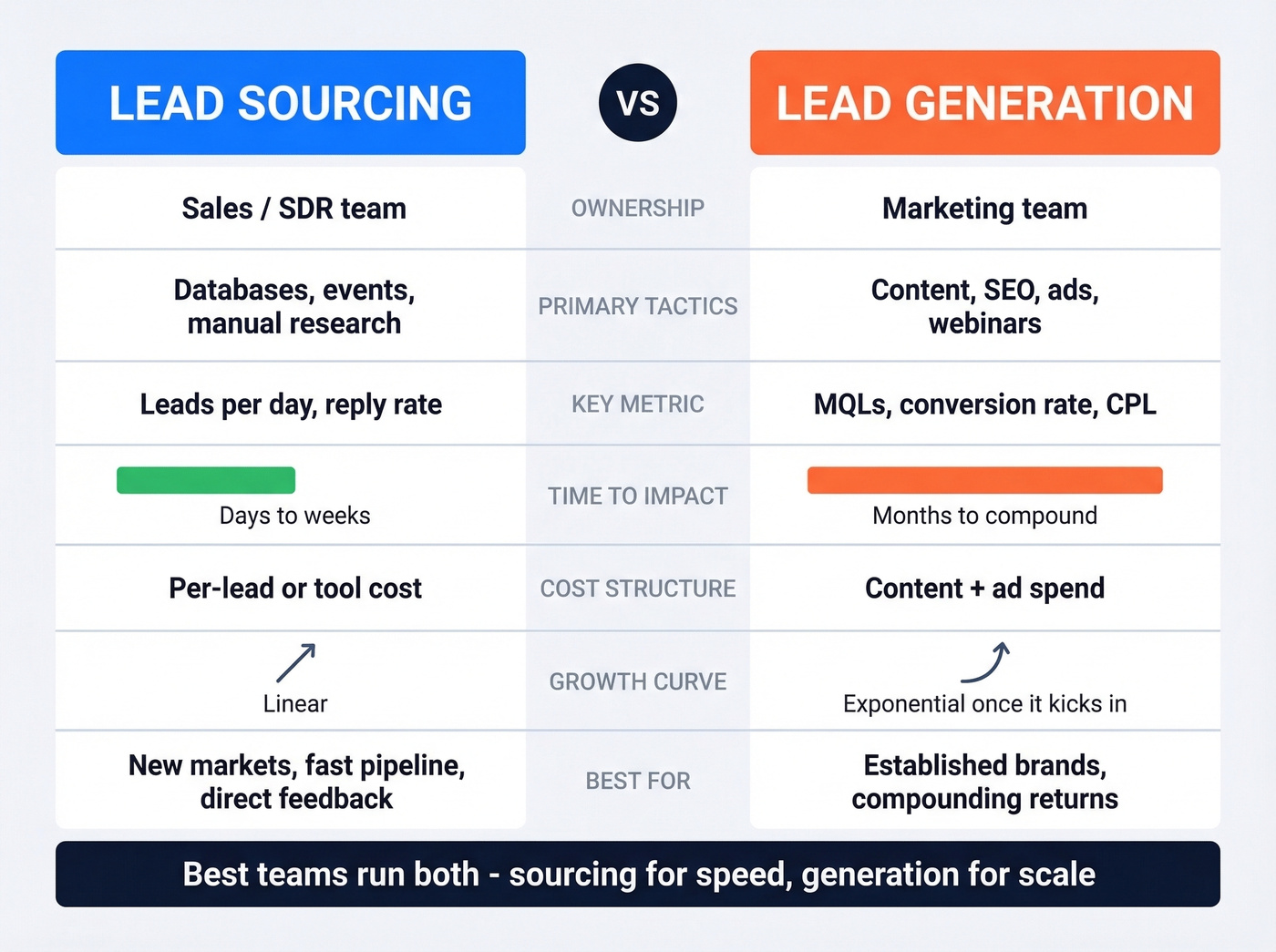
The biggest practical difference is time to impact. A rep can source 20 leads today and email them tomorrow. A blog post you publish today might not generate a single inbound lead for three months. That's not a knock on content - it's the compounding curve. Sourcing is linear; generation is exponential once it kicks in.

The article says sourcing 20 leads takes 80-100 minutes at 4-5 min each. Prospeo's 30+ ICP filters - intent data, technographics, funding, headcount growth - cut that to minutes. 300M+ profiles, 98% verified emails, and a 7-day refresh cycle so your lists never go stale.
Source your first 75 leads free and email them tomorrow.
The Numbers Behind Each Approach
Cold email reply rates run 3-8.5% for most teams, with top performers hitting 15-25% through tight ICP targeting and real personalization. Cold calling takes roughly 18 dials to reach a live person, and about 2% of those calls convert into meetings. Modern B2B deals involve around 266 touchpoints and roughly 2,879 impressions from first contact to closed-won.
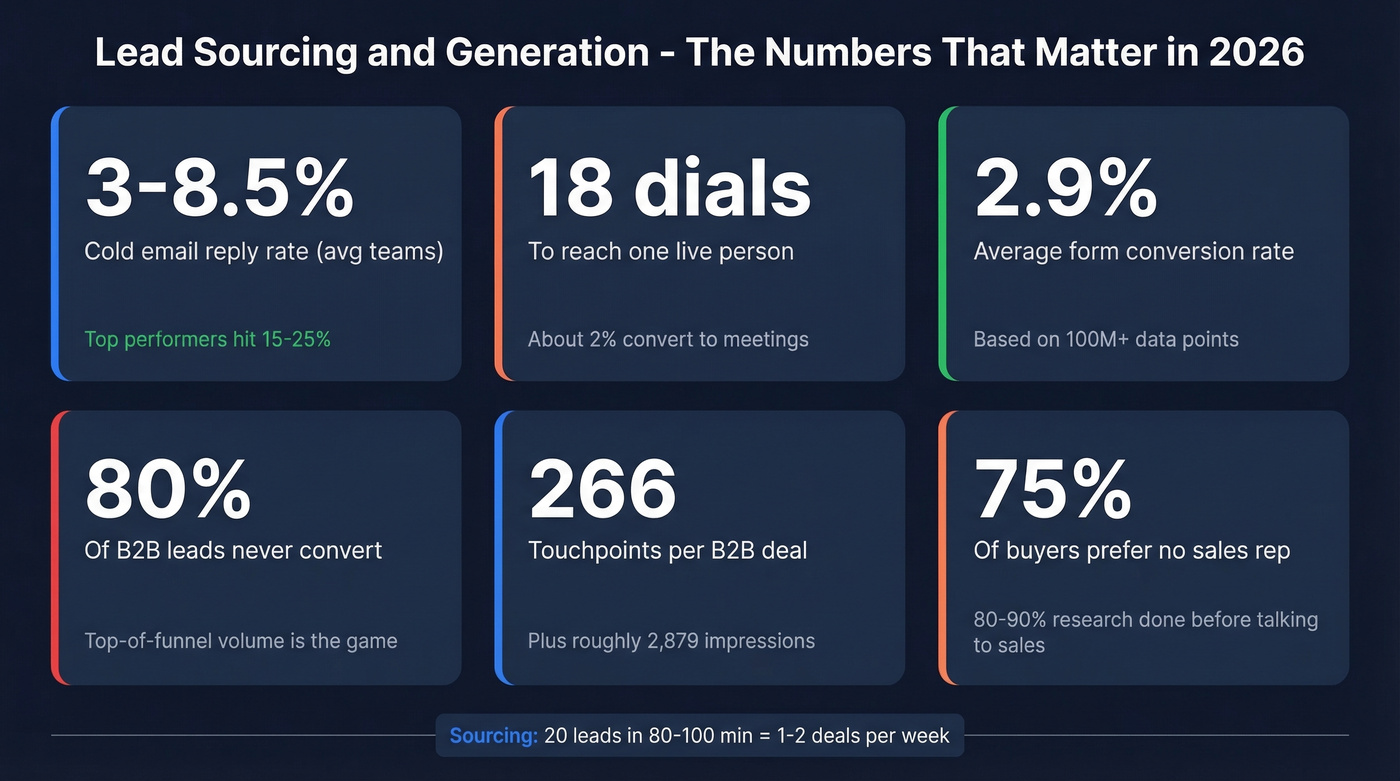
Let's talk practitioner math - the stuff that actually matters. For every 100 leads you source, expect to pitch about 25 in a given week, which generates one to two deals. At four to five minutes per lead, sourcing 20 leads takes about 80-100 minutes. That's a manageable daily block that produces real pipeline.
On the inbound side, the average form conversion rate across industries is 2.9% according to Ruler Analytics' analysis of 100M+ data points. Across the average B2B funnel, 80% of leads never convert at all. That's not a failure of lead gen - it's the nature of top-of-funnel volume. You need a lot of bait to catch a few fish.
The buyer behavior data makes the case for both approaches. 75% of B2B buyers prefer a rep-free experience per Gartner's research, and buyers do 80-90% of their research before talking to sales. Your inbound content shapes decisions before a rep gets involved - but sourcing is how you reach the buyers who'll never find your content on their own.
When to Use Which
Scenario 1: New market, new product, or zero inbound traction. Source aggressively. You can't wait six months for SEO to compound when you need pipeline this quarter. Sourcing gives you direct feedback on messaging, ICP fit, and market appetite within days.
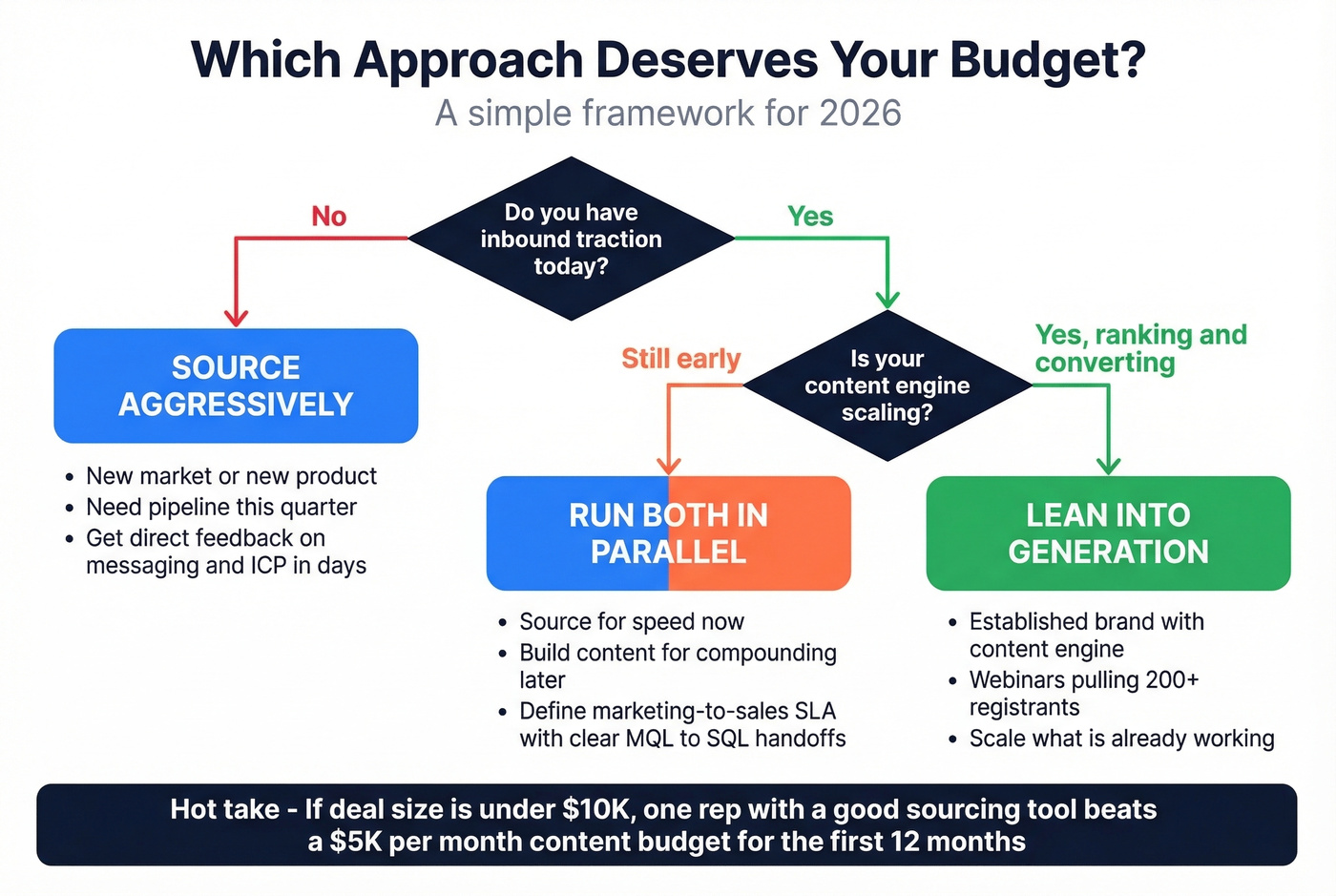
Scenario 2: Established brand with a content engine. Lean into generation. If you're already ranking for relevant terms and your webinars pull 200+ registrants, your marginal dollar is better spent scaling what's working than adding another SDR.
Scenario 3: Mature GTM team. Run both, connected by a marketing-to-sales SLA. Define your lifecycle stages - MQL, SAL, SQL - with clear handoff criteria and response times. 91% of B2B marketers say lead gen is their top priority, but sourcing fills the gap when inbound hasn't compounded yet or when you're entering a new vertical. With 71% of companies now running ABM programs, sourcing is the engine that feeds account-level targeting.
Hot take: If your deal size is under $10K, you probably don't need ZoomInfo-level data or a massive inbound machine. A single rep with a good sourcing tool and a sequencer will outperform a $5K/month content budget for the first 12 months. Fight me.
Best Practices That Move Pipeline
Lead Sourcing
Define your ICP before you touch a database. That means technographics, funding status, company size, revenue range, industry, and location. Without this, you're just collecting names.
Use trigger events to warm cold outreach - funding rounds, executive hires, press mentions, and technology adoption signals turn a cold email into a relevant one. A message that references a prospect's Series B announcement last week gets opened. A generic "I'd love to connect" doesn't.

Verify every email before loading it into your sequencer. This is where most sourcing workflows break down. If your list is bad enough that 35-40% of your emails bounce, you'll torch your sending domain within weeks. We've seen teams go from 35% bounce rates to under 4% just by adding a verification step - Snyk's 50-person AE team saw exactly this, and their AE-sourced pipeline jumped 180%.
One r/sales contributor systematized sourcing to 20 leads per day at four to five minutes each and tracked it to one to two deals per week. Source to a number, not a time block. "Source for an hour" is vague. "Source 20 leads before lunch" is actionable and measurable.
Lead Generation
Content and SEO compound over time - invest early, even if results feel invisible for the first few months. The teams that start publishing today are the ones with inbound machines twelve months from now.
Go multi-channel. Email nurture, social, webinars, and paid ads each reach different buyer segments at different stages. Score and route leads using behavioral and technographic signals - not just BANT - so reps work the hottest prospects first.
Run monthly attribution audits. Kill underperforming channels ruthlessly. Evaluate each source on conversion rate, ICP fit, cost per lead, and velocity to close. If your webinar CPL is 3x your organic content CPL with the same conversion rate, reallocate that budget.
Tools You Actually Need
Sourcing Tools
Prospeo is the strongest option for teams that care about data accuracy without enterprise pricing. The database covers 300M+ professional profiles with 143M+ verified emails and 125M+ verified mobile numbers. Over 30 search filters - including buyer intent powered by Bombora, technographics, job changes, and funding signals - let you build hyper-targeted lists fast. Data refreshes every 7 days while the industry average sits at 6 weeks, so you're not emailing people who changed jobs last month. At roughly $0.01 per email with a free tier of 75 emails/month, it's 90% cheaper than ZoomInfo with higher accuracy: 98% vs 87% on emails.

Apollo.io is a solid all-in-one if you want CRM, sequencing, and a database in one tool. Large database, free tier available, paid plans from ~$49/user/month. The tradeoff: dedicated data platforms typically win on verification depth and freshness, and outdated contact data is one of the biggest root causes of outbound underperformance.
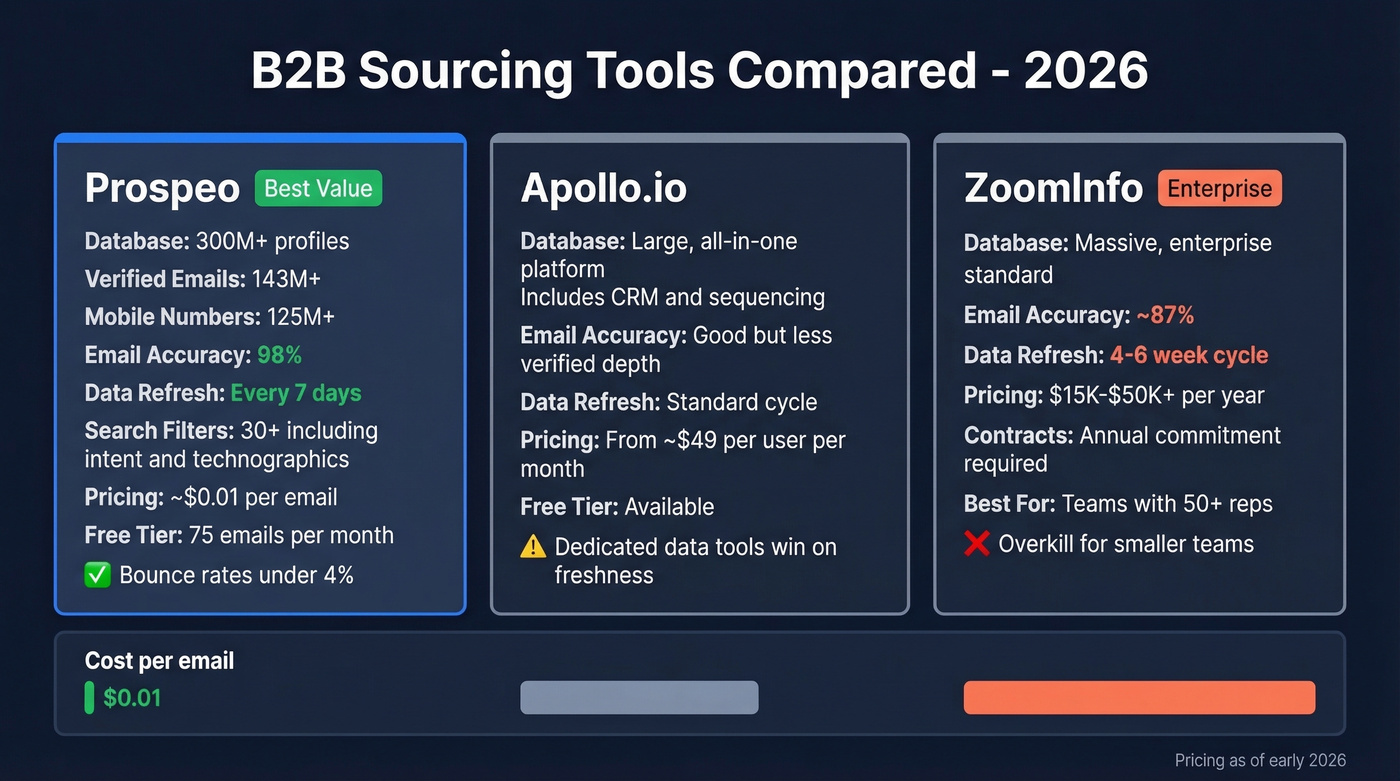
ZoomInfo is the enterprise standard at $15K-50K+/year with annual contracts. Skip this if your team is under 50 reps - it's overkill, and the 4-6 week refresh cycle means you're often emailing stale contacts anyway.
Sequencing and Generation Tools
Instantly handles outbound sequencing starting around $30/month and pairs well with any sourcing database. HubSpot is the default for inbound lead gen workflows - free CRM, with Marketing Hub Professional starting around $800-$1,000/month depending on contacts. ActiveCampaign is a strong alternative for teams that need sophisticated email automation without HubSpot's price tag, starting around $29-$49/month.
If you're evaluating your stack, start with a shortlist of SDR tools and then map them to your workflow.
Bad data kills sourcing workflows. Teams using unverified lists hit 35-40% bounce rates and torch their sending domains in weeks. Prospeo's 5-step verification with catch-all handling and spam-trap removal keeps bounce rates under 4% - exactly what Snyk's 50-AE team achieved before scaling pipeline 180%.
Stop sourcing leads you can't actually reach.
FAQ
What is lead sourcing and how does it differ from lead generation?
Lead sourcing is proactive - you identify ICP-fit prospects and collect their contact data using databases and research. Lead generation is reactive - you create content, ads, and experiences that attract prospects to you. Sourcing is sales-led and measured in leads per day; generation is marketing-led and measured in MQLs and conversion rates. Most teams need both, sequenced by maturity stage.
Is lead sourcing the same as prospecting?
No. Sourcing is finding and collecting contact data for ICP-fit prospects - building the list. Prospecting is the next step: actually reaching out via email, phone, or social. You can't prospect effectively without sourced, verified data to work from.
Can a small team do both sourcing and generation?
Yes, but sequence them. Start with sourcing to fill pipeline immediately - you'll see results in days, not months. Build content and SEO in parallel. As inbound grows, shift SDR time from sourcing to working inbound leads. Free tiers on sourcing tools keep costs near zero while you wait for content to compound.
What's the biggest mistake in lead sourcing?
Using unverified data. If 35-40% of your emails bounce, you'll burn your sending domain and waste SDR hours within weeks. Bad data is the root cause of most failed outbound campaigns. A proper verification process - including catch-all handling, spam-trap removal, and honeypot filtering - keeps bounce rates under 4-5% for most teams.