

LeadEngine.ai vs LeadsRush: They Don't Compete - Here's What You Actually Need
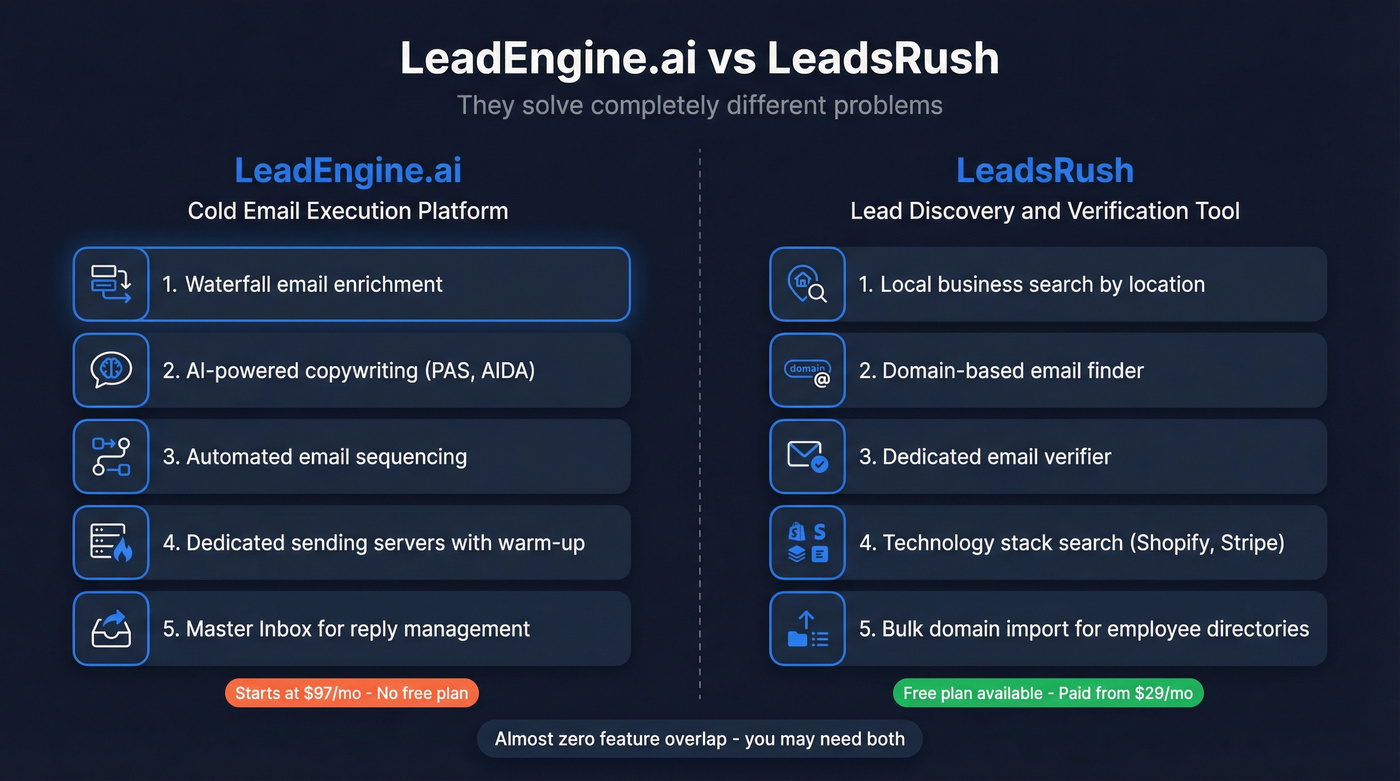
These two tools solve completely different problems. LeadEngine.ai is a cold email execution platform - it sends campaigns. LeadsRush is a lead discovery tool - it finds contacts. Comparing them is like comparing binoculars to a rifle: one spots the target, the other takes the shot. Before you pick either, figure out which piece is actually missing from your stack.
We've tested both platforms, and the near-total absence of independent reviews for either tool makes hands-on evaluation non-negotiable. Here's what we found.
30-Second Verdict
Pick LeadEngine.ai if your bottleneck is sending cold email at scale with solid deliverability. It handles enrichment, AI copywriting, sequencing, and warm-up in one platform.
Pick LeadsRush if you need to find local business contacts and verify emails on a budget. It's a discovery and verification tool, not an outreach platform.
What Each Tool Does
LeadEngine.ai: AI Cold Email Platform
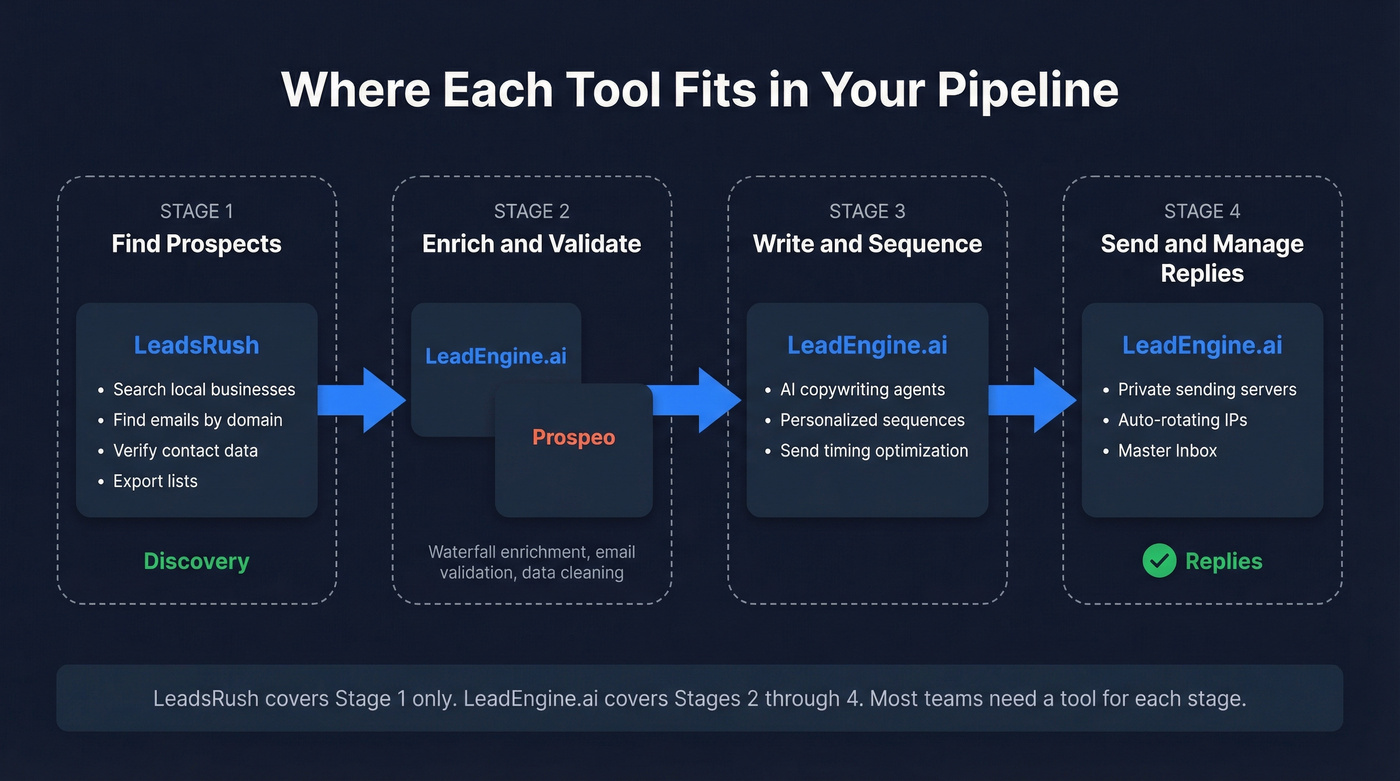
LeadEngine.ai bundles everything from lead enrichment to email delivery into a single workflow. You upload a raw list, it runs waterfall enrichment to find and validate emails, then AI agents generate personalized copy using frameworks like PAS and AIDA. The platform's "Quad Clutch Overdrive Method" - their term for combining enrichment, AI personalization, ML-based send timing, and risk filtering - orchestrates the entire sequence automatically.

Sending happens from dedicated private servers with auto-rotating IPs and continuous warm-up, plus features like AI IntelliSpintax for copy variation and a Master Inbox for managing replies across accounts. The vendor reports a 3.31% average reply rate and 98.48% delivery rate. Plans run from $97/mo to $497/mo, and annual billing saves 33%. There's no free plan, but a free trial is available.
Here's the thing: there's a real learning curve. The multiple AI agent layers and configuration options take time to dial in, and we spent a good chunk of our first session just figuring out which settings actually mattered versus which ones were set-and-forget. But for teams whose core problem is getting cold emails into the primary inbox, LeadEngine.ai is purpose-built for that fight.
LeadsRush: Lead Discovery & Verification
LeadsRush is a prospecting database, not a sending tool. Its sweet spot is local business discovery - search by location and keywords to pull company profiles with addresses, phone numbers, revenue data, and employee contacts. It also offers a domain-based email finder, a dedicated email verifier, and technology search for finding companies running specific stacks like Shopify, Stripe, or WooCommerce. Bulk tasks let you import lists of domains to pull employee directories, and company profiles can be enriched with SEO metrics and social media presence data.
One frustrating detail: the features page renders zeros for database size, technologies supported, and native integrations - likely a JavaScript rendering issue, but it means there's no public database size to evaluate. That's a problem if you need to assess coverage before committing. The free tier with 50 searches and 100 verifications per month partially offsets this by letting you test real results against your ICP before spending anything.
Feature Comparison
| Feature | LeadEngine.ai | LeadsRush |
|---|---|---|
| Email finding | Waterfall enrichment | Domain + name search |
| Email verification | Built-in validation | Dedicated verifier |
| Cold email sending | Yes (private servers) | No |
| AI copywriting | Yes (multi-agent) | No |
| Deliverability infra | Dedicated IPs, warm-up | N/A |
| Local business search | No | Yes |
| Tech stack search | No | Yes |
| Database size | N/A (enrichment-based) | Undisclosed |
| Integrations | Not public | Exports to CRM/email tools |
| API | Not highlighted | Domain Search, Email Finder, Email Verifier |
| Free plan | No | Yes (50 searches/mo) |
The overlap between these tools is almost zero. If you need both capabilities, you're buying two products.

LeadEngine.ai enriches what you give it. LeadsRush won't disclose its database size. Prospeo covers 300M+ profiles with 98% email accuracy on a 7-day refresh cycle - and pushes verified contacts straight into Smartlead, Instantly, or Lemlist.
Start with 75 free verified emails and see the difference clean data makes.
Pricing Breakdown
| LeadEngine.ai Plan | Monthly | Annual |
|---|---|---|
| Start | $97/mo | ~$65/mo (33% off) |
| Accelerate | $297/mo | ~$199/mo (33% off) |
| Speed | $497/mo | ~$333/mo (33% off) |
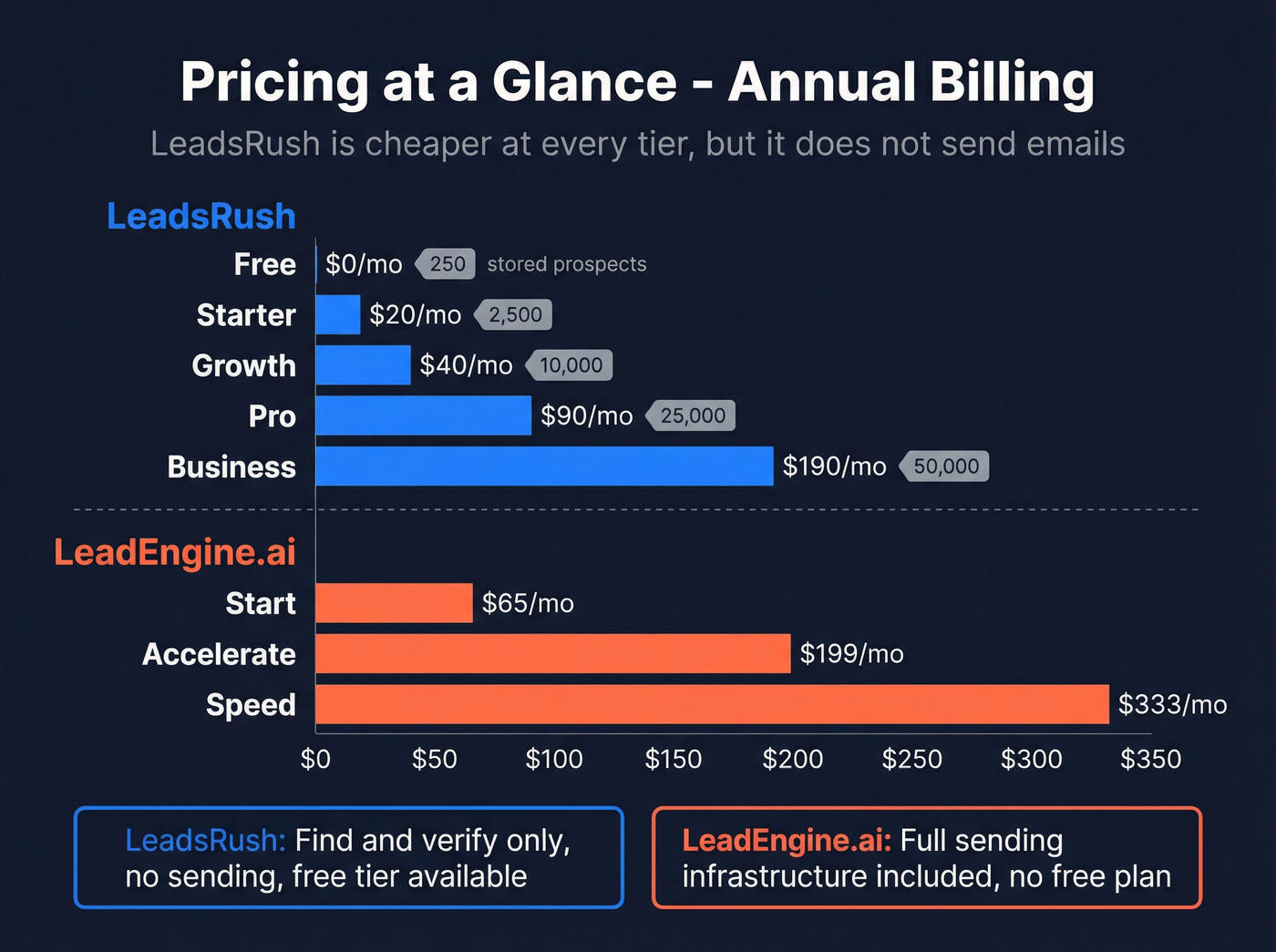
| LeadsRush Plan | Monthly | Annual (~30% off) | Stored Prospects |
|---|---|---|---|
| Free | $0 | $0 | 250 |
| Starter | $29/mo | $20/mo | 2,500 |
| Growth | $59/mo | $40/mo | 10,000 |
| Pro | $129/mo | $90/mo | 25,000 |
| Business | $269/mo | $190/mo | 50,000 |
LeadsRush is significantly cheaper at every tier, but it doesn't send emails. LeadEngine.ai's $97/mo floor is steep if you only need basic enrichment - you're paying for the sending infrastructure whether you use it or not.
Verdict: Which One Fits Your Stack?
Use LeadEngine.ai when your pipeline problem is deliverability and sending volume. You already have leads or can source them, and you need an AI-driven platform to write, sequence, and deliver cold email from clean infrastructure.
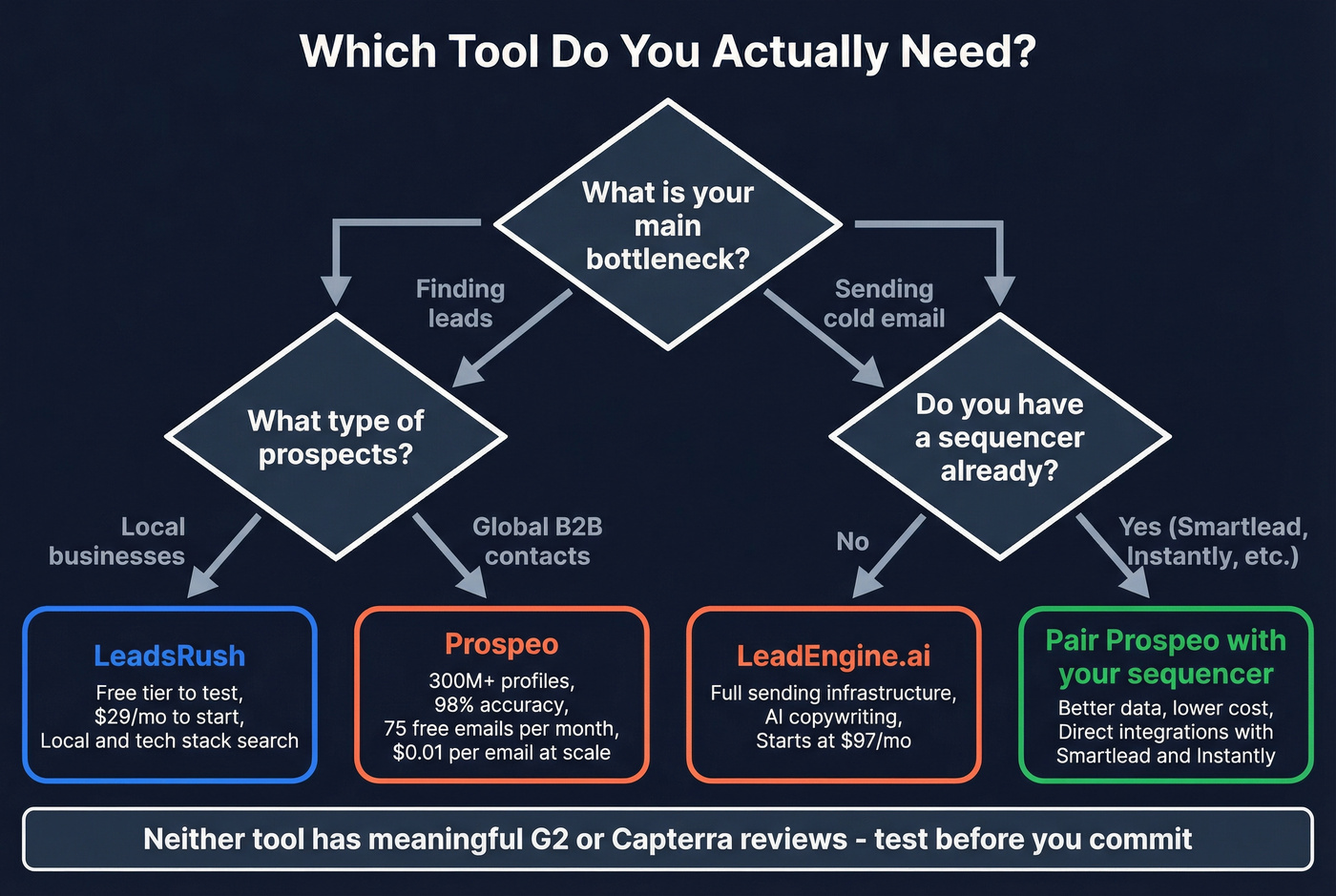
Use LeadsRush when you're prospecting local businesses on a tight budget and need a simple find-and-verify workflow. The free tier makes it low-risk to test.
Let's be honest: most teams searching this comparison actually need neither tool. They need better data feeding into a sequencer they already own. Neither LeadEngine.ai nor LeadsRush has meaningful G2 or Capterra reviews, and Reddit threads on both tools are limited to launch announcements with no substantive user feedback - which should give you pause. LeadsRush's undisclosed database size is a real concern for teams that need reliable coverage beyond local business search. In our experience, tools without public database metrics tend to have coverage gaps that surface at the worst possible time - mid-campaign, when your reply rates crater and you can't figure out why.
A Better Option for the Data Layer
If your actual problem is data quality and scale, Prospeo is the cleaner solve. It covers 300M+ profiles with 98% email accuracy on a 7-day refresh cycle - data that's fresher than what most enterprise providers offer. You search with 30+ filters including buyer intent, technographics, job changes, and headcount growth, then export verified contacts and push them directly into Smartlead, Instantly, or Lemlist. Pricing starts free at 75 emails per month and scales to roughly $0.01 per email. No contracts, no sales calls.

Pair it with LeadEngine.ai if you want dedicated sending infrastructure, or use it standalone with any sequencer if LeadsRush's database coverage doesn't cut it for your ICP.
The real gap in both tools is data you can trust at scale. Prospeo's 30+ search filters - buyer intent, technographics, job changes, headcount growth - let you build targeted lists that actually convert. At $0.01 per email, it costs less than LeadsRush's Starter plan.
Stop paying for sending infrastructure on top of bad data.
FAQ
Does LeadsRush send cold emails?
No. LeadsRush finds and verifies email addresses but has zero outreach or sequencing features. You'll need a separate sending tool like LeadEngine.ai, Smartlead, or Instantly to actually run campaigns.
Does LeadEngine.ai have a free plan?
No. LeadEngine.ai starts at $97/mo, and annual billing brings that down about 33%. LeadsRush offers a free tier with 50 searches and 100 verifications per month - a meaningful difference if you're testing on a budget.
What's a good free alternative for B2B lead data?
Prospeo's free tier gives you 75 verified emails per month plus 100 Chrome extension credits - more usable volume than LeadsRush's 50 searches. It also covers 300M+ profiles globally, so you aren't limited to local business discovery.
What if I need both lead data and cold email sending?
Pair a dedicated data platform with a sending tool like Smartlead or Instantly. This modular approach gives you better data quality and more flexibility than trying to force one tool to do everything, and it typically costs less than stacking two specialized platforms that each only solve half the problem.