

Lead Quality: How to Measure, Score, and Fix Your Pipeline in 2026
It's Thursday afternoon. Marketing just handed sales 200 webinar leads. By Monday, three have responded to outreach, one was a student, and the pipeline report looks exactly like it did last week. The problem isn't your sales team - it's that nobody agreed on what a "good lead" looks like before those 200 names hit the CRM.
Half of all marketers consider lead generation a top priority, yet the conversation almost always centers on volume. More leads, more form fills, more MQLs. The real gains come from lead quality - and most teams don't have a framework for measuring it, let alone improving it.
The 30-Second Version
If your leads aren't converting, the problem is almost always bad data or missing qualification criteria - not your reps.
- Verify your contact data first. 30-50% of CRM data is already stale. If you're outbounding into dead emails and disconnected numbers, no scoring model saves you. Run your list through a verification tool before anything else.
- Build a scoring model. Use the point-value template later in this article. It takes an hour to set up and immediately separates signal from noise.
- Track CPQL, not CPL. Cost per qualified lead is the only metric that tells you what a real, sales-ready lead actually costs. CPL is a vanity metric.
What Is a Quality Lead?
Lead quality measures how likely a prospect is to become a customer. A high-quality lead matches your ideal customer profile, has a real business need, and shows some signal of intent. A low-quality lead is everyone else.
The definition comes down to fit plus intent - without both, you're chasing noise.
The taxonomy breaks into three stages. MQLs (marketing qualified leads) have engaged enough to warrant sales attention - downloaded a whitepaper, attended a webinar, visited the pricing page twice. SQLs (sales qualified leads) have been vetted by a rep and confirmed as a real opportunity. PQLs (product qualified leads) have used your product and hit activation thresholds. Each stage filters harder.
The ICP - ideal customer profile - is the foundation underneath all of this. Without a clear ICP, your scoring model is just counting clicks. Ten conversations with ICP-fit prospects beat 1,000 cold dials to random contacts. That's arithmetic, not aspiration. 97% of people ignore cold calls entirely, so if you're calling the wrong people, you're burning budget and rep morale simultaneously.
There's also a compliance dimension most teams overlook. A lead captured without proper consent, or one generated by bot traffic, isn't just low quality - it's a liability. Consent documentation, bot filtering, and TCPA/GDPR compliance are qualification criteria too.
Benchmarks Worth Knowing
Benchmarks give you a baseline. They don't tell you what's "good" for your business - your own historical data does that - but they tell you whether you're in the ballpark or wildly off.
Industry Conversion Rates
Lead-to-MQL conversion rates vary dramatically by industry. The overall average sits at 31%, but that number hides enormous variation:
| Industry | Lead-to-MQL Rate |
|---|---|
| B2B SaaS | 39% |
| Cybersecurity | 39% |
| IT & Managed Services | 25% |
| Construction | 17% |
If you're in B2B SaaS and only 15% of your leads are qualifying as MQLs, something's broken upstream - likely targeting or data quality. In construction, hitting 20% means you're actually outperforming.
Channel Benchmarks
Where your leads come from matters as much as who they are:
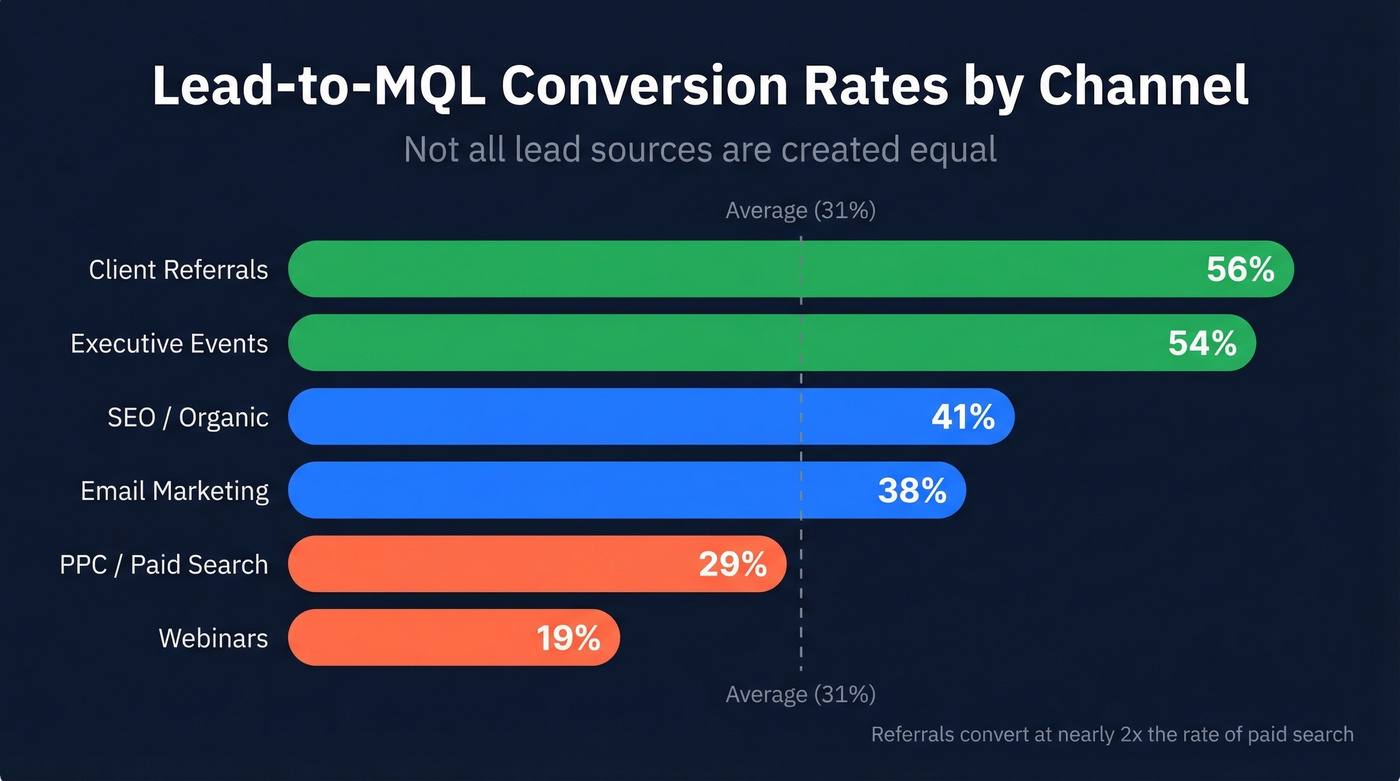
| Channel | Lead-to-MQL Rate |
|---|---|
| Client Referrals | 56% |
| Executive Events | 54% |
| SEO / Organic | 41% |
| Email Marketing | 38% |
| PPC / Paid Search | 29% |
| Webinars | 19% |
Referrals convert at nearly double the rate of PPC. Not surprising - a warm intro carries implicit qualification. But the real insight is that organizations generate roughly 1,877 leads per month on average, and most of those come from channels in the 20-40% qualification range. That means 60-80% of your inbound volume isn't sales-ready. Plan accordingly.
One more number: the average website-to-qualified-lead conversion rate is 2.9% across 100M+ data points. Above 3%, your site is doing real work. Below 2%, your forms or targeting need attention.
How to Measure Lead Quality
CPQL - The Metric That Matters
CPL tells you what a form fill costs. CPQL tells you what a sales-ready lead costs. The difference is everything.
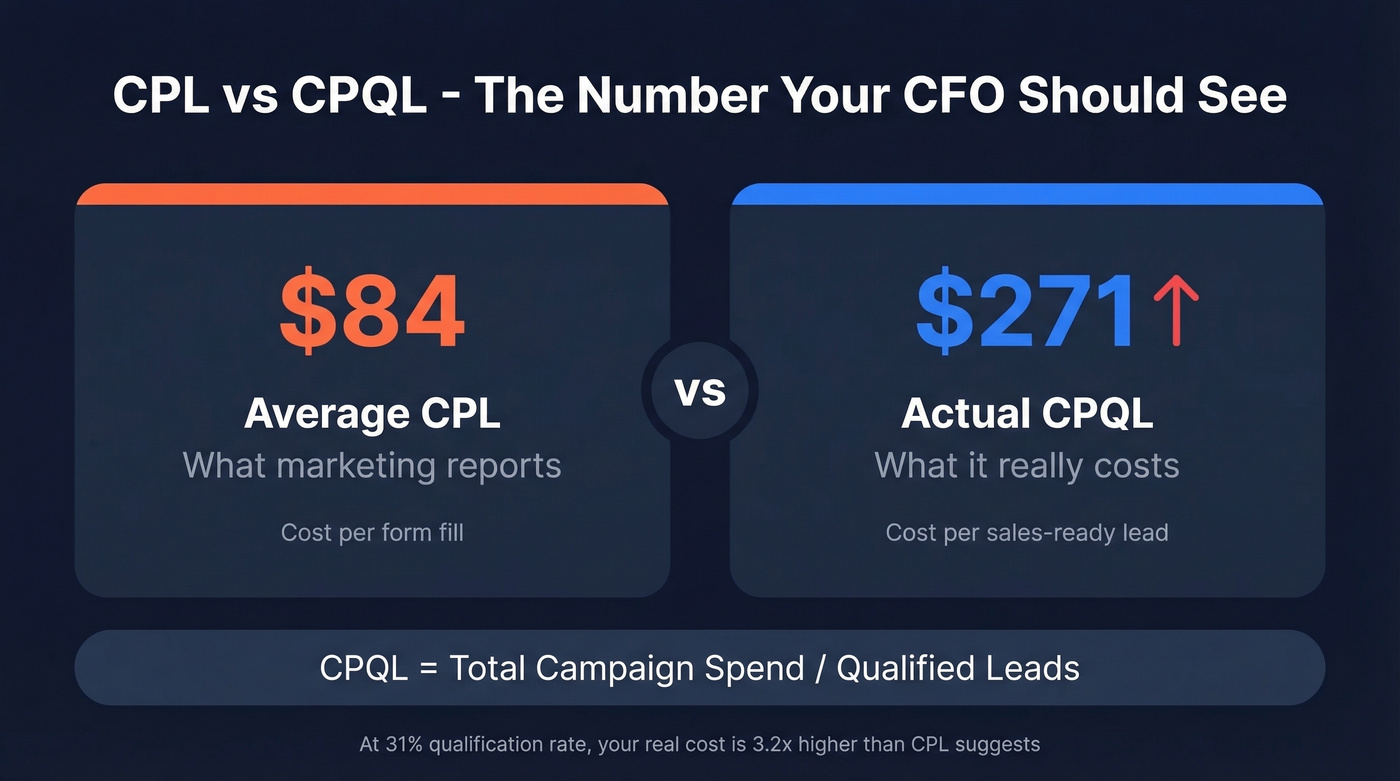
CPQL = Total Campaign Spend / Number of Qualified Leads
The average B2B CPL across channels is $84. Some sources put the mean CPL across all industries at $198.44 - which makes CPQL even more eye-opening when only a third of those leads qualify. At the $84 figure with a 31% qualification rate, your CPQL is roughly $271. That's a very different number than $84, and it's the one your CFO should be looking at.
Channel matters here too. Google Ads CPL averages $70.11; LinkedIn runs $110+. But if LinkedIn leads qualify at 45% and Google leads qualify at 20%, LinkedIn's CPQL is actually lower despite the higher CPL. In B2B, CPQL typically runs 1.5-3x CPL when qualification criteria are strict. If yours is higher than 3x, your top-of-funnel targeting is leaking.
Here's a useful gut check: if a lead's expected deal size doesn't cover your acquisition cost, they're disqualified by math, not opinion.
Funnel Drop-Off Diagnostics
The other measurement that matters is where leads die in your funnel. Map your stages - Lead, MQL, SQL, Opportunity, Closed - and calculate conversion rates between each. If MQL-to-SQL is healthy but SQL-to-Opportunity craters, the problem isn't lead quality; it's sales process or pricing. If Lead-to-MQL is terrible, your targeting or data is off. The healthy benchmark for LTV:CAC is 3:1 or higher. Below that, trace the funnel backward to find the leak.

You just read that 30-50% of CRM data is stale. That's not a lead quality problem - it's a data quality problem. Prospeo verifies every email through a 5-step process and refreshes all 300M+ profiles every 7 days, not every 6 weeks. 98% email accuracy means your scoring model scores real prospects, not dead contacts.
Stop scoring leads that don't exist. Start with verified data.
Build a Lead Scoring Model
A Scoring Template You Can Steal
We've tested variations of this across multiple campaigns, and this HubSpot-style point model works as a solid starting framework. Adjust the values for your business, but the structure holds across most B2B contexts:
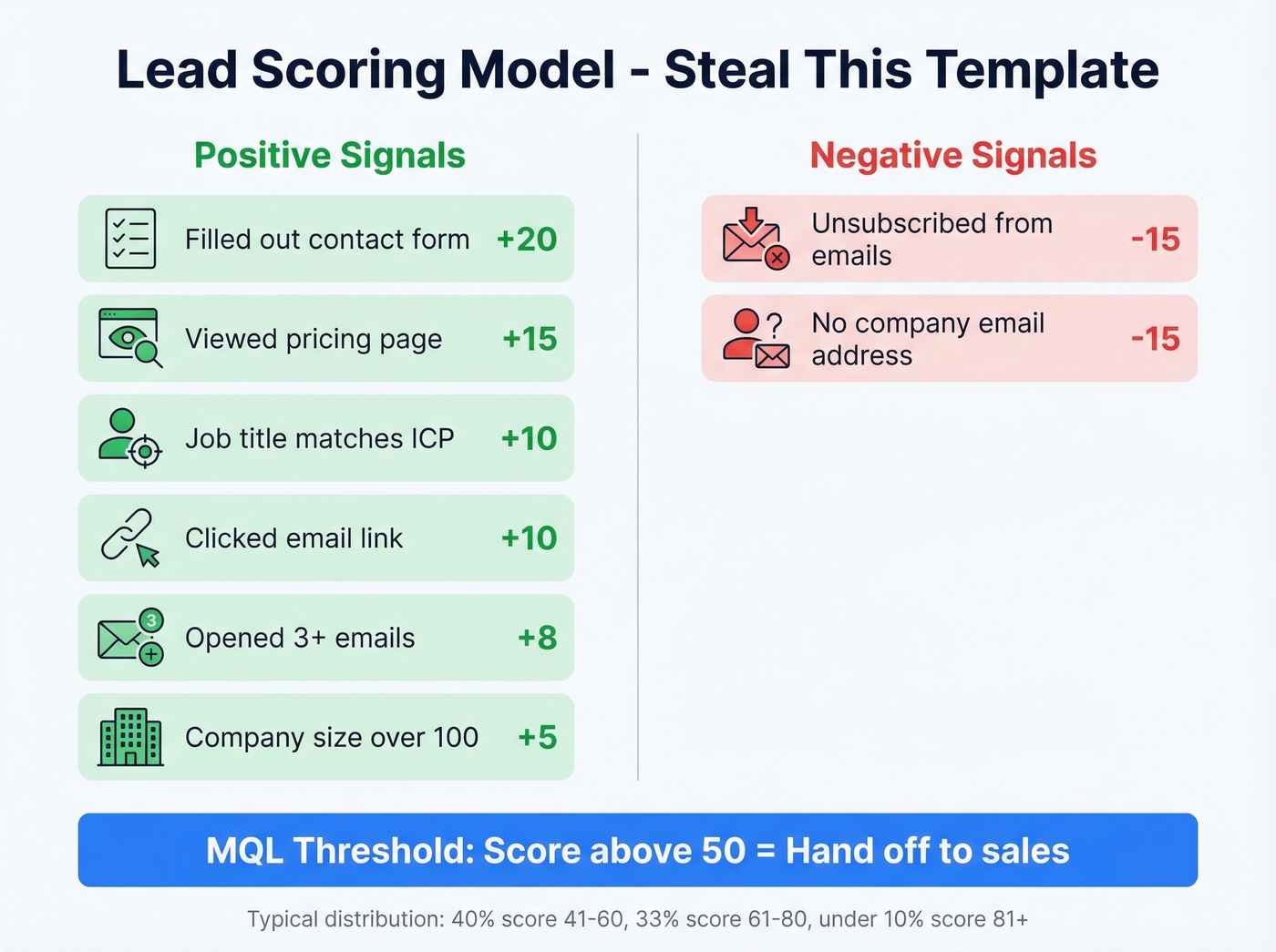
| Signal | Points |
|---|---|
| Job title matches ICP | +10 |
| Company size >100 | +5 |
| Opened 3+ emails | +8 |
| Clicked email link | +10 |
| Viewed pricing page | +15 |
| Filled out contact form | +20 |
| Unsubscribed | -15 |
| No company email | -15 |
Threshold: score >50 = MQL. That's your handoff trigger.
The distribution you'll typically see: about 40% of leads score 41-60, roughly a third score 61-80, and fewer than 10% break 81+. If everyone clusters in the same range, your model isn't differentiating - add more signals or widen the point spreads.
Pardot takes a slightly different approach, splitting scoring (engagement behaviors) from grading (firmographic fit, A-F scale). Marketo and HubSpot handle similar parallel-score models natively. The platform doesn't matter as much as the principle: you need both fit and engagement to identify qualified prospects.
Why Negative Scoring Matters
Lead scoring without negative scoring is just lead counting. A competitor researching your pricing page shouldn't get +15 points. Someone who unsubscribes shouldn't keep their accumulated score. No company email address? That's a -15 at minimum.
Here's the thing - the risk with scoring models, as one B2B marketing lead put it on r/b2bmarketing, is that they "add friction without actually improving outcomes" unless the criteria map to actual revenue patterns. Review your scoring weights quarterly against closed-won data. If a signal doesn't correlate with revenue, kill it.
Routing Leads by Score Tier
Scoring is useless without routing rules. P1 leads - hand-raisers, demo requests, pricing page + form fill combos - get routed immediately with a 10-minute response SLA. P2 leads - high-value opt-ins like webinar attendees or specific content downloads - get a 48-hour follow-up window.
For more advanced setups, use intent as a multiplier on fit score rather than a standalone signal. A director-level contact at an ICP company who's also showing Bombora intent signals on your category? That's a P1 regardless of their behavioral score. In our experience, the hybrid model - firmographic fit multiplied by intent - outperforms pure point-based systems every time.
Five Mistakes That Kill Pipeline
1. Stale or missing data. 30-50% of CRM data decays annually. If you're outbounding into emails that bounce and phones that ring dead, your reps lose trust in the data and stop using it. Fix: verify every list before outreach. Catch invalid emails, spam traps, and honeypots before they tank your deliverability.
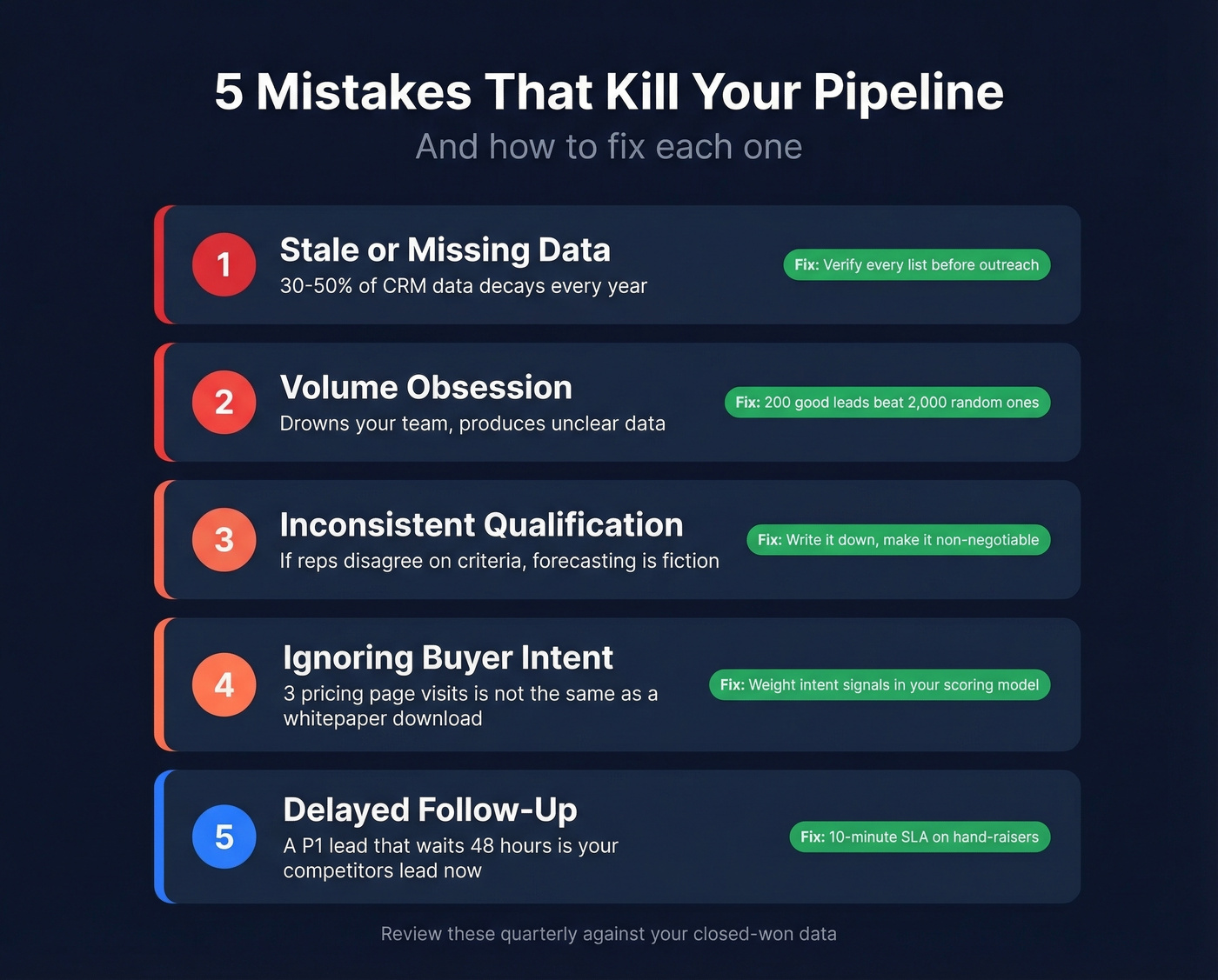
2. Volume obsession. "Unlimited leads" sounds great in a pitch deck. In practice, it drowns your team and produces unclear data. As one r/Entrepreneur poster put it bluntly: volume-first approaches exhaust callers and make it impossible to diagnose what's actually working. If your average deal is under $10K, you probably don't need 2,000 leads a month. You need 200 good ones.
3. Inconsistent qualification criteria. If Rep A considers a director-level contact at a 50-person company an SQL and Rep B doesn't, your pipeline forecasting is fiction. Write down the criteria. Make them non-negotiable.
4. Ignoring buyer intent signals. A prospect who visited your pricing page three times this week is a completely different lead than someone who downloaded a whitepaper six months ago. If your scoring model treats them the same, you're leaving revenue on the table.
5. Delayed follow-up on high-value leads. A P1 lead that waits 48 hours is a P1 lead your competitor already called. Speed-to-lead is the simplest lever most teams never pull.
How to Improve Lead Quality
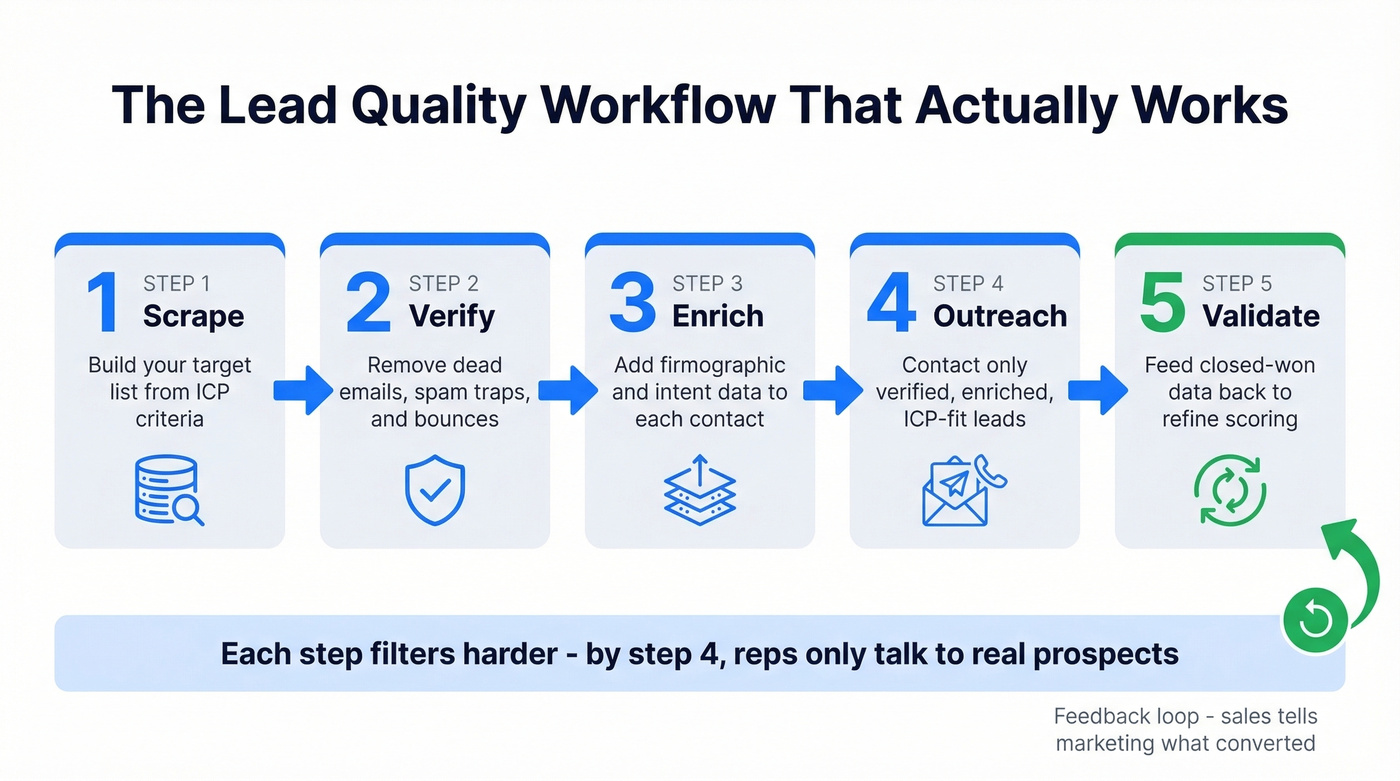
The workflow that actually works: scrape, verify, enrich, outreach, validate. Each step filters harder, so by the time a rep picks up the phone, they're talking to someone who matches the ICP, has a valid email, and shows some intent signal.
Pre-qualification layers matter too. Add questions to your forms that filter out low-intent inquiries - budget range, timeline, company size. Yes, you'll get fewer form fills. That's the point. 67% of buyers prefer self-service, so make your forms do the qualifying work rather than forcing a sales call.
The marketing-sales feedback loop can't be skipped. Sales needs to tell marketing which leads actually converted and why. Marketing needs to adjust targeting based on that data. Without this loop, you're optimizing for CPL while your CPQL quietly climbs.
On the data side, the 30-50% CRM decay problem means your scoring model is grading stale contacts. A 5-step verification process - catch-all handling, spam-trap removal, honeypot filtering - on a 7-day refresh cycle versus the 6-week industry average makes a measurable difference. Prospeo runs exactly this, delivering 98% email accuracy and 50+ data points per enrichment.
Let's look at concrete outcomes. Meritt cut bounce rate from 35% to under 4%, and Snyk cut bounce rate from 35-40% to under 5% after upgrading their verification layer and workflow. Those aren't marginal improvements - they're the difference between a pipeline that works and one that doesn't.
Skip single-source enrichment if you can. It leaves 40-60% of qualified prospects unreachable. Waterfall enrichment - querying multiple providers sequentially - closes that gap, but it starts with having a primary source you trust.
Tools That Improve Data Quality
| Category | Tool | Price | Best For |
|---|---|---|---|
| Verification | Prospeo | Free tier; ~$0.01/email | Accuracy + freshness |
| Verification | Kaspr | From $49/user/mo | Quick phone lookups |
| Enrichment | Breeze Intelligence | $30-$700/mo | HubSpot-native teams |
| Database | ZoomInfo | ~$15-40K/yr | Enterprise full-stack |
| Database | Cognism | ~$1-3K/mo | EMEA mobile numbers |
| Database | Lusha | Free tier; from ~$49/mo | SMB quick-start |
Kaspr is solid for quick phone number lookups, especially in European markets. Lusha works as a lightweight starting point for SMB teams who need a free tier and basic enrichment. ZoomInfo remains the enterprise default - powerful but expensive and contract-heavy. Cognism wins on EMEA mobile coverage and GDPR compliance.
Your CPQL skyrockets when reps chase bounced emails and disconnected numbers. Prospeo's 98% email accuracy and 30% mobile pickup rate mean more of your budget reaches real buyers. At $0.01 per email, cleaning your pipeline costs less than one wasted rep hour.
Cut your CPQL by eliminating bad data before it enters the funnel.
FAQ
What's the difference between lead quality and lead scoring?
Lead quality is the overall fit and readiness of a prospect to buy - it's a concept. Lead scoring is one method to measure it, assigning numerical values to behaviors and attributes. You can assess quality without a scoring model, but scoring makes it systematic and repeatable.
How often should I verify my lead data?
At minimum monthly. CRM data decays at 30-50% per year, meaning every quarter a meaningful chunk of your pipeline points at dead emails and disconnected numbers. If your current tool runs on a 6-week refresh cycle, that's too slow - look for providers that refresh weekly to catch decay before it compounds.
Is CPQL more important than CPL?
Yes. CPL tells you what a form fill costs; CPQL tells you what a sales-ready lead costs. If your CPL is $30 but only 10% qualify, your real cost is $300 per qualified lead. CPQL exposes the true economics of your funnel - CPL hides them.
What's a good lead-to-MQL conversion rate?
The overall average is 31%, but it varies wildly by industry - B2B SaaS and cybersecurity average 39%, while construction sits closer to 17%. Compare against your own industry benchmark first, then track your trend line quarter over quarter. Even a 5-percentage-point improvement can meaningfully shift pipeline economics.
How do I align marketing and sales on lead quality?
Start with a shared ICP definition - written down, not assumed. Then build a feedback loop: sales reports which leads converted and why, marketing adjusts targeting accordingly. Hold a monthly pipeline review where both teams look at the same CPQL numbers. Shared metrics kill finger-pointing faster than any process document.