

Leadzen.ai vs RocketReach: Honest Comparison (2026)
Your SDR manager just flagged that bounce rates crossed 5%. Reps are wasting dials on wrong numbers, and someone's asking whether the data tool you're paying for is actually the problem. The Leadzen.ai vs RocketReach decision isn't about features - it's about which tool fits your outbound motion without wrecking your sender reputation.
30-Second Verdict
Pick RocketReach for fast, self-serve contact lookups. It carries a 4.4/5 on G2 across 1,212 reviews, which is strong validation for a lookup-first workflow. RocketReach also claims 11M+ users and coverage across 95% of the S&P 500.
Pick Leadzen.ai for AI-curated prospecting with multi-channel outreach automation - but know you're buying blind. Zero G2 reviews. A dormant G2 profile for over a year.
Skip both if stale data is your real problem. Neither tool offers a hard freshness guarantee that protects deliverability by default.
Feature Comparison at a Glance
Leadzen.ai markets geo-tagging and location intelligence for territory-based prospecting, which is a genuine differentiator if your team sells by region. Intent data is listed as "coming soon," signaling the platform is still maturing. RocketReach, by contrast, is a pure lookup tool - deep on contacts, thin on workflow automation.
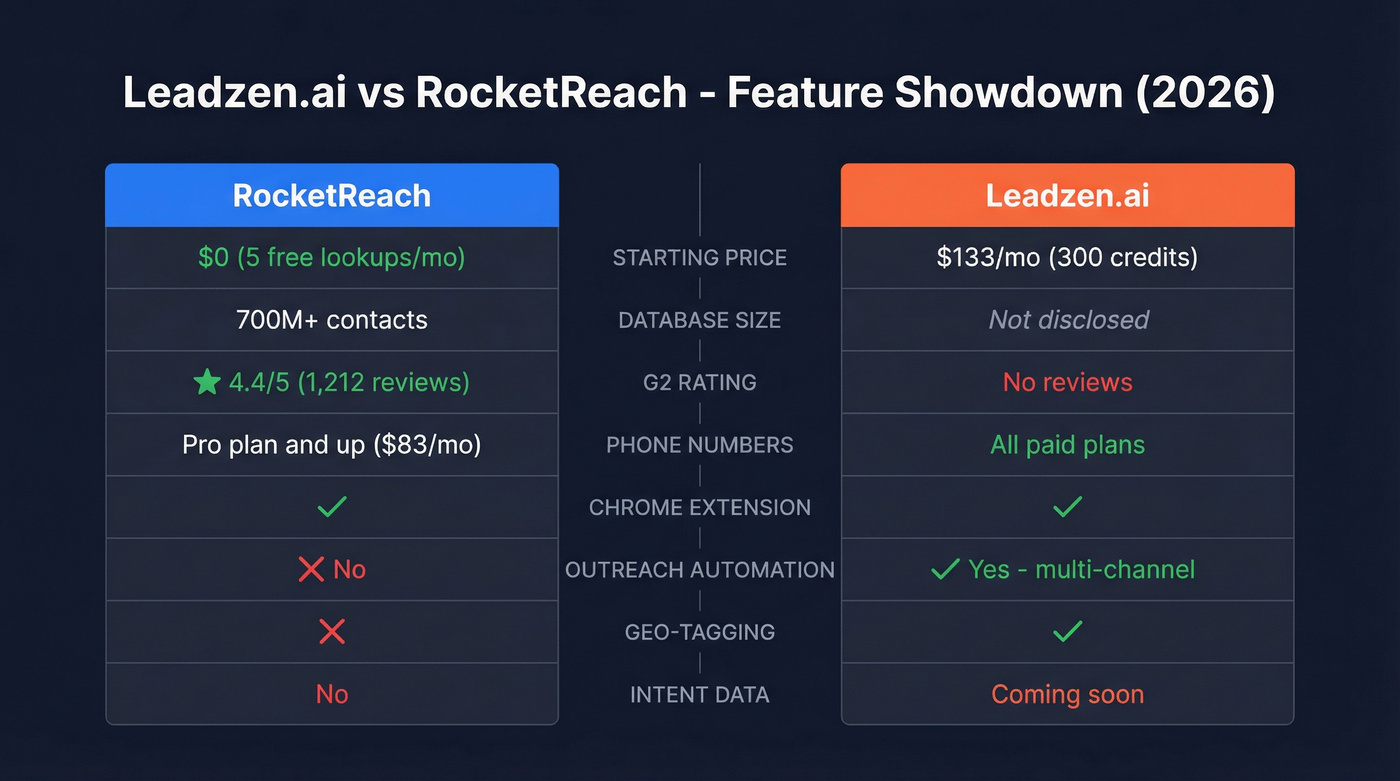
| Feature | RocketReach | Leadzen.ai |
|---|---|---|
| Starting price | $0 (5 lookups/mo) | $133/mo (300 credits) |
| Database size | 700M+ contacts | Not public |
| G2 rating | 4.4/5 (1,212 reviews) | 0/5 (0 reviews) |
| Phone numbers | Pro+ ($83/mo) | All paid plans |
| Chrome extension | Yes | Yes |
| Sequencing / outreach automation | No | Yes (multi-channel + follow-ups) |
| Geo-tagging | No | Yes |
| Intent data | No | Coming soon |
| Key integrations | Salesforce, HubSpot, Zapier | CRM workflows + automation |
Pricing and Cost Math
RocketReach has a free plan with 5 lookups/month. Essentials runs $33/user/mo on annual billing for email-only lookups (1,200 lookups/year). Pro is $83/user/mo with phone numbers and 3,600 lookups/year. Monthly billing jumps sharply - Essentials hits $80/user/mo and Pro climbs to $150/user/mo. Overages cost $0.30-$0.45 per lookup.
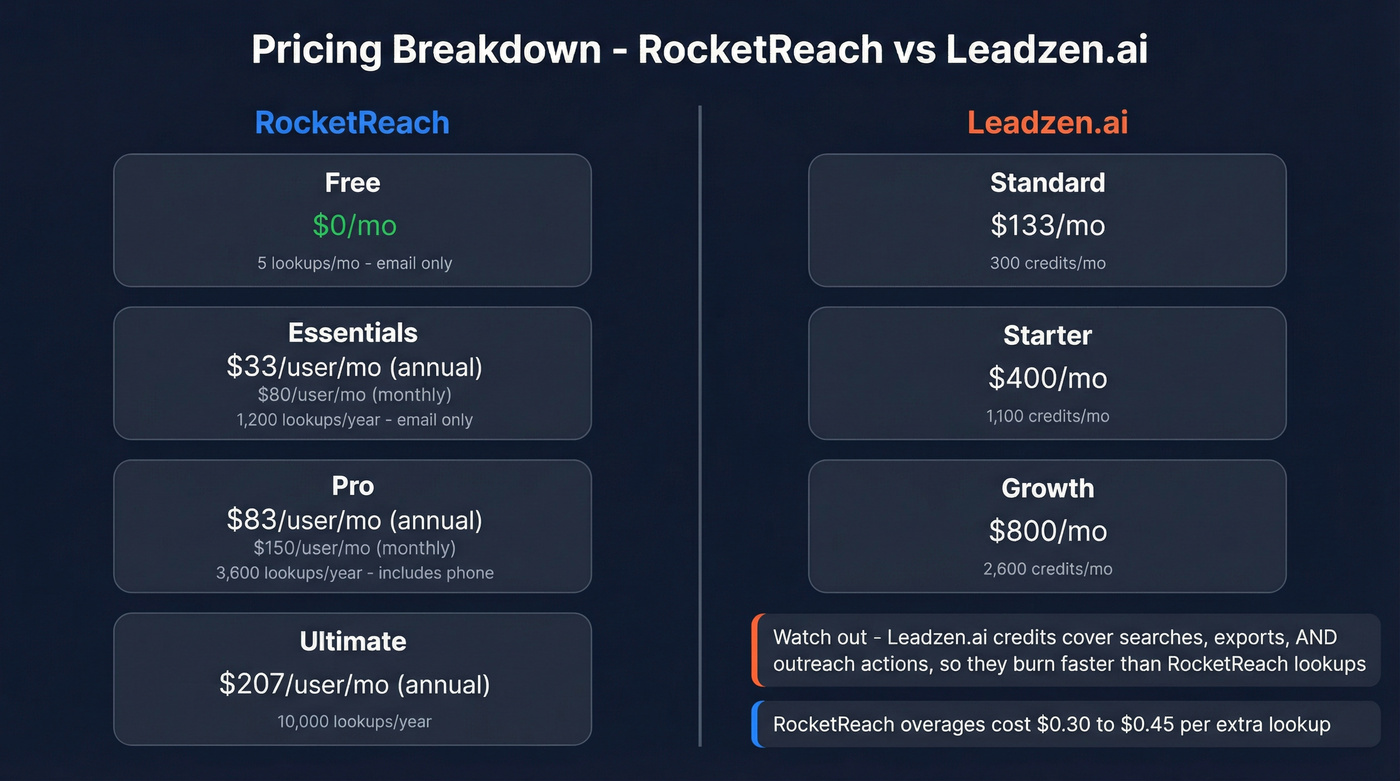
A five-person team on Pro annual billing pays $415/mo. That's reasonable until you factor in the contacts that bounce.
Leadzen.ai bundles prospecting and outreach into the price. Standard is $133/mo for 300 credits, Starter is $400/mo for 1,100, and Growth is $800/mo for 2,600. Because credits cover multiple actions - not just exporting a contact - teams often burn through them faster than expected.
Here's the thing: if your team already runs sequences in Outreach or Salesloft, you're paying twice for automation you don't need with Leadzen.ai. And if you're on RocketReach, you're paying for lookups that may bounce. Neither pricing model protects you from bad data.

RocketReach users report 10-20% bounce rates. Leadzen.ai has zero independent reviews to verify its claims. Prospeo delivers 98% email accuracy through 5-step verification - including catch-all handling and spam-trap removal - at ~$0.01 per email with no annual contract.
Stop paying for contacts that bounce. Verify the difference with 75 free emails.
Data Quality and Freshness
Email lists decay by roughly 28% per year. Database size is the wrong metric. Freshness and verification determine whether you book meetings or burn domains.
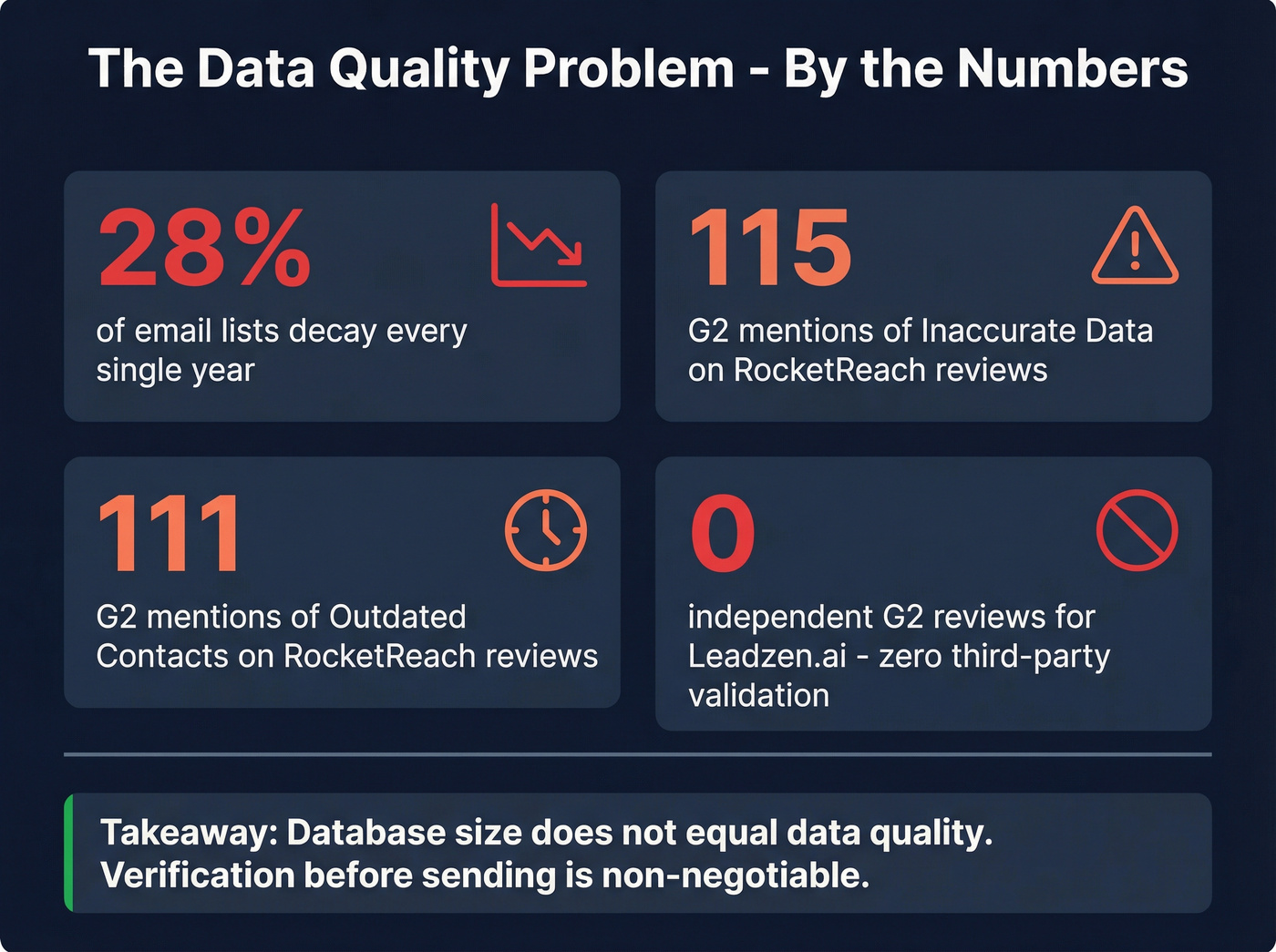
RocketReach covers 700M+ contacts across 35M+ companies. On G2, the negatives are consistent: "Inaccurate Data" (115 mentions) and "Outdated Contacts" (111 mentions) show up as the top recurring complaints. That doesn't make RocketReach unusable, but you should expect cleanup work if deliverability matters to you. We've seen users report 10-20% bounce rates on RocketReach-sourced lists in r/sales threads and G2 reviews alike.

Leadzen.ai markets real-time verification and dynamic data refresh. With zero third-party reviews on G2, there's no independent way to pressure-test those claims. That's a red flag for any team spending $400+/mo.
Regardless of which tool you pick, running contacts through a separate verification layer before loading them into sequences is the most reliable way to keep bounce rates under 5%. Prospeo's 5-step verification process - including catch-all handling, spam-trap removal, and honeypot filtering - catches the garbage that source databases miss, which is why we recommend it as a verification layer on top of any data provider.
Best Choice by Scenario
Solo rep doing quick lookups - RocketReach Free or Essentials. Hard to beat $0-$33/mo for occasional searches.
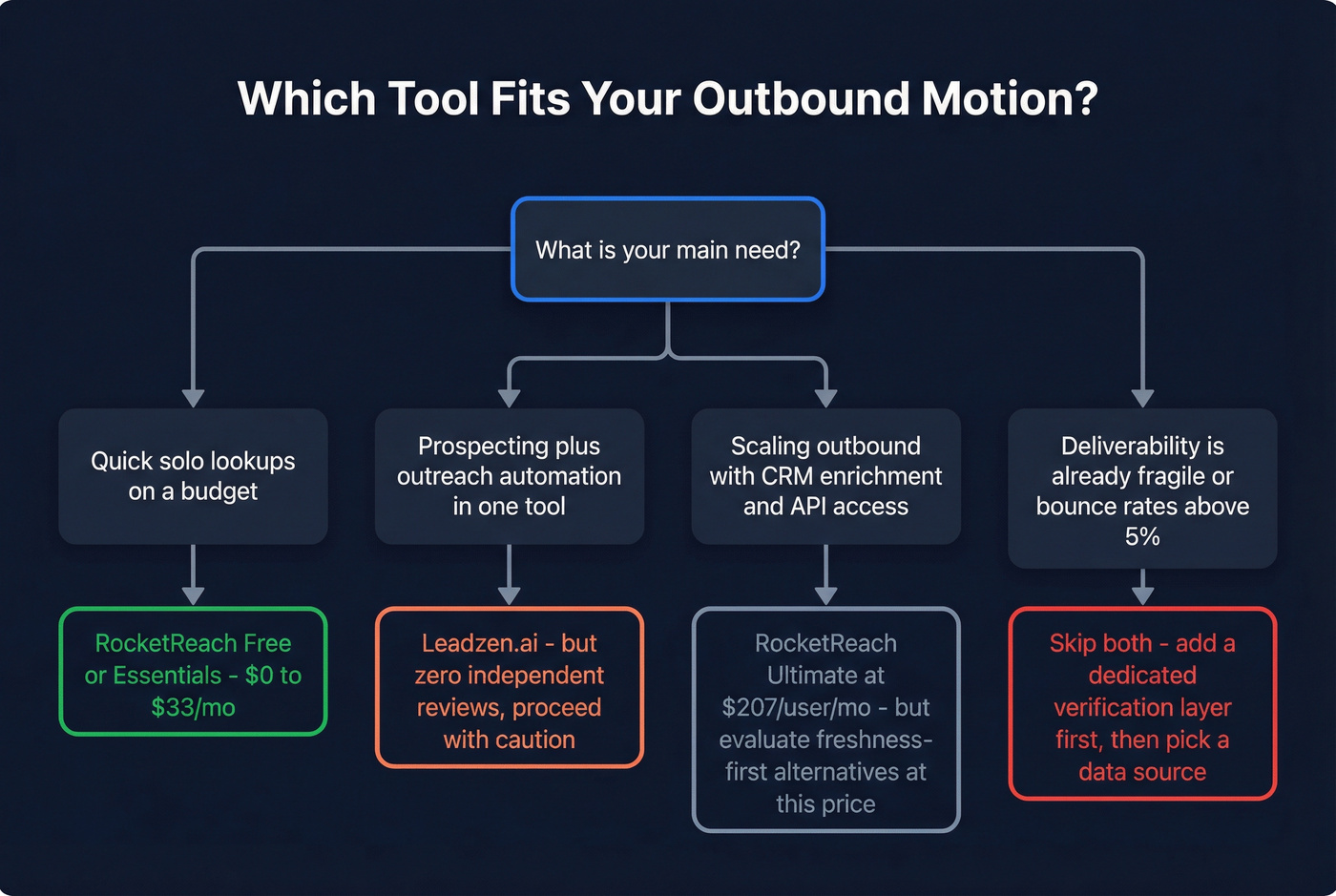
Team wanting prospecting + outreach automation in one place - Leadzen.ai, if you're comfortable with zero independent validation and a maturing product.
Scaling outbound with CRM enrichment + API - RocketReach Ultimate at $207/user/mo on annual billing gets you there, but at that price point, you should be evaluating sales intelligence platforms that compete harder on freshness and verification. Prospeo's 7-day data refresh cycle and 92% API match rate make it worth a serious look before committing to a $1,000+/mo RocketReach contract.
Deliverability already fragile - Add a dedicated verification layer before committing to either tool. Don't pour more contacts into a broken funnel.
When to Skip Both Tools
Let's be honest: if your core problem is data accuracy rather than data access, neither platform solves it by default.
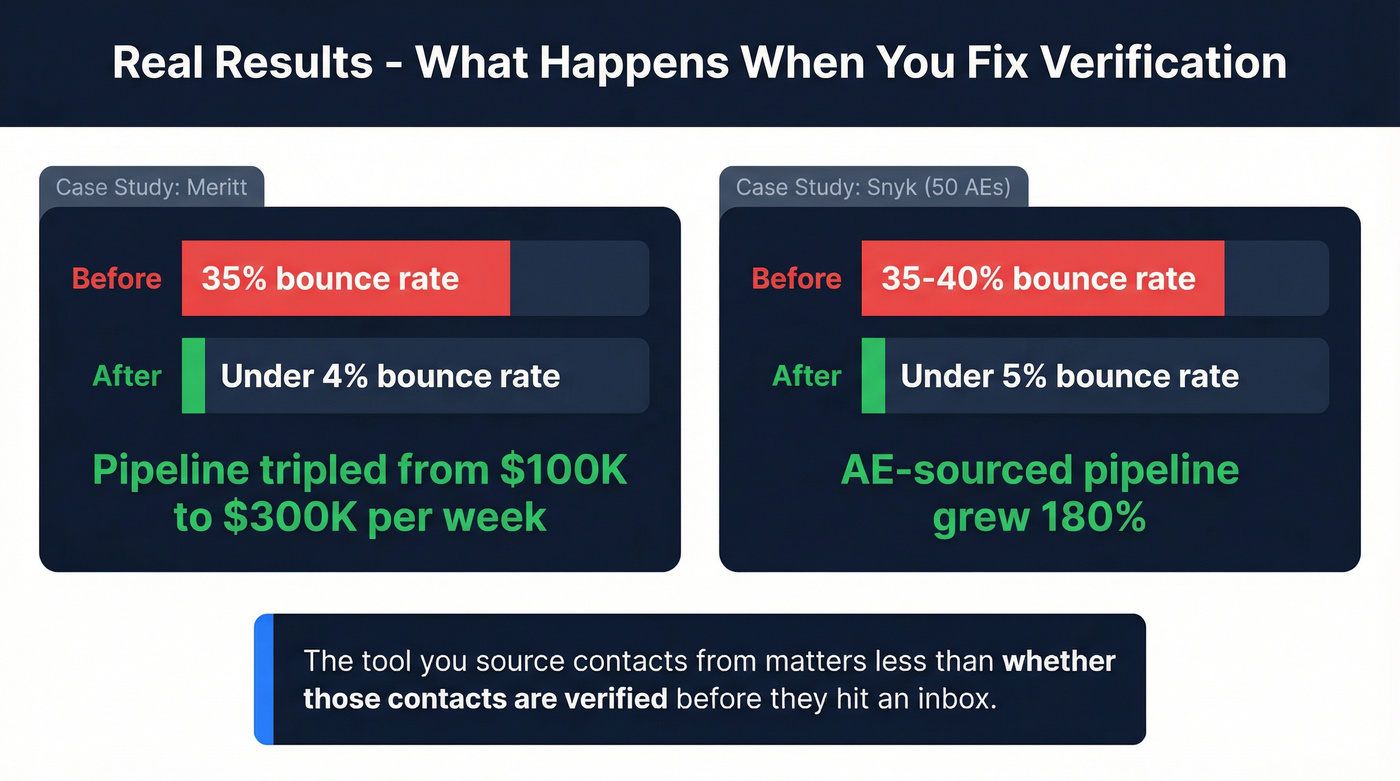
The tool you source contacts from matters less than whether those contacts are clean before they hit an inbox. Real results back this up: Meritt tripled pipeline from $100K to $300K/week and cut bounce rates from 35% to under 4% after switching to verified data. Snyk's 50 AEs dropped bounce rates from 35-40% to under 5% while growing AE-sourced pipeline 180%. Those numbers came from fixing the verification problem, not from switching lookup tools.
For teams that need both sourcing and verification in one platform - 300M+ professional profiles, 143M+ verified emails, 125M+ verified mobiles with a 30% pickup rate, buyer intent across 15,000 topics, and a 7-day refresh cycle - a single stack beats duct-taping two or three tools together. At roughly $0.01 per email with no annual contracts, the math speaks for itself.
If you're rebuilding your outbound stack, it also helps to compare broader B2B lead generation software options and the best cold email outreach tools before you lock in a data provider.
Neither Leadzen.ai nor RocketReach guarantees data freshness. Prospeo refreshes all 300M+ profiles every 7 days - not every 6 weeks. Add 143M+ verified emails, 125M+ verified mobiles with a 30% pickup rate, and buyer intent across 15,000 topics in one platform.
Replace the duct tape. Get sourcing, verification, and intent data in one stack.
FAQ
What's the difference between lookups and credits?
RocketReach lookups are annual allotments - one lookup reveals one contact's email or phone. Leadzen.ai credits are monthly and cover searches, exports, and outreach actions, so they deplete faster. A 300-credit Leadzen.ai plan often yields fewer usable contacts than 300 RocketReach lookups because each outreach step eats credits too.
Does RocketReach include phone numbers on all plans?
No. Phone numbers require Pro ($83/user/mo) or higher. Free and Essentials are email-only. If direct dials are critical to your outbound motion, budget for Pro at minimum.
Should I verify emails from either tool before sending?
Yes. Always. Export contacts from RocketReach or Leadzen.ai, then run them through a dedicated verification tool before loading sequences. This keeps bounce rates under 5% and protects your sender reputation. A 2024 Validity study found that even a 2% bounce rate increase can trigger spam filters at major inbox providers - so verification isn't optional, it's insurance.
Which tool has better integrations for outbound workflows?
RocketReach integrates with Salesforce, HubSpot, and Zapier but lacks native sequencing. Leadzen.ai bundles outreach automation but has limited third-party CRM depth. For teams running Outreach, Salesloft, Instantly, or Lemlist, a standalone data provider with native integrations across those platforms gives you more flexibility than either option.