

The Best Sales Intelligence Platforms in 2026 - With Real Pricing
You just opened the renewal quote from your data vendor. $38,000 for five seats - and your SDRs still spend half their mornings cleaning bad phone numbers out of sequences. The sales intelligence market has hit $3.8 billion at a 12.3% CAGR, which means more tools than ever are fighting for your budget. The right one transforms prospecting efficiency by 35% or more. The wrong one tanks your domain reputation and burns quota capacity before Q2.
Most comparison articles list the same ten tools and dodge the pricing question. We're not doing that. Every platform below includes real pricing ranges, credit economics, and a direct take on who should buy it - and who shouldn't.
How we evaluated: We tested each platform on data accuracy through sample bake-offs against real ICPs, pricing transparency, integration depth, compliance posture, and user sentiment from G2 reviews and Reddit threads.
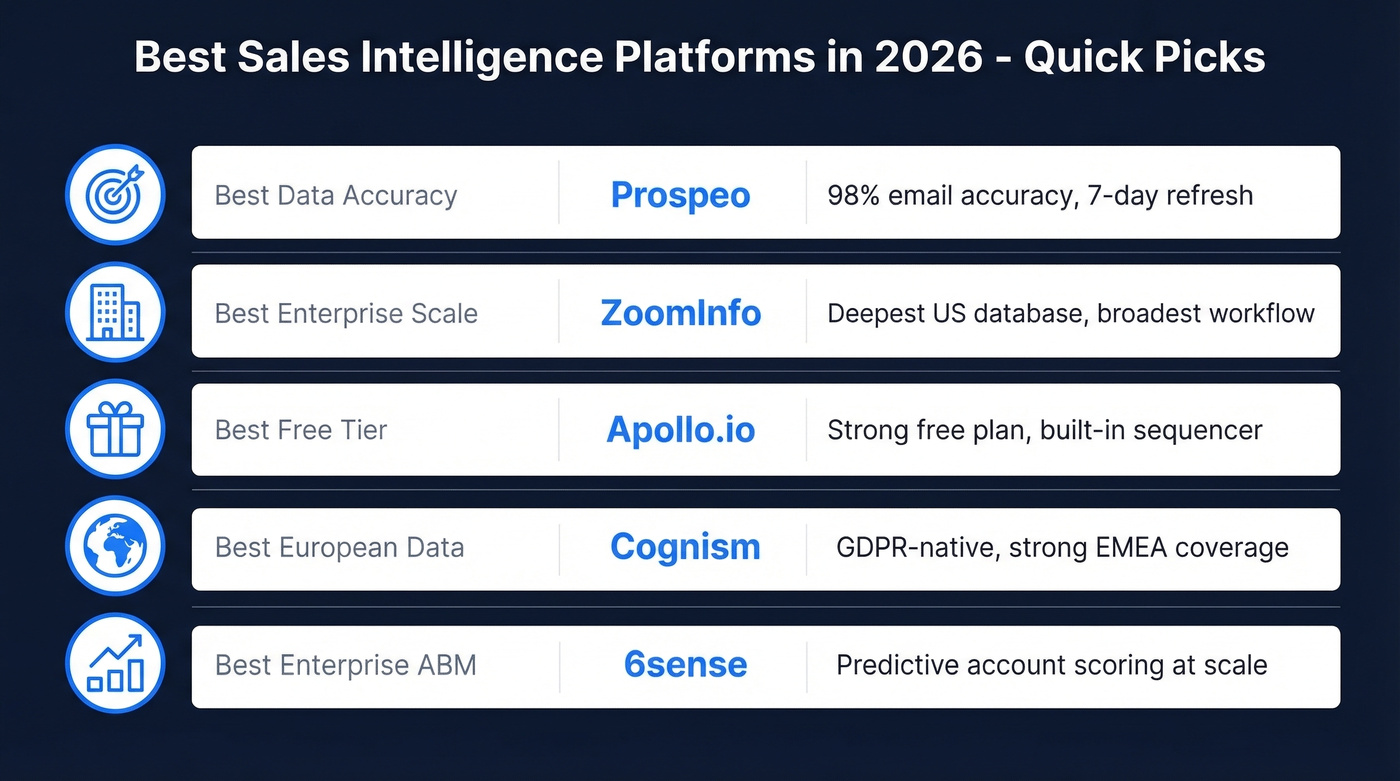
Quick Picks
| Need | Pick | Why |
|---|---|---|
| Best data accuracy and freshness | Prospeo | 98% email accuracy, 7-day refresh |
| Best for enterprise with budget | ZoomInfo | Deepest US database, broadest workflow |
| Best free tier to start | Apollo.io | Strong free plan, built-in sequencer |
| Best for European prospecting | Cognism | GDPR-native, strong EMEA coverage |
| Best for enterprise ABM/intent | 6sense | Predictive account scoring at scale |
What Is Sales Intelligence?
Sales intelligence platforms provide external data - contacts, firmographics, technographics showing what software a company runs, intent data revealing which accounts are actively researching solutions like yours - so your reps can find and prioritize the right buyers. They're distinct from your CRM, which stores internal relationship data, and from revenue intelligence tools like Gong or Clari, which analyze deal progression and call patterns.
The confusion between these categories is real, and vendors blur the lines on purpose. A CRM tells you what happened with a prospect. A sales intelligence tool tells you who to prospect in the first place and whether they're likely to buy right now. Revenue intelligence tells you why deals are winning or dying. 45% of sales professionals struggle to choose the right sales technology, partly because of this category soup.
The core data types you're evaluating: verified contact info like emails and direct dials, firmographics like company size and revenue, technographics showing what software a company runs, and intent data revealing which accounts are actively researching solutions like yours. The best platforms combine all four. Most only do one or two well.
The Data Quality Crisis
Here's the thing nobody in sales tech marketing wants to say out loud: most of these databases are full of garbage.
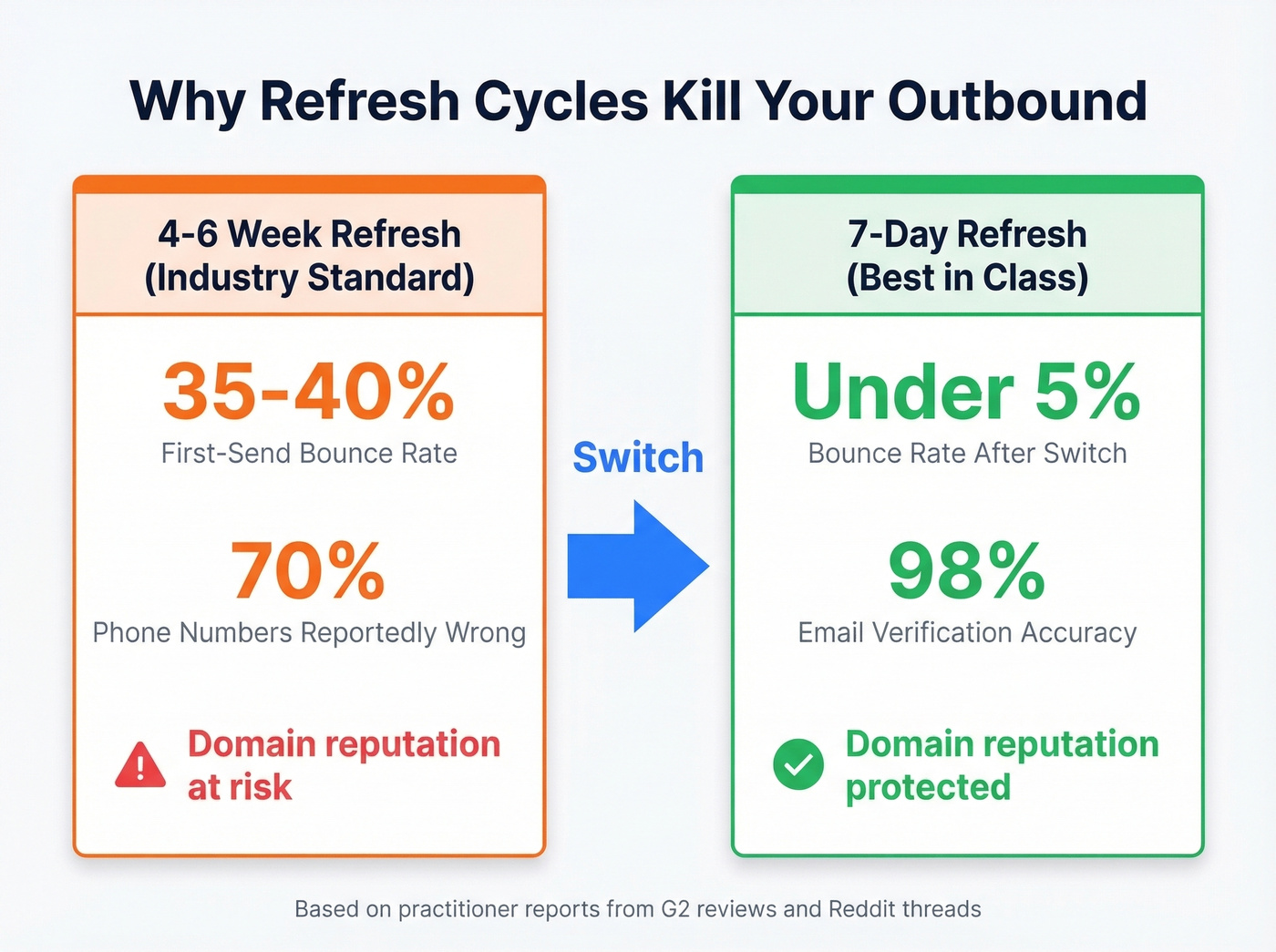
The consensus on r/b2bmarketing is blunt - big lead databases are broken. Outdated contacts, generic info@ emails, phone numbers that haven't worked in months. One practitioner claimed 70% of phone numbers from major providers are wrong. That's extreme, but directionally? We've run bake-offs where first-send bounce rates hit 35-40%. That's not a data problem. That's a domain reputation crisis waiting to happen.
The root cause is refresh cycles. Most platforms update records every four to six weeks. In that window, people change jobs, get promoted, switch companies entirely. A VP of Marketing at a Series B company today might be a CMO somewhere else next month, and if your platform hasn't caught that change, your SDR is emailing a dead address with a pitch that references the wrong company. Practitioners on Reddit are increasingly shifting to signal-based workflows - combining tools like Clay and Instantly with intent triggers rather than relying on static databases alone.

ZoomInfo's G2 reviews tell the same story: 4.5/5 overall with 9,031 reviews, but "inaccurate data" and "outdated contacts" are consistently among the top complaints. The best accuracy usually correlates with faster refresh cycles - weekly beats monthly, every time. If your current provider can't tell you exactly how often they update records, that's your answer.
10 Best Sales Intelligence Platforms in 2026
1. Prospeo - Best for Accuracy and Freshness
Use this if you care more about data that actually works than having the biggest database on paper. Pair with a sequencer like Lemlist or Instantly if you need a full-stack GTM suite with a built-in dialer and ABM orchestration.
Prospeo's database covers 300M+ professional profiles, 143M+ verified emails, and 125M+ verified mobile numbers. The numbers hold up in practice: Snyk's 50-person AE team dropped bounce rates from 35-40% to under 5%, with AE-sourced pipeline up 180% and 200+ new opportunities per month. Meritt tripled weekly pipeline from $100K to $300K. Stack Optimize built from $0 to $1M ARR while maintaining 94%+ client deliverability and zero domain flags.
The 30+ search filters go beyond basic firmographics - buyer intent powered by 15,000 Bombora topics, technographics, job changes, funding events, and headcount growth signals. The 7-day data refresh cycle means you're working with contacts that are actually current, not six-week-old snapshots. The proprietary 5-step email verification process includes catch-all handling, spam-trap removal, and honeypot filtering - they don't rely on third-party email providers.
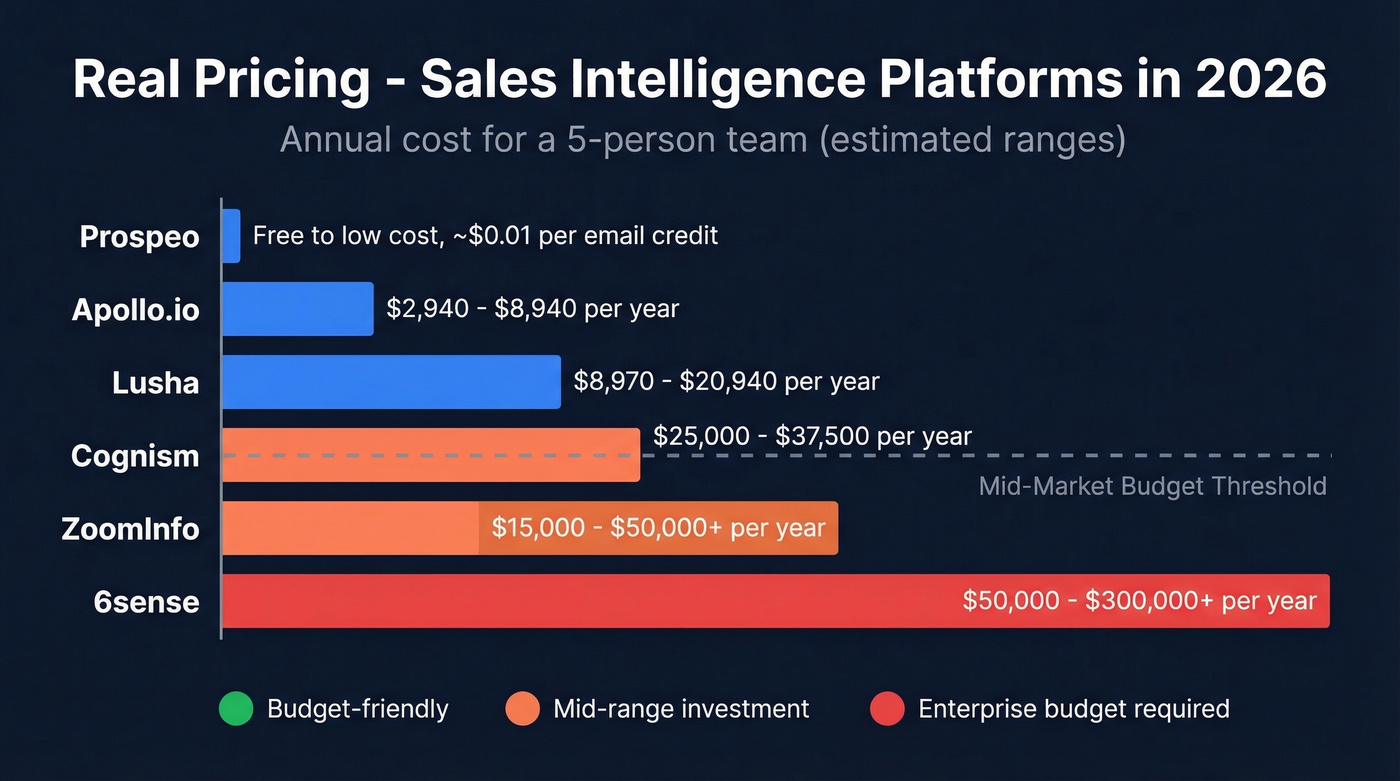
Pricing is transparent and self-serve. Credits run ~$0.01 per email. The free tier gives you 75 verified emails and 100 Chrome extension credits per month. No contracts, no sales calls required.


You just read why most sales intelligence platforms ship stale data on 6-week refresh cycles. Prospeo refreshes every 7 days, verifies emails through a proprietary 5-step process, and delivers 98% accuracy - at $0.01 per email.
Run your own bake-off with 75 free verified emails - no credit card required.
2. ZoomInfo - Best for Enterprise Scale
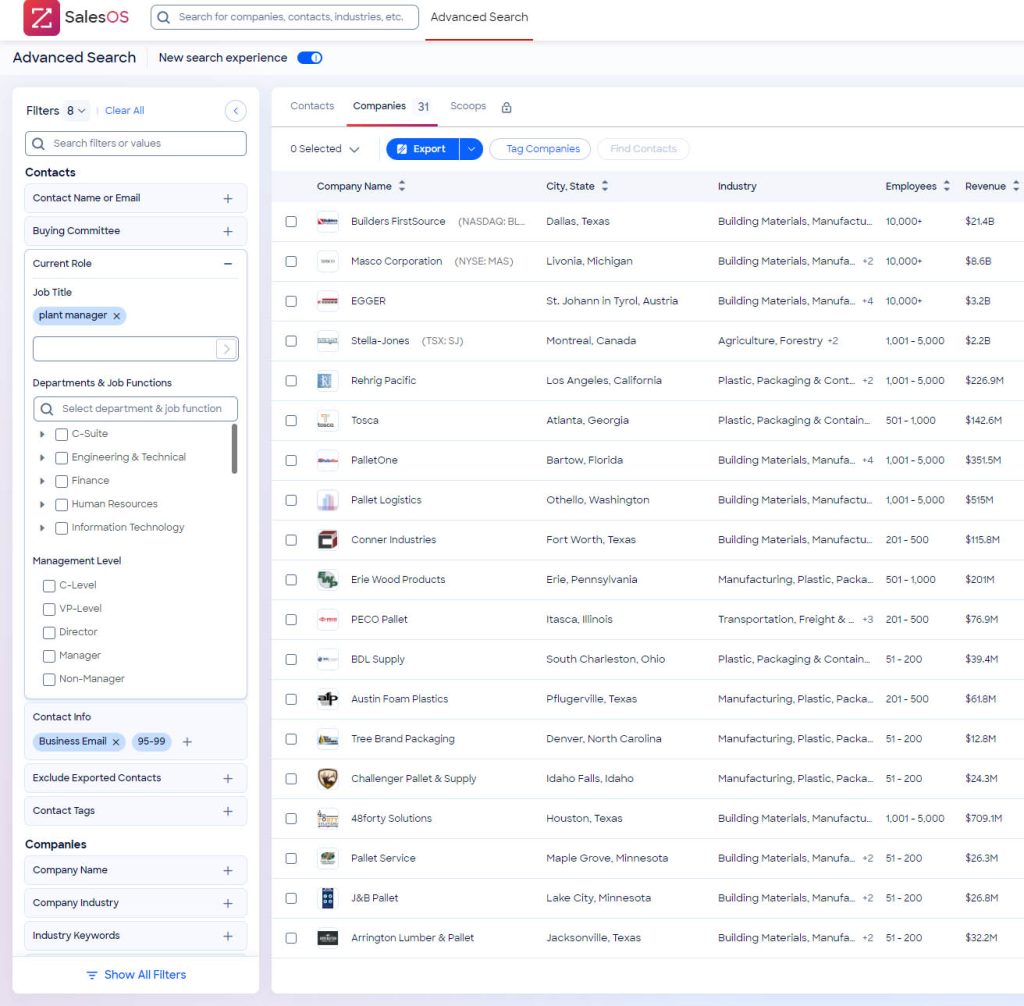
ZoomInfo is the default choice for large sales orgs. It's also the platform most teams realize they're overpaying for within six months.
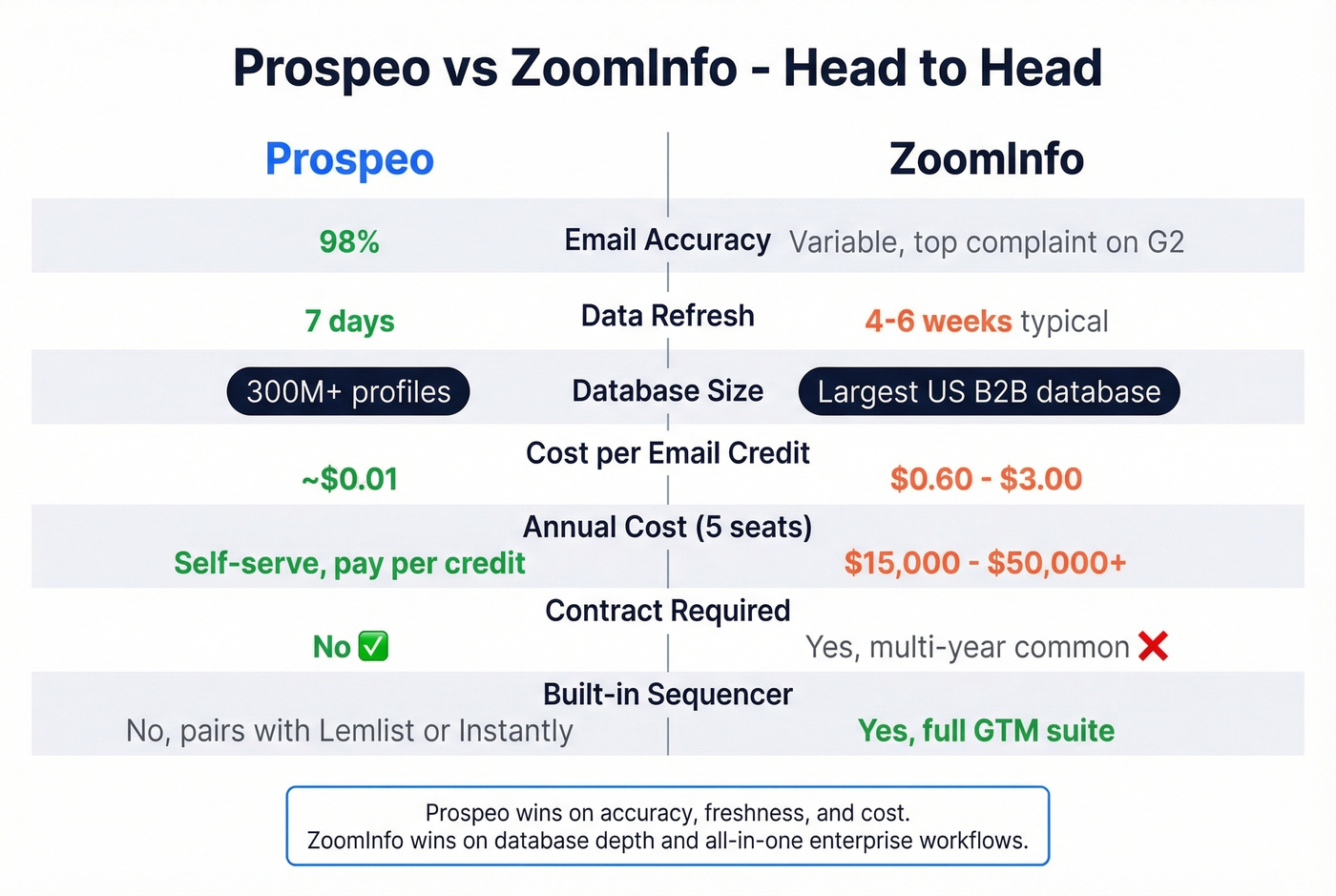
Pros: The deepest US B2B database, period. Advanced intent data, website visitor tracking, conversation intelligence via Chorus, and workflow automation that ties prospecting to engagement. If you're a 200+ person sales org running outbound, ABM, and intent from one platform, ZoomInfo can earn its price. The 4.5/5 G2 rating across 9,031 reviews reflects genuine product strength.
Cons: The #1 complaint on G2 and Reddit? Price - followed immediately by data accuracy. A Professional plan starts at ~$15,000/year, Advanced runs $24,000+, and Elite hits $40,000+. Once you add Global Data ($9,995), extra credits (~$3,000 per 5,000), and NeverBounce (~$3,000), teams routinely land near $50,000/year. Credit costs range from $0.60 to $3.00 each depending on volume.
The contract structure is the real trap. Multi-year deals with 60-90 day auto-renewal windows mean you need to flag cancellation months in advance. Discounts of 30-65% are common if you negotiate - never accept the first quote.
Best for: Enterprise teams with $30K+ annual data budgets who need a single-vendor GTM stack.
3. Apollo.io - Best Free Tier
Apollo is the obvious starting point for any startup bootstrapping outbound. The free plan includes contact access, basic search, and up to two sequences - enough to validate whether outbound works for your business before spending a dollar.
Paid tiers commonly land around $49-$59/user/month (Basic), $79-$99/user/month (Professional), and $119-$149/user/month (Organization, often with a minimum seat count). The database covers 210M+ contacts with a built-in sequencer, which means you don't need a separate outreach tool on day one.
The catch is credit economics. Credits don't roll over - unused credits expire each billing cycle. Waterfall enrichment means variable credit burn depending on geography, so a team prospecting into EMEA will chew through credits faster than one focused on the US. We've seen accuracy degrade at scale, particularly for mobile numbers and contacts outside North America. ZoomInfo still wins on data depth for enterprise accounts, but Apollo's speed to value and built-in sequencer are hard to beat at the price.
Best for: Seed to Series A teams running their first outbound motion. Graduate to a dedicated data provider once you're past 5-10 reps.
4. Cognism - Best for European Data
If you're selling into the UK, DACH, or Nordics, Cognism is one of the strongest options. Their GDPR-first approach isn't just a compliance checkbox - it's the reason their EMEA coverage is so competitive versus US-centric providers.
Cognism's intent data is powered by Bombora and sold as an add-on. They also offer mobile verification as a separate add-on, and the platform checks against 15+ Do-Not-Call lists - a real differentiator for teams cold-calling into regulated European markets.
Pricing is quote-based and commonly sold as a platform fee plus per-seat access. Typical benchmarks: ~$15,000 platform fee + $1,500/user/year on lower tiers, ~$25,000 access fee + $2,500/user/year on higher tiers. For a five-person team on the higher tier, you're looking at roughly $37,500/year - meaningful money, but often less than ZoomInfo for teams that are Europe-heavy.
Best for: Teams with 30%+ of their pipeline in Europe. If you're US-only, look elsewhere.
5. Lusha - Quick Enrichment
Lusha's strength is speed. The Chrome extension reveals contacts in seconds, and the credit system is simple: 1 credit per email, 10 credits per phone number. The free tier gives you 70 credits per month - enough for casual prospecting but not serious outbound.
Here's the credit math that matters: if your team is phone-heavy, 70 free credits gets you exactly 7 phone reveals. Even on the Pro plan ($29.90-$39.90/user/mo with 250 credits), 25 phone reveals burns your monthly allocation. Phone-heavy SDR teams should budget for Premium ($52.45-$69.90/user/mo, 800 credits) or higher.
Best for: Individual reps or small teams who need quick contact lookups, not bulk list building. Skip this if you're running high-volume outbound - the credit economics don't scale.
6. 6sense - Enterprise ABM
6sense is the heavyweight intent platform. The median buyer pays $58,617/year, with contracts typically ranging from $50K to $300K+ depending on TAM size, modules, and professional services. There's a free plan with 50 credits/month, but you're not getting 6sense's value from 50 credits.
The platform excels at predictive account scoring - showing you which accounts are in-market before they fill out a form. For enterprise marketing-sales alignment, it's best in class. But it's overkill for teams under 100 people. The implementation alone takes months, and the ROI only materializes when you have enough pipeline volume to justify the predictive models.
Best for: Enterprise orgs with dedicated ABM teams and $50K+ data budgets.
7. Gong - Conversation Intelligence
Gong sits in a different category than the contact databases above. It's revenue intelligence - analyzing sales calls, emails, and deal progression to tell you why deals win or lose. Pricing is quote-only, but expect roughly $100-$150/user/month with modules priced separately.
The ROI case is strong. Outreach's data on their Kaia coaching assistant - a comparable product - shows deals close 11 days faster on average, with a 10-point win-rate lift on deals over $50K. Their broader analysis also found that deals closed within 50 days carry a 47% win rate versus just 20% after 50 days. Speed matters, and coaching tools compress cycles.
Best for: Mid-market and enterprise teams with 10+ AEs where coaching quality directly impacts revenue.
8. Lead411 - Budget-Friendly Prospecting
Lead411 takes a different approach than the enterprise giants. The Spark plan starts at $49/month with a free 7-day trial. It won't match the data depth of Tier 1 tools, but the pricing makes it a reasonable option for small teams that need basic contact data without a big annual commitment.
9. HubSpot Sales Hub
HubSpot Sales Hub isn't a standalone intelligence tool - it's a CRM with prospecting features bolted on. Free tier available, Starter at $20/seat/mo, Professional at $100/seat/mo. If your team already lives in HubSpot, the native tools save integration headaches. Otherwise, pair a dedicated data provider with HubSpot's CRM.
10. Kaspr, Demandbase, and Others Worth Knowing
Kaspr is a Chrome extension-first tool focused on European contact data. Free plan available, paid from ~$49/user/month. Think of it as Lusha's European cousin - lighter, cheaper, narrower.
Demandbase is 6sense's direct competitor in the enterprise ABM space, combining intent data with advertising and personalization. Pricing runs $30K-$100K+/year. Best for large organizations running coordinated marketing-sales ABM plays where advertising spend and intent data need to live in one platform.
Other tools worth evaluating: RocketReach (frequently recommended on Reddit for quick lookups), Seamless.AI (aggressive pricing, mixed accuracy reviews), and Clearbit/Breeze Intelligence (strong for enrichment workflows).
The data quality crisis isn't theoretical - 35-40% bounce rates destroy domain reputation and burn quota. Snyk's 50 AEs dropped bounces to under 5% and added 200+ opportunities per month after switching. Stack Optimize hit $1M ARR with zero domain flags.
Pick the sales intelligence platform your deliverability actually survives.
Pricing Comparison
Here's what you'll actually pay - not the "contact sales" runaround.
| Tool | Starting Price | Credit Cost | Free Tier | Contract? |
|---|---|---|---|---|
| Prospeo | ~$0.01/email | ~$0.01/email | 75 emails/mo + ext | No |
| ZoomInfo | ~$15K/year | $0.60-$3.00/credit | No | Yes, multi-year |
| Apollo.io | Free / ~$49-$59/user/mo | Varies by action | Yes (generous) | No |
| Cognism | ~$15K + ~$1.5K/user/yr | Included in plan | No | Yes, annual |
| Lusha | Free / $29.90/user/mo | 1/email, 10/phone | 70 credits/mo | No |
| 6sense | ~$58K/yr median | Included in plan | 50 credits/mo | Yes, annual |
| Gong | ~$100-$150/user/mo | N/A | No | Yes, annual |
| Lead411 | $49/mo | Plan-based | 7-day trial | No |
| HubSpot Sales Hub | Free / $20/seat/mo | N/A | Yes | No |
| Kaspr | Free / ~$49/user/mo | Credit-based | Yes | No |
| Demandbase | $30K-$100K+/yr | Included in plan | No | Yes, annual |
How to Choose the Right Platform
Six criteria matter. Everything else is noise.
Data accuracy. The single most important factor. Upload 200-500 contacts from your actual ICP and measure bounce rates, phone connect rates, and match rates against your own data. Ask the vendor: "Can I run a sample test before committing?" If they say no, walk. (If you need a framework for list hygiene, start with email bounce rates.)
Refresh cycle. Stale data is worse than no data - it actively damages your sender reputation. Weekly refresh is the gold standard. Monthly is acceptable. Anything longer and you're paying for a database that's rotting in real time. If you're already seeing deliverability issues, use an email deliverability guide and a plan to improve sender reputation.
Pricing transparency. If a vendor won't publish pricing, budget 3x what you'd expect. The fact that ZoomInfo, Cognism, 6sense, and Demandbase all require sales conversations to get a number isn't an accident - it's a negotiation tactic. Self-serve pricing means you know what you're paying before you commit. Ask: "What's the all-in cost including add-ons, overages, and renewal increases?" (If you're comparing vendors, see our breakdown of sales prospecting databases.)
Integration depth. Your data provider needs to push contacts into your CRM and your sequencer without manual CSV exports. Bi-directional sync and duplicate handling separate real integrations from glorified data dumps. If you're mapping your stack, use this guide to connect outreach tool to CRM.
Compliance posture. If you sell into Europe, GDPR compliance isn't optional - and CCPA matters for California contacts. DNC list checking, opt-out enforcement, and data processing agreements separate serious platforms from liability risks.
Self-serve vs. enterprise sales process. Can you buy and start using the tool in five minutes, or does it take three months of procurement, legal review, and implementation? For teams under 50 people, self-serve platforms get you to value faster. Enterprise tools earn their complexity only when you have the ops team to manage them. (For stack planning, start with the broader list of SDR tools.)
The AI Layer - What Actually Matters
56% of sales professionals now use AI daily, and sellers partnering with AI tools are 3.7x more likely to meet quota. But "AI-powered" has become the most meaningless phrase in sales tech. Let's be honest - half the time it just means they added a chatbot to the search bar.
Three AI categories actually move numbers. Predictive scoring - platforms like 6sense and Demandbase that identify in-market accounts before they raise their hand. Conversation intelligence - tools like Gong analyzing call patterns to coach reps. And AI SDRs - automated agents handling initial outreach and qualification, with 45% of teams now running hybrid AI-SDR models. If you're building that motion, start with AI cold email outreach and a practical lead scoring model.
The distinction that matters: AI-native platforms built intelligence into the core product from day one. AI-bolted-on platforms slapped a feature label on something cosmetic and called it innovation. When evaluating, ask what the AI actually does - not whether it exists. If the answer is "it writes your emails," that's table stakes.
Look, if your average deal size is under $15K, you probably don't need a $50K intelligence suite with AI-powered intent scoring. A $50/month tool with accurate emails and a solid sequencer will outperform a bloated enterprise stack that your team barely uses. The companies seeing a 23% increase in annual revenue from sales intelligence aren't the ones buying the most expensive tool - they're the ones whose reps actually use the data every day.
Sales Intelligence Platforms FAQ
What's a sales intelligence platform?
It provides external data about prospects and companies - verified contacts, firmographics, technographics, and intent signals - so sales teams can find and prioritize buyers. It's distinct from a CRM (internal relationship data) and revenue intelligence (deal analytics). The core job is answering "who should we sell to next?"
How much do these platforms cost?
Pricing ranges from free tiers to $300,000+/year for enterprise 6sense deployments. Most mid-market teams spend $15,000-$50,000/year. Credit-based models mean your actual cost depends on usage volume - a phone-heavy team on Lusha pays dramatically more per contact than an email-focused team at ~$0.01/email.
What's the most important feature to evaluate?
Data accuracy and refresh frequency matter more than database size. A 300M-contact database refreshed weekly beats a 600M-contact database refreshed every six weeks. Bad data damages your domain reputation, wastes SDR time on dead numbers, and erodes trust in the entire outbound motion. Run a sample test with your actual ICP before committing to anything.
Can I combine multiple tools in one stack?
Yes - most mature teams do. Teams using the right combination of tools see 28% higher win rates and 26% larger deal sizes. A common stack pairs a data provider for contacts and enrichment with an engagement tool like Lemlist or Instantly for sequences, and optionally a conversation intelligence layer like Gong for coaching.
Which platform has the best email accuracy?
Prospeo leads with 98% verified email accuracy and a 7-day refresh cycle. The accuracy gap compounds at scale: a 10% difference in email validity across 50,000 sends means 5,000 bounces that could've been avoided, plus lasting damage to sender reputation.
Start with a sample test of 200 contacts against your actual ICP. The platform that delivers the lowest bounce rate wins your budget.