

Every Email Provider in 2026: The Full List
There are 4.59 billion email users on the planet - projected to hit 4.73 billion this year - sending 376.4 billion messages daily across hundreds of providers. The average person juggles 1.86 accounts. Yet most articles claiming to list all email providers cover the same dozen names and call it a day.
This is the full directory: every major provider across six categories, with market share data, storage limits, pricing, and the regional and legacy domains you won't find elsewhere.
Quick Picks
- Personal - Gmail or Outlook. Free, reliable, massive storage.
- Privacy - Proton Mail or Tuta (zero-knowledge encryption).
- Business - Google Workspace ($7/user/mo) or Zoho Mail ($1/user/mo).
- Temporary - Guerrilla Mail or 10MinuteMail.
That covers 90% of people. The rest of this page is for the other 10% - and for anyone who needs to understand the full provider ecosystem.
Email Provider Market Share
"Market share" in email gets measured two ways: by email opens (which client renders the message) and by domain volume (which provider hosts the address). They tell different stories.
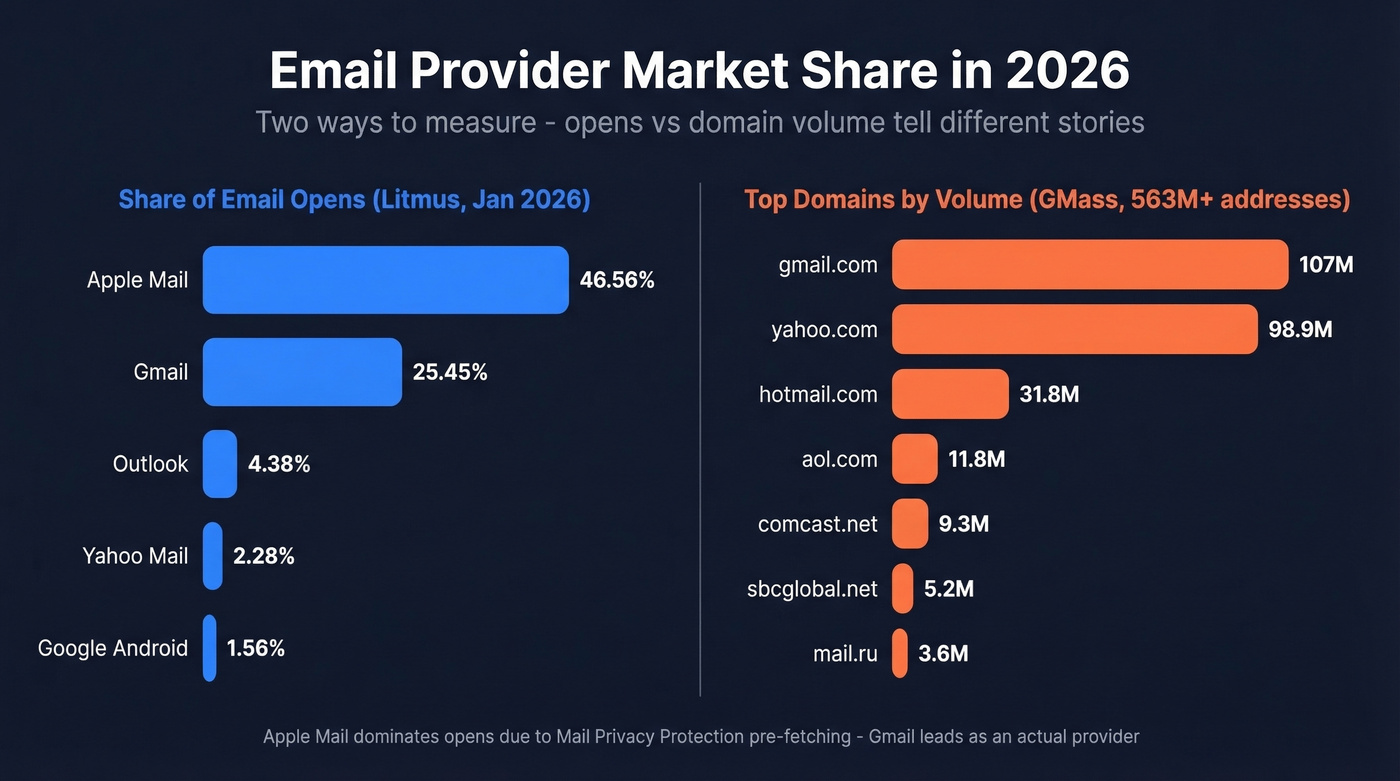
Litmus's January 2026 report, calculated from over 1.1 billion opens, shows Apple Mail dominating the client side - largely because Apple's Mail Privacy Protection pre-fetches opens. Gmail leads as an actual provider.
| Client/Provider | Share of Opens |
|---|---|
| Apple Mail | 46.56% |
| Gmail | 25.45% |
| Outlook | 4.38% |
| Yahoo Mail | 2.28% |
| Google Android | 1.56% |
On the domain side, GMass's dataset of 563M+ email addresses paints a different picture: gmail.com leads at 107M, yahoo.com follows at 98.9M, and hotmail.com still pulls 31.8M. After that come aol.com at 11.8M, comcast.net at 9.3M, sbcglobal.net at 5.2M, and mail.ru at 3.6M - ISP and regional domains that most people forget exist.

Hundreds of email providers. Millions of domains. One problem: finding the right person's actual address. Prospeo's proprietary email-finding infrastructure works across every provider on this list - Gmail, Outlook, regional domains, legacy ISPs - and verifies each address through a 5-step process that delivers 98% accuracy.
Stop memorizing providers. Start finding verified emails at $0.01 each.
The Full List of All Email Providers
Free Consumer Providers
| Provider | Free Storage | Attachment Limit | Ads | IMAP/POP3 |
|---|---|---|---|---|
| Gmail | 15 GB | 25 MB | Yes | Yes |
| Outlook.com | 15 GB | 32 MB | Yes | Yes |
| Yahoo Mail | 20 GB | 25 MB | Yes | Yes |
| AOL Mail | Up to 1 TB | 25 MB | Yes | Yes |
| GMX | 65 GB | 50 MB | Yes | Yes |
| Mail.com | Not public | 50 MB | Yes | Yes |
| iCloud Mail | 5 GB | 20 MB | No | Yes |
| Zoho Mail | Free tier available | 25 MB | No | Yes |
Gmail is the default: 1.8 billion active accounts, tight Google ecosystem integration, and 15 GB of shared storage most people never fill. Outlook.com matches that storage and edges Gmail on attachment size - 32 MB vs 25 MB. Yahoo Mail cut its free storage from 1 TB to 20 GB in mid-2025, a move that frustrated long-time users but still leaves it competitive.
The sleeper pick is GMX, which offers 65 GB free. We've tested it - that number is real, no catch, no asterisk. If storage is your constraint, nothing else comes close at zero cost.
Privacy-Focused Providers
Most "secure email" services encrypt messages in transit. That's table stakes. Proton Mail and Tuta are the providers built around zero-knowledge, end-to-end encryption by default. Proton has over 100M accounts, giving it real network effects for encrypted Proton-to-Proton messaging.
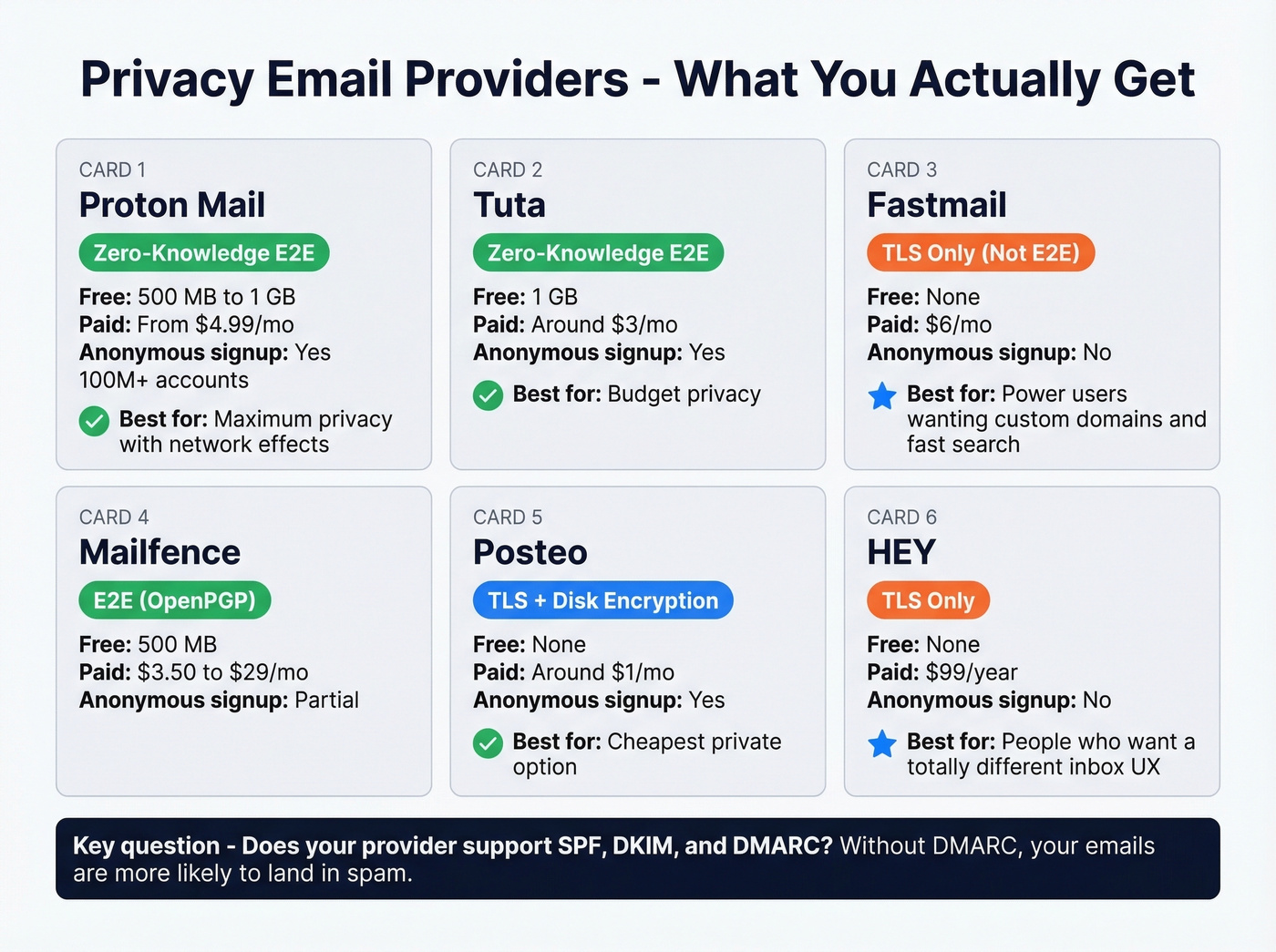
Fastmail is excellent for power users who want custom domains and fast search, but it isn't zero-knowledge. HEY ($99/yr) rethinks the inbox UX itself. It's polarizing, but people who love it really love it.
One technical dimension worth checking: does your provider support SPF, DKIM, and DMARC authentication? If a provider doesn't support DMARC, your emails are more likely to land in spam, especially when sending to corporate addresses.
| Provider | Encryption | Free Storage | Paid Price | Anon Signup |
|---|---|---|---|---|
| Proton Mail | E2E, zero-knowledge | 500 MB-1 GB | From $4.99/mo | Yes |
| Tuta | E2E, zero-knowledge | 1 GB | ~$3/mo | Yes |
| Fastmail | TLS (not E2E) | None | $6/mo | No |
| Mailfence | E2E (OpenPGP) | 500 MB | ~$3.50-29/mo | Partial |
| Posteo | TLS + disk encrypt | None | ~$1/mo | Yes |
| Mailbox.org | PGP optional | 2 GB | ~$1-9/mo | No |
| StartMail | PGP built-in | None | Not public | Yes |
| HEY | TLS | None | $99/yr | No |
Business Email Hosting
Google Workspace at $7/user/month (Business Starter) remains the go-to - Gmail with your domain, plus Docs, Drive, and Meet. Microsoft 365 Business Basic starts at ~$6/user/month and makes sense if your team lives in Excel and Teams.
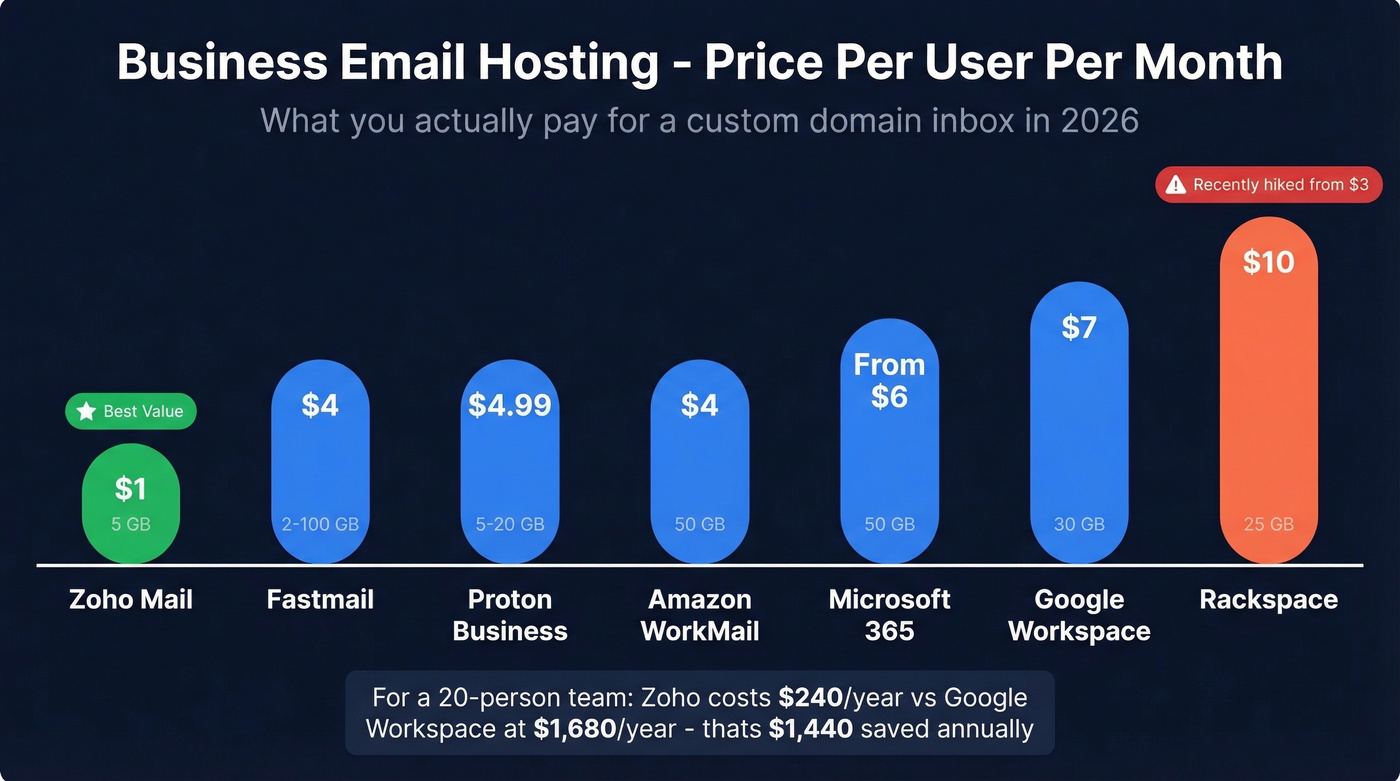
But here's the thing: Zoho Mail at $1/user/month is the most underrated business email on the market. It's clean, ad-free, supports custom domains, and works fine for teams that don't need the full Google or Microsoft ecosystem. For bootstrapped startups, that's $1 vs $7 per seat. The math is obvious. Rackspace recently hiked from $3 to $10/mailbox/month, so if you're still there, it's time to move.
| Provider | Price/User/Mo | Storage | Custom Domain |
|---|---|---|---|
| Google Workspace | $7 / $14 / $22 | 30 GB-5 TB | Yes |
| Microsoft 365 | From ~$6 | 50 GB | Yes |
| Zoho Mail | $1 | 5 GB | Yes |
| Fastmail | $4/user | 2-100 GB | Yes |
| Proton Business | $4.99 | 5-20 GB | Yes |
| Rackspace | $10 | 25 GB | Yes |
| Amazon WorkMail | $4 | 50 GB | Yes |
Regional and International Providers
Over 1 billion email users sit outside the English-speaking world, and their default providers aren't Gmail. Most English-language articles ignore these entirely, but they're massive: QQ Mail and NetEase (163.com, 126.com) dominate China, Mail.ru and Yandex Mail own Russia and the CIS countries, Naver Mail is the default in South Korea, and T-Online serves 12M+ users in Germany alone.
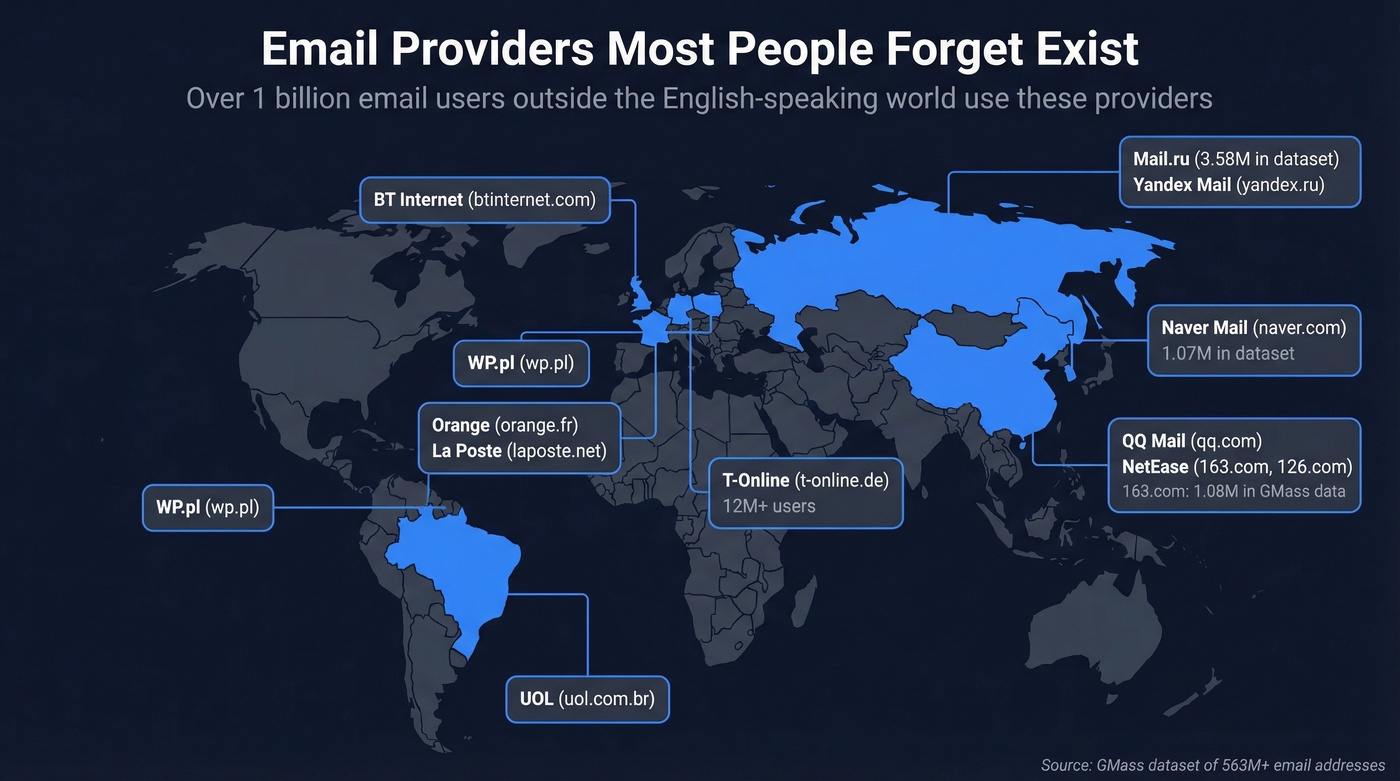
GMass's domain data confirms these aren't niche - 163.com shows 1.08M emails in their dataset, naver.com 1.07M, and mail.ru 3.58M. Developer-oriented lists like the GitHub free-email-domains project catalog hundreds of domains in JSON format, but without context on which ones actually matter.
| Provider | Country/Region | Domain(s) |
|---|---|---|
| QQ Mail | China | qq.com |
| NetEase | China | 163.com, 126.com |
| Mail.ru | Russia/CIS | mail.ru |
| Yandex Mail | Russia/CIS | yandex.ru |
| Naver Mail | South Korea | naver.com |
| T-Online | Germany | t-online.de |
| Orange | France | orange.fr |
| La Poste | France | laposte.net |
| WP.pl | Poland | wp.pl |
| UOL | Brazil | uol.com.br |
| BT Internet | UK | btinternet.com |
ISP and Legacy Domains
ISP email addresses are the cockroaches of the email world - they refuse to die. An estimated 70M+ legacy addresses remain active in 2026, even though most ISPs stopped offering new signups years ago.
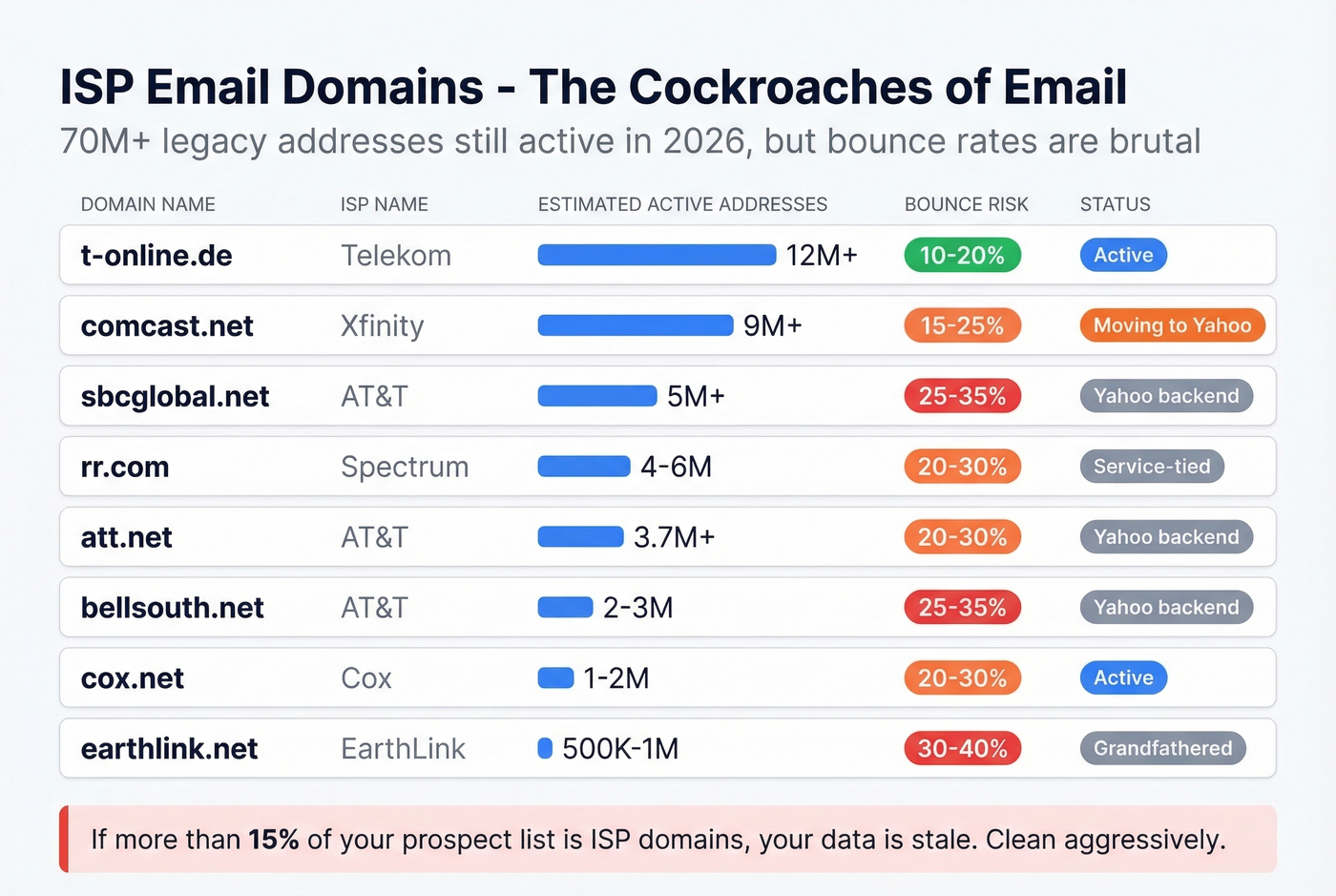
Comcast is transitioning subscriber mailboxes to Yahoo Mail's backend, which means Yahoo sender requirements now apply. Note that comcast.net is for Xfinity subscribers, while comcast.com is reserved for Comcast employees. If you're sending to these domains, expect bounce rates in the 30-50% range.
Let's be honest: if more than 15% of your prospect list is ISP domains, your data is stale. These addresses skew older, bounce harder, and convert worse than any other category. Clean them aggressively - starting with email bounce rates and what they signal.
| Domain | ISP | Est. Active Addresses | Bounce Risk | Status |
|---|---|---|---|---|
| comcast.net | Xfinity | 9M+ | 15-25% | Moving to Yahoo |
| att.net | AT&T | 3.7M+ | 20-30% | Yahoo backend |
| sbcglobal.net | AT&T | 5M+ | 25-35% | Yahoo backend |
| bellsouth.net | AT&T | 2-3M | 25-35% | Yahoo backend |
| rr.com | Spectrum | 4-6M | 20-30% | Service-tied |
| cox.net | Cox | 1-2M | 20-30% | Active |
| earthlink.net | EarthLink | 500K-1M | 30-40% | Grandfathered |
| sympatico.ca | Bell Canada | 500K-1M | 30-40% | Grandfathered |
| rogers.com | Rogers | 500K-1M | 25-35% | Service-tied |
| t-online.de | Telekom | 12M+ | 10-20% | Active, largest EU |
Service-tied means the email only works while you're an active subscriber. Grandfathered means existing accounts remain active but new signups are closed.
Disposable and Temporary Services
These exist for one purpose: avoiding spam when you need a quick signup. Skip this category entirely if you need anything permanent.
- Guerrilla Mail - 60-minute inbox that supports replies. The most full-featured throwaway option.
- 10MinuteMail - Stricter time limit, dead simple interface. Good for one-time verifications.
- 1SecMail - No ads, no signup, multiple domains, and API access. The pick for automated testing.
- Temp-Mail.org - Auto-generates an address instantly. Solid browser-based option.
- ThrowAwayMail - Bare-bones, no frills. Works when you need something in five seconds.
How to Choose the Right Provider
The Quick Picks section above covers most use cases. The remaining edge cases come down to specifics: if you need anonymous signup, go Proton or Tuta. If you're sending newsletters, your provider's DMARC support matters more than its storage. If you're operating in China, QQ Mail isn't optional - it's required.
For teams building prospect lists, the provider domain matters for a different reason entirely: deliverability. We've verified emails across every provider type on this page - from gmail.com to legacy ISP domains like sbcglobal.net - and Prospeo handles all of them with 98% accuracy across 143M+ verified addresses. That includes catch-all domain verification and spam-trap removal, which is where most verification tools fall apart on ISP and regional domains.
If you're doing outbound at any real volume, pair provider choice with an email deliverability guide and a clear plan to improve sender reputation.

ISP domains, legacy addresses, catch-all servers - if more than 15% of your list is stale data, your bounce rates will destroy your sender reputation. Prospeo refreshes 300M+ profiles every 7 days and strips out spam traps, honeypots, and dead addresses so you never send to an inbox that doesn't exist.
Clean data across every domain. Under 4% bounce rates, guaranteed by the data.
FAQ
How many email providers exist worldwide?
Estimates range up to 1,000 free providers globally, with SMTPedia documenting 130+ in detail. This directory covers the most important ones across six categories: free consumer, privacy, business, regional, ISP/legacy, and disposable.
What's the most popular email provider in 2026?
Gmail leads with 1.8 billion active accounts and 25.45% of opens in Litmus's January 2026 dataset. Apple Mail tops opens at 46.56%, but that's a client metric - Apple doesn't host email addresses.
Are ISP email addresses still active?
Yes - roughly 70M+ legacy ISP addresses remain active, though bounce rates run 30-50%. Many are tied to active internet subscriptions. Verify them before sending to avoid domain reputation damage.
Can I use multiple email providers at once?
Most people already do - the average person manages 1.86 accounts. A common setup: Gmail for personal use, Google Workspace or Microsoft 365 for work, and Proton Mail for sensitive communication.