

Lusha vs Nymeria: Honest Comparison (2026)
Most "Lusha vs Nymeria" comparison pages are either auto-generated or based on a test from 2018. Here's the thing: these two tools don't really compete anymore. Lusha has evolved into a full sales intelligence platform with intent data and AI-built lead lists, and its Scale tier is custom-priced - typically starting around ~$37K/year for ~25 seats. Nymeria is still a focused contact-lookup tool at $39-$159/month. They solve different problems at wildly different price points, and we've spent time testing both to figure out where each one actually makes sense.
30-Second Verdict
- Pick Lusha if you need intent data, outreach automation, and CRM enrichment - and have the budget for the Scale plan.
- Pick Nymeria if you need cheap, simple contact lookups without a full workflow suite.
- Skip both if email accuracy matters most. Prospeo delivers 98% verified emails at ~$0.01/email with a free tier - no $37K contracts required.
What Each Tool Actually Does
You'll see wildly wrong database sizes for these tools in some directories (3.5B, 3.5M). Both figures are outdated or incorrect.
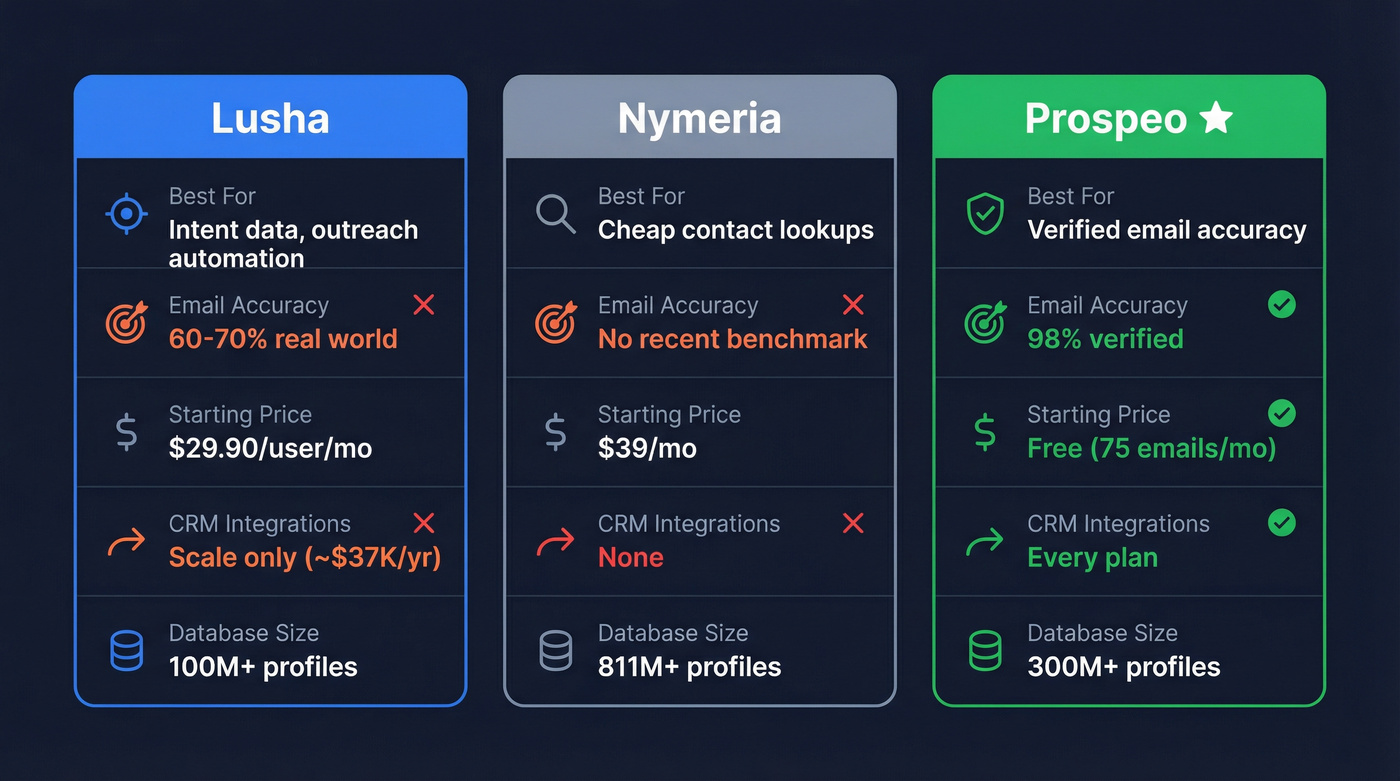
Lusha offers 100M+ profiles layered with buying signals like job changes, funding news, and hiring momentum. AI Playlists auto-build lead lists based on your ICP criteria. It's trying to be your entire top-of-funnel stack - CRM enrichment, outreach sequencing, the works.
Nymeria indexes 811M+ profiles, runs browser extensions across Chrome, Edge, and Firefox, and charges only for successful lookups. It covers GitHub profiles, which is a niche recruiters love. But there's no native CRM integration, no intent data, and no automation layer to speak of.

Lusha locks CRM integrations behind a $37K/year paywall. Nymeria has zero native CRM connections. Prospeo gives you Salesforce and HubSpot integrations on every plan, 98% email accuracy, and 300M+ profiles - starting free.
Stop paying enterprise prices for basic CRM sync and accurate emails.
Pricing Side by Side
| Feature | Lusha | Nymeria |
|---|---|---|
| Free plan | 40-70 credits/mo | 5 credits/mo |
| Entry paid | $29.90/user/mo (Pro) | $39/mo (Nano) |
| Mid-tier | $52.45-$69.90/user/mo (Premium) | $79/mo (Micro) |
| Top tier | Custom (Scale), ~$37K+/yr starting | $159/mo (Kilo) |
| Credits per email | 1 | 1 (successful only) |
| Credits per phone | 5-10 | 1 (successful only) |
| CRM integrations | Scale only | None |
| API access | Scale only | All paid plans |
| Database size | 100M+ | 811M+ |
| G2 reviews | 1,516 (4.3 stars) | 6 (4.7 stars) |
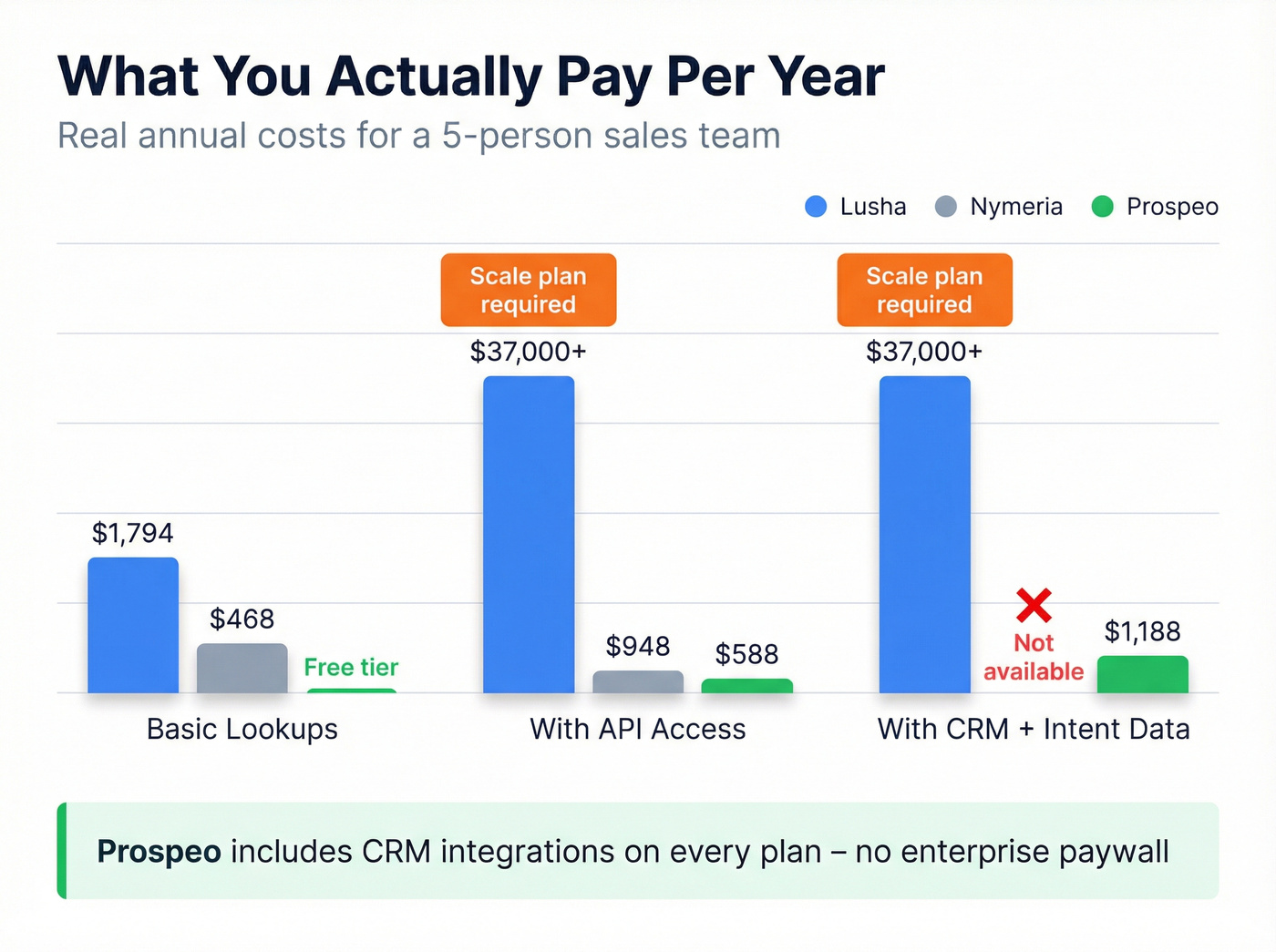
The pricing gap tells the real story. A 5-person team on Lusha Pro pays ~$1,794/year for basic email lookups. The moment you need CRM sync, API access, or intent data, you jump to Scale - and that's where the $37K+ conversation starts.
Nymeria's Kilo plan at $159/month gives you API access and roughly 5,000+ lookups/month for $1,590/year. We've seen teams burn through Lusha credits in a week because phone reveals cost 5-10 credits each. Nymeria's "pay only for successful lookups" model avoids wasted credits on empty results, which is a genuine advantage.
A bigger database doesn't mean better data, though. Nymeria's 811M profiles haven't translated into stronger accuracy signals than Lusha's 100M.
Accuracy: The Real Differentiator
The only independent head-to-head test comes from ERE, and it's from 2018. Nymeria found emails on 70 of 100 profiles versus Lusha's 60. Nymeria's unique finds validated at 69%; Lusha's at just 44%.
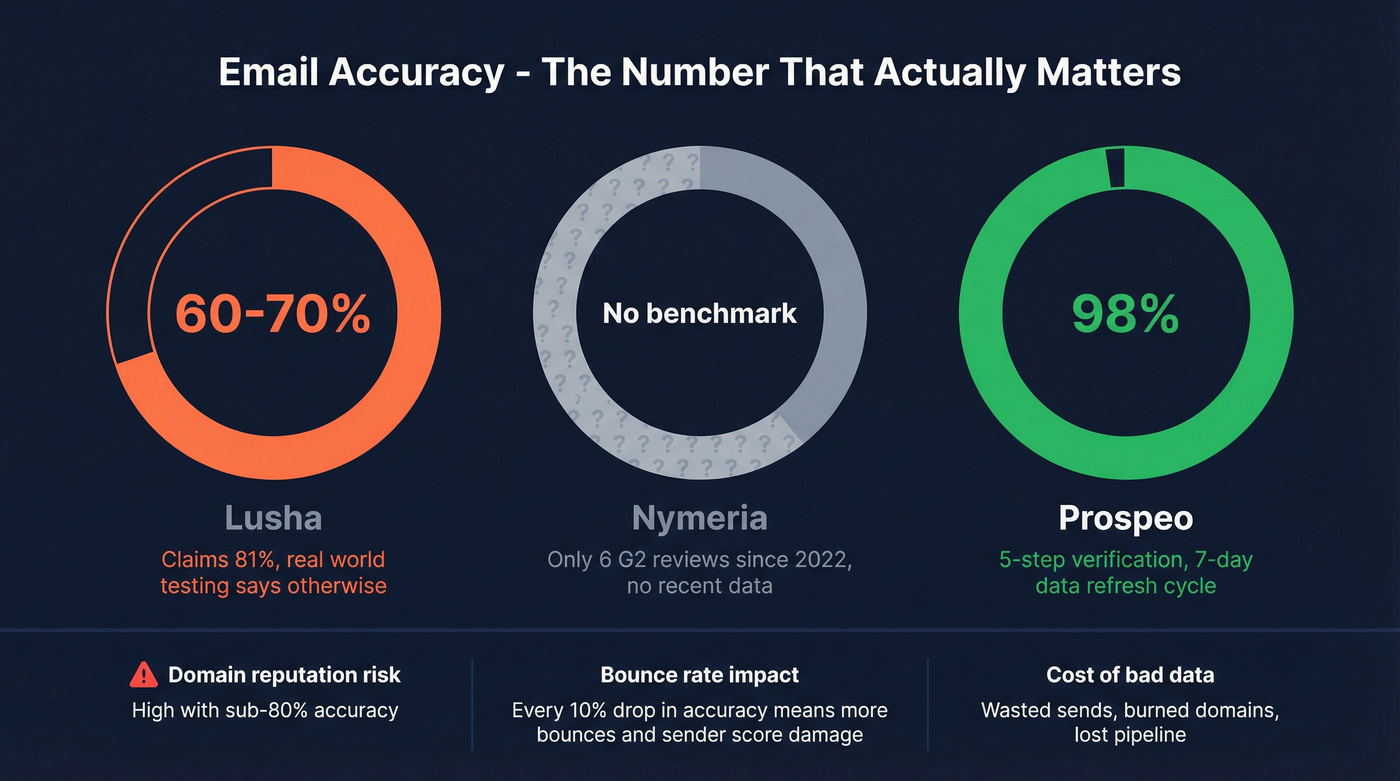
In 2026, Lusha self-reports 81% accuracy. In our testing and across Reddit threads on r/EmailProspecting, the real number lands closer to 60-70%. Phone numbers are, as one user put it, "a total coin flip - 50/50 at best." Lusha's A+/A confidence scoring helps filter for better contacts, which is a nice touch, but it doesn't fix the underlying data quality issue.
Nymeria's accuracy picture is thinner. G2 reviewers flag outdated contact information, and with only 6 reviews - all from 2022 - there's almost no recent signal to work with. That's a red flag for anyone running high-volume outbound.

Let's be honest: if your outbound depends on email deliverability, neither tool gives you enough confidence. When your data is only ~60-81% accurate, you're going to waste a meaningful chunk of sends on bad addresses. That's a domain reputation problem waiting to happen.
Feature Comparison at a Glance
Lusha wins on intent data and buying signals, AI Playlists for auto-building lead lists, outreach and workflow automation, and GDPR/CCPA compliance infrastructure.
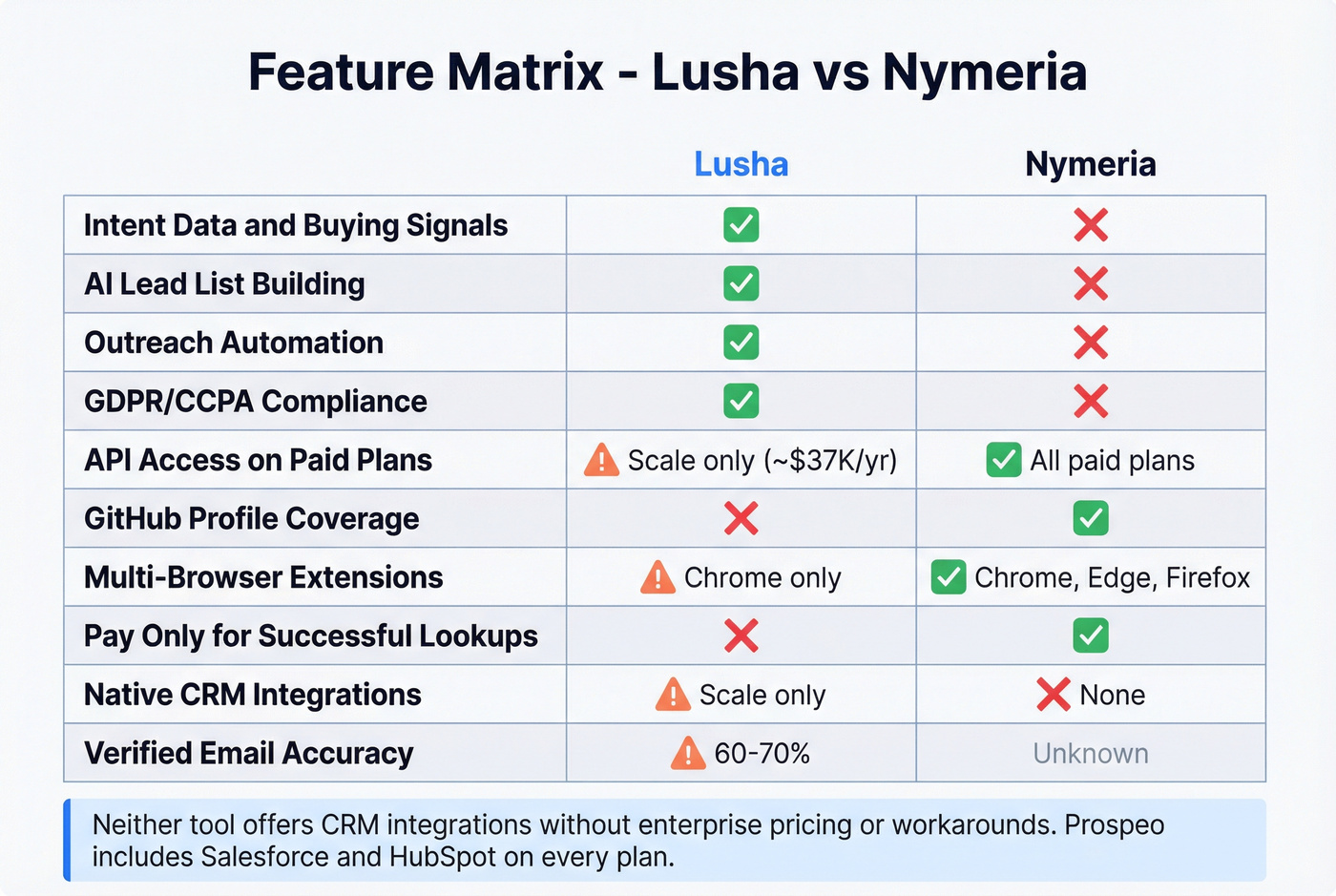
Nymeria wins on API access across all paid plans (Lusha locks it behind Scale), GitHub profile coverage for technical recruiting, multi-browser extensions, and a pay-only-for-successful-lookups credit model.
The frustrating gap: neither tool handles CRM integrations well. Lusha gates Salesforce and HubSpot behind Scale. Nymeria has zero native CRM connections. If your workflow depends on pushing contacts straight into your CRM without manual exports, both tools leave you stuck - unless you're willing to pay enterprise pricing on Lusha's side.
Who Should Pick Which
Technical recruiter sourcing developers across GitHub? Nymeria. Its GitHub coverage and personal email strength are purpose-built for this use case, and the $39-$159/month pricing won't blow your recruiting budget.
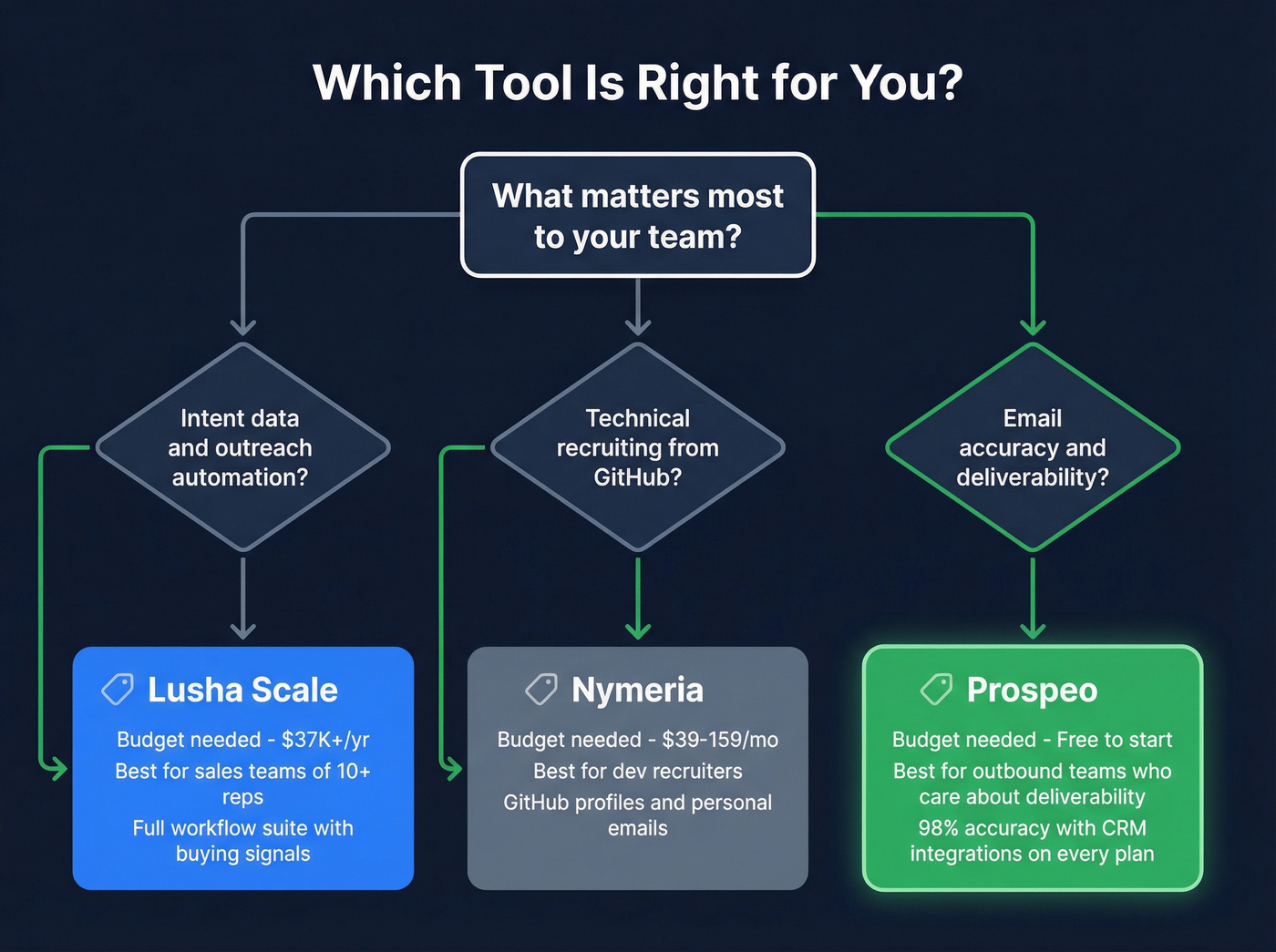
Sales team of 10+ reps running outbound with intent signals? Lusha Scale - if you can justify the price. Nymeria's feature set simply doesn't support that workflow. Worth noting that Lusha's 1,516 G2 reviews versus Nymeria's 6 isn't just a popularity gap; it's a trust signal about long-term viability and product investment.
Team that cares most about email accuracy? Skip both. Prospeo's 98% verified email accuracy, 300M+ professional profiles, and native Salesforce/HubSpot integrations on every plan - no $37K gate - cover what both Lusha and Nymeria leave on the table. A 7-day data refresh cycle means you're not emailing people who changed jobs last month. At ~$0.01 per email with a free tier of 75 emails/month, the cost comparison isn't close.
If you're building lists at scale, it's also worth tightening your lead generation workflow and using lead scoring so verified contacts go to the right sequences.
At 60-70% real-world accuracy, Lusha puts your domain reputation at risk. Nymeria's data is too thin to benchmark. Prospeo's 5-step verification and 7-day refresh cycle deliver 98% accuracy - so every send actually lands.
Your deliverability deserves better than a coin flip on contact data.
FAQ
Is Nymeria still active in 2026?
Yes. The Chrome extension was last updated in late 2025, so it's functional. But its G2 profile has only 6 reviews since 2022, and community growth has stalled. Expect limited support compared to larger platforms.
Is Lusha worth it for small teams?
On Pro at $29.90/user/month, basic lookups work fine. CRM integrations, API, and intent data all require Scale though, and that's custom-priced starting around ~$37K/year. That's overkill for most teams under 10 reps.
What's the most accurate email finder in 2026?
Prospeo leads at 98% verified accuracy with a 7-day data refresh cycle. Lusha lands at 60-70% in practice despite claiming 81%. Nymeria lacks any recent independent benchmark, making it hard to trust for high-volume outbound campaigns.