


ManyReach vs Saleshandy: Honest Comparison (2026)
ManyReach and Saleshandy solve the same problem - getting cold emails into inboxes - but they charge for it in completely different ways. If you're weighing ManyReach vs Saleshandy, the core distinction is simple: one sells credits, the other sells subscriptions. That single difference shapes how you scale, what you'll actually pay six months from now, and whether your CFO sends you an angry Slack message when the invoice hits.
30-Second Verdict
Pick ManyReach if you're a solo founder running a handful of sending accounts and you hate recurring subscriptions. Credits don't expire, and every feature ships on every tier.
Pick Saleshandy if you're building a team, need CRM integrations like Salesforce or HubSpot, and want roughly a decade of platform maturity - but budget for Pro at $99/mo, because Starter locks out the features that matter.
Skip both if your campaigns are bouncing because of bad contact data. Neither tool is a data platform. Verify your list with Prospeo before loading contacts into any sender - its 5-step verification catches invalid addresses, spam traps, and honeypots before they tank your sender reputation.
Feature Comparison
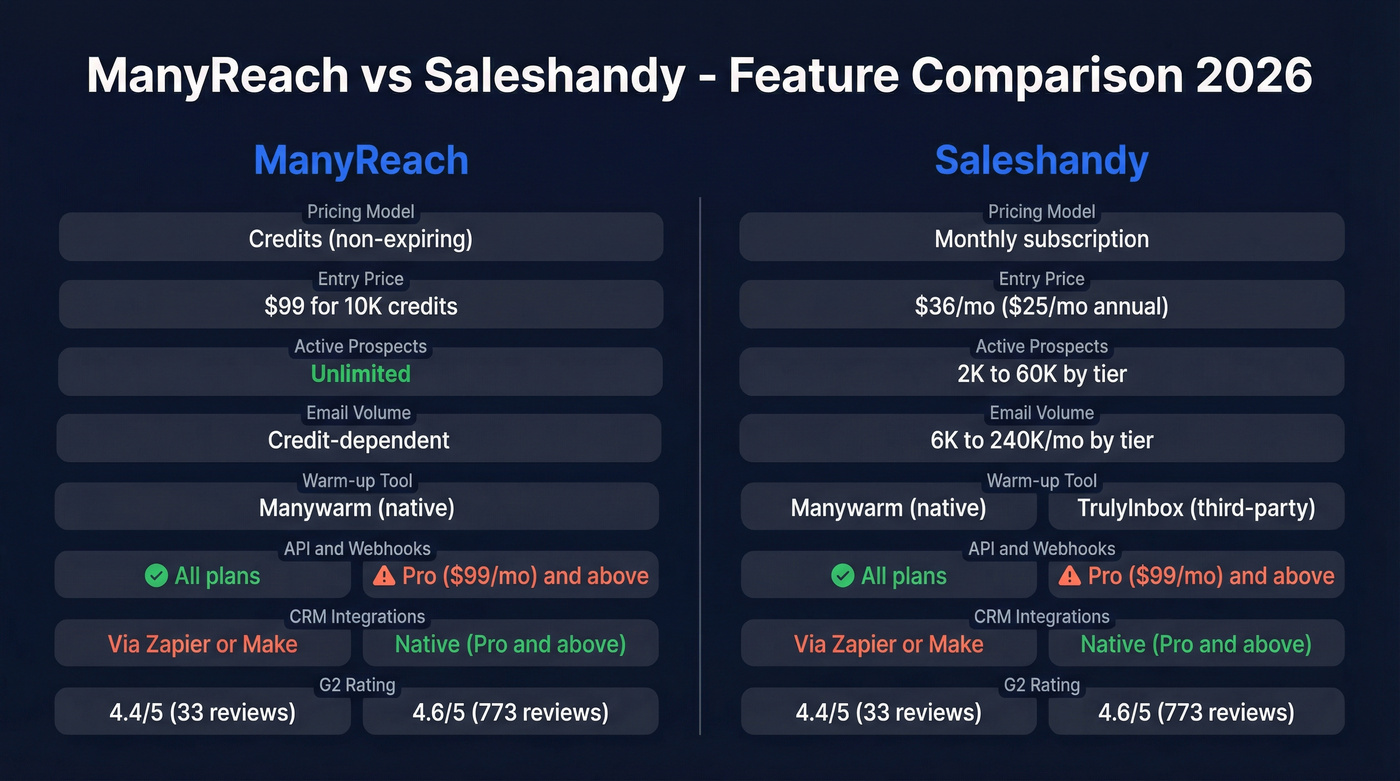
| Feature | ManyReach | Saleshandy |
|---|---|---|
| Pricing model | Credits (non-expiring) | Monthly subscription |
| Free tier | 250 credits | 7-day trial (100 emails) |
| Entry price | $99/10K credits | $36/mo ($25/mo annual) |
| Active prospects | Unlimited | 2K / 30K / 60K by tier |
| Email volume | Credit-dependent | 6K-240K/mo by tier |
| Warm-up | Manywarm (native) | TrulyInbox (third-party) |
| API & webhooks | All plans | Pro ($99/mo) and above |
| CRM integrations | Via Zapier/Make | Native (Pro+) |
| G2 rating | 4.4/5 (33 reviews) | 4.6/5 (773 reviews) |
Pricing Breakdown
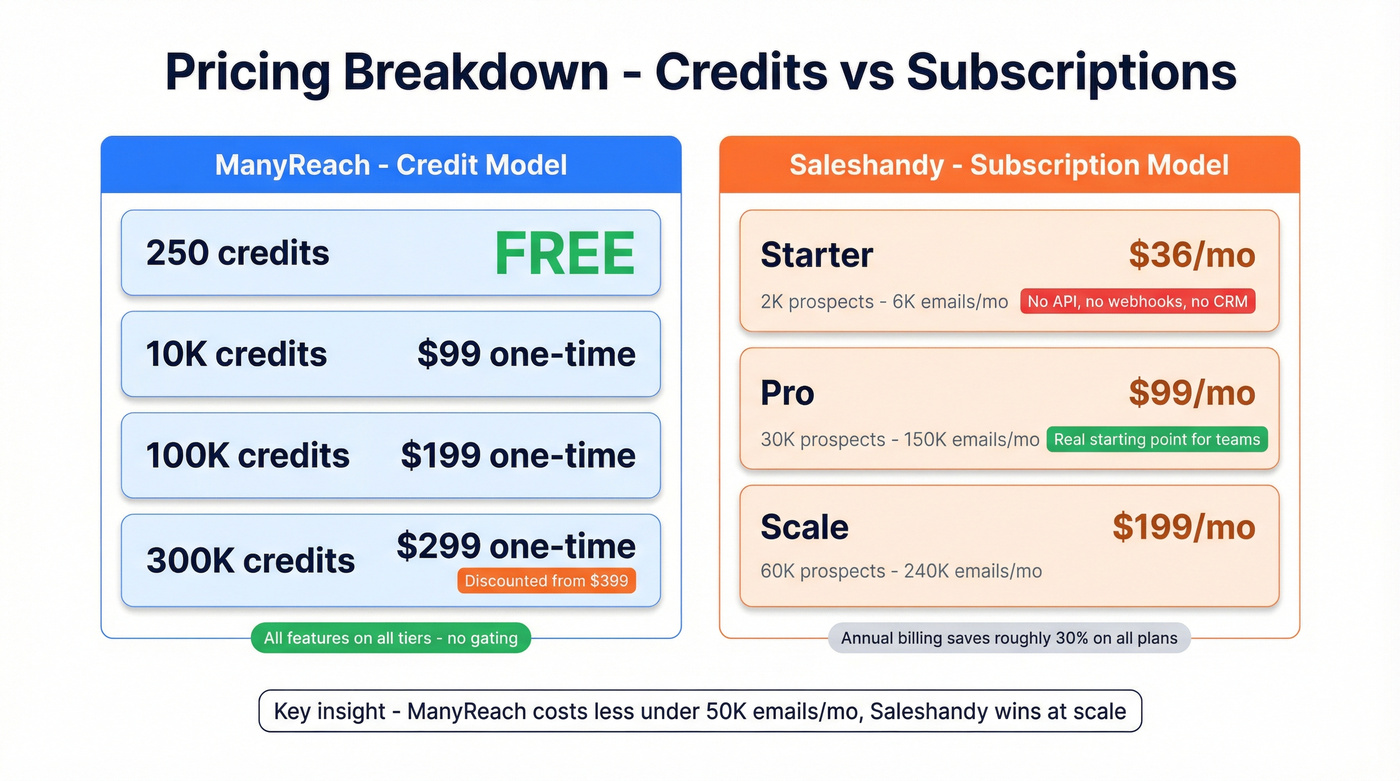
ManyReach runs on a credit ladder: 250 free credits to start, then $99 for 10K credits, $199 for 100K, and $299 for 300K (discounted from $399). Credits don't expire monthly, which is genuinely appealing if your sending volume swings wildly from week to week. Every feature - API, webhooks, unlimited sending accounts and mailboxes - ships on every tier. No feature gating at all.
If you're comparing tools in this category, it also helps to understand what a cold email API can (and can't) safely automate.
The catch? ManyReach has floated lifetime deals on AppSumo-style marketplaces, and Reddit sentiment around those LTDs is cautious. The general vibe: "buy once and send forever, if they don't shut down."
Saleshandy's Starter plan at $36/mo looks reasonable until you read the fine print. It caps you at 2,000 active prospects and 6,000 emails/month, and locks out API access, webhooks, and native integrations. All of that lives behind Pro at $99/mo, or $69/mo billed annually. Scale runs $199/mo for 60K active prospects and 240K emails.
Here's a detail no competitor mentions: Saleshandy lets you import up to 30x your active prospect cap - so 60K total imports on Starter - but only 2,000 can sit in live sequences at once. Starter feels like a trial with a price tag.
Our take: If your average deal size is under $5K, Saleshandy Pro at $99/mo is probably overkill. ManyReach's credit model will cost you less until you're consistently sending 50K+ emails a month.
If you're trying to forecast what "50K+ emails a month" really means operationally, start with email velocity and safe sending limits.

Neither ManyReach nor Saleshandy tells you if your contacts are real before you hit send. Prospeo's 5-step verification catches spam traps, honeypots, and catch-all domains - delivering 98% email accuracy at $0.01 per email. That's the difference between a campaign that books meetings and one that burns your domain.
Fix your list before you pick a sending tool.
Deliverability and Warm-Up
This is where the maturity gap shows.
If deliverability is the bottleneck, a dedicated email deliverability guide will usually move the needle faster than switching senders.
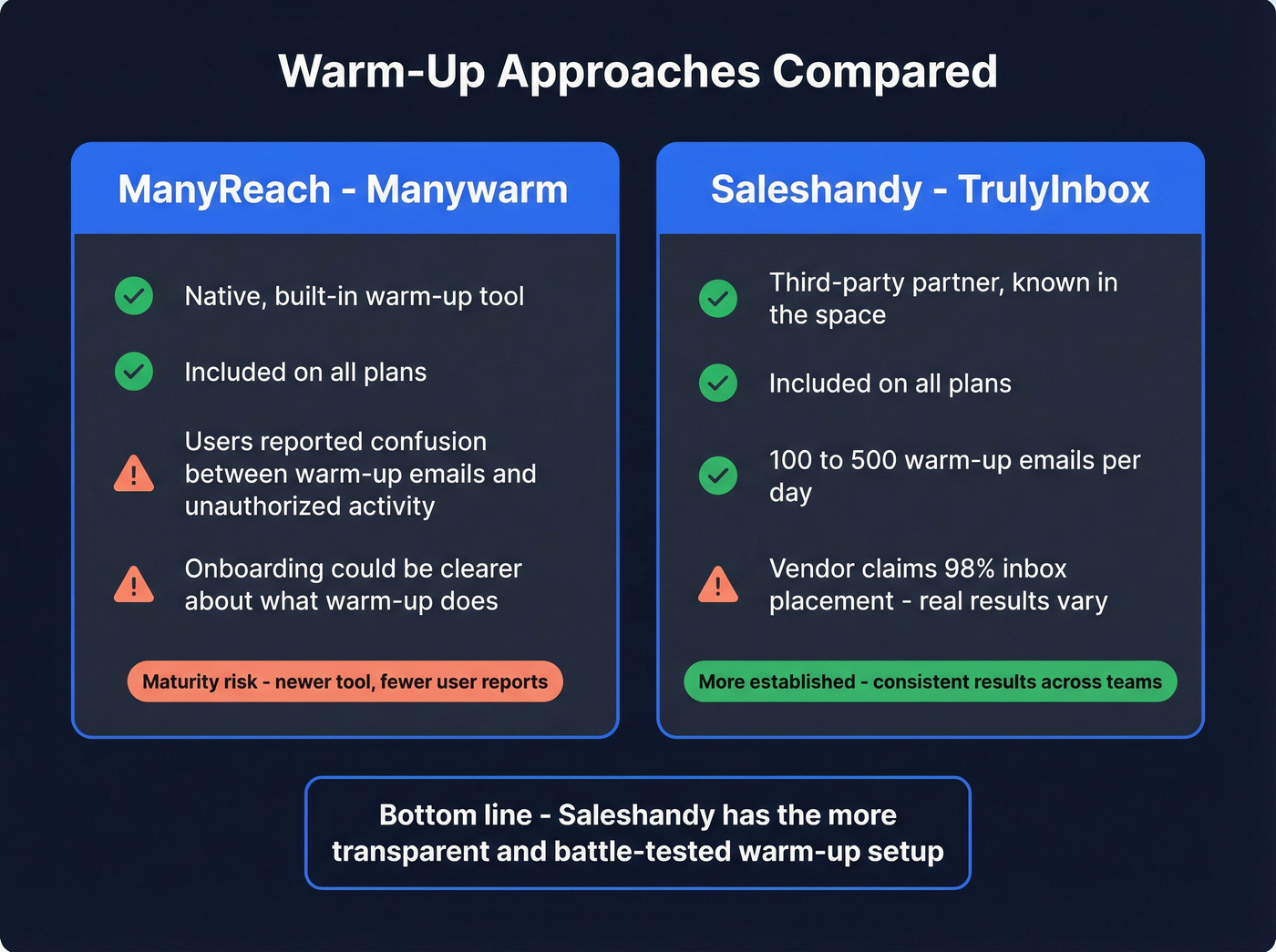
Saleshandy partners with TrulyInbox for warm-up, included on all plans. Their blog claims 98% primary inbox placement - that's a vendor-run test, so real-world results will vary - but TrulyInbox handles 100-500 warm-up emails per day and is a known quantity in the space. We've seen consistent results from teams using it across multiple domains.
ManyReach uses Manywarm, its native warm-up tool. It works, but there's a transparency problem that frustrated us when we dug into user reports. One Reddit user reported seeing unauthorized-looking emails sent from their Gmail after connecting - they thought they'd been hacked before realizing it was warm-up behavior. That's not a security flaw, but if users can't distinguish warm-up from a breach, the onboarding needs serious work.
What Real Users Say
Saleshandy has the review volume advantage at 4.6/5 (773 reviews). Users consistently praise ease of use, automation, and support. The recurring complaints center on warm-up inconsistencies and aggressive feature gating on lower plans.
ManyReach sits at 4.4/5 on G2 from 33 reviews and 4.3/5 on Trustpilot from 26 reviews. The praise centers on credit-based pricing and easy setup. The complaints are more concerning - sender disconnections, a laggy web app, and poor deliverability from an LTD buyer who regretted the purchase. A Trustpilot reviewer also flagged SMTP passwords appearing unencrypted in settings, which is worth verifying before connecting sensitive accounts.
Let's be honest: Saleshandy was founded around 2016; ManyReach launched in 2019. We've seen this pattern repeatedly - younger tools offer better pricing but rougher edges. That gap narrows over time, but it hasn't closed yet.
When to Choose Which
Use ManyReach if you're a solo founder or freelancer running 5-10 sending accounts, your volume is low and unpredictable, and you're willing to accept platform-maturity risk for a lower cost floor. If you're sending under 10K emails a month and don't need native CRM connections, the credit model genuinely saves money.
If you're still dialing in messaging, keep a swipe file of cold email subject line examples handy before you scale volume.
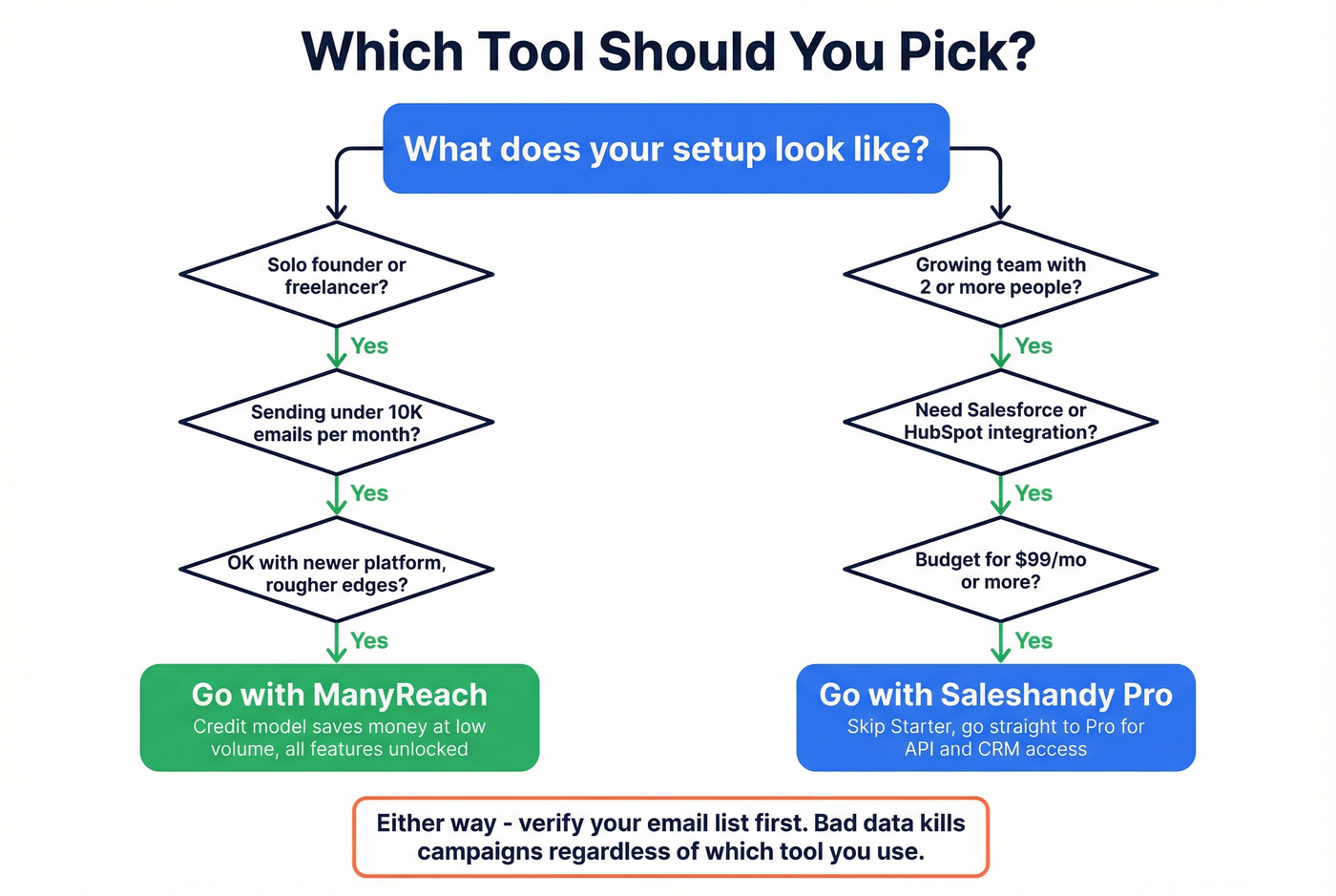
Use Saleshandy if you're a growing team that needs Salesforce or HubSpot integration, API access, 30K+ active prospects, and a battle-tested platform with real support infrastructure. The $99/mo Pro plan is the real starting point - don't kid yourself about Starter being enough.
The Layer Both Miss
Neither ManyReach nor Saleshandy verifies whether your contact emails are real. Look - the number-one reason cold campaigns fail isn't the sending tool. It's bad data. We've watched teams spend weeks optimizing subject lines and send schedules while 15% of their list bounces silently, torching their domain reputation in the process.
Run your list through Prospeo before you hit send. With 98% email accuracy, a 7-day data refresh cycle, and catch-all domain handling, it catches the garbage addresses that other verification tools miss. The free tier gives you 75 email verifications per month - enough to see the difference on your email bounce rate before committing.

You're comparing credit-based vs subscription pricing for sending - but the real cost is bounced emails destroying your sender reputation. Teams using Prospeo-verified lists see bounce rates drop below 4%. With a 7-day data refresh cycle and 143M+ verified emails, your contacts stay current while competitors work with 6-week-old data.
Stop optimizing send schedules on a list full of dead addresses.
FAQ
Is ManyReach really unlimited?
ManyReach offers unlimited email accounts, contacts, and workspaces, but sending is credit-based. Each campaign email costs credits, so your actual volume depends on how many you purchase. "Unlimited" applies to infrastructure, not sending volume.
What does Saleshandy Starter include?
Starter at $36/mo gives you 2,000 active prospects and 6,000 emails per month. You can import up to 60K contacts, but only 2,000 can sit in live sequences simultaneously. API access, webhooks, and native CRM integrations require Pro at $99/mo ($69/mo annual).
Do I need a separate tool for email verification?
Yes. Neither platform specializes in contact data quality. A dedicated verification step before import - using any reputable tool - catches invalid addresses, spam traps, and honeypots before they damage your sender reputation. It's the single highest-ROI step most teams skip.