

Industrial B2B Marketing: What Actually Works in 2026
Manufacturers are running Google Ads, publishing blogs, posting on social - and pipeline stays flat. A common theme in manufacturing marketing threads on Reddit is that teams already doing the standard mix still can't figure out what actually moves lead flow. The core challenge of marketing industrial B2B products is structural: industrial sales require nearly 35 touch points before a deal closes. Doing "the basics" isn't enough. You need the right channels, real benchmarks, and clean data underneath all of it.
If your budget is under $5K/month, prioritize SEO, email, and LinkedIn organic. They deliver strong ROI for the lowest upfront cost. Before you scale anything, fix your data quality - bounced emails and disconnected numbers gut every channel's performance.
Why Industrial Marketing Isn't SaaS Marketing
Industrial B2B isn't SaaS marketing with harder hats. The buying committee for a typical industrial purchase involves 13 stakeholders across multiple departments - engineering, procurement, operations, finance, sometimes legal - and buyers spend only 17% of their purchasing time meeting vendors. The rest is independent research and internal consensus-building.
That creates a specific problem. 86% of B2B purchases stall, and 68% of buyers prefer doing their own research before talking to a rep. Industrial buyers also face high consequences for wrong decisions: a bad software subscription wastes money, but a bad materials supplier shuts down a production line. Your marketing must reduce perceived switching risk and build trust across an entire committee over a 6-to-18-month cycle. Generic B2B advice doesn't account for those stakes.
Manufacturing Marketing Benchmarks
You need to know what "good" looks like before optimizing anything. The problem? 39% of manufacturers don't know their website conversion rate. If that's you, fix it first.
| Metric | Average | Top Quartile |
|---|---|---|
| Visitor-to-lead | 1.2%-2.5% | 5%-8% |
| Email open rate | 37.36% | - |
| Email click rate | 4.22% | - |
| Lead-to-customer | 4.6% | - |
A 37.36% manufacturing email open rate is a real signal: when industrial buyers opt in, they pay attention. The gap between average and top-quartile website conversion reveals massive upside in site optimization alone. And 98% of industrial manufacturers now generate SQLs through digital channels, so the question isn't whether digital works - it's which channels deserve your budget.
Where to Spend Your B2B Industrial Budget
Among manufacturers, 69% use organic search, 69% use social, and 43% run PPC. Here's how those channels stack up.
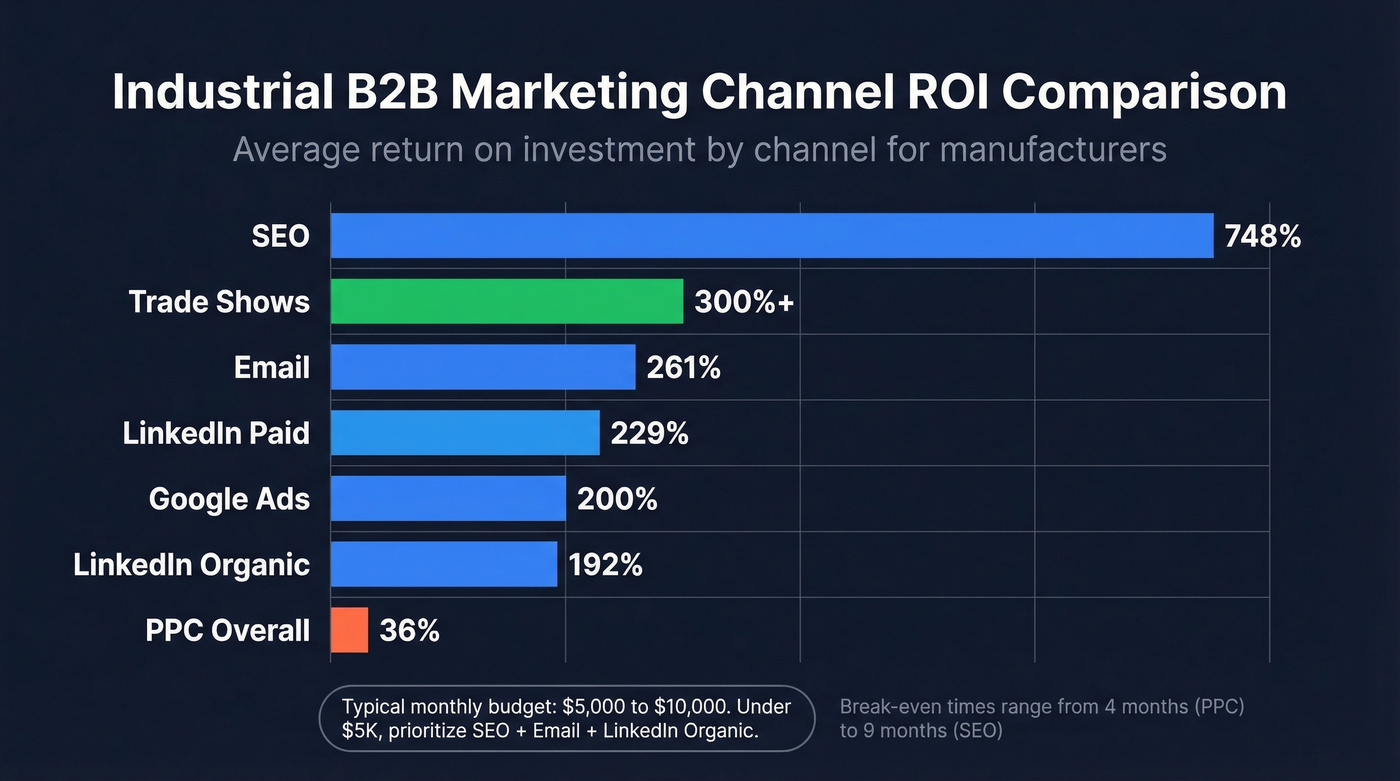
| Channel | Avg ROI | Break-Even | Monthly Cost |
|---|---|---|---|
| SEO | 748% | ~9 months | $2,500-$7,500 |
| 261% | ~7 months | $500-$2,000 | |
| LinkedIn (organic) | 192% | - | Time only |
| LinkedIn (paid) | 229% | - | CPC ~$5.58 |
| PPC (overall) | 36% | ~4 months | $100-$10,000 |
| Google Ads (B2B) | ~200% | - | $100-$10,000 |
| Trade shows | 300%+ | Per event | ~20% of budget |
The typical monthly manufacturing marketing budget falls in the $5,000-$10,000 range. At that level, SEO plus email plus LinkedIn organic is your demand generation foundation.
Above $10K/month, add paid channels. A practical PPC allocation:
- Google Ads: 35-45% of paid budget
- LinkedIn Ads: 25-35%
- Bing: 15-20%
- Meta: 5-10%
Trade shows deserve special mention. CEIR pegs the cost to meet an exhibition lead at $96 vs $1,039 outside events, and 33% of new business originates from trade show leads. But 57% of manufacturers generate fewer than 20 leads per show. The channel isn't broken; execution is. Skip trade shows if you don't have a follow-up sequence ready to fire within 48 hours of the event - otherwise you're paying $96 per lead just to let them go cold.
LinkedIn for Manufacturers
Target VP of Operations, Director of Engineering, Procurement Manager, and Plant Manager roles. Focus on automotive, aerospace, industrial machinery, and chemical manufacturing verticals.
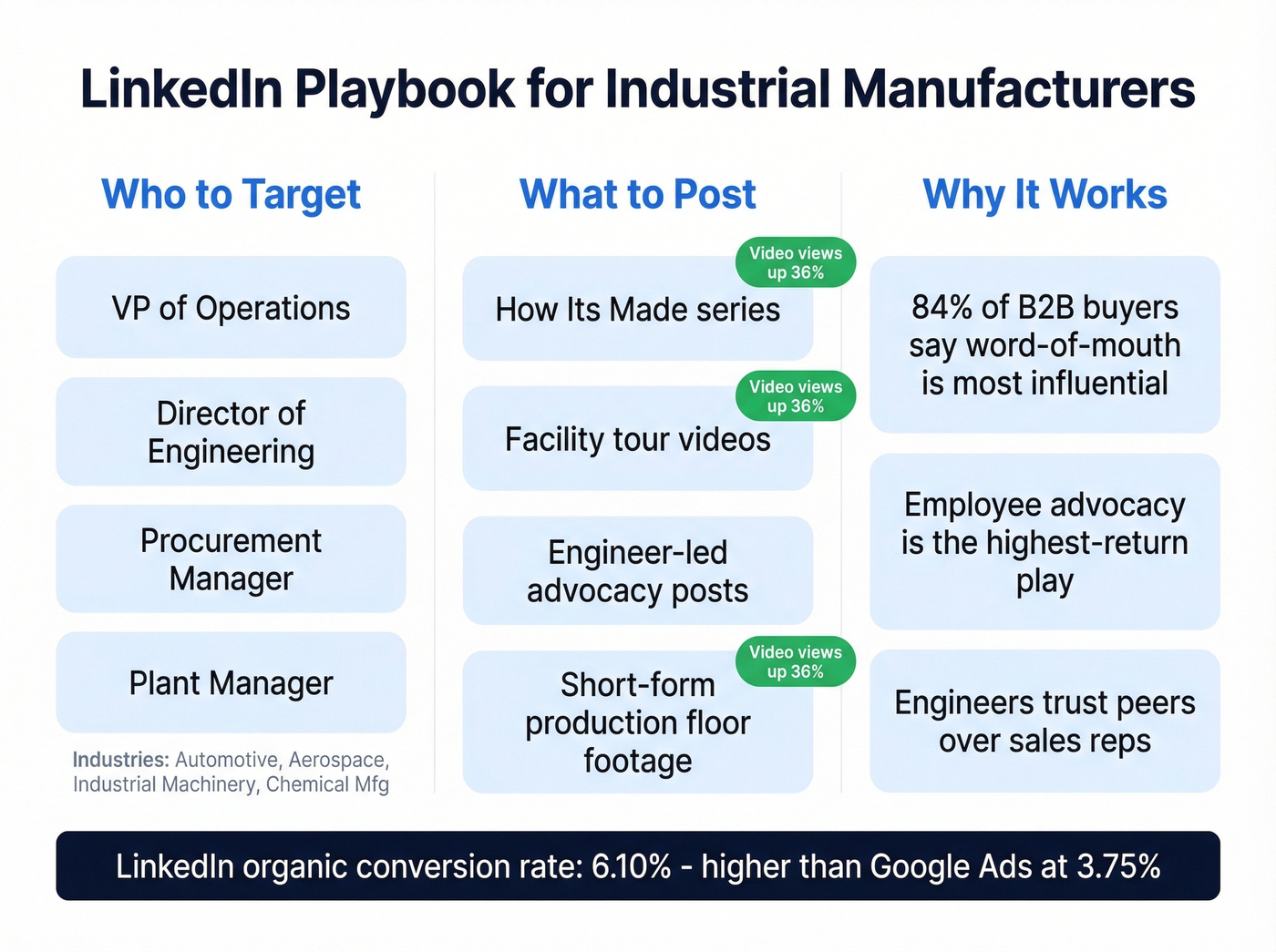
What actually performs: "how it's made" series, facility tours, and engineer-led employee advocacy posts. Short-form video is the format to bet on - LinkedIn video views are up 36%, and production floor footage outperforms spec sheets every time. Let's be honest: 84% of B2B buyers say word-of-mouth recommendations are the most influential factor in purchasing decisions, which makes employee advocacy your highest-return play on the platform.
PPC Benchmarks Worth Knowing
Google Ads B2B averages: 3.17% CTR, $2.69 CPC, $48.96 CPL, 3.75% conversion rate. LinkedIn's conversion rate runs higher at 6.10%, with MQL-to-SQL rates of 14-18% compared to Google's 7-12%. We've seen teams waste $10K/month on PPC driving leads into a CRM full of dead emails - the channel works, but only when your downstream data is clean.

You just read that teams waste $10K/month on PPC driving leads into CRMs full of dead emails. Prospeo delivers 98% email accuracy with a 7-day refresh cycle - so every dollar you spend on SEO, PPC, and LinkedIn actually converts. At $0.01 per verified email, cleaning your pipeline costs less than a single wasted click.
Stop feeding bad data into channels that actually work.
Tactical Upgrades for 2026
Three shifts are reshaping industrial B2B marketing strategy right now.
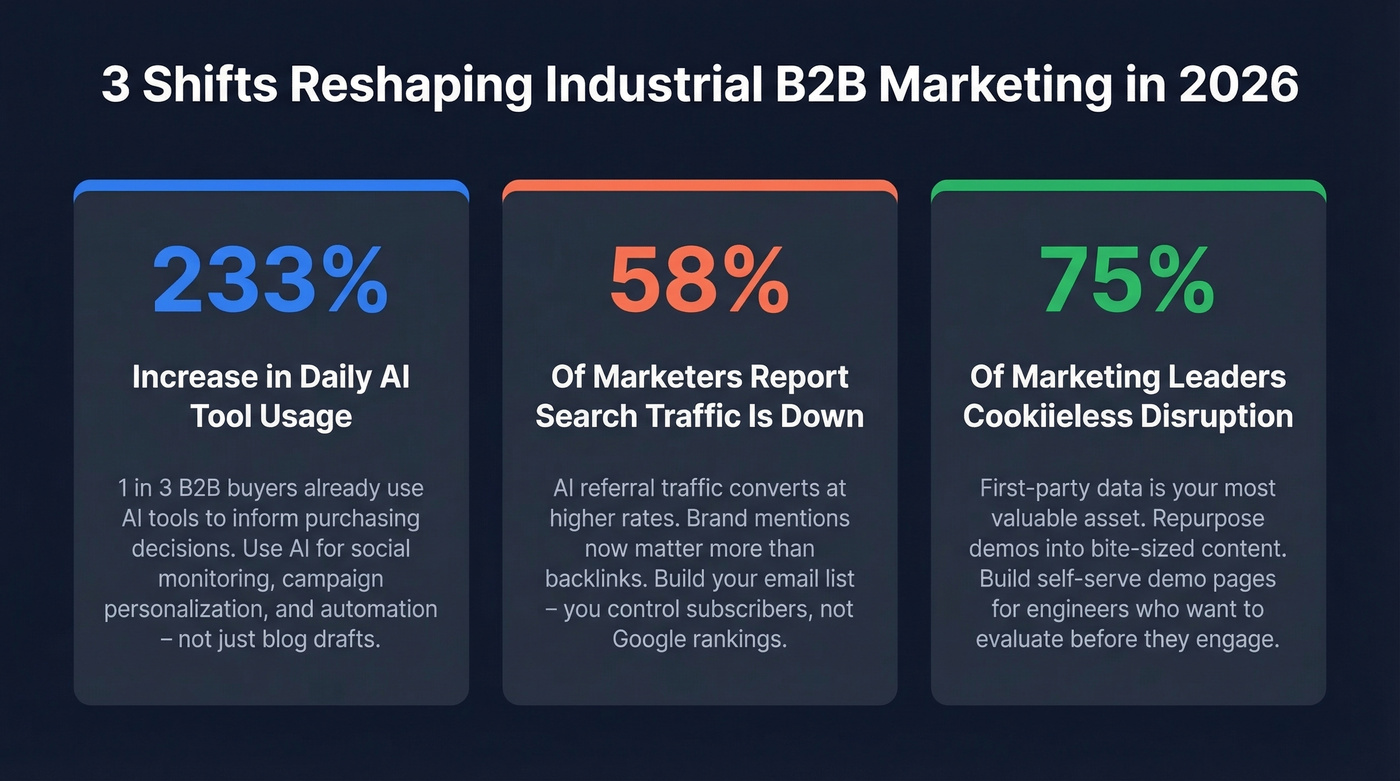
AI is operational. Daily AI tool usage is up 233%, and one-third of B2B buyers already use AI tools to inform purchasing decisions. If you're only using AI for blog drafts, you're missing the operational wins - social monitoring, content ideation, campaign personalization, and marketing automation at scale all benefit from AI agents today, not next year.
Search is fragmenting. 58% of marketers report search traffic is down, but AI referral traffic converts at higher rates. Brand mentions now matter more than backlinks for AI visibility. Here's the thing: 75% of marketing leaders expect the cookieless shift to disrupt operations, which makes first-party data your most valuable asset. Build your email list aggressively. Google controls your organic traffic, but you control your subscriber list.
Repurpose ruthlessly. Turn product demos into bite-sized, value-first content. Build self-serve demo pages that let engineers explore on their own terms. In our experience, these outperform a 30-minute sales call for technical buyer journey stages by a wide margin, because engineers want to evaluate before they engage.

Measuring What Matters
Stop measuring impressions. Start measuring pipeline.
Your KPI checklist: MQL-to-SQL conversion rate, cost per SQL, marketing-sourced pipeline value, and website visitor-to-lead conversion rate. That's it. If you're tracking those four metrics, you're already ahead of most competitors - remember, 39% of manufacturers can't even report their website conversion rate.
Attribution across a 13-stakeholder buying cycle is hard. Don't let that stop you. BT Enterprise achieved 13.52x ROMI for every pound spent on brand marketing. BOLT ON Technology saw 272% more inbound demos and 411% ROI on marketing-impacted revenue. These results come from measuring the right things and optimizing accordingly.
Before scaling email campaigns, audit your list quality. Prospeo verifies emails in real time with 98% accuracy and refreshes data every 7 days - the free tier covers 75 emails per month, enough to spot problems before committing budget. Its 30+ search filters, including buyer intent powered by Bombora across 15,000 topics, let you build targeted lists of procurement managers, plant directors, and engineering leads without manual research.
Common Mistakes That Kill ROI
Vanity metrics over pipeline. Impressions don't pay invoices. Track MQL-to-SQL rate and marketing-sourced revenue instead.
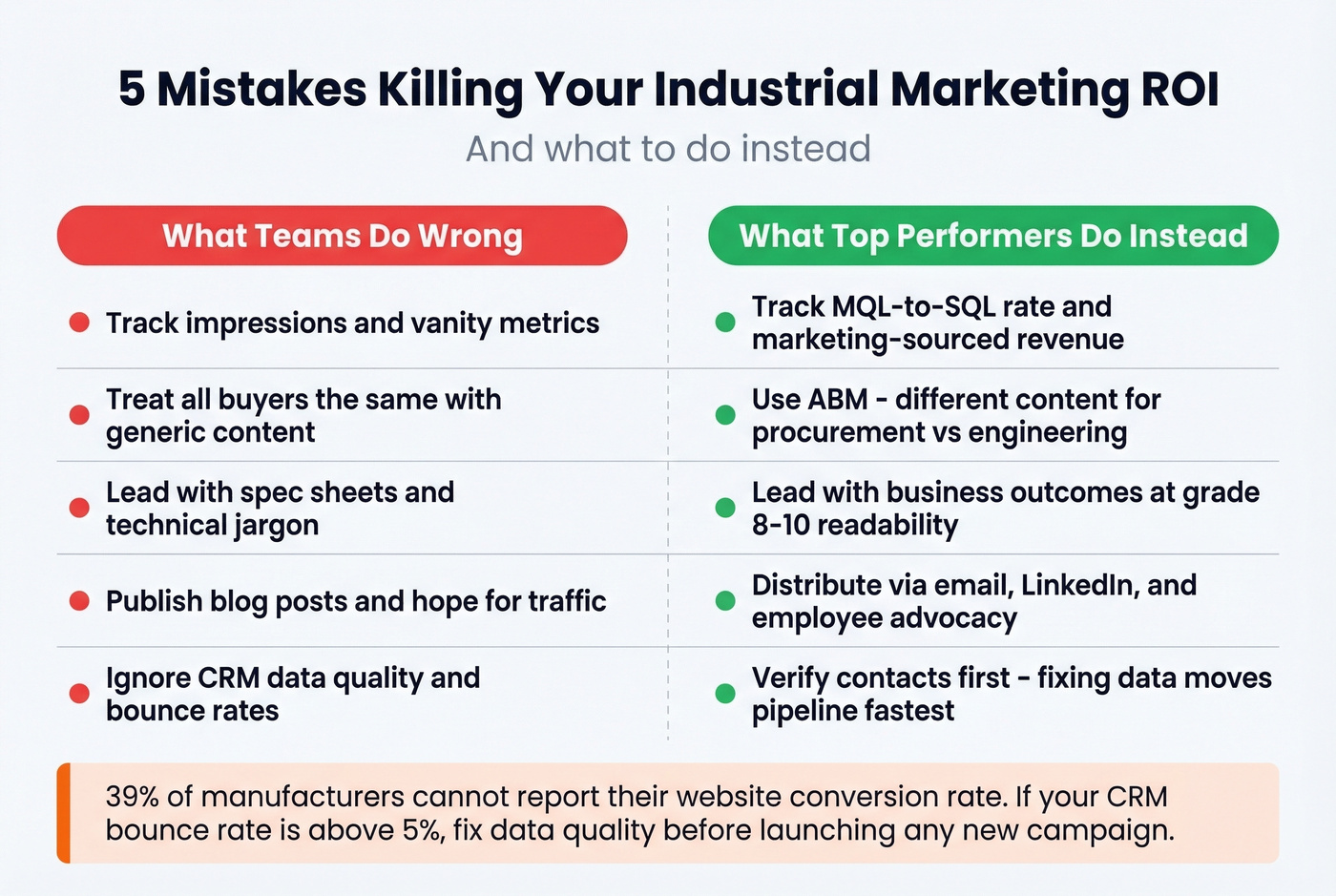
Treating all buyers the same. A procurement manager and a plant engineer need different content. Account-based marketing exists for a reason - use it.
Overly technical content. Lead with business outcomes, not spec sheets. Aim for grade 8-10 readability. Your engineers love the technical detail, but the CFO signing off on the purchase doesn't.
Publishing without distribution. A blog post without email, LinkedIn, and employee advocacy behind it isn't a strategy. It's a diary entry.
Ignoring data quality. Bounced emails and wrong numbers erode every channel's ROI. This is the most fixable problem on the list, and it's where we'd start with any manufacturing client who came to us frustrated with campaign performance.
Look - most industrial manufacturers don't have a marketing problem. They have a data problem. If your average deal size exceeds $50K and your CRM bounce rate is above 5%, fixing data quality will move pipeline faster than any new channel or campaign you launch.
Industrial buying committees have 13 stakeholders. You need direct lines to every one of them. Prospeo's 30+ search filters let you target VP of Operations, Procurement Managers, and Plant Managers by industry, headcount growth, and buyer intent - with 125M+ verified mobile numbers that hit a 30% pickup rate.
Reach the full buying committee, not just the gatekeeper.
FAQ
How much should an industrial B2B company spend on marketing?
Most manufacturers budget $5,000-$10,000 per month, with Gartner benchmarks showing industrial firms allocating 6.7%-9.5% of revenue to marketing. Start with SEO, email, and LinkedIn organic under $5K/month. Add PPC and video production above $10K.
What's the best channel for industrial lead generation?
SEO delivers the highest long-term ROI at 748% over a multi-year horizon, followed by email at 261%. Trade shows produce the cheapest per-lead cost at $96 per exhibition contact. Every industrial marketing strategy should start with those three, then layer paid channels as budget allows.
How does bad contact data affect B2B campaign performance?
Bounced emails and disconnected numbers waste every dollar spent on demand generation. Meritt cut their bounce rate from 35% to under 4% using real-time verification, tripling pipeline from $100K to $300K per week. Cleaning your CRM data is the fastest ROI fix available to any manufacturing marketing team.