

How to Set Up Marketo Data Enrichment (Without Wrecking Your Database)
Around 40% of your Marketo leads are missing job title, company size, or both. Your scoring model is grading on incomplete data, and your routing logic is sending enterprise prospects into the SMB nurture. Contact data decays at 20-25% annually, which means Marketo data enrichment isn't a one-time fix - it's an ongoing architecture problem that gets worse every quarter you ignore it.
What You Need (Quick Version)
- Clean your database first. Enrichment on top of duplicates and garbage fields just creates expensive garbage.
- Enrich in Marketo before the Salesforce sync. Scoring, routing, and segmentation should fire on enriched data - not wait through multiple sync cycles.
- Use a waterfall with 2-3 tools. No single vendor covers everything.
Clean First, Enrich Second
Here's the thing: enrichment amplifies whatever's already in your database. Duplicate records, inconsistent field values, leads that never synced to your CRM - layering appended data on top makes all of it worse.
Marketo Champions have flagged this repeatedly. Poor hygiene leads to MQAs not syncing to Salesforce, broken routing, and misattributed pipeline. Deduplicate, standardize your picklists, and fix your field formatting before you spend a dollar on enrichment.
Enrich in Marketo, Not Salesforce
This is the single most important architectural decision you'll make.
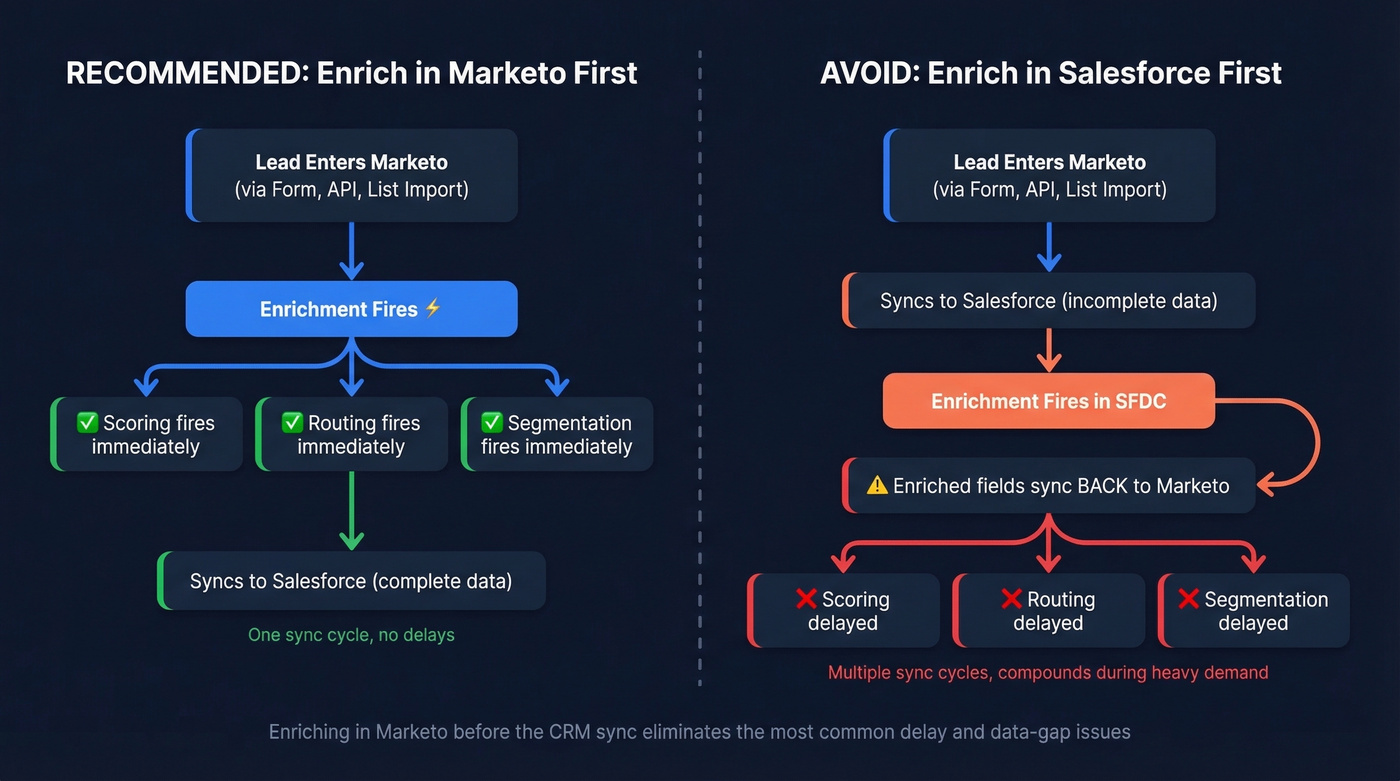
For most environments, you should enrich data in Marketo first, before the initial Salesforce sync. If a lead enters via form, API, or list import and you enrich in Salesforce instead, the appended fields have to travel back through the Marketo-SFDC sync before your scoring, routing, and segmentation logic can use them. That's multiple sync cycles, and during heavy sync demand, those delays compound fast. Enriching in Marketo first eliminates the most common sync headaches and lets demographic scoring, geo-routing, and trigger campaigns fire immediately on complete data.
Three Integration Patterns
| Method | Best For | Complexity | Example Tools |
|---|---|---|---|
| Native integration | Plug-and-play | Low | Clearbit |
| Webhook | Custom field mapping | Medium | Any tool with API access |
Most enrichment tools support API access even if they lack a native Marketo connector. Middleware platforms like Zapier or Make bridge the gap - trigger an enrichment call on lead creation, map the response fields back to Marketo, and you're running. Clearbit's Marketo integration guide shows the field-mapping approach well: choose overwrite behavior field by field, so you keep user-entered data where it matters and standardize where it doesn't.

Enriching in Marketo first only works if the data coming back is accurate. Prospeo's API returns 50+ data points per record at a 92% match rate with 98% email accuracy - on a 7-day refresh cycle, not quarterly batch jobs. Connect it to Marketo via Zapier, Make, or direct API in minutes.
Stop scoring leads on incomplete data. Enrich them before they sync.
Best Tools for Enriching Marketo Leads
The Marketo community consistently names ZoomInfo, Clearbit, and 6sense as go-to options. But there are more choices than that, and pricing varies wildly.
If you're comparing vendors, start with a broader shortlist of data enrichment services so you don't miss better-fit options.
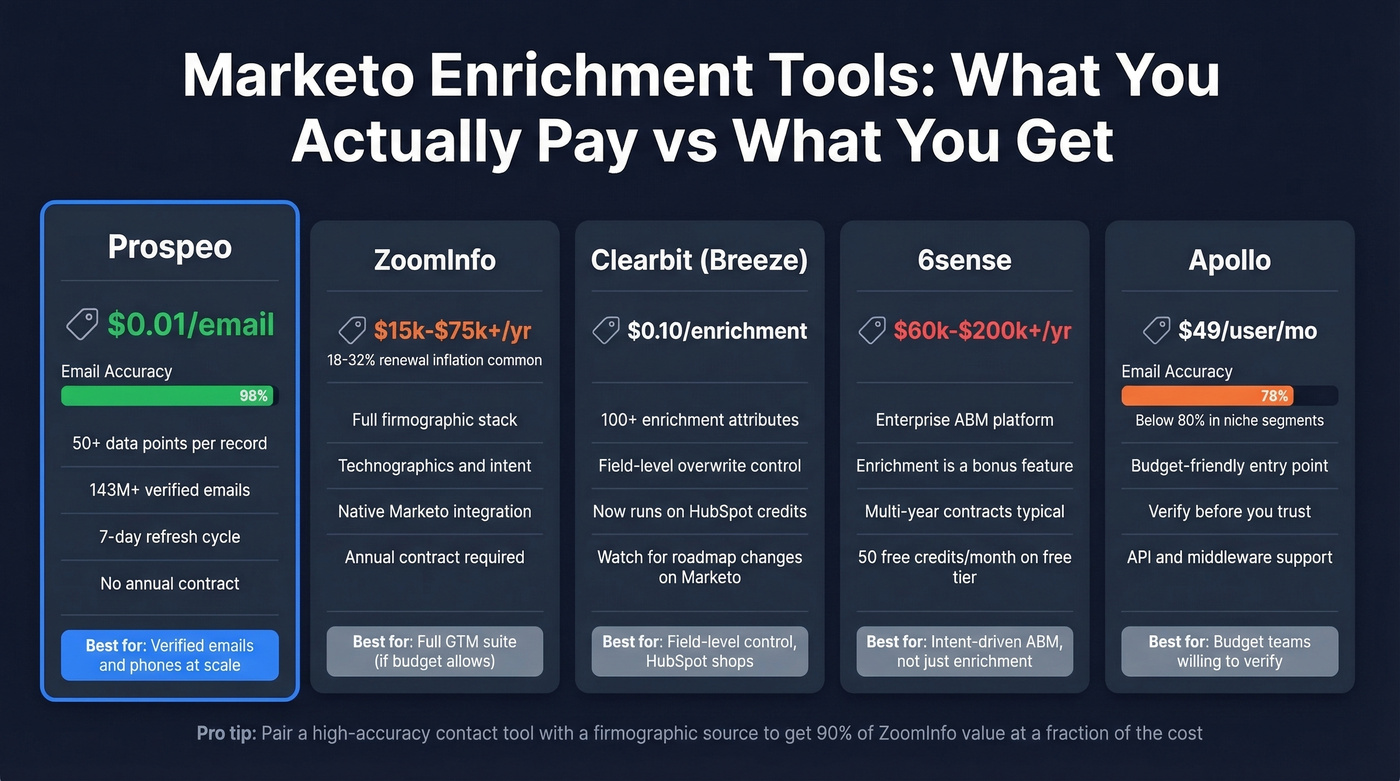
| Tool | Best For | Integration | Approx. Cost | Email Accuracy |
|---|---|---|---|---|
| Prospeo | Verified emails/phones | API, Zapier, Make | ~$0.01/email | 98% |
| ZoomInfo | Full firmographic stack | Native Marketo integration | $15k-$75k+/yr | N/A |
| Clearbit / Breeze | Field-level control | Marketo integration | ~$0.10/enrichment | N/A |
| 6sense | ABM + intent | API/Webhook | $60k-$200k+/yr | N/A |
| Apollo | Budget enrichment | API, middleware | $49/user/mo | Below 80% in niche segments |
Prospeo is the strongest option for email and phone accuracy at scale. It delivers a 92% API match rate with 50+ data points per record at roughly $0.01 per email, backed by 300M+ professional profiles and 143M+ verified emails. The 7-day refresh cycle means your Marketo data stays current without quarterly batch jobs. No annual contracts, no sales calls - just self-serve access via Zapier, Make, or direct API. We've seen teams pair it with a firmographic source and get 90% of ZoomInfo's value at a fraction of the cost.
If you're building a broader enrichment stack, it helps to separate contact vs company sources (see B2B company data providers for firmographic coverage).
Skip ZoomInfo if you mainly need accurate emails and phones - you're overpaying. ZoomInfo remains the industry default for breadth: firmographics, technographics, org charts, intent signals, all in one platform. But most teams pay $30k-$75k+ annually, locked into annual contracts and often seeing 18-32% renewal inflation without usage governance. If you need the full GTM suite, it delivers. Otherwise, pair a contact data tool with a cheaper firmographic source.
Clearbit (now Breeze Intelligence) works well for field-level control. Zenefits used it to split personal-email leads into sales-assist vs. self-serve tracks based on appended company data - a smart use of its 100+ enrichment attributes and field-level overwrite control. Post-HubSpot acquisition, it runs on HubSpot credits at roughly $0.10 per enrichment. If you're a HubSpot shop, it works out of the box. Marketo-native teams should watch for roadmap changes.
Don't buy 6sense just for enrichment. It's an enterprise ABM platform where enrichment is a bonus feature. Free tier gives 50 credits/month; paid plans run $60k-$200k+/year with typically multi-year contracts. Buy it for intent-driven ABM orchestration, not data appending.
Apollo looks attractive at $49/user/month - until you test accuracy. A 1,000-contact benchmark found email accuracy drops below 80% for several niche segments. Verify before you trust.
If you're using Apollo primarily for finding addresses, compare it against dedicated workflows like email append vendors and email verification to avoid deliverability issues.
Building a waterfall for Marketo? Start with the highest-accuracy source. Prospeo delivers 143M+ verified emails at ~$0.01 each - 90% cheaper than ZoomInfo - with no annual contracts locking you in. Pair it with a firmographic tool and your coverage gaps disappear.
Get ZoomInfo-level contact data at 10% of the cost.
Use a Waterfall, Not a Single Source
Let's be honest: no single enrichment vendor covers everything. That same 1,000-contact benchmark found that running a waterfall - multiple providers sequentially - delivered roughly 35% higher coverage than any single-source tool.
This is also where having a clear lead enrichment spec (what fields, what sources, what overwrite rules) prevents tool sprawl.
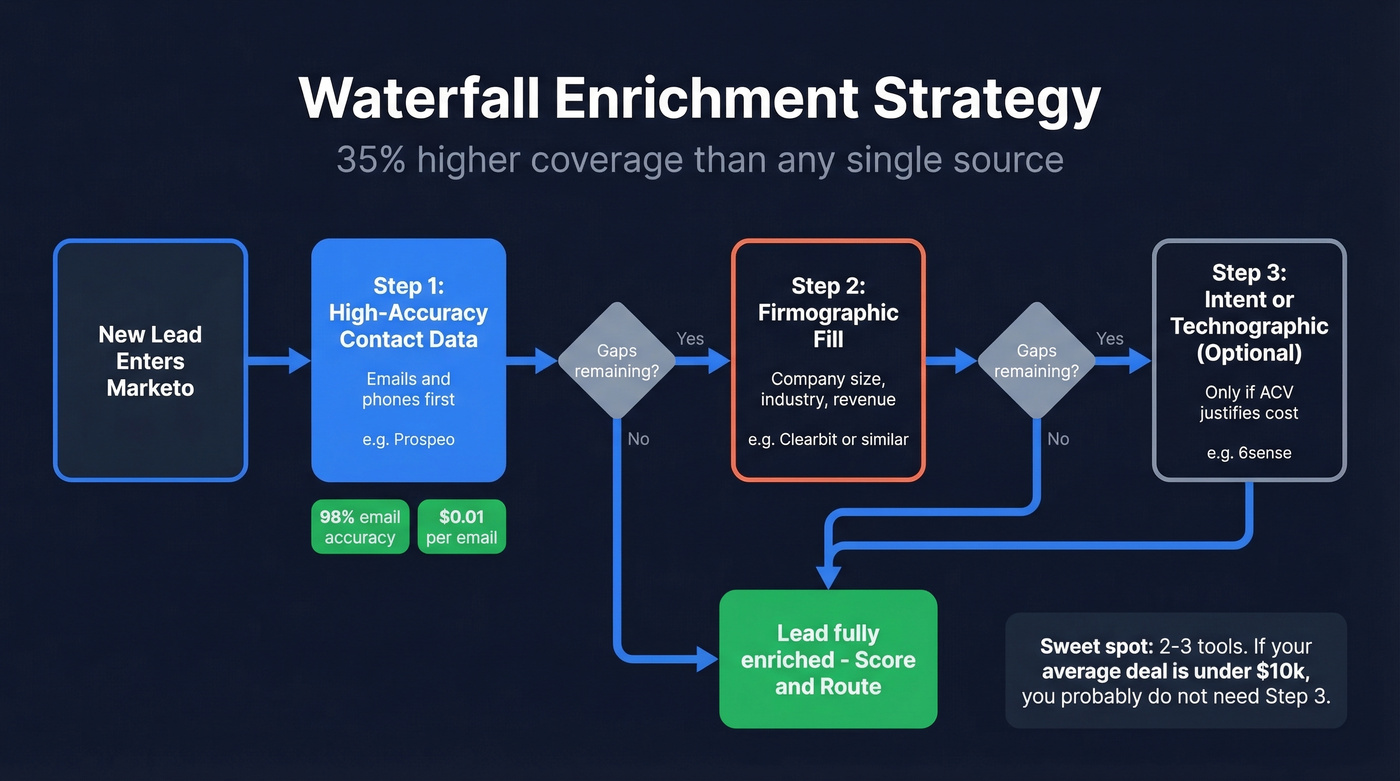
In our experience, the sweet spot is two to three tools. Start with your highest-accuracy source for emails and phones, then fill firmographic gaps with a second provider. If your average deal size is under $10k, you probably don't need ZoomInfo-level data at all. A contact accuracy tool plus a firmographic source gets you there at a fraction of the cost.
Governance: Don't Corrupt Your Database
Governance isn't optional. A popular pattern from r/MarketingAutomation: have your automation propose changes to a staging layer rather than writing directly into Marketo. Here are the rules we've seen work across implementations:
If you're tying enrichment to scoring and routing, align it with your lead scoring model so the right fields drive the right actions.
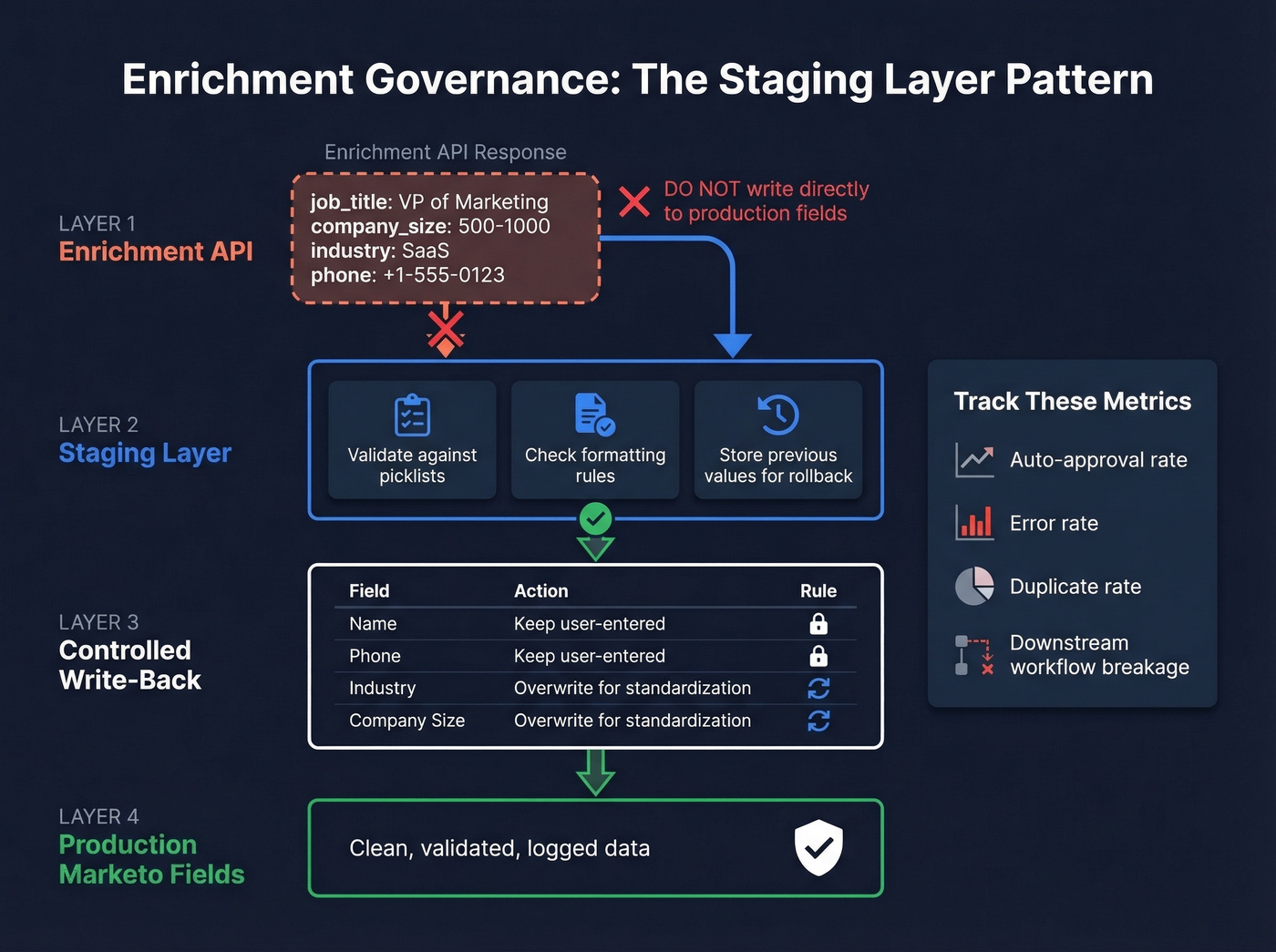
Use a staging layer. Don't write enrichment data directly into production fields. Stage proposed updates, validate against picklists and formatting rules, then write back via a controlled integration with logging. This sounds like overkill until the first time a bad API response overwrites 5,000 job titles with null values.
Set field-level overwrite rules. Keep user-entered names and phone numbers. Overwrite industry and company size for standardization. Document every rule so the next person who inherits your instance doesn't have to reverse-engineer your logic.
Store previous values before any overwrite. Rollback capability isn't paranoia - it's insurance.
Track your metrics: auto-approval rate, error rate, duplicate rate, downstream workflow breakage. If enrichment creates more problems than it solves, these numbers will tell you before your sales team does.
Common Questions
Can Marketo enrich data natively?
No. Marketo has no built-in enrichment engine. You need a third-party tool connected via native integration, webhook, or API middleware like Zapier or Make.
How often should I re-enrich?
Quarterly at minimum, since 20-25% of contact data decays annually. Tools with automatic refresh cycles reduce the manual burden significantly compared to quarterly batch jobs.
What's the cheapest way to enrich Marketo leads?
Prospeo starts at ~$0.01/email with a free tier of 75 email lookups/month. Apollo offers plans from $49/user/month but with lower accuracy in niche segments. Enterprise tools like ZoomInfo start at $15k+/year - a different budget conversation entirely.
Should I enrich in Marketo or Salesforce?
Marketo first. Enriching before the initial CRM sync lets scoring, routing, and segmentation fire immediately on complete data instead of waiting through multiple sync cycles. This is the consensus among Marketo practitioners and the single biggest architectural win for most teams.