

"May I Follow Up on the Email Below?" - What to Say Instead
You sent a proposal three days ago. Now you're staring at an empty inbox, drafting a follow-up, and second-guessing whether "may I follow up on the email below" sounds too stiff. Here's the thing: the phrase is grammatically correct. But there are sharper ways to say it - and bigger problems to fix than word choice.
What You Actually Need (Quick Version)
"May I follow up on the email below" is perfectly fine English. But "May I" asks permission you don't need - you're already following up by sending the message. For most situations, just write "I'm following up on the email below." It's direct, professional, and gets the job done.
For formal contexts: "Could you please provide an update on the email below?" For casual or internal threads: "Any updates on the below?" The real problem usually isn't phrasing. It's timing, threading, or the email never arriving in the first place.
Is This Phrase Grammatically Correct?
Short answer: yes. Ludwig confirms the phrase is correct and usable in written English. It works as a polite inquiry to check status or prompt a response.
The nuance is in the "May I." In modern business email, asking permission to follow up reads as overly deferential. You're not requesting a favor - you're doing something completely normal. Reserve "May I" for emailing a C-suite executive you've never met or a government official. For your colleague, your prospect, or your hiring manager, it's unnecessarily formal. Most people simply write "I wanted to follow up on the email below" and move on - same politeness, no permission-seeking tone.
Then there's the "below" problem. "Below" only makes sense if the original email is visible in the same thread. If you're forwarding, if the recipient's mobile client collapses threads, or if the email landed in a ticketing system, "below" points to nothing.
12 Better Alternatives
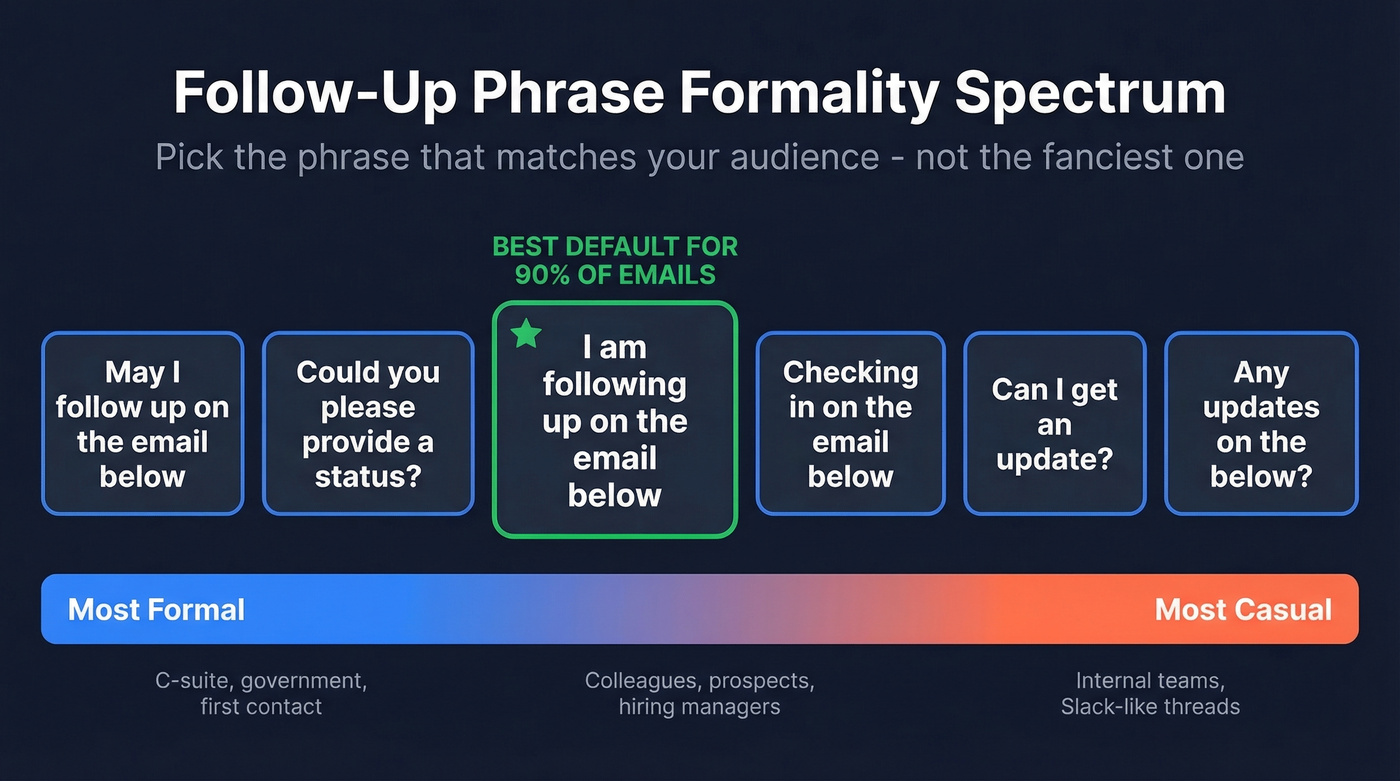
Here's the full spectrum, from boardroom-formal to Slack-casual. Pick the one that matches your audience.
| Formality | Phrase | Example |
|---|---|---|
| Most formal | May I follow up on the email below | "May I follow up regarding our Q3 proposal?" |
| Formal | With reference to the email below | "With reference to the email below, could you confirm next steps?" |
| Formal | Could you please provide a status? | "Could you provide a status on the budget request below?" |
| Professional | I would like to follow up on the email below | "I'd like to follow up on the vendor contract below." |
| Professional | I am writing to follow up | "Writing to follow up - any updates on timing?" |
| Best default | I'm following up on the email below | "Following up on the email below. Need anything from me?" |
| Neutral | To follow up on my previous email | "To follow up on my previous email, could you share the revised timeline?" |
| Casual-professional | Checking in on the email below | "Checking in - happy to hop on a call if easier." |
| Casual | Can I get an update? | "Can I get an update on the below? No rush." |
| Casual | Following my last email | "Following my last email, any updates on the timeline?" |
| Casual | Any news on what I sent? | "Any news on what I sent over Tuesday?" |
| Most casual | Any updates on the below? | "Any updates on the below?" |
"I'm following up on the email below" is the best default for 90% of business emails. Confident without being pushy, professional without being stiff. Use it and move on.
When "Below" Gets Confusing
"Below" only works when the original email is visible in a single, unbroken thread. The moment you forward a message or send to someone whose mobile client collapses quoted text, "below" points to a void.
Swap in a specific reference: "I'm following up on the proposal I sent on March 12th" or "Following up on the email titled 'Q3 Budget Review.'" Specificity beats elegance every time. If the thread is broken, reattach the original or summarize the key ask in one sentence.
Phrases to Avoid
Not every follow-up phrase is created equal. A few will actively hurt your reply rates.
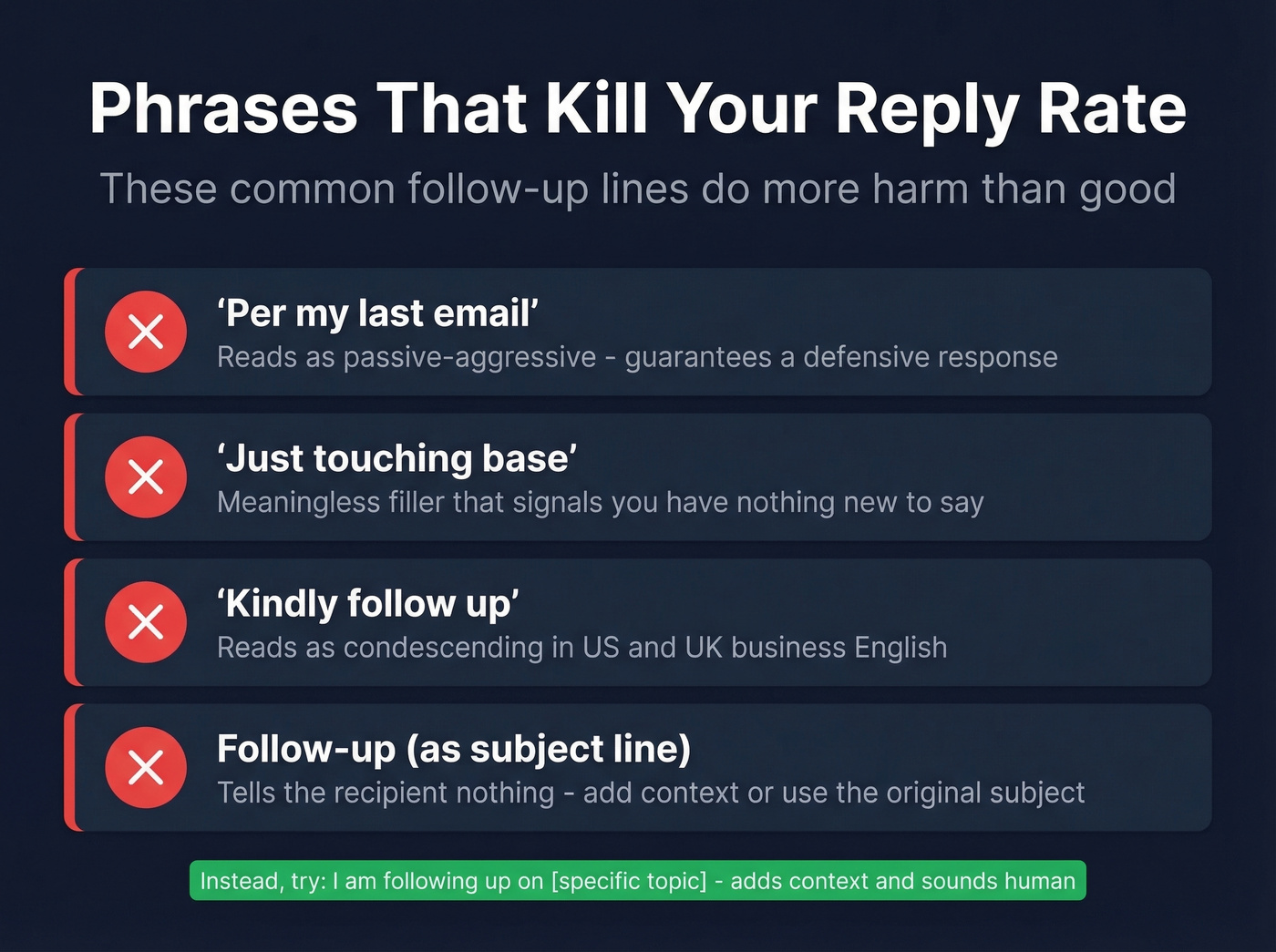
"Per my last email" is passive-aggressive, full stop. The Muse breaks down why - it reads as "I already told you this, why aren't you paying attention?" Even if that's exactly how you feel, saying it guarantees a defensive response.
"Just touching base" and "just circling back" are meaningless filler. They add zero value. Every follow-up should give the recipient a reason to respond, and "touching base" isn't a reason. The consensus on r/sales is pretty clear: these phrases signal you have nothing new to say - because you don't.
"Kindly follow up" is a cultural landmine. In US and UK business English, "kindly" often reads as condescending. If you're writing in South Asian business English, "kindly" is standard and fine. For a US or European audience, drop it.
"Follow-up" as a subject line tells the recipient nothing. Use the original subject line or add context: "Follow-up: Q3 proposal - need your input by Friday."

Your follow-up phrasing won't matter if the email bounced in the first place. Prospeo delivers 98% verified email accuracy - so your carefully crafted follow-ups actually land in real inboxes. Teams using Prospeo cut bounce rates from 35% to under 4%.
Fix the deliverability problem before you fix the wording.
Mistakes That Actually Kill Reply Rates
Look, the phrasing of your follow-up matters about 10% as much as people think. These structural mistakes are what actually tank response rates.
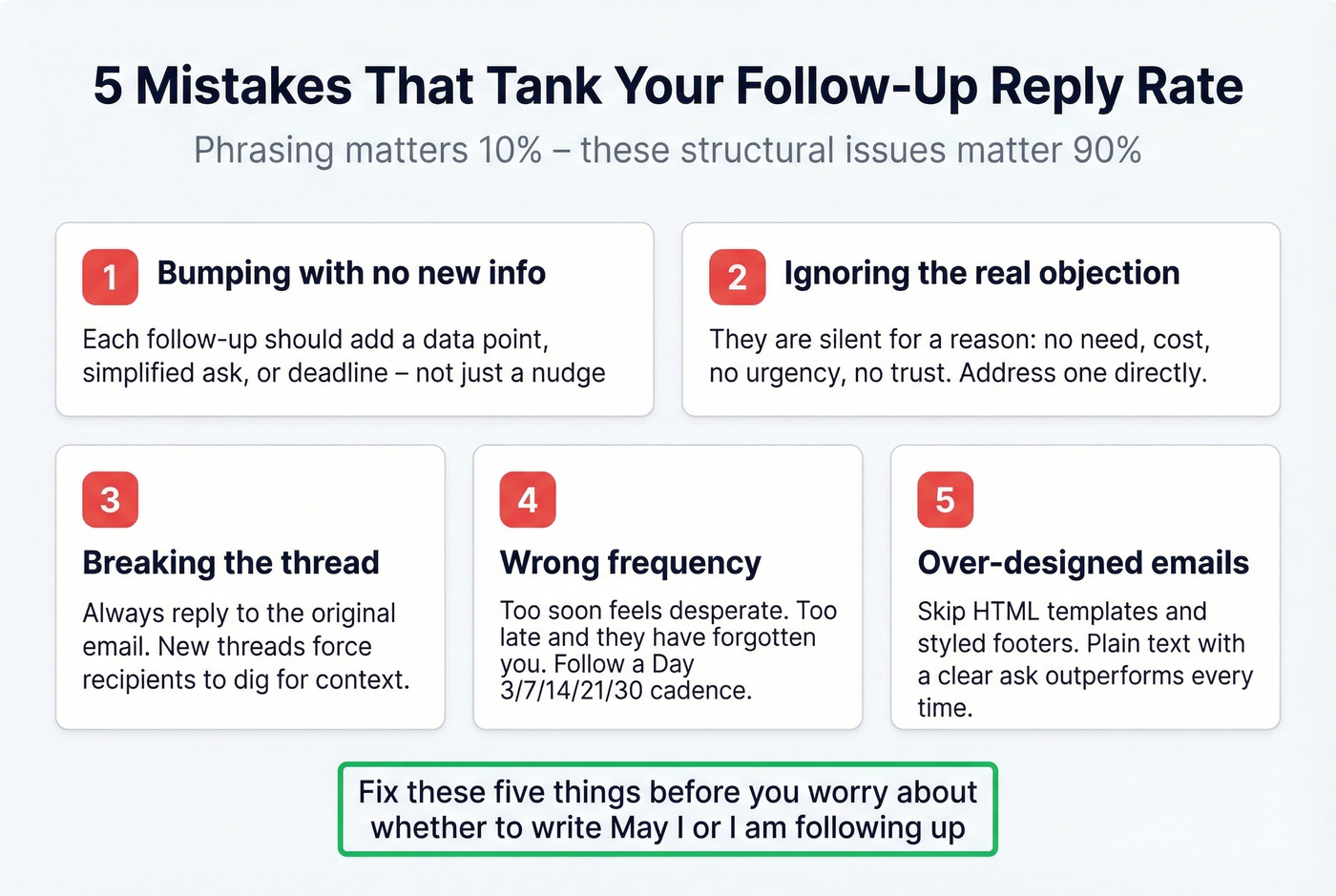
Bumping with no new information. "Just making sure you saw this" is a dead-end message. Each follow-up should add something - a new data point, a simplified ask, a deadline. If your follow-up is just a nudge, it's easy to ignore.
Not addressing the real objection. People don't respond for five reasons: no need, cost concerns, no urgency, they don't want it, or they don't trust you. Your follow-up should speak to one of these - not just repeat the original ask louder. We've seen reply rates double when the second email tackles a specific objection instead of restating the pitch.
Breaking the thread. Send your follow-up as a reply to the original email. Starting a new thread forces the recipient to dig for context, and most won't bother.
Wrong frequency. Too soon feels desperate. Too late and they've forgotten you exist. There's a sweet spot, and we'll cover it next.
Over-designed emails. Skip HTML templates, embedded images, and styled footers. Plain text with short paragraphs and a clear ask outperforms every time.
When to Send Your Follow-Up
Timing isn't guesswork. Data from Instantly shows that 4-7 step email sequences generate a 27% reply rate, compared to just 9% for 1-3 step sequences. That's a 3x difference just from not giving up too early. And while 58% of replies come on step one, a full 42% arrive across steps two through four - nearly half your responses come from follow-ups.
If you want a deeper breakdown, see our guide on follow-up timing in When to send your follow-up.
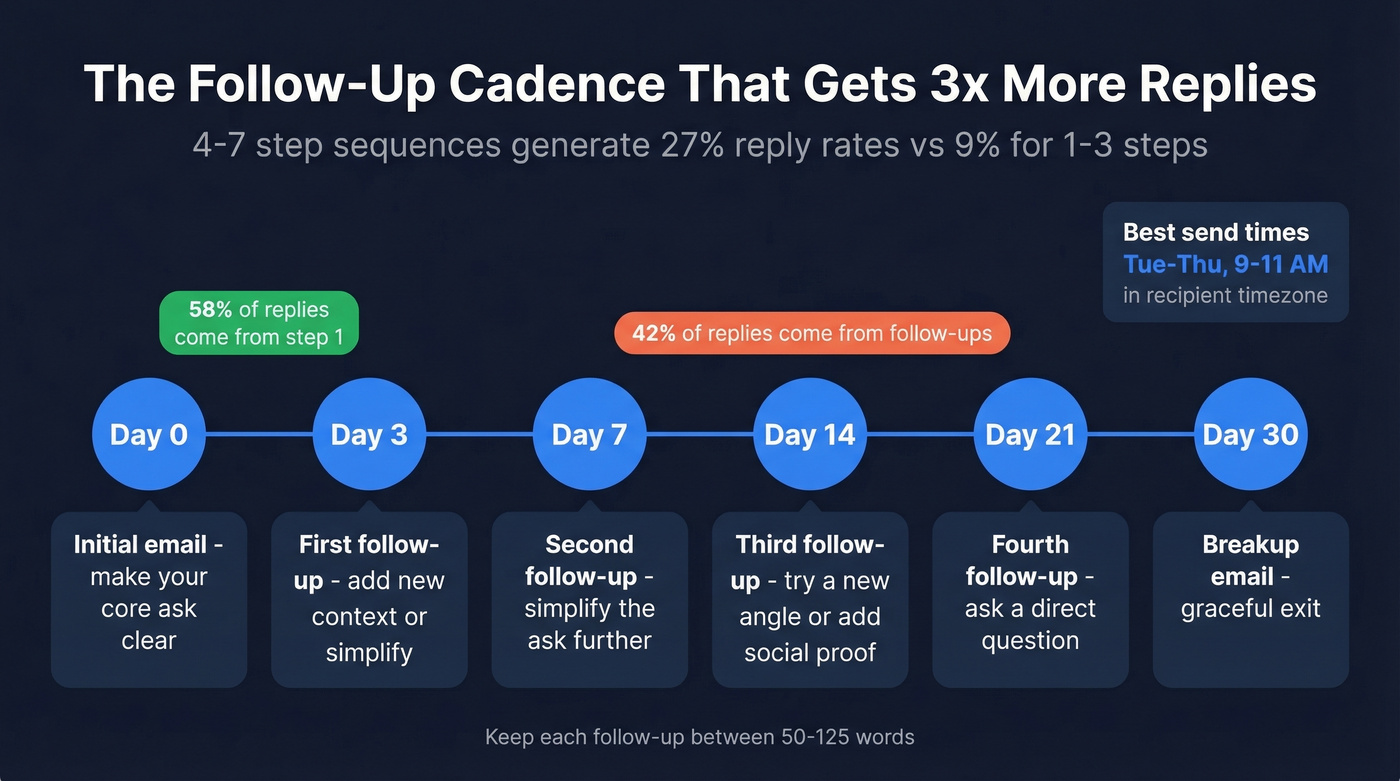
The sweet spot for send timing: Tuesday through Thursday, 9-11 AM in the recipient's timezone. Here's a cadence that works:
- Day 0: Initial email
- Day 3: First follow-up - add new context or a simplified ask
- Day 7: Second follow-up (simplify the ask further)
- Day 14: Third follow-up (new angle or social proof)
- Day 21: Fourth follow-up (direct question)
- Day 30: Breakup email
Keep each follow-up between 50 and 125 words. Anything longer and you're writing a memo. Anything shorter and you're just bumping.
Templates That Actually Work
We've tested dozens of follow-up variations, and the ones that get replies share one trait: they add new information. Here are four you can copy and customize in under a minute.
If you want more options, these follow-up templates cover more scenarios and tones.
No response after your initial email:
Hi [Name], I'm following up on the email below about [specific topic]. I know things get buried - happy to resend or simplify if that helps. What's the best way to move this forward?
After a meeting with no next steps confirmed:
Hi [Name], great speaking with you on [day]. I wanted to follow up on [specific discussion point]. Would a 15-minute call this week make sense to nail down next steps?
Cold outreach follow-up (sales):
Hi [Name], I sent a quick note last [day] about [value prop - one sentence]. Thought this might be relevant given [trigger: new hire, funding round, product launch]. Worth a 10-minute chat?
Internal request or overdue deliverable:
Hi [Name], following up on my email regarding [specific request] from [date]. I want to keep [project/timeline] on track - is there anything blocking this on your end? Happy to adjust scope if needed.
Job application follow-up:
Hi [Name], following up on my previous email regarding the [role] position submitted on [date]. Still very interested - happy to provide any additional materials that would help.
Make Sure Your Email Actually Arrived
Most follow-up advice ignores a very common reason for silence: the email bounced and you never knew about it.
Bad email data leads to bounces. Bounces damage your sender reputation. A damaged sender reputation means even your good emails start landing in spam. Google's sender guidance uses a 0.3% spam complaint threshold - go above it and you risk delivery restrictions. I've personally watched a team send five follow-ups to a prospect who never received the first email because the address was dead. That's not a phrasing problem. That's a data problem.
You don't need a fancier phrase. You need cleaner data. Prospeo verifies emails in real time with 98% accuracy and catches bad addresses before they bounce. The free tier covers 75 verifications per month - enough to clean a slice of your active pipeline before your next sequence goes out.
If you're troubleshooting bounces, start with email bounce rate benchmarks and fixes, then work through a full email deliverability checklist.
Following up 4-7 times only works when you're reaching the right person at a real address. Prospeo's 300M+ profiles refresh every 7 days - not 6 weeks - so your sequences hit active inboxes, not dead ends. At $0.01 per email, bad data isn't worth the risk.
Every follow-up deserves a verified email behind it.
FAQ
Is "may I follow up on the email below" too formal?
For most business emails, yes. "I'm following up on the email below" is more natural - it states what you're doing instead of asking permission. Reserve "May I" for C-suite executives or officials you've never met. For peers or hiring managers, a direct opener works better.
How long should I wait before following up?
Two to three business days is the standard. Data shows 4-7 step sequences generate 3x the reply rate of shorter ones. Follow a Day 3/7/14/21/30 cadence for best results.
What if my follow-up emails get no response at all?
After four to five follow-ups with no reply, stop that thread. First, verify the email address is valid - many "no responses" are actually bounces. If you're sending cold outreach at scale, skip this if you haven't verified your list first. That's the most common culprit we see.
What's the best subject line for a follow-up email?
Reply to the original thread so the subject line carries over automatically. If you must start fresh, use the format "Follow-up: [original topic] - [specific ask or deadline]." Never use a bare "Follow-up" with no context - it tells the recipient nothing and gets ignored.