

MEDDIC Sales Methodology: What Every Enterprise Rep and Sales Leader Needs to Know
A RevOps lead we know rolled out the MEDDIC sales methodology last year after a $180k training engagement. Six months later, reps were backfilling CRM fields from memory after calls, managers were reading those fields back in pipeline reviews like a liturgy, and forecast accuracy hadn't moved. The framework wasn't the problem. The implementation was.
MEDDIC remains the dominant qualification framework for enterprise B2B sales - and for good reason. But the gap between knowing the acronym and running it in live deals is where most teams lose.
Here's the short version: 73% of SaaS companies selling $100k+ ARR use some variant of MEDDIC. Choose your variant by deal complexity - MEDDIC for ~$50k-$250k deals, MEDDICC for $250k+ competitive situations, MEDDPICC for complex enterprise cycles where paper process and competition matter. Most implementations fail, not the framework itself. And the framework tells you who matters in the deal - you still need accurate contact data to actually reach them.
Why MEDDIC Matters More Now Than in 1996
Enterprise selling has gotten structurally harder. Buying committees have expanded from 3-5 stakeholders to 8-12. Sales cycles that used to close in 3 months now stretch to 6-9. Buyers complete roughly 80% of their research - per CEB/Gartner's original study - before they'll even take a meeting.
That's the environment this framework was built for, even if it was built about 30 years ago. Developed at PTC in the 1990s, commonly credited to Dick Dunkel, with Jack Napoli and John McMahon helping document and spread it, the core insight hasn't aged: in complex deals, intuition isn't enough. You need a systematic way to assess whether a deal is real, who controls it, and what it takes to close it.
The reason so many enterprise SaaS companies run some MEDDIC variant isn't because it's trendy. Nothing else gives you the same rigor for multi-stakeholder, multi-month deals.
What MEDDIC Stands For
Metrics
Metrics are the quantifiable outcomes your prospect needs to achieve. Not your product's features - their business results. If you can't tie your solution to a number the prospect already cares about, you don't have a deal. You have a demo request.
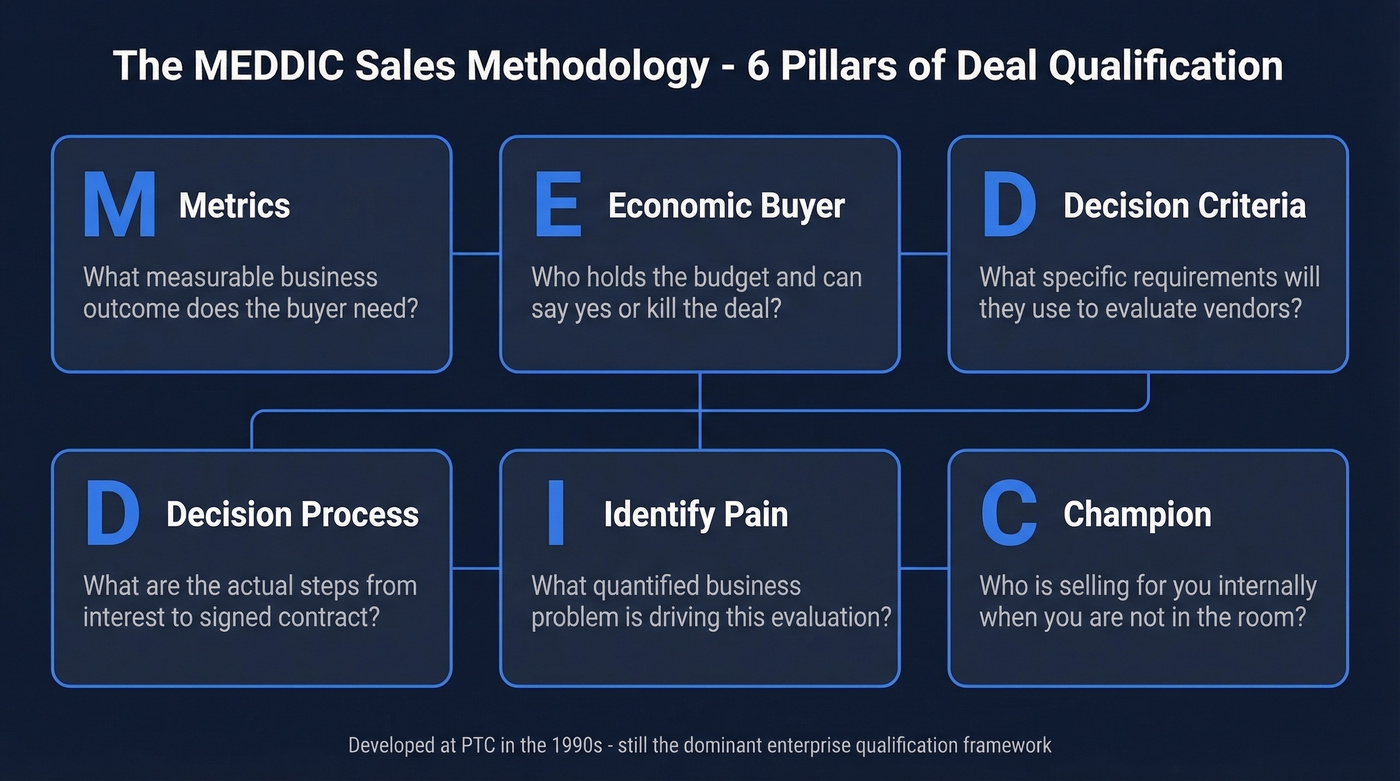
The goal is to anchor every conversation in measurable impact: revenue gained, costs reduced, time saved, risk mitigated. Unquantified metrics account for roughly 20% of failed enterprise deals. The trap is accepting vague aspirations. A prospect says "we want to improve efficiency" and the rep writes that in the CRM. That's not a metric. Push for the number behind the aspiration: "What does 'improved efficiency' mean in dollars or headcount saved this quarter?"
Economic Buyer
The economic buyer is the person who can say yes when everyone else says no - and who can kill the deal when everyone else says yes. They control the budget. They sign the contract. They're often not in your first meeting.
Missing the economic buyer accounts for 30% of failed enterprise deals. That's the single most expensive qualification gap after champion confusion. Reps routinely mistake an enthusiastic director for the economic buyer, only to discover three months in that the VP of Finance they've never spoken to holds the actual budget authority.
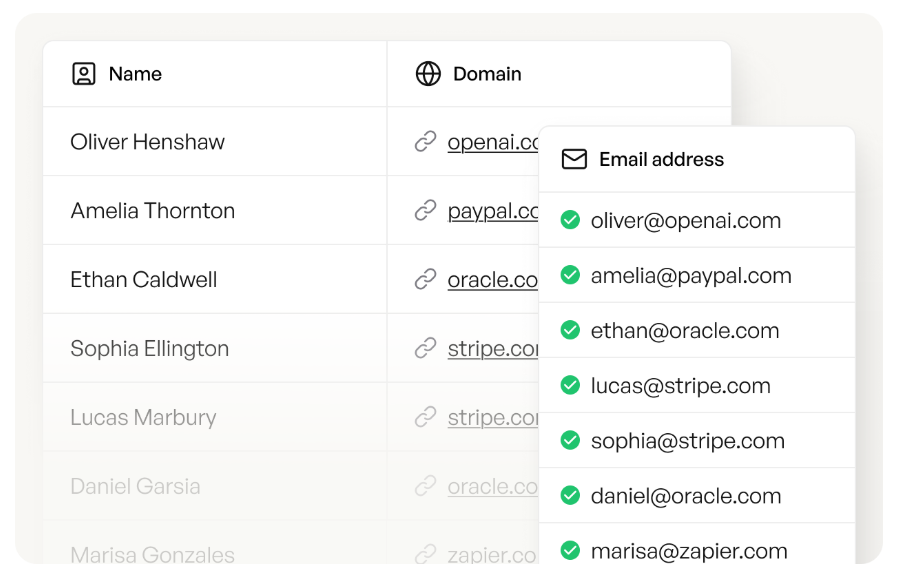
The gap between identifying the economic buyer and actually reaching them kills more deals than bad discovery. You need verified contact data - not a generic info@ email. Prospeo gives you verified emails and mobile numbers across 300M+ professional profiles with 98% email accuracy, so you can multi-thread into the account the same day you identify the stakeholder.
Don't ask your champion "are you the decision-maker?" They'll almost always say yes. Instead, ask about the approval chain. The org chart tells you more than self-reporting ever will.
Decision Criteria
Decision criteria are the specific requirements - technical, financial, operational - the buying committee uses to evaluate vendors. These aren't always written down, and they're almost never complete in the first conversation.
We've watched reps lose deals they should have won because they assumed decision criteria were static. They're not. Criteria shift every time a new stakeholder enters the evaluation. A security team joins in week six and suddenly "SOC 2 compliance" is a non-negotiable that didn't exist in week one. Check back on criteria at every major stage transition, and ask directly: "What criteria knocked out the last vendor you evaluated?"
Decision Process
Here's a scenario that plays out constantly: a rep runs a flawless demo, gets verbal buy-in from the champion and the economic buyer, and then the deal goes dark for eight weeks. What happened? A procurement committee the rep didn't know existed. A legal review that requires three rounds of redlines. A security assessment with a 30-day SLA.
Unknown decision process accounts for 25% of deal failures. The fix is simple but uncomfortable - ask your prospect to walk you through every step between "we like this" and "contract signed." Most reps confuse their own pipeline stages with the buyer's internal approval flow. They aren't the same thing.
Identify Pain
Pain is the business problem driving the evaluation. Not the feature request - the underlying pain. No pain, no urgency. No urgency, deals stall indefinitely.
"We need better reporting" isn't pain. "We lost a $2M renewal because we couldn't prove ROI to the CFO" is pain. Dig until you hit a number or a consequence. Ask what happens if they do nothing for the next 12 months. Ask what this problem is costing them in revenue, headcount, or time. The best discovery reps treat pain identification like investigative journalism - they aren't satisfied until they have a specific, quantified business impact.
Champion
Your champion is the internal advocate who wants your solution to win and has the influence to make it happen. They're not just friendly - they're actively selling on your behalf inside the organization.
Champion confusion is the #1 failure mode in enterprise deals, accounting for 35% of lost or slipped opportunities. A real champion has three qualities: they have power or influence, they have a personal stake in the outcome, and they're willing to sell internally when you're not in the room.
Where reps go wrong is having only one champion. In deals with 8-12 stakeholders, you need multiple internal advocates. If your single champion leaves or gets reassigned, the deal dies. Test your champion's strength by asking: "How would you present this to the executive team?" If they can't articulate the business case without your help, they're a coach, not a champion.
MEDDIC vs MEDDICC vs MEDDPICC
Not every deal needs every letter. Overcomplicating the framework for a $75k deal is just as damaging as under-qualifying a $500k one.
| Variant | Letters Added | Best For | Deal Size | Stakeholders |
|---|---|---|---|---|
| MEDDIC | - | Standard enterprise | $50k-$250k | 5-8 |
| MEDDICC | +Competition | Competitive RFPs | $250k+ | 8-12 |
| MEDDPICC | +Paper Process, Competition | Complex procurement | $250k-$1M+ | 10-15 |
| MEDDPICCR | +Risks | Strategic accounts | $1M-$10M+ | 15+ |
MEDDPICC adoption yields 18% higher win rates and 24% larger deal sizes compared to simplified frameworks - but only when the deal complexity justifies it. Forcing MEDDPICC on a 45-day mid-market deal creates the exact documentation burden that makes reps hate the framework.
The Paper Process addition matters when procurement, legal, and security reviews add weeks or months to your cycle. Competition matters when you're in a formal bake-off. If neither applies, stick with the core six letters and save your team the overhead.
Let's be honest: if your average deal is under $100k ACV and closes in 60 days, you probably don't need MEDDIC at all. BANT will get you 80% of the way there with a fraction of the overhead. The framework's value scales with deal complexity - below a certain threshold, it's just bureaucracy.
The 4 Deal-Killing Gaps MEDDIC Exposes
We've reviewed dozens of deal post-mortems, and RevWiser's analysis of failed and slipped enterprise deals confirms the same four gaps show up every time. These aren't theoretical - they're the specific places where pipeline turns into fiction.
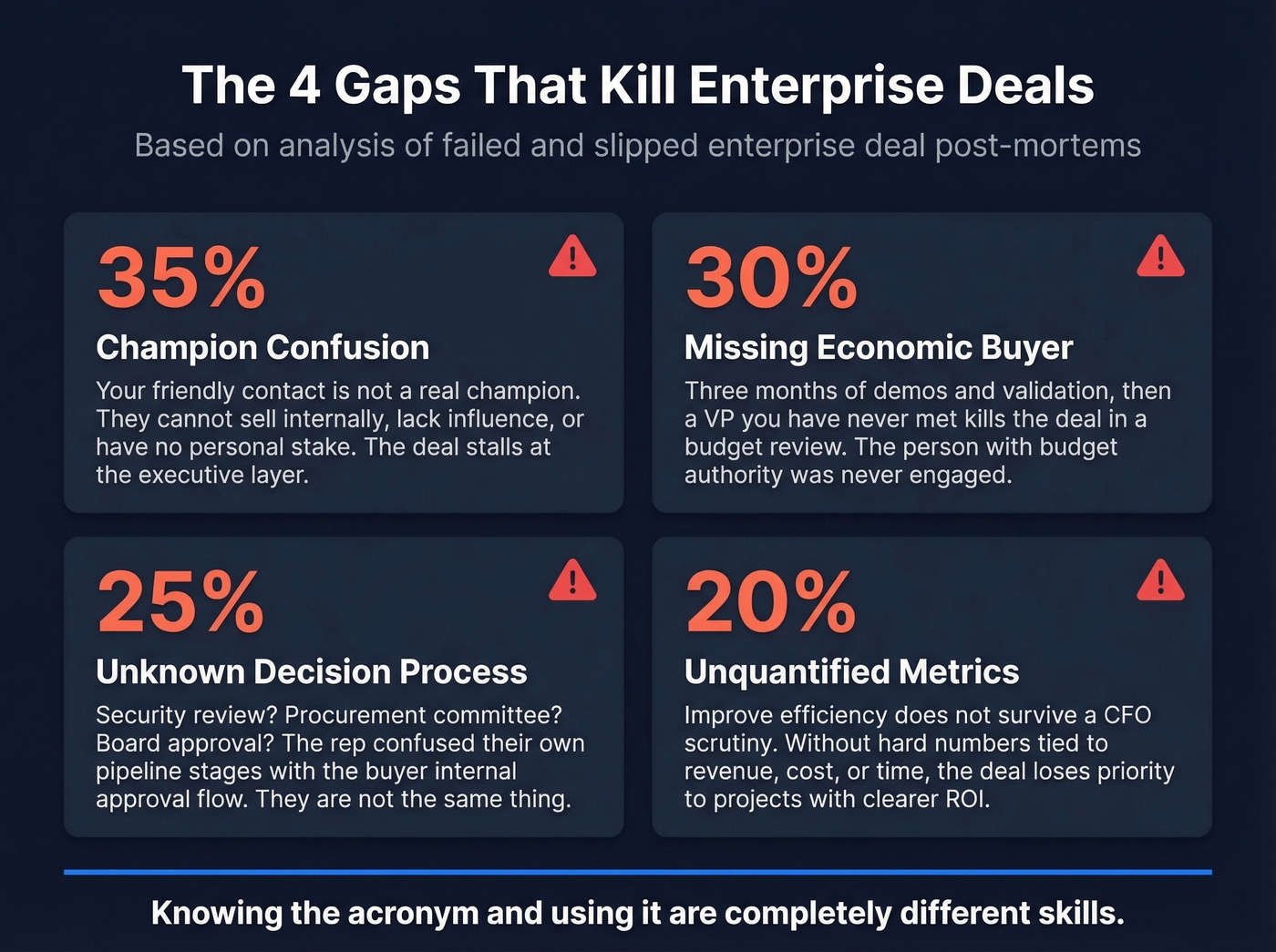
Champion confusion (35%). The rep has a friendly contact, not a true champion. The "champion" can't sell internally, doesn't have influence, or doesn't have a personal stake in the outcome. The deal stalls when it hits the executive layer.
Missing economic buyer (30%). The rep never identified or engaged the person who controls the budget. Three months of demos and technical validation, then a VP they've never met kills the deal in a budget review.
Unknown decision process (25%). The rep doesn't know the approval stages, the stakeholders involved, or the timeline. Security review? Procurement committee? Board approval? Surprise.
Unquantified metrics (20%). The business case is vague. "Improve efficiency" doesn't survive a CFO's scrutiny. Without hard numbers, the deal loses priority to projects with clearer ROI.
Knowing the acronym and using it are completely different skills. Most reps can recite the letters. Far fewer can diagnose these gaps in a live conversation and course-correct before the deal slips.

MEDDIC tells you the economic buyer matters most - but 30% of deals fail because reps can't reach them. Prospeo's 300M+ profiles with 98% email accuracy and 125M+ verified mobiles let you multi-thread into any account the moment you map the buying committee.
Stop losing deals to stakeholders you identified but never contacted.
Why Reps Hate MEDDIC (And 3 Fixes)
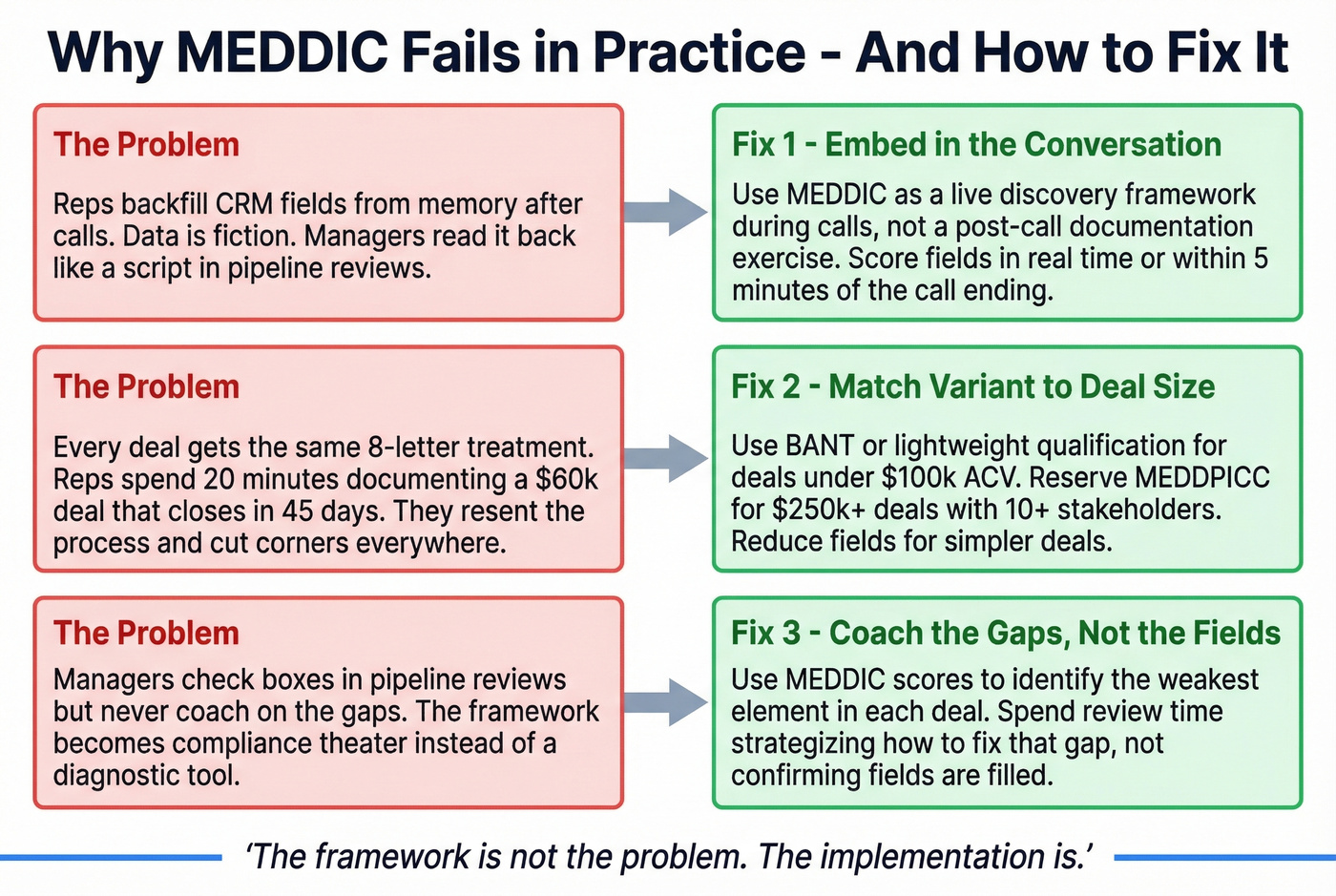
The consensus on r/sales is blunt: "MEDDIC is a CRM exercise. Reps fill out fields to make managers happy. Managers check boxes to survive pipeline reviews." Another thread calls MEDDPIC documentation "wasting everyone's time" - leadership using process to make sales "seem closer to brain surgery than sales."
And then there's the convergence argument: "All sales methodologies are basically the same." Need, budget, stakeholders, timeline. Sandler, BANT, Challenger, MEDDIC - different acronyms, same fundamentals.
These complaints aren't wrong. They're describing bad implementations, not a bad framework. Three fixes actually work.
Fix 1: Stop using it as a CRM audit. If your pipeline reviews consist of a manager reading MEDDIC fields back to you and asking "is this still accurate?", you don't have a methodology - you have a bureaucracy. Use it as a coaching tool in deal reviews. "You've identified the champion, but have you tested whether they can actually sell internally? What's your evidence?"
Fix 2: Match variant complexity to deal size. Forcing MEDDPICC on a $60k deal with a 30-day cycle is absurd. MEDDIC for mid-market, MEDDPICC for enterprise. Simple rule, massive reduction in rep frustration.
Fix 3: Teach fundamentals first. Reps who can't run a good discovery call won't be saved by a framework. Teach them to ask great questions, listen for pain, and map stakeholder dynamics. Then layer the qualification structure as the system that scales those skills across a team. In our experience, the teams that make it stick are the ones that use it as a coaching language, not a compliance checklist.
CRM Implementation That Sticks
Most MEDDIC rollouts follow the same arc: expensive training, enthusiastic first month, CRM fields that collect dust by month four. Adherence decays 40-50% within 6 months without active reinforcement. Training engagements from firms like Force Management or Winning by Design run $100k-$500k, so that decay is expensive.
Teams that enforce the process through stage-gating can drive forecast variance from 30-50% down to under 10%. That alone justifies the implementation effort.
Maturity Model
Before you build anything, assess where your team sits today.
- Level 1 - Fields Exist. CRM has MEDDIC fields. Reps fill them out sporadically, usually before pipeline reviews. No enforcement, no coaching.
- Level 2 - Stage-Gated. Validation rules prevent deals from advancing without qualification data. Reps can't skip steps. Pipeline hygiene improves immediately.
- Level 3 - Coach-Led. Managers use the framework in deal reviews as a diagnostic tool, not a compliance checklist. Reps start internalizing it.
- Level 4 - AI-Assisted. Call intelligence tools auto-populate fields from conversation transcripts. Reps focus on selling, not data entry. This is where the framework finally stops feeling like overhead.
Most teams are stuck at Level 1. The goal is Level 3 within 6 months and Level 4 within 12.
Salesforce Setup
Your stage model should align to qualification gates: Qualification, Discovery, Solution Alignment, Proposal/Validation, Negotiation/Review, Closed Won. Each stage maps to specific components that must be validated before the opportunity advances.
Validation rules enforcing exit criteria are what separate real implementations from checkbox theater. You can't move from Qualification to Discovery without identifying the economic buyer. You can't move from Discovery to Solution Alignment without documented decision criteria. Stage-gating prevents the optimistic stage-jumping that inflates pipeline.
Plan for 6-8 custom fields on the Opportunity object - one per component, plus fields for champion strength and competitive positioning if you're running MEDDICC or MEDDPICC. Use Salesforce Sales Path to surface guidance and key fields at each stage. For HubSpot teams, use required properties on deal stages and deal pipelines to achieve similar gating. The logic is the same - just different plumbing.
Qualification Scorecard
| Component | 0 - Unknown | 1 - Identified | 2 - Validated | 3 - Confirmed | Evidence Required |
|---|---|---|---|---|---|
| Metrics | No data | Prospect mentioned goals | Quantified with numbers | Tied to business case | ROI doc or email confirmation |
| Econ. Buyer | Unknown | Named | Met/engaged | Aligned to your solution | Meeting notes or calendar invite |
| Decision Criteria | Unknown | General requirements | Specific, weighted | You shaped them | Scorecard or email from prospect |
| Decision Process | Unknown | High-level timeline | Stages mapped | Milestones confirmed | Written timeline from buyer |
| Identify Pain | Unknown | Surface-level pain | Quantified impact | Urgent, funded | Business case with dollar impact |
| Champion | No advocate | Friendly contact | Active internal seller | Proven influence | Internal email forwarded or intro made |
Score each deal 0-18. Anything below 12 at the Proposal stage is a red flag. Below 8 at Discovery? Disqualify or send it back for more work.
Your qualification fields are only as good as the data feeding them. When you identify a new stakeholder in a deal review, you need their verified email and mobile number within minutes, not days. Tools like Prospeo refresh data every 7 days - the industry average is 6 weeks - and return 50+ data points per contact through CRM enrichment, which keeps your MEDDIC fields grounded in reality rather than guesswork.
Your MEDDIC framework is only as strong as your ability to reach every stakeholder in the deal. With 30+ search filters - including job title, department, and company size - Prospeo helps you map and contact entire buying committees at $0.01 per verified email.
Cover every stakeholder in your deal for less than a dollar.
MEDDIC vs BANT vs SPIN vs Challenger
The "all methodologies are the same" crowd has a point - at the fundamental level, every framework addresses need, budget, stakeholders, and timeline. The difference is structural depth and where each one shines.
| Framework | Best For | Cycle Length | Stakeholders | Core Strength |
|---|---|---|---|---|
| BANT | Transactional, <$50k | <60 days | 1-3 | Speed, simplicity |
| SPIN | Consultative, mid-market | 60-180 days | 3-6 | Question-based discovery |
| Challenger | Complex, insight-led | 90-180 days | 5-10 | Teaching, reframing |
| MEDDIC | Enterprise qualification | 180-270 days | 8-12 | Qualification rigor |
SPIN Selling was built on analysis of 35,000+ sales calls by Neil Rackham. Challenger came from CEB/Gartner's study of 6,000+ reps. Both are excellent selling methodologies. Neither is a qualification framework.
That's the distinction most people miss. MEDDIC doesn't tell you how to sell. It tells you whether to sell - and to whom. You can run Challenger as your selling methodology and MEDDIC as your qualification framework simultaneously. We've seen that combination work extremely well for enterprise teams: Challenger teaches reps to lead with insight, and the qualification structure ensures they're leading with insight to the right people in the right deals.
Skip MEDDIC entirely if your team sells transactional deals with one or two decision-makers. It'll slow you down without adding value. BANT or a simple qualification checklist will serve you better.
Discovery Question Bank
Good execution lives and dies in the questions you ask. These are designed for later-stage conversations - second and third meetings where you're pressure-testing what you learned in initial discovery. Inspired by Scratchpad's 60-question framework, trimmed to the highest-leverage questions per component.
Metrics - Pressure-Testing the Business Case
- What financial impact would a 20% improvement in [key metric] have on your P&L?
- If we can prove [specific outcome] in a pilot, is that enough to justify the full rollout?
- Who else in the organization needs to see these numbers before they're credible?
Economic Buyer - Navigating the Power Structure
- What would make the economic buyer say no, even if your team says yes?
- Has this budget been pre-approved, or does it need to be carved from somewhere else?
- What competing priorities is the economic buyer weighing this against?
Decision Criteria - Uncovering Hidden Requirements
- If you had to rank your top three criteria, what order would they fall in?
- Are there any requirements that haven't been formally documented but will matter?
- What would make you choose a more expensive option over a cheaper one?
Decision Process - Mapping the Approval Gauntlet
- Are there procurement, legal, or security reviews we should plan for? What's the typical timeline for each?
- Has anyone in your organization tried to push a purchase through faster than the standard process? What happened?
- What's the single biggest bottleneck between "we want this" and "contract signed"?
Identify Pain - Going Deeper
- What have you tried before, and why didn't it work?
- If this problem disappeared tomorrow, what would your team do differently with the freed-up time or budget?
- Who else in the organization feels this pain most acutely - and are they involved in this evaluation?
Champion - Stress-Testing Internal Advocacy
- If I weren't in the room, how would you pitch this to the executive team in two minutes?
- Who's most likely to push back, and what's their specific objection going to be?
- What happens for your career if this project succeeds? What happens if it doesn't?
A lot of teams search for a downloadable PDF to hand reps as a quick reference. The question bank above, combined with the scorecard in the CRM section, gives you everything a one-pager would - but tied directly to your live deal workflow instead of sitting in a forgotten downloads folder.
FAQ
Is MEDDIC a methodology or a qualification framework?
It's a qualification framework, not a selling methodology. It tells you whether a deal is worth pursuing and who controls the outcome - not how to run discovery or deliver a pitch. Pair it with Challenger or SPIN for full sales cycle coverage.
Does MEDDIC work for SMB or transactional sales?
Not well. It's built for complex B2B deals with multiple stakeholders and cycles exceeding 90 days. For deals under $50k with short timelines, BANT is simpler and sufficient - you'll get 80% of the qualification value with a fraction of the overhead.
How long does it take to implement?
Expect 2-3 months for CRM setup, stage-gating, and initial training. Embedding it into team behavior takes 6-12 months of consistent reinforcement through deal reviews and coaching. Budget $100k-$500k if you're using a training firm like Force Management.
What's the difference between MEDDIC and MEDDPICC?
MEDDPICC adds Paper Process and Competition. Use it for deals above $250k with formal procurement gates or head-to-head vendor evaluations. For simpler enterprise deals, the original six letters are enough.
How do I find and reach the economic buyer?
Start with your champion - ask who signs off on budget and what the approval chain looks like. Then use a B2B data platform to get verified contact details so you can multi-thread into the account. Relying on a single internal path to the economic buyer is the #1 way deals stall at the finish line.