

MEDDPICC Decision Criteria: The Practitioner's Field Guide
It's Thursday afternoon. You're in the pipeline review. Your manager pulls up a deal and asks, "What are their Decision Criteria?" You glance at the CRM field. It says "price, features, support." Three words that tell you absolutely nothing about how this buyer will actually choose a vendor.
A common take on r/sales is blunt: MEDDIC fields are "CRM exercises disguised as a sales methodology." Reps fill them out to make managers happy. Nobody uses them to actually win. That's a shame, because decision criteria is the most underused letter in the framework that took PTC from $300M to $1B in four years. Let's fix that.
What Are Decision Criteria in MEDDPICC?
Decision Criteria are the specific standards your buyer uses to evaluate and rank competing solutions - their grading rubric.
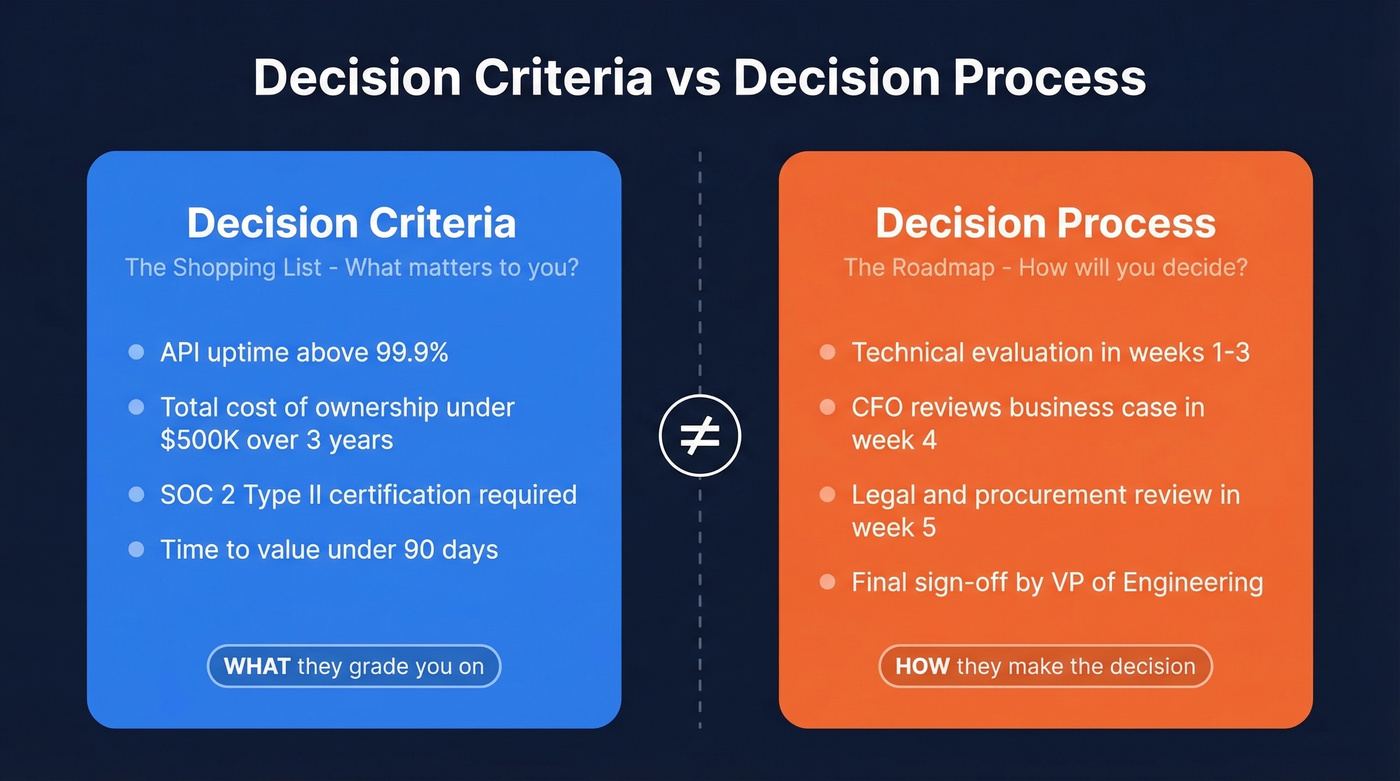
The most common confusion is mixing up Decision Criteria with Decision Process. Here's the cleanest distinction: Criteria = the shopping list. Process = the roadmap. Criteria answers "what matters to you?" Process answers "how will you decide?" If you're asking "who signs off after the proposal?" - that's Process. If you're asking "what are the three capabilities you can't live without?" - that's Criteria.
Three Types of Evaluation Criteria
Not all criteria come from the same person, and they don't carry the same weight. Three distinct types show up in every enterprise deal:
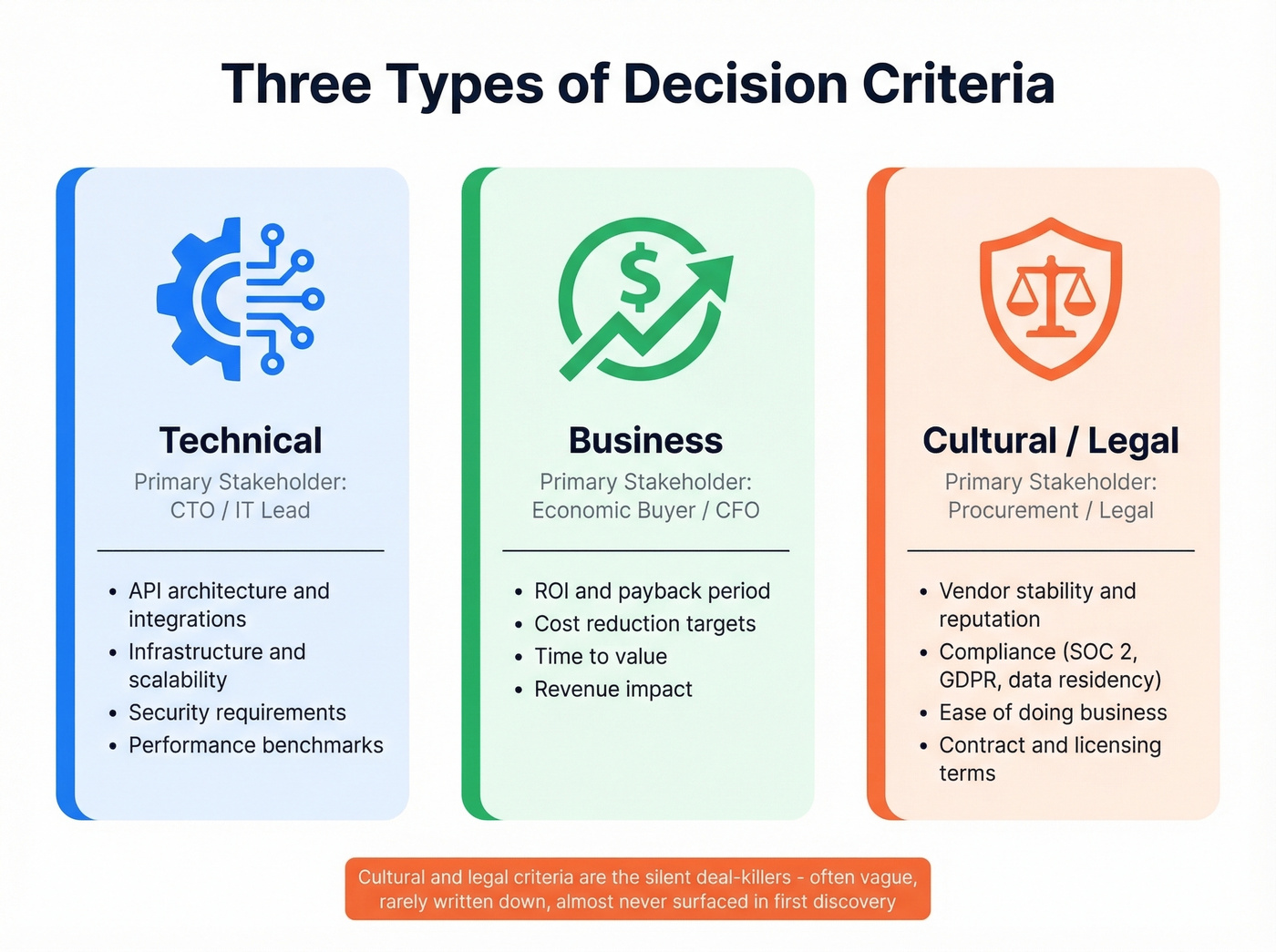
| Type | What It Covers | Primary Stakeholder |
|---|---|---|
| Technical | Integration, infrastructure, security | CTO / IT lead |
| Business | ROI, cost reduction, time-to-value | Economic Buyer |
| Cultural/Legal | Vendor stability, compliance, ease of doing business | Procurement / Legal / Security & Compliance |
Research shows 13 people are involved in an average B2B purchase, with 89% of deals spanning two or more departments. Each stakeholder brings their own criteria type to the table. Your CTO cares about API architecture. Your CFO cares about payback period. And procurement? They'll kill your deal over SOC 2 compliance or data residency requirements that nobody mentioned until week six.
Cultural and legal criteria are the silent deal-killers - often vague, rarely written down, almost never surfaced in a first discovery call. If your CRM field doesn't include at least one cultural or legal factor, you're flying blind.
Discovery Questions That Work
You don't need 137 questions. You need five great ones and the judgment to know when to ask them. As one practitioner put it, question banks are useful for inspiration - reciting them robotically in a discovery call is a fast way to lose credibility.
Technical criteria:
- "What are the three capabilities your team can't go live without?"
- "How will your technical team evaluate integration with your current stack?"
Business criteria:
- "What are the top three must-have outcomes this investment needs to deliver?"
- "How are you measuring ROI - and who owns that number?"
Cultural/legal criteria:
- "Beyond the technical and financial fit, what intangible factors will influence this decision - vendor support, implementation ease, compliance?"
In our experience, that last question surfaces more deal-critical information than any technical requirements question. The stuff buyers won't volunteer is the stuff that kills your deal in month two. We've seen seven-figure deals stall for weeks because nobody asked about data residency until legal got involved at the eleventh hour.

Hidden criteria from stakeholders you never reached kill more deals than weak demos. Prospeo's 30+ search filters - including department headcount, job change signals, and buyer intent - let you map the full buying committee before the RFP locks. 98% email accuracy means your outreach actually lands.
Stop losing deals to stakeholders you didn't know existed.
How to Influence Buyer Criteria
Timing is everything. Challenger research across ~5,000 respondents found that sales experience drives 53% of customer loyalty - more than brand, product, and price combined. The way you teach buyers to think about their evaluation standards is itself a competitive advantage.
When you can influence: Before the RFP drops, when there's no incumbent, when the buyer is a startup or mid-market company with no formal procurement process. This is where you shape the game.
When you can't: After the RFP is locked, when the buyer has frame contracts with an incumbent, when Fortune 500 procurement owns the template. At that point, you're playing defense. Skip the influence playbook and focus on scoring well against what's already written.
Here's the thing: when you can influence, the highest-leverage move is trap-setting. Frame your unique differentiators as named criteria before the competition can respond. If your platform has a proprietary integration capability, make "native integration with [X]" a named criterion in the evaluation. Once criteria are written into an RFP or scorecard, they're hard to change - and your competitor is now scrambling to address a requirement they didn't see coming.
But you can't influence criteria from stakeholders you can't reach. Before the discovery call, make sure you've got verified contact data for the Economic Buyer, technical evaluators, and procurement lead. Prospeo's 30+ search filters - including department headcount and job change signals - help you map the full buying committee before hidden criteria surface too late.
Build a Weighted Scoring Matrix
If your CRM field says "price, features, support," you've failed. Those aren't criteria - they're categories. "Cost" isn't a criterion. "Total cost of ownership over three years, below $X" is. Real criteria are specific, weighted, and tied to stakeholders.
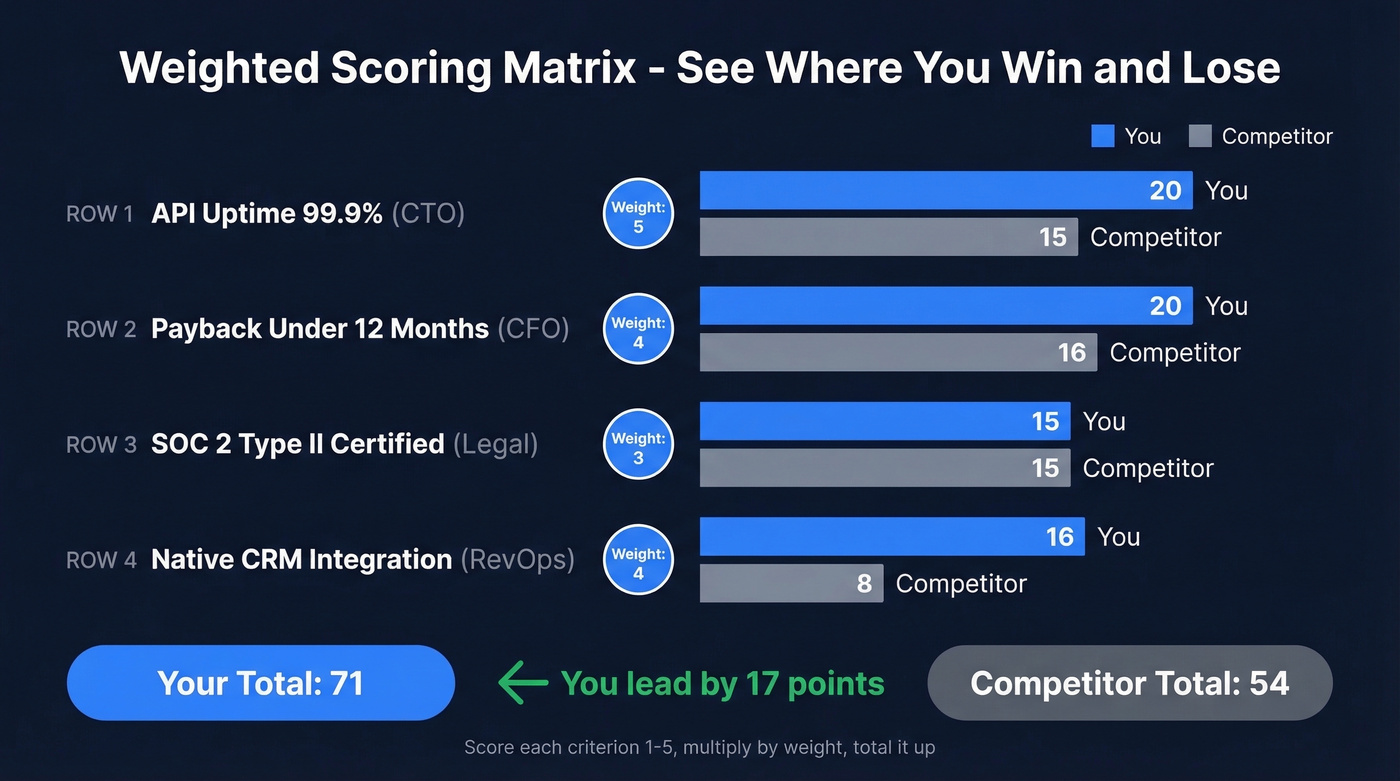
A simple weighted scoring matrix you can build in minutes:
| Criterion (Stakeholder) | Weight | Your Weighted Score | Competitor Weighted Score |
|---|---|---|---|
| API uptime 99.9% (CTO) | 5 | 20 | 15 |
| Payback < 12 mo (CFO) | 4 | 20 | 16 |
| SOC 2 Type II (Legal) | 3 | 15 | 15 |
| Total | 55 | 46 |
Score each criterion 1-5, multiply by weight, total it up. You'll immediately see where you're winning, where you're losing, and where you need to go deeper.
For deals where the status quo is the real competitor, use a Pugh matrix. The status quo is your baseline - score each alternative as better (+1), worse (-1), or same (0) on every criterion. If the total is negative, the status quo wins on the criteria you've agreed to, which means you either need to change the criteria or change the value case.
Common Mistakes Reps Make
Checkbox culture. Filling in the CRM field to survive a pipeline review isn't the same as understanding how your buyer will decide. The documentation burden is real, but the answer isn't to skip criteria - it's to make the field actually useful.
If you want a tighter way to run discovery without turning MEDDPICC into a script, borrow a few prompts from MEDDIC discovery questions and adapt them to your deal.
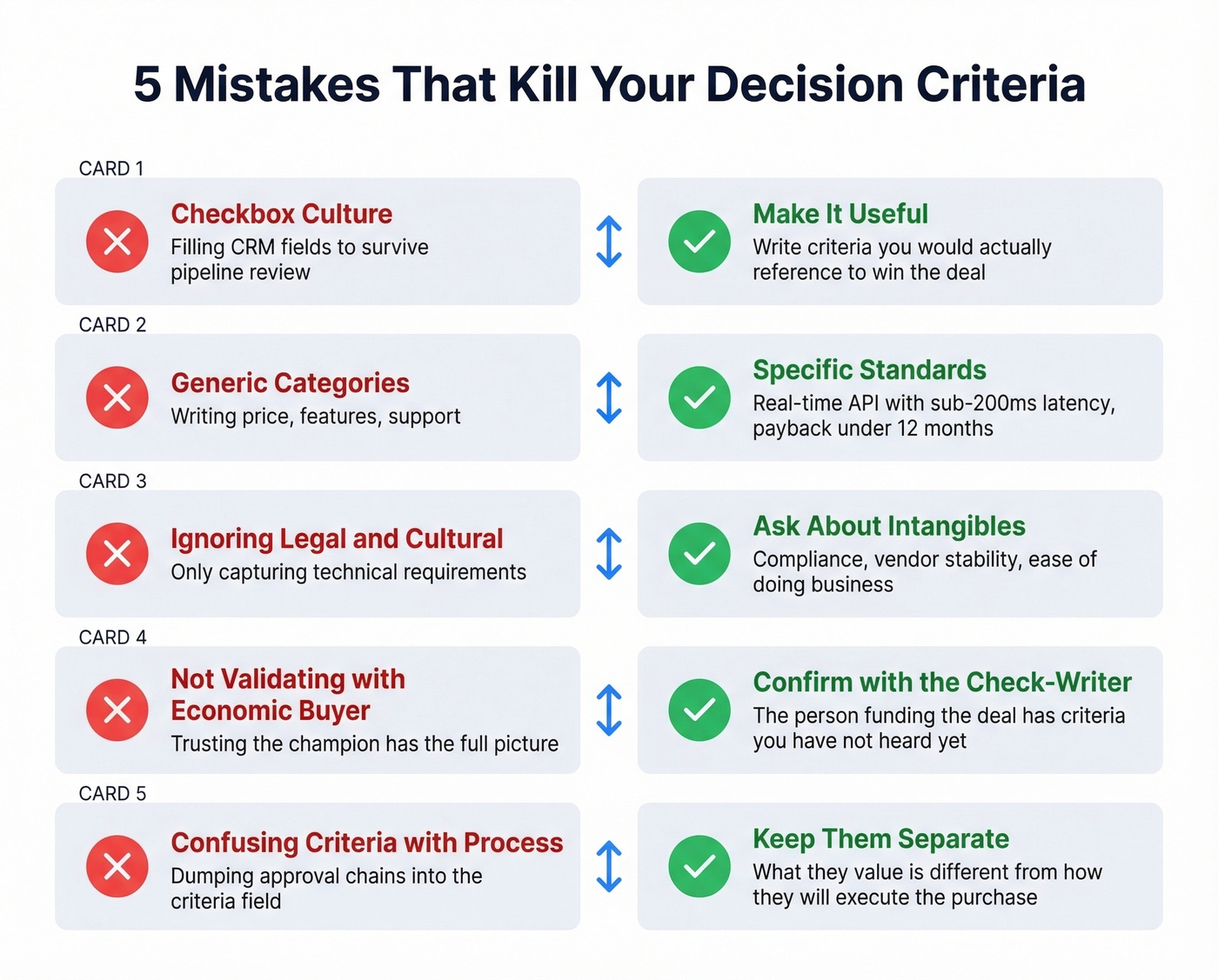
Generic categories instead of specific standards. "Features" tells you nothing. "Real-time API with sub-200ms latency" tells you exactly where you stand.
Ignoring cultural and legal criteria. Technical fit gets all the attention. Procurement kills the deal. We've watched this play out dozens of times - a rep nails the demo, the champion is bought in, and then a compliance requirement nobody documented torpedoes the timeline by two quarters.
Not validating with the Economic Buyer. Reps capture criteria from a champion or technical evaluator and assume it represents the full picture. It doesn't. The person writing the check has criteria you haven't heard yet. (If your team still mixes these roles up, this breakdown of Technical Buyer vs Economic Buyer helps.)
Confusing criteria with process. Reps sometimes dump MEDDPICC decision process steps - approval chains, legal reviews, procurement timelines - into the criteria field. That muddies both fields and leaves you blind to what the buyer actually values versus how they'll execute the purchase.
Look, most teams don't have a MEDDPICC problem. They have a laziness problem. The framework works. Filling in three-word CRM fields and calling it "qualification" doesn't. If you need a refresher on the full framework, start with MEDDIC Sales Qualification.
Your weighted scoring matrix is useless if you're missing the CTO's integration requirements or procurement's compliance demands. Prospeo gives you verified emails and direct dials for every stakeholder on the committee - at $0.01 per email, with 125M+ verified mobiles for the conversations that close deals.
Reach the full buying committee before hidden criteria surface too late.
FAQ
What's the difference between decision criteria and decision process?
Decision criteria are the specific standards a buyer uses to grade your solution - capabilities, ROI thresholds, compliance requirements. Decision process is the sequence of steps, approvals, and reviews from evaluation to signed contract. One defines what matters; the other defines how they'll get to a decision. Confusing them is one of the most common MEDDPICC qualification errors.
How many criteria should I track per deal?
Five to eight weighted criteria mapped to specific stakeholders is the sweet spot for most enterprise deals. More than eight and you're building a laundry list nobody will reference. Fewer than five and you're probably missing a stakeholder's perspective - especially procurement or legal.
How do I uncover criteria buyers won't volunteer?
Ask about intangible factors explicitly - vendor stability, implementation support, compliance requirements - then validate with the Economic Buyer in a separate conversation. Mapping the full buying committee early, including legal and procurement contacts, is the single best way to prevent hidden criteria from surfacing too late.
Can you influence decision criteria after an RFP is issued?
Rarely. Once criteria are locked into a formal RFP or procurement scorecard, changing them requires executive-level sponsorship and a compelling business case. Your best window is before the RFP drops - ideally during early discovery when the buyer is still defining what "good" looks like.
Now go score your top three deals against their stated criteria. You'll know within five minutes where you're exposed.