

The Best Media Contact Databases in 2026: Pricing, Accuracy, and Honest Reviews
You just got the Muck Rack renewal quote. $34,000 for roughly 12 employees needing access. Your CEO is asking why the PR team needs a media contact database that costs more than two junior hires - and honestly, you're not sure you have a great answer.
Here's what most PR teams learn the hard way: database size is the most overrated metric in media software. Cision can tout 1.4M contacts all day, but if 20-50% of your pitches never reach the inbox and 86% of journalists reject outreach for irrelevance, you're paying thousands of dollars a year to annoy people. The real question isn't "how big is the database?" It's "how many of these emails actually work?"
That's the lens we used to evaluate these 10 tools. Accuracy over size. Pricing transparency over "talk to sales."
Our Picks
Best for verified, deliverable contacts: Prospeo - 98% email accuracy, 7-day refresh cycle, free tier with 75 verified emails/month, no contract. Starts at ~$0.01/email.
Best full PR workflow: Muck Rack - the strongest journalist profiles on the market. Budget $5,000-$50,000+/year depending on team size.
Best for startups on a budget: Prowly - database + newsroom + outreach from $258/month. Owned by Semrush, so it's not going anywhere.
Just need a free starting point? Try Qwoted.
Comparison Table
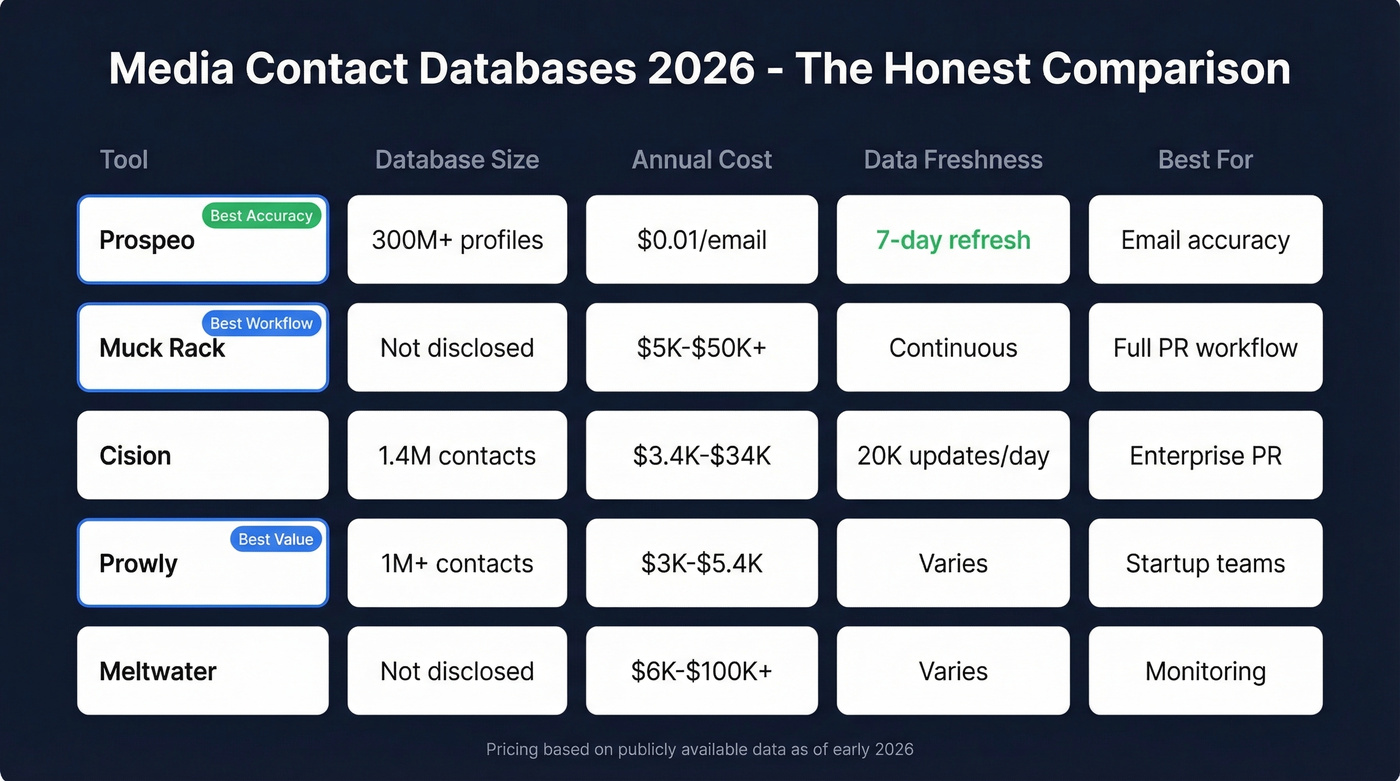
Here's how all 10 options stack up on database size, pricing, and data freshness.
| Tool | Database Size | Pricing Range | Data Freshness | Best For | Our Pick? |
|---|---|---|---|---|---|
| Prospeo | 300M+ profiles | Free tier; ~$0.01/email | 7-day refresh | Email accuracy | Best accuracy |
| Muck Rack | Not disclosed | $5K-$50K+/yr | Continuous | Full PR workflow | Best workflow |
| Cision | 1.4M contacts | $3.4K-$34K/yr | 20K+ updates/day | Enterprise PR | |
| Meltwater | Not disclosed | $6K-$100K+/yr | Varies | Media monitoring | |
| Prowly | 1M+ contacts | $258-$449/mo | Varies | Startup PR teams | Best value |
| JournoFinder | Not disclosed | $99-$189/mo | Varies | Niche outreach | |
| Qwoted | Limited | Free tier available | Varies | Freelancers | Best free option |
| BuzzStream ListIQ | Web-sourced | Free-$99+/mo | Live web research | List building | |
| Roxhill | UK-focused | £3K-£25K/yr | Varies | UK media | |
| Agility PR | Mid-market | ~$3K/yr | Varies | Budget teams |
The Best Media Contact Databases
Prospeo - Best for Verified Contact Data
Most journalist databases solve the discovery problem - finding which reporter covers your beat. Prospeo solves the deliverability problem - making sure the email you found actually works. The platform covers 300M+ professional profiles with 143M+ verified emails, all refreshed on a 7-day cycle. That matters when the industry average sits around six weeks.

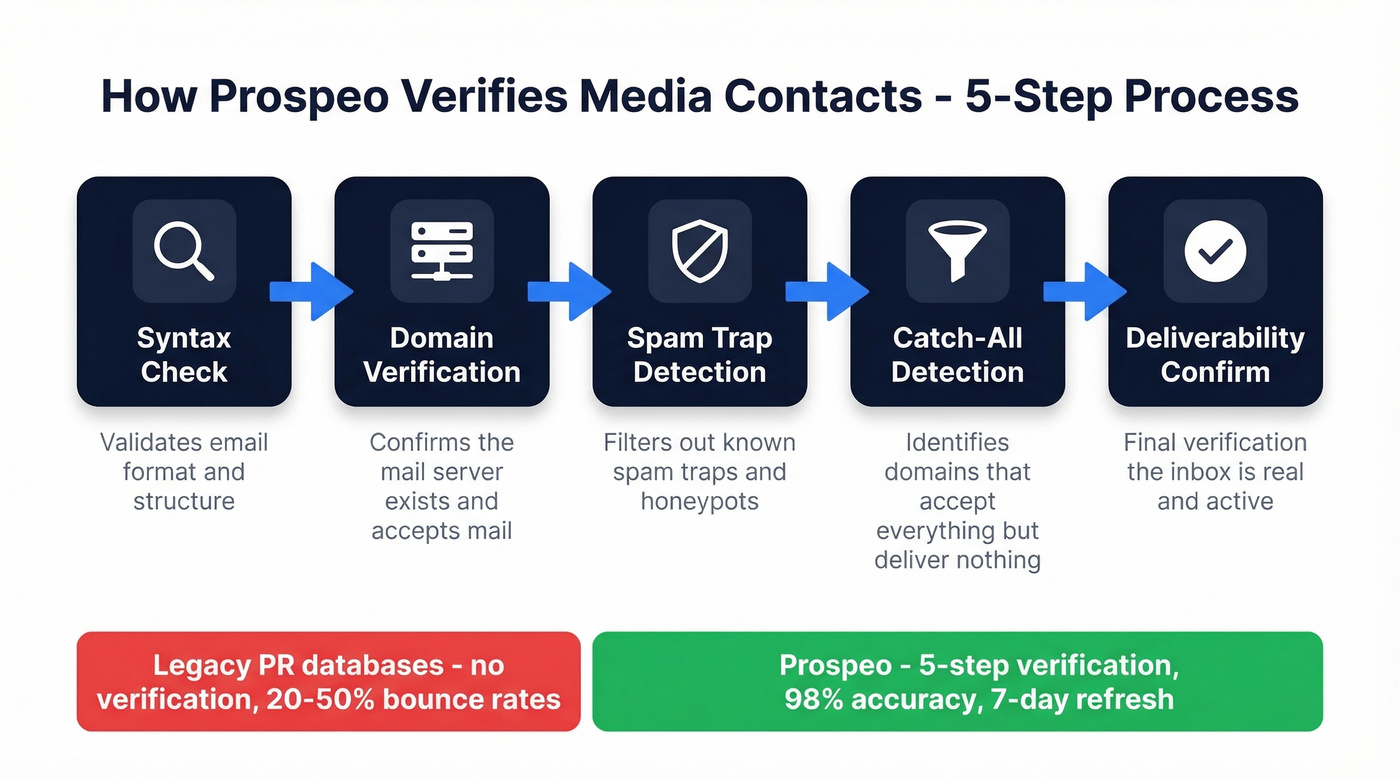
The search runs through 30+ filters, and the Chrome extension (40,000+ users) pulls verified contact data from any website in one click. The 5-step verification process catches spam traps, honeypots, and catch-all domains that legacy PR databases don't even flag.
Use it if you need journalist emails that actually land, you want to verify contacts from other databases before pitching, or you're running lean and need enterprise-grade accuracy without enterprise pricing. The free tier gives you 75 verified emails/month - enough for a focused startup PR operation.
Pair it with Muck Rack or Prowly for the full workflow if you need journalist profiles and pitch tracking alongside verified emails.

If 20-50% of your pitches never reach the inbox, your media contact database is the problem. Prospeo's 5-step verification catches spam traps, honeypots, and catch-all domains - delivering 98% email accuracy on a 7-day refresh cycle.
Stop paying thousands to bounce. Start with 75 free verified emails.
Muck Rack - Best Full PR Workflow
The verdict first: If your team lives in media relations daily and you have the budget, Muck Rack is the best all-in-one PR platform available. The journalist profiles are deep - recent articles, social feeds, beat descriptions that reporters write themselves. We've found the profile quality genuinely best-in-class, and that tracks with what practitioners report too.
As one practitioner from Reboot Online put it: Muck Rack is "the most accurate and up-to-date" media database they've used.
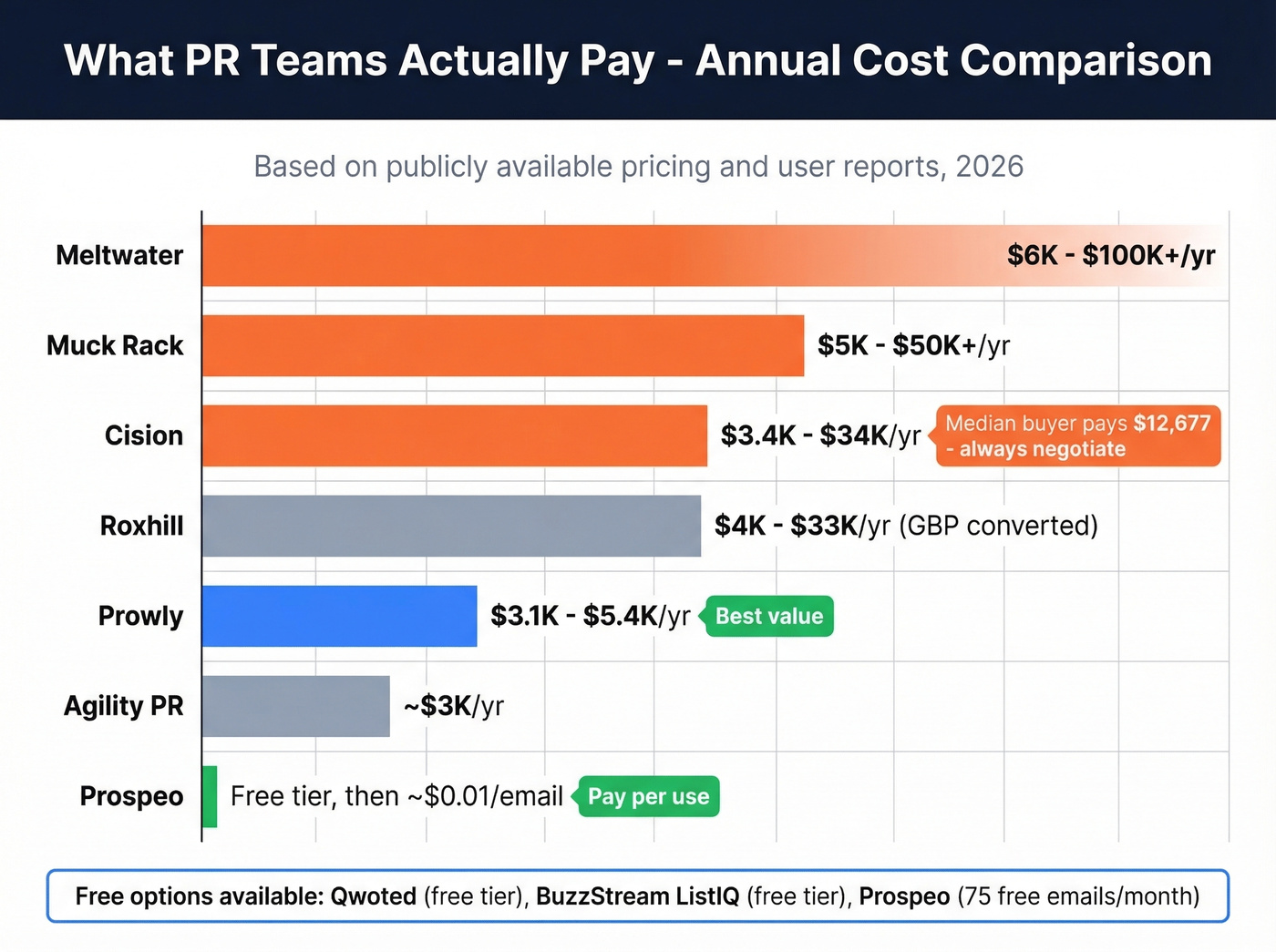
The pricing is where it gets painful. A single Agency Starter seat runs about $4,400/year. Scale to a mid-size team and you're looking at $34,000/year for ~12 employees. Annual contracts required. Muck Rack has been cracking down on shared accounts, so the "just share one login" workaround is dead.
Skip it if you're a small agency or startup that can't justify $5K+ per seat per year. A free limited version exists, but it's heavily restricted on search results.
Cision - The Enterprise Default
Across 102 purchases tracked by Vendr, the median Cision buyer pays $12,677/year, with a range spanning $3,400 to $33,700. That 26% average negotiation savings Vendr reports? Use it. Cision expects you to negotiate.
Cision's database is often cited as 1.4M contacts, including 850,000+ media contacts and 1.18B social media profiles. They report 20,000+ updates per day. On paper, that's impressive.
But the gap between that claim and user reality is wide. The consensus on r/PublicRelations is that Cision's data feels "always out of date" - particularly for beat assignments and freelancer contacts. The interface hasn't meaningfully evolved in years. You're paying for breadth and brand recognition, not for a modern experience.
Use it if you're an enterprise team that needs broad contact coverage, monitoring, and social listening bundled together. Skip it if you care more about accuracy than breadth, or if your team is under 5 people.
Meltwater - Buy It for Monitoring, Not Contacts
Skip this tool if your primary need is finding journalist emails. You'll overpay for features you don't use.
Meltwater's strength is tracking coverage, sentiment, and social mentions at scale. The contact database is a secondary feature bolted onto a monitoring engine. Pricing reflects that positioning: Essentials runs $6,000-$12,000/year, Suite hits $15,000-$25,000/year, and Enterprise climbs to $40,000-$100,000+. The median sits around $25,000/year. Watch out for auto-renewal clauses and ~5% annual price increases that sneak into contracts.
Prowly - Best for Startups
Prowly hits a sweet spot that's rare in PR software: a real journalist directory, a built-in newsroom, and email outreach - all starting at $258/month on annual billing. The database covers 1M+ journalist and influencer contacts. The Basic plan includes 500 contact exports, 1,000 emails/month, and 2 seats. Professional bumps to ~$449/month with 5 seats. A 7-day free trial lets you test before committing.
Use it if you're a startup or small agency that needs an all-in-one PR tool without the $15K+ annual commitment. Skip it if you need the journalist profile depth of Muck Rack or the monitoring breadth of Meltwater.
JournoFinder - The Niche Challenger
The pitch: 89% delivery rate versus 47% with users' prior approach, according to JournoFinder's own data. The tool includes built-in email verification, which already puts it ahead of most legacy databases that ship unverified contacts.
The catch: No deep journalist profiles, no pitch tracking, no media monitoring. This is a focused tool for finding and emailing journalists, nothing more.
Pricing is straightforward: $189/month on monthly billing, $99/month on annual. A 7-day free trial is available. For solo PR pros or small teams that want verified journalist emails without the overhead of Cision or Muck Rack, JournoFinder delivers.
Already using Cision or Muck Rack? Run those journalist emails through Prospeo before you pitch. At $0.01 per verified email, cleaning a 1,000-contact media list costs less than a single bounced pitch costs your domain reputation.
Verify every media contact in your database before hitting send.
More Options Worth Knowing
Qwoted
Free tier with a pitch-credits system makes Qwoted the obvious starting point for freelancers and bootstrapped teams. The database isn't deep enough for serious agency work, but for finding a handful of relevant journalists without spending a dollar, it's hard to argue with free.
BuzzStream ListIQ
A different philosophy entirely. BuzzStream ListIQ builds media lists from live web research rather than a static database. Free tier gives you 200 Standard Credits and 20 Email Credits. Paid plans start at $99/month for 1,000 Standard Credits and 100 Email Credits. Best for teams that want to discover journalists based on what they've recently published rather than what a database says their beat is.
Roxhill
UK-focused and unapologetic about it. Pricing runs £3,000-£25,000/year depending on team size and features. If your PR operation targets British media specifically, Roxhill's depth in that market is stronger than any global database's UK coverage.
Agility PR
Budget option at ~$3,000/year for mid-market teams. But budget-level pricing comes with budget-level data quality. Reddit users report too few contacts for major publications, miscategorized entries, and frequent bounces. You get what you pay for.
Nexis Media Contacts (LexisNexis)
A major option often used by larger comms teams. LexisNexis positions it as covering 1M+ journalists, bloggers, social media influencers, and analysts across 200 countries, with 2M+ updates and additions annually. Pricing isn't public.
Connectively (formerly HARO)
Worth mentioning because it's a different model entirely. Instead of searching a database, you respond to journalist queries. It's free to start and useful for earned media, but it's reactive - you wait for opportunities rather than creating them. Not a replacement for a proper media contact database, but a solid complement to one.
When You Don't Need a Journalist Database
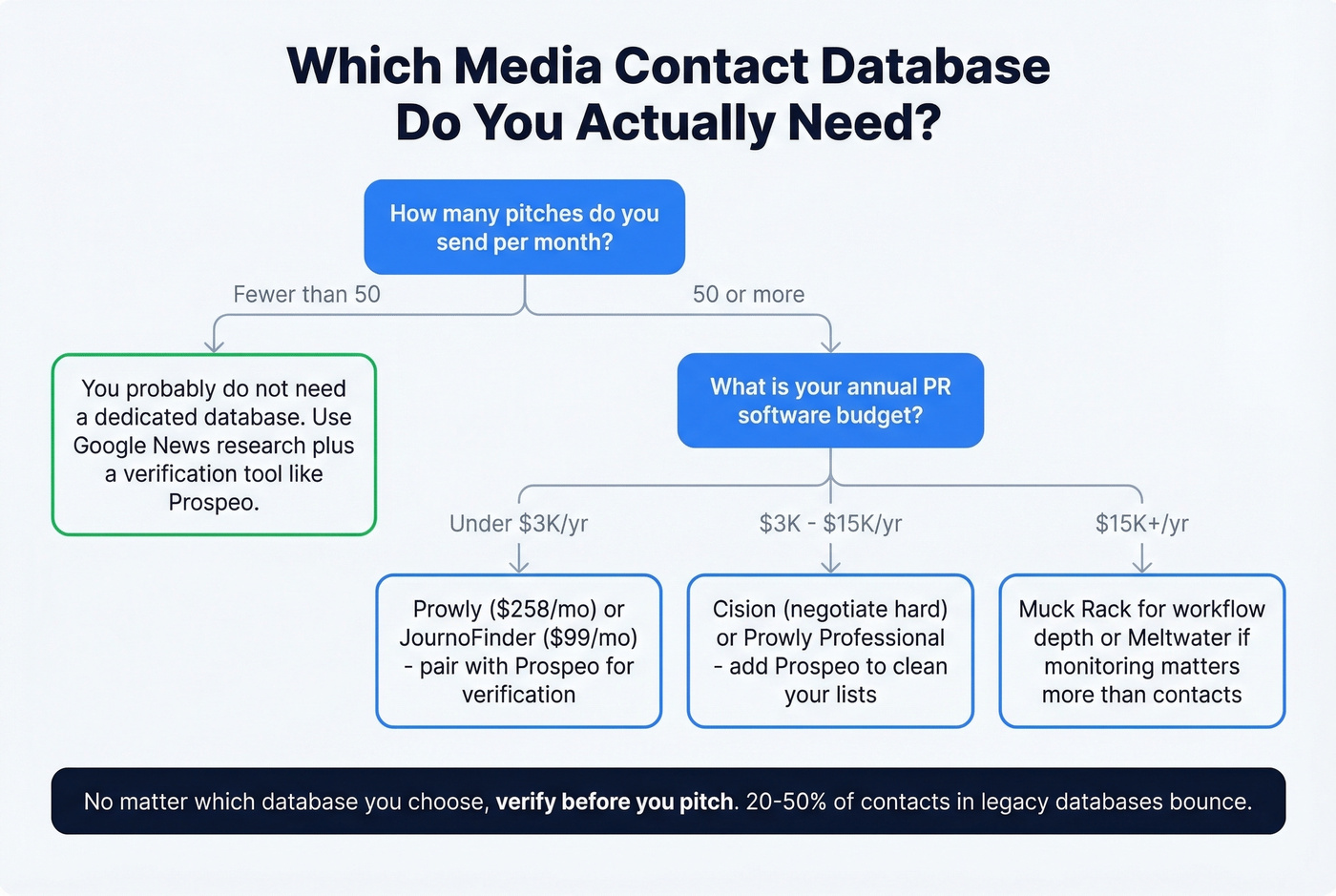
Let's be honest: if you're sending fewer than 50 pitches a month, you probably don't need a dedicated media contact database at all. Despite what vendors want you to believe, 57% of PR professionals say building and nurturing media relationships is the most time-consuming part of the job - and for many teams, the media list still ends up as an Excel sheet regardless of what database they're paying for.

A B2B data tool paired with Google News research gets you 80% of the value at 5% of the cost. Find journalists who've recently covered your space, verify their emails, and pitch. That workflow costs under $50/month and takes less time than learning Cision's interface.
You probably don't need a full database if:
- You pitch fewer than 50 journalists per month
- You're targeting one geographic market
- Your beat is narrow enough that you already know the key reporters
- Your budget is under $3,000/year for PR tools
Getting the Most From Any Database
Whichever tool you pick, these practices separate teams that get coverage from teams that get ignored.
Verify before you pitch - every single time. The 20-50% deliverability failure rate on purchased database contacts isn't a scare tactic. It's what happens when journalists change beats, switch outlets, or go freelance faster than databases can update. Run every list through a dedicated email verification tool before hitting send. In our experience, this single step cuts bounce rates by more than half.
Filter for beat relevance, not database size. A database with 1.4M contacts is worthless if you're pitching fintech reporters and pulling in lifestyle editors. Spend the extra five minutes filtering by beat, recent coverage topics, and outlet type.
Check "last published" dates. A journalist who hasn't published in six months might have left the outlet, gone on leave, or shifted beats. Use Muck Rack's "Recent Articles" feature or manually check bylines. Sending to dead contacts tanks your sender reputation.
Personalize beyond {first_name}. Reference a specific article they wrote. Mention why your story fits their beat. Generic mail-merge pitches get deleted on sight - I've watched PR teams triple their response rates just by adding one sentence of genuine context per pitch. If you need a starting point, borrow a few email subject lines that don't sound automated.
Monitor bounce rates and clean lists monthly. If your bounce rate creeps above 5%, stop sending and clean your list. GDPR and CAN-SPAM violations can result in fines above $40,000 per offense. That's not theoretical - it happens. Track your email bounce rate and use a dedicated email deliverability guide to fix the root cause.
FAQ
What is a media contact database?
A searchable directory of journalist, editor, and blogger contact information - including email addresses, beats covered, outlets, and social profiles. PR teams use them to find the right reporters for pitches and press releases instead of guessing email formats or cold-messaging on social media.
How much do media databases cost?
The range is enormous. Prowly starts at $258/month. Cision averages $12,677/year across 102 tracked purchases. Muck Rack runs $5,000-$50,000+/year depending on seats. Free tiers exist from Qwoted and BuzzStream ListIQ for teams just getting started.
Are free media databases good enough for real outreach?
For small teams sending under 50 pitches monthly, yes. Qwoted offers free journalist discovery. Prospeo's free tier includes 75 verified emails/month with 98% accuracy - enough for focused campaigns. You don't need to spend $15K to start landing coverage.
How often is contact data updated?
It varies dramatically. Cision reports 20,000+ daily updates. Prospeo refreshes on a 7-day cycle. Most legacy databases operate on a 4-6 week schedule. Regardless of vendor claims, always verify emails before sending - journalist turnover outpaces even the best refresh rates.
Can I use a media database under GDPR?
Yes, but carefully. You need a legitimate interest basis for outreach, must honor opt-outs promptly, and shouldn't bulk-email purchased lists without verification. Fines can exceed $40,000 per offense. Most reputable databases include compliance features, but the legal responsibility is yours.