

How to Write a Meeting Request Email That Actually Gets a Reply
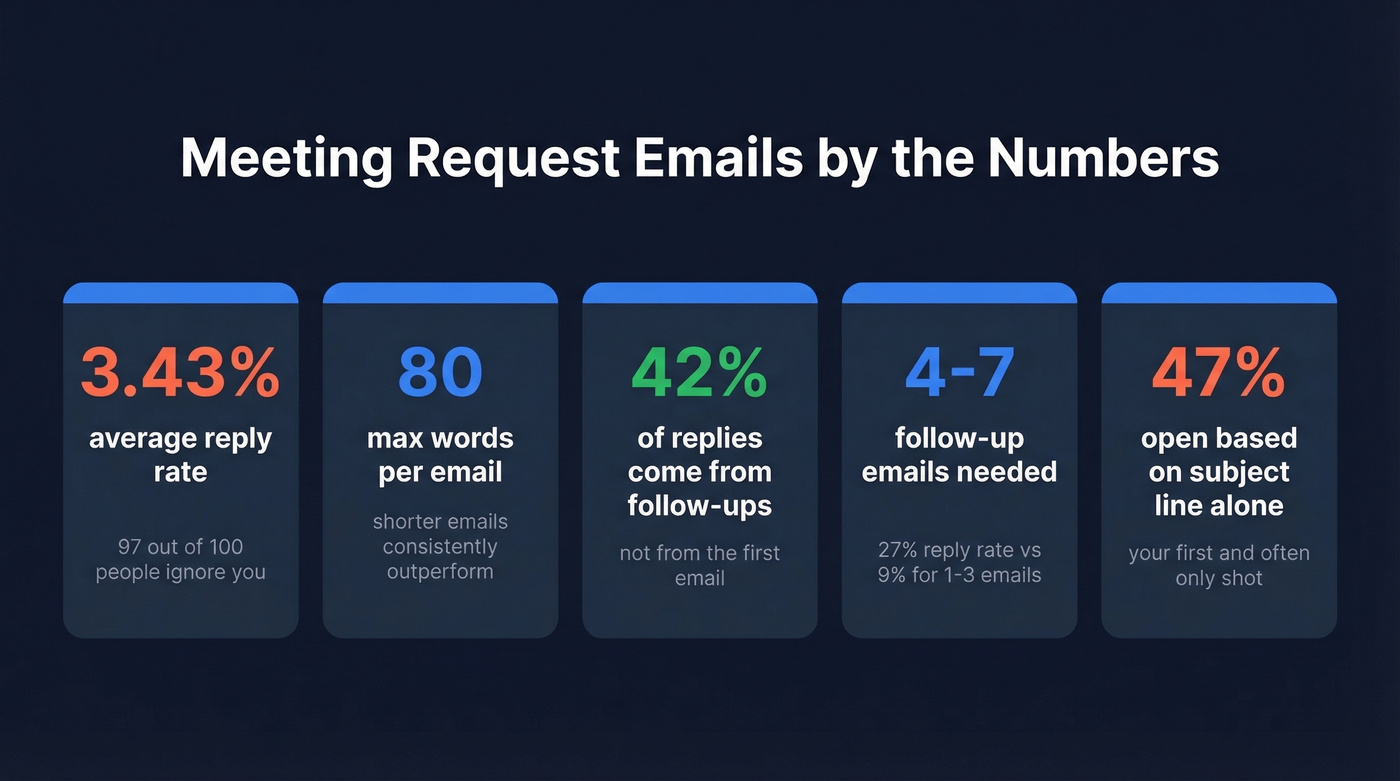
You've written the email. Rewritten it. Stared at the subject line for ten minutes, hit send, and watched it vanish into the void. The average meeting request email pulls a 3.43% reply rate. That's roughly 97 out of 100 people ignoring you. But top performers hit 10.7% or higher - and the gap isn't talent. It's structure, timing, and a handful of data-backed decisions most people never bother to learn.
The Short Version
- Keep it under 80 words with a 1-4 word lowercase subject line. Instantly's 2026 benchmark shows the best-performing campaigns stay under 80 words with a single clear CTA. Gong data from an analysis of 85M+ cold emails confirms 1-4 words is the sweet spot for subject lines.
- Follow up 4-7 times. 42% of replies come from follow-ups, not the first email. Campaigns with 4-7 emails achieve a 27% reply rate - roughly 3x higher than sequences of 1-3.
- Verify the email address before you send. A perfect request sent to a dead address is a wasted email. Prospeo catches invalid addresses and spam traps before they tank your domain reputation, and the free tier includes 75 email verifications per month.
Five Elements of an Effective Request
Every email requesting a meeting needs five things. Miss one and you're gambling.
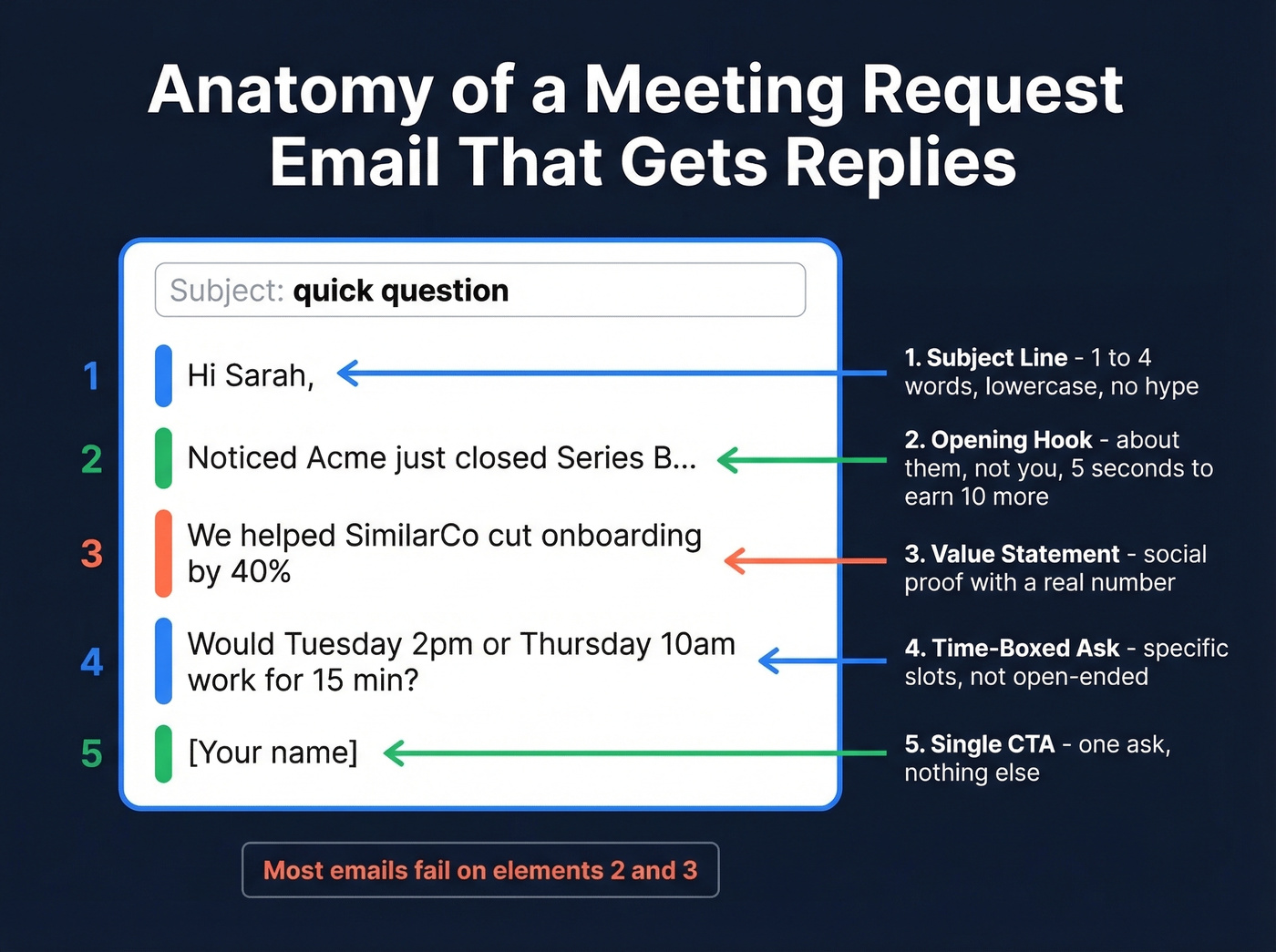
1. Subject line. 47% of recipients decide whether to open based on the subject line alone. Adding the recipient's first name can lift opens - one cited example shows 18.30% open rates with a name versus 15.70% without, about a 17% relative lift. This is your first and often only shot.
2. Opening hook. You have about five seconds to earn the next ten seconds. The hook needs to be relevant to the recipient - not about you, your company, or your product. Mention something specific: their role, a recent company event, a shared connection. This works because of reciprocity. You've invested effort in them, so they feel a pull to invest a few seconds back.
3. Value statement. One sentence connecting what you offer to a problem they actually have. "We helped [similar company] cut onboarding time by 40%" beats "We're a leading provider of HR solutions." Social proof does the heavy lifting: a named result from a similar company triggers the "people like me" shortcut that makes executives lean in instead of hit delete.
4. Time-boxed ask with specific slots. Don't say "let me know when you're free." That puts the work on them. Propose two or three specific windows: "Would Tuesday at 2pm or Thursday at 10am work for a 15-minute call?" The constraint makes it easier to say yes - it turns an open-ended decision into a simple binary choice.
A note on scheduling links: Calendly and similar tools work great for warm leads who already want to meet you. For cold outreach, proposing specific times outperforms. Clicking through to a scheduling tool adds friction and feels presumptuous when the recipient hasn't agreed to meet yet. Save the scheduling link for the confirmation email after they say yes.
5. Single CTA. One ask. Not "check out our site, watch this video, and let me know if Tuesday works." Best-performing campaigns use a single clear CTA - anything more dilutes the response.
Most emails fail on element #2 or #3. The subject line gets them to open, but a generic opener ("I hope this email finds you well") or a self-centered value prop ("We're the #1 platform for...") kills the momentum before they reach your ask.
One more thing people forget: include a simple opt-out line like "No worries if the timing isn't right." It reduces spam complaints and, counterintuitively, increases reply rates. People are more willing to engage when they feel they can easily say no.
Subject Lines That Get Opened
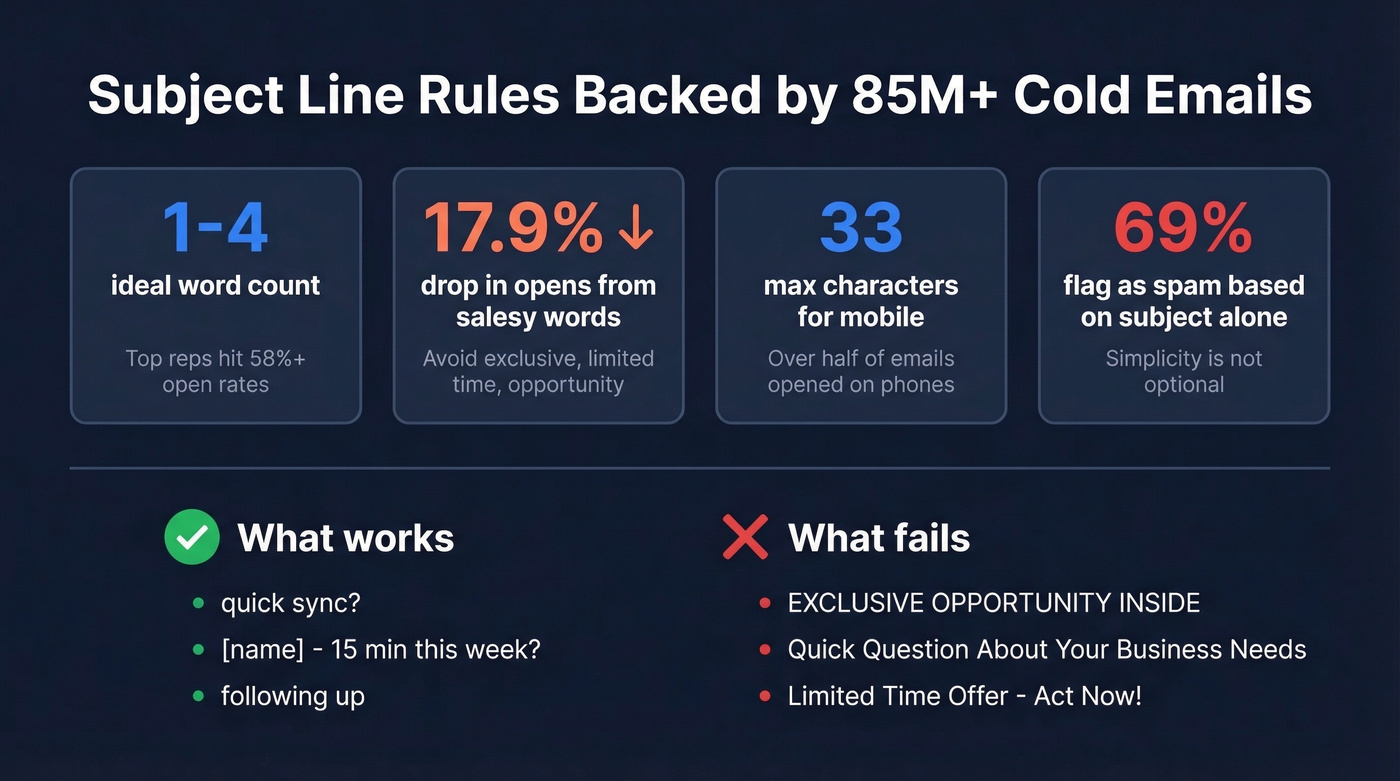
The data here is surprisingly clear. An analysis of 85M+ cold emails found that 1-4 words is the ideal subject line length. Top reps in that dataset hit 58%+ open rates. Short, lowercase, non-salesy.
A few specific findings worth knowing:
- All-lowercase outperforms. Exception: proper nouns. But "quick question" beats "Quick Question" and crushes "QUICK QUESTION."
- Salesy language drops opens by 17.9%. Words like "exclusive," "limited time," "opportunity" - they trigger the mental spam filter even when they clear the technical one.
- Mobile truncation matters. Stay under 33 characters for full visibility across major Apple and Android devices. Over half of emails are opened on mobile, so this isn't optional.
- 69% of recipients flag emails as spam based on the subject line alone. Simplicity isn't a nice-to-have.
The empty subject line trick? Open rates jump ~30%, but reply rates drop ~12%. It's a gimmick. You get curiosity clicks but lose the people who actually would've responded.
Subject lines that work:
quick sync?[first name] - 15 min this week?intro: [your company] + [their company]following up[mutual connection] suggested we connectquestion about [specific topic]
Notice the pattern: short, lowercase, specific, zero hype. You don't need 25 variations. You need one that's honest and relevant.
Best Time to Send
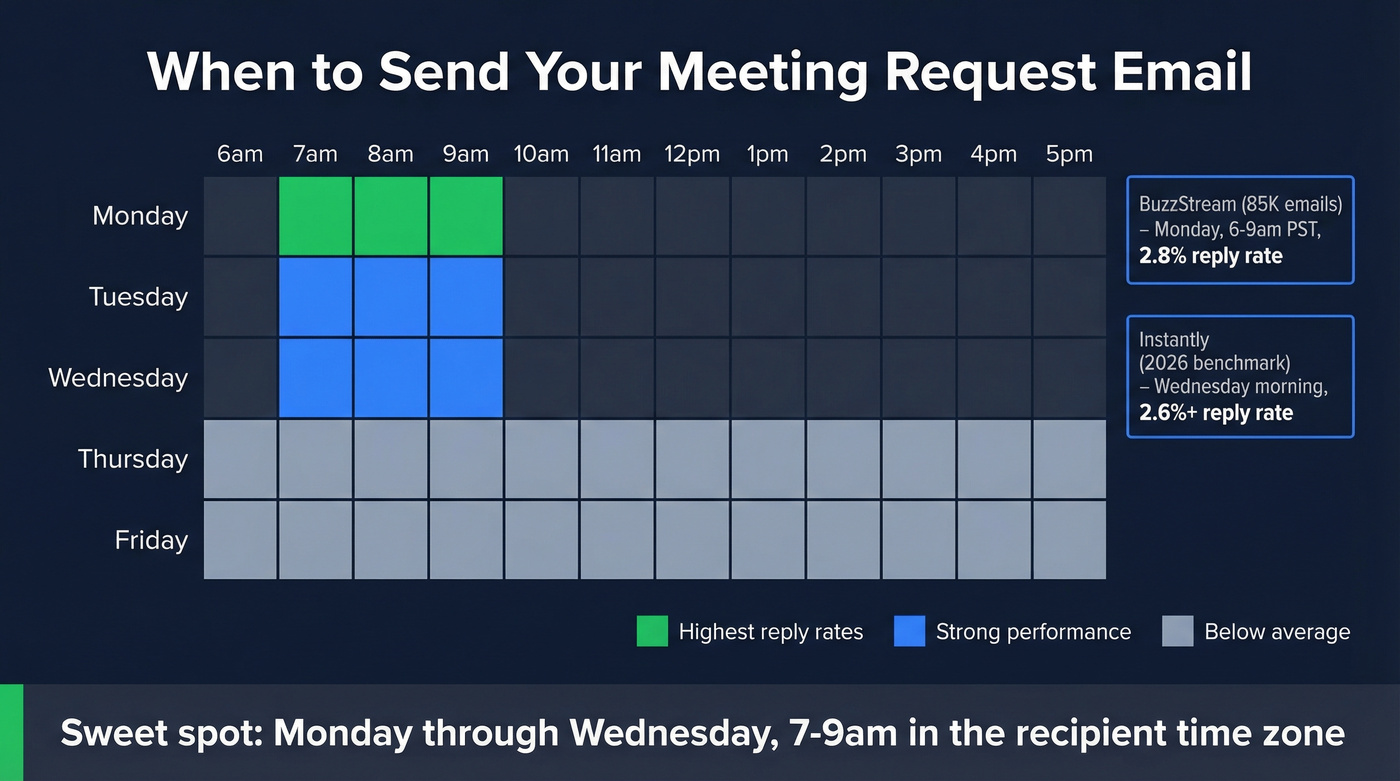
Two datasets, two slightly different answers - but the overlap is clear enough to act on.
| Dataset | Best Day | Best Time | Reply Rate |
|---|---|---|---|
| BuzzStream (85K emails) | Monday | 6-9am PST | 2.8% |
| Instantly (2026 benchmark) | Wednesday | Morning | 2.6%+ |
The BuzzStream/Siege Media dataset of 85,000+ personalized outreach emails found Monday mornings at 6-9am PST produced the highest combined open and reply rates. Monday open rates topped 20% with a 4.3% click rate. The 2026 benchmark data leans toward Tuesday-Wednesday, with Wednesday pulling the highest reply rate.
The practical takeaway: schedule your outreach for Monday through Wednesday mornings, ideally hitting inboxes between 7-9am in the recipient's time zone. Thursday and Friday aren't dead, but they consistently underperform.

You just learned that 97 out of 100 meeting requests get ignored. Don't make it worse by sending to dead addresses. Prospeo's 5-step verification catches invalid emails, spam traps, and honeypots before they tank your domain - with 98% accuracy and a 7-day data refresh cycle.
Start with 75 free email verifications - no credit card required.
17 Templates That Get Replies
You don't need a library. You need one framework and the discipline to keep it under 80 words. That said, context matters - a cold email sequence and an investor request require different tones. Every template below follows the five-element anatomy and stays under the 80-word threshold.
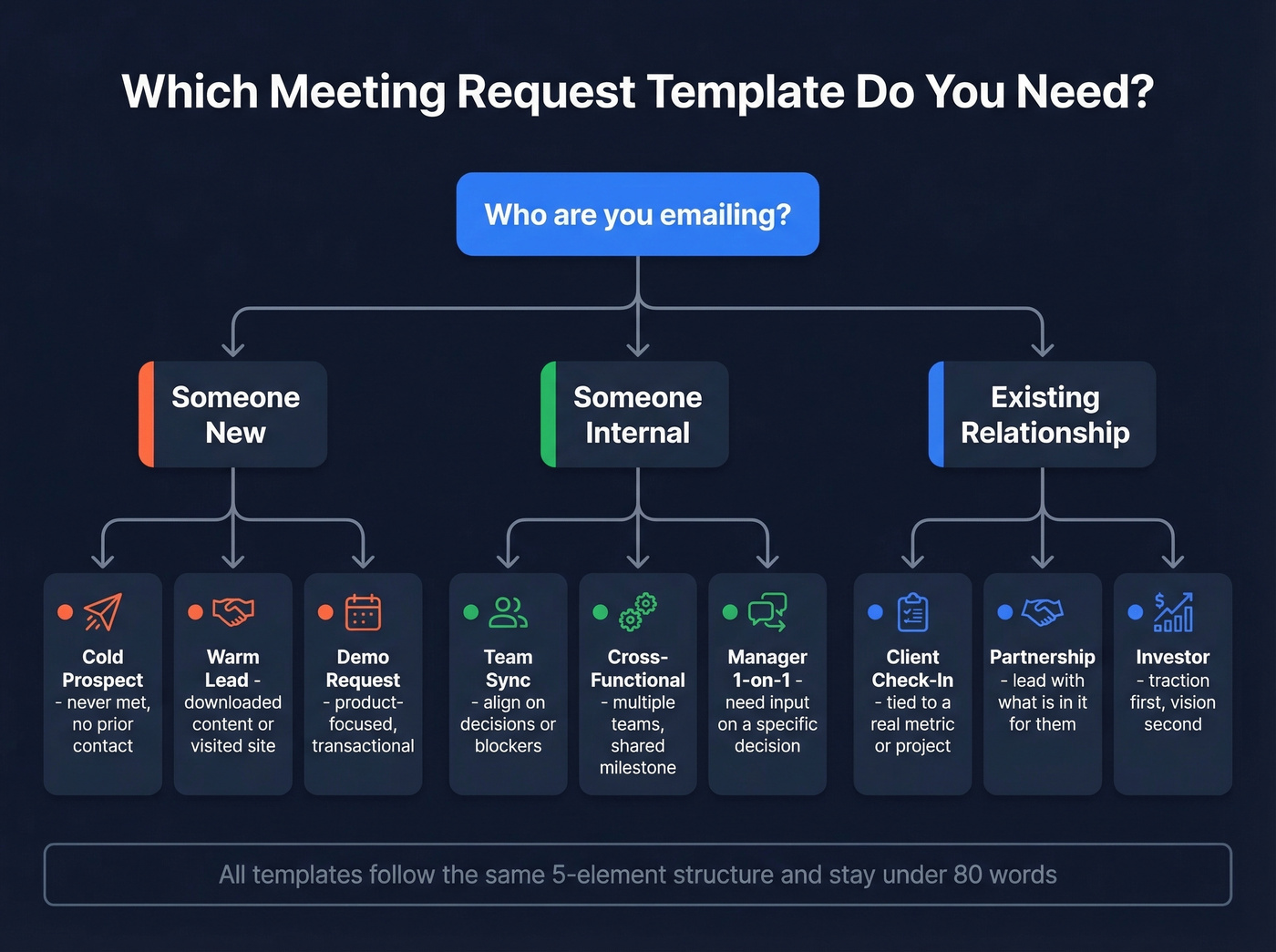
Cold Outreach Templates
Cold prospect (never met). The hardest email to get right. This template applies the single-CTA principle and the specific-time-slot rule - two of the biggest reply-rate drivers in the data.
Here's what each line is doing:
Subject:
quick questionHi [First Name],
Noticed [their company] just [specific trigger - new hire, funding round, product launch]. Hook: proves you did homework
When [similar company] hit that stage, they ran into [specific problem]. We helped them [specific result with a number]. Value: social proof with a number
Would a 15-minute call on [Tuesday] or [Thursday] work to see if it fits? Time-boxed ask with two slots
[Your name]
Strip the annotations and this email is under 60 words. That's the target.
Warm lead (engaged with content or site). They've shown interest - convert curiosity into a conversation without being creepy about the tracking.
Subject:
saw you checking us outHi [First Name],
You downloaded [resource] last week - curious if [specific problem the resource addresses] is something your team's actively working on.
We've helped [similar company] [specific result]. Happy to share what worked in a quick call.
Does [day] at [time] work for 15 minutes?
[Your name]
Cold email demo request. Keep it transactional. Under 80 words, single CTA, no pitch deck promises.
Subject:
[product] demo - 20 minHi [First Name],
Based on [trigger - their tech stack, job posting, company size], [product] could help your team [one specific outcome].
I can walk you through it in 20 minutes - no pitch deck, just the product.
[Day] at [time] or [day] at [time]?
[Your name]
Internal & Cross-Team Templates
Internal team meeting. Internal emails get sloppy because there's no sales pressure. Respect your colleagues' time the same way you'd respect a prospect's.
Subject:
[project name] syncHi team,
Need 30 minutes to align on [specific decision or blocker]. Key questions: [1-2 bullet points].
Proposing [day] at [time]. If that doesn't work, drop your availability and I'll find a slot.
[Your name]
Cross-functional sync. State the "why" upfront or nobody shows up.
Subject:
[team A] + [team B] alignmentHi [names],
[Project/initiative] needs input from both teams before we [specific milestone]. Want to get 30 minutes on the calendar this week to resolve [specific question].
Does [day] at [time] work? I'll send an agenda beforehand.
[Your name]
One-to-one with your manager. Be direct. They hate guessing what you need.
Subject:
need 15 min - [topic]Hi [Name],
I need your input on [specific decision]. I've narrowed it to [two options] and want to walk you through the tradeoffs before [deadline].
Can we grab 15 minutes on [day]? Happy to adjust if another time works better.
[Your name]
Client & Partner Templates
Most people nail cold outreach templates but phone in the client emails. That's backwards - your existing relationships are where the real revenue lives.
Email requesting a meeting with a client. Tie it to something real - not "just checking in."
Subject:
checking in - [specific metric or project]Hi [First Name],
It's been [timeframe] since we [last milestone]. Wanted to check in on how [specific feature/outcome] is tracking and share a couple of things we've seen work for similar teams.
Would [day] at [time] work for a quick 20-minute call?
[Your name]
Partnership or collaboration. Lead with what's in it for them.
Subject:
[your company] + [their company]Hi [First Name],
[Their company]'s work on [specific initiative] caught my attention. We're doing [complementary thing] and I think there's a natural overlap worth exploring.
Would 20 minutes next week make sense to see if there's a fit?
[Your name]
Investor meeting request. Investors get hundreds of these. Traction speaks louder than vision.
Subject:
[company] - [key metric] in [timeframe]Hi [First Name],
[Company] hit [specific traction metric] in [timeframe]. We're raising [round] to [one-sentence use of funds].
Your investments in [portfolio company] suggest this might be in your wheelhouse. Would 20 minutes next week work?
[Your name]
Specialty Scenarios
Executive/C-level outreach. Executives scan, they don't read. This template is deliberately structured as bullets instead of prose - more on executive emails in the next section.
- The problem: [One sentence tying a specific challenge to their company]
- The proof: [One sentence with a named result from a similar company]
- The ask: 15 minutes on [day] to see if it's relevant?
That's the entire email. Subject line: [their company] + [one-line value]. Sign off with your name. No preamble, no pleasantries beyond a first name.
Conference follow-up. Strike within 48 hours. Reference the specific conversation, not just the event.
Subject:
good meeting you at [event]Hi [First Name],
Great connecting at [event] - our conversation about [specific topic] stuck with me. I'd love to continue it.
Would [day] at [time] work for a 15-minute call?
[Your name]
For a cold conference outreach, the same structure works - just swap the opening hook for a reference to a session or speaker you both attended, and lead with a specific reason to meet rather than a shared memory.
Recruiter to candidate. Candidates are skeptical of recruiter emails. Lead with the role, not your agency.
Subject:
[role title] at [company]Hi [First Name],
Your background in [specific skill/experience] is a strong fit for a [role title] opening at [company]. [One sentence about why the role is interesting - comp, mission, growth].
Worth a 15-minute call to share details?
[Your name]
Formal/board meeting request. Formality is appropriate here. But formality doesn't mean length.
Subject:
board meeting - [date]Dear Board Members,
Requesting a board meeting on [date] at [time] to discuss [agenda items - 2-3 bullets max].
Please confirm your availability by [deadline]. Materials will be circulated [timeframe] in advance.
Regards, [Your name]
Virtual Meeting Templates
Virtual meeting with logistics. Don't make them hunt for the link.
Subject:
[topic] - virtual, [day] at [time]Hi [First Name],
Confirming our [duration] call on [day] at [time] [timezone].
Zoom link: [link] Agenda: [1-2 bullets]
Let me know if the time needs to shift.
[Your name]
Follow-Up & Rescheduling Templates
Follow-up #1 (3 days, no response). 42% of replies come from follow-ups. This one applies the single-CTA rule with a new time slot.
Subject:
re: [original subject]Hi [First Name],
Wanted to bump this up in case it got buried. [One sentence restating the value prop or ask].
Would [new day/time] work instead?
[Your name]
Follow-up #2 (7 days, new angle). Here's what most people get wrong: they just repeat themselves. The before/after below shows the difference.
❌ Before (lazy follow-up):
Just following up on my last email. Would love to connect when you have a chance. Let me know!
✅ After (new-angle follow-up):
Subject:
[new angle - e.g., "saw this and thought of you"]Hi [First Name],
[One sentence with a new piece of value - a relevant article, case study, or industry stat]. Thought it might be relevant given [their situation].
Still happy to chat if the timing works. [Day] at [time]?
[Your name]
The "before" version adds nothing. The "after" gives them a reason to re-engage. Across large datasets, advanced personalization drives 17% reply rates versus 7% for generic emails. That gap widens with each subsequent touch.
Rescheduling a meeting. Apologize briefly, propose alternatives immediately.
Subject:
need to reschedule - sorryHi [First Name],
Something came up and I need to move our [day] call. Apologies for the shuffle.
Would [option 1] or [option 2] work instead? Same agenda, just a different slot.
[Your name]
How to Email an Executive
Executives don't read emails the way everyone else does. They scan. They prioritize ruthlessly. And they have zero patience for emails that waste their time.
Direct quotes from senior leaders at JackHenry paint a clear picture: long emails "require reading time" that executives don't have. If your email needs more than 30 seconds to process, it's too long. Use bullets. Label FYI-only emails as "FYI ONLY" so they know no action is needed. Summarize long threads at the top instead of making them scroll.
The anti-patterns are even more instructive. BoardEx research on C-level outreach flags these killers:
🚫 Executive Email Anti-Patterns - Instant Delete Triggers
- Copy-paste errors. Leaving another prospect's name or company in the email. Executives notice instantly and you're done.
- Buzzword-heavy descriptions. "We're a leading AI-powered synergy platform" tells them nothing. Say what you do in plain English.
- Presumptive meeting asks. "I've blocked 30 minutes on your calendar" without establishing why it's worth their time. Earn the meeting first.
- No homework. If you can't reference something specific about their company or role, you haven't done the minimum.
The executive template above works because it's three bullet points and an ask. No preamble, no pleasantries beyond a first name, no "I hope this email finds you well." Executives respect brevity because it signals you respect their time.
Follow-Up Strategy
Most people send one email, get no response, and assume the prospect isn't interested. The data says otherwise.
The 2026 benchmark data shows 58% of replies come from the first email - which means 42% come from follow-ups. If you're only sending one email, you're leaving nearly half your potential replies on the table.
The sweet spot is 4-7 emails. An analysis of 20M+ sales emails found that campaigns with 4-7 emails achieve a 27% reply rate - roughly 3x higher than sequences with just 1-3 emails. Beyond 7 touchpoints, returns diminish unless each follow-up adds genuinely new value.
Each follow-up should introduce a new angle - a relevant case study, a stat, a question that reframes the conversation. Repeating "just bumping this up" three times doesn't add value; it adds annoyance. The same dataset shows advanced personalization drives 17% reply rates versus 7% for generic emails, and that gap widens with each subsequent touch.
Vary your send timing too. Don't fire every follow-up at 8am Tuesday. Mix mornings and afternoons, shift days. This avoids pattern detection by spam filters and catches recipients at different points in their week. The consensus on r/sales echoes this constantly: the money is in the follow-up, but only if each touch earns its place in the inbox.
Here's the thing: if your deal size is under five figures, you probably don't need a 12-step automated sequence with AI-generated personalization. Five well-crafted emails sent over three weeks will outperform a bloated sequence every time. We've seen teams triple their meeting-book rate just by extending from two emails to five - without changing a single word in the first email. The follow-up isn't a nuisance. It's where nearly half the results live.
7 Mistakes That Kill Your Request
1. It's too long. The consensus on Reddit is blunt: if your cold email "looks like homework," it gets archived. Best-performing cold emails stay under 80 words, and meeting requests are no exception.
2. Robotic openings. "Dear Sir or Madam" and "I hope this email finds you well" are delete triggers. Write like a human. Start with their name and get to the point.
3. Vague subject lines. 69% of recipients flag emails as spam based on the subject line alone. "Great opportunity" and "Let's connect" are vague enough to feel like spam even when they're not.
4. Too many links. Every extra link hurts deliverability and erodes trust. One link, maybe two. That's it.
5. No follow-up. You already know the data: 42% of replies come from follow-ups. Sending one email and giving up is the single most common mistake in our experience. If you need a swipe file, use these sales follow-up templates and adapt them to your offer.
6. Wrong tone for the audience. A casual "hey, got 15?" works for a peer. It doesn't work for a board member. Match the formality to the recipient.
7. Emailing the wrong address. This is the invisible killer. Your email bounces, your domain reputation takes a hit, and you never know why nobody replied. Before any outreach campaign, verify your contact list. A bounced email doesn't just waste one send - it damages your sender reputation for every email that follows. If you're troubleshooting bounces, start with email bounce rate basics and then tighten your email deliverability.
You've nailed the subject line, the hook, and the time-boxed ask. Now you need the right person's verified email. Prospeo gives you 300M+ professional profiles with 30+ filters - buyer intent, job changes, funding - so your meeting request hits a real inbox, not a bounce.
Stop crafting perfect emails for the wrong addresses.
FAQ
How long should a meeting request email be?
Under 80 words. The 2026 benchmark data shows shorter emails with a single CTA consistently outperform longer ones. Cut the fluff, state your value, propose a specific time. If your email requires scrolling on a phone screen, it's too long.
What's the best subject line for requesting a meeting?
Keep it 1-4 words, all lowercase, under 33 characters for mobile. An analysis of 85M+ cold emails found short, non-salesy subject lines produce the highest open rates. Think "quick question" or "[name] - 15 min?"
How many follow-ups should I send?
Four to seven. An analysis of 20M+ emails shows sequences of 4-7 emails achieve a 27% reply rate - 3x higher than stopping after 1-3 sends. Each follow-up should add new value, not just repeat the original ask.
When is the best time to send?
Monday 6-9am PST for the highest combined open and reply rates, based on 85,000+ personalized outreach emails. Tuesday and Wednesday mornings are strong alternatives. Skip Friday afternoons - they consistently underperform across every dataset we've reviewed.
How do I make sure my email doesn't bounce?
Verify the address before sending. Prospeo validates emails in real time with 98% accuracy and flags spam traps and catch-all domains so your message actually reaches the inbox. The free tier handles 75 verifications per month - enough to test any campaign before you scale it.