

Mock Call Practice: Scripts, Rubrics & Drills (2026)
A hiring manager on r/techsales put it bluntly: roughly 80% of candidates fail the mock call stage, staying surface-level even when they're spoon-fed pain points. That's not a candidate problem - it's a practice problem. Only 18% of buyers think salespeople show up prepared, which means most reps aren't practicing the right way, or at all.
You need three things to fix this: scripts for the scenarios you'll actually face, a scoring rubric so you know if you're improving, and a way to practice when nobody's available.
Why Practicing Mock Calls Matters
The global sales training market hit $10.32 billion in 2024 and is climbing toward $19B by 2032. Companies are spending more than ever on training, yet most reps still underperform in live conversations because they forget 75% of new information within two weeks without reinforcement. Only 26% of reps receive weekly coaching. The other 74% are left to figure it out on their own.
One-and-done training sessions don't work. Structured enablement does. Organizations with a real sales enablement strategy see 49% higher win rates on forecasted deals and cut onboarding time by 40-50%. Every dollar invested in training returns $4.53 on average - but only when practice is consistent.
Mock calls are the cheapest, most direct form of reinforcement available. You don't need a platform or a budget. You need a script, a rubric, and 15 minutes.
Scripts vs. Frameworks
Most training programs blur an important distinction. Scripts are word-for-word prompts that newer reps lean on when they freeze up. Frameworks are step-by-step guidance that experienced reps use to navigate a conversation without sounding robotic. The MicroSourcing model breaks it down cleanly: scripts for beginners, frameworks for veterans.
| Scripts | Frameworks | |
|---|---|---|
| Best for | New reps, first 90 days | Experienced reps |
| Structure | Word-for-word lines | 4-step flow: connect, discover, solve, wrap |
| Risk | Sounds robotic | Requires improvisation skill |
| When to use | Mock calls, onboarding | Live calls, complex deals |
Start every new hire on scripts. Graduate them to frameworks once they can handle objections without looking down.
How to Run a Mock Sales Call Session
Most sessions fail because they're unstructured. Two reps sit across from each other, fumble through a scenario, laugh about it, and learn nothing. Here's the thing: structure is what separates practice from performance.
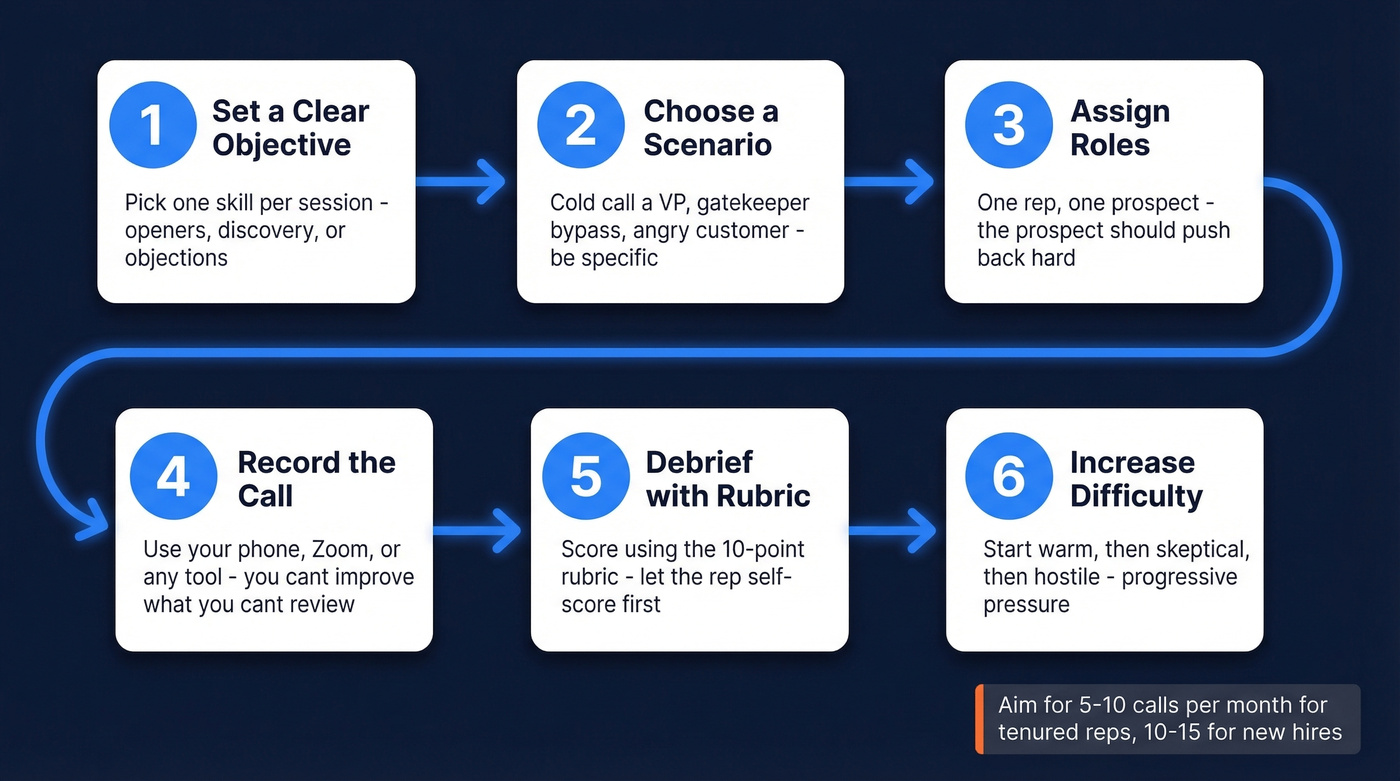
- Set a clear objective. Don't just "practice." Decide: are you working on openers, discovery questions, or objection handling? One skill per session.
- Choose a scenario. Cold call to a VP of Marketing. Gatekeeper at an enterprise account. Angry customer calling about billing. Pick something specific.
- Assign roles. One person plays the rep, the other plays the prospect. The prospect should push back - not make it easy.
- Record the call. Use your phone, Zoom, or any recording tool. You can't improve what you can't review.
- Debrief with the rubric. Score the call using the 10-point rubric below. Let the rep self-score first, then compare with the manager's score.
- Repeat with progressive difficulty. Start with a warm prospect. Next round, make them skeptical. Then hostile.
Space sessions out - back-to-back drills without time to process feedback reduce retention. Aim for 5-10 practice calls per month for tenured reps. Newer reps or anyone on a performance plan should target 10-15.
Mock Call Scoring Rubric
Without a rubric, feedback devolves into "that was pretty good" or "you need to be more confident." Neither is actionable. We've adapted this 10-criteria scorecard from the HiveDesk QA framework, scored 1-5 per category. Print it out and bring it to every session.
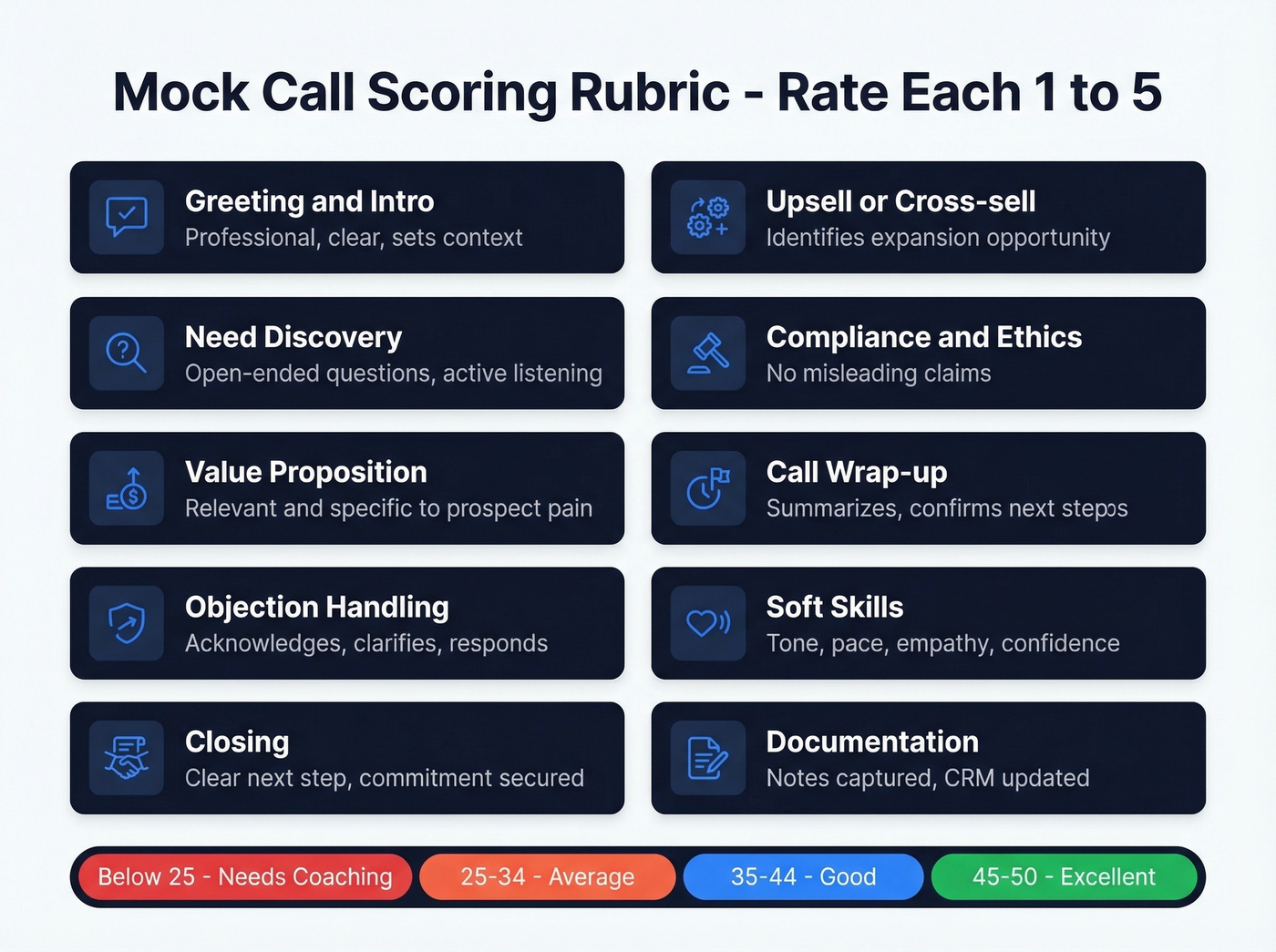
| Criteria | What to evaluate | Score (1-5) |
|---|---|---|
| Greeting & Intro | Professional, clear, sets context | |
| Need Discovery | Open-ended questions, active listening | |
| Value Proposition | Relevant, specific to prospect's pain | |
| Objection Handling | Acknowledges, clarifies, responds | |
| Closing | Clear next step, commitment secured | |
| Upsell/Cross-sell | Identifies expansion opportunity | |
| Compliance & Ethics | No misleading claims, proper disclosures | |
| Call Wrap-up | Summarizes, confirms next steps | |
| Soft Skills | Tone, pace, empathy, confidence | |
| Documentation | Notes captured, CRM updated |
Benchmark ranges: 45-50 = Excellent. 35-44 = Good. 25-34 = Average. Below 25 = Needs focused coaching.
Have reps self-score before the manager reviews. The gap between self-perception and reality is where the best coaching conversations happen.
Scripts for Every Scenario
These scripts are starting points, not gospel. Adapt the language to your product, your ICP, and your voice. The structure matters more than the exact words.
Cold Call Opener
Rep: "Hi [Name], this is [Your Name] from [Company]. I know I'm calling out of the blue - do you have 30 seconds? I'll be quick."
(If yes) "We help [role/industry] solve [specific problem]. I noticed [trigger - hiring, funding, tech stack change]. Worth a 15-minute conversation this week?"
Keep it under 20 seconds. Use a permission-based opener and get to the point fast. If you need a full system around this, build a repeatable cold calling system before you scale headcount.
Referred Lead
Rep: "Hi [Name], [Referrer] suggested I reach out. They mentioned you're dealing with [problem] - we helped their team [result]. Do you have two minutes so I can see if it's relevant for you?"
Referrals convert better than cold outreach. Lead with the name, not your pitch.
Gatekeeper Bypass
Rep: "Hi, I'm trying to reach [Decision Maker] regarding [brief context]. Could you transfer me?"
Gatekeeper: "They're not available."
Rep: "Understood. Could I get their direct number or email so I can follow up at a better time?"
Don't fight the gatekeeper. Get the direct line and call back. Zendesk's script library has 21 scenario templates worth bookmarking.
Discovery Call
Rep: "Thanks for taking the time. Before I walk through anything, I'd love to understand your current setup. How are you handling [process] today?"
(Listen. Don't pitch.) "What's the biggest friction point with that approach?"
"If we could solve [pain], what would that free up for your team?"
The best discovery calls are listening-heavy. Practice shutting up after the question - it's harder than it sounds. If you want a tighter flow, use a structured discovery call script as your baseline.
"I Don't Have Time"
Prospect: "I really don't have time for this."
Rep: "Totally respect that. Can I have 15 seconds to tell you why I called, and you tell me if it's worth a callback? ... [One-sentence value prop]. Should I call back Thursday, or is email better?"
This objection is a scheduling problem, not a rejection. Treat it that way.
Customer Complaint
Rep: "I'm sorry you're dealing with this - that's frustrating. Let me make sure I understand: [restate the issue]. Is that right?"
(Confirm) "Here's what I can do right now: [specific action]. I'll follow up by [time] to make sure it's resolved."
Acknowledge first. Solve second. Confirm third.

Mock calls build the skill. But when it's time for the real call, you need the right person's direct line. Prospeo gives you 125M+ verified mobile numbers with a 30% pickup rate - so your reps actually reach the decision-maker they practiced for.
Stop practicing for calls you'll never get to make.
Objection-Handling Drills
60% of cold calls hit "I'm not interested" as the first response. If your reps can't navigate that reflexive brush-off, nothing else matters. (If this is a chronic issue, use a dedicated cold call rejection playbook to diagnose what's breaking.)
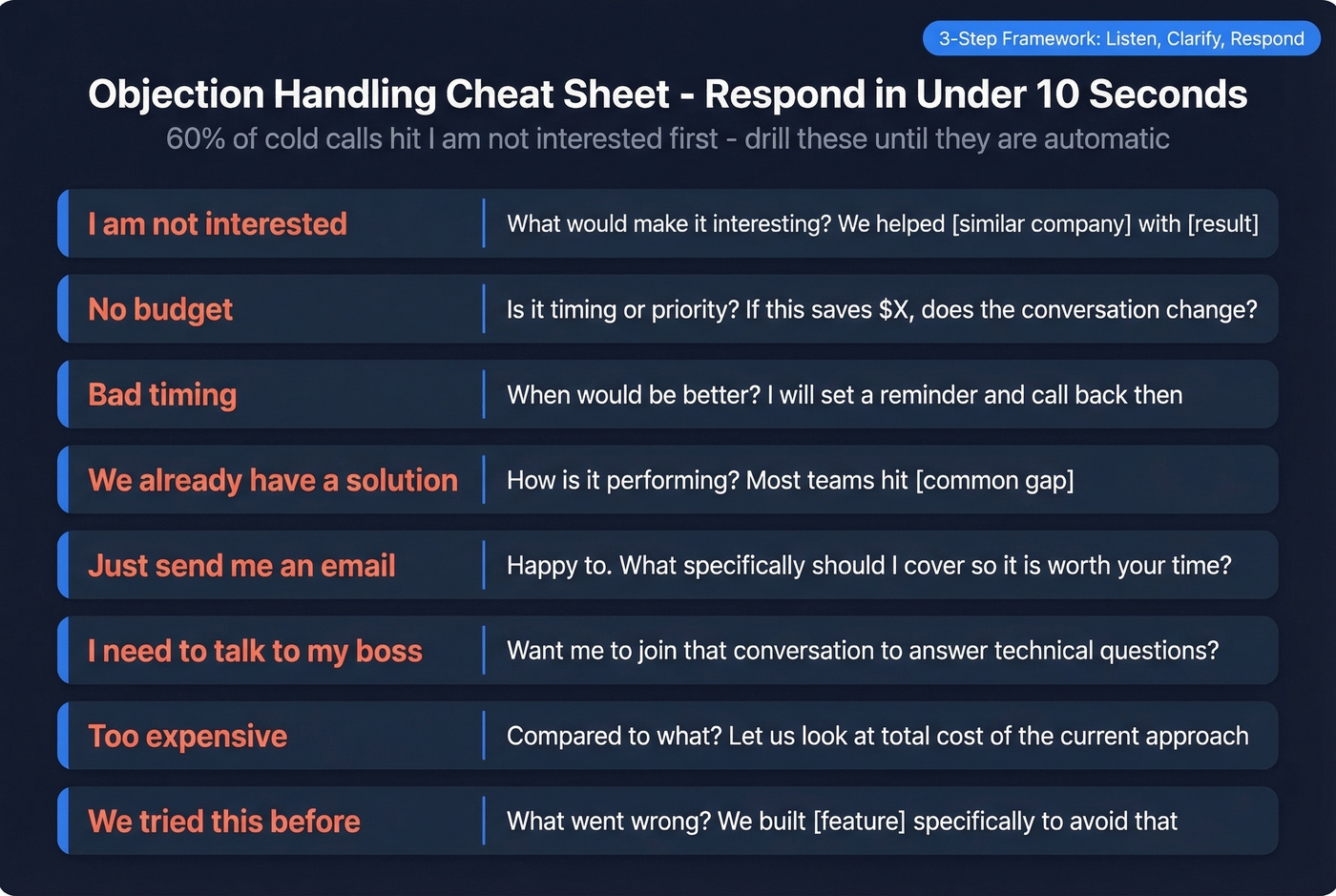
Use the 3-step framework from LeadsAtScale: Listen & Understand, Clarify & Confirm, Respond with Value. Drill these objections until responses are automatic:
- "I'm not interested." - "What would make it interesting? We've helped [similar company] with [result]."
- "No budget." - "Is it timing or priority? If this saves $X, does the conversation change?"
- "Bad timing." - "When would be better? I'll set a reminder and call back then."
- "We already have a solution." - "Great - how's it performing? Most teams I talk to are hitting [common gap]."
- "Just send me an email." - "Happy to. What specifically should I cover so it's worth your time?"
- "I need to talk to my boss." - "Makes sense. Want me to join that conversation to answer technical questions?"
- "Too expensive." - "Compared to what? Let's look at total cost of the current approach."
- "We tried something like this before." - "What went wrong? We've built [feature] specifically to avoid that."
Run these as rapid-fire drills: one rep reads the objection, the other responds in under 10 seconds. Speed builds instinct.
Live Role Plays vs. AI Simulations
| Live Role Plays | AI Simulations | |
|---|---|---|
| Strengths | Real pressure, peer feedback, knowledge transfer | Safe environment, scalable, objective scoring |
| Weaknesses | Stage fright, human bias, hard to scale past 50 reps | Lacks human nuance, setup cost |
| Best cadence | Weekly | Daily (10-min drills) |
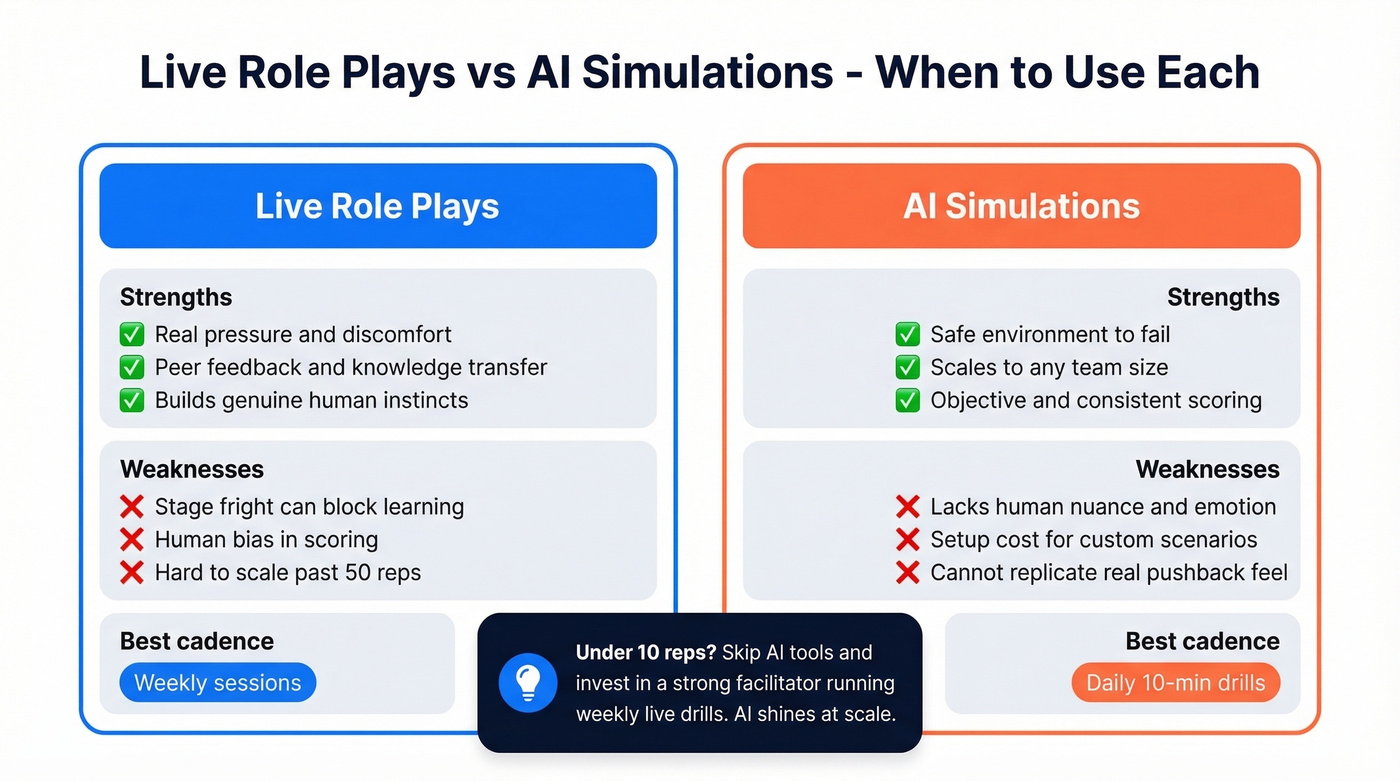
The StratX research nails the core tension: live role plays build pressure tolerance but don't scale, and peer sessions can devolve into jokes. AI simulations scale beautifully but can't replicate the discomfort of a real human pushing back.
Let's be honest: if your team has fewer than 10 reps, skip AI tools entirely and invest that budget in weekly live sessions with a strong facilitator. AI roleplay shines at scale. At small scale, a good manager running structured drills will outperform any platform.
Use both when you can. AI for daily volume and muscle memory. Live sessions for weekly pressure-testing and calibration. For maximum realism, build AI scenarios from real call transcriptions, not hypothetical scripts.
Best AI Mock Call Tools in 2026
The AI roleplay market has split into three lanes: conversation intelligence (diagnose real calls), roleplay platforms (practice simulated calls), and assistant layers (real-time coaching). For mock call practice, you want lane two.
| Tool | Best for | Approx. pricing |
|---|---|---|
| Yoodli | Free solo practice | Free tier available |
| Hyperbound | Sales-specific AI roleplay | ~$50-150/user/mo |
| Second Nature | Enterprise, 20+ languages | Custom quote |
| Mindtickle | Broader enablement suite | Custom quote |
| Zenarate | Contact center simulation | Custom/enterprise |
| Gong | Reviewing real calls (CI) | ~$160-250/user/mo |

Yoodli is the easiest entry point - free tier, no sales call required, and it gives feedback on filler words, pacing, and clarity. It's more presentation coach than sales simulator, but for solo practice at zero cost, it's a strong starting point.
Hyperbound is purpose-built for sales. You create AI buyer personas that match your ICP, run cold call simulations, and get scored automatically. In our experience, it's the best option for teams that want dedicated roleplay without buying an entire enablement suite.
Second Nature targets enterprise call centers with AI avatars that simulate customer interactions across 20+ languages. Expect a custom quote based on user count, modules, and integration complexity.
Mindtickle wraps roleplay into a broader enablement suite - content management, coaching, readiness scoring, the works. It's the right pick if you want one platform for training, not just mock calls. Skip it if all you need is roleplay.
Zenarate focuses on contact center simulation with immersive, screen-based scenarios. Strong for support and service teams that need to practice navigating systems while talking.
Gong isn't a roleplay tool - it's conversation intelligence. Use it to diagnose what's going wrong on real calls, then practice fixes with one of the tools above.
The selection heuristic is simple: if your bottleneck is diagnosis (reps don't know what they're doing wrong), buy conversation intelligence. If your bottleneck is execution (reps know the theory but can't perform), buy a roleplay platform.
Solo Practice Methods
The biggest complaint we hear from newer reps: seniors are too busy, and asking for help feels awkward. You don't need a partner to get better.
Even 10 minutes a day on Yoodli or Hyperbound adds up fast. Treat it like going to the gym - short, consistent sessions beat occasional marathons. Record yourself reading scripts aloud and play them back. You'll catch filler words, rushed pacing, and weak transitions you'd never notice in real time. I once recorded a 90-second opener that felt smooth in the moment and counted seven "ums" on playback. Humbling, but that's the point.
When you're ready for live reps, build a practice list of real but low-priority contacts. Pull verified numbers from a tool like Prospeo so you're not wasting time on disconnected lines. Real conversations - even with long-shot prospects - teach more than any simulation.
After every practice session or recording, score yourself on the 10-point rubric. Track your scores weekly. The trend line matters more than any single score.
Before You Dial: Fix Your Data
You've practiced the pitch. You've drilled objections until they're reflexive. Now make sure you're calling real, reachable people.
When your phone numbers are dead - common with stale databases - every hour you spent on mock call practice gets diluted by wrong numbers and voicemails to former employees. We've seen teams burn entire afternoons dialing lists where 40% of the numbers were disconnected. That's not a skills gap. That's a data gap.
Prospeo refreshes contact data every 7 days, compared to the 6-week industry average, and covers 125M+ verified mobile numbers with a 30% pickup rate. At roughly $0.01 per email with a free tier to start, there's no reason to dial blind. If you're evaluating options, start with a shortlist of data enrichment services and compare refresh rates and verification methods.

Your cold call script mentions a trigger - hiring, funding, tech stack change. Prospeo's 30+ search filters surface those exact signals so reps walk into every call with real context, not made-up scenarios. Data refreshed every 7 days, not 6 weeks.
Turn mock call prep into live pipeline at $0.01 per lead.
FAQ
How often should I practice mock calls?
Aim for 5-10 sessions per month minimum. Reps on performance plans should target 10-15 monthly. Daily 10-minute AI drills build skill faster than a single weekly hour-long session because spaced repetition improves long-term retention.
Can I practice mock calls alone?
Yes - solo drills are one of the fastest ways to improve. Use Yoodli (free) or Hyperbound for AI-powered feedback, or record yourself reading scripts and review the playback against the 10-point rubric. Solo practice beats no practice every time.
What's the best free tool for call practice?
Yoodli offers a free tier with AI feedback on pacing, filler words, and delivery clarity. For a zero-cost alternative, Prospeo's free plan (75 credits/month) lets you pull verified contacts for real low-stakes calls - live reps teach more than any simulator.
How do I score a mock call?
Use the 10-criteria rubric covering greeting, discovery, objection handling, closing, and soft skills. Score each category 1-5 for a total out of 50. Below 25 signals a rep needs focused coaching; above 44 means they're ready for live pipeline calls.
How do I start if I've never done a mock sales call?
Pick one scenario - like a cold call opener - and read the script aloud until the flow feels natural. Then recruit a colleague or use an AI tool to play the prospect, record the session, and debrief with the scoring rubric. Focus on one skill per attempt rather than simulating an entire sales cycle on your first try.