

Motivation for Sales: Stop Chasing Feelings, Build a System
It's 8:47 AM. Your top SDR is staring at a screen full of disconnected numbers and bounced emails from yesterday's sequence. She hasn't booked a meeting in six days. The Zig Ziglar quote you dropped in Slack at 7:30 didn't help. Neither did the $50 Starbucks gift card for "most dials this week."
You don't need another list of 100 motivational quotes. You need a system. Motivation for sales isn't a mood you inject into people - it's infrastructure you build, or fail to build, around them.
What You Need (Quick Version)
- Map your team's drive to Autonomy, Mastery, and Purpose - not just quota and commission.
- Fix your data and tools so reps aren't burning energy on dead leads and bounced emails.
- Give specific, developmental feedback weekly - not quarterly, not a quote in Slack.
The Sales Motivation Crisis in 2026
The numbers are ugly. 67% of sales reps feel burned out at least sometimes, per Salesforce's data. Average SDR tenure sits at 14 months. Bridge Group research shows 54% of SDRs say burnout is a top reason they'd leave, and 23% of new sales hires never reach full productivity - they're gone within a year before they ever ramp.
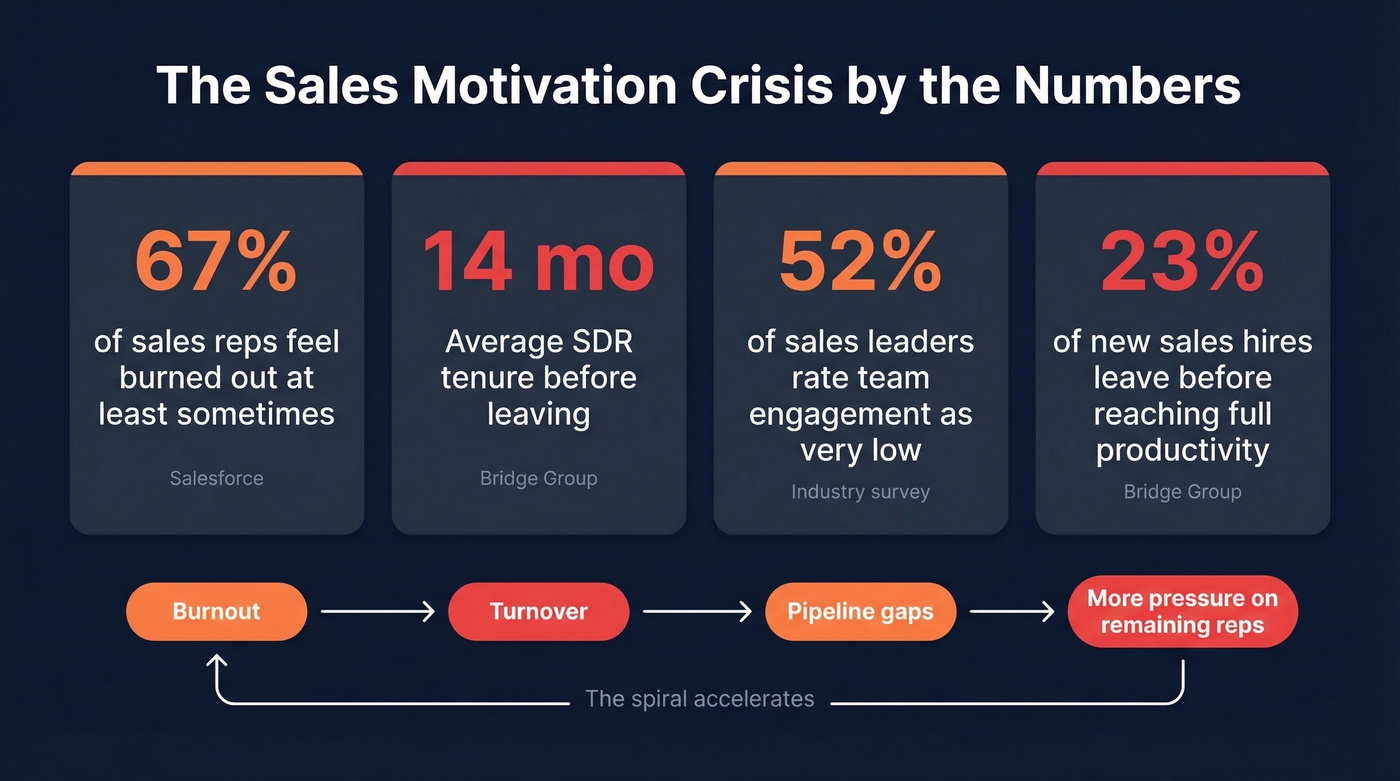
It's not just reps feeling it. 52% of US sales leaders rate their team's overall engagement as "very low." You can't solve this with a pizza party. It's a structural failure that compounds: burnout drives turnover, turnover kills pipeline continuity, pipeline gaps create more pressure on remaining reps, and the spiral accelerates. Understanding what drives salespeople to stay - or leave - is the first step toward reversing it.
Why Most Advice Fails
US companies spend roughly $800B annually on sales force compensation. McKinsey's research (cited by ZS) shows adjusting comp models can deliver up to 50% higher impact on sales than increasing advertising spend. Money clearly matters. But it's not the whole story, and most organizations treat it like it is.
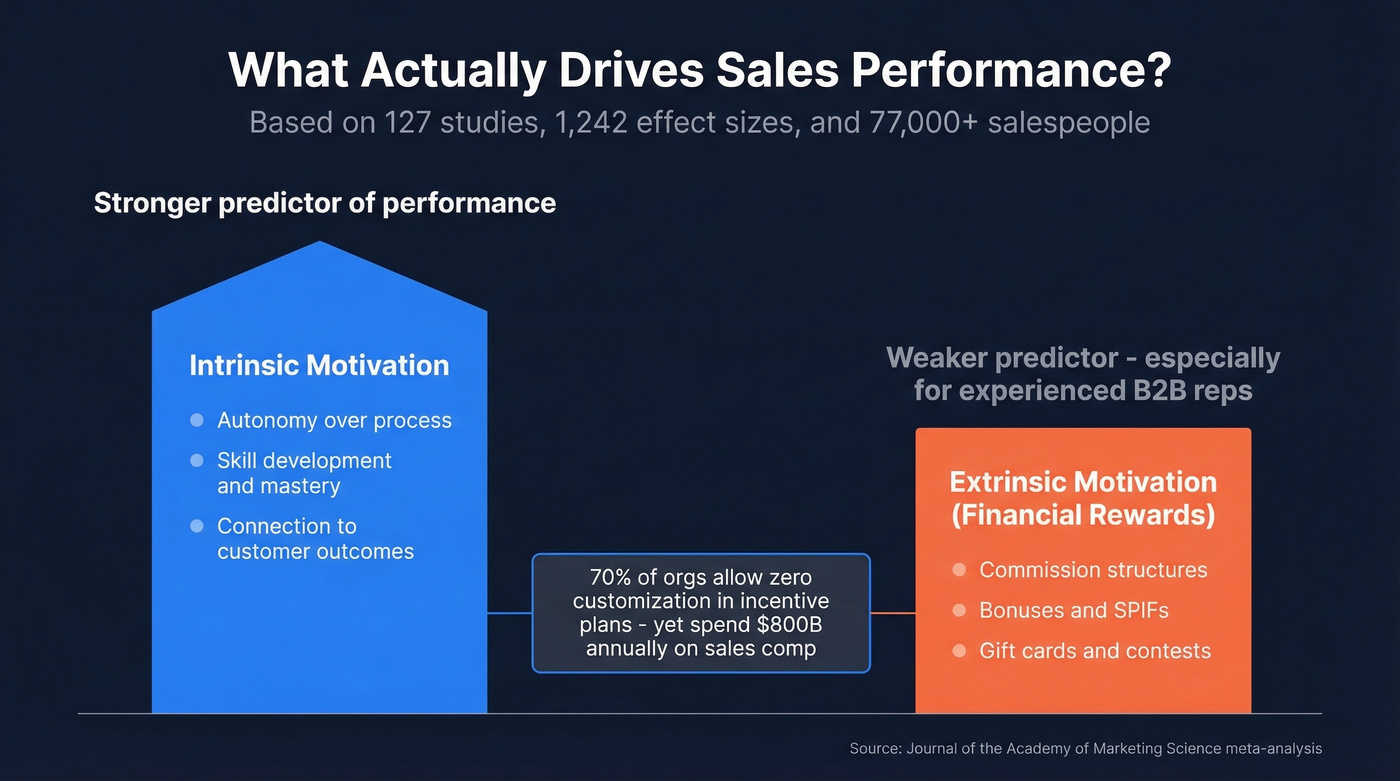
A meta-analysis in the Journal of the Academy of Marketing Science synthesized 127 studies, 1,242 effect sizes, and 77,000+ salespeople. The core finding: intrinsic motivation is a significantly stronger performance predictor than financial rewards. The gap widens for experienced reps and is especially pronounced in B2B selling. The Incentive Research Foundation found incentive programs produce roughly 7.5% net sales gains - meaningful, but hardly enough on its own.
Here's the kicker: a ZS study found 70% of organizations don't allow any customization in their incentive plans. We're spending $800B on comp, designing it generically, and wondering why reps disengage. On r/sales, a recurring thread captures this perfectly - reps who were initially motivated by spite or ego hit a wall once they've outperformed their peers. The extrinsic driver disappears, and without a deeper reason to keep pushing, they stall.

You just read it: most motivation problems are actually operational problems. When reps burn energy on bounced emails and disconnected numbers, no coaching framework saves them. Prospeo delivers 98% verified emails and 125M+ mobile numbers with a 30% pickup rate - so reps spend time selling, not chasing dead leads.
Remove the friction that's draining your team's drive.
Autonomy, Mastery, Purpose
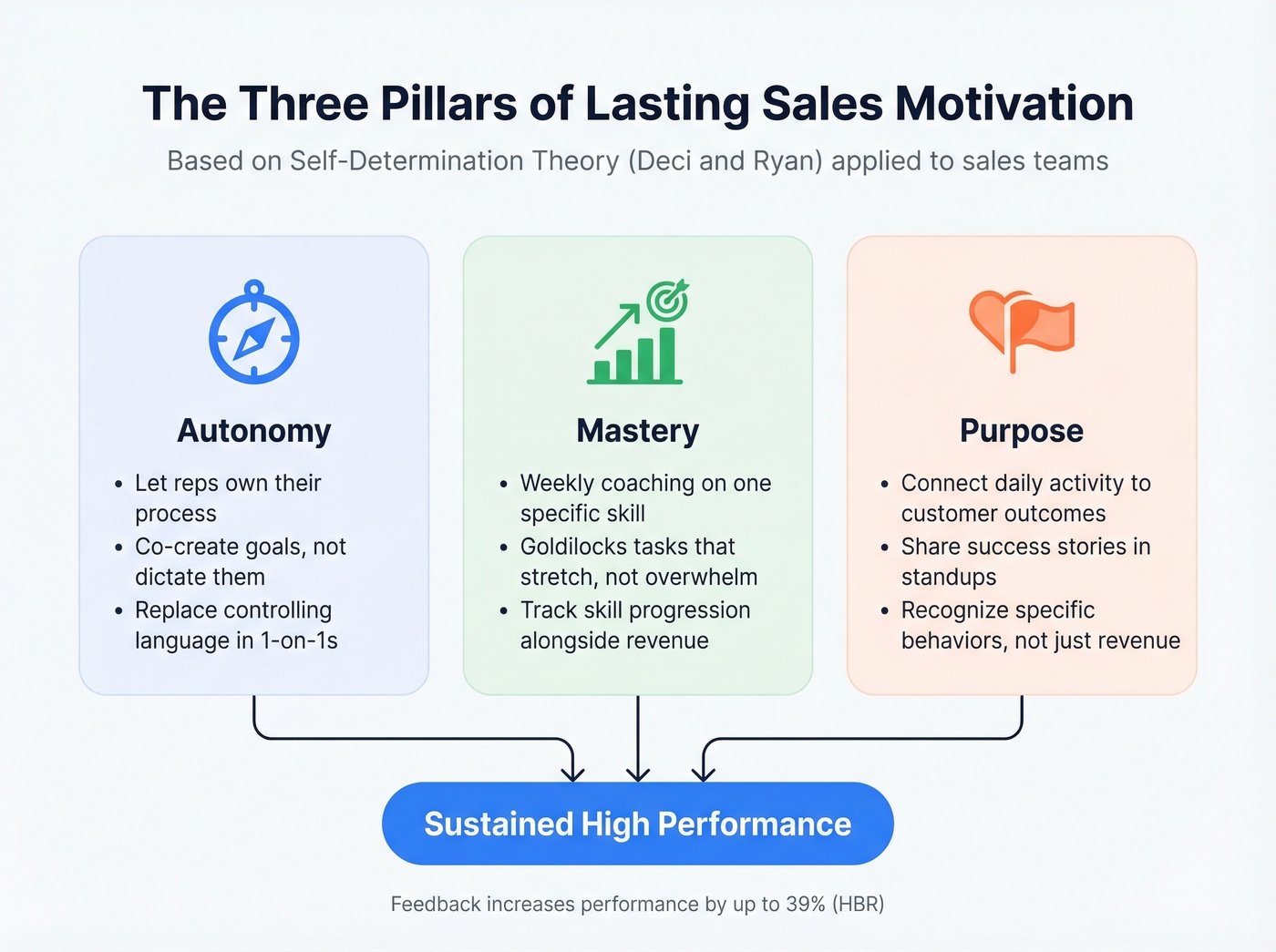
Several frameworks float around sales blogs. Daniel Pink's - rooted in Deci and Ryan's Self-Determination Theory - holds up because it maps directly to sales operations. These aren't abstract concepts. They're levers you can pull this week.
Autonomy
Let reps own their process. Reduce controlling language in one-on-ones. Involve them in goal-setting rather than handing down quotas from on high. Personal initiative - the freedom to experiment, adapt, and iterate - is what separates reps who grind from reps who grow. The rep who builds her own prospecting workflow will outperform the one following a script she had no hand in creating, every single time.
- Let reps choose their own sequencing and channel mix
- Co-create quarterly goals instead of dictating them
- Replace "why didn't you hit X?" with "what would you change?"
Mastery
Invest in skill development, not just quota attainment. Assign "Goldilocks tasks" - challenges that stretch without overwhelming. Regular, developmental feedback increases performance by up to 39% according to HBR research.
- Run weekly coaching focused on one specific skill, not pipeline rehash
- Pair mid-performers with top reps for live call reviews
- Track skill progression alongside revenue metrics
Purpose and Mission
Connect daily activity to customer outcomes. "You made 80 dials" means nothing. "You helped three companies solve their data quality problem this week" means something. 76% of sales leaders say team activities are the most effective lever for retaining engaged reps. Recognition amplifies purpose. Silence erodes it.
When reps feel a genuine sense of mission, they push through slumps that would otherwise break them - and that sense of mission doesn't come from a motivational poster on the break room wall, it comes from seeing the downstream impact of their work on real customers with real problems.
- Share customer success stories in weekly standups
- Tie individual activity to team-level wins publicly
- Recognize specific behaviors, not just closed revenue
What Kills Sales Motivation
Stop doing this:
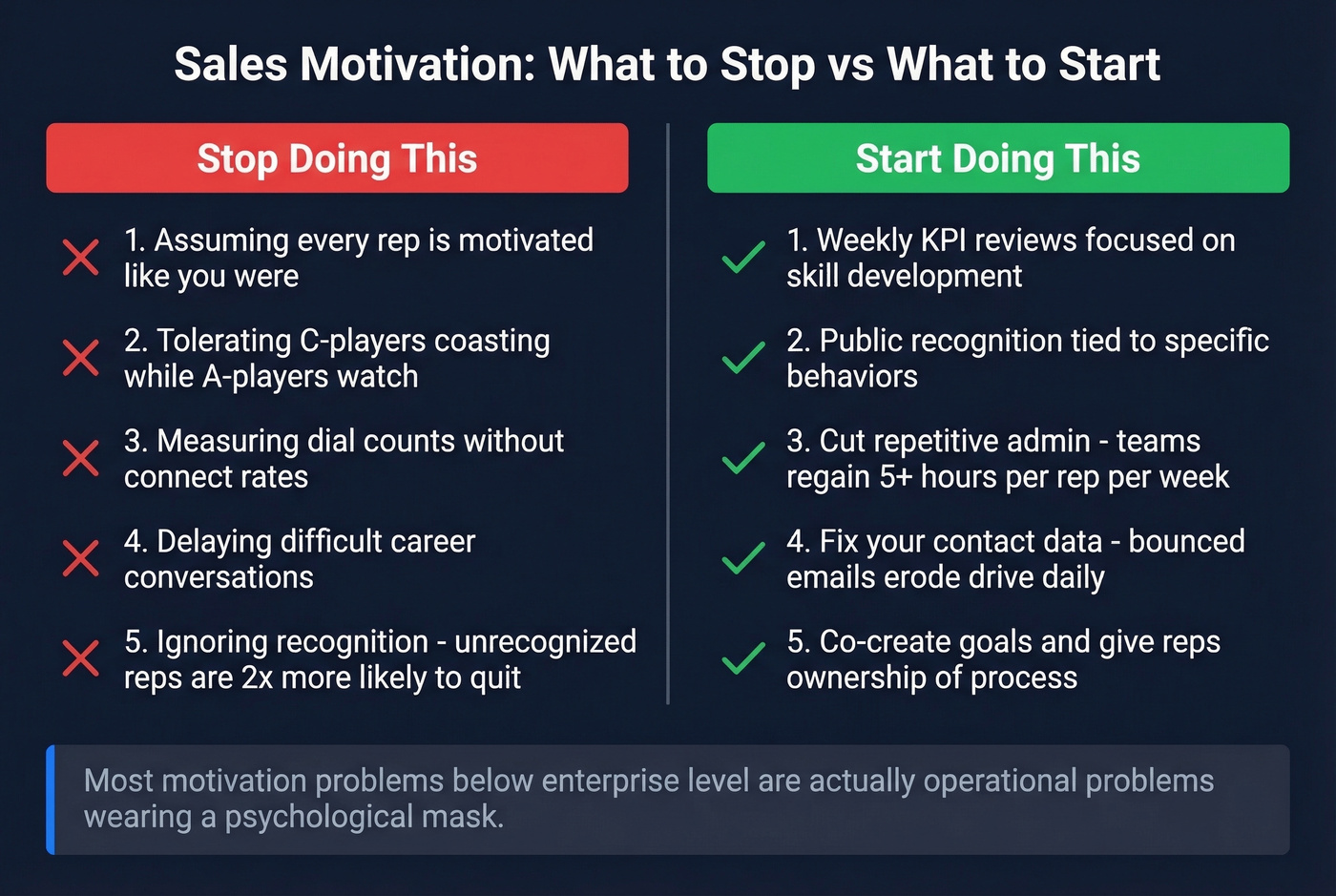
- Assuming every rep is motivated the way you were.
- Tolerating consistent underperformance - nothing demoralizes A-players faster than watching a C-player coast.
- Measuring activity over results. Dial counts without connect rates punish efficient reps.
- Delaying difficult conversations. If you can't give a rep a clear growth path, they'll find one elsewhere.
- Ignoring the recognition gap. Gallup's data shows employees who don't feel adequately recognized are 2x more likely to quit within the year.
Start doing this:
- Weekly KPI reviews focused on skill development, not just numbers.
- Public recognition tied to specific behaviors, not just closed deals.
- Ruthlessly cutting repetitive admin work. We've watched teams regain 5+ hours per rep per week just by automating CRM entry - and the energy shift was immediate.
Let's be honest: if your average deal size is under $15K, you probably don't need a complex incentive redesign. You need to remove friction. Most motivation problems below the enterprise level are actually operational problems wearing a psychological mask. The right mindset can't take hold in an environment that's actively working against it.
The Tactical Playbook for Slumps
When the system is right but a rep (or the whole team) is in a rut, these tactical moves help.
Stack Your Best Days
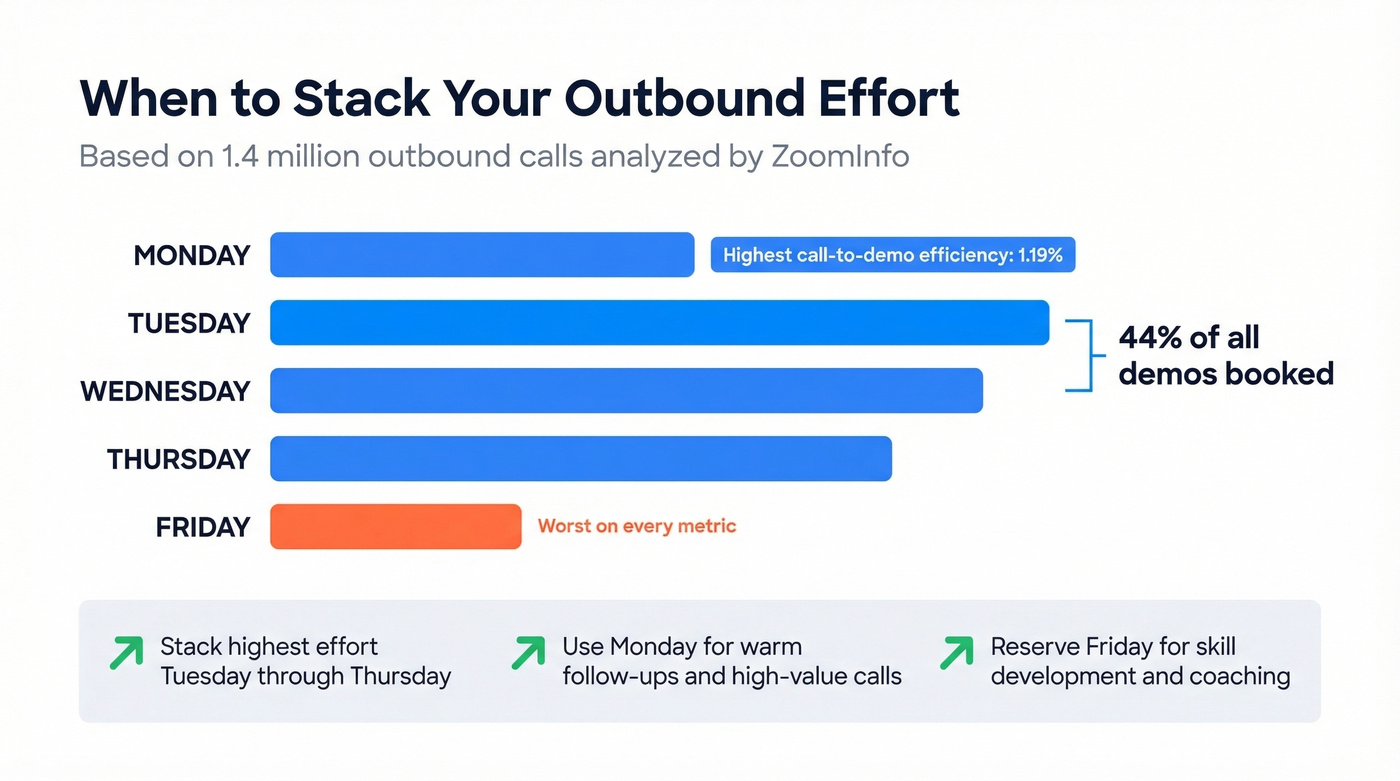
ZoomInfo analyzed 1.4 million outbound calls and the data is clear: Tuesday and Wednesday account for 44% of total demos booked. Monday has the highest call-to-demo efficiency at 1.19%. Friday is worst on every metric. If your team is struggling, stack effort Tuesday through Thursday and use Fridays for skill development.
Shrink the Goal
Monthly quotas feel abstract on day three of a slump. Break them into daily micro-goals. "Book one meeting today" beats "hit 12 meetings this month." When reps can see themselves moving forward, momentum builds.
Fix the Data
Bad contact data is the most concrete, fixable motivation killer in sales. Every bounced email and disconnected number tells a rep their effort was wasted. That erosion compounds daily.
I've seen this firsthand: a team running outbound off a stale database will burn through morale faster than any quota pressure ever could. When we helped one team switch to Prospeo's verified data - 98% email accuracy on a 7-day refresh cycle - their reps stopped dreading the dial block because they were actually reaching real people. That's not a motivation hack. That's removing the thing that was killing motivation in the first place.
Cut the Admin
Automate everything that isn't selling. CRM enrichment instead of manual research. Sequence automation instead of copy-paste follow-ups. Every minute you give back to a rep is a minute their drive has room to breathe. Skip this step if your team genuinely enjoys the research process - some do, especially in complex enterprise sales - but for most SDR teams, admin is pure drag. If you're rebuilding the stack, start with SDR tools and a clean lead generation workflow.
Five Quotes Worth Keeping
If you must share quotes, make them these - and know when to use each one.
| Quote | Who | When to Use It |
|---|---|---|
| "People work for money but go the extra mile for recognition." | Dale Carnegie | After a rep closes a tough deal |
| "Success is not final, failure is not fatal." | Winston Churchill | During a team-wide slump |
| "The only way to do great work is to love what you do." | Steve Jobs | Career-path conversations |
| "Discipline is choosing between what you want now and what you want most." | Abraham Lincoln | Coaching on daily habits |
| "What gets measured gets managed." | Commonly attributed to Peter Drucker | Introducing new KPIs |
Your reps don't need another Zig Ziglar quote - they need data that connects. Teams using Prospeo book 26% more meetings than ZoomInfo users and 35% more than Apollo, at $0.01 per email. That's the kind of infrastructure that turns slumps into pipelines.
Give your SDRs meetings to book, not bounces to explain.
FAQ
Does money motivate salespeople?
Yes, but it has a ceiling. A meta-analysis of 127 studies found intrinsic motivation is a stronger performance predictor than financial rewards - especially for experienced B2B reps. Design comp well, but layer autonomy, mastery, and purpose on top.
How do I motivate a burned-out sales team?
Diagnose first: is the problem operational (bad tools, bad data, too much admin) or psychological (no autonomy, no growth path)? Fix operational friction before layering on motivational programs. In our experience, bad data is the culprit more often than managers expect - reps won't tell you "my contact list is garbage," they'll just quietly disengage.
What's the best motivation for sales teams?
A system that combines competitive pay with autonomy over process, clear skill-development paths, and tools that eliminate friction. Remove what drains energy before adding what's supposed to inspire it.
What drives salespeople to perform long-term?
Reps who sustain high performance year after year almost always have intrinsic drivers - a growth mindset, a connection to customer outcomes, and enough autonomy to feel ownership over their results. Commission gets people in the door. Purpose and mastery keep them there.