

The MQL Is Dead Debate: What the Numbers Actually Say
The "MQL is dead" argument has been raging for years. Here's what the data actually shows: 13% average MQL-to-SQL conversion, misaligned incentives, and a buying process that outgrew the metric. Replace MQL volume with buying group coverage, fix your contact data, and align on pipeline generation. That's the whole article in three sentences.
The QBR Slide Nobody Wants to Present
Marketing presents 500 MQLs. Sales shows 12 opportunities. The CEO asks why the numbers don't connect, and the room goes quiet.
A Marketing Week survey of 450 brand marketers found that 37.7% feel pressured to deliver MQLs regardless of quality. Over a quarter said delivering leads is their only success metric. The incentive structure rewards volume, not pipeline - and that's the dysfunction at the heart of every MQL-centric org.
The consensus on r/marketing is blunt: there's a "black hole between 'MQL' and 'closed won' where nobody knows what happened." Marketing blames sales for not following up. Sales blames marketing for sending garbage. The MQL absorbs blame it was never designed to handle, and the finger-pointing just keeps cycling.
Why MQLs Fail in Complex B2B
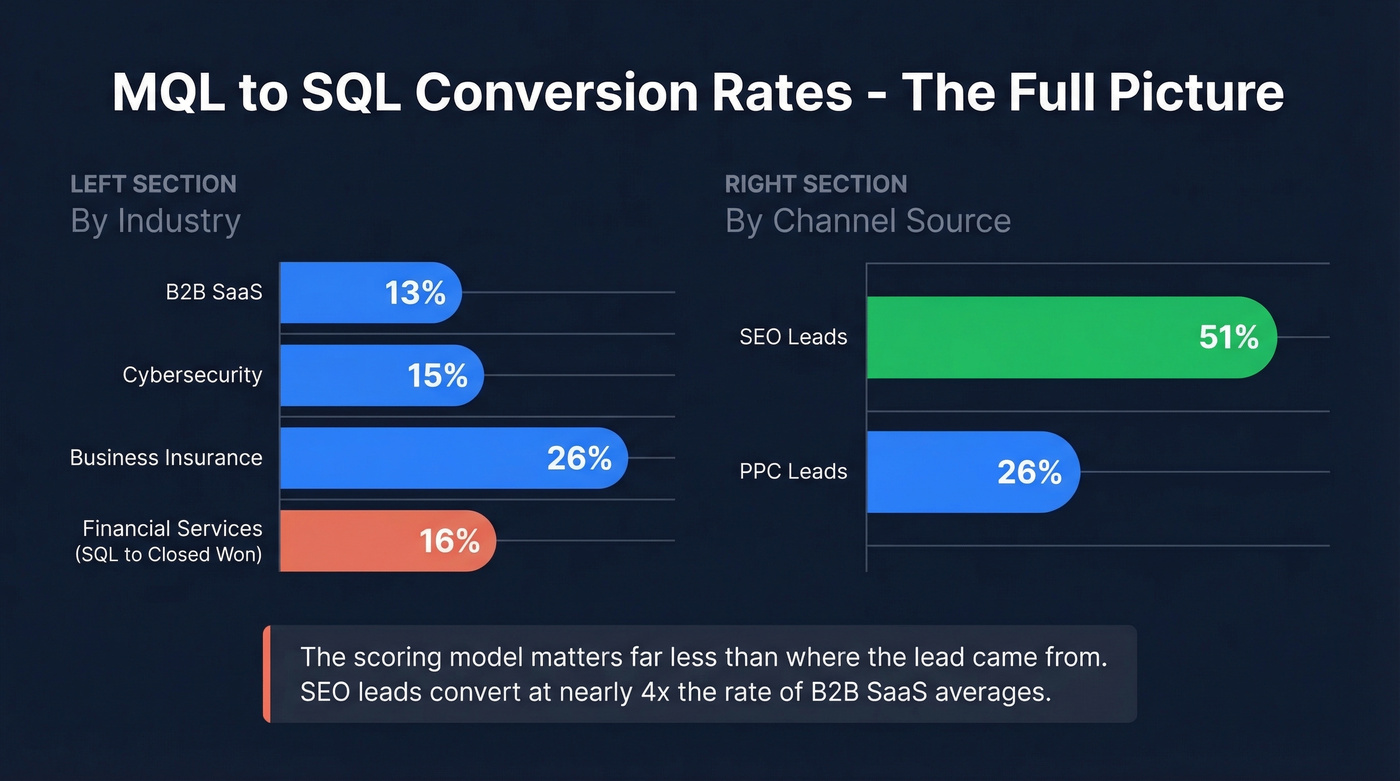
Here are MQL-to-SQL conversion rates by industry:
| Metric | Rate |
|---|---|
| MQL-to-SQL (B2B SaaS) | 13% |
| MQL-to-SQL (Cybersecurity) | 15% |
| MQL-to-SQL (Business Insurance) | 26% |
| MQL-to-SQL from SEO leads | 51% |
| MQL-to-SQL from PPC leads | 26% |
| SQL-to-Closed Won (Financial Services) | 16% |
A whitepaper download isn't buying intent. It never was. The channel breakdown tells the real story: SEO-sourced MQLs convert at 51% because those buyers are actively researching a problem. PPC converts at 26%. The scoring model matters far less than where the lead came from.
Run the full-funnel math. Start with 100 MQLs in B2B SaaS. At 13% conversion, you get 13 SQLs. At a roughly 15-25% SQL-to-Closed Won rate, that's 2-3 deals. An 87% discard rate before leads ever become opportunities should make any CMO rethink the metric they're optimizing for.
Here's the thing: if your average deal size is under $15K and one person signs the contract, MQLs are fine. Keep using them. The metric isn't broken for transactional sales. It's broken for the complex, multi-stakeholder deals where most B2B revenue actually lives - the ones where you're trying to apply a single-contact scoring model to a buying committee of 11 people who all have veto power.

87% of MQLs never become opportunities because you're scoring one contact while 12 others make the decision. Prospeo gives you the full buying group - 300M+ profiles with 30+ filters including department headcount, job changes, and buyer intent across 15,000 topics. Find every stakeholder at the account, not just the ebook downloader.
Stop qualifying leads. Start covering buying committees.
How B2B Buying Actually Works
The MQL model assumes one person raises their hand, gets qualified, and buys. Real B2B purchasing looks nothing like that.
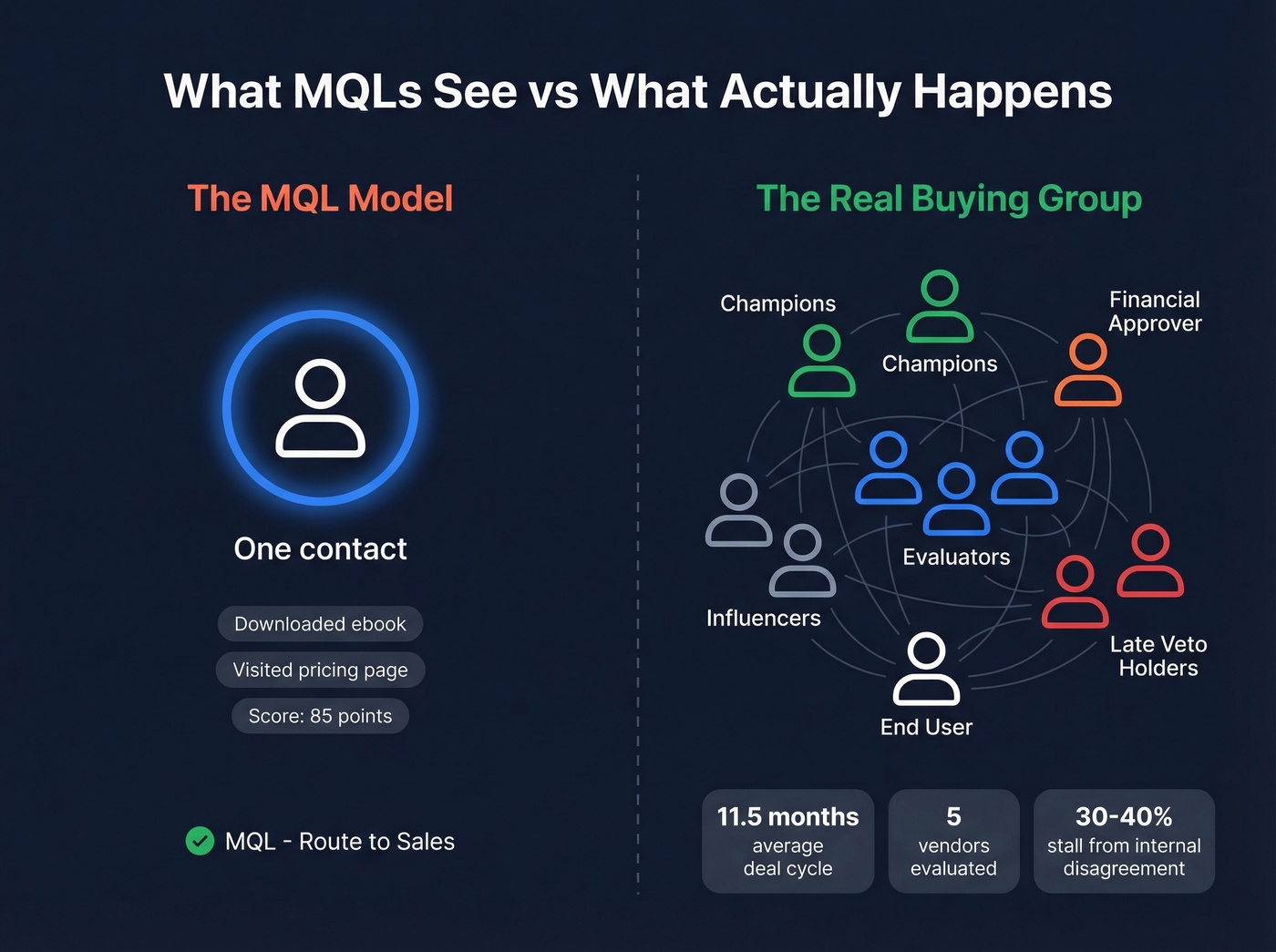
The 6sense Buyer Experience Study puts hard numbers on it: a typical $250K deal takes about 11.5 months, involves 11 people, and evaluates 5 vendors. The average buying group includes 13 participants. And 30-40% of failed buying processes stall not because of price or product fit, but because the buying committee can't reach internal consensus. Let that sink in - deals die from internal disagreement, not from your competitor's pricing page.
You've probably seen the "57% of the buyer journey happens before a vendor conversation" stat floating around. That number was debunked years ago. The actual finding from Forrester: 74% of business buyers conduct more than half their research online before talking to sales. Buyers typically already know 4 of the 5 vendors they'll evaluate on day one. By the time sales enters the conversation, the buying group has formed opinions and started internal debates. Scoring one contact's form fills misses the other 10-12 people who influence the decision.
What Replaces MQLs
The answer isn't swapping one acronym for another. We've watched too many teams rename MQLs to "hand-raisers" and change nothing else. Truly moving past the Marketing qualified lead requires rethinking how you define and measure demand.
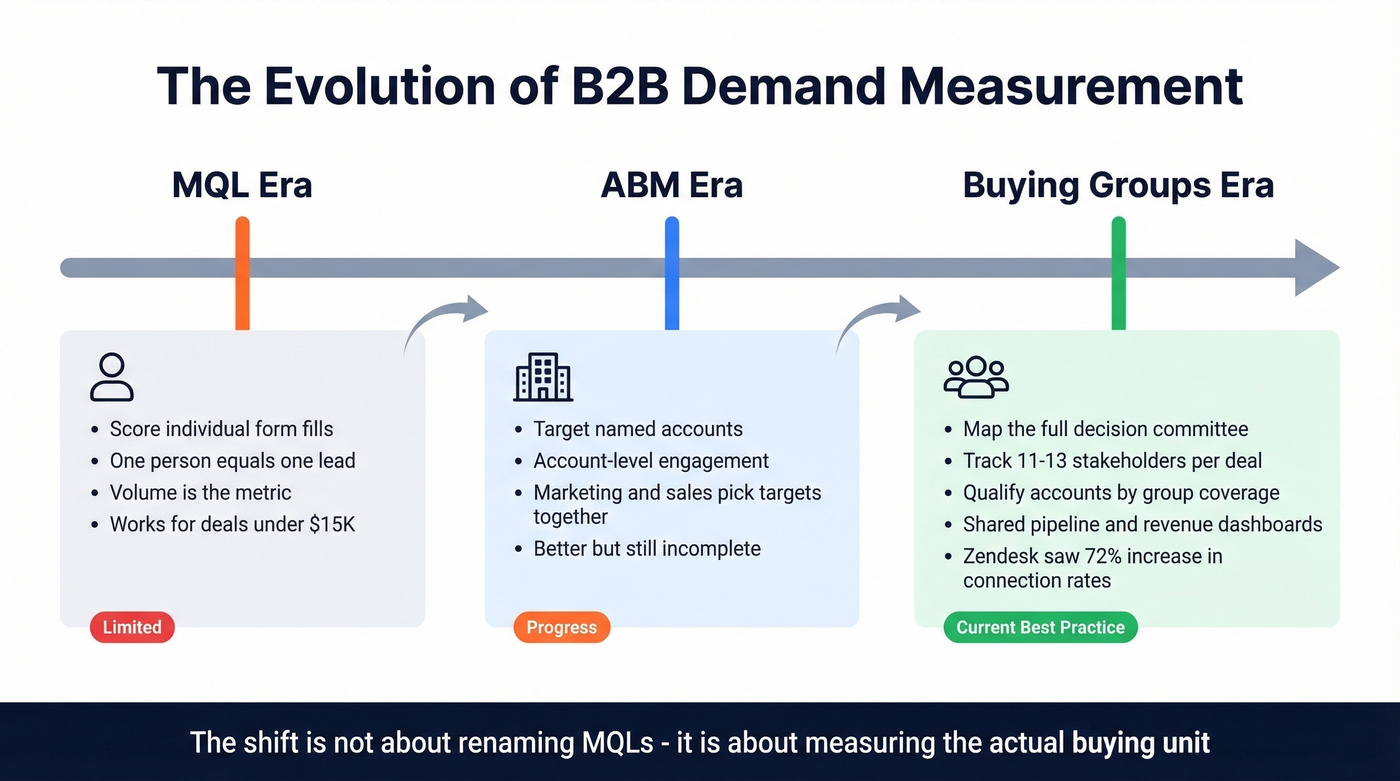
Demandbase frames the evolution as three eras: MQL, then ABM, then Buying Groups. The original SiriusDecisions MQL framework was built for a world where one person downloaded a whitepaper and sales called them. Buying groups add precision by narrowing the focus to the actual decision unit: the Champion, the Financial Approver, the late-arriving veto holder who kills deals in week 10. If your CRM only tracks the ebook downloader, you're blind to the people who actually decide.
6sense operationalizes this with 6QAs (6sense Qualified Accounts) - accounts scored on intent signals, profile fit, and multi-stakeholder engagement rather than individual lead scores. One scores a person's form activity; the other scores an account's collective buying behavior. The principle holds regardless of tooling: qualify accounts by account scoring, not individual form fills.
Inbound Demo Requests Are Different
Not all hand-raisers are created equal. An inbound demo request signals active evaluation, while a typical MQL campaign captures someone who grabbed a PDF and never thought about your product again. Teams that separate high-intent actions from content engagement and route them differently see dramatically better conversion rates.
Zendesk saw a 72% global increase in BDR connection rates after shifting to buying groups. A LeanData pilot reported deals 2x-4x bigger with higher close rates. Forrester's guidance centers on treating opportunities as the container, interpreting every interaction as a signal rather than a single threshold, expanding buying-group engagement, and running shared revenue dashboards with sales throughout the revenue process.
What to Do This Quarter
You don't need a $50K intent platform to start seeing results. Let's break this into three moves you can make right now.
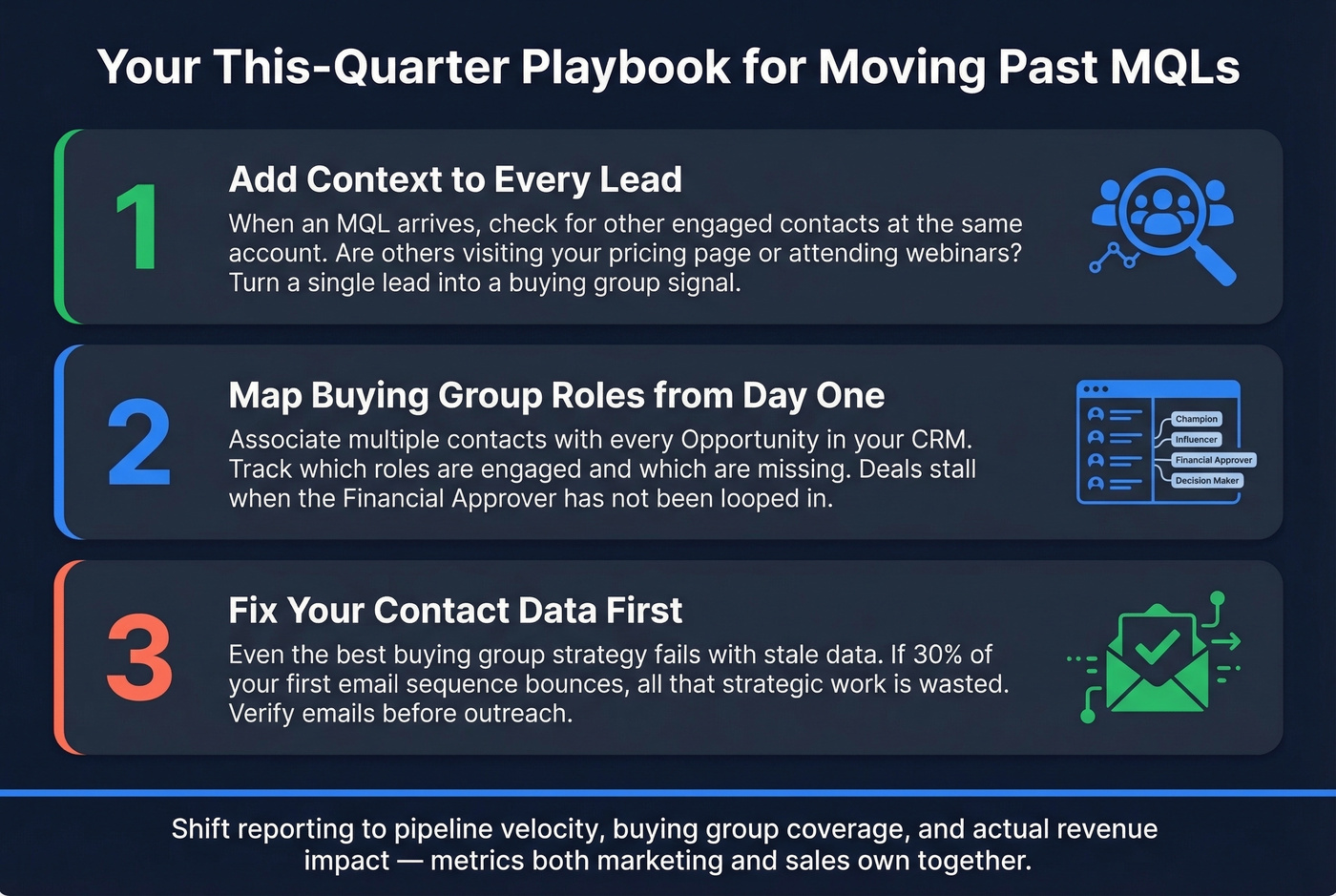
Add Context to Every Lead
So what is an MQL in practice? It's a single contact who crossed a scoring threshold. When one comes in, check for additional engaged stakeholders at the same account. Other people visiting your pricing page, attending webinars, or downloading content? That context turns a single lead into a buying group signal - and it's the simplest change teams can implement today.
Map Buying Group Roles
Most CRMs let you associate multiple contacts with an opportunity. Do it from day one. Track which roles are engaged and which are missing - deals stall when the Financial Approver hasn't been looped in, and you can't fix what you can't see.
In that same Reddit thread, a RevOps lead described replacing MQL reporting entirely with "pipeline velocity, SQL conversion, and actual revenue impact" - metrics that forced both teams to own the same number. Agencies should apply the same logic: attach every engaged contact to the account before routing to the client's sales team.
Fix Your Data First
Even the best buying group strategy fails if contact data is stale. We've watched teams build beautiful stakeholder maps only to bounce 30% of their first email sequence - all that strategic work, wasted on dead addresses. Prospeo's 98% email accuracy on a 7-day refresh cycle means your reps reach actual inboxes, not addresses from last quarter's lead batch. Skip this step and every improvement above gets undermined by bad data.

Your MQL-to-SQL rate tanks when contact data is wrong. Prospeo's 98% email accuracy and 7-day refresh cycle mean sales actually reaches the people marketing identifies - Champions, Financial Approvers, and the late-arriving veto holders who kill deals in week 10. At $0.01 per email, mapping an 11-person buying group costs less than a cup of coffee.
Reach all 11 decision-makers, not just the one who filled out a form.
FAQ
Is the MQL dead in 2026?
For enterprise deals with 11+ person buying committees, individual-lead scoring misses the point. The MQL is dead as a primary success metric for complex B2B - track buying group coverage and pipeline velocity instead. For simple, single-buyer transactions under $20K, it still works fine.
What's the average MQL to SQL conversion rate?
B2B SaaS averages 13%. Channel matters more than scoring - SEO MQLs convert at 51% versus 26% for PPC. These numbers show why lead scoring alone is a poor standalone performance indicator.
Why are MQLs wrong for enterprise sales?
MQLs score individuals, but enterprise purchases are made by committees of 11-13 people. Scoring one champion's activity while ignoring the other stakeholders who influence the decision gives you a dangerously incomplete picture of deal health and pipeline accuracy.
How do I start a buying groups motion without a full overhaul?
When a lead arrives, check for other engaged contacts at the same account before routing to sales. Attach all identified stakeholders to the Opportunity in your CRM from day one. Use an enrichment tool to fill buying group gaps at target accounts, then shift reporting to pipeline and buying group coverage first. The tech stack can evolve later.