

Stop Writing Follow-Up Emails. Start Writing Next Steps Emails.
"Just checking in" is the most ignored phrase in professional email. It looks backward - reminding someone you exist - instead of forward, toward what happens next. A next steps email proposes a specific action. A follow-up just nags.
90% of buyers respond within two days of their most recent message, yet only 8% of reps follow up more than five times - despite most deals needing 5-12 touchpoints to close. The gap isn't effort. It's framing.
When to Send a Next Steps Email
Timing is half the battle.
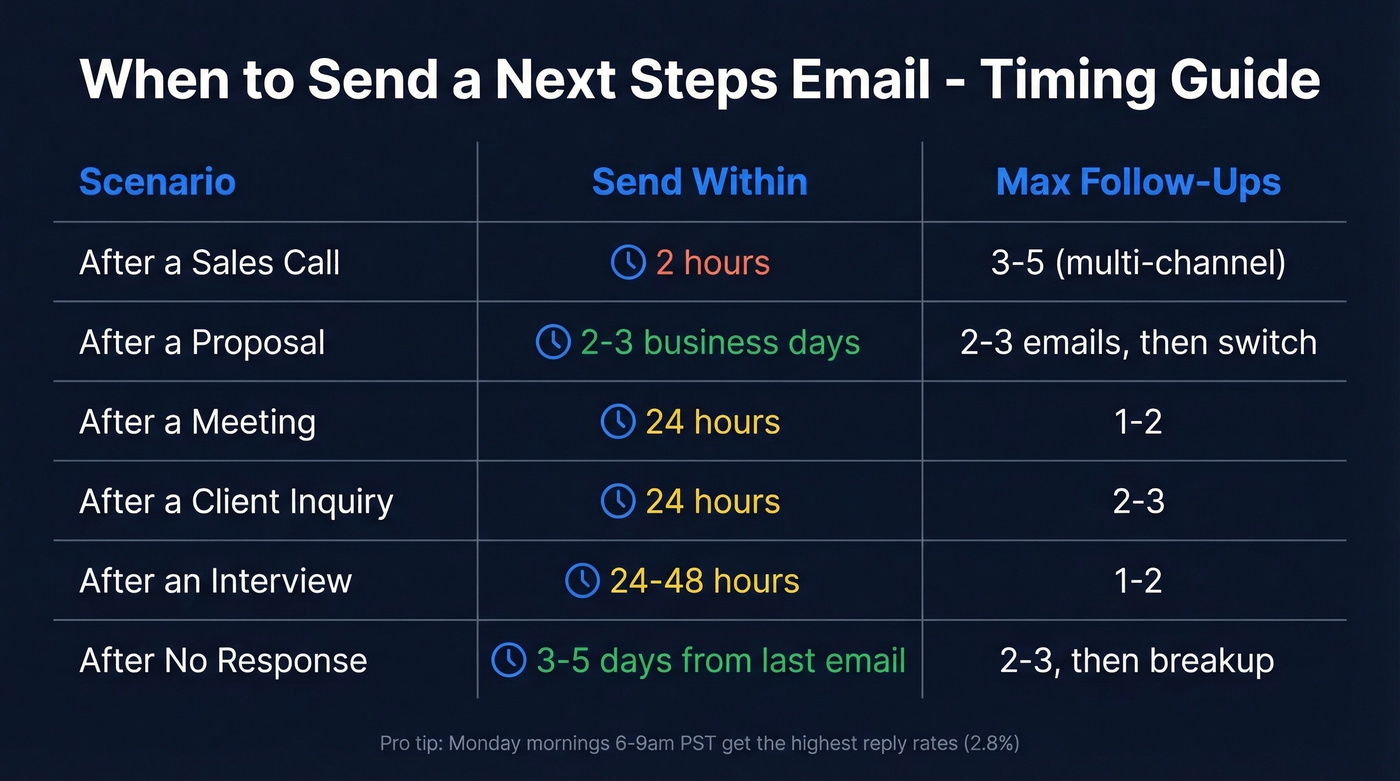
| Scenario | Send Within | Max Follow-Ups |
|---|---|---|
| After a sales call | 2 hours | 3-5 (multi-channel) |
| After a proposal | 2-3 business days | 2-3 emails, then switch channels |
| After a meeting | 24 hours | 1-2 |
| After a client inquiry | 24 hours | 2-3 |
| After an interview | 24-48 hours | 1-2 |
| After no response | 3-5 days from last email | 2-3, then breakup |
An 85,000-email study found Monday mornings between 6-9am PST had the highest reply rate at 2.8%. When you're sending dozens a week, that edge compounds fast.
When not to follow up: don't email before the timeframe you promised, don't email after a clear "no," and stop after 2-3 unanswered emails.
Templates for Every Scenario
After a Sales Call or Demo
Send within two hours. First follow-ups boost reply rates by 49%. The single most important thing: propose a specific next step with a date and time. Never end with "let me know your thoughts."
Subject: Quick recap + next step
Hi [Name],
Great speaking today. Here's what we covered: [one-sentence summary of their pain point and how you address it].
I'd like to get you a [proposal / demo environment / intro to our implementation team] by [day]. Does [specific date and time] work for a 15-minute call to walk through it?
Talk soon, [You]
Knowing how to recap a phone conversation in email is the skill that separates a forgettable message from one that moves the deal forward. Anchor the summary around the prospect's pain point, not a play-by-play of everything you discussed.
After Sending a Proposal
Set the follow-up expectation before you send the proposal. Say "I'll check in Thursday" during the call, so your email feels expected rather than pushy.
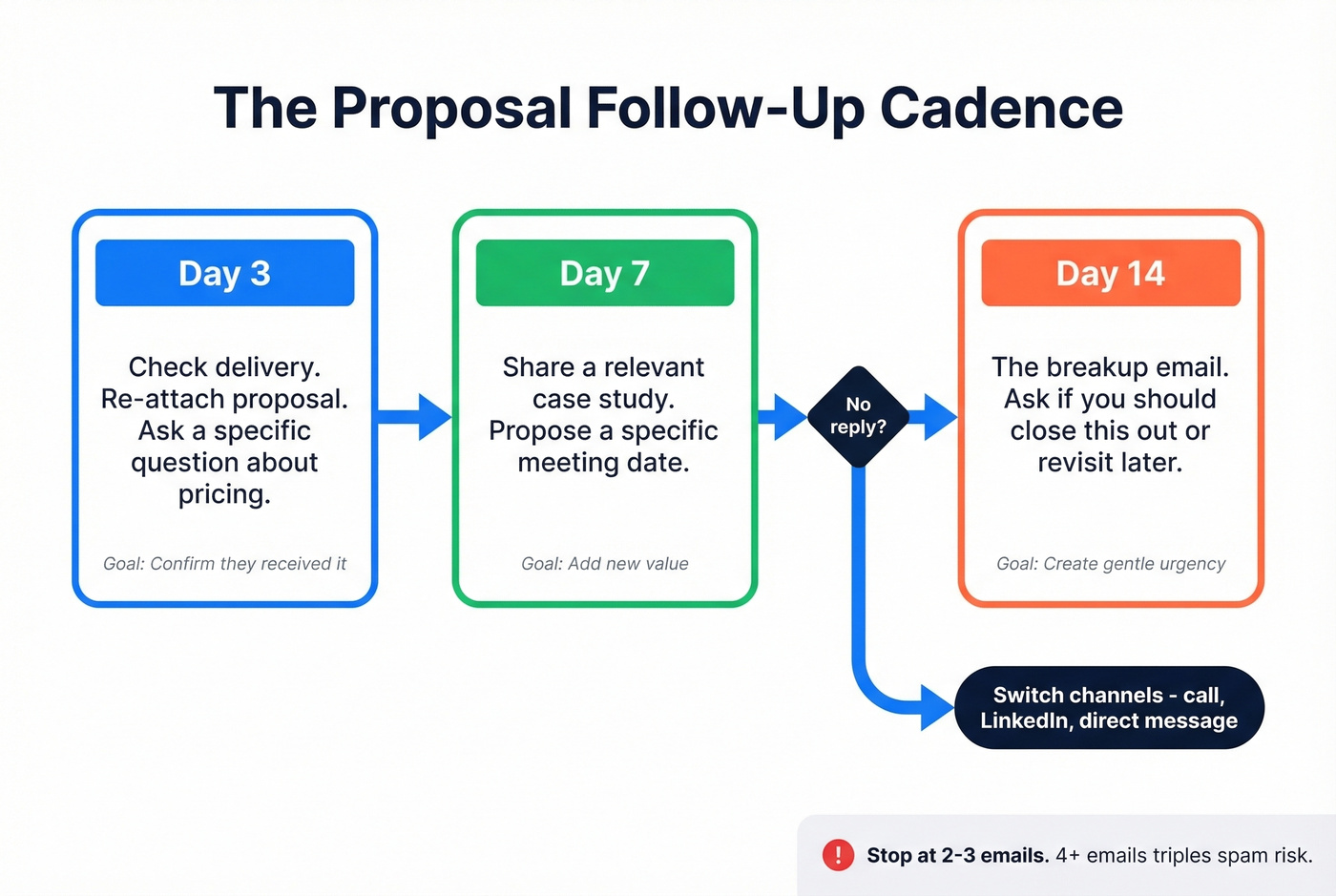
Then follow this cadence:
Day 3: "Hi [Name], wanted to make sure the proposal came through. I've re-attached it here. Any questions on the pricing in section 2?"
Day 7: "Hi [Name], I put together a quick case study from [similar company] that maps to what we discussed. [Link.] Happy to walk through it - does [date] work?"
Day 14 (breakup): "Hi [Name], I haven't heard back, so I want to be respectful of your time. Should I close this out, or is there a better time to revisit?"
Re-attach the proposal every time - people lose attachments. Cap the sequence at 2-3 emails. Belkins found that 4+ emails in a proposal sequence more than triples spam risk. After that, switch channels. Multi-channel campaigns drive 287% higher purchase rates than single-channel, so a call or direct message breaks the pattern far more effectively than email number four.

After a Meeting
Appreciated employees report 47% higher leadership satisfaction. Start with thanks, then get to substance: action items with an owner and a due date.
Subject: Action items from today
Hi team,
Thanks for a productive session. Here's what we agreed on:
- [Action item 1] - Owner: [Name], due [date]
- [Action item 2] - Owner: [Name], due [date]
- [Decision made]: [one sentence]
Next check-in: [date/time]. Let me know if I missed anything.
Send within 24 hours. Specific owner, measurable deliverable, clear deadline - this eliminates the "wait, who's doing that?" confusion that kills follow-through.
After a Client Inquiry
This template doubles as a lead filter. Include your timeline, a starting price, and a required action. Serious leads complete it. Everyone else disappears - and that's a good thing.
Subject: Next steps for [project type]
Hi [Name],
Thanks for reaching out. Here's how we typically work:
- Timeline: [X weeks/months] from kickoff
- Starting at: $[price]
- Next step: Fill out [this brief / intake form] so I can put together a custom proposal
Once I have that, I'll send a proposal within [X days]. Sound good?
If they don't fill out the form, they weren't ready to buy. You didn't lose a client - you saved yourself a wasted proposal.
After No Response
Never just "bump" an email. The consensus on r/sales is that scheduling-based nudges feel natural and actually get replies. Each message should address a different objection - price, urgency, trust, need, or perceived value.
Subject: Trying to finalize my schedule
Hi [Name],
I'm locking in my calendar for next week and wanted to see if [date] still works for you. If timing's changed, no worries - just let me know what looks better.
[One new piece of value - a link, a stat, a relevant insight]
We've seen the breakup email - "Should I close this out?" - outperform the third nudge every time. That phrasing creates just enough urgency without being aggressive. If they don't respond to that, move on.

A perfect next steps email means nothing if it bounces. Prospeo delivers 98% email accuracy across 143M+ verified addresses - so every recap, proposal follow-up, and meeting summary actually reaches the inbox.
Stop crafting great emails that land in the void.
Subject Lines That Get Opened
Cold email open rates dropped from 36% to 27.7% year-over-year. Your subject line is doing more heavy lifting than ever. Keep it under 33 characters for mobile visibility.
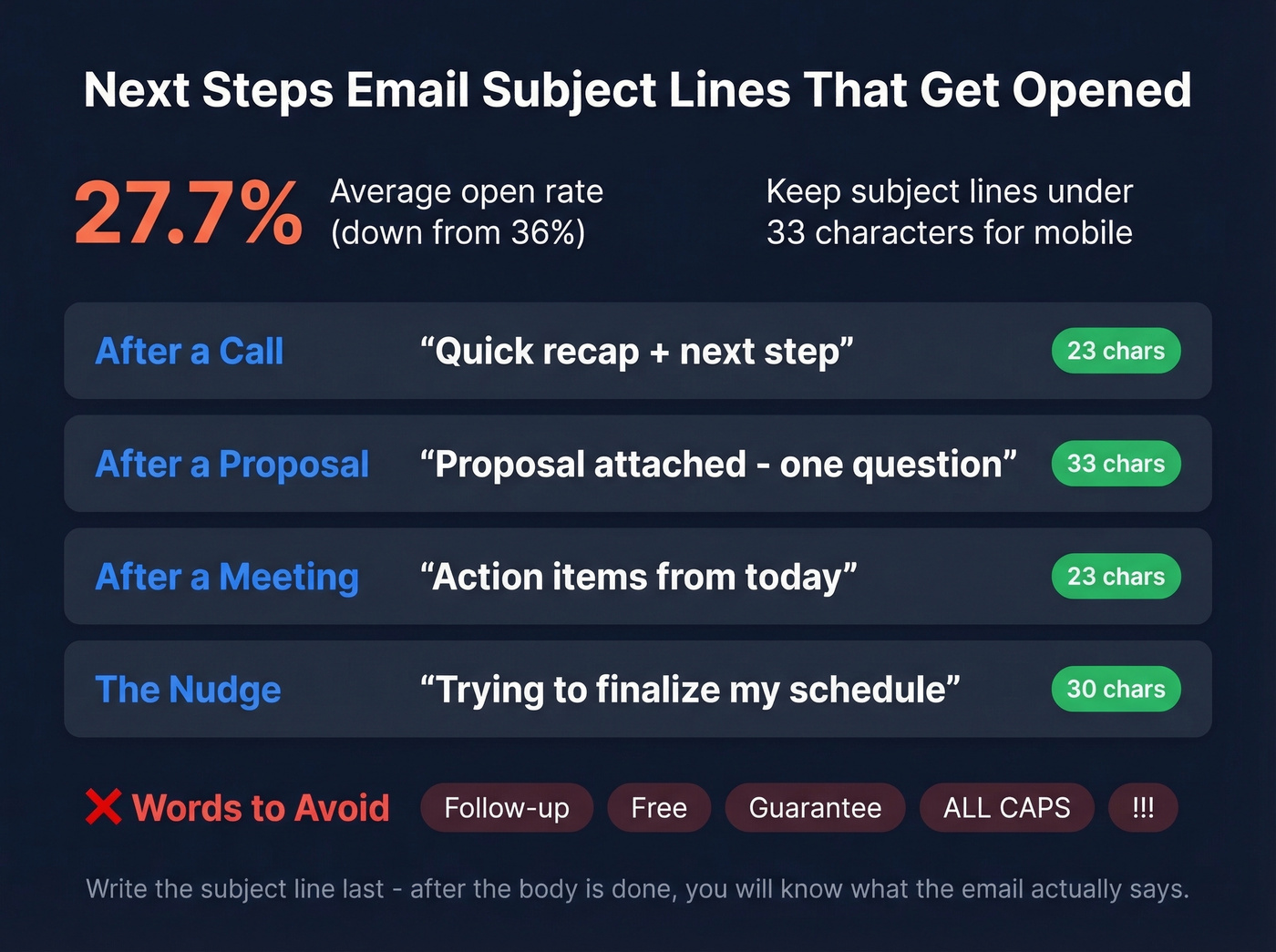
Here's the thing: write the subject line last. After the body is done, you'll know what the email actually says.
- After a call: "Quick recap + next step" (23 chars)
- After a proposal: "Proposal attached - one question" (33 chars)
- After a meeting: "Action items from today" (23 chars)
- The nudge: "Trying to finalize my schedule" (30 chars)
Avoid "follow-up" in the subject line - it practically begs to be ignored. Skip the spam triggers too: "Free," "Guarantee," ALL CAPS, and excessive punctuation all hurt deliverability.
Mistakes That Kill Replies
"Just checking in" with no new information. Every touchpoint needs to add something - a case study, a data point, a new question. "Bumping this" tells the recipient you have nothing new to say.
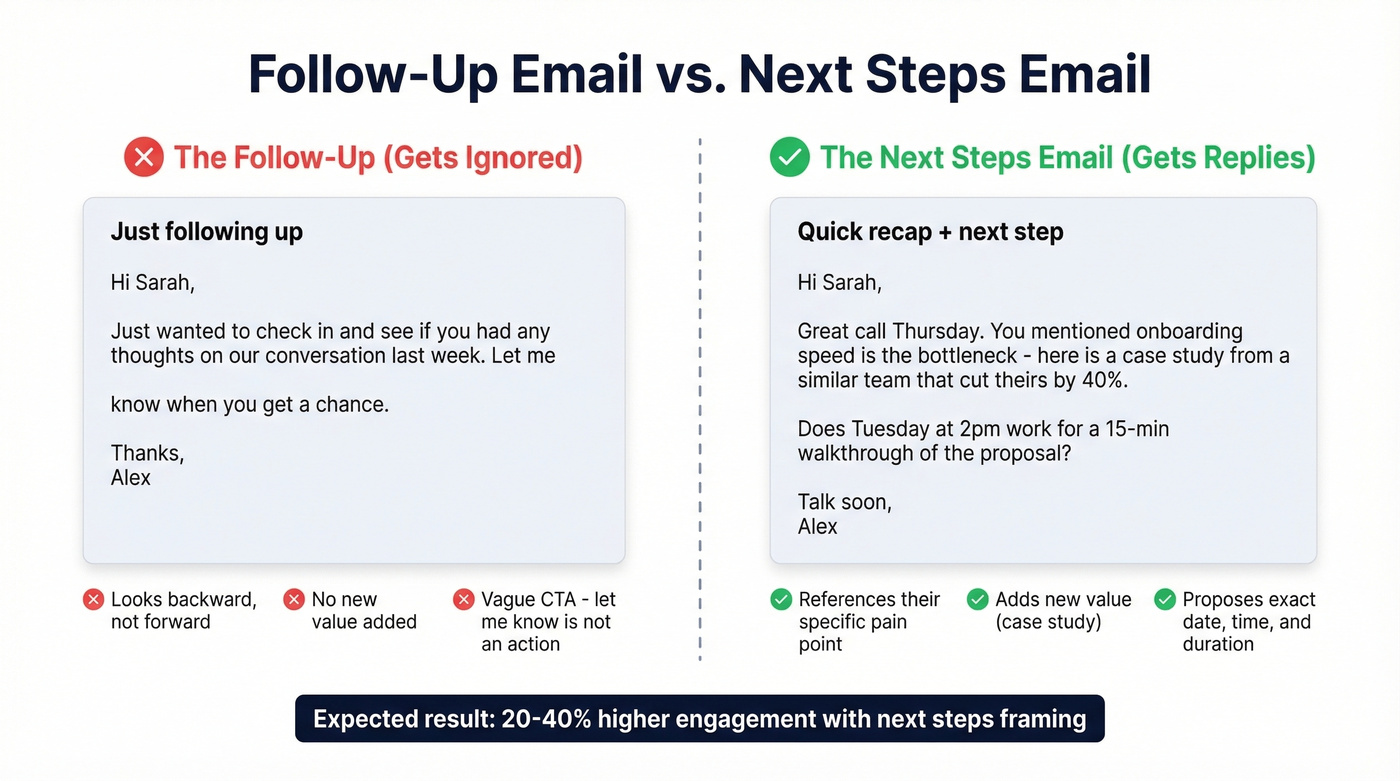
Vague CTAs. "Let me know your thoughts" isn't a next step. "Does Thursday at 2pm work for a 15-minute call?" is. Always propose a specific action with a specific time. (If you want more options, pull from these sales follow-up templates.)
Wrong frequency. Daily follow-ups don't show persistence - they get you blacklisted. Space emails 3-5 days apart, and cap at 2-3 before switching channels. If you're unsure on timing, use this when to follow up guide.
Sounding robotic. If your email reads like a template, it gets treated like one. Reference something specific from your conversation. Keep it plain-text and make it feel like a real 1:1 reply. Strong sales communication habits make this easier.
Writing too much. If your message requires scrolling, it's too long. Get to the point by the third sentence. Tighten your structure with proven email copywriting principles.
Let's be honest: most people don't need better follow-up templates. They need to stop thinking of these as follow-ups at all. The moment you reframe every email around a concrete next action - with a date, a time, and a reason - you stop sounding like every other rep in the inbox. That's the entire philosophy behind a good next steps email, and in our experience it's the single biggest lever for reply rates that most teams overlook. (If you're building sequences at scale, this sequence management breakdown helps.)
When 2-3 emails go unanswered, the playbook says switch channels. Prospeo gives you 125M+ verified mobile numbers with a 30% pickup rate - so your next steps conversation happens live, not in a spam folder.
Turn silent inboxes into answered phone calls.
FAQ
How long should I wait before following up?
Two hours after a sales call, 24 hours after a meeting, 2-3 business days after a proposal. The timing table above has the full breakdown by scenario, including max follow-ups for each.
How many follow-ups is too many?
Cap at 2-3 emails per channel, then switch to phone or direct message. 80% of deals close between the 5th and 12th touchpoint - but those touchpoints should span multiple channels, not just your inbox.
What's the difference between a follow-up and a next steps email?
A follow-up looks backward ("circling back"). A next steps email looks forward with a specific proposed action, date, and reason. Same inbox, completely different reply rate - expect 20-40% higher engagement when you lead with a concrete ask instead of a vague check-in.
Should I verify emails before sending outreach?
Always. A single hard bounce tanks your sender reputation, and recovering from that takes weeks. Run your list through a verification tool before every sequence - it takes seconds and saves you from deliverability problems that are much harder to fix after the fact.