

NLP Sales Techniques: What's Real, What's Pseudoscience, and What Actually Closes Deals
You ran a perfect demo. The prospect nodded along, asked smart questions, said "this is exactly what we need." Then came the email: "Let me think about it." Then silence. Then you're Googling NLP sales techniques at 11 PM, wondering if there's some Jedi mind trick you missed.
There isn't. But there are communication frameworks buried inside Neuro-Linguistic Programming that sharpen how you sell. Let's separate the useful from the nonsense.
The Three Techniques Worth Your Time
If you learn three things from NLP and nothing else, make them these:
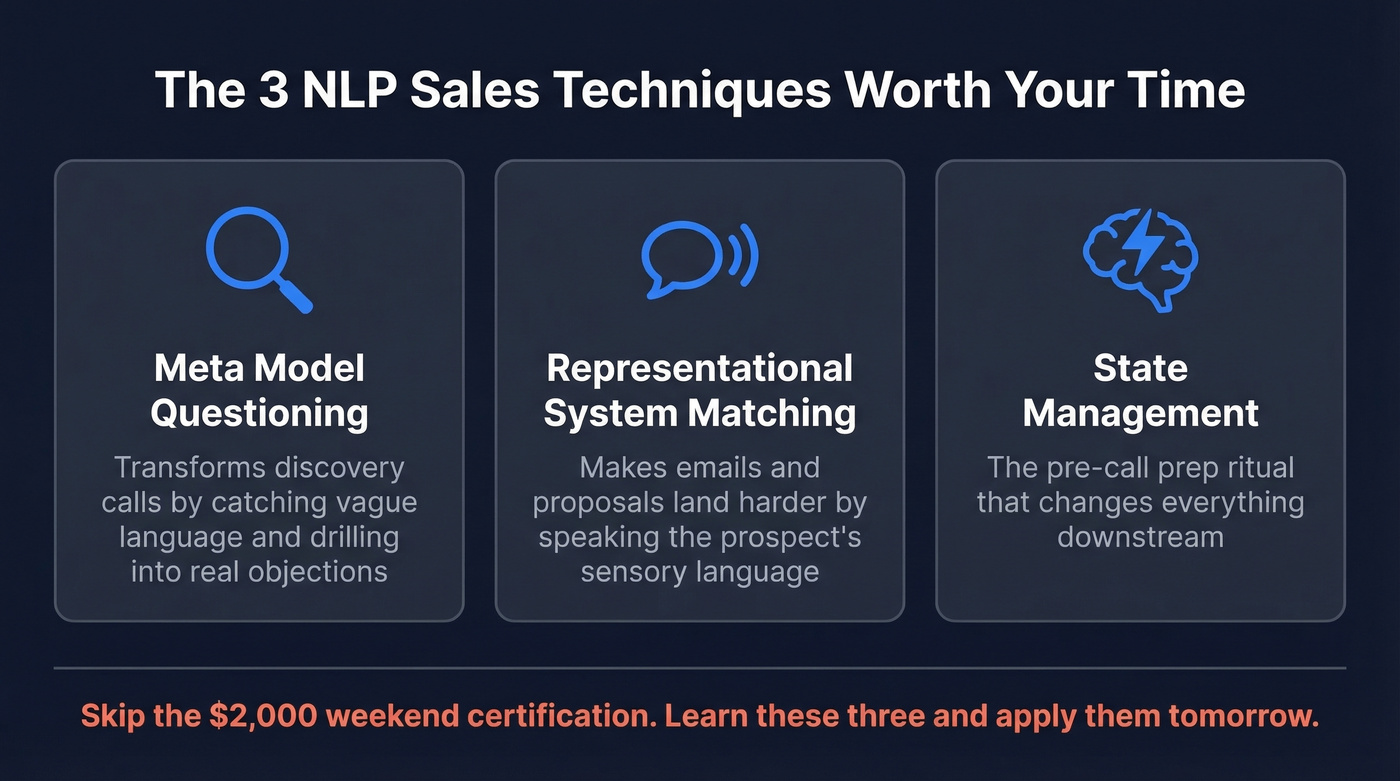
- Meta Model questioning - transforms discovery calls immediately
- Representational system matching) - makes emails and proposals land harder
- State management - the pre-call prep ritual that changes everything downstream
Here's the honest framing: the science behind Neuro-Linguistic Programming is thin. The training industry is unregulated. But the communication principles underneath - active listening, language matching, emotional calibration - overlap with validated psychology and real sales craft. Don't pay $2,000 for a weekend certification. Do learn the three techniques above.
Quick disambiguation: NLP in this article means Neuro-Linguistic Programming, the 1970s communication framework. It's not Natural Language Processing, the AI discipline powering chatbots and sentiment analysis - a $34.83 billion market in 2026. Same acronym, completely different fields.
Do These Techniques Actually Work?
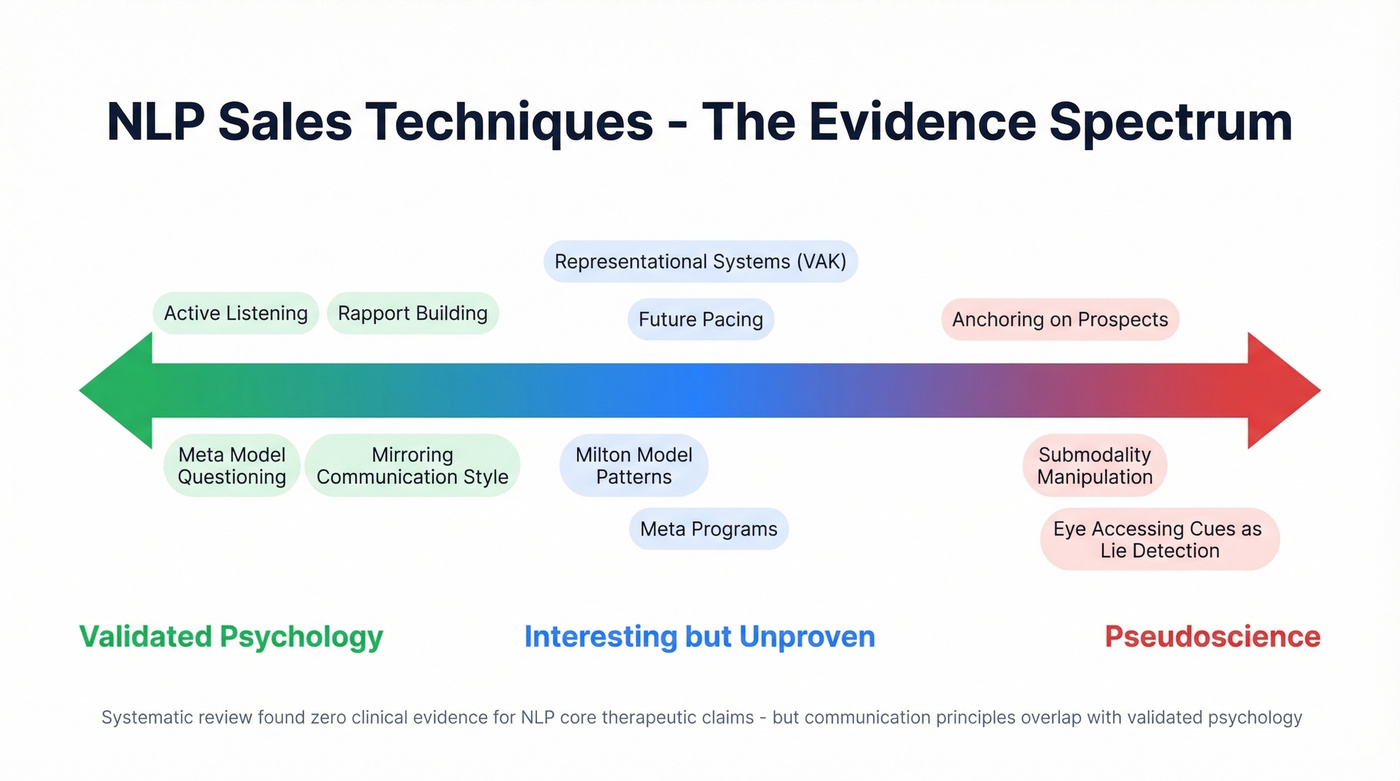
Let's be direct. A systematic review found zero clinical evidence supporting NLP's core therapeutic claims. Of five randomized controlled trials examined, only one was even mildly supportive. The important nuance: the reviewers also point out this conclusion reflects the limited quantity and quality of NLP research - not a mountain of high-quality evidence proving NLP can't work.
NLP was developed in the early 1970s by Richard Bandler and John Grinder. The early books - The Structure of Magic (1975) and Patterns of the Hypnotic Techniques of Milton H. Erickson (1976) - were interesting linguistic analyses. By the '80s, it was a certification industry. Today, anyone can claim to be an NLP trainer. No governing body, no standardized curriculum, no quality control.
Some training content throws around conversion-lift numbers like 20-30% for "NLP-based communication," but those figures don't trace back to peer-reviewed studies. A more honest estimate: single-digit to low double-digit conversion improvement when applied as a rapport and discovery questioning discipline.
Sales communities are predictably polarized. Half dismiss NLP as pseudoscience, the other half treat it as repackaged communication skills they already use under different names. Both sides are partially right. A lot of what gets taught as neuro-linguistic programming for sales overlaps with established psychology and modern sales craft: active listening, rapport building, influence principles, tactical empathy. The parts that are more "NLP-specific" - anchoring, submodality work, some of the more exotic language patterns - range from "interesting but unproven" to "outright pseudoscience."
The pivot that matters: you don't need to believe in NLP theory to use the communication techniques that happen to live inside it. Meta Model questioning works whether or not you buy the neuro-linguistic map. Take the tools, leave the ideology.
Here's the thing: If your average deal closes under $10k in less than 30 days, you don't need linguistic finesse - you need more at-bats with better data. NLP is a force multiplier for complex, relationship-driven sales. For transactional selling, volume and targeting matter more.
Core NLP Sales Techniques
Mirroring and Matching (+ VAK Cheat Sheet)
Mirroring is the most intuitive technique: match your prospect's communication style. This includes verbal patterns like word choice, pace, and sentence length, plus non-verbal cues like posture, gestures, and energy level. The principle isn't magic - it's basic rapport mechanics that every good salesperson does instinctively.
Where it gets specifically useful is representational system matching. NLP categorizes people by their dominant sensory language - visual, auditory, or kinesthetic. Listen for the cues, then match them.
| System | Prospect Says | You Match With |
|---|---|---|
| Visual | "I see what you mean" | "Let me show you" |
| Auditory | "That sounds right" | "Let me walk you through" |
| Kinesthetic | "That feels off" | "Let's get a handle on this" |
This isn't about mind control. It's about speaking someone's language - literally. When a prospect says "I can't picture how this fits," responding with "Let me paint the picture" lands better than "Let me explain the logic." Match the words and the tone.
Anchoring - Yours, Not Theirs
Use this if: You want a reliable pre-call state management ritual.
Skip this if: You're thinking about using anchoring on prospects. That's the technique most likely to feel manipulative, and it's the one that gives NLP its bad reputation in sales communities.
Self-anchoring is straightforward. Associate a physical trigger - a specific gesture, a deep breath, even a scent - with a prior win. Before your next big call, fire the anchor. It sounds woo-woo, but athletes have used pre-performance routines for decades. The mechanism is simple conditioned association, not hypnosis.
A practical pre-call routine we've used: recall your best close in vivid detail for 30 seconds, press your thumb and forefinger together, take one deep breath, then dial. The state shift is noticeable fast once you start doing it consistently.
Meta Programs (Decision Filters)
Meta programs are the unconscious filters your prospect uses to process information - their motivations, risk tolerance, and decision strategies. Two prospects can have the exact same need and require completely different pitches.
The diagnostic questions are simple. Ask "What's most important to you in a solution like this?" A logic-driven prospect answers with data points, ROI timelines, and integration requirements. An achievement-driven prospect talks about competitive advantage, team recognition, and speed to results.
Once you've identified the filter, tailor accordingly. The data buyer needs a spreadsheet and a case study. The achievement buyer needs a vision of what winning looks like with your product. Same product, different frame. This is one of the more practically useful concepts because it forces you to stop pitching features and start matching decision architecture.
Future Pacing
Future pacing is guided visualization of post-purchase success - helping the prospect mentally experience the outcome before they've committed.
Discovery call script: "Walk me through what your team's workflow looks like six months from now if this problem is solved. What changes first?"
Demo script: "When you start seeing these reports auto-populate every Monday morning, what's the first decision that gets easier?"
Notice the presupposition in "when you start seeing results" - it assumes the purchase happens. That's a Milton Model pattern layered into future pacing. Subtle, effective, and not manipulative when the product actually delivers.

You just read it: for deals under $10k, volume and targeting beat linguistic finesse. Prospeo gives you 300M+ profiles with 30+ filters - buyer intent, technographics, job changes - so every NLP technique you master hits the right person. 98% email accuracy means your carefully crafted message actually arrives.
Stop perfecting your pitch for the wrong prospect.
Advanced Techniques Most Guides Skip
The Milton Model - Artful Vagueness
Named after hypnotherapist Milton H. Erickson, the Milton Model is the inverse of the Meta Model. Where the Meta Model seeks precision, the Milton Model uses intentional vagueness so the listener's mind fills in the gaps with their own meaning.
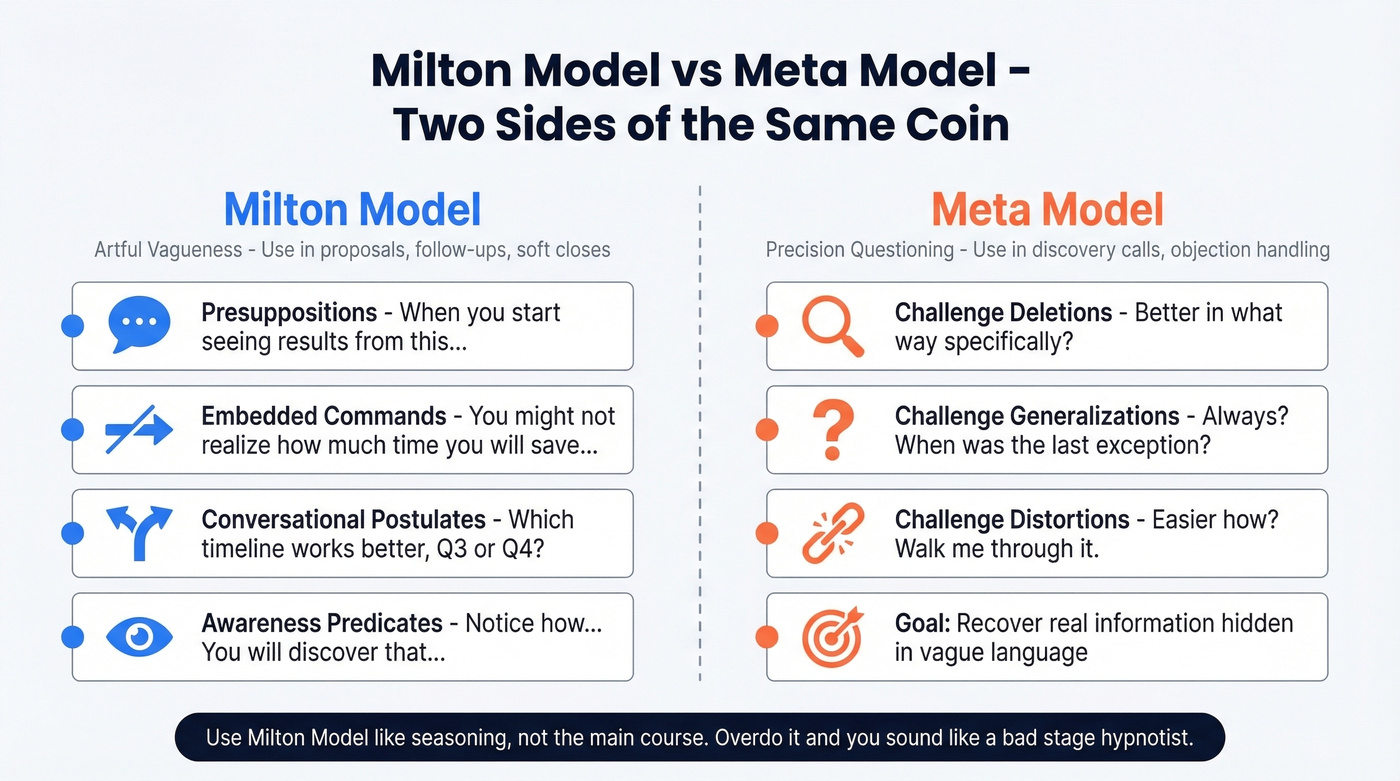
Adapted for sales, the patterns look like this:
- Presuppositions: "When you start seeing results from this..." (assumes results happen)
- Embedded commands: "You might not even realize how much time you'll save..." (the command is "realize how much time you'll save")
- Conversational postulates: "Which implementation timeline works better - Q3 or Q4?" (assumes implementation, offers only timing choice)
- Awareness predicates: "Notice how..." / "You'll discover that..." / "Most teams realize within the first week..."
You've seen these patterns in every good sales deck and follow-up email. The Milton Model just names what skilled communicators already do.
One warning: don't overdo it. The NLP Mastery Insight blog calls this "hypnosis cosplay" - when someone leans so hard into analogue marking and embedded commands that they sound like a bad stage hypnotist. That label is worth remembering. Use these patterns like seasoning, not the main course.
The Meta Model - Discovery Call Superpower
If you take one framework from this entire article, make it this one. The Meta Model identifies three ways people distort communication - deletion, generalization, and distortion - and gives you precise questions to recover the real information.
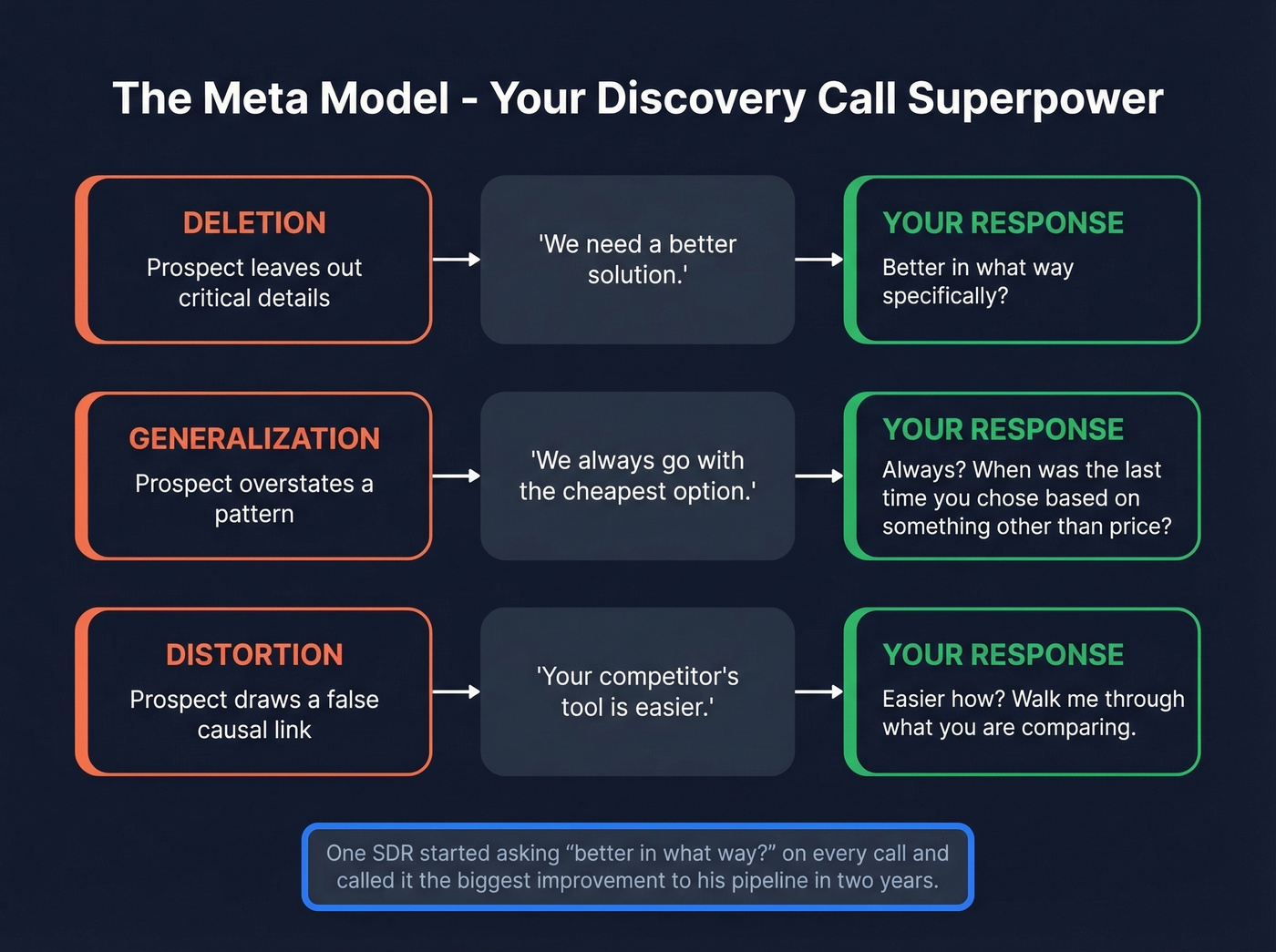
Here's how it plays in B2B discovery:
Deletion - the prospect leaves out critical details.
- Prospect: "We need a better solution."
- You: "Better in what way specifically?"
Generalization - the prospect overstates a pattern.
- Prospect: "We always go with the cheapest option."
- You: "Always? When was the last time you chose based on something other than price?"
Distortion - the prospect draws a causal link that doesn't hold.
- Prospect: "Your competitor's tool is easier."
- You: "Easier how? Walk me through what you're comparing."
These aren't trick questions. They're the same kind of clarifying questions great discovery frameworks teach - the Meta Model just gives you a systematic way to catch vague language and drill into it. We've seen reps change the quality of their discovery calls within a week by practicing these three patterns. One SDR on our team started asking "better in what way?" on every single call and said it was the biggest improvement to his pipeline in two years.
State Management - The Technique Nobody Talks About
Most people think sales skill means finding the right words. It doesn't. The highest-leverage point is managing state - yours and the prospect's - moment by moment.
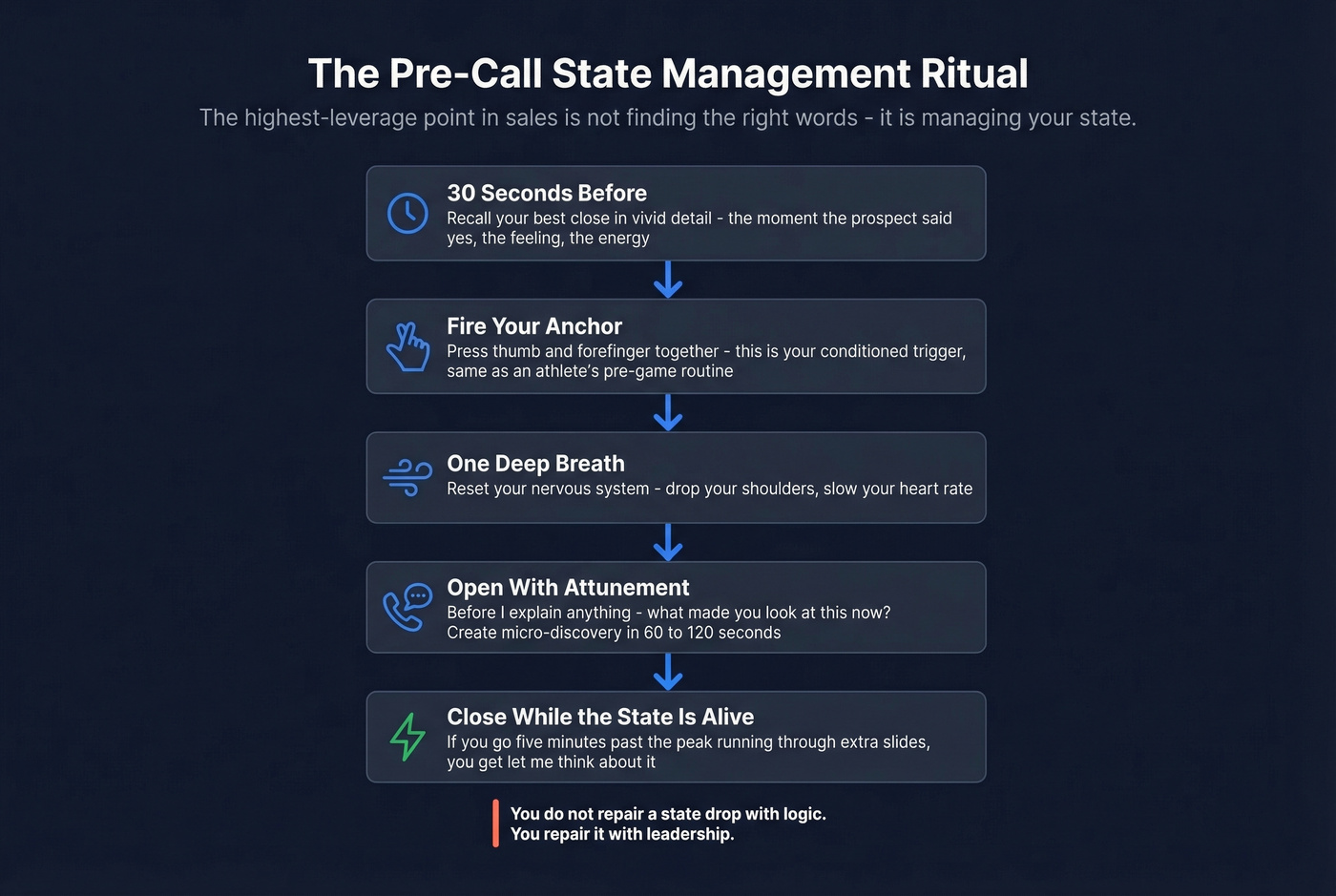
Here's a pattern that works on Zoom. Open with an attunement question: "Before I explain anything - what made you look at this now?" Create a micro-discovery in 60-120 seconds by reflecting a pattern back so they feel it, not just hear it. Then close while the state is alive. If you go five minutes past the peak - running through extra slides, answering questions nobody asked - you get "let me think about it."
You don't repair a state drop with logic. You repair it with leadership.
The soft close: "Do you want to keep going with this momentum, or pause it?" That line alone is worth more than most NLP certification programs.
Channel-by-Channel Playbook
Cold Calls
Mirror the prospect's energy level within the first 10 seconds - high-energy gets high-energy, measured gets measured. Self-anchor before dialing with a 30-second pre-call ritual. Use Meta Model questions the moment you hit a vague objection. State management starts before you pick up the phone, not after.
But step zero of any cold call is reaching a human. Prospeo's verified mobile numbers hit a 30% pickup rate, which means you get more real conversations from the same dialing effort. Communication techniques are a force multiplier, but only if someone answers.
If you want a full system beyond scripts, build a repeatable cold calling system and track what actually moves meetings.
Zoom Demos
Open with an attunement question, not a slide. Match representational systems during screen shares - "Let me show you" for visual prospects, "Walk through this with me" for kinesthetic ones. Close while state is alive. If you sense energy dropping, stop presenting and ask a question. The worst thing you can do on a Zoom demo is keep clicking slides after the prospect has already decided.
If your demos feel bloated, use a tighter product demo checklist to keep momentum.
Emails and DMs
Match VAK language in subject lines and body copy - visual prospects get "picture this," kinesthetic prospects get "get a feel for." Use Milton Model presuppositions in CTAs: "When you're ready to see the impact..." Embedded commands work well in follow-up sequences: "You'll notice the difference when..."
In DMs, create clarity and movement - don't let the thread become an FAQ. And before crafting carefully worded email copy, verify the address actually lands. Prospeo's 98% email accuracy means your sequence reaches a human inbox, not a bounce.
To tighten the written side, borrow proven sales follow-up templates and upgrade your email copywriting.
Persuasion vs. Manipulation
The ethics question isn't "do you use emotion in sales?" Every purchase involves emotion. The real question: are you creating clarity, or manufacturing pressure?
NLP techniques have been co-opted by everyone from pickup artists to organizations like NXIVM - which is exactly why the ethics framework matters. Cialdini's six principles of influence - reciprocity, commitment/consistency, social proof, authority, liking, scarcity - provide the evidence-based backbone for ethical persuasion. NLP sales techniques overlap heavily with these principles. The problems start when you cross three tripwires:
- Cognitive dissonance from tie-downs - forcing micro-agreements that trap the prospect into a yes
- Fabricated social proof - exaggerating testimonials or inventing case studies
- Artificial urgency - "this price expires tonight" when it doesn't
If you're using future pacing to help a prospect visualize real value, that's persuasion. If you're using anchoring to associate your product with emotions the prospect didn't consent to, that's manipulation. The line is clearer than most NLP trainers admit.
If you want a cleaner framework for the line between influence and pressure, see our guide on ethics in sales.
Recommended reading: Influence by Cialdini, Never Split the Difference by Voss, The Structure of Magic by Bandler & Grinder. Those three books contain more actionable sales communication insight than any $2,000 NLP workshop.
Meta programs tell you how a prospect decides. Prospeo tells you who's actually in-market. Layer 15,000 intent topics with job role and company growth signals to find buyers already researching your category - then use your NLP skills to close them.
Rapport techniques work better when the prospect is already looking to buy.
FAQ
Is NLP in sales manipulative?
NLP techniques are neutral communication tools - manipulation depends entirely on intent. Using Meta Model questions to create clarity is ethical persuasion; manufacturing false urgency or bypassing rational decision-making crosses the line. Judge the application, not the framework.
Which NLP technique should I learn first?
Start with Meta Model questioning. It transforms discovery calls immediately, requires no belief in NLP theory, and overlaps with validated sales frameworks. You'll ask sharper questions on your very next call - no certification required.
Does NLP work over email or only live?
Representational system matching and Milton Model presuppositions translate well to written outreach. Mirroring and state management are more effective on calls and video. Match the technique to the channel.
What's the difference between NLP and NLP in AI?
Neuro-Linguistic Programming is a 1970s communication and persuasion framework. Natural Language Processing is AI technology powering chatbots, sentiment analysis, and machine translation - a $34.83 billion market in 2026. Same acronym, completely different disciplines.
How do I practice without a coach?
Run Meta Model questions on your next three discovery calls and note what changes. Record Zoom demos and listen for representational system cues - you'll hear patterns within a few sessions. Practice on real conversations, not voicemails.