

slug: no-cold-calling-means
What "No Cold Calling" Actually Means
"NO COLD CALLING!" - bolded, capitalized, triple-exclamation-pointed - shows up on job boards, sales decks, and front doors. The phrase means completely different things in each context. What "no cold calling" means in a job ad has almost nothing in common with what it means on a sticker in suburban England.
Three contexts, three definitions. Let's break each one down with real data, legal specifics, and what it actually changes about your day-to-day.
Quick Version
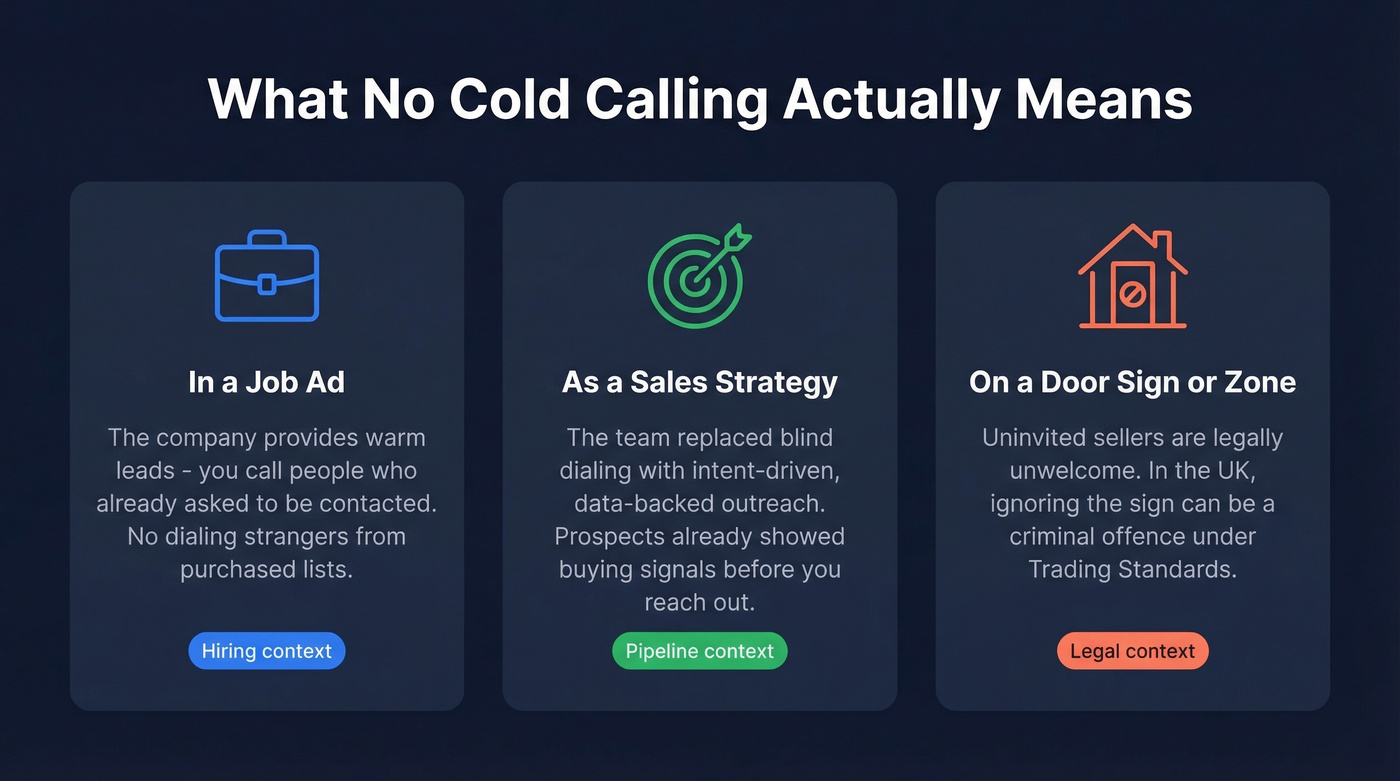
- In a job ad: The company generates leads for you - you call people who already asked to be contacted.
- As a sales strategy: The team replaced blind dialing with intent-driven, data-backed outreach.
- On a door sign or zone: Uninvited sellers are legally unwelcome - and in the UK, ignoring the sign can be a criminal offence.
In a Job Ad: Warm Leads Provided
When a job listing says "no cold calling," it almost always means the company provides inbound or marketing-generated leads. You're not dialing strangers from a purchased list. You're following up with people who filled out a form, requested a quote, or clicked an ad.
Browse ZipRecruiter's "no cold calling" listings and the pattern is immediate. Insurance companies write things like "No cold calling - you'll be working with in-house leads from people who requested someone to contact them." Home services companies say "We will provide you qualified leads." The message is consistent: someone else did the prospecting, and your job is to close.
The r/sales community on Reddit backs this up. In a thread on zero-cold-calling roles, the original poster described their setup as "our company generates leads we call" - pure follow-up and qualification work. But the same subreddit is full of people complaining that these ads still required heavy outbound via email and social. That skepticism is earned.
Here's the honest caveat. A meaningful share of these roles still expect outbound work through other channels - cold email, social outreach, direct messaging. If the ad only says "no cold calling," ask directly whether cold email or social prospecting is part of the role. In our experience, about half the time, the answer is yes. "No cold calling" and "no outbound prospecting" aren't the same thing, and plenty of hiring managers blur the line on purpose.
As a Sales Strategy: Intent Over Volume
When a sales leader says "we don't cold call," they're describing a deliberate shift in pipeline generation. It's not about compliance. It's about replacing blind dialing with data-driven engagement targeting prospects who've already shown buying signals.
Clay's glossary defines this well: forgoing unsolicited calls in favor of engaging prospects "who have already shown interest or are actively in the market." This isn't about the Do Not Call list - it's a strategic choice to prioritize efficiency and relevance over volume.
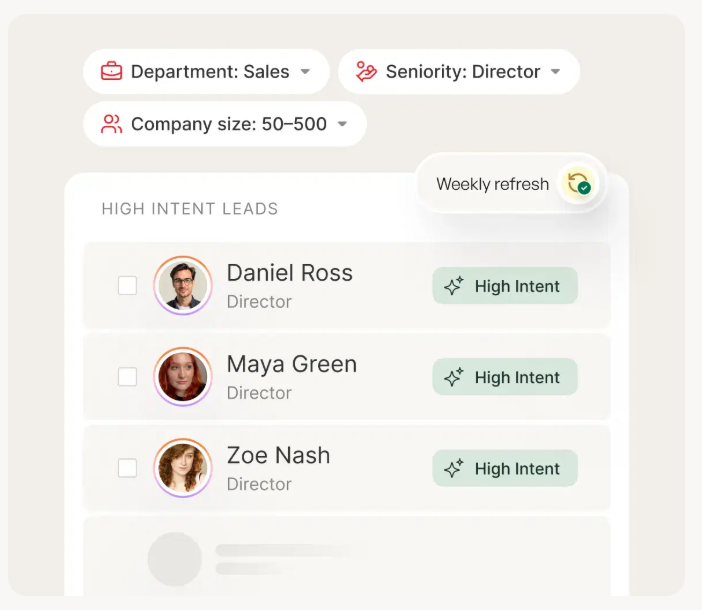
The data supports the shift. A HubSpot survey of 379 sales professionals found that only 24% of organizations use cold calling as their primary channel. Another 28% of individual reps don't cold call at all. That's not a dead channel - it's a declining one, with teams increasingly betting on intent signals, verified data, and multi-channel sequences.
Here's the thing: cold calling isn't dying because it's annoying. It's dying because caller ID, cell phone dominance, and spam-filtering have made the connect rate so low that the math doesn't work for most teams anymore. For many sub-$15K deal sizes, the ROI on blind dialing is negative.

Moving away from cold calling means you need intent signals and verified contact data - not stale lists. Prospeo tracks 15,000 buyer intent topics and delivers 98% accurate emails on a 7-day refresh cycle, so every outreach hits a real person who's actually in-market.
Stop dialing blind. Start reaching buyers who are already looking.
On Door Signs and Zones
UK - No Cold Calling Zones
In the UK, "No Cold Calling" signs carry real legal weight. According to Northern Ireland's Trading Standards guidance, door-to-door sellers must check for signs before visiting. If a property displays one, sellers must not call unless the occupier invited them.
Ignoring the sign? You could be committing a criminal offence. Some areas go further with designated No Cold Calling Zones, marked by signs on lampposts and street furniture. Hampshire County Council clarifies that these zones aren't literal exclusion zones - they're deterrents that send "a clear message to uninvited callers that they are not welcome." But Trading Standards can and does investigate anyone who cold-calls within a zone. Deterrence backed by enforcement teeth.
US - No Soliciting Signs
Door-to-door sales are legal across the US but regulated at the municipal level. Most jurisdictions require permits, restrict operating hours, and enforce a cooling-off period (commonly three days) for certain off-premises sales. "No Soliciting" signs strengthen a homeowner's position - ignoring one can support trespass or solicitation violations depending on local ordinances. Enforcement varies wildly by city and county.
Strategy vs. Do Not Call Registry
These two concepts get confused constantly.
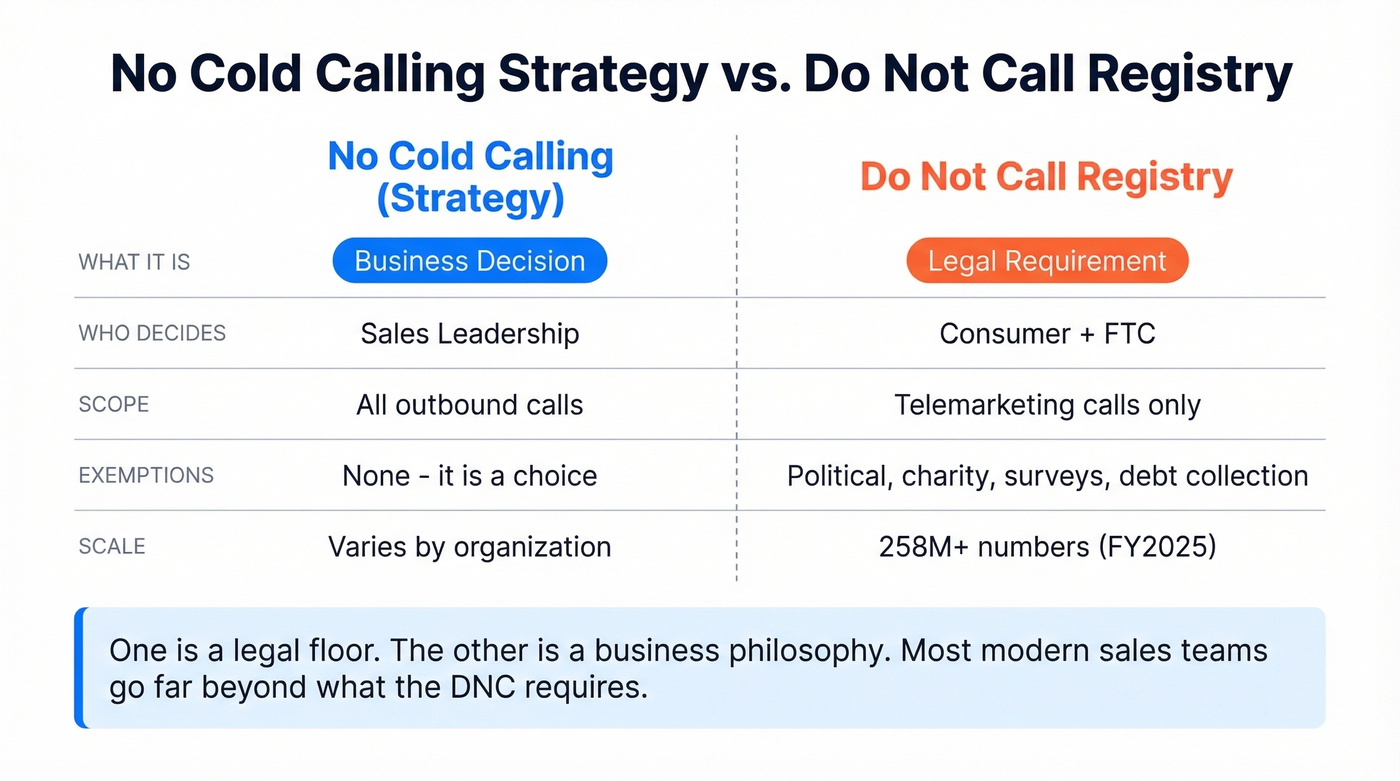
| No Cold Calling (Strategy) | Do Not Call Registry | |
|---|---|---|
| What it is | Business decision | Legal requirement |
| Who decides | Sales leadership | Consumer + FTC |
| Scope | All outbound calls | Telemarketing only |
| Exemptions | None - it's a choice | Political, charity, surveys, debt |
| Scale | Varies by org | 258M+ numbers (FY2025 data) |
The DNC Registry had over 258 million active phone numbers by the end of FY2025, with 4.7 million new registrations and more than 2.6 million complaints filed in that period alone. But the registry doesn't prevent political calls, charitable solicitations, debt collection calls, survey calls, or informational calls. That's why you're still getting calls even after registering.
"No cold calling" as a strategy goes far beyond what the DNC requires. One is a legal floor. The other is a business philosophy.
Why Teams Are Moving Away
Cold calling's core metrics are brutal. Around 1% of cold calls result in an appointment. Roughly 72% don't reach a human. And 80% of B2B buyers prefer to be contacted over email rather than phone.
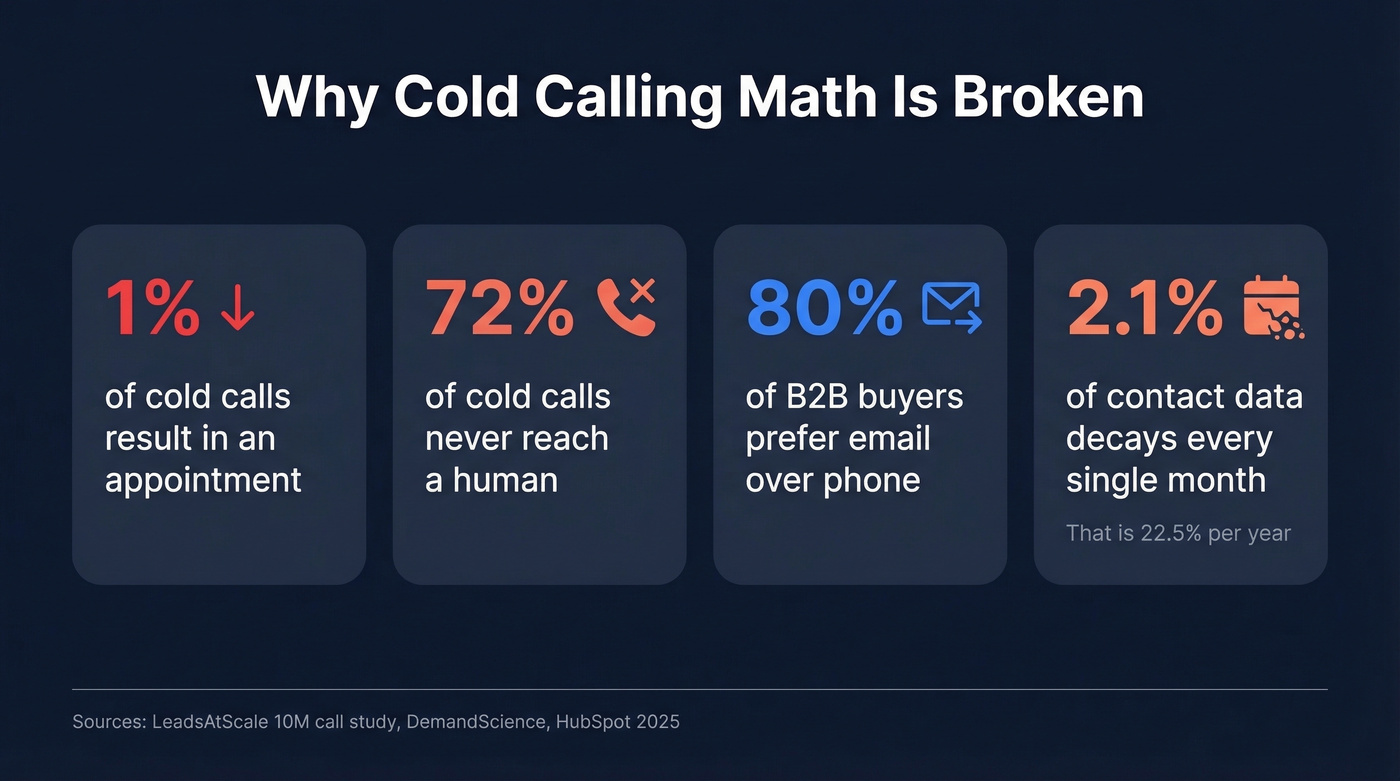
The data quality problem compounds everything. B2B contact data decays at roughly 2.1% per month - about 22.5% annually. You can't have a good conversation with someone who left the company six months ago. We've seen teams cut bounce rates from 35% to under 4% just by switching from stale lists to weekly-refreshed data through platforms like Prospeo, which runs on a 7-day refresh cycle compared to the 6-week industry average.
Generating Leads Without Cold Calling
If you're moving away from cold calling, the shift isn't complex - it's a data problem, not a strategy problem.
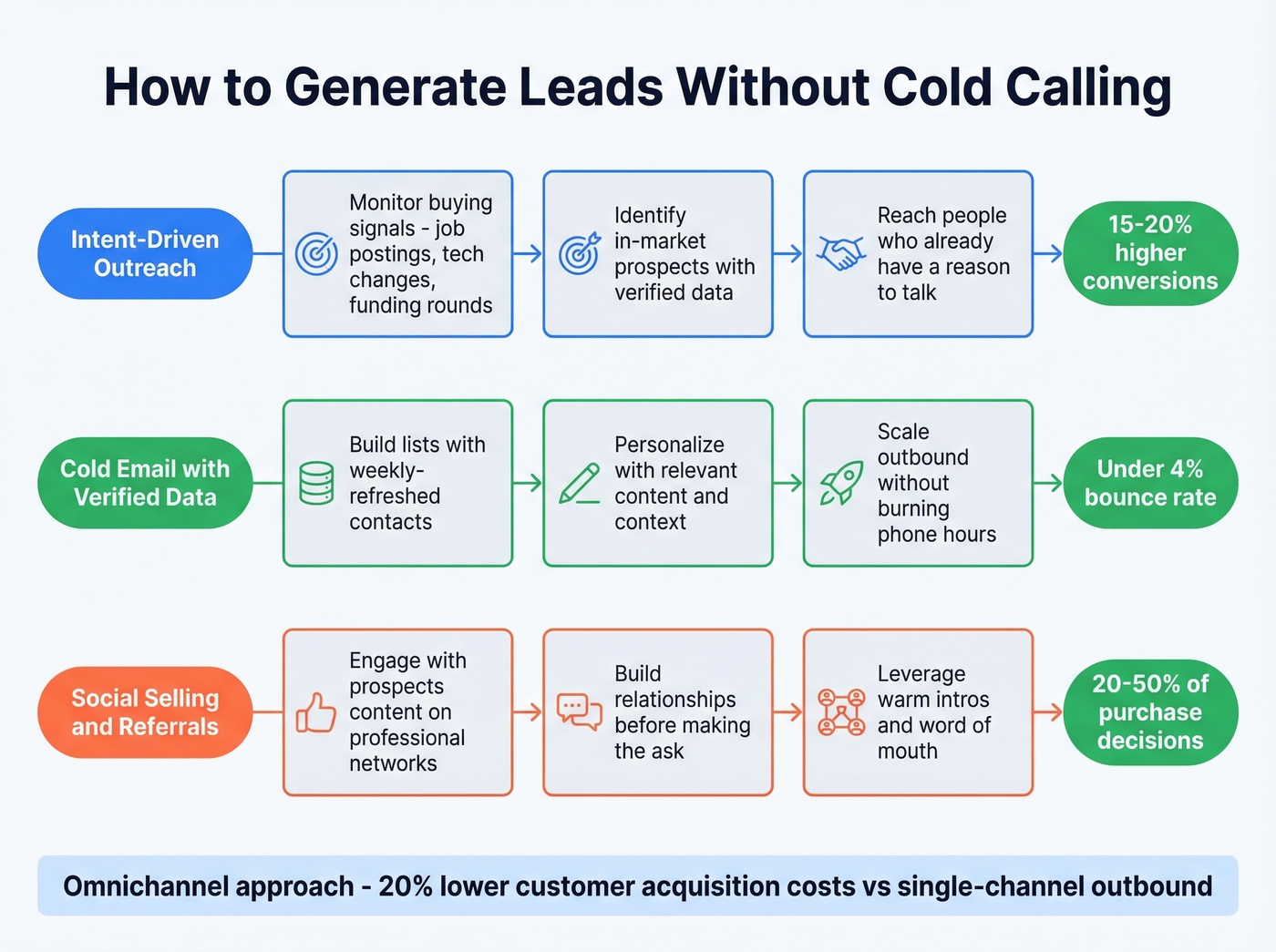
Intent-data-driven outreach is the highest-leverage replacement. You target prospects showing active buying signals - job postings, tech stack changes, funding rounds - and reach people already in-market instead of interrupting strangers. This single change can flip your connect-rate math entirely, because the person on the other end actually has a reason to talk to you.
Cold email with verified data is the workhorse channel. Email isn't cold calling. With verified contacts and personalization, email often outperforms blind dialing on scalable outbound. 91% of B2B marketers already use content marketing to feed these sequences with relevant material.
Then there's the relationship layer: social selling through professional networks, engaging with prospects' content before the ask, and referrals. Word of mouth drives 20-50% of purchase decisions. A warm intro converts at multiples of any cold channel.
Omnichannel approaches that combine these tactics deliver 15-20% higher conversions and 20% lower customer acquisition costs compared to single-channel outbound. Skip this approach if your average deal size is under $1K - the orchestration overhead probably isn't worth it at that price point.
Data decay at 2.1% per month is why cold calling fails. Prospeo refreshes all 300M+ profiles every 7 days - not the 6-week industry average. Teams using Prospeo cut bounce rates from 35% to under 4% and book 26% more meetings than ZoomInfo users.
Fresh data turns cold outreach into warm conversations at $0.01 per lead.
FAQ
Is Cold Calling Illegal?
No. Cold calling is legal in most countries but heavily regulated. In the US, the Do Not Call Registry restricts telemarketing calls, and the TCPA governs consent and calling hours. In the UK, ignoring a No Cold Calling sign can be a criminal offence under Trading Standards. The activity itself isn't banned - but how, when, and where you do it matters.
Does "No Cold Calling" Mean No Cold Email?
Usually not. Most job ads and sales strategies using the phrase refer specifically to phone calls. Cold email, social outreach, and direct messaging are typically still expected. With verified data and proper personalization, email outreach outperforms blind dialing for most B2B teams.
What Should I Ask Before Taking a "No Cold Calling" Job?
Ask whether cold email, social prospecting, or any outbound activity is expected. Roughly half of "no cold calling" roles still require outbound through non-phone channels. Also confirm whether leads are truly inbound or if you'll be working aged lists that feel cold in practice. If the hiring manager can't give you a straight answer on lead source and volume, that tells you everything.