

Objection Handling Techniques That Actually Work, According to 67,149 Sales Calls
It's 2pm on a Tuesday. You're 22 minutes into a demo that's going well - the prospect is nodding, asking questions, leaning in. Then: "This looks great, but honestly, the timing just isn't right." Your stomach drops. The objection handling techniques you deploy in the next eight seconds determine whether this deal moves forward or dies in your pipeline for six months.
Those seconds matter more than most reps realize. Effective objection handling correlates with win rate increases of up to 30%, yet only 43.5% of sales professionals hit quota. 17% of reps generate 81% of revenue. The gap isn't talent - it's technique. Gong analyzed 67,149 sales meetings from a database of 5M+ recorded calls and found measurable behavioral differences between reps who close and reps who don't.
The Three Things That Matter Most
If you take nothing else from this article, take these:
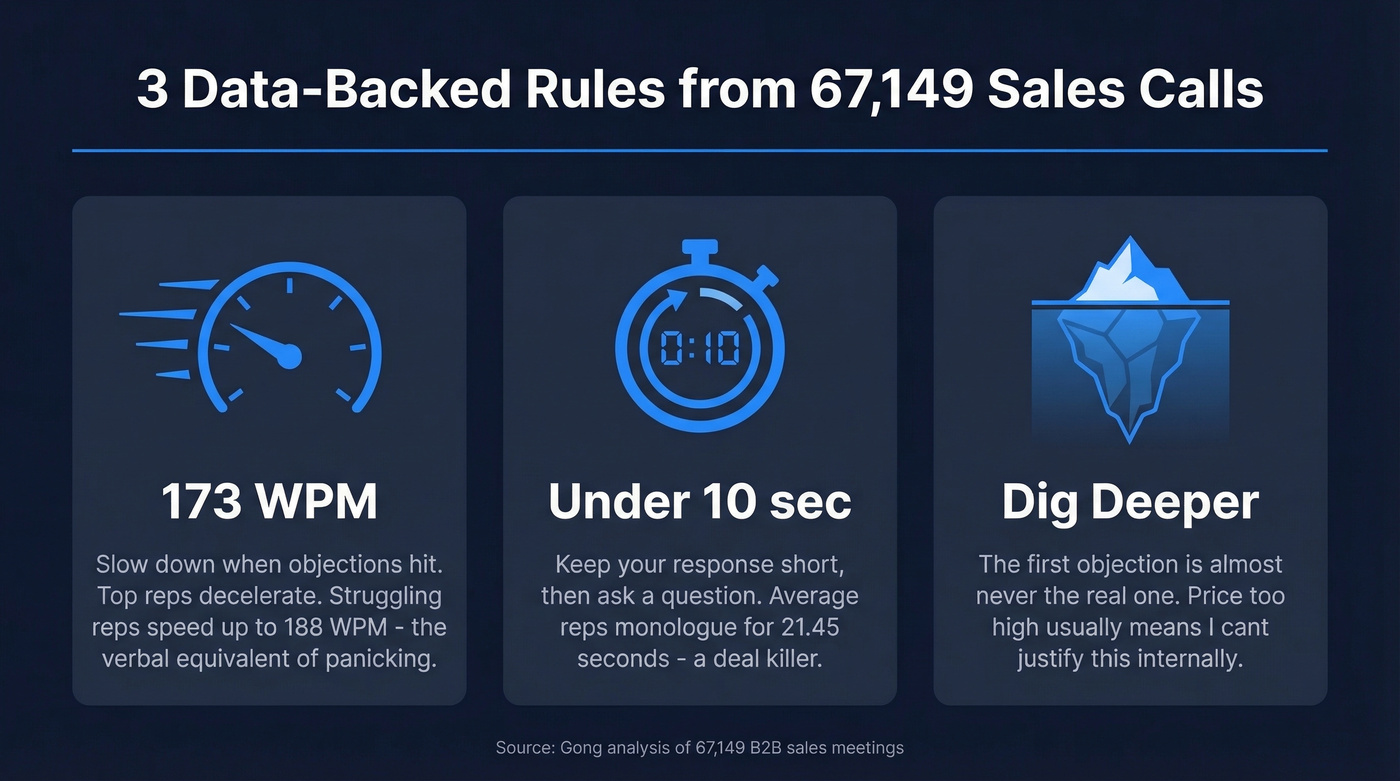
- Slow down to 173 words per minute or below when you hear an objection. Top reps decelerate. Struggling reps speed up to 188 wpm - the verbal equivalent of panicking.
- Keep your response under 10 seconds, then ask a follow-up question. Average reps monologue for 21.45 seconds after an objection. That's a deal killer.
- The first objection is almost never the real one. Probe before you respond. The prospect who says "the price is too high" usually means "I can't justify this internally."
Objections vs. Obstructions
Before you can handle an objection, you need to know if you're actually facing one. An objection is uncertainty about your solution's value or fit. An obstruction is an excuse to end the conversation entirely.
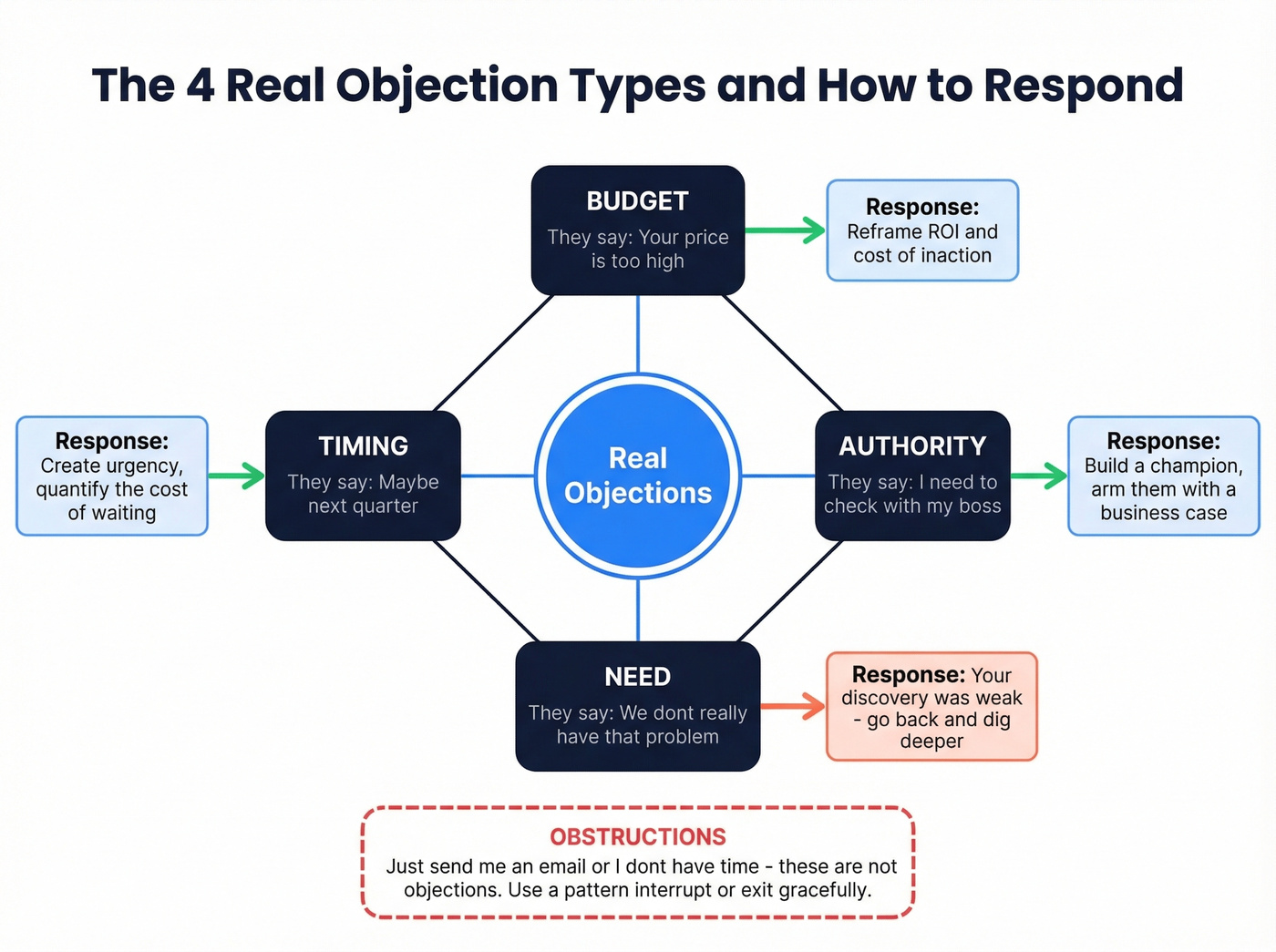
"We already use a competitor" is an objection - there's something to work with. "I don't have time for this" on a cold call is usually an obstruction - the prospect isn't expressing doubt about your product, they're trying to get off the phone.
Most real objections fall into four buckets - Budget, Authority, Need, and Timing - and each requires a different response. A budget objection needs ROI reframing. An authority objection needs a champion-building play. A need objection means your discovery was weak. A timing objection demands urgency creation. Obstructions need pattern interrupts or graceful exits.
| Objection | Obstruction | |
|---|---|---|
| Signal | Uncertainty about value | Desire to end conversation |
| Example | "Your price is higher than X" | "Just send me an email" |
| Response | Explore the concern | Pattern interrupt or exit |
Here's a reframe that changes everything: a prospect who objects is still engaged. The ones who say nothing and ghost you are the real losses. Reps already spend only 30% of their time actually selling - wasting that window on obstructions instead of real objections compounds the problem.
Modern B2B deals involve an average of 7.4 decision-makers, and Gartner reports 61% of buyers would prefer a rep-free experience. You're competing for attention against other vendors and the prospect's preference to not talk to any of you.
What 67K Calls Reveal About Top Performers
Let's get into the data. Gong's analysis of 67,149 sales meetings is one of the largest datasets we have with quantified benchmarks on what separates top performers from everyone else during objections.
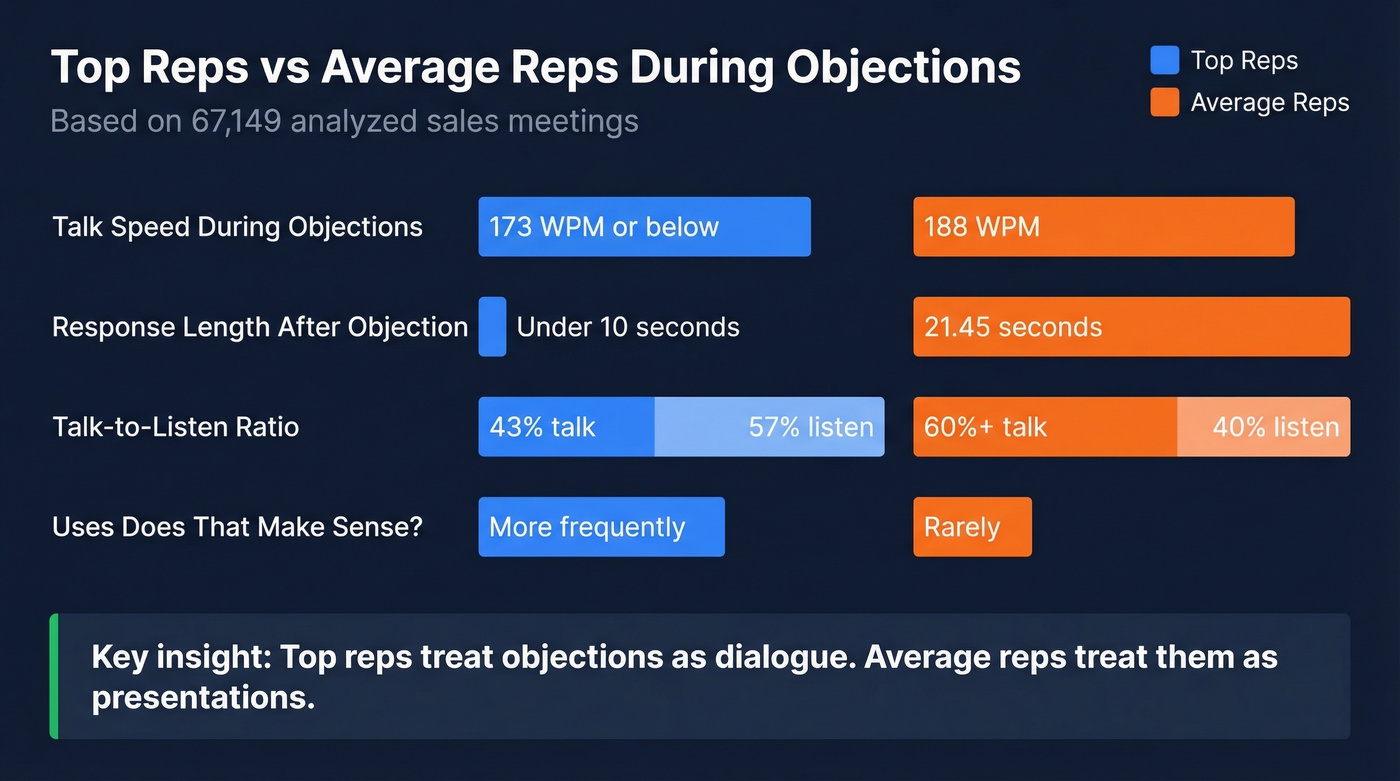
Talk speed tells the story. The baseline for sales conversations is 173 words per minute. When an objection hits, struggling reps accelerate to 188 wpm. They're nervous, and it shows. Top reps do the opposite - they slow down, pause, and let silence do some of the work. That pause signals confidence and gives the prospect space to elaborate.
The 21.45-second monologue is the single biggest anti-pattern. Average reps hear an objection and launch into an uninterrupted response that lasts over 21 seconds. Time that on your phone. It's an eternity in a conversation. Speaker switches per minute drop, meaning the conversation becomes a lecture. The prospect disengages.
Top reps keep responses short and pivot to a question. They treat objections as a dialogue, not a presentation - and that's the clearest behavioral marker the data reveals.
Don't ask "why." The data flags this explicitly. "Why do you feel that way?" puts buyers on the defensive - it feels like an interrogation. Instead, top reps use mirroring, a technique Chris Voss popularized, where you repeat the last few words of what the prospect said with an upward inflection. "The timing isn't right?" That simple repetition gets the prospect to elaborate without feeling challenged.
The talk-to-listen ratio matters. The highest-performing B2B conversations average about 43% talk / 57% listen. Reps who talk more than they listen during objections close less. And here's a counterintuitive finding: top reps close objection responses with "Does that make sense?" more frequently than average reps. It's not a weak filler phrase - it's a micro-confirmation that keeps the prospect engaged and surfaces lingering concerns before they fester.
Handling Objections by Deal Stage
Objections look different at every stage of the sales cycle. A cold call brush-off requires a completely different response than a budget objection in final negotiations.
Cold Call Brush-Offs
Use this if: You're getting "not interested" or "we're all set" within the first 15 seconds. These are obstructions, not objections - the prospect hasn't heard enough to object to anything.
Skip this if: The prospect has engaged for 2+ minutes and raises a specific concern. That's a real objection - move to discovery techniques instead.
The boomerang method works here: take the brush-off and redirect it back as a reason to keep talking. "Totally fair - most people I call say that. Quick question before I let you go: how are you currently handling [specific pain point]?" You're not arguing. You're buying 15 more seconds.
80% of sales require 5+ follow-ups, but 92% of reps quit after 4 attempts. The reps who win at cold calling aren't better at handling brush-offs - they're more persistent and better prepared. If you're burning through dials and hitting wrong numbers, even the best talk track won't save you. We'll come back to that problem.
When a prospect replies to an email with "Not interested, please remove me," don't treat it like a cold call brush-off. A one-line reply acknowledging their request, paired with a single reframe - "Understood, removing you now. In case it's useful: [one-sentence value prop relevant to their role]" - is a clean way to exit without burning the relationship.
Discovery Objections
"I don't have time for a full discovery call" is the classic discovery-stage obstruction. Don't fight it. Use the ask-permission technique from Verbal Judo: "Totally understand. Would you mind if I shared one quick perspective on what we're seeing with teams like yours? If it doesn't resonate, I'll respect your time."
That "would you mind if" phrasing gives the prospect control. They almost always say yes - and now you have permission to make your point.
For real discovery objections like "We already have a solution for this," lean into the SPIN Selling approach: use open-ended questions instead of pitching. "How's that working for your team right now?" is infinitely better than "Well, let me tell you why we're different." Isolate the objection first - "Is that the main thing holding you back, or is there something else?" - before responding. The goal at discovery isn't to overcome. It's to understand.
Demo-Stage Pushback
This is where the 21.45-second monologue does the most damage. A prospect says "I'm not sure this integrates with our stack" and the average rep launches into a feature dump.
Keep your initial response under 10 seconds. Something like: "Good question - which integrations are make-or-break for your team?" Then listen. The prospect will tell you exactly what matters, and you can address that specific concern instead of shotgunning features. Close with "Does that address your concern?" or "How does that land?" These aren't weak phrases - they're confirmation checkpoints that prevent objections from going underground and killing the deal two weeks later.
Negotiation and Budget Objections
"Our budget for this quarter is locked - maybe next year."
This is where most reps either fold or discount. Both are wrong. One strong late-stage approach we've seen work well - and it comes up constantly in r/sales threads on objection handling - is to reframe the cost of inaction:
"Totally understand budget cycles. Quick question though - if the problem we discussed is costing your team 300+ hours by next fiscal, is there usually a process for surfacing that kind of operational risk to leadership now?"
You're not pushing past the objection. You're helping the prospect build an internal business case.
Here's the thing: if your deal size is under five figures, most budget objections aren't really about budget. They're about priority. The prospect has the money - they just don't believe your solution is more important than the twelve other things competing for the same dollars. Your job isn't to prove affordability. It's to prove urgency.
Discounting before understanding the objection isn't handling - it's surrender. A 1% improvement in price negotiation effectiveness drives an 11% increase in operating profits. Every dollar you give away compounds.

80% of sales require 5+ follow-ups, but you can't follow up with bad data. Prospeo gives you 98% verified emails and 125M+ direct dials with a 30% pickup rate - so your objection handling skills reach real decision-makers, not voicemail boxes.
Stop perfecting your talk track for wrong numbers.
Pick One Framework and Master It
There are at least six well-known frameworks. You don't need all of them. You need one that becomes muscle memory, and maybe a second for specific situations.
| Framework | Steps | Best For | Limitation |
|---|---|---|---|
| LAER ★ | Listen, Acknowledge, Explore, Respond | All-purpose default | Can feel like interrogation |
| Feel-Felt-Found | Feel, Felt, Found | Emotional objections | Sounds scripted if overused |
| 4Ps | Pause, Probe, Provide, Prove | High-pressure moments | Needs strong proof points |
| ARC | Acknowledge, Respond, Close | Quick objections | Skips exploration step |
| LAARC | Listen, Acknowledge, Assess, Respond, Confirm | Complex enterprise deals | Too many steps for cold calls |
| Boomerang | Redirect objection as reason to continue | Cold call brush-offs | Fails on real objections |
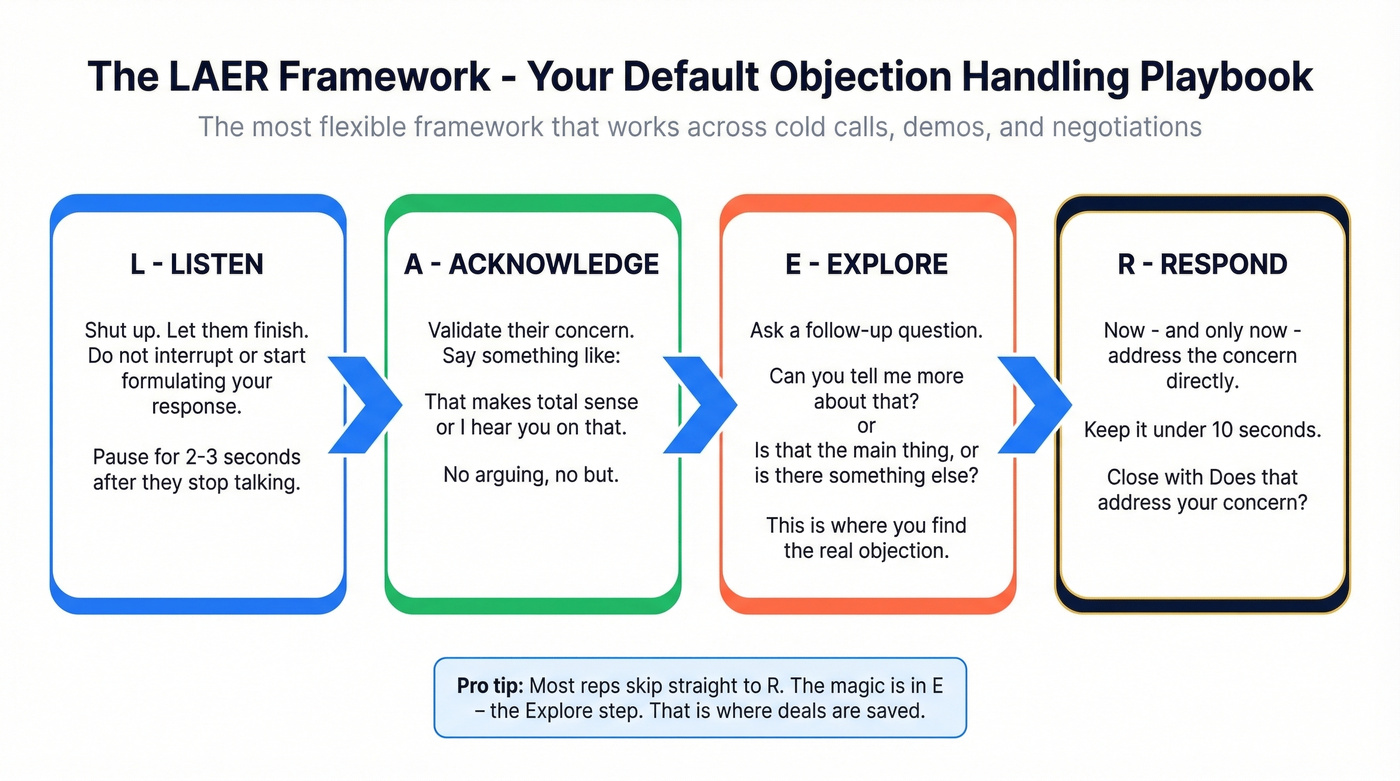
Our recommendation: start with LAER. It's the most flexible, hardest to screw up, and works across cold calls, demos, and negotiations. The "Explore" step is what separates it from simpler frameworks - it forces you to ask questions before responding, which is exactly what the data says top reps do. Some teams refer to a similar flow as LAPAC, which adds an explicit confirmation step at the end - useful for complex enterprise cycles where you need to verify the objection is fully resolved before moving on.
For emotional objections ("I've been burned by vendors like you before"), Feel-Felt-Found still works. "I understand how you feel - other [role] at [similar companies] felt the same way. What they found was..." It's formulaic, but it works because it validates the emotion before redirecting.
Don't try to memorize all six. We've seen teams waste weeks building elaborate framework playbooks that nobody references on a live call. Pick one, drill it until it's automatic, then layer in a second.
Mistakes That Kill Deals
HubSpot's research identifies six anti-patterns that consistently sink deals. Each one maps back to the behavioral data from the 67K-call analysis:
Treating the first objection as the real one. The surface objection is almost never the root cause. "Price is too high" usually means "I can't justify this to my boss." Dig before you respond.
Rushing to answer. The 21.45-second monologue starts here. Reps feel pressure to respond immediately and end up talking past the prospect. Pause. Ask a clarifying question. Then respond.
Getting defensive or argumentative. When reps speed up to 188 wpm, they're usually arguing. Defensiveness increases resistance and undoes whatever rapport you've built.
Offering discounts too soon. The moment you discount without understanding the objection, you've told the prospect your price wasn't real. Every future negotiation starts from a weaker position.
Interrupting the objection. Distinct from rushing - this is about not letting the prospect finish. Cutting someone off mid-sentence signals you're not listening, which is the one thing every framework agrees you should be doing.
Ignoring emotional drivers. Fear of change, fear of making the wrong decision, fear of looking bad internally - these drive more objections than features or pricing ever will. If you only address the logical layer, you'll lose deals you should've won.
How to Practice Without Burning Prospects
You wouldn't run a marathon without training. Don't run live calls without practice either. Three methods, ranked by cost:
Peer role-play sessions are free, immediate, and underrated. Pair up with a colleague, take turns being the prospect, and run through your framework. Record it on your phone. Structured coaching alone improves win rates by 28%.
Call recording review is the "game film" approach. Watch real objection moments from your team's recorded calls and study what top reps actually say - not what the playbook says they should say. In our experience, the gap between playbook theory and live execution is where most reps stall out.
AI roleplay platforms like Hyperbound and Second Nature simulate realistic buyer conversations with adaptive objections. Personalized AI coaching improves quota attainment by roughly 15%. Not cheap, but cheaper than burning real pipeline.
Fix Your Data Before Your Technique
Remember the wrong-numbers problem? The best objection handling techniques won't help if the call never reaches the right person. Stale data means you're burning your best talk track on someone who left the company last quarter. Wrong person, outdated title, dead email - these create objections no framework can fix.

Prospeo addresses this at the source: 300M+ professional profiles, 143M+ verified emails at 98% accuracy, and 125M+ verified mobile numbers with a 30% pickup rate - all on a 7-day data refresh cycle versus the 6-week industry average. Layer in Bombora-powered intent data tracking 15,000 topics, and you're not just reaching the right person - you're reaching them when they're actively in-market. That means fewer "we're not looking at this right now" objections before you even open your mouth.
There's a free tier to test it, no contracts, and self-serve onboarding. Before you invest another hour memorizing scripts, make sure the people you're calling are worth the effort.
With 7.4 decision-makers per deal, you need every conversation to count. Prospeo's 300M+ profiles with 30+ filters let you reach the right buyer before the call - so you're handling real objections, not cold brush-offs from the wrong person.
Reach the actual decision-maker on your first dial.
FAQ
What's the best objection handling framework for beginners?
LAER (Listen, Acknowledge, Explore, Respond) is the most flexible and hardest to misuse. It works across cold calls, demos, and negotiations. The "Explore" step forces you to ask questions before responding - exactly what 67K calls of data show top reps do. For longer enterprise cycles, LAPAC adds a confirmation step to verify the concern is fully resolved.
How many objections should I expect per deal?
Expect 3-7 meaningful objections across a mid-market B2B sales cycle. Early-stage objections tend to be brush-offs or obstructions. Late-stage objections focus on budget, risk, authority, and implementation - these are the ones that determine whether the deal closes or stalls.
Should I discount when a prospect says the price is too high?
Almost never as a first response. Probe first - "When you say the price is too high, is that relative to budget or relative to what you expected?" Discounting before understanding the real objection devalues your product and trains buyers to always push on price. A 1% improvement in negotiation effectiveness drives 11% more operating profit.
How do I reduce objections caused by bad contact data?
Use a verified data provider with a fast refresh cycle. Reaching the right decision-maker with current info eliminates "wrong person" objections entirely, and intent data helps you call when buyers are actively researching - which cuts down on timing objections too.