


7 Best Octoparse Alternatives in 2026: Honest Picks From a Biased Team
Our Picks (TL;DR)
- Prospeo - Best if you're scraping for B2B contacts. Skip the scraper entirely. 300M+ profiles, 98% email accuracy, starts free.
- Apify - Best general-purpose Octoparse replacement. $29/mo, 21,000+ pre-built scrapers, cloud platform.
- Browse AI - Closest no-code experience to Octoparse with simpler pricing at low volume. Free tier, $19/month on an annual plan.
Why People Switch From Octoparse
Octoparse carries a 4.8/5 on G2 across 52 reviews, and it earns that score - reviewers praise ease of use and automation features like scheduling and background extraction. But dig into the complaint themes and a pattern emerges: 7 reviewers flag a steep learning curve, 3 call out slow performance at scale, and 2 mention proxy issues on protected sites. For a tool that markets itself as "no-code," needing hours to configure a workflow isn't great.
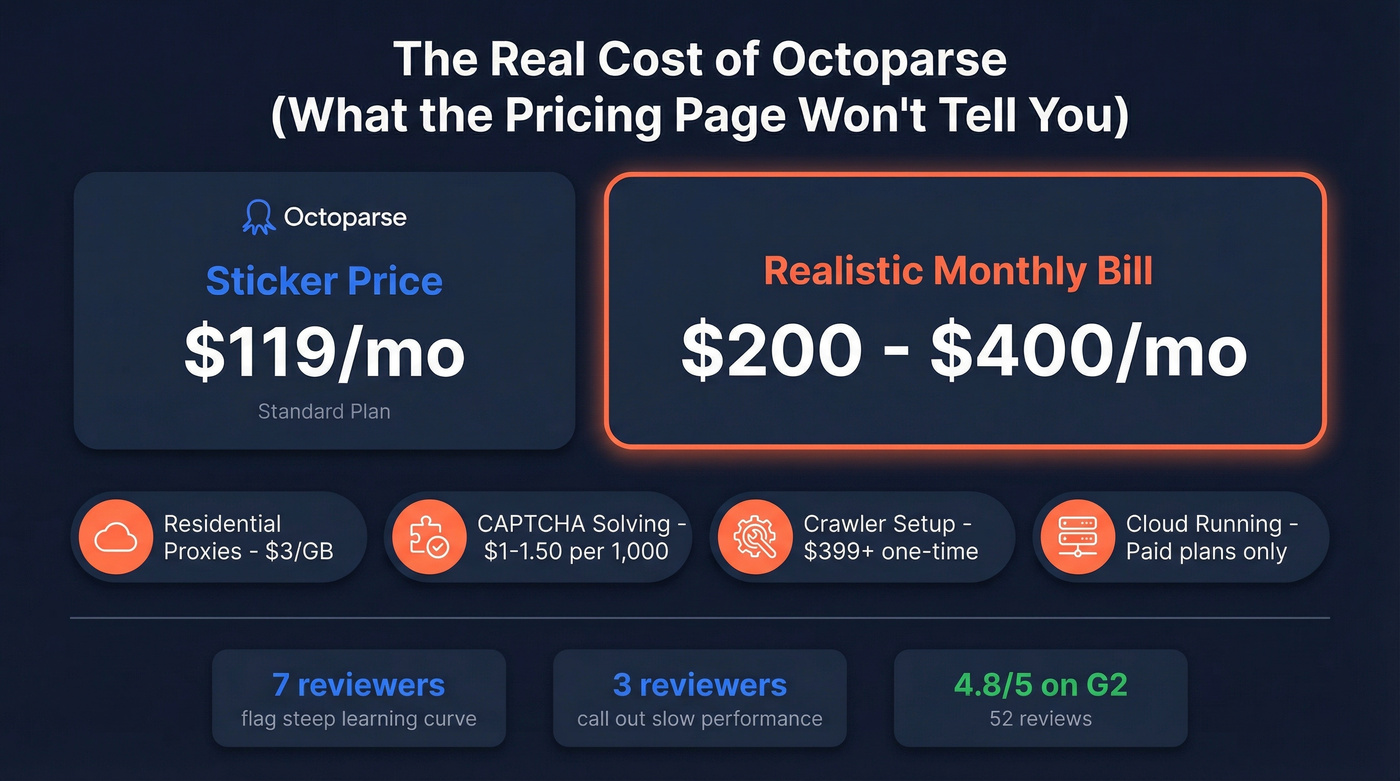
The free plan is where the frustration really starts. You get 10 tasks, 50,000 rows per month, and a 10,000-row cap per export. Cloud running? Paid plans only.
Here's the thing: the sticker price isn't the real cost. Octoparse's paid plans start around $119/month, but that's before add-ons. Residential proxies run $3/GB. CAPTCHA solving costs $1-1.50 per thousand. Need someone to build your crawler? That's $399+ for setup. A realistic monthly bill for a team doing serious scraping lands between $200 and $400, which is a far cry from the number on the pricing page. On r/webscraping, users describe Octoparse as "resource intensive" and "confusing" - and the pricing as "steep" once you factor in the extras.
The web scraping market is projected to double from $1B to $2B by 2030 according to Mordor Intelligence. More tools, more complexity, and more reason to question whether scraping is even the right approach for your use case.
Side-by-Side Comparison
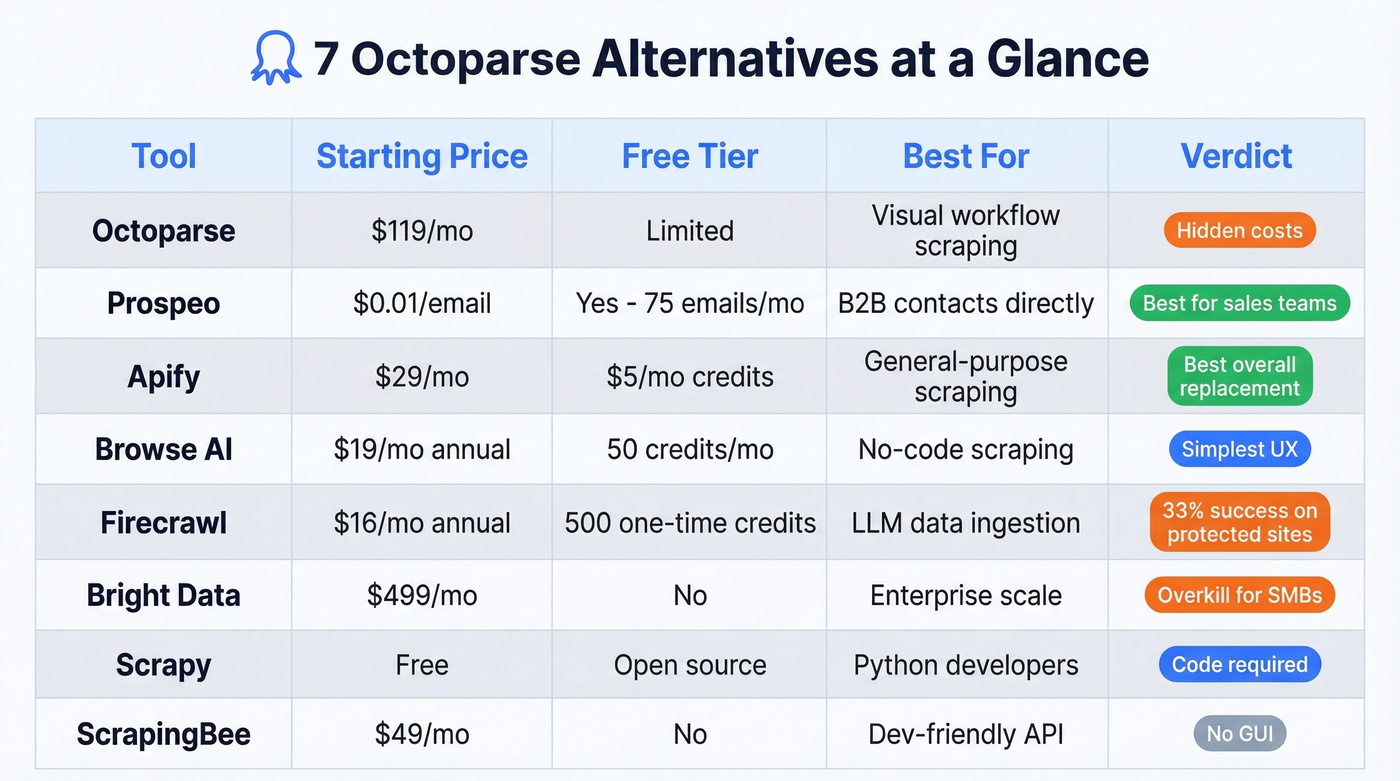
| Tool | Starting Price | Free Tier | Best For | Key Limitation |
|---|---|---|---|---|
| Octoparse | ~$119/mo | 10 tasks, local only | Visual workflow scraping | Hidden add-on costs |
| Prospeo | ~$0.01/email | 75 emails/mo | B2B contacts | Not a web scraper |
| Apify | $29/mo | $5/mo credits | General scraping | Config required |
| Browse AI | $19/mo (annual) | 50 credits/mo | No-code scraping | Credits burn fast |
| Firecrawl | $16/mo (annual) | 500 credits once | LLM data ingestion | Lower success on protected sites |
| Bright Data | ~$499/mo | No | Enterprise scale | Expensive for SMBs |
| Scrapy | Free | Yes (open source) | Python developers | Zero GUI |
| ScrapingBee | ~$49/mo | No | Dev-friendly API | No-code users out |

You're paying $200-400/month to scrape websites, clean data, deduplicate rows, and verify emails - and you're still bouncing at 35%. Prospeo replaces that entire chain: 300M+ profiles, 98% email accuracy, 125M+ verified mobiles, refreshed every 7 days. Starting at $0.01/email.
Collapse your scrape-clean-verify pipeline into a single search.
The Best Tools to Replace Octoparse
Prospeo - Skip the Scraper Entirely
If your Octoparse workflow looks like scrape, clean, deduplicate, verify emails, enrich with phone numbers, import to CRM - Prospeo collapses that entire chain into a single search. It's not a web scraper. It's a B2B data platform with 300M+ professional profiles, 143M+ verified emails, and 125M+ verified mobile numbers.

The search filters go deep - 30+ options including buyer intent powered by Bombora across 15,000 topics, technographics, job changes, headcount growth, funding rounds, and revenue. Data refreshes every 7 days, which matters when you're prospecting into fast-moving markets. Email accuracy sits at 98%, and the mobile pickup rate runs 30% across all regions. We've seen teams like Snyk cut bounce rates from 35-40% to under 5% and generate 200+ new opportunities per month after switching from manual scraping workflows.
Pricing is straightforward: the free tier gives you 75 verified emails and 100 Chrome extension credits per month. Paid plans work out to roughly $0.01 per email. No annual contracts, no "talk to sales" gates.
Use this if: You're scraping websites to build prospect lists for outbound sales.
Skip this if: You need to scrape product data, pricing pages, or non-contact content. Prospeo isn't a general-purpose scraper - pair it with Apify or Scrapy for those jobs.
Apify - The Verdict First
Use this if you need a versatile cloud scraping platform and your team can handle some configuration. Skip this if you want a pure drag-and-drop experience with zero technical overhead.
Apify is the closest thing to a true Octoparse replacement for teams that need general-purpose web scraping. The Actor marketplace has 21,000+ pre-built scrapers - compared to Octoparse's 460+ templates - covering everything from e-commerce product pages to social media feeds to real estate listings. That's not a small gap.

The platform runs entirely in the cloud. You build, configure, monitor, and schedule scrapers without installing anything locally. Integrations with Zapier, Make, and webhooks let you pipe scraped data directly into your stack. The free tier provides $5 in monthly credits, enough to test a few Actors. Paid plans start at $29/month.
The tradeoff is complexity. Apify's Actors are powerful but not truly point-and-click for non-technical users. You'll spend time configuring inputs, understanding proxy settings, and debugging when a target site changes its structure. If you're comfortable with that, Apify offers more flexibility than Octoparse at a lower price point. On r/webscraping, Apify consistently gets recommended alongside Scrapy as the go-to for anyone who's outgrown visual scraping tools.
Browse AI - No-Code Showdown
Browse AI is the tool that most closely replicates Octoparse's no-code promise - and in many cases delivers on it better. Where Octoparse requires you to build extraction workflows step by step, Browse AI lets you train a "robot" by clicking on the data you want. The interface is genuinely intuitive, and the gap in usability is noticeable within the first five minutes.

Pricing runs on credits: 50 credits equals 500 rows of data. The free tier gives you 50 credits/month, enough for light monitoring. The Personal plan starts at $19/month billed annually, or $48/month if you pay monthly. The Professional tier runs $69/month annual. Add-on credits cost $0.024 each. One thing to understand: "websites" in Browse AI's pricing means domains, not pages - subpages and subdomains generally count as one website.
The catch is volume. Credits burn fast on large scraping jobs. If you're extracting thousands of rows daily, you'll blow through even the Professional tier quickly. Browse AI works best for monitoring use cases - tracking competitor prices, watching job boards, pulling structured data on a schedule - rather than one-time bulk extraction.
Let's be honest: if your monthly scraping volume stays under 10,000 rows, Browse AI is a better tool than Octoparse. The UX is cleaner, the pricing is more transparent, and you won't get nickel-and-dimed on proxies. Past that threshold, the credit math flips and you need Apify or Scrapy.
Firecrawl
Firecrawl is API-first and built for a specific audience: teams feeding scraped data into LLMs. It outputs Markdown and structured JSON, which makes it ideal for RAG pipelines and AI data ingestion. The Hobby plan runs $16/month billed annually with 3,000 credits. There's a free tier with 500 one-time credits to test.
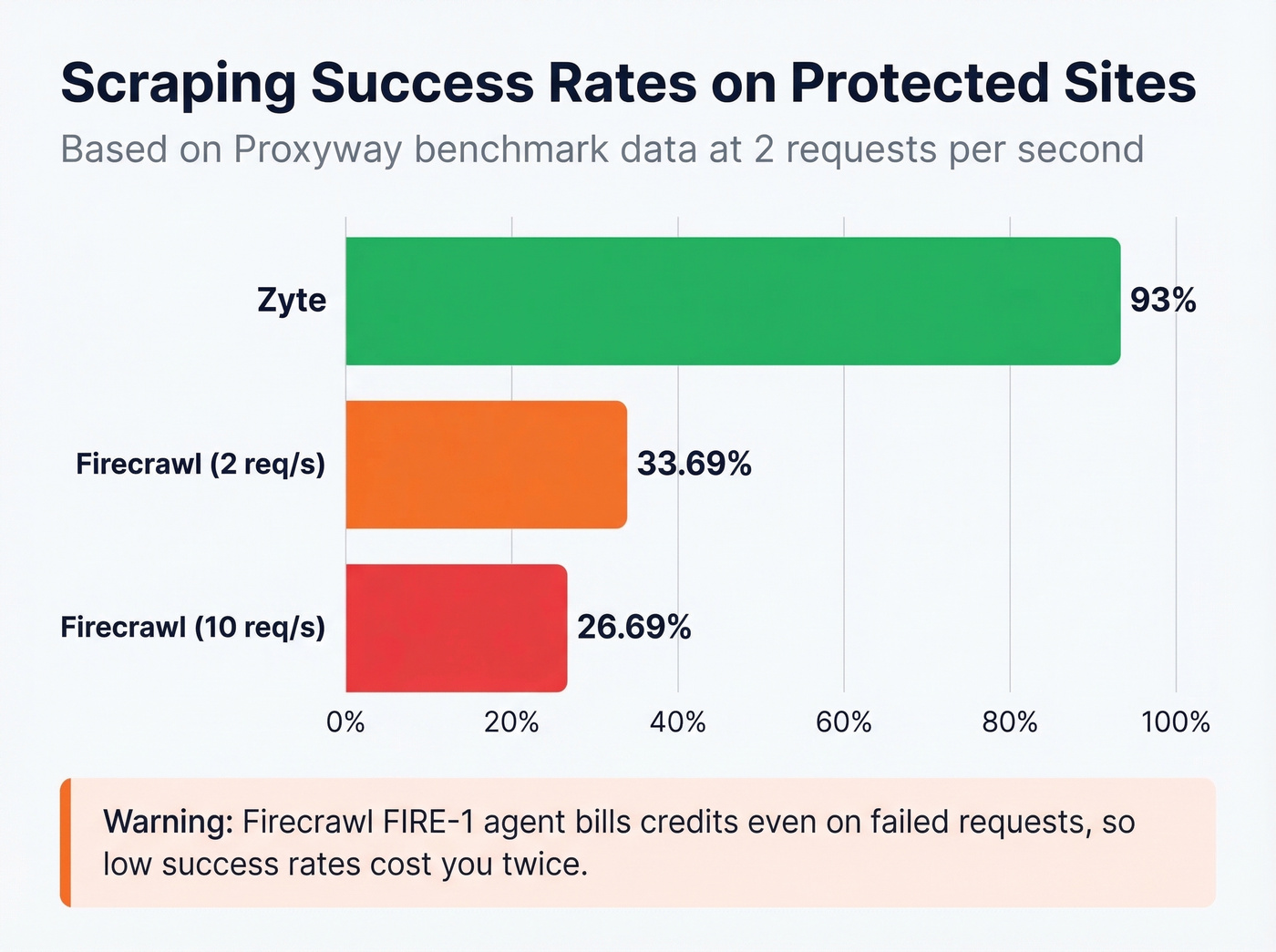
The problem is success rates. A Proxyway benchmark tested Firecrawl at just 33.69% on protected sites at 2 req/s. That dropped to 26.69% at 10 req/s. For comparison, Zyte hit 93%. Credits don't roll over, and the FIRE-1 agent endpoint bills even on failed requests - so you're paying for misses.
Use this if: You're building AI/ML pipelines that need clean, structured web content.
Skip this if: You're scraping anti-bot-protected sites. The success rates aren't there yet.
Bright Data
Bright Data is the enterprise play. Their Web Scraper API runs about $1.50 per 1,000 records on pay-as-you-go, or roughly $499/month for 510,000 records on a plan. They also offer large-scale proxy networks across residential, datacenter, ISP, and mobile categories.
This isn't a realistic option for most readers. It's what you graduate to when you're scraping millions of pages and need enterprise-grade reliability. The learning curve is steep, the pricing is steep, and the minimum viable spend puts it out of reach for solo operators and small teams.
Use this if: You're an enterprise team scraping at massive scale with budget to match.
Skip this if: You're spending under $500/month on scraping. Bright Data is overkill.
Scrapy
Free, open-source, Python-based. That's it. Scrapy is a framework for developers who want full control over their scraping pipeline. If you can write Python, it's the most powerful and flexible option on this list. If you can't, skip it entirely - there's no GUI, no hand-holding, and no support team to call.
On r/webscraping, Scrapy is the default recommendation for anyone willing to write code. No credit limits, no vendor lock-in, no surprise bills. We've used it internally for non-contact scraping jobs where we needed full control over retry logic and output formatting.
ScrapingBee
API-based scraping that handles proxies and headless browsers for you, starting around $49/month. It's a solid middle ground for developers who want simplicity without building proxy infrastructure. Non-technical users won't find a GUI here - it's code-only.
Do You Actually Need a Scraper?
You scrape a website, and what do you get? Raw HTML. Maybe some structured data if your selectors are good. Then you clean it, deduplicate it, verify email addresses, enrich it with phone numbers, and import it into your CRM or sequencer. That's five steps before you can actually use the data.
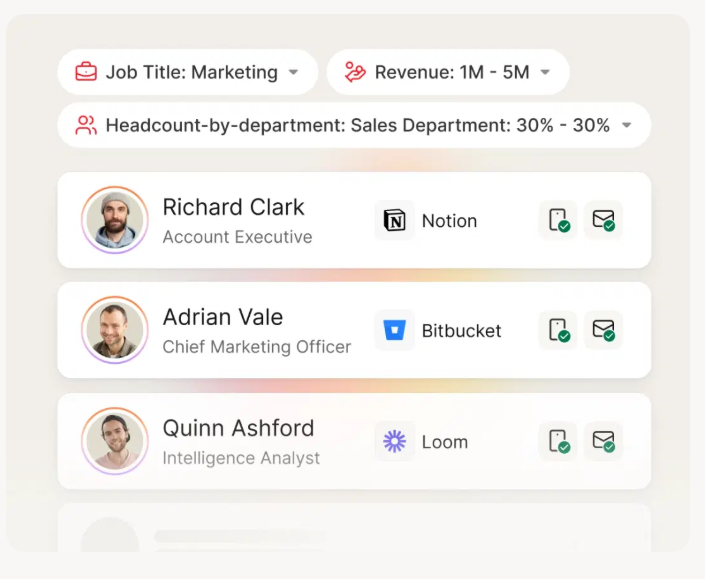
If you're scraping for B2B leads - and a huge percentage of Octoparse users are - you're doing it the hard way. A dedicated contact database gives you the end result without the scraping step. You search by filters, export verified contacts, and push them straight to Salesforce, HubSpot, Lemlist, or Instantly. We've seen teams spend weeks building scraping workflows that a 2-minute database search replaces entirely.
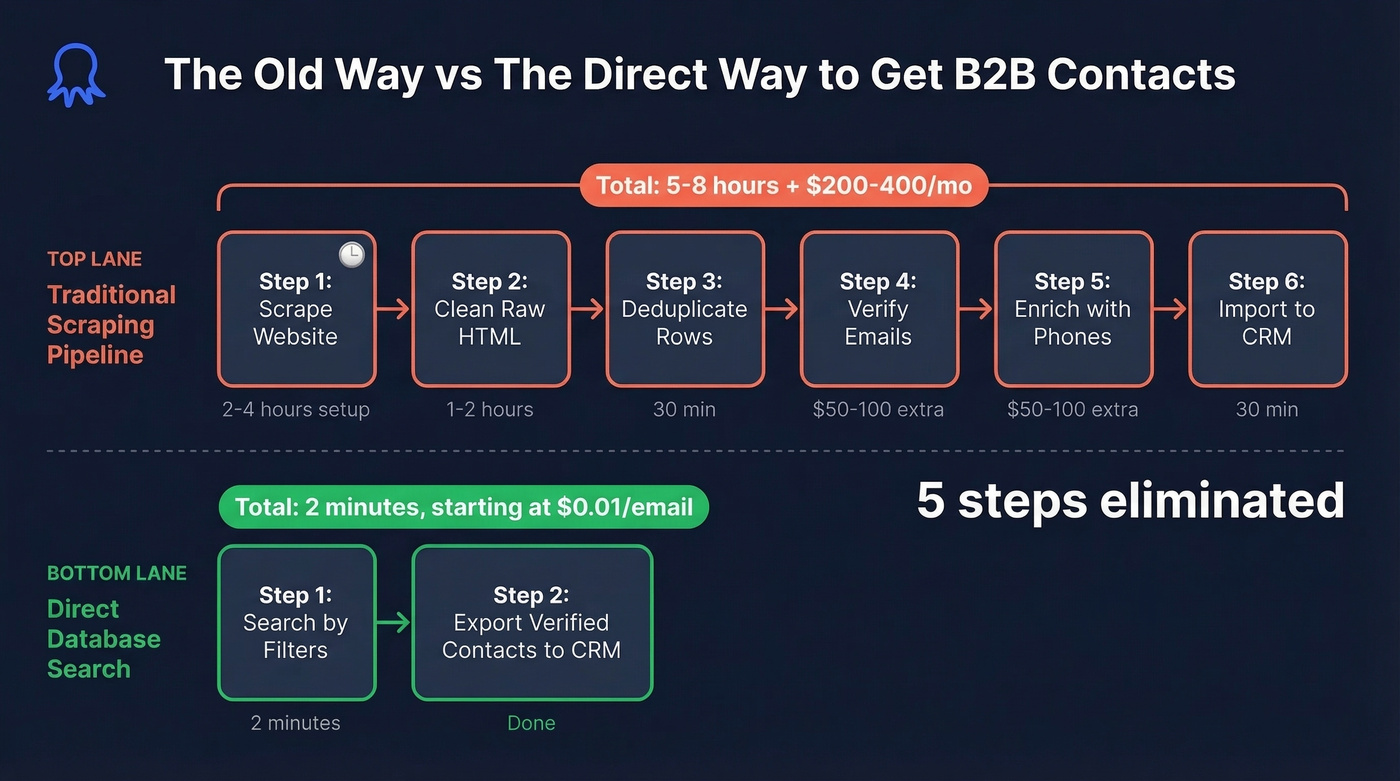
The math is simple: if your end goal is verified contact data, start with verified contact data.
Snyk's 50 AEs cut bounce rates from 35-40% to under 5% and generated 200+ new opportunities per month - no scraping workflows, no proxy fees, no CAPTCHA costs. Just 30+ filters, verified contacts, and direct CRM integrations.
Get the contacts directly. No scraper required.
How to Choose the Right Tool
The right tool depends entirely on what you're actually trying to do:
Sales teams building prospect lists - Skip scraping. Use a B2B contact database and go straight to verified emails and direct dials.
Technical teams needing general-purpose scraping - Apify. Biggest marketplace, true cloud, reasonable pricing.
Non-technical solo users - Browse AI. Closest to Octoparse's no-code promise, better pricing at low volume.
AI/ML engineers feeding LLM pipelines - Firecrawl. Markdown output, API-first design.
Enterprise teams at scale - Bright Data. Proxy networks plus enterprise-grade scraping infrastructure.
Developers on a budget - Scrapy. Free, open-source, unlimited flexibility if you write Python.
Tools like Clay and Gumloop are also emerging as AI-agent alternatives that chain scraping with enrichment and CRM updates in a single flow. Worth watching if your workflow has more than three steps.
Look - most people searching for Octoparse alternatives are scraping websites to find business contacts. If that's you, the answer isn't a better scraper. It's skipping the scraper.
FAQ
Is there a free alternative to Octoparse?
Scrapy is completely free and open-source but requires Python knowledge. Apify provides $5 in monthly credits on its free plan, and Browse AI gives 50 credits/month, roughly 500 rows. For B2B contact data specifically, Prospeo's free tier includes 75 verified emails and 100 Chrome extension credits monthly - no scraping setup needed.
What's the real cost of Octoparse?
Paid plans start around $119/month, but add-ons push the real spend to $200-400/month for most teams. Residential proxies run $3/GB, CAPTCHA solving costs $1-1.50 per thousand, and crawler setup starts at $399. Always budget for extras beyond the sticker price.
Which tool is best for beginners?
Browse AI offers the closest no-code experience for general web scraping - you point, click, and train a robot in minutes. For B2B contact data, Prospeo requires zero scraping skills: search by 30+ filters and export verified emails and phone numbers directly.
How do scraping tools handle anti-bot protection?
Tools use proxy rotation, CAPTCHA solving services, and headless browsers to bypass anti-bot measures. Success rates vary wildly - Proxyway benchmarks show rates from 33% (Firecrawl) to 93% (Zyte) on protected sites. Budget for proxy costs separately; they're rarely included in base pricing.