

Omnichannel Outreach: What It Actually Is, How to Run It, and What Breaks
You've been sending 200 cold emails a day for three months. Reply rate: 1.2%. So you add LinkedIn. Now you're doing what one practitioner on r/sales described as "keeping consistent follow-up timing across both channels without manually tracking each conversation." Your reply rate climbs to a staggering 1.4%. That's not omnichannel outreach - that's multichannel chaos with extra steps.
The teams booking the most meetings in 2026 don't use 15 tools and 8 channels. They use three channels and obsess over data quality and timing.
What Omnichannel Actually Means
The term gets thrown around loosely. Here's the real distinction:
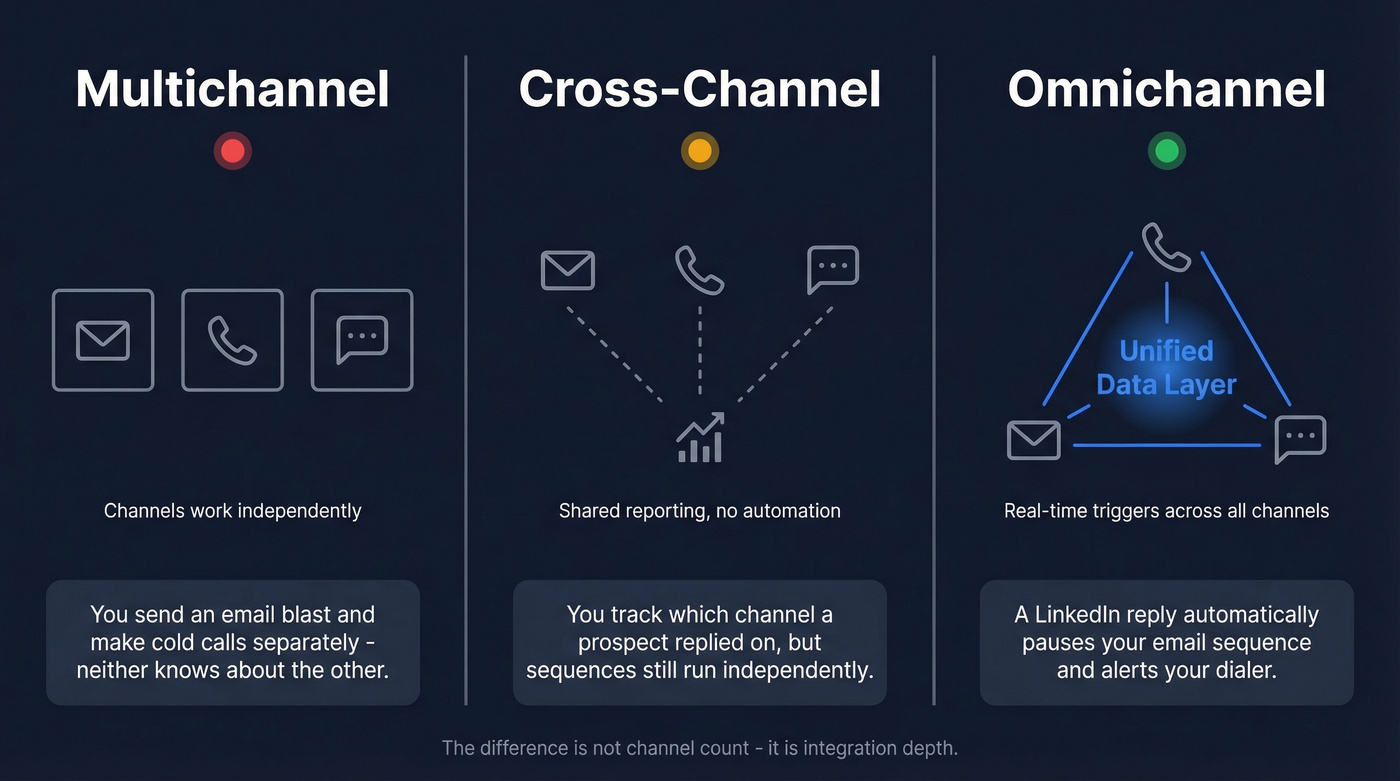
| Multichannel | Cross-Channel | Omnichannel | |
|---|---|---|---|
| Channels | 3-4, independent | 3-5, tracked together | 3+, unified |
| Data | Separate databases | Shared analytics | Unified profile, real-time |
| Automation | None across channels | Reporting only | Triggers across channels |
| Example | Email blast + cold calls | Track which channel replied | LinkedIn reply pauses email |
The operational difference is what matters. In a multichannel setup, your email tool doesn't know your prospect just accepted a connection request. In an omnichannel setup, it does - and it adjusts automatically. Every channel feeds the same data layer, so no touch happens in a vacuum.
Enterprise-grade implementations with five-plus channels take 6-12 months to build. A functional three-channel setup? You can have that running in a week.
Why Coordinated Outbound Works
Campaigns using three or more channels achieve 287% higher purchase rates compared to single-channel strategies. That's not a rounding error.
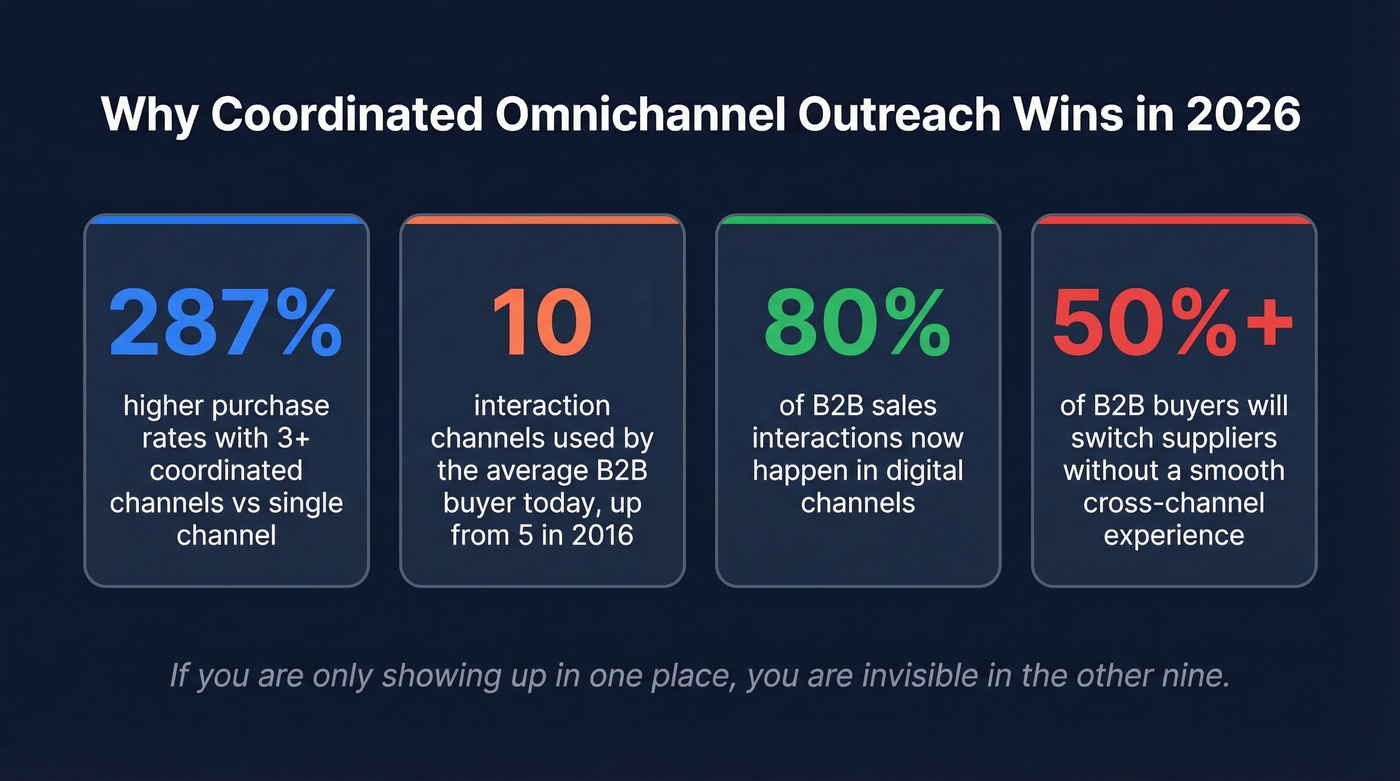
B2B buyers now use an average of 10 different interaction channels, up from 5 in 2016. 80% of B2B sales interactions happen in digital channels, and over 50% of B2B buyers will switch suppliers if they don't get a smooth cross-channel experience. Your prospects aren't sitting in their inbox waiting - they're spread across platforms, and if you're only showing up in one place, you're invisible in the other nine.
In our experience, the lift from adding a second and third coordinated channel dwarfs any gains from optimizing a single channel further. It's not even close.
Building Your Omnichannel Outreach Strategy
The Base Cadence
Before Day 1, run your list through a verification tool. A 35% bounce rate doesn't just waste sends - it torches your domain reputation and drags down every future campaign. We've seen teams skip this step and wonder why deliverability craters by Day 5.
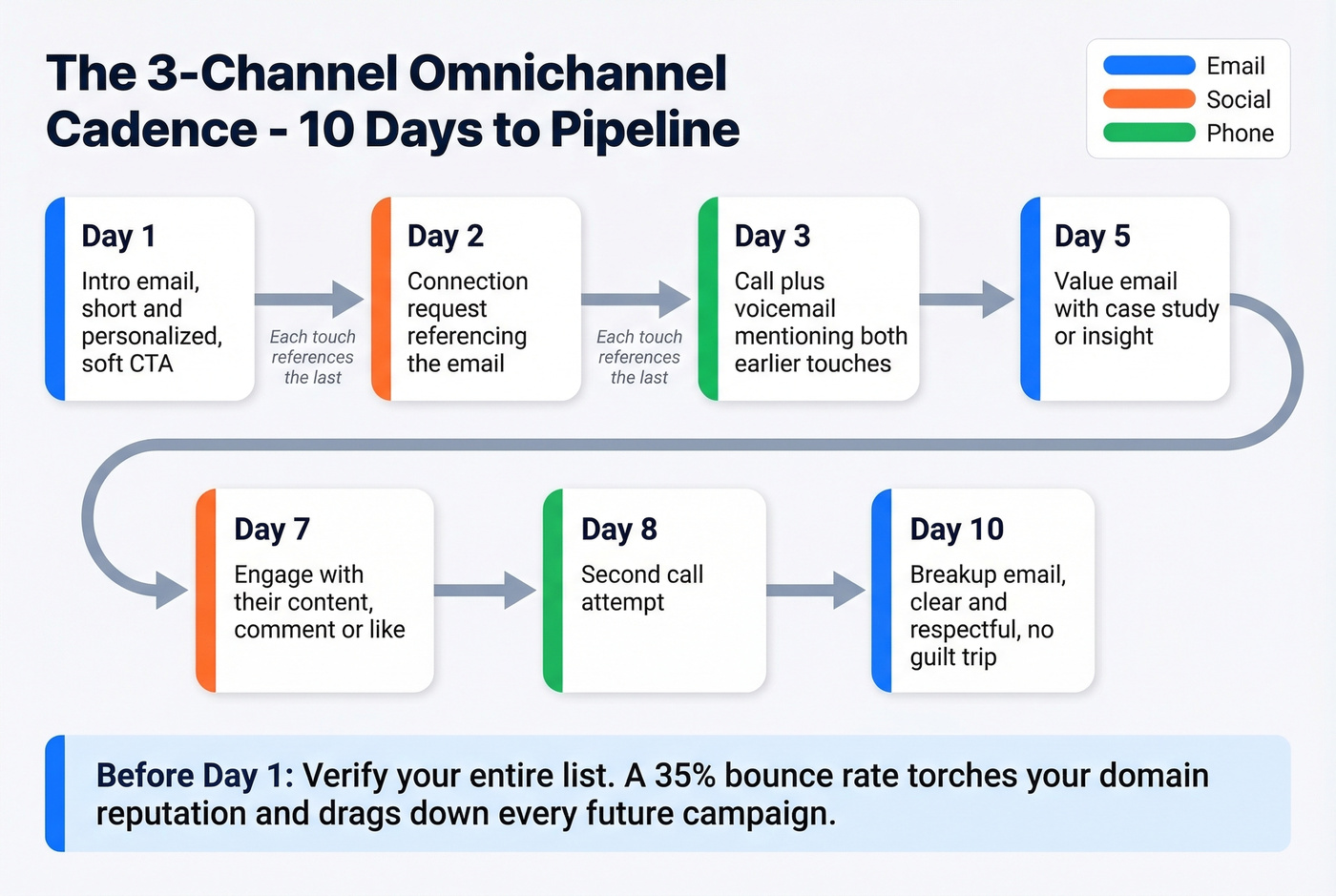
| Day | Channel | Action |
|---|---|---|
| 1 | Intro email - short, personalized, soft CTA | |
| 2 | Social | Connection request referencing the email |
| 3 | Phone | Call + voicemail referencing earlier touches |
| 5 | Value email with case study or insight | |
| 7 | Social | Engage with their content (comment, like) |
| 8 | Phone | Second call attempt |
| 10 | Breakup email - clear, no guilt trip |
The magic isn't the exact days - it's the cross-referencing. Day 2's connection request mentions the email. Day 3's voicemail mentions both. Each touch builds on the last, creating presence without spam.
GDPR requires a lawful basis for processing personal data, typically legitimate interest for B2B outreach in the EU. CAN-SPAM means including a physical address and a clear opt-out. Bake compliance into your templates from the start - not after your first complaint.
Intent-Triggered Bursts
When a buying signal appears - pricing page visit, whitepaper download, company-level intent on a relevant topic - compress the cadence. First touch within 24 hours. Call on Day 2, email on Day 4, social on Day 6, final call on Day 7.
For SaaS teams running intent-triggered bursts, we've seen reply rates jump to 18-25%, roughly a 2-3x lift over standard sequences. A prospect researching your category today is gone next month. Speed matters more than polish here.

Intent-triggered bursts only work when you have verified contact data ready to fire. Prospeo tracks 15,000 intent topics via Bombora, pairs them with 98% accurate emails and 125M+ verified mobiles, and refreshes everything every 7 days - so your three-channel cadence hits real buyers, not dead inboxes.
Stop optimizing cadences built on garbage data.
Five Mistakes That Kill B2B Outbound
1. Data silos with no unified profile. Your email tool, dialer, and social tool each maintain separate contact records. Prospects repeat themselves, reps lose context. Fix: centralize in your CRM, enforce a single source of truth.
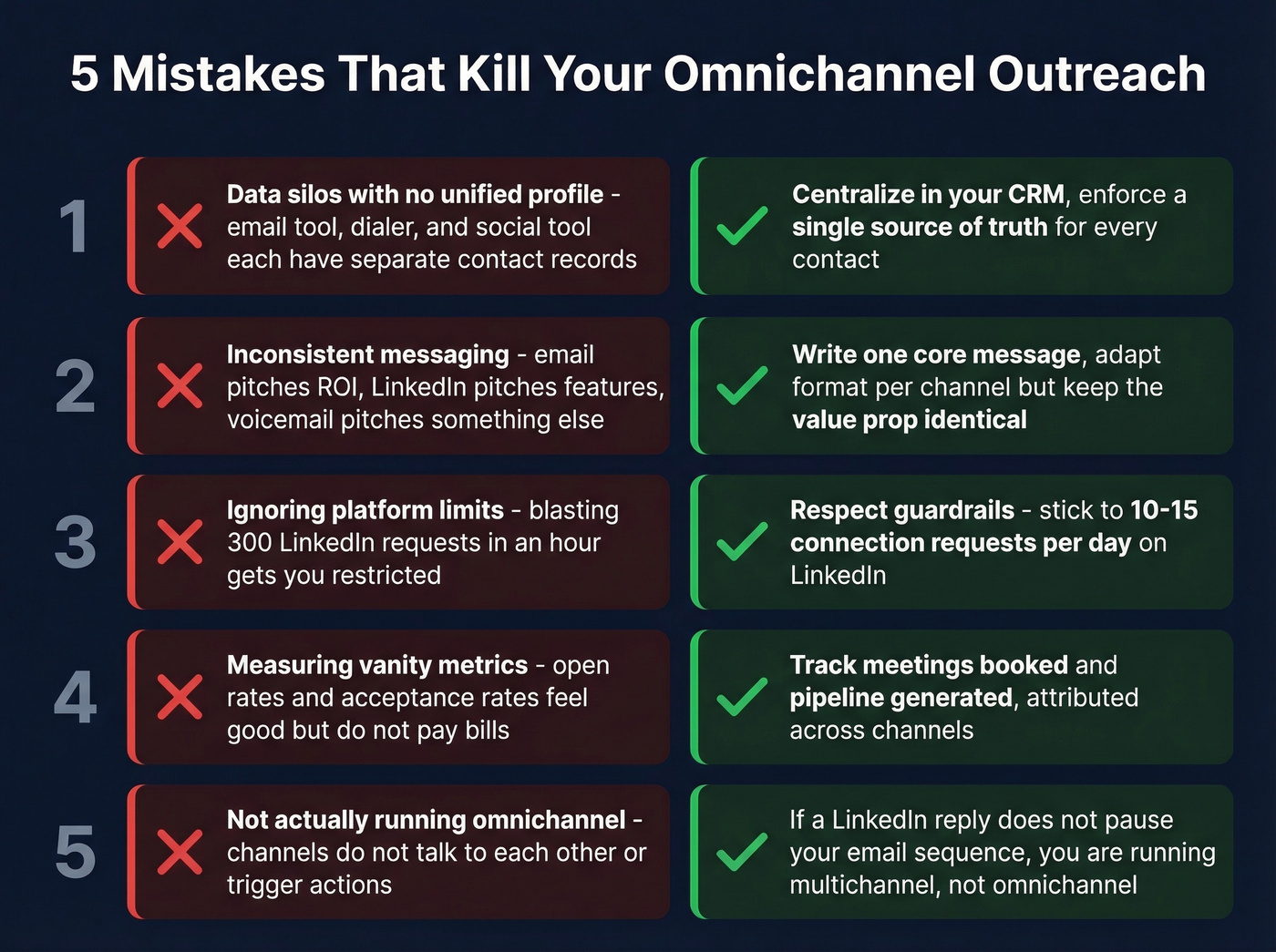
2. Inconsistent messaging across channels. Your email pitches ROI, your message pitches features, your voicemail pitches something else entirely. Write one core message. Adapt the format per channel, keep the value prop identical.
3. Ignoring platform limits. LinkedIn caps safe connection requests at roughly 10-15 per day. Blast 300 in an hour and you'll get restricted. Respect the guardrails.
4. Measuring vanity metrics instead of pipeline. Open rates and connection acceptance rates feel good but don't pay the bills. Track meetings booked and pipeline generated, attributed across channels.
5. Skipping the "is this actually omnichannel?" check. Ask yourself: if a prospect replies on LinkedIn, does my email sequence pause? Can I see every touchpoint on one screen? Do I know which channel combination drives the most meetings? If you answered no to two or more, you're running multichannel, not omnichannel.
Data Quality: The Part Nobody Wants to Talk About
Look - every channel in your cadence suffers when your data is wrong. Consider the LinkedIn burnout funnel: 150 connection requests per week, 20-30% acceptance rate, 3-4 actual replies. That math only works if you're reaching the right people. 37% of marketers cite data quality as their top multichannel challenge, and bad data costs organizations $12.9 million annually.

Prospeo addresses this at the foundation - 300M+ professional profiles with 98% email accuracy and 125M+ verified mobile numbers, all refreshed on a 7-day cycle versus the 6-week industry average. Meritt went from a 35% bounce rate to under 4% after switching, and their pipeline tripled from $100K to $300K per week. That's not a cadence improvement. That's what happens when your existing cadence finally runs on clean data.
Most teams don't have a channel problem. They have a data problem dressed up as a channel problem. Fix the data first, and a simple three-channel cadence will outperform a sophisticated seven-channel mess built on garbage contacts.
Meritt ran the same cadence and tripled pipeline from $100K to $300K/week - the only change was switching to Prospeo's verified data. 300M+ profiles, 30+ filters including technographics and job change signals, and emails at $0.01 each. Your omnichannel strategy doesn't need more channels. It needs cleaner contacts.
Get the data layer your omnichannel cadence is missing.
How to Measure Omnichannel ROI
Most teams default to last-touch attribution - whoever booked the meeting gets the credit. This systematically undervalues the early touches that created awareness and built familiarity. For outbound, time-decay or U-shaped attribution models work better. Time-decay gives more credit to touches closer to conversion while still acknowledging the opener; U-shaped splits credit between the first touch and the converting touch, with middle touches sharing the remainder.
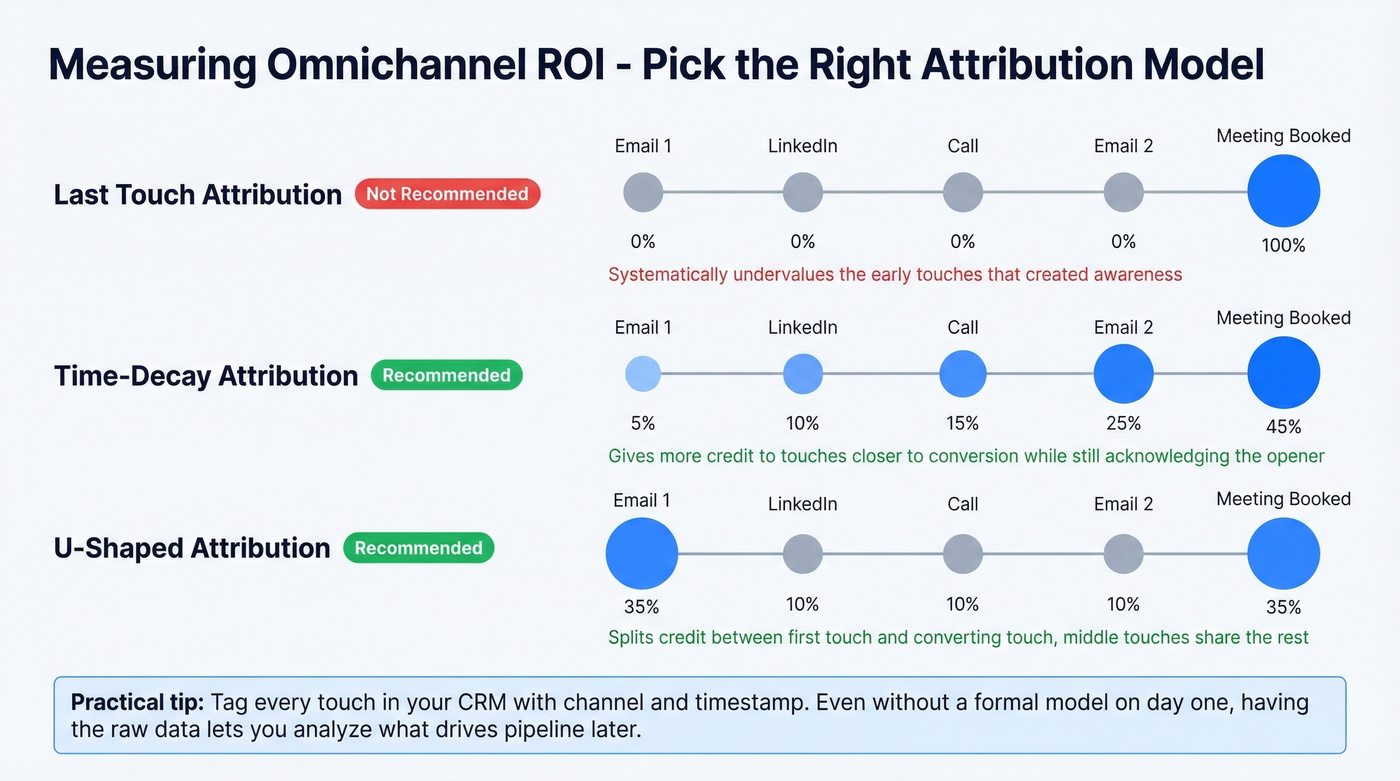
The practical move: tag every touch in your CRM with channel and timestamp. Even without a formal attribution model on day one, having the raw data lets you analyze what's actually driving pipeline later. Skip this if you're running fewer than 50 prospects through your cadence - the sample size won't tell you anything useful yet.
FAQ
What's the difference between multichannel and omnichannel outreach?
Multichannel means being present on multiple channels that operate independently. Omnichannel means those channels share data and trigger actions across each other - when a prospect replies on one channel, the others adjust automatically. The distinction is integration depth, not channel count.
How many channels do I need?
Three coordinated channels - email, phone, and one social platform - outperform five uncoordinated ones. SMS and ringless voicemail exist but add compliance overhead most teams don't need at the start. Nail three before expanding.
What tools do I need to start?
A verified contact database, a sending tool like Instantly or Smartlead at around $30/month, and a CRM like HubSpot's free tier. That's a functional starting stack for under $50/month that covers data, sequencing, and tracking.
How long before I see results?
Expect 2-3 weeks to calibrate messaging and timing, then measurable pipeline lift by week 4-6. Teams with clean data - sub-5% bounce rates - typically see 18-25% reply rates on intent-triggered sequences within the first month.
Let's be honest: the best omnichannel outreach isn't about being everywhere. It's about being coordinated in the three places that matter, with data clean enough to make every touch count.