

Open-Ended Sales Questions: 55 Examples for 2026
You're eight minutes into a discovery call. You've asked what you thought was a great question, and the prospect gives you a four-word answer: "Yeah, it's been fine." The call stalls. You panic-pitch. The deal dies in stage one.
The difference between reps who close 20-30% of their deals and those stuck in the low teens isn't charisma or product knowledge - it's the quality of their open-ended sales questions. Below you'll find 55 examples that fix yours, backed by SPIN's 35,000-call research base and Gong Labs benchmarks, plus frameworks top performers actually use.
The Quick Version
- Ask 11-14 open-ended questions per discovery call - not 20+. Top reps talk about 46% of the time and listen about 54%.
- Organize questions by call stage (rapport, pain, qualifying, close), not as a random list you read off a screen.
- Pick one framework and internalize it. SPIN for mid-market, MEDDPICC for enterprise, Challenger for commoditized markets .
What the Data Says
Gong Labs data paints a clear picture. Top-performing reps keep talk time to about 46% of the call, spending roughly 54% listening. Average reps? They're up in the high 60s, steamrolling prospects with product features nobody asked about.
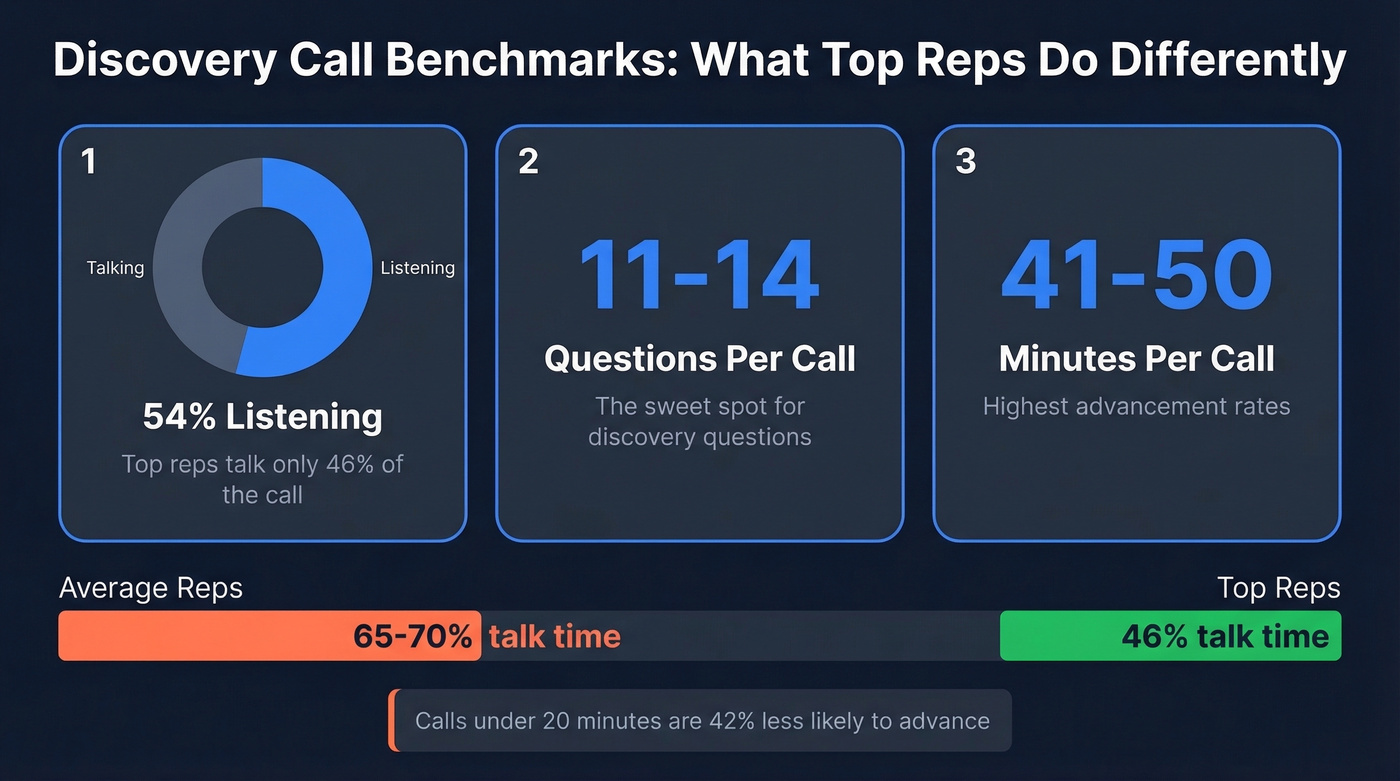
The sweet spot for discovery questions is 11-14 per call. Discovery calls that run 41-50 minutes correlate with the highest advancement rates, while calls under 20 minutes are 42% less likely to advance. These aren't arbitrary numbers. They reflect a simple truth: good discovery takes time, and the best reps spend that time listening, not talking.

Open-Ended vs. Closed-Ended
Open-ended questions start with what, how, why, "tell me about," or "walk me through" - and they invite multi-sentence responses. Closed-ended questions produce yes/no answers and kill momentum.
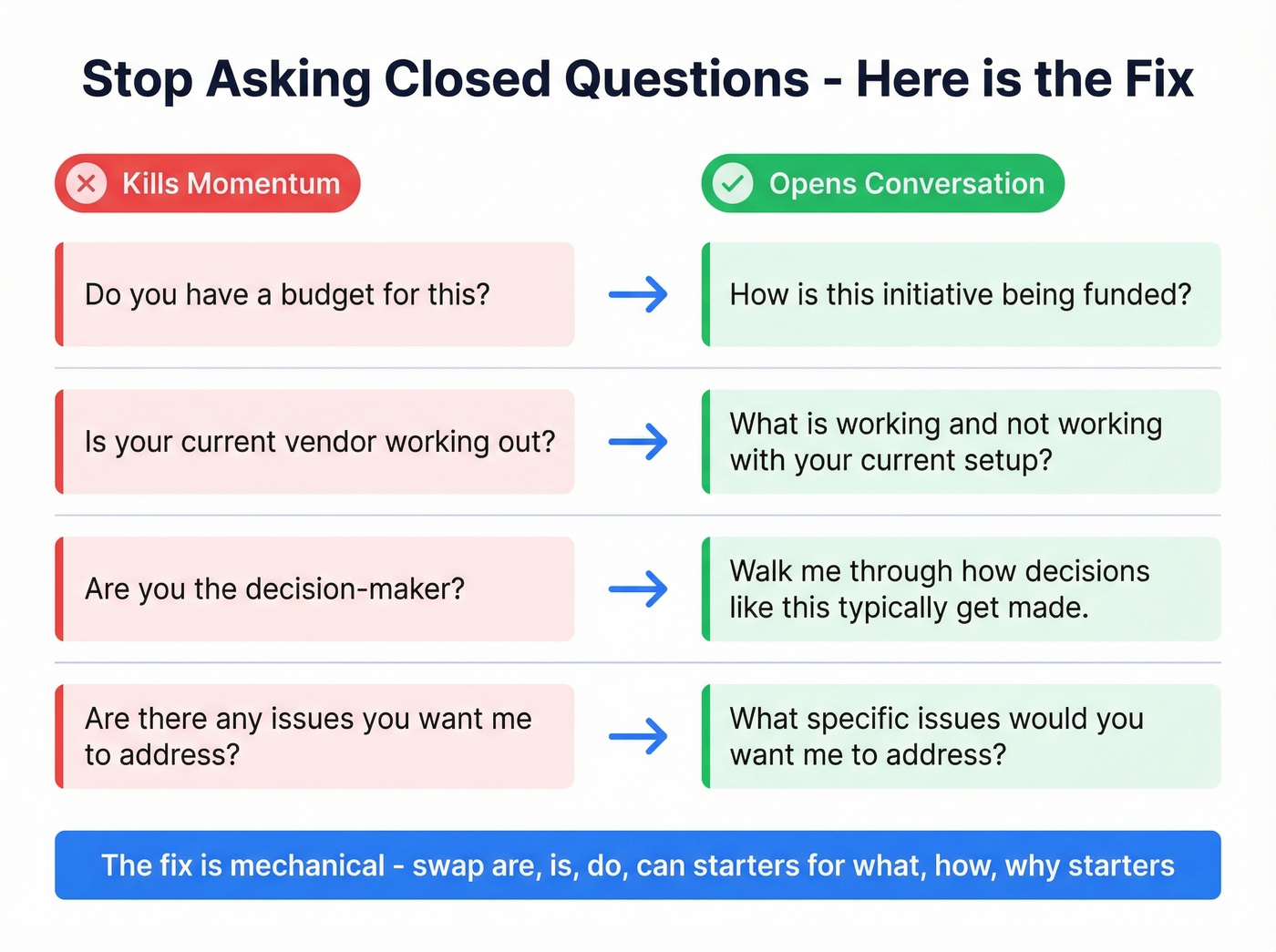
But there's a sneakier problem: false open-ended questions. These look open but function as closed:
| Closed / False Open | Rewritten as Truly Open |
|---|---|
| Are there any issues you'd want me to address? | What specific issues would you want me to address? |
| Do you have a budget for this? | How is this initiative being funded? |
| Is your current vendor working out? | What's working and not working with your current setup? |
| Are you the decision-maker? | Walk me through how decisions like this typically get made. |
The fix is mechanical: swap "are/is/do/can" starters for "what/how/why" starters. It takes practice, but once you internalize it, you'll catch yourself mid-sentence and self-correct.
55 Examples Organized by Stage
Rapport and Opening
These set the tone. You're signaling that this is a conversation, not a pitch.
- What motivated you to take this call?
- What would make this meeting worthwhile for you today?
- What's going on in your world that made you decide to talk to me?
- What's top of mind for you right now in [relevant area]?
- How did you first hear about us?
- What does your day-to-day actually look like in your role?
- What are you hoping to walk away with from this conversation?
- What's changed recently that's making this a priority now?
Discovery and Pain
This is where deals are won or lost. We've listened to hundreds of recorded discovery calls, and the pattern is always the same: reps who spend 60%+ of the call in this phase close at nearly double the rate of those who rush through it. Dig into the problem before you ever mention your product.
- Walk me through how you're currently handling [process] today.
- What's the biggest headache in your workflow right now?
- What happens if nothing changes?
- What have you already tried to fix this, and what worked or didn't?
- Why hasn't this problem been fixed before today?
- Give me an example of how this causes problems day-to-day.
- What do you like about your current setup?
- Where are you losing the most time or money?
- Who feels the pain most on your team?
- What would you like those metrics to be instead?
- If you didn't solve it, could you live with it?
- How does this affect you personally?
That last one is underrated. r/sales threads repeatedly recommend personal-impact questions as the ones that unlock real honesty from prospects. People buy to solve their own problems, not just the company's.
Implication and Consequences
These questions make the cost of inaction concrete. Skip them and you'll lose to "we'll revisit next quarter."
- If you didn't solve this in the next 6-12 months, what would the impact be?
- What downstream effects is this creating for other teams?
- What's the financial cost of this problem on a monthly basis?
- How is this affecting your ability to hit your targets?
- What happens to your team's morale if this drags on?
- What opportunities are you missing because of this?
- How does this compare to where you were a year ago?
- What's the risk of doing nothing?
Qualifying
Half the deals in your pipeline right now will never close. These questions help you figure out which half so you stop wasting months on ghosts.
- Who else should be involved in this decision before we move forward?
- Walk me through how decisions like this typically get made at your company.
- How is this initiative being funded?
- What's your timeline for making a change?
- What criteria matter most when you're evaluating options?
- How are you navigating the process of choosing a solution?
- What would need to be true for you to move forward this quarter?
- Is this project funded, or are we building the case together?
Objection Handling
Don't wait for objections to surface - pull them out early so you can address them while you still have the prospect's attention.
- What's the main reason you'd hesitate to go ahead with this?
- What concerns would your team raise if you brought this to them tomorrow?
- What would your CFO push back on?
- Are there any reasons not to move forward together?
- What's worked or not worked with vendors you've tried before?
- What would make you confident this is the right choice?
- What's the worst-case scenario if this doesn't deliver?
Closing and Next Steps
- What questions can I answer for you now?
- Based on what we've discussed, how are you feeling about fit?
- What would a successful next step look like for you?
- Who else needs to see this before you can move forward?
- What's the best way to keep this moving on your end?
- If we could solve [specific pain], what would that be worth to your team?
Field Sales Bonus
If you're selling in person, you have an advantage remote reps don't - you can observe, not just listen.
- Would you mind giving me a quick tour of your operation?
- Can you show me how your team currently handles [specific area]?
- If you could change one thing about what I just saw, what would it be?
- What does a typical day look like for the people using this?
- I noticed [something specific] - tell me more about that.
- What would your team say if I asked them what's broken?
These field-specific questions work because they use physical context. You're not asking someone to describe a problem - you're standing next to it.

Your 55 questions are useless if you're asking them to the wrong people. Prospeo gives you 300M+ profiles with 30+ filters - buyer intent, job changes, headcount growth - so every discovery call starts with a qualified prospect, not a dead end.
Stop wasting perfect questions on unqualified leads.
Questions Mapped to Frameworks
The 55 questions above are starting points, not scripts. A framework tells you which ones to pull and when.
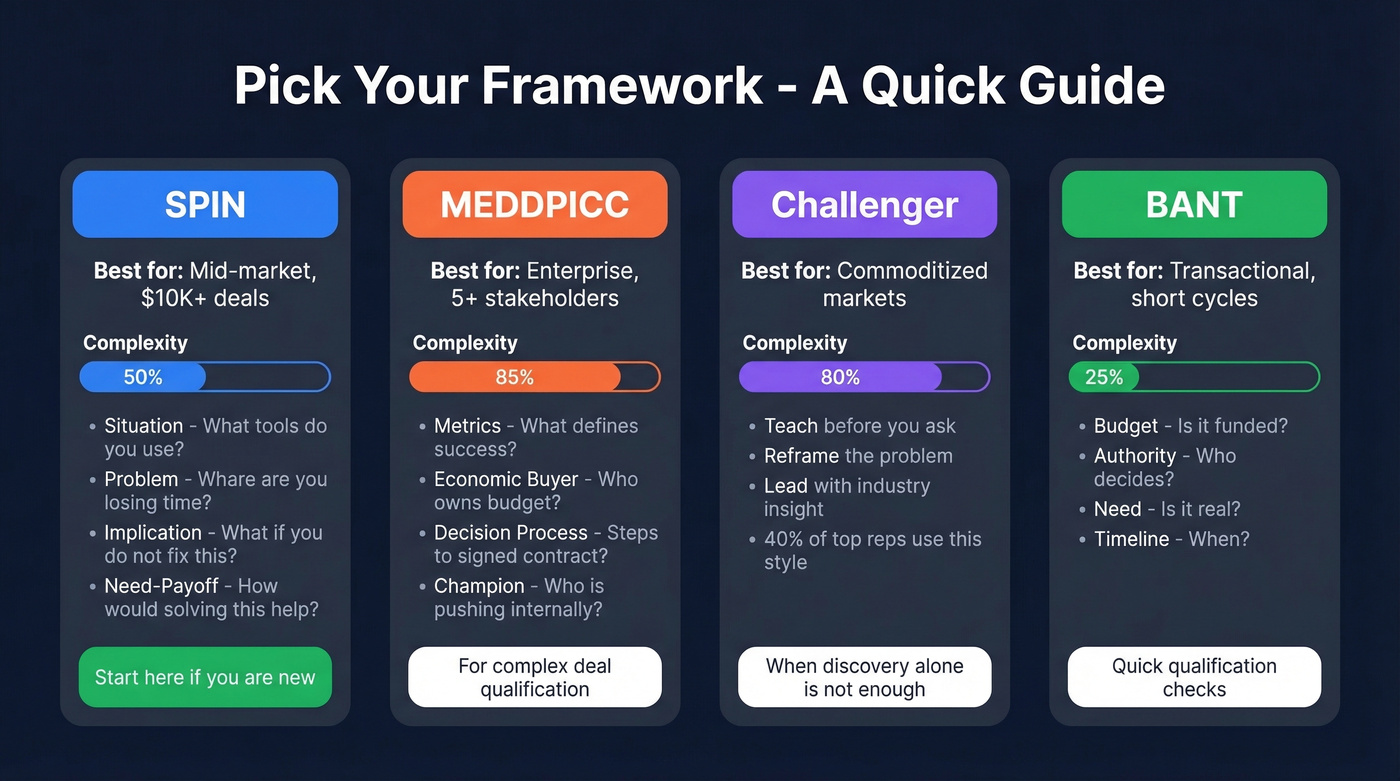
| Framework | Best For | Key Focus | Complexity |
|---|---|---|---|
| SPIN | Mid-market, $10K+ deals | Uncovering implications | Medium |
| MEDDPICC | Enterprise, 5+ stakeholders | Qualification rigor | High |
| Challenger | Commoditized markets | Teaching and reframing | High |
| BANT | Transactional, short cycles | Budget/authority check | Low |
SPIN Questions
SPIN - Situation, Problem, Implication, Need-Payoff - comes from research across 35,000 sales calls. The biggest mistake reps make with SPIN is over-indexing on Situation questions. They're boring, they feel like an interrogation, and half of them could've been answered with five minutes of pre-call research.
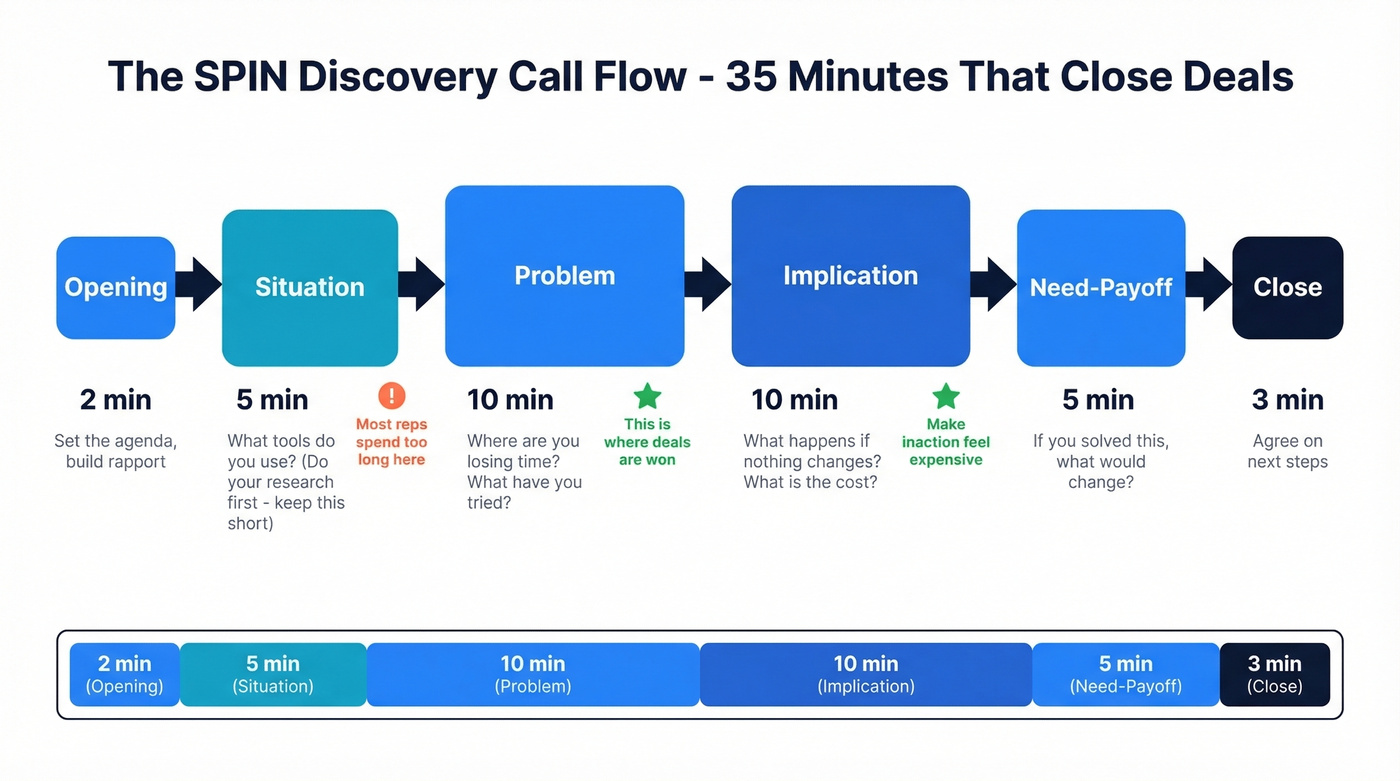
Here's the call flow that works: Opening (2 min), Situation (5 min), Problem (10 min), Implication (10 min), Need-Payoff (5 min), Close (3 min).
- Situation: "What tools are you currently using for [process]?"
- Problem: "Where are you losing the most time?"
- Implication: "What happens if you don't fix this in the next 6 months?"
- Need-Payoff: "If you could solve this, how would that help your team?"
If you're starting from scratch, learn SPIN first. It's the most intuitive framework and blends well with others as you mature.
MEDDPICC Questions
MEDDPICC is an internal compass, not a script you read to the prospect. The best practitioners run it so seamlessly that the prospect never knows it's happening. Use it for enterprise deals with 5+ stakeholders where qualification rigor determines whether you waste six months chasing a dead opportunity.
- Metrics: "What key metrics define success for this initiative?"
- Economic Buyer: "Who has the final say on budget?"
- Decision Criteria: "What are the top three must-have outcomes?"
- Decision Process: "Can you outline the steps from today to a signed contract?"
- Champion: "Who internally is most invested in making this happen?"
- Competition: "What other approaches are you evaluating?"
Challenger Questions
Challenger flips the script. Instead of asking what keeps the prospect up at night, you tell them what should be keeping them up. A study of 6,000 sales reps found that 40% of top performers used Challenger-style questioning heavily. And here's the uncomfortable truth: 75% of B2B buyers told Gartner they preferred a completely seller-free buying experience. If you're only asking discovery questions, you're not adding enough value to justify the meeting.
Challenger questions look different:
- "Most companies in your space are losing 15-20% of pipeline to [specific problem] - is that showing up for you?"
- "We're seeing a pattern where teams that [do X] outperform by [metric]. How does that compare to your approach?"
The goal isn't to discover - it's to teach something that reframes how the prospect thinks about their problem.
Closed-to-Open Rewrites
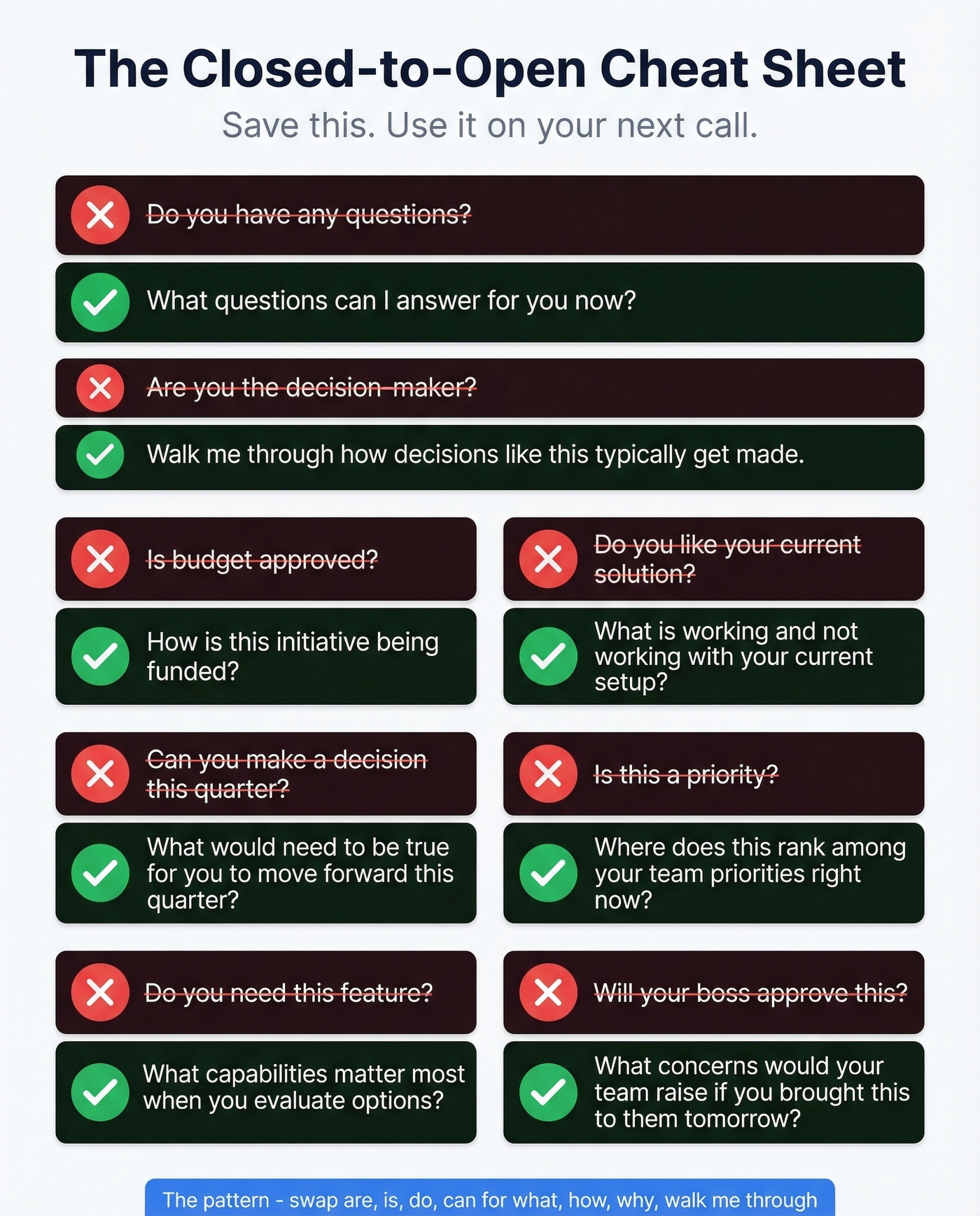
If you catch yourself asking these, here's the fix:
| Closed Version | Open-Ended Rewrite |
|---|---|
| Do you have any questions? | What questions can I answer for you now? |
| Are you the decision-maker? | Walk me through how decisions like this typically get made. |
| Is budget approved? | How is this initiative being funded? |
| Do you like your current vendor? | What's working and not working with your current setup? |
| Can we schedule a follow-up? | What would a productive next step look like? |
| Is this a priority? | Where does this rank against your other initiatives this quarter? |
Mistakes That Kill Discovery Calls
Interrogation mode. Asking 20+ questions tanks conversion. Pace yourself - mix in anecdotes, share relevant data points, and let the conversation breathe.
Asking Googleable Situation questions. "How many employees do you have?" is a waste of everyone's time. Do your homework before the call - check their website, recent funding rounds, and job postings.
Answering your own questions. "What's your biggest challenge - is it maybe the onboarding process, or the reporting?" You just gave them an easy out. Ask the question, then shut up. The best reps wait a full three seconds after asking. The discomfort is yours, not theirs.
Rushing to pitch before Implication questions. The prospect mentions a pain point and you immediately jump to "well, our platform solves that by..." Stop. Ask what happens if they don't fix it. Let them sell themselves on the urgency.
Blowing the opener. Even your first sentence matters. Data from 35,000+ analyzed calls shows "Did I catch you at a bad time?" drops meeting-booking chances by 40%. Try "How have you been?" instead - it produced a 6.6x higher success rate. Small words, massive swing.
Calling the wrong person with bad data. Here's the thing: you can master every framework on this list and it won't matter if you're calling a disconnected number or emailing someone who left the company six months ago. We've seen teams waste entire quarters on outdated contact lists. Tools like Prospeo, with 98% email accuracy and a 7-day data refresh cycle, exist specifically so your prep time doesn't get burned on bounced emails and dead numbers.
How to Actually Improve
Record and review your calls. Count your questions - target 11-14 - and measure your talk ratio against the 46% benchmark. The numbers don't lie, and most reps are shocked at how much they talk when they first check. Turn your camera on while you're at it: data from analyzed sales calls shows win rates are 94% higher when video is used.
Let's be honest about frameworks vs. question lists. A rep who understands SPIN can generate 50 questions on the fly. A rep who memorized 50 questions from a blog post freezes the moment a prospect goes off-script. Memorize the logic, not the words. And practice the pause - after you ask a question, wait. Prospects fill silence with truth.
Read the source material. Start with Gap Selling by Keenan, then SPIN Selling by Rackham, then The Challenger Sale. In that order. The r/sales community also swears by Sandler's approach and the NEPQ method if you want to go deeper.
If your average deal size is under $15K, skip MEDDPICC-level qualification rigor. SPIN or even BANT will get you there faster. The reps who overcomplicate their framework end up spending more time filling out CRM fields than actually selling.
If you want to tighten qualification without bloating your process, start with an Ideal Customer Profile and a simple lead scoring model.
Half the deals in your pipeline will never close - you said it yourself. Prospeo's intent data tracks 15,000 topics so you can run discovery with buyers who are already in-market. Pair that with 98% accurate emails and a 30% mobile pickup rate, and your questions actually reach decision-makers.
Ask the right questions to the right people at the right time.
FAQ
What's the difference between open-ended and closed-ended questions?
Open-ended questions start with what, how, or why and invite multi-sentence responses. Closed-ended questions produce yes/no answers. The simplest test: if a prospect can answer in one word, it's closed. Swap "are/is/do" starters for "what/how/why" to convert any closed question instantly.
How many discovery questions should I ask per call?
Aim for 11-14 open-ended questions per discovery call - that range correlates with the highest close rates in Gong's dataset. More than 20 feels like an interrogation and tanks conversion. Fewer than 6 means you're pitching, not discovering.
Which framework is best for discovery?
SPIN works best for mid-market complex deals, MEDDPICC for enterprise cycles with 5+ stakeholders, and Challenger for commoditized markets where teaching adds value. Start with SPIN - it's the most intuitive and blends well with other methodologies as your team matures.
How do I avoid sounding scripted on calls?
Learn the framework's logic, not exact wording. Set expectations early - "I'll ask some questions to understand your situation before jumping into anything" - then adapt based on what the prospect actually says. These open-ended sales questions examples are meant to be adapted to your voice and context, not read verbatim.
What tools help with pre-call research?
Any tool that gives you verified contact data and company context before you dial saves you from wasting discovery time on Googleable Situation questions. Look for platforms that offer real-time verification, intent signals, and enrichment data so you walk into every call already knowing the basics - and can jump straight to pain discovery.