

How to Build an Organic Email List That Drives Revenue (Not Just Vanity Metrics)
Email marketing returns $36-$40 for every $1 spent. But that number assumes you're emailing people who actually want to hear from you. With 4.48 billion email users worldwide and the email marketing market projected to hit $18.9 billion by 2028, the channel isn't slowing down. The opportunity gap is between teams doing organic email list building well and everyone else.
Organic lists - built on consent, not purchased from a sketchy broker - deliver 25-41% engagement rates. Purchased lists limp along at 2-5%, torching your sender reputation in the process. That's not a marginal difference. It's the difference between a channel that prints revenue and one that gets your domain blocklisted.
Here's the thing: most companies don't have a list size problem. They have a list quality problem. A thousand subscribers who actually care will outperform 50,000 dead addresses every single time.
What You Need (Quick Version)
Three moves deliver the highest return for the least effort:
- Move your signup CTA from the footer to the header. One case study showed a 46% lift with zero design changes. Same copy, same form - just a different location.
- Replace "Subscribe to our newsletter" with a specific lead magnet. Generic CTAs often convert under 1%. A targeted offer like a template, discount, or checklist converts 5-15%.
- Set up a welcome email that fires within 60 minutes. 75% of new subscribers expect a welcome email. Without it, 90% go cold before you ever get a second chance.
Each of these takes less than a day to implement. The rest of this playbook builds on top of them.
Before You Collect a Single Email
Don't start driving signups until your backend is ready. Two things need to be in place first.
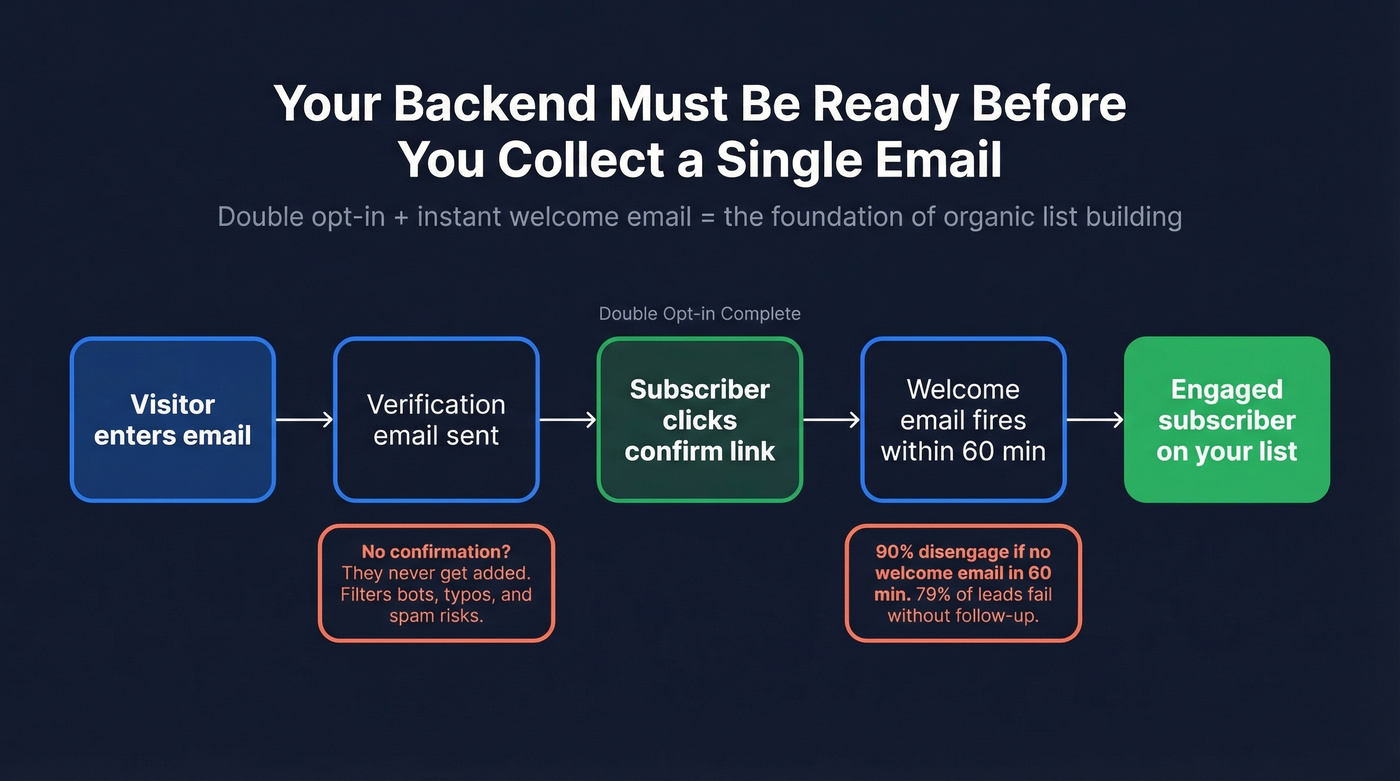
Double opt-in. A subscriber enters their email, then confirms via a link in a verification email before they're added to your list. It adds friction - and that's the point. You're filtering out typos, bots, and people who'll mark you as spam two weeks later. It's also the safest default for GDPR and CASL compliance.
A welcome email that fires immediately. Not "within 24 hours." Not "in the next batch send." Within the hour. The data is stark: 75% of subscribers expect a welcome email, and 90% disengage if they don't get one in the first 60 minutes. Meanwhile, 79% of marketing leads fail to convert without proper follow-up - so your welcome email should deliver whatever you promised and set expectations for what's coming next.
Get these two pieces working before you optimize anything else. A leaky bucket doesn't need more water - it needs a patch. Make sure your ESP supports both double opt-in and basic automation natively; platforms like MailerLite, ConvertKit, and ActiveCampaign all handle this out of the box.
9 Tactics to Grow Your List Organically
Not all signup methods convert equally. Inline forms convert 0.5-2% of visitors, popups land in the 2-6% range, and dedicated landing pages with a strong offer can hit 10-30%. The tactic you choose matters less than how specific your offer is.
Content Upgrades and Lead Magnets
Well-optimized lead magnets convert 5-15% of visitors into subscribers. The key word is "specific." A generic PDF nobody asked for won't move the needle. E-commerce brands win with discount codes and free shipping thresholds. B2B companies do better with templates, checklists, and mini-tools that solve an immediate problem.
We've seen teams spend weeks building a 40-page ebook that converts worse than a one-page checklist. Match the format to the problem your reader is trying to solve right now, not the one you wish they cared about.
Popups and Exit-Intent Forms
Popups get a bad reputation, but the numbers don't lie. Shopify store Asphalte improved popup CTR from 15% to 25% through A/B testing, generating roughly 4,000 new leads per month. In a separate A/B test, "10% off your first order" converted at 6.2% while "special deals & news" converted at 2.9%. That's a 2x difference from changing a single headline.
Exit-intent popups work particularly well because they catch visitors who were leaving anyway - minimal downside when you implement them thoughtfully, especially on mobile where screen real estate is tight.
Dedicated Landing Pages
When you're driving traffic from ads, social, or partnerships, send people to a dedicated landing page - not your homepage. Stripping away navigation and competing CTAs focuses attention on the signup. Conversion rates for well-built landing pages routinely hit 10-30%. Landing page builders like Unbounce, Leadpages, and Carrd make these easy to spin up without engineering resources.
Webinars and Live Events
Webinar registrants are high-intent by definition - they're giving you their email and committing time. Gate the replay afterward and a one-time event becomes an evergreen lead magnet. Run the same webinar quarterly, update the content slightly, and you'll generate steady subscriber growth from replay access alone.
SEO-Driven Content Funnels
This is the highest-compounding tactic on the list, and in our experience, it's the one most teams underinvest in. Publish a blog post targeting a problem your audience searches for, embed a content upgrade directly in the post, and capture the email in exchange for the download. Each post becomes a permanent subscriber acquisition channel.
It takes 3-6 months to build momentum, but once it compounds, it's the only tactic here that generates subscribers while you sleep. The key is matching search intent - rank for a query, solve the problem in the post, and offer a deeper resource behind the signup form.
Social Media Conversion
Followers aren't subscribers. The goal is to move people off platforms you don't own and onto a list you control. Put a specific CTA in your bio - not "check out my newsletter" but something like "grab the free cold email template." Pin posts that link to your lead magnet. Use story links and carousel posts that tease the value behind the signup. One Pinterest creator generated 4,000+ subscribers just by optimizing opt-in CTAs on two existing posts.
Referral and Viral Loops
"Give X, get X" mechanics turn every subscriber into a distribution channel. Offer something tangible for referrals - an extra template, early access, a discount tier. Newsletter platforms like SparkLoop and beehiiv have built-in referral tools that make this straightforward. Morning Brew scaled to millions of subscribers largely through referral mechanics that rewarded sharing with exclusive merch and content.
Co-Marketing and Newsletter Swaps
Find a complementary newsletter with a similar audience size and swap recommendations. You promote them; they promote you. Alignment is everything - a SaaS newsletter swapping with a sales tactics newsletter makes sense. A SaaS newsletter swapping with a cooking blog doesn't. Start with one swap and measure subscriber quality before scaling.
Gated Tools, Calculators, and Quizzes
Interactive lead magnets convert higher than static ones because they deliver personalized value. A "What's your email deliverability score?" quiz or an ROI calculator gives visitors something tailored to their situation - and they'll hand over an email to get it. These take more effort to build, but they attract higher-quality subscribers who are actively solving a problem.
Tactic Comparison
| Tactic | Conversion Range | Effort | Time to Impact |
|---|---|---|---|
| Content upgrades | 5-15% | Low | 1-2 weeks |
| Popups / exit-intent | 2-6% | Low | Immediate |
| Dedicated landing pages | 10-30% | Medium | 1-2 weeks |
| Webinars | High-intent signups | Medium | 2-4 weeks |
| SEO content funnels | 5-15% (compounding) | High | 3-6 months |
| Social media conversion | 1-3% | Low | 2-4 weeks |
| Referral loops | Variable (exponential) | Medium | 1-3 months |
| Newsletter swaps | Variable | Low | Immediate |
| Gated tools / quizzes | 10-25% | High | 4-8 weeks |
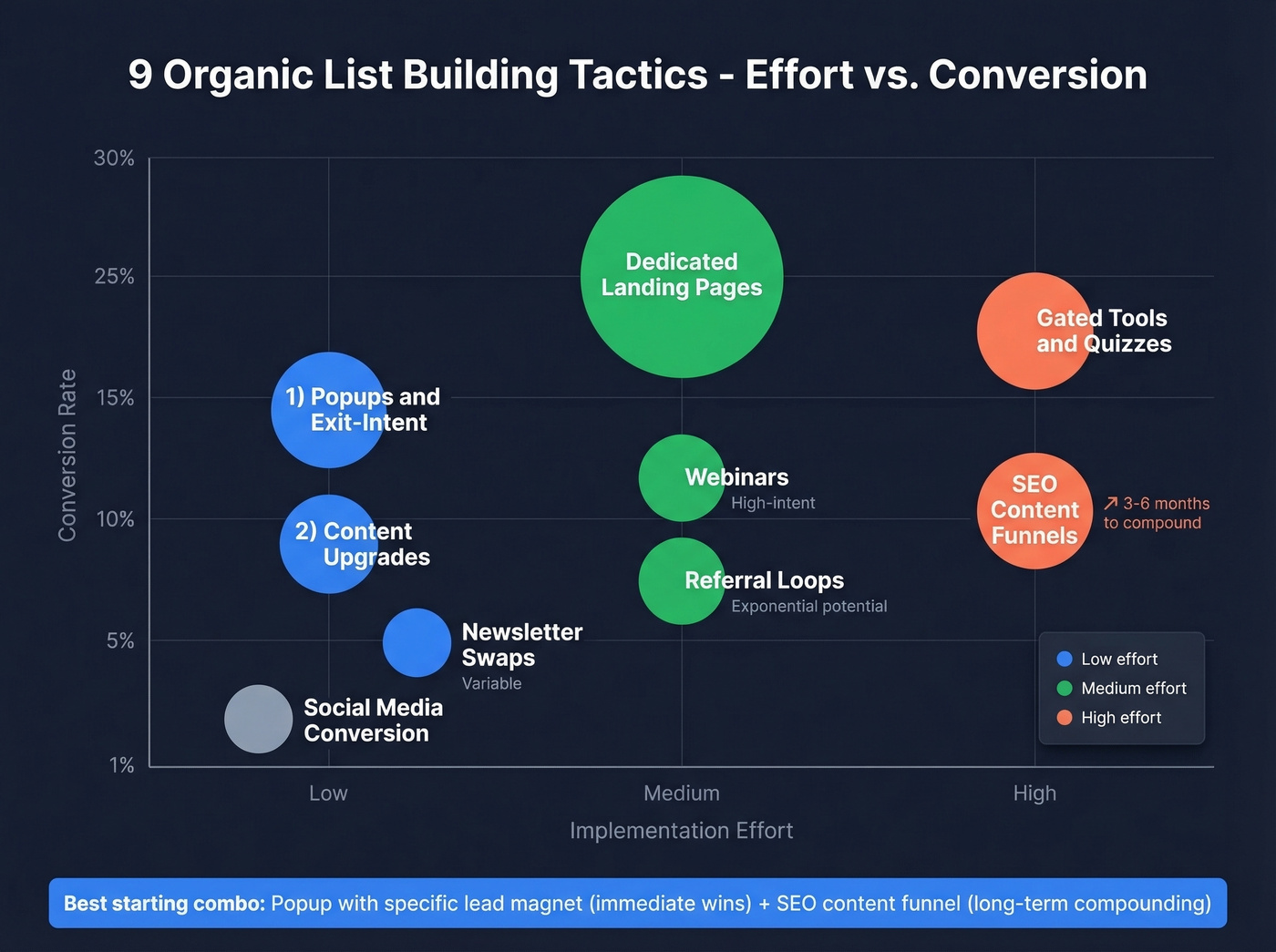
If you can only pick two, start with a popup offering a specific lead magnet and an SEO content funnel. The popup delivers immediate results; the SEO funnel compounds over time.
Small Changes, Big Lifts
You don't always need a new tactic. Sometimes you need to optimize what's already there.
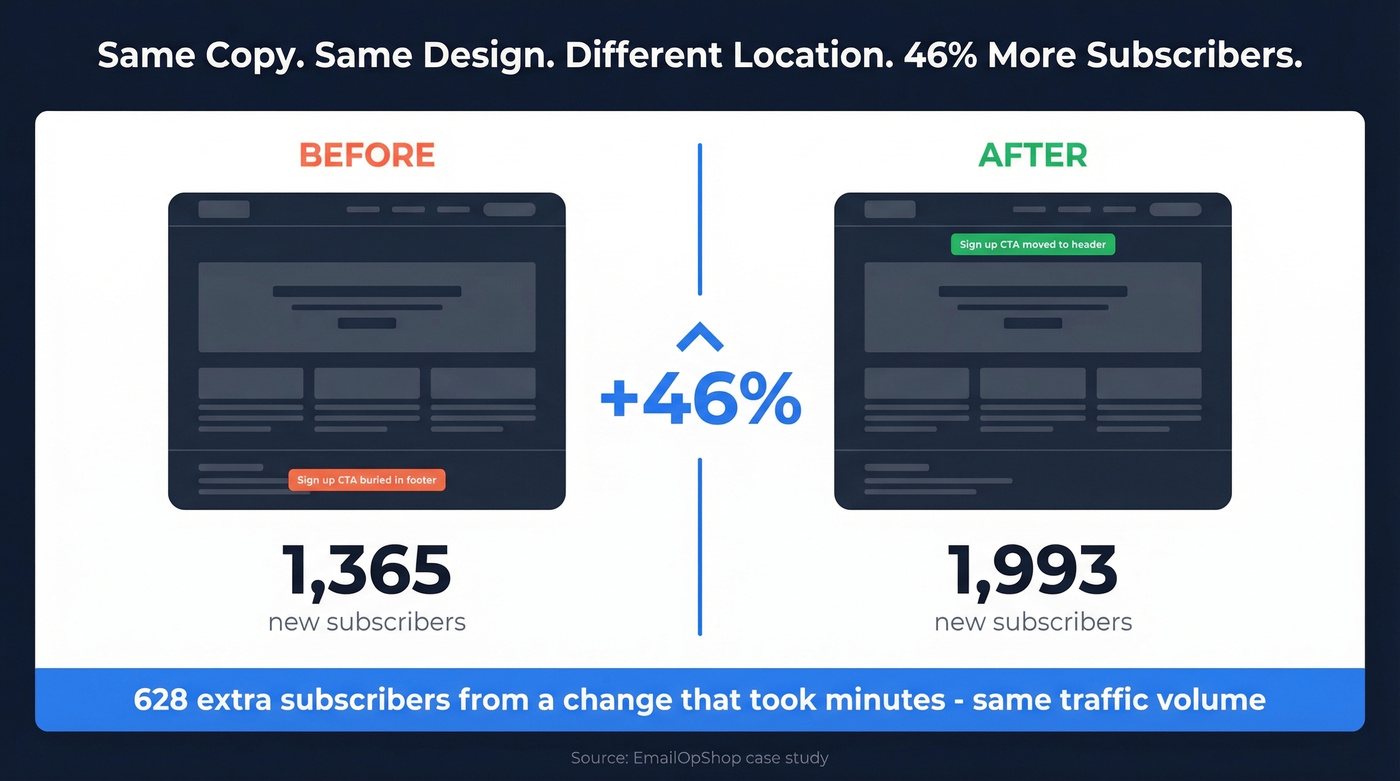
A site moved its email opt-in CTA from the footer to the header area, below navigation. Same copy. Same design. The only change was location. The result? A 46% increase in opt-in conversion rate - from 1,365 new subscribers to 1,993 on the same traffic volume. That's 628 extra subscribers from a change that took minutes.
When A/B testing signup elements, wait for 100+ conversions per variation, or run the test for at least 7 days to account for weekday/weekend traffic patterns. Anything less and you're reading noise, not signal.

Organic list building gets you engaged subscribers. But when you need to proactively reach decision-makers, you need verified data. Prospeo gives you 143M+ verified emails at 98% accuracy - so your outbound complements your inbound without torching your sender reputation.
Stop guessing at email addresses. Start with 98% accuracy at $0.01 per lead.
2026 Email Benchmarks
Once you're building the list, you need to know what "good" looks like. The most recent large-scale dataset comes from MailerLite's benchmark report covering 3.6 million campaigns across 181,000 accounts.
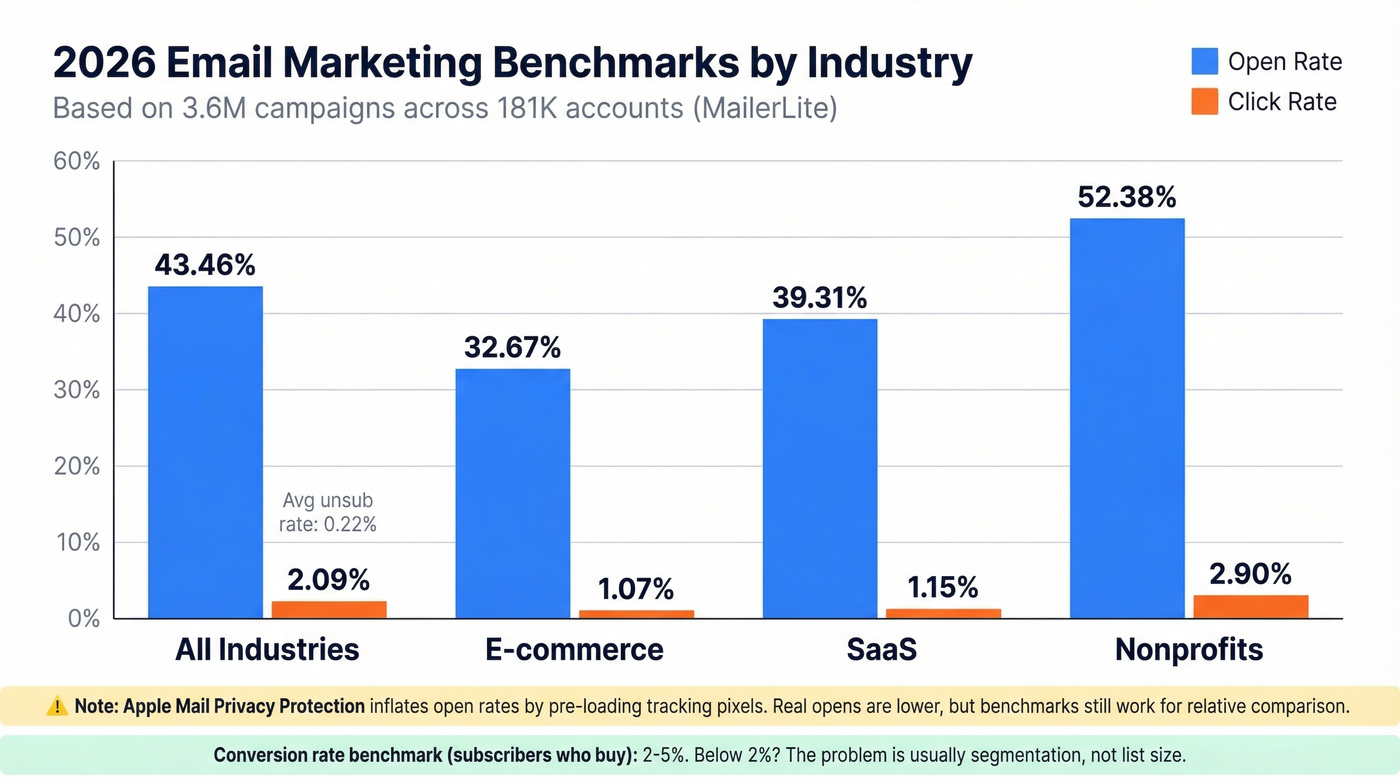
| Metric | All Industries | E-commerce | SaaS | Nonprofits |
|---|---|---|---|---|
| Open rate | 43.46% | 32.67% | 39.31% | 52.38% |
| Click rate | 2.09% | 1.07% | 1.15% | 2.90% |
| Unsub rate | 0.22% | - | - | - |
One caveat worth knowing: Apple Mail Privacy Protection inflates open rates by pre-loading tracking pixels. Real open rates are lower than what your dashboard shows. But since the inflation affects everyone equally, these benchmarks still work for relative comparison.
For conversion rates - subscribers who actually buy or take a desired action - the industry benchmark sits at 2-5%. If you're below 2%, the problem is usually segmentation or offer relevance, not list size.
Verify Before You Send
Here's a stat that should make you uncomfortable: ZeroBounce analyzed 1 billion email addresses and found only 56% were active. The rest were fake, abandoned, or invalid. Even an organically built list decays - people change jobs, abandon inboxes, and let domains lapse. The estimated annual degradation rate is 22-30%.
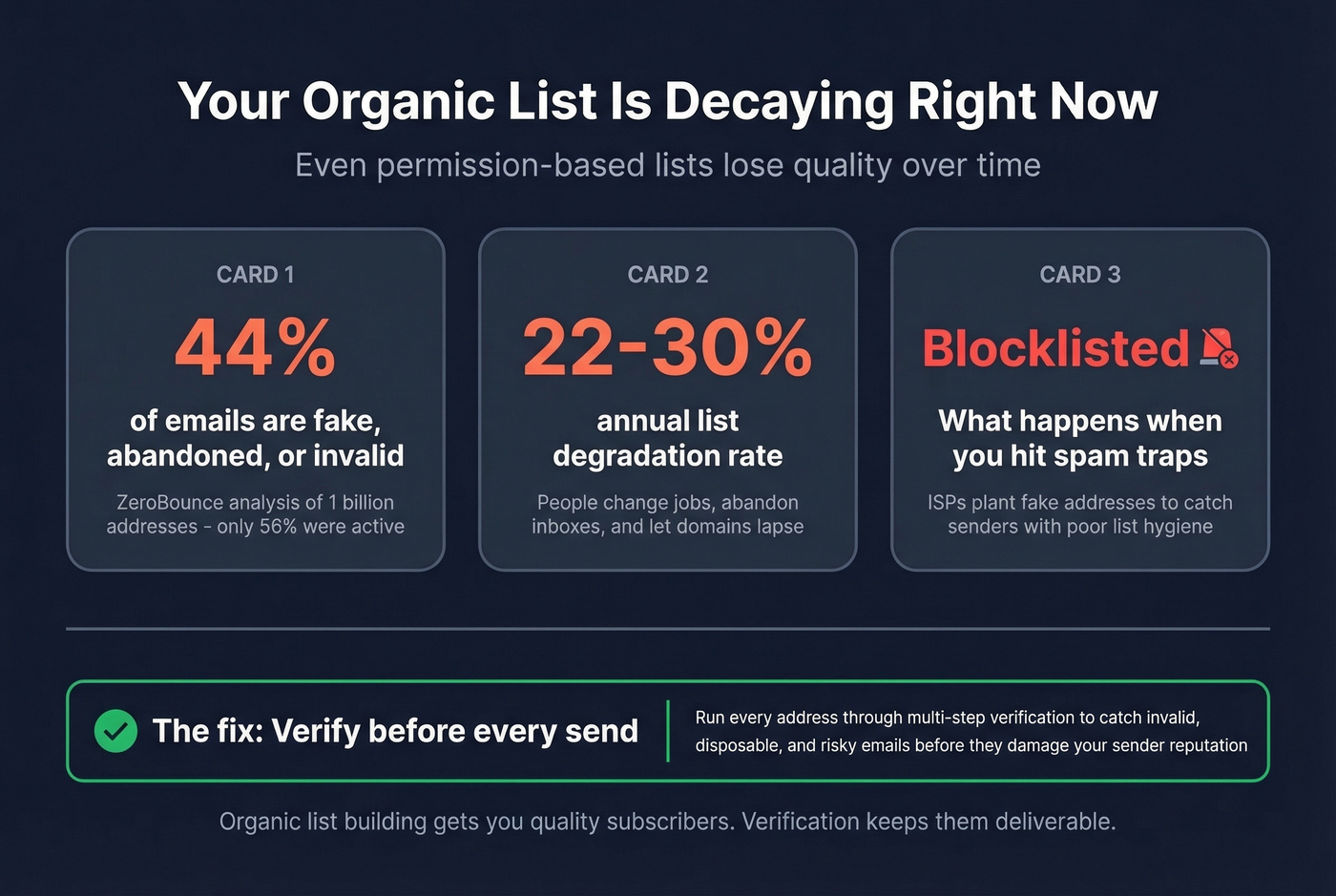
Sending to dead addresses doesn't just waste sends. It triggers spam traps - fake addresses planted by ISPs and anti-spam organizations to catch senders with poor list hygiene. Hit enough of them and your domain gets blocklisted.
Prospeo's email verification runs every address through a 5-step process that catches invalid emails, spam traps, and honeypots before they damage your sender reputation. Accuracy sits at 98%, and the system handles catch-all domains, which accept any email address and make verification harder for most tools. Upload a CSV and get results in seconds - no API setup required. The free tier gives you 75 verifications per month, with bulk verification running about $0.01 per email after that.
Building an organic list takes real effort. Don't let unverified addresses waste it.
You just read that purchased lists convert at 2-5% and destroy deliverability. Prospeo is the opposite - 300M+ profiles verified every 7 days through a 5-step process that removes spam traps and honeypots. Your domain stays clean, your emails land in inboxes.
Verified emails that protect your domain reputation, not wreck it.
Compliance - The Fines Are Real
Growing your list organically isn't just a best practice - it's how you stay compliant when sending marketing emails. The penalties for getting this wrong are severe:
- CAN-SPAM (US): Up to $53,088 per email sent in violation. Per message, not per campaign.
- CASL (Canada): Up to $10 million for businesses, $1 million for individuals.
- GDPR (EU): Fines up to EUR10 million.
CAN-SPAM requires you to honor opt-out requests within 10 business days. GDPR and CASL require consent before you send marketing emails. Double opt-in is the safest default across all three frameworks. It creates a clear consent trail that protects you if anyone ever questions how a subscriber ended up on your list.
One counterintuitive insight: making it easy to unsubscribe actually helps your deliverability. An unsubscribe is far better than a spam complaint, and ISPs track complaint rates more aggressively than unsubscribe rates. A prominent, one-click unsubscribe link protects your sender reputation more than it hurts your list size.
Mistakes That Kill Your List
Let's be honest - we've made some of these ourselves before learning better.
"Subscribe to our newsletter" with no value proposition. Nobody wakes up wanting more newsletters. Tell them exactly what they'll get.
No welcome email. You had their attention for 60 seconds. Now they've forgotten you exist.
Blasting the entire list without segmentation. A first-time subscriber and a two-year customer shouldn't get the same email. The consensus on r/EmailWhisperers is that this is the single most common mistake - and they're right.
Never cleaning the list. Addresses decay 22-30% per year. Set a quarterly reminder to verify and remove dead weight.
Ignoring mobile. Broken layouts and hard-to-tap CTAs on phones are conversion killers for the majority of your audience. Skip the fancy multi-column designs unless you've tested them on a phone screen first.
Your First 1,000 Subscribers
A thousand subscribers sounds modest, but it's enough to validate your messaging, test offers, and start generating revenue. One brand grew to 300,000 subscribers - but the real insight was what happened after they segmented: open rates jumped from 7.2% to 50.2%, and email revenue increased 66%.
Week 1: Move your CTA to the header, create your first lead magnet, set up a welcome email sequence.
Month 1: Launch a popup with a specific offer, start adding content upgrades to your top-performing blog posts.
Month 3+: SEO content starts compounding, referral loops kick in, and co-marketing swaps expand your reach. Most businesses hit 1,000 organic subscribers within 3-6 months at this pace.
That brand with 300K subscribers saw open rates jump 7x and revenue climb 66% after segmenting. Quality over quantity - and it starts with how you build the list in the first place. If you take one action today, move your signup CTA from the footer to the header. It's a five-minute change that delivered a 46% lift. Organic email list building pays off when every subscriber on your list actually wants to be there. Start there.
FAQ
How do I build an email list organically from scratch?
Start with one strong lead magnet and a double opt-in welcome sequence. Most businesses reach 1,000 consent-based subscribers in 3-6 months by combining a popup with an SEO content funnel. Paid social promotion of lead magnets can compress the timeline to 4-8 weeks if you have budget to accelerate.
What's a good email signup conversion rate?
Inline forms convert 0.5-2% of visitors, popups convert 2-6%, and dedicated landing pages with a specific lead magnet convert 10-30%. If you're below these ranges, test your offer specificity and CTA placement first - those two variables account for most of the variance.
How often should I clean my email list?
Verify your list quarterly at minimum. Email addresses decay 22-30% annually as people change jobs or abandon inboxes. Tools like Prospeo's email verifier check your entire list in seconds at 98% accuracy, flagging spam traps, invalid addresses, and honeypots before they damage your sender reputation - with 75 free verifications per month to get started.