

Outbound Mail: Everything You Need to Know in 2026
A RevOps lead we know ran a 3-tool bake-off last quarter. The "best" database created 4,000 duplicate contacts in Salesforce in five days. The cheapest one had better phone connect rates. The tool that actually moved pipeline? The one with clean, verified data feeding a dead-simple 3-email sequence.
That's outbound mail in 2026. The boring fundamentals win.
What You Need (Quick Version)
"Outbound mail" means two things: physical letters and packages sent to prospects, and cold email sent to people who haven't asked to hear from you. Both work. This guide covers both, but let's be honest - most of you are here for the email side.
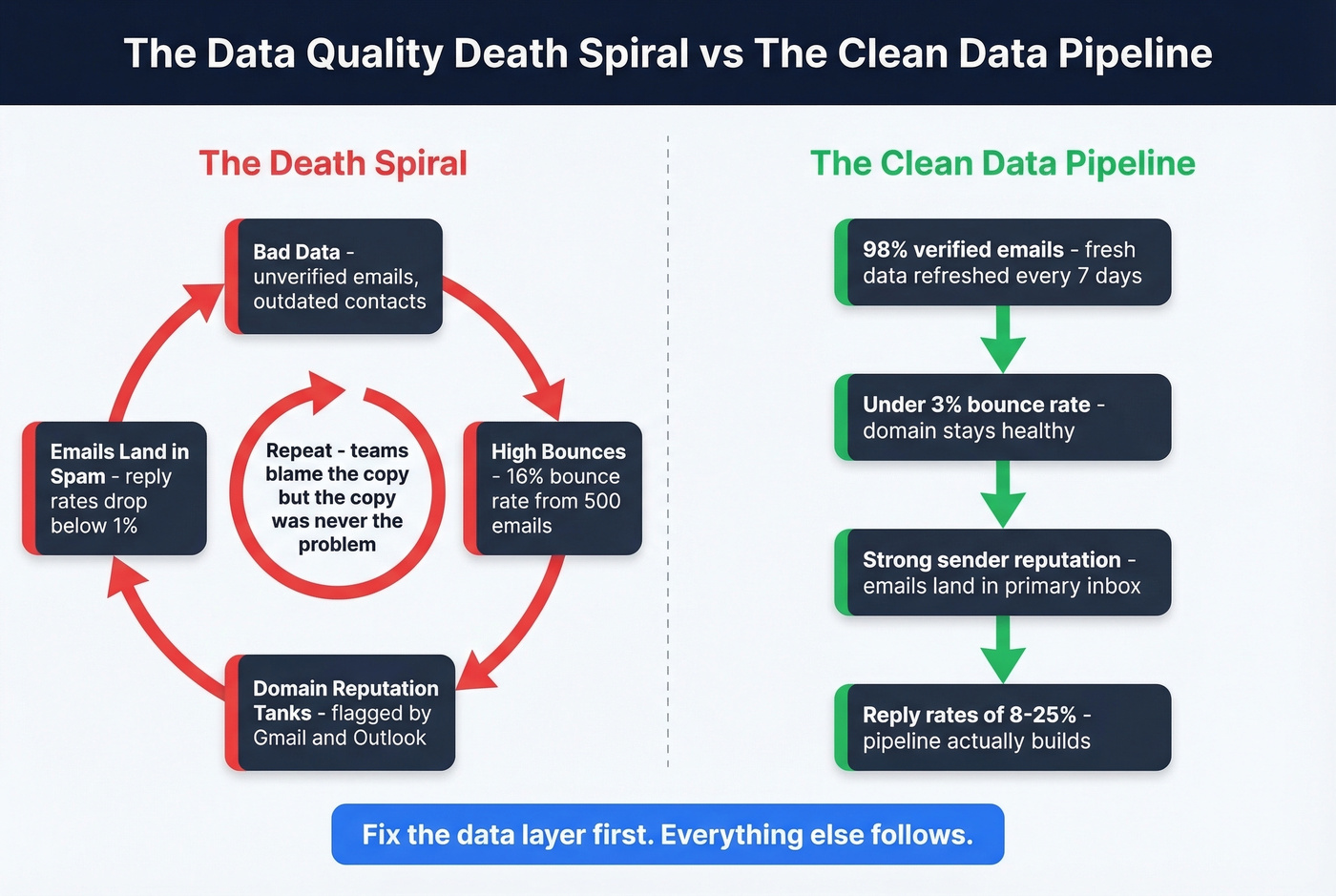
Modern outbound email works when you nail three things: clean data, proper infrastructure, and short sequences of 3-4 emails instead of 9. Typical reply rates land between 3-8.5%, while top teams push 15-25% with tight targeting and strong hooks. Most campaigns fail because of bad data, not bad copy. Fix the data layer first, then worry about subject lines.
What Is Outbound Mail?
Outbound mail is any unsolicited communication you send to a prospect to start a conversation.
In the physical world, that's direct mail - letters, postcards, dimensional mailers, branded packages. In the digital world, it's cold email, cold social messages, and multi-channel sequences that blend everything together. Here's the thing most people miss: 68% of recipients worry about missing important emails due to spam filters. That stat matters for both sides of outbound. Your physical mail doesn't have a spam folder problem. Your email does. Understanding both channels and when to use each is what separates teams that build pipeline from teams that burn domains.
Why Physical Mail Still Works
Physical mail isn't dead - it's underpriced. While every SDR on the planet fights for inbox space, a well-designed direct mail piece sits on someone's desk for days. People are 70% more likely to remember a message delivered by mail than by email. That's why direct mail marketing for sales teams targeting enterprise accounts remains one of the highest-ROI plays available.
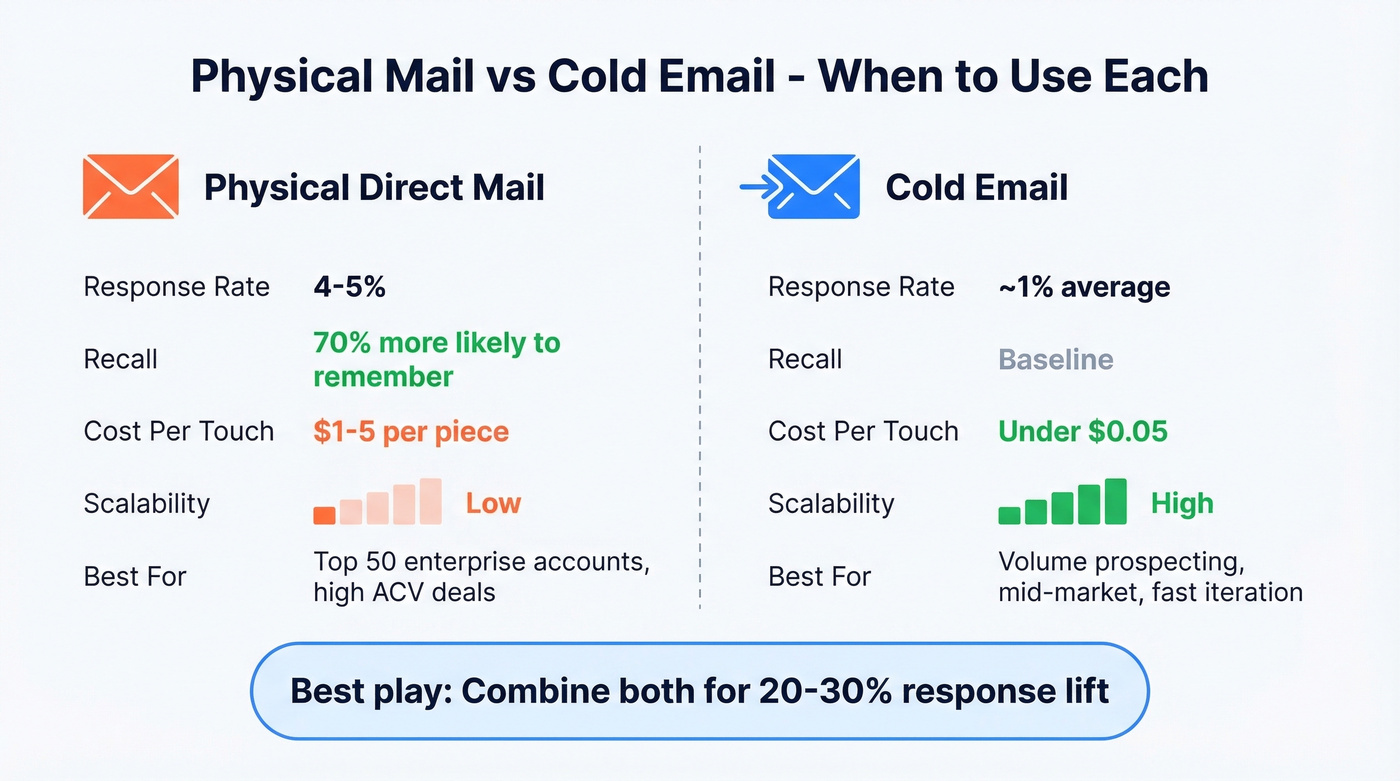
The 2024 ANA Response Rate Report found house lists pulling 5-9% response rates and prospect lists hitting 4-5%. Median ROI for direct mail came in at 112%, beating paid search at 93% and online display at 89%. In the UK, cold direct mail returns £3.90 for every £1 spent.
| Metric | Physical Mail | |
|---|---|---|
| Response rate | 4-5% (prospects) | ~1% (average) |
| Recall likelihood | 70% higher | Baseline |
| Median ROI | 112% | Varies widely |
| Cost per piece | ~$1-5 | <$0.05 |
| Scalability | Low | High |
The real play is combining both. Campaigns that blend print and digital lift overall response by 20-30%. Send a handwritten-style note to your top 50 accounts, then follow up with a cold email referencing it. The cost per piece is higher, but the conversion math works out better for high-value accounts. Smart teams use this channel precisely because everyone else abandoned it.
Cold Email Benchmarks for 2026
Cold email reply rates typically land between 3-8.5% across the industry. Top-quartile teams push 15-25%. Below 1%? Stop rewriting subject lines. You have a deliverability or data problem.
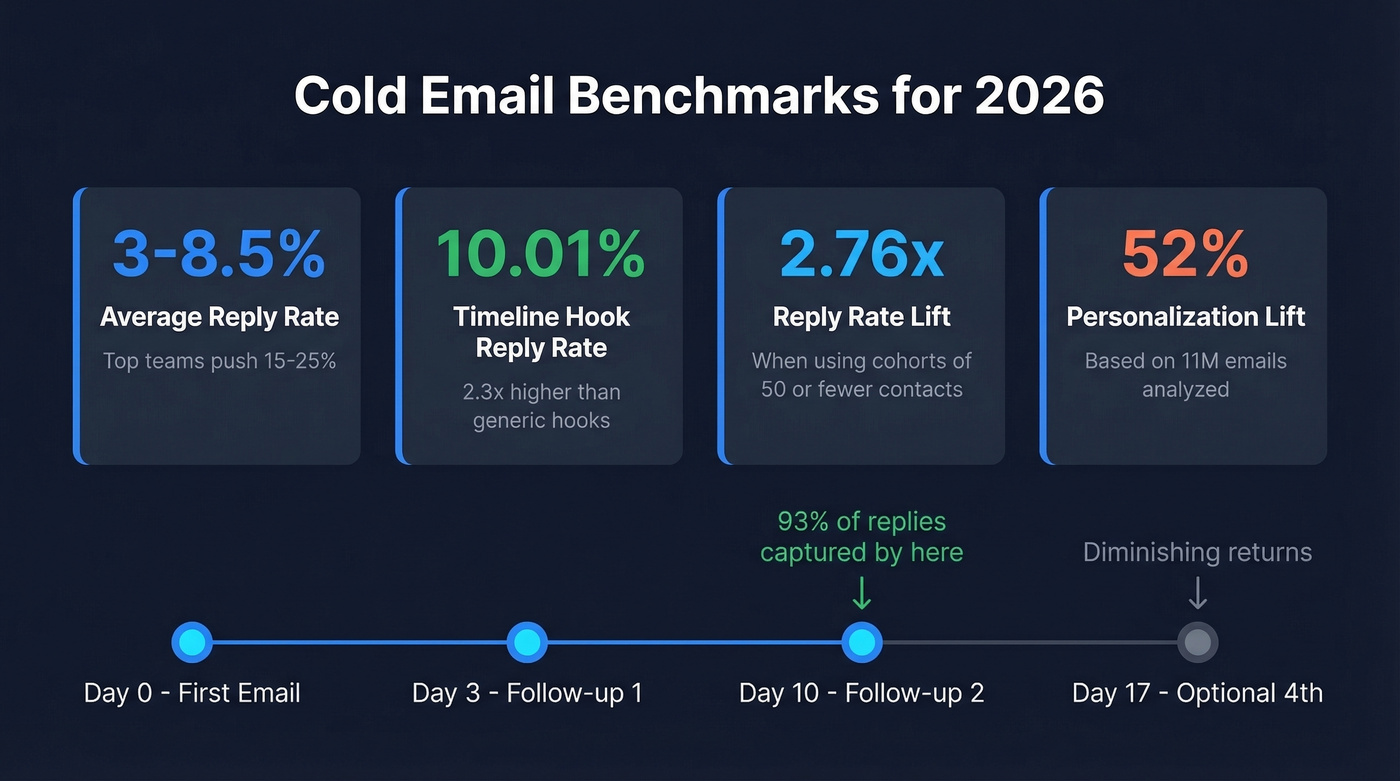
Hook type matters more than most people realize. Timeline-based hooks like "saw you just raised a Series B" or "noticed you're hiring 3 AEs" pull a 10.01% reply rate vs. 4.39% for generic problem hooks - a 2.3x gap. Meeting rates follow the same pattern: 2.34% for timeline hooks vs. 0.69% for problem hooks.
Two more benchmarks worth pinning to your wall. Cohorts of 50 contacts or fewer increase reply rates by 2.76x - smaller lists, tighter targeting, better results. Personalization lifts replies by about 52%, per Hunter.io's analysis of 11M emails. And the cadence insight that saves you from over-sending: a 3-7-7 follow-up cadence (Day 0, Day 3, Day 10, Day 17) captures 93% of replies by Day 10. Everything after that is noise.

You just read that most campaigns fail because of bad data, not bad copy. Prospeo's 98% email accuracy and 7-day data refresh cycle mean your 3-email sequences actually land in real inboxes - not bounce lists that torch your domain reputation.
Stop rewriting subject lines. Start with data that connects.
Building Your Outbound Playbook
Define Your ICP and Segment Tight
Spray and pray is dead. The consensus on r/b2bmarketing is clear: targeting should be based on why a company is interesting right now, not broad filters like "20-500 employees in SaaS." The signals that matter are job changes, funding rounds, hiring surges, tech installs, and engagement spikes. Timing isn't everything; it's the only thing.
Build lists of 50 contacts or fewer per segment. That 2.76x reply rate increase isn't magic. It's the natural result of writing messages that actually fit the recipient's situation.
Write Short Sequences
Most replies come from Email #1, sometimes #2. Email #3+ is thin ice.
Send 3-4 emails max. Use a 3-7-7 cadence: first email on Day 0, follow-up on Day 3, third touch on Day 10, optional fourth on Day 17. Cap volume at 40-50 emails per inbox per day. If you need more volume, add inboxes - don't push a single domain past its limits. A/B test offers and angles, not just subject lines. "Save time" vs. "make money," case study first vs. pain first - these variables actually move reply rates.
Go Multichannel
Email alone isn't enough. A practical net-new sequence runs 12-18 touches over 20-30 days across email, phone, and social. The buyer journey now involves roughly 266 touchpoints from first touch to closed-won, and that's not a number you hit with three emails. It's why the best teams layer email with phone, social, and even direct mail to cover every channel where buyers pay attention.
AI-augmented sales teams see 30% higher win rates and 41% more revenue per rep. The reason isn't better AI-written copy - it's that AI handles research and personalization grunt work, freeing reps to focus on the 50 accounts that matter most. Tools like Clay work well for signal-based research automation; feed that context into your sequences and watch the relevance jump.
Deliverability Setup
Domain Separation and Warmup
Never send cold email from your primary domain. One spam complaint wave and your entire company's email reputation is toast. Set up a separate sending domain - something like hello.yourcompany.com - and warm it up properly.
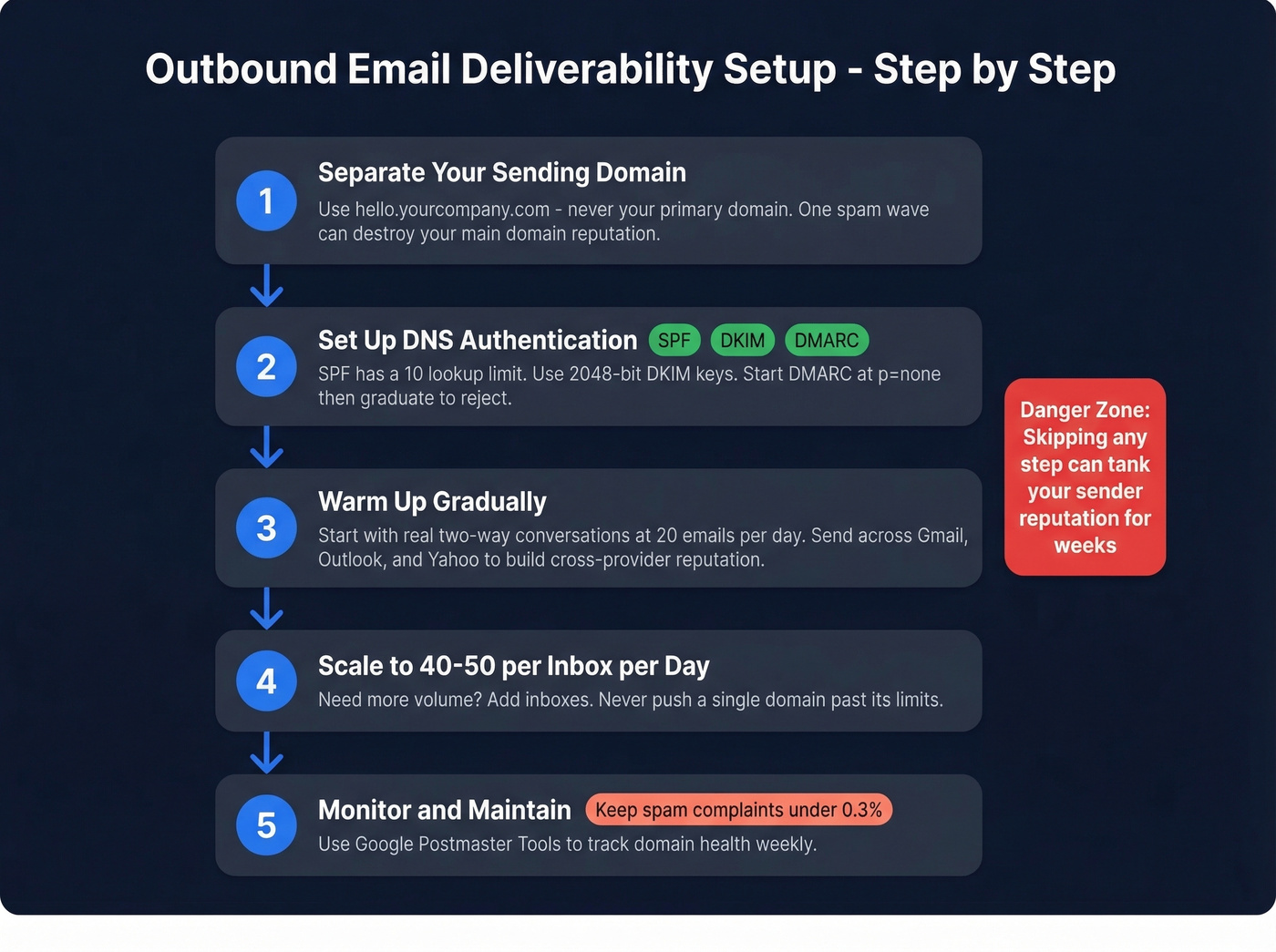
Start by exchanging emails with colleagues and friends in real two-way conversations. Then expand to cross-provider sends (Gmail to Outlook, Outlook to Yahoo) to build reputation across mailbox providers. Begin around 20/day for the first couple of weeks, then scale toward 40-50/day as your domain reputation stabilizes.
SPF, DKIM, and DMARC
These three DNS records are table stakes. Gmail has enforced bulk sender authentication since February 2024, and Outlook followed with high-volume enforcement in May 2025. If you haven't set these up, you're already behind.
SPF tells receiving servers which IPs can send on your behalf. Critical detail: SPF has a 10 DNS lookup limit per RFC 7208, and exceeding it triggers a PermError that breaks alignment entirely. DKIM signs your emails cryptographically - use 2048-bit keys when your provider supports them. DMARC ties it all together: start with p=none and reporting enabled, then graduate to quarantine and eventually reject once you've confirmed alignment.
Keep your spam complaint rate under 0.3% as measured by Google Postmaster Tools. Above that threshold, you're actively damaging your domain reputation with every send.
Data Quality - The Real Problem
Look, we've seen this play out dozens of times. Your SDR sent 500 emails last Tuesday. 80 bounced. That's a 16% bounce rate, and it just triggered a reputation hit that'll haunt your domain for weeks. Bad data leads to high bounces, which tanks domain reputation, which sends more emails to spam, which kills reply rates. Teams blame the copy. The copy was never the problem.
Stack Optimize built from $0 to $1M ARR using Prospeo, maintaining 94%+ deliverability and under 3% bounce across all their clients - zero domain flags.
Timeline hooks pull 2.3x higher reply rates - but only if you can spot the signals. Prospeo's 30+ filters surface job changes, funding rounds, hiring surges, and buyer intent across 15,000 topics so your 50-contact micro-segments write themselves.
Build signal-rich lists in minutes, not hours.
Legal Compliance
Cold email is legal. But the rules vary by region, and the penalties for getting it wrong are steep.
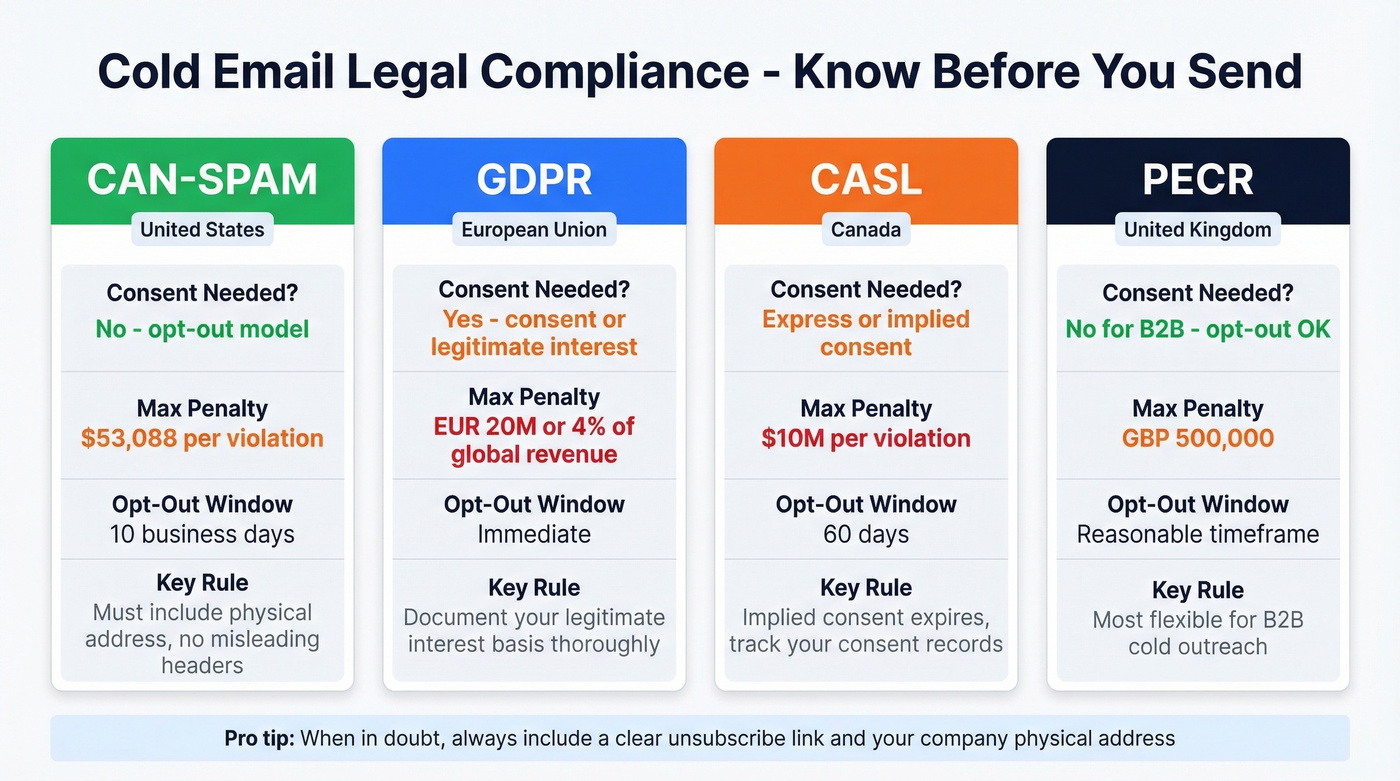
| Regulation | Region | Consent? | Max Penalty | Opt-Out Window |
|---|---|---|---|---|
| CAN-SPAM | US | No (opt-out model) | $53,088/violation | 10 business days |
| GDPR | EU | Consent or legit interest | EUR 20M / 4% revenue | Immediate |
| CASL | Canada | Express or implied | $10M/violation | 60 days |
| PECR | UK | B2B: opt-out OK | GBP 500,000 | Reasonable |
CAN-SPAM is the most permissive - no prior consent needed, but you must include a valid physical address, honor opt-outs within 10 business days, and avoid misleading headers. The $53,088 per-violation penalty means a single campaign to 1,000 people could theoretically cost $53M.
GDPR requires either explicit consent or documented "legitimate interest." Most B2B cold emailers in the EU rely on legitimate interest, but you need to document it and provide immediate opt-out. The UK's PECR is more flexible for B2B: cold email is fine as long as you offer an opt-out. CASL in Canada requires express or implied consent with a 60-day functional unsubscribe window. Spend an hour with the table above and you'll be ahead of most outbound teams.
Best Tools for Outbound Email
You need three tools: a data source, a sender, and a CRM. Everything else is noise.
| Tool | Best For | Starting Price | Email Accuracy |
|---|---|---|---|
| Prospeo | Data and verification | Free (75/mo) | 98% |
| Apollo | All-in-one | Free / $59/mo | ~79% |
| Instantly | Cold email sending | ~$30/mo | N/A (sender) |
| Smartlead | Multi-mailbox rotation | ~$39/mo | N/A (sender) |
| GMass | Budget Gmail sending | $25/mo | N/A (sender) |
| Clay | Signal-based orchestration | ~$149/mo | N/A (workflow) |
For sending, Instantly and Smartlead both handle warmup and multi-inbox rotation well; pick based on UI preference. Apollo works as an all-in-one if you want database plus sending in one tool, but its ~79% email accuracy creates bounce problems at scale - we've seen teams burn through two sending domains before switching data providers. GMass is the budget play for teams already living in Gmail. Clay is the orchestration layer for signal-based workflows - powerful but complex.
Skip Apollo's database if your average deal size is above $25k. The bounce rates aren't worth the risk to your domain at that level.
Hot take: If your average deal size is under $10k, you probably don't need a $15k/year data platform. A verified list from a self-serve tool, a $30/month sender, and tight targeting will outperform an enterprise stack with dirty data every single time.
FAQ
What's the difference between outbound and inbound mail?
Outbound mail is communication you initiate - cold emails, direct mail, prospecting messages sent to people who haven't contacted you. Inbound is communication that comes to you: responses, inquiries, form fills. In sales, outbound means you start the conversation; inbound means the prospect did.
How many cold emails should I send per day?
Cap at 40-50 emails per inbox per day. If you need more volume, add additional inboxes and sending domains rather than pushing a single inbox past safe limits. Going higher risks deliverability damage that takes weeks to recover from.
Is cold email legal?
Yes, in most jurisdictions. The US uses an opt-out model under CAN-SPAM - no prior consent needed. The EU requires consent or legitimate interest under GDPR. Canada requires express or implied consent under CASL. Always include an unsubscribe link and a physical address.
What's a good cold email reply rate?
Typical reply rates run 3-8.5%. Top teams with tight targeting and strong hooks hit 15-25%. If you're below 1%, the problem is almost certainly deliverability or data quality, not your copy.
What free tools work for outbound email verification?
Prospeo's free tier includes 75 verified emails per month with full 5-step verification - enough for small teams running targeted campaigns. Hunter offers 25 free searches monthly but caps enrichment features. For teams sending more than a few hundred emails, paid verification at $0.01/email pays for itself by preventing domain damage from bounces.